
An SEO competitor report is meant to be your secret weapon. It’s a deep dive into what your rivals are doing right (and wrong) in the search results, so you can find juicy keywords, plug your content gaps, and snag backlink opportunities they've missed.
At its best, a competitor report turns a mountain of data into a clear strategic roadmap for outranking everyone else and capturing more organic traffic.
Why Most SEO Competitor Reports Fail to Deliver

Let's be real for a minute. Most competitor reports are dead on arrival. They land in a stakeholder's inbox as a sprawling spreadsheet—a data dump of vanity metrics like raw traffic estimates and keyword counts. They look impressive on the surface, but they don't inspire a single meaningful action.
Stakeholders might glance at the numbers, nod, and archive the email. Nothing ever changes. This old-school approach is a losing game, especially now that AI is reshaping the search landscape. Just keeping tabs on a list of keyword rankings means you’re missing the bigger picture entirely.
Shifting from Imitation to Opportunity
The biggest flaw in traditional SEO competitor reports comes down to the question they try to answer: "What are our competitors doing?" This mindset inevitably leads to imitation, not innovation.
A much more powerful question to ask is: "What openings are our competitors leaving for us?"
This simple pivot completely reframes your focus from reactively copying what’s already been done to proactively building a strategy. Instead of just churning out a "me too" version of a competitor's content, you start hunting for their weaknesses.
The goal isn’t to build a mirror image of your competitor’s SEO strategy. It’s to build a better one by exploiting the gaps they’ve ignored and serving the audiences they’ve underserved.
Adapting to a New Search Reality
In the age of AI-powered search like Gemini and Perplexity, the competitive landscape has gotten a lot bigger. Visibility is no longer just about owning a blue link on a results page. Your reports have to account for these new battlegrounds.
Modern analysis needs to track things like:
- AI Answer Mentions: Is your competitor being cited as a source in generative AI answers? This reveals a whole new layer of authority and brand presence.
- Topical Authority Gaps: Forget the keyword-for-keyword slugfest. Analyze entire topic clusters. Where is your competitor a recognized authority, and where is their expertise paper-thin?
- Conversion-Oriented Analysis: Chasing vanity traffic is a waste of time. Your analysis should zero in on the keywords and content that signal high purchase intent, even if the search volume seems low.
Laying this kind of foundation for modern competitive intelligence is what separates a passive, historical record from an active, forward-looking playbook. A well-structured report can be a truly powerful tool, and a great starting point is understanding the ideal SEO monthly reporting format to keep stakeholders engaged.
When you take this approach, your insights start driving tangible business results instead of just clogging up an inbox.
Finding Your True SEO Competitors
Before you even think about pulling data for a competitor report, you have to answer one crucial question: who are you really up against? The answer isn't always what you'd expect. In fact, your biggest business rival might be a ghost in the search results, while some obscure blog is eating your lunch.
Effective analysis always starts by making a clear distinction between your direct business competitors and your SERP competitors.
Direct competitors are the obvious ones—they sell similar products or services to the same people you do. Think Coca-Cola versus Pepsi. But SERP competitors are a different beast. They're any website, blog, or publication that shows up for your target keywords and grabs your audience's attention, even if they don't sell a thing. If you’re a SaaS company selling project management software, another software company is a direct competitor. A SERP competitor? That could be a popular industry blog that just reviews project management tools.
Ignoring these SERP competitors is a massive, unforced error. They are actively stealing clicks and building authority around the very topics that should belong to you. Your report has to account for both types to give you a complete picture of the battlefield.
Identifying Your SERP Competitors
So, how do you actually unearth these hidden rivals? The easiest way is to stop thinking like a marketer and start thinking like a customer.
Pop open an incognito browser window and start searching for your most important head terms—the broad, high-level keywords your customers would use.
Let’s say you sell high-end coffee beans. You’d probably search for things like:
- "best single origin coffee beans"
- "how to brew pour over coffee"
- "ethically sourced coffee brands"
Take note of the domains that consistently pop up on the first page for these queries. Those are your primary SERP competitors. You’ll likely find specialty coffee review sites, food bloggers, or even major publications you never would have considered rivals. These are the players winning the search game, and your SEO competitor report needs to dig into why.
The goal here is to zero in on 3-5 key competitors for your first report. Trying to analyze ten or more is a recipe for data overload and paralysis. Prioritize the ones with the highest topical overlap and the strongest organic footprint.
This focused approach keeps your analysis deep and actionable, not wide and shallow. You can always expand your list later, but starting small is the key to building momentum. To get even more specific, you can dive deeper into how to improve your competitor rank tracking for these specific rivals.
Setting a Smart Scope for Your Report
Once you have your shortlist of competitors, the last step before diving in is to define the scope of your analysis. A common pitfall is trying to boil the ocean—analyzing everything at once. This just creates an overwhelming report that no one knows what to do with.
Instead, narrow your focus to a specific area. This will generate much more detailed and, more importantly, usable findings.
Consider scoping your report by one of these angles:
- Product Line or Service Category: If you're an e-commerce site, you could focus your analysis solely on your "running shoes" category versus a competitor's equivalent.
- Content Hub or Topic Cluster: Analyze how a competitor performs for a very specific topic, like "financial planning for millennials," across all of their related content.
- Audience Segment: If you target both small businesses and enterprise clients, create separate reports focused on the unique competitors in each of those verticals.
This kind of strategic scoping transforms your report from a vague overview into a precise diagnostic tool. It’s this level of detail that’s fueling the incredible demand for competitive intelligence. The global SEO platforms market is projected to hit $2,309.5 million by 2025, and a huge driver of that is businesses using these reports to find competitor gaps. In fact, companies that do this well can boost organic traffic by 20-30% within six months. You can learn more about the growth of the SEO platform market and its drivers.
By defining a clear, tight scope, you ensure your efforts will actually contribute to that kind of growth.
Gathering Data That Actually Matters

Alright, you’ve got your scope defined and a shortlist of your real SERP rivals. Now for the fun part: getting your hands dirty with the data. The goal here isn't to drown yourself in spreadsheets; it's to zero in on the metrics that will actually lead to a breakthrough. We’re hunting for a story, not just numbers.
Your investigation should really focus on three core areas: their keywords, their backlinks, and their top-performing content. Each one gives you a different piece of the puzzle, helping you map out their strategy so you can find the cracks.
Uncovering Their Winning Keywords
First up is a solid keyword gap analysis. This isn't just about finding a list of keywords they rank for and you don't. It's about digging into the strategic intent behind their choices. This is your treasure map, showing exactly where they’re meeting their audience and what topics are driving their most valuable traffic.
Specifically, you want to be on the lookout for:
- Striking Distance Keywords: These are the low-hanging fruit. Terms where a competitor is just a few spots ahead of you on page one. Often, a quick content refresh or a few new internal links is all it takes to leapfrog them.
- Competitor-Only Keywords: This is the goldmine. When you see valuable, relevant keywords that multiple competitors rank for but you're nowhere to be found, that’s a massive red flag. It points to a major content gap you need to fill, fast.
- High-Intent Commercial Keywords: Don't get distracted by pure volume. Isolate the keywords that scream commercial intent—phrases like "best software for," "product reviews," or location-specific service queries. These are the terms that signal a user is ready to pull out their wallet.
Essential Metrics for Your SEO Competitor Report
To build a complete picture, you need to pull specific data points that reveal the 'why' behind their performance. Here’s a quick rundown of what to collect and the tools that can help you get it.
| Metric | What It Tells You | Recommended Tools |
|---|---|---|
| Domain Authority (DA) | A general score of the site's overall authority and linking power. | Ahrefs, Moz, Semrush |
| Organic Keywords | The total number of keywords the site ranks for in the top 100. | Semrush, Ahrefs, SpyFu |
| Organic Traffic | An estimate of monthly non-paid traffic from search engines. | Ahrefs, Similarweb, Semrush |
| Top Pages | The pages driving the most organic traffic to their site. | Semrush, Ahrefs |
| Keyword Gap | Keywords competitors rank for that you don't. A direct roadmap for new content. | Ahrefs, Semrush, Moz |
| Backlink Profile | The number and quality of domains linking to them. Reveals their off-page authority. | Ahrefs, Majestic, Semrush |
| Backlink Gap | Authoritative sites linking to competitors but not to you. Prime outreach targets. | Ahrefs, Moz, Semrush |
| Content-Type Analysis | The formats they rely on (blogs, guides, tools). Informs your content strategy. | Manual Review, Ahrefs |
| Social Shares/Engagement | How their content performs on social media. Shows what resonates with their audience. | BuzzSumo, SharedCount |
Gathering this data gives you the raw material to spot patterns and uncover actionable opportunities, moving you from simply observing to strategizing.
Identifying Their Most Powerful Backlinks
Next, you'll dive into a backlink gap analysis. A competitor’s link profile is a direct reflection of their online authority. Seeing who links to them tells you exactly which publications, industry blogs, and key players see them as a credible source.
This isn’t about matching them link-for-link. The goal is to spot patterns and find replicable opportunities for your own outreach.
Your competitor’s best backlinks aren't just links; they are endorsements. Replicating those relationships—or finding similar ones—is one of the fastest ways to build your own site's authority.
Pinpoint high-quality links from relevant industry sites, news outlets, and resource pages. These are your prime targets. Understanding what kind of content earned those links gives you a blueprint to create something even better.
Dissecting Their Top-Performing Content
Knowing their keywords and backlinks is one thing, but you also need to analyze the actual content that's doing the heavy lifting. By identifying their top pages by traffic and links, you can reverse-engineer what works for their audience and for the sites that link to them.
Go beyond the topic. Look at the format, structure, and depth. Are their winners long-form guides? Interactive tools? Original research reports? These insights should directly shape your content calendar, helping you create assets designed to outperform theirs from the get-go. To learn more about the specifics, you can check out our guide on using SEO ranking data to inform your content decisions.
Emerging Metrics for the AI Era
The game is changing. Globally, organic search drives 94% of clicks, but the rise of AI Overviews means up to 60% of searches could end without a click at all. This makes your SEO competitor report more vital than ever. You need to identify the top-10 ranking sources that get cited in the 52% of these AI summaries, because that's the new visibility frontier.
Tracking brand and content mentions within AI-generated answers is no longer a "nice-to-have." It’s critical. Tools like Sight AI are built to surface these mentions, showing you where competitors are being positioned as authoritative sources by models like Gemini and ChatGPT.
And don't stop at traditional SEO. Understanding what social media monitoring is and how it drives competitive insights can add another rich layer to your report, often revealing content promotion tactics you’d otherwise miss entirely.
By weaving together these different threads—keywords, backlinks, top content, and AI visibility—you create a powerful, multi-dimensional view of the competitive landscape. This is the foundation for a report that actually drives action.
Crafting a Report That Inspires Action
All the data in the world is useless if it just sits in a spreadsheet, collecting digital dust. The real magic of an SEO competitor report isn’t in the raw numbers; it’s in the story you tell with them. A truly great report translates complex data into a clear, compelling narrative that gets stakeholders excited and inspires them to actually do something.
This means you need to shift your mindset from data collector to storyteller. Your job is to connect the dots between a competitor’s backlink profile and a tangible revenue opportunity for your own business. It's about synthesis, not just summarization.
Structuring Your Report for Maximum Impact
A great report doesn't just dump findings on someone's desk; it guides the reader toward a specific conclusion. To pull this off, you need a logical structure that builds from a high-level overview to specific, tactical recommendations. Forget those endless spreadsheet tabs and start thinking more like you're writing a business proposal.
Your report should always have these core components:
- Executive Summary: This is, without a doubt, the most crucial part. It’s a one-page snapshot that boils everything down to the most critical findings and recommended actions. Many executives will only read this part, so it has to be sharp, concise, and laser-focused on business outcomes.
- Key Findings Dashboard: Think of this as a visual appetizer—a quick overview of the competitive landscape. Use simple charts to show metrics like share of voice, the size of a keyword opportunity, and backlink momentum. This gives everyone immediate context before you dive into the nitty-gritty.
- Opportunity Deep Dives: These are dedicated sections for your core analysis—keywords, content, and backlinks. The key here is that each section should present the data and then immediately translate it into a strategic opportunity.
- Action Plan and Next Steps: This is where the rubber meets the road. Provide a clear, prioritized list of what to do next. This is what transforms your report from an academic exercise into an actual project plan.
From Data Points to Strategic Narratives
The secret to an actionable report is all in the framing. Raw data points are pretty meaningless without context. Instead of just listing off numbers, you need to translate them into the kind of strategic language your team and leadership actually understand.
For instance, don’t just present a list of keywords your competitor ranks for. Reframe it.
Instead of: "Competitor A ranks for 50 keywords we don't." Try: "We've identified 50 high-intent keywords where Competitor A is capturing our target audience. These represent a major content gap and a Q3 opportunity to develop a new topic cluster around 'financial planning for freelancers.'"
That subtle shift changes everything. You’re no longer just reporting data; you're highlighting a strategic blind spot and proposing a concrete solution. It’s the difference between being a data librarian and a strategic advisor.
The Power of Smart Data Visualization
Let's be honest, humans are visual creatures. A simple chart can communicate a trend far more effectively than a dense paragraph of text ever could. But the goal isn't to create complex, dazzling graphics that confuse people. Simplicity and clarity are your best friends here.
Consider these powerful (and simple) visualization tactics:
- Share of Voice Pie Chart: Instantly shows who dominates the conversation for a core set of keywords. It’s a powerful way to visualize market positioning at a glance.
- Keyword Gap Bar Chart: A stacked bar chart is perfect for showing keywords you rank for, keywords they rank for, and keywords you both rank for. This makes the "gap" immediately and painfully obvious.
- Backlink Momentum Line Graph: Plot the number of new referring domains acquired per month for you versus your competitors. This quickly reveals who is accelerating their authority-building efforts and who's falling behind.
These visuals aren’t just for decoration; they are tools of persuasion. They make your conclusions feel intuitive and undeniable, helping to build the consensus you need to get your recommendations approved. If you're looking for ways to streamline this, exploring various SEO reporting tools for agencies can give you a major head start on creating impactful dashboards.
Ultimately, the best SEO competitor reports feel less like reports and more like strategic blueprints. They don't just show where you are; they illuminate the exact path you need to take to get ahead. By focusing on storytelling, strategic framing, and clear visualization, you create a document that doesn’t just get read—it gets used.
Turning Your Insights Into a 90-Day Action Plan
You've done the hard work. You’ve gathered the data, pieced together the story, and flagged the big opportunities. But this is the exact moment where most SEO competitor reports die a quiet death on a shared drive somewhere. An insight without a corresponding action is just trivia. It's time to turn your analysis into a concrete, time-bound roadmap that will actually move the needle.
A 90-day plan is the perfect timeframe. It’s long enough to execute meaningful projects and start seeing real results, but short enough to keep everyone focused and energized. The goal here is simple: leave this process with a documented plan where every single task is directly tied to an opportunity you just uncovered.
This simple flow shows how raw data gets translated into real-world action. It’s not just about numbers; it’s about the story they tell and the steps that story inspires.
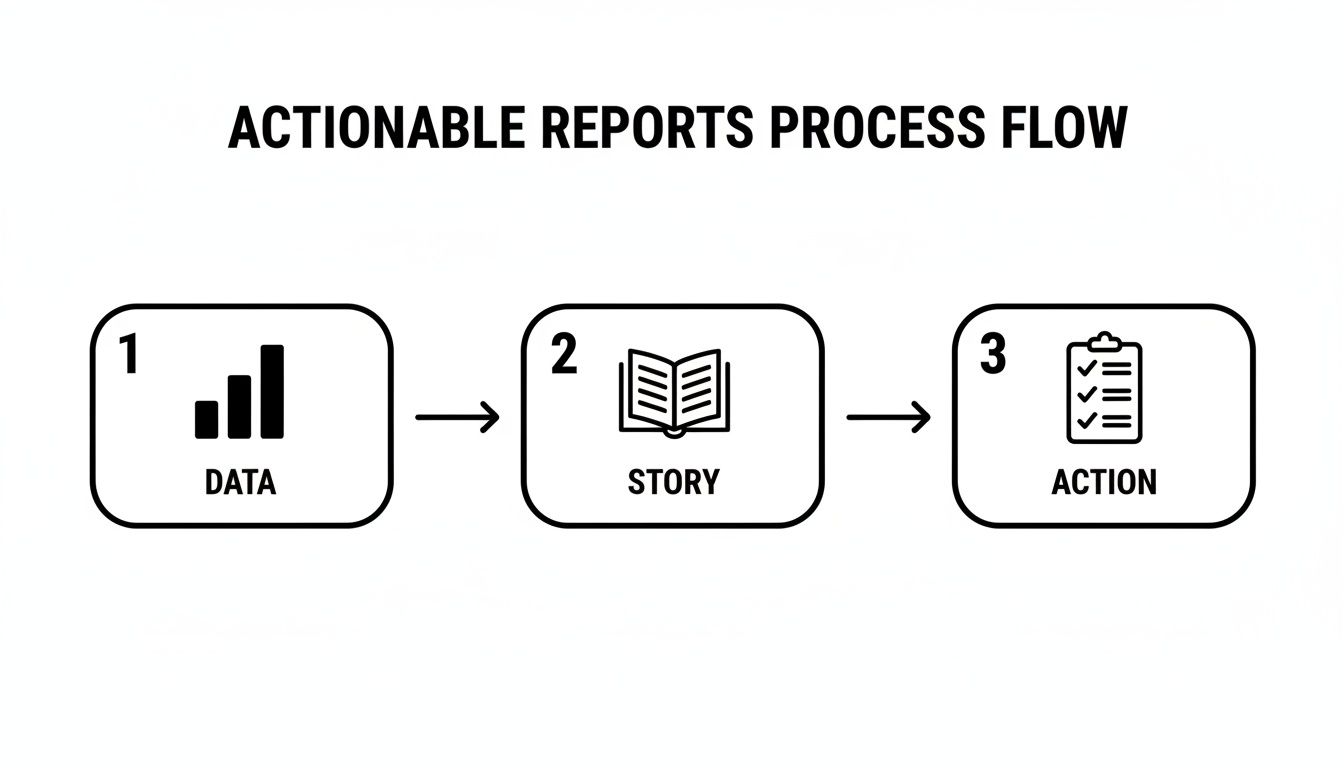
Without turning data into a compelling story, you can't create an effective plan. This bridge is critical.
Prioritizing Your Content Gaps
Let's be real—your report probably unearthed dozens, if not hundreds, of potential content gaps. Trying to tackle all of them at once is a surefire way to get absolutely nothing done. Ruthless prioritization is the name of the game.
Not all keywords are created equal. Your job is to find the ones with the highest potential return on effort. I like to run each opportunity through a simple framework:
- Business Value: How close is this topic to making us money? A keyword with clear purchase intent will almost always beat a high-volume informational term.
- Keyword Difficulty (KD): Let's be realistic. If a keyword has a KD of 85 and is dominated by household names, it’s a long-term war, not a quick battle. Look for that sweet spot of decent volume and achievable difficulty.
- Search Intent: What is someone actually trying to do when they search for this? Make sure you can create content that genuinely solves their problem, whether they're looking for information, comparing options, or ready to buy.
The best opportunities are almost always found at the intersection of high business value and moderate keyword difficulty. These are the quick wins that build momentum and prove the value of all this competitive intelligence work.
This simple process turns a messy, overwhelming list of keywords into a focused hit list for the next quarter.
Creating High-Impact Content Briefs
Once you have your prioritized list, the next step is building out detailed content briefs for your writers. A great brief is the bridge between your SEO strategy and the finished article. It’s how you guarantee the content is optimized from the ground up to blow your competitors' pages out of the water.
Every single brief should include:
- Primary and Secondary Keywords: No ambiguity. State the main target and the key related terms to weave in.
- Search Intent Summary: A quick paragraph explaining what the user is looking for and the core questions the article must answer.
- Competitor Content: Direct links to the top-ranking pages. This shows writers the benchmark they need to beat.
- Required Headings & Subtopics: Outline the essential H2s and H3s needed to cover the topic better than anyone else.
- Internal Linking Ideas: Note a few relevant pages on your own site to link out to.
This level of detail takes the guesswork out of the equation and empowers your content team to create strategically sound assets every time. For a deeper dive into making this process seamless, check out our guide on https://www.trysight.ai/blog/building-a-workflow.
Identifying Content Refresh Opportunities
New content isn't your only weapon. Your analysis probably highlighted a bunch of "striking distance" keywords—terms where you're already on page one or two, but a competitor is sitting just a few spots ahead. These are goldmines for a content refresh.
Scan your existing content for articles that are:
- Ranking somewhere between positions 4-15 for a valuable keyword.
- Factually outdated or missing key information that's emerged since it was published.
- Noticeably thinner or less comprehensive than what's now ranking at the top.
Often, updating an existing page with fresh data, adding a couple of new sections, and beefing up its internal links is a much faster path to ranking gains than starting from scratch.
Building Your Targeted Outreach List
The final piece of your 90-day plan comes straight from your backlink gap analysis. You now have a ready-made list of high-authority websites that link to your competitors but not to you. This isn't a cold list; it's a warm list of highly qualified outreach targets.
Organize these domains in a simple spreadsheet and prioritize them by Domain Rating and relevance. For each target, make a note of the specific competitor page they linked to. This gives you the perfect context for your pitch, allowing you to approach them with a newer, better, more up-to-date resource on the exact same topic.
To see what this looks like in practice, it helps to review examples of successful B2B Content SEO initiatives. This is more critical than ever, with the SEO software market projected to hit $271.9 billion by 2034. As 57.6% of SEOs feel the heat from increased AI-fueled competition, building these actionable, data-backed plans is no longer optional.
Common Questions About SEO Competitor Reports
Even with the best game plan, you're going to have questions when you start digging into SEO competitor reports. It just comes with the territory. I've rounded up a few of the most common ones we hear to help you sidestep some frequent mistakes and keep your analysis on track.
How Often Should I Run a Competitor Report?
This is a big one. You need a rhythm that gives you useful data without just creating more work.
For most businesses, a deep-dive SEO competitor report every quarter is the sweet spot. This schedule gives you enough runway to actually implement changes from your last report and see some results before you go back to the data. It keeps you from constantly reacting to every minor shift in the SERPs and lets you focus on bigger, more strategic moves.
But that doesn't mean you can go dark on your rivals for three months. I always recommend monthly check-ins on a handful of critical metrics. These are quick hits, not full-blown analyses, and should focus on things like:
- New high-value keywords your competitors suddenly started ranking for.
- Significant backlinks they just landed from authoritative sites.
- Brand mentions in AI answers, which can pop up fast and often need a quick response.
This hybrid approach gives you the best of both worlds: deep strategic insight from the quarterly report and nimble, tactical adjustments from the monthly check-ins. You're never caught flat-footed.
What Is the Biggest Mistake to Avoid?
Easy. The single biggest mistake is collecting data without finding the story. A spreadsheet with a thousand competitor keywords isn't intelligence; it's just noise. Your job is to sift through all that raw data and pull out a few crystal-clear, actionable insights that tell your team, "Here's exactly what we need to do next."
Another classic pitfall is trying to track too many competitors at once. This is a direct path to analysis paralysis. The sheer volume of data makes it impossible to find any real meaning.
Start with three to five of your closest SERP competitors. It’s so much more effective to deeply understand a few key rivals than to have a shallow, surface-level view of a dozen. When it comes to competitive analysis, the quality of your insight always beats the quantity of your data.
And finally, fight the urge to just copy what your competitors are doing. The real gold is in finding their weaknesses—thin content, unanswered customer questions, a weak link profile—and creating something that is demonstrably better. The goal here is to innovate, not imitate.
Can I Do This Without Expensive Tools?
Absolutely. While premium tools like Ahrefs and Semrush make data collection way faster and richer, you can definitely get started without them. A manual approach takes more elbow grease, but it's infinitely better than flying blind.
Your most powerful free tool is Google Search itself—just be sure to use incognito mode to see what real-world rankings look like without any personalization bias. You can also lean on Google Keyword Planner to find keyword ideas and get a feel for search volumes. Many of the big-name tools also offer a limited number of free searches each day, which you can use strategically to spot-check a specific domain or keyword you're curious about.
Ready to turn competitive insights into a high-growth content engine? Sight AI monitors how AI models talk about your competitors, surfaces your most valuable content gaps, and uses specialized AI agents to generate SEO-optimized articles that drive results. See how it works at try-sight.ai.