Localized keyword research isn't just about tacking a city name onto a broad search term. It's the art of figuring out the exact phrases, slang, and questions your neighbors are typing into Google to find services right where they are. This means getting inside the head of someone searching "near me" and understanding their unique, immediate needs.
Why You Can't Afford to Skip Local Keyword Research

Ignoring local customers is like opening a fantastic coffee shop but forgetting to put a sign on the door. You could have the best espresso in town, but if no one on your block knows you exist, you’re basically invisible.
In today's market, winning the local search game isn't just a nice-to-have; it's a matter of survival. Why? Because consumer behavior has completely shifted. People now expect search engines to know where they are and deliver relevant, nearby solutions instantly. This makes local intent one of the most powerful signals a business can tap into.
The Data Doesn't Lie
The numbers behind local search are pretty staggering. Just consider that 46% of all Google searches now have local intent. What’s even more telling is that a massive 80% of those searches lead to conversions. That’s a direct line from a local search to your bottom line.
It gets even better on mobile. A full 76% of people who look for something local on their phone visit a physical location within 24 hours. And to top it off, 28% of those searches result in a purchase.
Here's the bottom line: Local searchers aren't just window shopping. They have a problem, they need a solution now, and they're ready to buy. If you don't show up for these high-intent searches, you're literally handing customers over to your competition.
Precision Beats Power Every Single Time
Big, national brands often chase broad, high-volume keywords, and that's great for them. But it leaves a huge opening for smaller, local businesses to dominate their own turf. When you do your local keyword research right, you uncover the precise phrases your community is actually using.
Think about the difference here:
- Broad Keyword: "best plumber"
- Localized Keyword: "emergency plumber Hyde Park Austin"
- Hyper-Local Keyword: "leaky pipe repair near Mueller development"
The first query is just research. The second and third? That’s someone with a credit card in hand, likely standing in a puddle of water. Capturing that kind of urgent traffic is the whole point of smart local SEO. It's a key part of A Modern Playbook for Local SEO Lead Generation.
You don't need a massive marketing budget to compete; you just need to be more relevant to the people right outside your door. For a deeper dive, you might want to explore our detailed guide on https://www.trysight.ai/blog/local-seo-keywords. This focused approach ensures your message lands in front of the most qualified customers imaginable—the ones in your own backyard.
Building Your Local Keyword Foundation
Great local SEO isn’t about guesswork or just hoping for the best. It’s a deliberate strategy built on a deep understanding of how your customers actually search. Before you can start climbing those local search rankings, you need to map your territory by building a strong foundation of relevant keywords.
This first step is all about moving from what you think your customers are looking for to what they’re actually typing into Google. It’s the difference between aiming for a broad, generic term and hitting a bullseye with a customer who has an immediate need, right in your neighborhood.
Start With Your Core Service Keywords
First, let's get back to basics. What do you do? If you're a plumber, your core keywords are the non-negotiables: things like "plumbing services," "drain cleaning," and "water heater repair." These are your seed keywords, the very bedrock of your business.
Don't hold back here. List every single service you offer, no matter how specific. A landscaping company, for instance, wouldn't just stop at "landscaping." They'd dig deeper:
- lawn mowing service
- tree trimming
- sod installation
- irrigation system repair
These terms are the "what" in your local SEO strategy. They become the first column in what we'll build out as your local keyword matrix—a simple but powerful way to organize and multiply your search targets.
Layer on Geographic Modifiers
Now, we bring in the "where." This is where the magic of localization really happens. A term like "HVAC repair" is far too broad on its own, but adding a location turns it into a high-intent local search. Your mission is to brainstorm every possible geographic term a customer might use.
Think beyond just your main city. Get granular and build a comprehensive list:
- Cities and Towns: The obvious starting point (e.g., "Austin," "Round Rock").
- Counties: For those searching across a slightly wider area (e.g., "Travis County").
- Neighborhoods: Hyper-local terms that scream proximity (e.g., "Hyde Park," "South Congress").
- ZIP Codes: Especially powerful for service-based businesses (e.g., "78704," "78751").
- Landmarks or Districts: Well-known local spots that people use as reference points (e.g., "near The Domain," "Downtown Austin").
When you systematically combine these modifiers with your core services, you create a massive list of valuable long-tail keywords. Suddenly, "water heater repair" becomes "water heater repair in Hyde Park" or "emergency plumber 78704." This is precisely how you connect with customers who know exactly where they need you.
Your job is to think like a local. What names do people actually use for their neighborhoods? Are there unofficial district names or slang terms for areas that only a resident would know? These hyper-local nuances are often low-competition goldmines.
Think Like a Local and Find Hidden Gems
Beyond the standard geo-modifiers, tap into the conversational phrases real people use. With voice search on the rise, people are searching more naturally than ever. The term "near me" is a classic example, but it’s really just the beginning.
Brainstorm variations that reflect how people talk. A coffee shop isn't just a "coffee shop," right? It could be a "cafe with wifi," a "place to study," or the "best espresso." Marrying these descriptive phrases with your geographic terms uncovers high-value keywords your competition is probably sleeping on.
A Local Keyword Matrix is the perfect way to organize this brainstorming session. It's essentially a spreadsheet that helps you systematically combine your keywords so you don't miss a single opportunity. This framework is crucial for building a complete map of your local search landscape and helps you group keywords into logical clusters. You can dive deeper into this process in our guide that explains what keyword clustering is and why it matters.
Here’s a simple look at how this matrix can help you visualize your local keyword opportunities.
Local Keyword Matrix Template
This template shows how you can systematically combine your core services with different geographic terms to generate a powerful list of localized keywords.
| Core Service Keyword | City Modifier | Neighborhood Modifier | ZIP Code Modifier | Example Generated Keyword |
|---|---|---|---|---|
| Emergency plumber | Austin | Hyde Park | 78751 | emergency plumber Hyde Park Austin |
| Best tacos | Austin | South Congress | 78704 | best tacos 78704 |
| HVAC repair | Round Rock | Teravista | 78665 | HVAC repair near Teravista |
By building this foundational map first, you create a strategic asset that will guide your entire local SEO and content strategy, ensuring every move you make is aimed at a specific, valuable local audience.
Alright, you've got your foundational keywords sorted. Now it's time to get our hands dirty and dig for the hyper-local gold.
General SEO tools are great for spotting broad trends, but they miss the subtle, specific language people use in their own neighborhoods. We're about to shift our focus to the places where you can find the exact, conversational phrases your customers are typing into their phones when they need you right now.
Think of it this way: this isn't about chasing high-volume, generic terms. It's about uncovering high-intent queries that signal someone is ready to act. It's the difference between what someone might search for someday and what a person standing on a specific street corner is looking for this afternoon.
Mine Your Google Business Profile Insights
Your Google Business Profile (GBP) is way more than just a digital business card—it's a direct pipeline into the minds of your local customers. Head straight to the "Performance" section. This is where Google hands you a list of the actual search queries people used to find your business on Search and Maps.
This isn't theory; it's a literal record of the terms that got your profile in front of real people. You need to pay close attention here. I guarantee you'll find surprising keyword variations, neighborhood-specific slang, and service modifiers you never would have dreamed up on your own.
For example, a local coffee shop might think they're ranking for "coffee near me." But their GBP Insights could reveal people are actually searching for "quiet coffee shop to work Hyde Park" or "cafe with outdoor seating 78704." These long-tail gems are pure gold because they're packed with specific, actionable intent.
Pro Tip: Make a habit of exporting your GBP query data every month. Track the recurring themes and, more importantly, watch for new terms that pop up. These are often the first signs of shifting local demand and should jump to the top of your content priority list.
Listen In on Local Community Hubs
Where do people in your town go to ask for recommendations, complain about a busted pipe, or hunt down the best local tacos? They head to digital community hubs. These platforms are absolute treasure troves of conversational, needs-based keywords that most SEO tools will never, ever find.
Start lurking on these platforms and search for mentions of your services (and your competitors):
- Neighborhood Facebook Groups: Look for posts asking for a "recommendation for a good plumber" or "does anyone know a reliable roofer in the area?" Pay attention to the exact phrasing.
- Reddit: Find your city or neighborhood's subreddit (like r/Austin). People here are brutally direct. You'll see questions like, "Best place for an oil change that won't rip me off in South Austin?"
- Nextdoor: This entire platform is built around hyper-local chatter. The language you'll find here is as authentic and neighborhood-specific as it gets.
These sources give you raw, unfiltered access to your community's pain points and priorities. A standard keyword tool might suggest "landscaper," but on Nextdoor, you’ll find someone asking for a "gardener who knows how to handle Texas heat" or "someone to fix sprinklers in Circle C." That's the language you need to be using on your website.
Use Google’s Own Search Features as a Clue
Google itself drops powerful hints about local search behavior right on the results page. You just have to know how to look with a local mindset.
First, pop open a search bar and start typing one of your core services followed by a location. Google's Autocomplete will immediately start suggesting popular searches. These aren't random guesses; they're based on real, high-frequency queries from people in that area. It’s a super quick way to find relevant long-tail keywords.
Next, run a search and scroll down to the "People Also Ask" (PAA) box. This little section is a content strategy cheat code, showing you the exact questions people have about your service. For a local search like "roof repair Austin," the PAA box might serve up questions like:
- How much does a new roof cost in Austin TX?
- Is it better to repair or replace a roof in Texas?
- Do you need a permit to replace a roof in Austin?
Every single one of those questions is a perfect topic for a blog post, a service page section, or an FAQ. By answering them, you're directly addressing the concerns of your local audience, which builds massive trust and authority.
This is a critical part of finding the best geo-optimization tools and building a strategy that actually works. When you combine these on-the-ground research methods, you move beyond generic SEO and start connecting with your community using the words they actually use.
Analyzing Local Competitors to Find Your Opening
Your local competitors are leaving a trail of digital breadcrumbs. Learning to follow it is one of the fastest ways to supercharge your own localized keyword research.
This isn't about just copying their strategy. It's about smart, ethical intelligence to figure out where they're strong, where they're weak, and—most importantly—where they're not even showing up. By reverse-engineering what’s already working in your market, you can leapfrog the painful trial-and-error phase and build a strategy based on proven local demand.
The real goal here is to identify the "low-hanging fruit"—valuable local keywords they're targeting with thin content or, even better, high-intent keywords they've completely overlooked.
Deconstructing the Local SERP Leaders
First things first, run a few of your core local searches, like "HVAC repair in Hyde Park" or "best coffee shop downtown Austin." Who consistently owns the top three organic spots and the local map pack? These are your primary subjects. Don't just glance at their homepage; your mission is to dissect their entire local digital footprint.
Look beyond their main website to find the other assets they’re using to pull in local customers:
- Google Business Profile (GBP): How dialed in is it? Comb through their service descriptions, posts, Q&A section, and reviews for keyword patterns.
- Local Landing Pages: Do they have dedicated pages for specific neighborhoods or services (e.g.,
their-site.com/services/drain-cleaning-78704)? These are absolute goldmines for keyword ideas. - Local Citations: Where are they listed? Check out local directories, chamber of commerce sites, and niche industry portals. The names and categories they use can reveal even more keyword targets.
This initial audit gives you a clear picture of how the top players are positioning themselves. It’s the groundwork for a much deeper dive to find gaps you can exploit.
Pinpointing Keyword Gaps and Opportunities
Once you have your list of top local competitors, it's time to get granular with their keyword strategy. You're hunting for two key opportunities: keywords they rank for weakly, and keywords they’ve missed entirely. This is where you can carve out a real competitive edge.
Fire up an SEO tool and analyze their domain. Head straight to the organic keywords report and filter it by your target city or neighborhood names. Are they sitting on page two for a high-intent local term with a blog post that barely scratches the surface? That’s your opening. You can create a more comprehensive, genuinely helpful piece of content and blow them out of the water.
The real magic happens when you find keywords they aren't targeting at all. Cross-reference their keyword list with the foundational list you built earlier. Did they forget to target a specific ZIP code you serve? Are they ignoring a common local slang term for a service you both offer? These are your openings.
To make this process systematic, use a simple checklist to audit each competitor's on-page approach for a target keyword. This structure helps you move from analysis to action quickly. A thorough competitor review is a fundamental aspect of any successful SEO campaign. For a broader look at this process, check out our guide on how to do a competitive analysis in SEO.
Simple Competitor On-Page Local SEO Checklist
Use this quick audit to evaluate how well a competitor is targeting a specific local keyword on one of their pages.
| On-Page Element | Yes / No | Notes and Opportunities |
|---|---|---|
| Keyword in Title Tag | Yes | Their title is generic; we can add a stronger benefit. |
| Keyword in H1 Heading | No | Major gap. We will ensure our H1 is optimized. |
| Location in Content Body | Yes | They only mention the city, not specific neighborhoods. |
| Embedded Google Map | Yes | Standard practice, we need this too. |
| Local Schema Markup | No | Huge opportunity for us to stand out to search engines. |
| Localized Images/Alt Text | No | Their images are stock photos; we can use real local pics. |
By systematically breaking down what your competitors are doing right—and more importantly, what they're doing wrong—you can build a localized keyword strategy that is designed to win from the start.
Mapping Local Keywords to High-Impact Content
A powerful keyword list is just potential energy. Now it's time to put it to work. This is the critical moment where we bridge the gap between exhaustive research and tangible results—transforming raw data into a steady pipeline of local customers.
This process is all about making sure every keyword has a specific job and a designated home on your website. You wouldn't use a sledgehammer to hang a picture frame, right? In the same way, you shouldn’t target a broad, commercial keyword with a casual blog post. Matching search intent to the right content type is the secret sauce to a killer local SEO strategy.
Think of it like this: analyze the market, find where your competitors are weak, and turn those gaps into your strategic advantage.
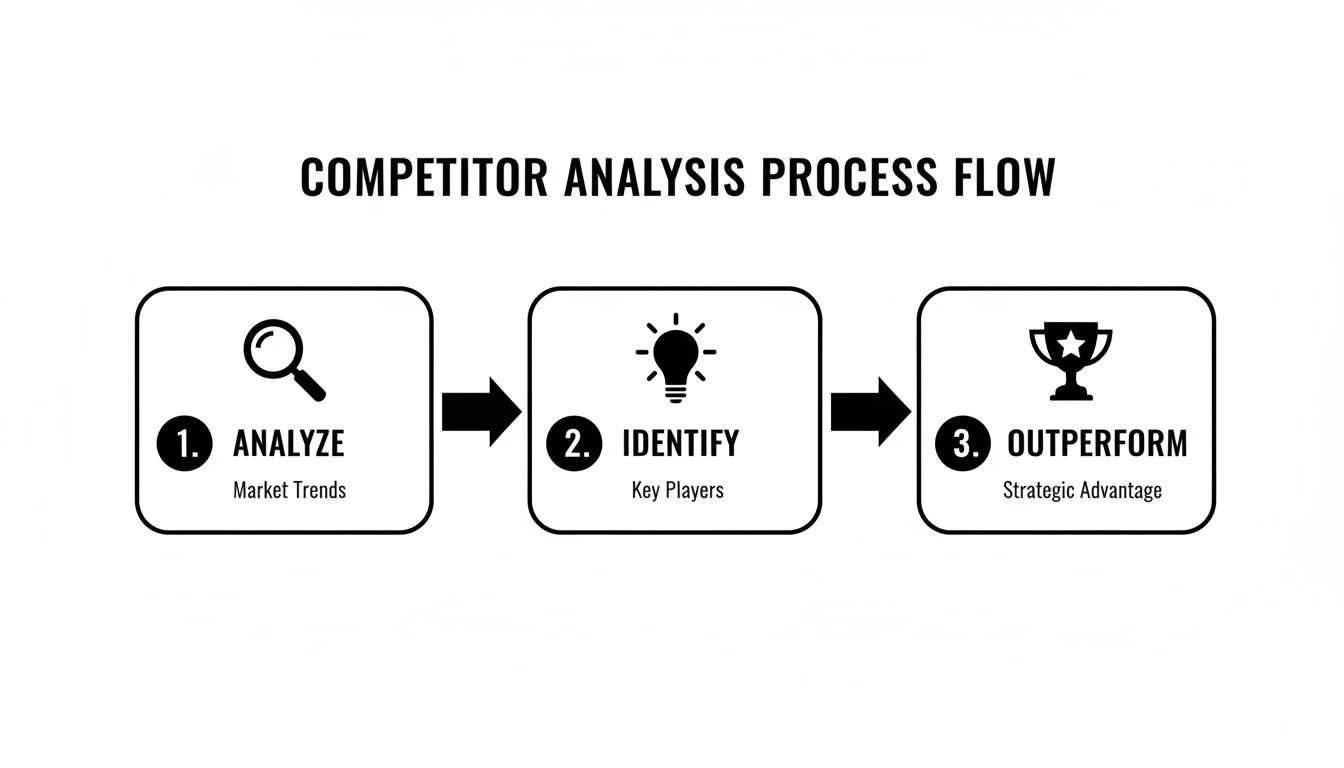
Success isn't just about finding the keywords; it's about systematically turning competitor weaknesses into your strengths.
Aligning Keywords with Your Digital Storefront
Your core digital assets—the homepage, service pages, and location pages—are your primary conversion points. They need to be laser-focused on the most valuable, high-intent keywords that scream "I'm ready to buy."
These are the pages where your most important "money" keywords belong.
- Homepage: This is your digital billboard. It should target your main service in your primary city (e.g., "Austin plumbing services"). It’s your chance to clearly state who you are, what you do, and where you do it.
- Service Pages: Every core service you offer needs its own dedicated page. These should target service-specific keywords plus your main city, like "emergency drain cleaning Austin" or "water heater installation Austin."
- Local Landing Pages: Absolutely essential if you serve multiple neighborhoods or nearby towns. Create a unique page for each key service area, targeting hyper-local terms like "HVAC repair in Hyde Park" or "plumber in 78704."
This tiered structure creates a clear path for both users and search engines. It moves from the general authority of your homepage down to the specific expertise on your local landing pages, proving your relevance across your entire service area.
Capturing Early-Stage Interest with Content
Not every local searcher is ready to pull out their credit card right away. Many are just in the research phase, looking for answers, costs, or advice. This is where informational keywords come in, and your blog becomes a powerhouse for building trust and authority.
Blog posts are the perfect home for question-based and long-tail informational keywords. For instance, a keyword like "cost of plumbing services in Austin" is a fantastic topic for a detailed blog post. You'll attract potential customers early in their journey, answer their questions, and position yourself as the go-to local expert.
By creating genuinely helpful content that addresses local concerns, you capture an audience that your competitors—who are only focused on commercial terms—completely miss. This builds a pipeline of future customers who will remember your brand when they're finally ready to make a decision.
This content can be organized around a central theme, creating a powerful content hub. To learn more about this super-effective structure, check out our guide on what a pillar page is and how to build one.
Your Google Business Profile Is a Keyword Magnet
Your Google Business Profile (GBP) is often the very first interaction a local customer has with your brand. It’s non-negotiable: you have to optimize it with your localized keywords. A well-tuned GBP can capture traffic before a user even decides to click through to your website.
Think of your GBP as a mini-website that needs its own keyword strategy.
- Business Description: Weave your top service and location keywords into your business description naturally. Tell your story while signaling to Google exactly what you're relevant for.
- Services List: Don't just list "Plumbing." Add every single service you offer, like "Leak Detection," "Sewer Line Repair," and "Faucet Installation." Each one is another keyword opportunity.
- GBP Posts: Use the Posts feature to share updates, offers, and tips. Treat the titles and text just like a blog post, incorporating relevant local and service keywords.
- Q&A Section: Get ahead of the game by populating this section yourself. Ask and answer common questions your customers have, phrasing both the questions and answers with the exact keywords your audience uses.
This comprehensive optimization is a game-changer. Data shows that customers are 70% more likely to visit a business with a complete profile. Don't leave that opportunity on the table.
Got Questions About Local Keyword Research?
As you start putting all this theory into practice, you're bound to run into a few practical questions. That's a good thing. It means you're in the trenches, doing the actual work. Localized keyword research isn't a one-and-done task you can check off a list; it's a living, breathing part of your marketing rhythm.
Getting a handle on these common challenges now will help you build a smarter, more sustainable process for local growth. Let's tackle some of the most frequent questions I hear from businesses diving into local SEO.
How Often Should I Refresh My Local Keyword Research?
Think of your local keyword list as a living document, not a static report you create once and then bury in a folder. You should plan for a major, deep-dive refresh every 6 to 12 months. That’s usually enough time to catch any big market shifts, see new competitors pop up, or account for changes in your own services.
But the real key is to get into the habit of a lighter, more frequent check-in—maybe once a quarter. Local trends can change on a dime. A new housing development, a popular community event, or even shifting neighborhood dynamics can introduce new search terms. Your Google Business Profile Insights are a goldmine for this, showing you the new and interesting ways real people are finding you.
Here's a simple rule of thumb: If you launch a new service, expand into a new area, or spot a new competitor making moves, don't wait. That’s your signal to do targeted keyword research for that specific change right away.
What's the Difference Between a Local Landing Page and a Blog Post?
It really boils down to one simple word: intent. Each piece of content plays a totally different role in a potential customer's journey, and mapping your keywords to the right format is absolutely critical.
A local landing page is your digital salesperson. Its entire job is to convert. It targets commercial-intent keywords like "plumber in Brooklyn" or "best deep dish pizza near me." It’s designed to give visitors everything they need to make a decision: services, contact info, service areas, reviews, and a clear call to action.
A local blog post is your helpful neighborhood expert. It goes after informational-intent keywords, which often look like questions: "how to choose a roofer in Austin" or "average cost of lawn care in Florida." The goal here is to build trust and authority by answering questions, which naturally guides people toward your services when they're ready.
So, think of it this way: a landing page is there to close the deal, while a blog post is there to start the conversation.
How Does This Apply to a Service Area Business Without a Storefront?
If you run a Service Area Business (SAB)—think plumbers, mobile dog groomers, or electricians—a solid localized keyword strategy is even more important for you. You don't have a physical storefront for customers to drop by, so your online presence is your storefront, and it needs to be built around the specific cities, neighborhoods, and counties you serve.
Your strategy just shifts from optimizing for one pin on a map to blanketing an entire service area.
Here's how that looks in practice:
- Build Dedicated Landing Pages: Don't just list your service areas on one page. Create unique, fully optimized pages for each core city or town you serve (e.g., a page for "landscaping in Town A" and another for "lawn maintenance in Town B").
- Lean into Location Modifiers: The names of those towns, counties, and even well-known neighborhoods become your most powerful keyword modifiers.
- Get Your GBP Right: Make sure your Google Business Profile is correctly set up as a Service Area Business. This lets you define your service radius on the map without showing a physical address, which is crucial for any SAB.
The fundamental principles are the same. You're just applying them across a much broader geographical canvas. Each of those landing pages acts like a mini-storefront for a specific community, proving your relevance to both local customers and Google.
Ready to turn AI and search visibility into measurable growth? Sight AI provides the insights and automation to get your brand discovered. Our platform monitors how AI models talk about your brand, surfaces high-value content gaps, and uses specialized AI agents to produce SEO-optimized articles that rank.