
Local SEO keywords are the exact phrases and questions people type into Google when they're looking for businesses, products, and services right around the corner. These are your golden ticket to high-intent customers.
They almost always include a location—think "near me," a city name, or even a specific neighborhood—which signals that the searcher is ready to pull the trigger.
Why Local Keywords Are Your Strongest Growth Lever
Let's cut to the chase: local search is where you find customers with an immediate problem to solve. Trying to rank for broad, hyper-competitive keywords is like yelling into a hurricane. But owning the high-intent, high-conversion searches happening in your own backyard? That’s how you win.
A dialed-in local keyword strategy isn't just another SEO task on a checklist; it's a core growth engine for any business with a physical footprint.
The intent behind these local searches is what makes them so powerful. These aren't people casually browsing; they're actively looking for a solution right now. Consider the difference between someone searching for "how to fix a leaky faucet" versus "plumber in downtown Boston." The first is purely informational. The second is a transactional cry for help—it signals an urgent need and a wallet ready to open.
The Power of Proximity and Intent
This isn't just a gut feeling; the data backs it up. Local searches are exploding, with over 1.5 billion 'near me' queries happening every single month on Google. And get this: 46% of all Google searches have local intent. Nearly half of the people using Google are looking for something nearby.
This is the bedrock of a smart small business SEO strategy. It allows you to skip the noise and connect directly with the people who can actually walk through your door or hire your service.
The goal is to stop thinking about competing on a national stage and start becoming the undisputed, go-to choice for customers in your service area. Your biggest growth lever isn't reaching everyone—it's reaching the right ones, right next door.
Local Search Intent vs General Search Intent
The difference in value between a local searcher and a general information-seeker is night and day. One is looking to learn, while the other is looking to buy. This table breaks it down:
| Attribute | Local Search ('plumber in Brooklyn') | General Search ('how does plumbing work') |
|---|---|---|
| User Intent | Transactional or Navigational | Informational |
| Urgency | High, often immediate need | Low, curiosity-driven |
| Conversion Potential | Very High | Very Low |
| Stage of Funnel | Bottom of Funnel (BoFu) | Top of Funnel (ToFu) |
| Audience | Geographically specific customers | Broad, global audience |
| Goal | Find a local provider, get directions, make a purchase | Learn, research, understand a concept |
As you can see, the value is heavily skewed toward local queries. Focusing your efforts here means you’re targeting users who are much further along in their buying journey.
Real-World Scenarios Speak Volumes
Think about these all-too-common situations where local keywords directly lead to new business:
- The Emergency Call: A homeowner’s pipe bursts. They aren't searching for "plumbing companies"; they're desperately typing "emergency plumber near me" or "24/7 plumber in [Your Zip Code]."
- The Last-Minute Gift: Someone remembers an anniversary—today. Their search for "same-day flower delivery in Brooklyn" is a direct signal of immediate purchase intent.
- The Weekend Craving: A family is trying to decide where to eat. They pull out their phone and search "best family-friendly Italian restaurant in North Austin."
In every case, the business that optimized for these specific local SEO keywords wins the click, the call, and the customer. This is why partnering with a top-tier creative studio for web design, branding, and SEO can be a game-changer for capturing this high-value traffic. A targeted local approach turns your website from a digital brochure into an active, lead-generating machine.
Finding High-Value Local Keywords That Actually Convert
Finding the right local keywords isn’t about mastering some complex piece of software. It’s about putting yourself in your customer's shoes. The real goal here is to pinpoint the exact phrases people type into Google when they need what you offer, right now.
So let's forget the generic advice. We're going to build a repeatable workflow to uncover the terms that actually drive phone calls, appointment bookings, and foot traffic through your door.
Start With Your Competitors
Often, the best place to start is right under your nose. Your competitors have already done a lot of the heavy lifting, and analyzing what they rank for gives you a direct look into what’s already working in your local market. This isn’t about blindly copying them; it’s about smart competitive intelligence.
You can use most SEO tools to pop in a competitor's website and see the top local terms sending them traffic. Look for the patterns. Are they targeting specific neighborhoods? Do they have pages dedicated to emergency services? This initial analysis gives you a fantastic foundation for your own keyword list.
Tap Into Google's Free Intel
Google itself is a goldmine for keyword ideas, giving you a direct line into what real people are searching for. It's the most authentic data you can get because it comes straight from user behavior.
Just start typing one of your core services into the Google search bar. Let's say you're a florist. You type "flower delivery..." and Google Autocomplete will immediately suggest:
- flower delivery brooklyn same day
- flower delivery near me cheap
- flower delivery williamsburg bk
These aren't just random suggestions; they're popular, real-world searches. This simple trick reveals crucial user intent—people want speed ("same day"), they're conscious of price ("cheap"), and they're looking in very specific locations ("williamsburg bk").
Next, scroll down the search results page and find the "People Also Ask" (PAA) box. This is where Google shows you the direct questions your potential customers are asking. An accounting firm might see questions like, "how much does a small business accountant cost in Houston?" or "best CPA for startups in Texas." Answering these questions directly on your site is a powerful way to pull in high-intent traffic.
Uncover Keywords In Your Community
Digital tools are great, but don't ever overlook the value of just listening to your local community. The language your customers use when they aren't on Google is often the most natural and valuable.
Dive into local Facebook groups, check out neighborhood forums like Nextdoor, or even scan the comments on a local news page. A post asking for "a reliable roofer after that big hailstorm" just handed you several powerful keywords: "reliable roofer," "hailstorm roof repair," and the implied local geography.
Customer reviews are another source of keyword gold. Go through your Google Business Profile reviews and even your competitors'. Do customers keep mentioning your "quick service," "affordable pricing," or a specific, tricky problem you solved? These are the exact phrases you should be weaving into your website copy.
A customer review that says, "They were the only ones who could fix my AC on a Sunday," gives you the keyword "emergency sunday ac repair." This is far more potent than a generic term because it's born from a real, urgent customer need.
Differentiating Between Keyword Types
Not all local keywords are created equal. Understanding the different types helps you build a strategy that targets customers at every stage of their journey, from just starting their research to needing urgent help.
Learning the nuances of localised keyword research is what separates a decent strategy from a great one.
Let's break down the common structures with some real-world examples:
- Service + City/Town: The classic. Think "divorce lawyer in Scottsdale" or "organic coffee shop San Diego." It’s straightforward and targets users who know what they want and where they are.
- Service + "Near Me": The explosion of mobile search has made "near me" searches incredibly common. While you can't explicitly target the phrase "near me," optimizing your Google Business Profile and local landing pages is how you show up for these high-intent queries.
- "Best" + Service + Location: When someone adds words like "best," "top," or "reviews" to their search, they're in the comparison phase and getting ready to buy. Ranking for "best deep dish pizza Chicago" positions you as a top contender right when it matters most.
- Hyper-Local/Neighborhood Keywords: If you're in a big city, targeting specific neighborhoods is non-negotiable. A user searching for a "yoga studio Upper East Side" is a much hotter lead than someone just looking for a "yoga studio NYC."
By blending these methods—spying on competitors, using Google's own suggestions, listening to your community, and understanding the different keyword types—you can build a powerful list of local SEO keywords that truly convert browsers into paying customers.
Using Geo-Modifiers and Keyword Clustering to Win
Coming up with a raw list of local keywords is a solid first step. But on its own, it’s just a pile of ingredients with no recipe. The real magic happens when you organize that list with intent. This is how you transform random terms into a cohesive strategy that tells Google exactly who you are, what you do, and—most importantly—where you do it.
The best way to start is by supercharging your keywords with geo-modifiers. These are simply location-based terms that give your services powerful local context. Most businesses stop at the city name, like "plumber in Austin," but your customers are thinking far more specifically. You should be, too.
Think about how real people talk and search. They don't just exist in a city; they live in a neighborhood, belong to a specific zip code, or orient themselves around a well-known landmark. Adding these layers helps you capture those ultra-targeted, high-intent searches that your competitors are probably ignoring.
Expanding Your Geographic Reach
Go beyond the obvious city-level terms and start thinking hyper-locally. A potential customer isn't just searching for "landscaper in Chicago"; they're much more likely to be looking for a "landscaper in Lincoln Park" or "lawn care 60614."
Here are a few powerful geo-modifiers you should be thinking about:
- Neighborhoods: "HVAC repair South End Boston"
- Zip Codes: "Emergency dentist 90210"
- Counties: "Family lawyer in Travis County"
- Well-known landmarks: "Coffee shop near Central Park"
- Informal area names: "IT support in the Triangle"
This granular approach aligns your content with the precise language of local searchers. It signals strong local relevance to Google and connects you directly with the most qualified leads in your service area. This flowchart breaks down the simple process of finding these core keywords before you start modifying them.
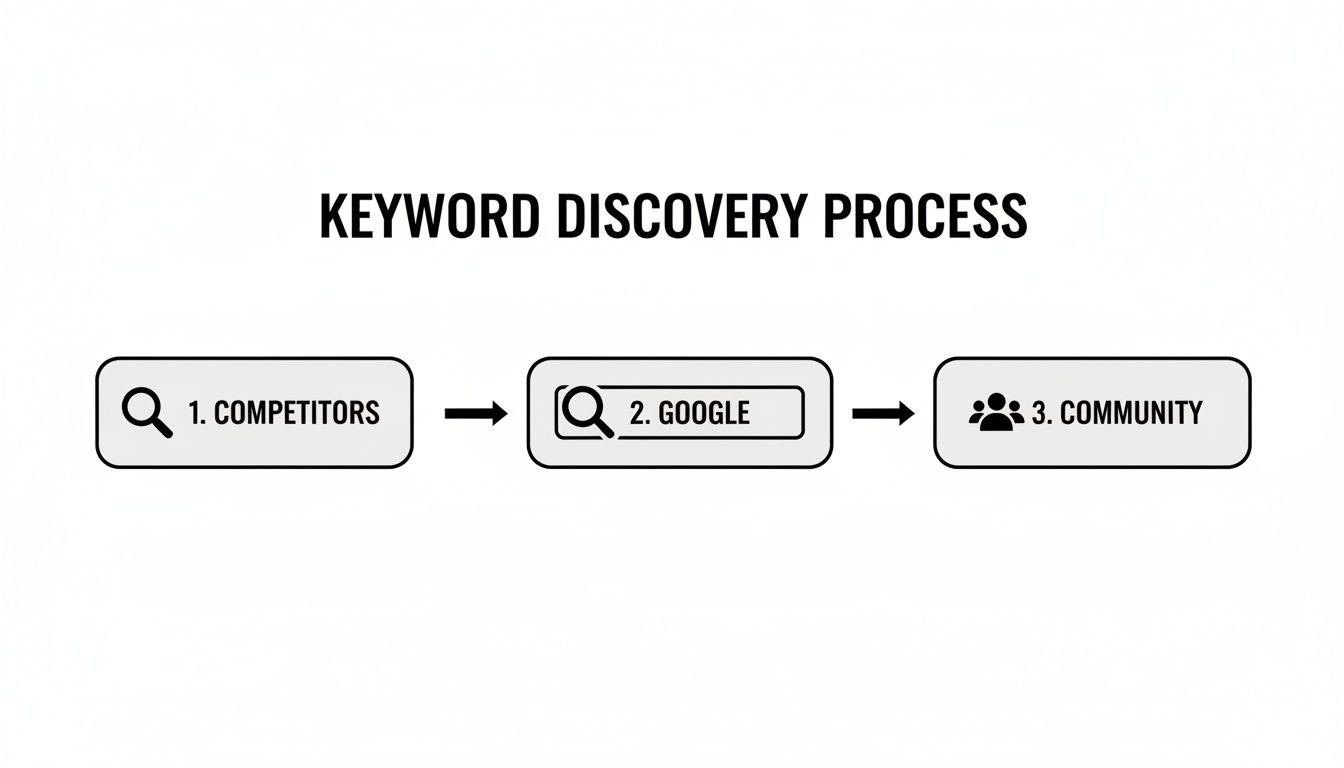
As you can see, solid keyword discovery is a multi-pronged effort. You need to pull insights from your competitors, use Google's own tools, and listen to community conversations to build a foundational list.
The Power of Keyword Clustering
Once you've beefed up your keywords with geo-modifiers, the next move is to organize them through keyword clustering. This is just the practice of grouping closely related keywords together based on their shared search intent. Instead of creating a dozen thin pages for every minor keyword variation, you build one powerful, authoritative page that can rank for the entire group.
This simple act of organization prevents "keyword cannibalization"—where your own pages compete against each other in the search results—and signals deep expertise on a topic to Google.
For example, a local roofing company might have keywords like 'emergency roof repair,' 'leaky roof fix,' and 'storm damage roofer.' Instead of creating three separate, weak pages, they should cluster these terms onto a single, comprehensive "Emergency Roof Repair" service page. This creates a much stronger resource that satisfies multiple related user queries at once.
This strategic grouping is a cornerstone of modern SEO. You can learn more about keyword clustering to really dive deep into building these thematic groups. It's what allows you to build stronger, more focused pages that deliver a better user experience and, ultimately, achieve higher rankings.
Structuring Your Website with Clusters
Keyword clustering doesn't just clean up your spreadsheet; it gives you a clear blueprint for your entire website's architecture. Each cluster you create should correspond directly to a specific page, helping you map out your content in a way that makes perfect sense to both users and search engines.
Here’s how a local business could structure its site using this method:
- Core Service Pages: Each primary service gets its own dedicated page, built around a cluster of related keywords. For an electrician, one cluster might include "electrical panel upgrade," "breaker box replacement," and "fuse box upgrade," all pointing to one service page.
- Local Landing Pages: If you target service areas without a physical office, create unique city or neighborhood landing pages. A plumber based in Dallas could create a page for "Plumbing Services in Plano," featuring unique content and testimonials from that specific area.
- Blog Content: Use clusters of informational, question-based keywords to fuel your blog. That same plumber could create a cluster around "how to fix a running toilet," "why is my toilet always running," and "leaky toilet tank solutions" to write a single, definitive problem-solving article.
By thoughtfully applying geo-modifiers and organizing your terms into logical clusters, you create a focused, authoritative website structure. This approach makes it incredibly easy for both users and search engines to understand your expertise and geographic relevance, setting you up to dominate the local search results.
Putting Your Local Keywords to Work
Alright, you've done the hard work. You've got a killer list of local keywords that are primed for action. But a keyword list sitting in a spreadsheet is just potential. Now it's time to turn that potential into performance by weaving those terms into the very fabric of your online presence.
This is the part where strategy meets reality. We're moving from research to real-world application, directly influencing how both Google and your future customers will find you. This isn't about mindlessly stuffing keywords wherever they'll fit. It’s a thoughtful, strategic integration that actually improves the user experience while screaming your local relevance to search engines.
Let's start with your digital home base—your website—and then jump into your most powerful local SEO weapon: your Google Business Profile.

On-Page SEO Implementation
Your website pages are prime real estate for your local SEO keywords. Think of each page as a billboard telling Google exactly what you do and where you do it. You want to give the search engine a crystal-clear map of your services and your territory.
Here’s where you’ll get the biggest bang for your buck:
- Title Tags: This is your #1 on-page signal. The formula is simple but incredibly effective:
Primary Keyword | Secondary Keyword | Brand Name. For a local roofer, that might look like:Roof Repair in Austin TX | Emergency Roofing Services | Apex Roofing. - Meta Descriptions: While not a direct ranking factor, a good meta description packed with your local keyword is your 160-character ad in the search results. It’s what convinces someone to click on your link instead of the competition's.
- Header Tags (H1, H2, H3): Your H1 tag is the main headline for the page and should feature your primary keyword. Use H2s and H3s to structure your content logically and sprinkle in related secondary keywords and long-tail phrases. It should feel natural, not forced.
- Image Alt Text: This is such an easy win. Instead of an image file named "roof.jpg," describe the image for search engines and visually impaired users. Try something like, "Certified roofer inspecting storm damage in Austin."
Remember, consistency is key. A crucial part of this process is ensuring all your online profiles are aligned, which includes knowing the essential things your business listings must have.
Your Google Business Profile Is a Keyword Powerhouse
For ranking in the Google Maps Local Pack, your Google Business Profile (GBP) is arguably even more important than your website. Every single section of your profile is another opportunity to reinforce who you are, what you do, and where you do it. Skipping this is like locking the front door of your shop during business hours.
These keywords aren't just for decoration; they are the fuel for local ranking dominance. Google's big three factors—relevance, distance, and prominence—are all directly influenced by them. The data doesn't lie: optimized GBPs with local keywords can pull in an average of 1,200 views per month and see 70% more visits than neglected ones. That direct line between keyword implementation and customer action is why this is non-negotiable.
Here’s your GBP implementation checklist:
- Business Description: You get 750 characters, so make them count. Naturally weave your most important service and location keywords into a compelling story about your business. Don't just list them.
- Services & Products: This is your menu. List out everything you offer using the exact service keywords you found. If you're a plumber, you should have separate entries for "drain cleaning," "water heater repair," and "emergency plumbing."
- GBP Posts: Treat these like mini-blog posts or social media updates. When you post an offer, an update, or an event, use a relevant local keyword in the title and the text. This keeps your profile looking fresh and active.
- Q&A Section: Don't wait for customers to ask questions—ask and answer them yourself! This is a perfect spot to use your keywords. For example: "Do you offer 24/7 emergency electrical services in Brooklyn?" followed by a helpful answer.
- Responding to Reviews: When you thank a customer for a great review, you have a chance to subtly reinforce what you do. "Thanks, John! We're so glad we could help with your HVAC installation in the North End."
By diligently applying your local keywords across your website and every corner of your GBP, you create a powerful, unified signal that establishes your local authority. This hands-on implementation is a vital piece of any SEO content strategy built to win in a competitive local market.
Creating Hyper-Local Content That Ranks and Connects
Getting your local SEO keywords onto your core service pages and Google Business Profile is table stakes. It's the absolute foundation. But if you want to truly own your market, you have to push beyond the basics. The real magic happens when you start creating content that cements your business as the go-to local authority.
This is about shifting your mindset from just selling services to building genuinely helpful resources for the community you serve. This kind of content doesn't just pull in high-intent search traffic; it builds incredible trust and, almost magically, earns you valuable local backlinks without you even asking for them.
Answer Your Community's Specific Questions
Your customers have unique, location-specific problems that people in other parts of the country just don't face. A landscaper in sunny Arizona deals with a completely different set of questions than one in snowy Vermont. Tapping into these hyper-local pain points is an absolute goldmine for content ideas that weave your keywords in naturally.
Forget the generic "lawn care tips" blog post. Instead, a Phoenix-based landscaper could crush it with an article on the "Best Drought-Resistant Plants for Phoenix Backyards." It's specific, it solves a real local problem, and it instantly positions them as the expert.
Just look at these real-world examples:
- An HVAC Company in Houston: "Preparing Your Air Conditioner for a Humid Texas Summer"
- A Roofer in Denver: "What Denver Homeowners Need to Know About Hail-Resistant Shingles"
- A Coffee Shop in Seattle: "A Guide to the Best Rainy Day Coffee Shops in Capitol Hill"
This approach is powerful because you're directly answering the questions your local audience is already typing into Google. It's relevance on a silver platter.
Become the Ultimate Neighborhood Guide
One of the most effective ways to build local authority is to create content about the community itself. People are constantly searching for things like the best local parks, school district information, or what's happening this weekend. By becoming the source for that information, you become a trusted local resource.
This strategy is about playing the long game. You're not just trying to rank for "plumber in Austin." You're also trying to become the website people visit when they want to know what's happening in Austin. That level of trust and visibility pays dividends.
Start developing content that showcases your deep connection to the community. This could be a "Best Family-Friendly Activities in [Your Neighborhood]" guide or a blog post spotlighting the "Top 5 Booths to Visit at the Local Farmers Market." Each piece is a new opportunity to naturally link back to your core service pages where it makes sense.
Spotlight Local Partners and Events
Your business doesn't operate in a silo. You're part of a vibrant local ecosystem filled with other businesses, organizations, and events. Creating content around these connections is a brilliant way to build relationships and generate the authentic local signals Google loves.
Think about writing a blog post featuring other non-competing local businesses you admire. For example, a wedding planner could create a roundup of "Our Favorite Wedding Venues in Napa Valley," linking out to each venue's website. This isn't just a great resource for potential clients; those venues are highly likely to share the post or even link back to your site—a massive win for your local SEO.
Here are a few quick ideas to get you started:
- Event Sponsorship Recaps: If you sponsor a local 5k or a little league team, write a recap. Post pictures, shout out the other sponsors, and share what it meant for your team to be involved.
- Partner Spotlights: Interview the owner of a complementary local business. A real estate agent, for instance, could interview a trusted local mortgage broker they work with.
- Community Initiative Updates: Does your team volunteer for a local charity? Document the experience. It shows genuine community involvement, which resonates deeply with local customers.
By committing to this type of hyper-local content, you transform your website from a simple digital brochure into a dynamic community hub. This not only drives highly targeted organic traffic but also builds the kind of brand loyalty that your competitors simply can't replicate.
How to Track and Measure Your Local SEO Success
Launching a local keyword strategy without a way to measure its impact is like flying blind. You’re putting in the work, but you have no real idea if you’re heading in the right direction or just burning fuel. To prove your efforts are actually working, you need to track the right metrics—the ones that connect what you do to what the business gets.
This isn't about chasing the number one spot for a single keyword. True local SEO success is a blend of visibility, customer engagement, and real-world actions that ultimately drive revenue.
Key Performance Indicators for Local Keywords
To get a clear picture of how you're doing, you need to focus on a handful of key performance indicators (KPIs) that tell the whole story. These aren't vanity metrics; they show you not just where you rank, but how customers are actually interacting with your business because of it.
Start by zeroing in on these essential data points:
- Local Pack Rankings: Your spot in the Google Maps "Local Pack" is gold. Showing up in this top-three box for your target local SEO keywords is a huge driver of high-intent clicks and calls.
- Google Business Profile Actions: This is where the magic happens. Keep a close eye on the number of people who clicked for directions, called your business, or visited your website straight from your GBP listing. These are tangible, bottom-funnel actions.
- Organic Traffic from Local Queries: Dive into Google Search Console and filter your performance reports. You'll want to specifically look at impressions and clicks for searches that include your city, neighborhood, or "near me."
These KPIs shift your focus from simply ranking to driving results. For a much deeper dive into the tools and methods for monitoring your positions, our guide on SEO rank tracking tools and strategies is a great next step.
Connecting Metrics to Business Outcomes
At the end of the day, the goal is to translate these SEO numbers into a language that stakeholders and clients actually care about: leads, sales, and return on investment. The trick is to draw a straight, undeniable line from your keyword performance to bottom-line results.
Don't just report that "we increased impressions for 'plumber in Brooklyn' by 50%." Instead, frame it as, "Our improved visibility for 'plumber in Brooklyn' led to a 20% increase in phone calls from our GBP, resulting in 5 new booked jobs this month."
This approach demonstrates the direct monetary value of your local SEO work. When you track phone calls, form submissions from your local landing pages, and even requests for directions, you can clearly attribute new business to your keyword strategy. This transforms your SEO report from a list of numbers into a powerful story of growth.
Common Questions About Local SEO Keywords
When you start digging into a local SEO keyword strategy, a few common roadblocks and questions always seem to pop up. Getting straight answers is the key to moving forward with confidence and not wasting time on tactics that just don't move the needle. Let's clear up a few of the most frequent ones I hear.
How Many Local Keywords Should I Target Per Page?
This is a classic. My advice? Keep it focused. Aim for one primary local keyword and a small, tight cluster of 3-5 closely related secondary keywords for each page.
This approach creates a thematically strong page that screams "expert" to search engines, but it does so without looking spammy or over-optimized. For instance, if your main target is "best pizza in downtown Austin," you'd naturally weave in terms like "downtown Austin pizza restaurant" and "pizza delivery 78701." The goal isn't to stuff in dozens of variations; it's to use natural language that matches what a real person is searching for.
What Is the Difference Between a Local Landing Page and a Service Page?
The distinction here is simple, but it's absolutely critical for your site's structure.
A service page is all about what you do. It's a core page on your site describing a specific offering, like "Residential Plumbing Services."
A local landing page, which you'll often hear called a city page, targets that very same service but in a specific geographic area where you don't have a physical office. Think "Residential Plumbing in [Neighboring Town]." The catch is that these pages have to offer unique, location-specific value—like local testimonials or project examples from that area—to avoid getting flagged by Google as thin or duplicate content.
How Long Does It Take to See Results From Local SEO?
Everyone wants to know this, and the honest answer is: it depends. You can sometimes see quick wins from tuning up your Google Business Profile in just a few weeks. But a full-blown local SEO strategy that builds real momentum? That typically takes 3 to 6 months to show significant traction.
Patience is a virtue in local SEO. So many factors are at play—how tough your local competition is, your website's current authority, and how consistently you're putting in the work. It's the steady drumbeat of creating content and managing your GBP that builds sustainable results over time.
Turn your local SEO insights into measurable growth with Sight AI. Our platform helps you discover high-value content opportunities, automate the creation of geo-optimized articles, and track your brand's visibility across search and AI. Start building your local authority today at https://www.trysight.ai.