Localised keyword research is all about figuring out the exact search terms your potential customers are typing into Google within a specific geographic area. It’s the difference between casting a wide, generic net and using a finely-tuned spear. You're moving beyond broad terms by adding location-specific modifiers—like "near me," a city name, or even a neighborhood—to connect with people who are showing clear local intent.
The Foundation of Local SEO Success
Think of it this way: effective local SEO is built on the simple idea that you need to speak the same language as your local customers. This isn't just about tacking a city name onto your service keywords. It's about getting into the weeds and understanding the community-specific slang, landmarks, and phrases people use when they need a solution right now and right here.
This targeted approach is what separates the local businesses that truly thrive from those that just get lost in the digital noise.
A massive, national strategy might work for an e-commerce giant, but if you run a brick-and-mortar shop, a local service, or a restaurant, your success is measured in foot traffic, phone calls, and sales from your community. Nailing your localised keyword research is the absolute first step to getting those tangible results.
Shifting from a Global to a Local Mindset
The biggest adjustment here is a change in perspective. You're no longer trying to capture every single search for "emergency plumber." Instead, you want to be the no-brainer, top-of-mind answer for "emergency plumber in Hyde Park" or "24/7 plumber near Wrigley Field." This kind of focus builds incredible trust and authority within your defined service area.
Here's what that shift looks like in practice:
- Relevance Over Volume: A keyword with 50 monthly searches in your city is infinitely more valuable than a national keyword with 5,000 searches. Why? Because local searchers have much higher commercial intent.
- Community Language: Your customers use neighborhood names, local landmarks, and even colloquialisms you won't find in a standard keyword tool. Unearthing these is a huge competitive advantage.
- Intent Is Everything: A search for "best coffee" is worlds apart from "best coffee shop open now." That second search shows an immediate intent to visit, which is pure gold for local businesses.
Localised keyword research isn't just another SEO task; it's a market research discipline. It forces you to listen to your community, understand what they need at this very moment, and position your business as the most convenient, relevant solution.
This visual breaks down the simple but powerful flow from a broad strategy to profitable local engagement.
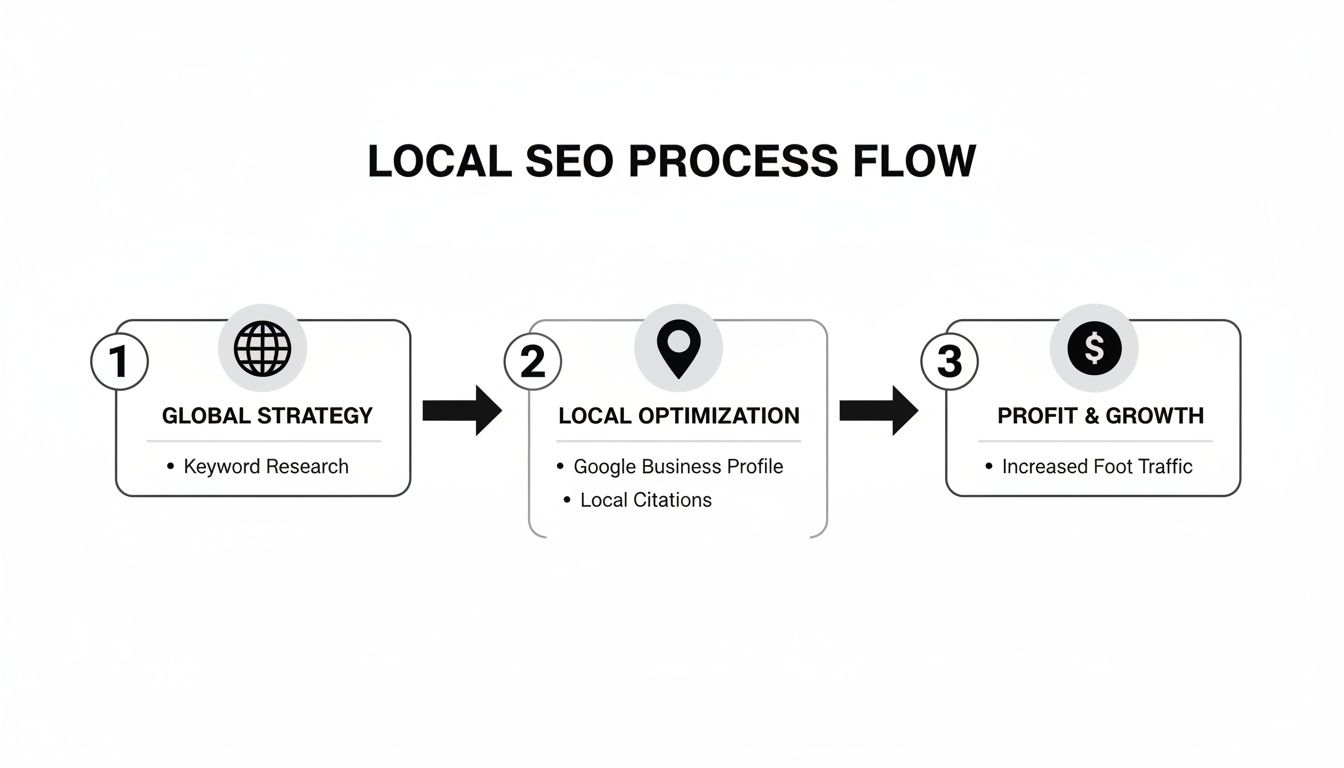
The key takeaway is that local optimization acts as a powerful filter, turning general online interest into real-world customers walking through your door.
Real-World Application
To see how this plays out, just look at these proven restaurant marketing tactics that include local SEO. A restaurant targeting the keyword "Italian food" nationally is going to struggle. But a restaurant that optimizes for "best Italian restaurant downtown Chicago" is connecting directly with hungry diners ready to book a table.
This foundational knowledge is a crucial piece of a broader keyword strategy for SEO (https://www.trysight.ai/blog/keyword-strategy-for-seo), making sure all your efforts pull in the same direction for maximum impact. When you start with a hyper-local focus, you lay the groundwork for a successful digital presence that drives real, measurable business growth.
Finding Keywords Your Local Customers Actually Use

This is where the rubber meets the road. Building a killer keyword list isn’t just about plugging your service into a tool; it's about getting inside the heads of your local customers to figure out the exact words they’re typing into Google.
You’re looking for the real language people use every day, which is often far more specific than a simple "service + city" combination.
Before you even think about keywords, you need to get crystal clear on your service areas. Are you targeting an entire county? A single city? Or are you focused on hyper-local neighborhoods like 'Midtown' or specific ZIP codes? This geographic scope becomes the foundation for everything that follows.
Tapping Into Real Local Search Behavior
Your best starting point is usually the most obvious one: Google itself.
Pop open a search bar and start typing your core service, followed by your location. Pay very close attention to what Google Autocomplete spits out. Those aren't just random guesses; they're the most common searches real people are making in your area.
For example, a roofer in Denver might start with "roof repair." Google will immediately serve up gold:
- "roof repair Denver CO"
- "hail damage roof repair Denver"
- "emergency roof repair near me"
- "best roofer Highlands Ranch"
See the difference? "Hail damage" is a climate-specific keyword that’s pure gold in Colorado but worthless in other places. This is the kind of local insight that separates a generic keyword list from one that actually drives business. For a deeper dive into this process, check out our guide on keyword research for organic SEO.
Using Local Keyword Modifiers
To really flesh out your list, you need to think in terms of "modifiers"—the extra words people tack onto their searches to get more specific results. We’re moving way beyond just city names here.
Think about the different ways a potential customer might qualify their search. This approach helps you capture searches all along the customer journey, from someone just starting their research to someone with an emergency.
Here’s a breakdown of how you can use different modifiers for a core service like "landscaping."
Effective Local Keyword Modifiers
| Modifier Type | Examples | Use Case |
|---|---|---|
| Location-Specific | near me, in [City], [Neighborhood], [ZIP Code] | Captures users looking for immediate, nearby services. Think "landscaping near me" or "landscaping in 78704." These are usually high-intent queries. |
| Service-Specific | xeriscaping, sod installation, sprinkler repair | Targets customers who know exactly what they need. A search for "sod installation Austin" is way more qualified than a generic one. |
| Intent-Based | best, affordable, emergency, same-day | Catches users who are qualifying their search by price, quality, or urgency. "Affordable landscaping Austin" is a classic example. |
| Branded Alternatives | [Competitor Name] reviews, services like [Competitor] | Helps you tap into the competitive landscape and even capture traffic from people actively considering your rivals. |
By thinking in these buckets, you start building a list that truly reflects the various ways local customers search for your services.
The explosive growth in 'near me' searches proves how powerful this is. Over the last two years, mobile queries with 'near me' variations have surged by a massive 500%. This trend is directly tied to conversions, as over half of all 'near me' searches lead to an offline visit or purchase.
Uncovering Keywords From Untraditional Sources
While your favorite SEO tool is indispensable, some of the most potent local keywords aren't found there. They’re hiding in plain sight where your actual customers are talking. These sources give you raw, unfiltered language and reveal the real pain points you can solve.
Get ready to do a little digital eavesdropping in these places:
- Local Competitor GMB Profiles: Go read the Q&A and reviews sections on your top competitors' Google Business Profiles. You'll see the exact phrasing real customers use when they have a problem or ask a question.
- Community Hubs: This is a goldmine. Check out neighborhood Facebook groups, local Reddit threads (like r/Austin), and Nextdoor. Find the posts where people are asking for recommendations—the way they phrase their requests is your next set of keywords.
- Your Own Team: Seriously, talk to your customer service reps and field technicians. What are the most common questions they get? What specific words do customers use on the phone? This internal knowledge is often completely overlooked but is incredibly valuable.
When you blend traditional keyword tools with these real-world listening tactics, you end up with a keyword list that isn't just comprehensive—it's deeply connected to your local market. This is the foundation you need to create content and campaigns that truly resonate.
Analyzing Local SERPs to Find Real Opportunities
So you've got a long list of keywords. Great start, but that's all it is—a start. The real magic in localised keyword research happens when you get out of your spreadsheet and into the actual search results. This is where you learn to spot genuine ranking opportunities by seeing what Google already thinks is a good answer for a query.
Chasing high search volume is a classic rookie mistake in local SEO. A keyword might get 500 searches a month, but if page one is a wall of powerhouse directories and huge brands, your chances of cracking it are slim to none. Context is everything.
Decoding the Local SERP Landscape
Before you get attached to any keyword, pop open an incognito window and search for it. What you see on that first page will tell you more about user intent and real-world competition than any tool ever could.
You're looking for the makeup of the SERP. What's ranking?
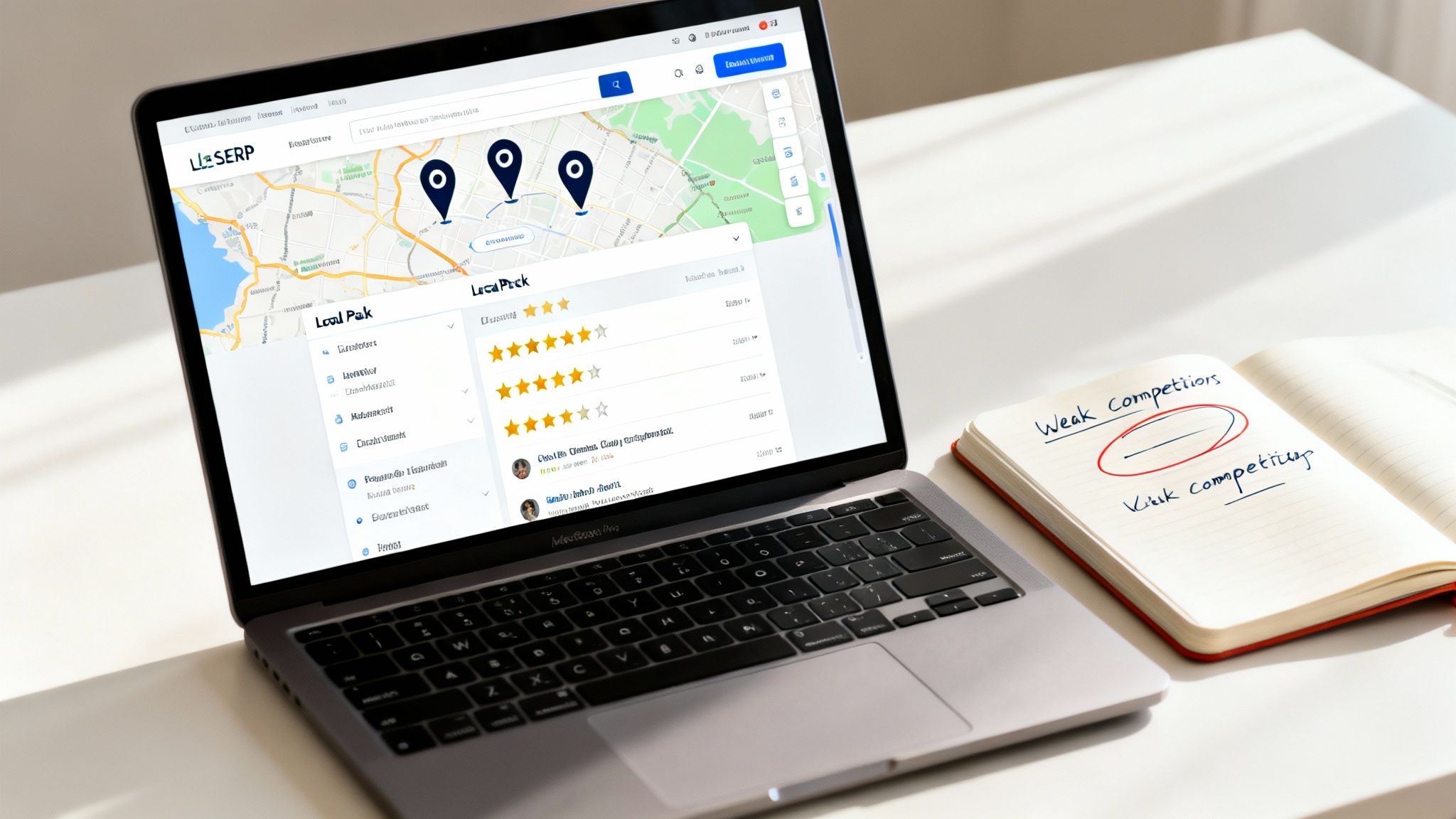
- The Local Pack? That box with a map and three businesses is prime real estate. If you see it, that keyword has serious local, ready-to-buy intent.
- Major Directories? Seeing sites like Yelp, TripAdvisor, or Thumbtack dominate the results means Google interprets this search as a comparison or review-based query.
- Local Blogs and News Sites? When these rank, it’s a strong signal that Google wants informational, community-focused content. This is often a golden opportunity for a small business to jump in with a helpful blog post.
- Direct Competitors? Are the top spots held by businesses just like yours? Perfect. This tells you that a well-built service page has a clear path to rank, provided you can do it better.
Think of this SERP analysis as your strategic roadmap. It tells you exactly what kind of content to build—a service page, a blog post, or a stronger directory profile—to meet Google's expectations.
The Local Pack isn't just a feature; it's a battleground. Recent research shows that a staggering 42% of local searchers click on results within the Local Pack, often skipping the traditional organic links entirely. That's why many agencies now consider Local Pack rankings their number one metric for success. You can dive into the details in the full industry report.
Identifying Your True Competitors and Their Weak Spots
Once you know the lay of the land, it's time to zoom in on the competitors who are actually ranking. Forget just looking at their domain authority; you need to dig deeper to find their weaknesses. This is how you find the low-hanging fruit where your superior content and on-page SEO can make a massive difference.
For each of the top-ranking pages, ask yourself:
- Is their content thin or outdated? Look for pages with barely any text, information that's years old, or content that just doesn't fully answer the question.
- Is their on-page SEO weak? Check the basics: title tag, H1 heading, and URL. Are they poorly optimized or even missing the keyword? You'd be surprised how many local businesses fumble these fundamentals.
- Is the user experience terrible? Is the site slow? A nightmare to use on a phone? Cluttered with ads? These are all red flags for Google, signaling a low-quality page.
When you find a SERP where the top results suffer from thin content and sloppy on-page SEO, that’s a huge green light. It’s a weak spot, an opportunity where you can realistically outrank them simply by creating a more comprehensive and better-optimized page.
Keeping track of these SERP movements and competitor positions is crucial for seizing these opportunities. You can explore some of the best SERP tracking tools to automate this monitoring and keep a constant pulse on the landscape. By combining sharp manual analysis with the right software, you can focus your efforts on keywords that will actually move the needle for your business.
Mapping Keywords to Content and On-Page SEO
So, you've done the heavy lifting—you've dug up and sorted a fantastic list of local keywords. What now? This is where the magic happens. We need to bridge the gap between that research and actual results on your website. This process is called keyword mapping, and it’s all about giving every single one of those valuable terms a strategic home.
Without a clear map, you’re just guessing. You might end up confusing search engines or, even worse, frustrating potential customers who can't find what they need. A smart keyword map ensures your homepage, service pages, and blog posts all work together, each pulling its own weight to capture local searchers at every stage.
Think of it like setting up a physical shop. You wouldn't just dump all your products in a pile by the front door. You'd create specific, clearly-labeled aisles for everything. Keyword mapping does the exact same thing for your website, creating a logical path for both people and search engine crawlers.
Matching Keyword Intent to Page Type
Here's a crucial rule of thumb: not all keywords belong on the same page. The user's intent—that 'why' behind the search you figured out earlier—is your ultimate guide here. Getting this right is the foundation of a local SEO strategy that actually works.
Let's break down how to assign your keywords practically:
Homepage: This is prime real estate for your broadest, most foundational "brand + location" keywords. Think big picture stuff, like "landscaper in Austin" or "Denver's best roofing company." It’s your digital welcome mat, establishing who you are and where you operate.
Service Pages: These pages are built for high-intent, transactional keywords. Every distinct service you offer deserves its own dedicated page. Get specific. Target terms like "emergency plumbing repair Austin" or "sod installation in Boulder."
Location Pages: If you serve multiple towns, cities, or even distinct neighborhoods, each one needs its own unique page. A page for a "plumber in Round Rock" should feel different from one for a "plumber in Cedar Park." Pack it with local flavor—testimonials from that area, photos of local jobs, and neighborhood-specific details.
Blog Posts: Your blog is the perfect spot for informational, question-based keywords. This is where you answer your customers' problems with long-tail queries like "how to prepare your lawn for a Texas summer" or "signs you have hail damage on your roof." These posts attract people who aren't ready to buy yet but are looking for an expert they can trust.
A deliberate mapping strategy also helps you sidestep a very common SEO mistake. By giving each page a unique primary keyword focus, you avoid sending mixed signals to Google—a problem better known as keyword cannibalization.
Essential On-Page SEO for Local Relevance
With your map in hand, it's time to optimize. On-page SEO is how you make it crystal clear to Google that your business is the most relevant local answer for a searcher.
And this stuff matters. A lot. Did you know that 46% of all Google searches are looking for local information? For brands with multiple locations, a sharp on-page strategy can boost their presence in the Google 3-Pack to 33.4% for competitive terms. That's a massive advantage.
Here are the absolute non-negotiables for your on-page checklist:
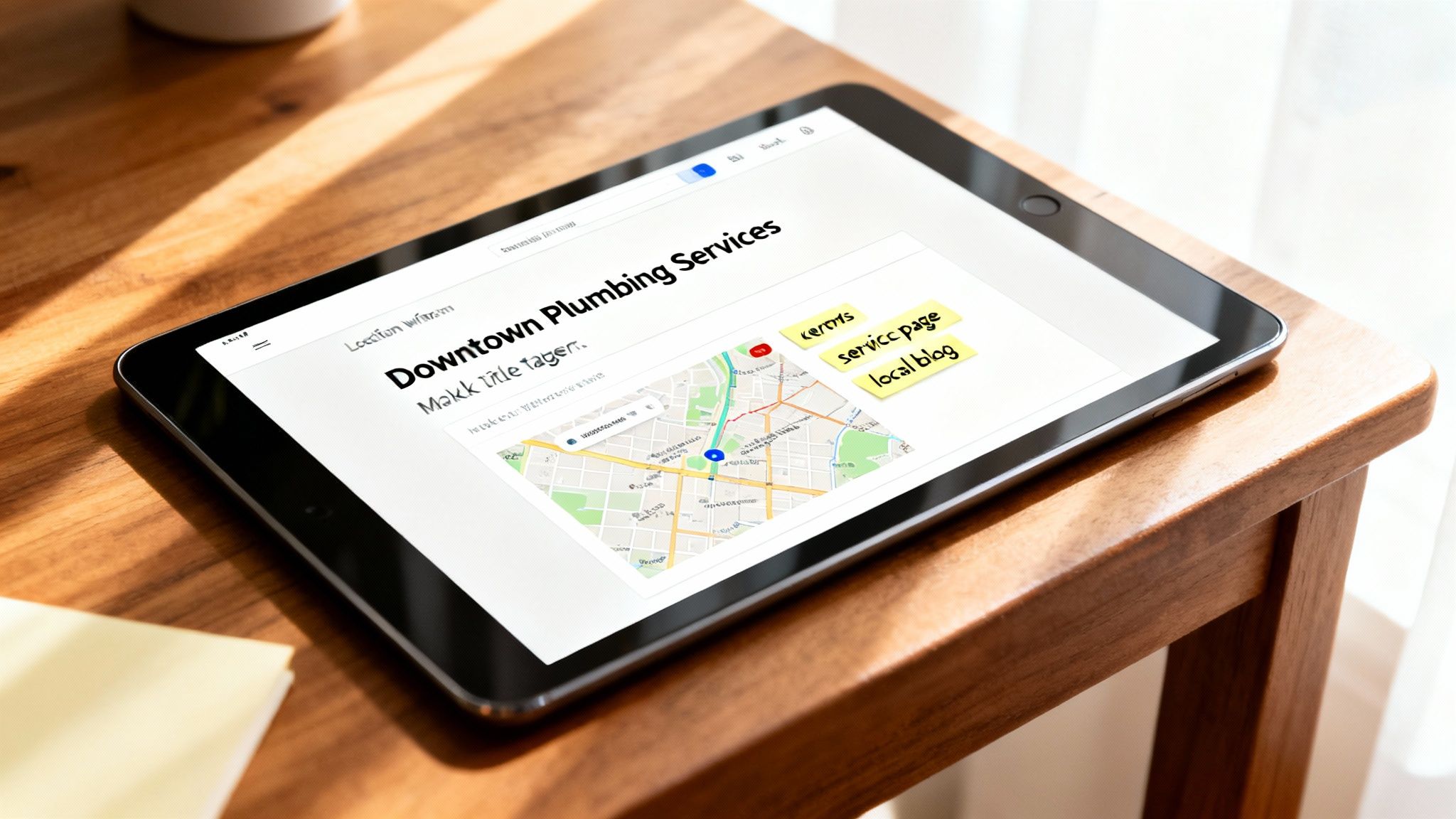
Geo-Specific Title Tags and Headers: Your page's title tag is your single most important on-page signal. Structure it to include your main keyword and location. Something like "Expert Hail Damage Repair | Denver, CO | Apex Roofing." Your H1 heading on the page should then echo that message.
Embedded Google Map: On your contact page and every single location page, embed a Google Map pointing to your physical address. It’s a direct, powerful signal that screams "we are right here!" to Google.
NAP Consistency: Your Name, Address, and Phone number need to be identical everywhere on your site, especially in the footer and contact page. This info must be a perfect match for what's on your Google Business Profile. No exceptions.
LocalBusiness Schema Markup: This is a bit of code that speaks search engines' language. Implementing LocalBusiness schema helps Google instantly understand crucial details like your address, hours, and service area. This can give you a real leg up in local search results.
Don't even think about just copying content and swapping out the city name for your location pages. Google sees right through that thin, low-value tactic. Every location page needs to be unique. Mention local landmarks, feature testimonials from customers in that area, or show off photos from jobs you’ve done nearby.
Finally, none of this is easy if your website is fighting you every step of the way. Choosing an SEO-friendly CMS framework is vital. A good technical foundation makes all these on-page tweaks much simpler, letting you focus on creating great content that connects with your local audience.
Measuring Performance and Refining Your Strategy
A local SEO strategy isn't a "set it and forget it" project. Far from it. Once you've mapped your keywords and dialed in your pages, the real work begins: tracking, measuring, and refining. This is the part of the process that turns those initial wins into real, long-term growth.
Honestly, without measurement, you're just flying blind. You have to know which of your local keywords are gaining traction and, more importantly, which ones are actually making the phone ring, getting forms filled out, or bringing people through your door.
This continuous feedback loop is what separates the businesses that just dabble in local SEO from the ones that truly own their service areas.
Establishing Your Local SEO Dashboard
You don't need a crazy-expensive suite of tools to get started. The key is to build a simple, actionable dashboard using tools you probably already have, like Google Search Console and Google Analytics. They’re packed with all the information you need to see how your local strategy is playing out.
Your main goal is to keep an eye on a handful of core metrics that show the direct impact of your efforts.
Focus on tracking these key performance indicators (KPIs):
- Local Pack Rankings: This is a big one. You need to know your visibility in the map pack for your top money-making keywords. Are you climbing the ranks for terms like "emergency plumber near me" or "best coffee shop downtown"?
- Organic Traffic to Location Pages: Jump into Google Analytics and filter your traffic to see how many people are landing on your specific city or service area pages. A steady climb here is a great sign that your on-page work is paying off.
- Google Business Profile (GBP) Actions: Your GBP Insights dashboard is a goldmine. Seriously. Track the number of clicks-to-call, requests for driving directions, and clicks to your website that come straight from your profile. These are high-intent actions.
- Impressions and Clicks for Geo-Keywords: Use Google Search Console to see exactly which local searches are bringing people to your site. A pro tip is to look for queries with tons of impressions but a low click-through rate (CTR)—these are often easy wins where a simple title tag tweak can make a huge difference.
The real magic happens when you connect the dots. Let's say you see GBP direction requests are up 25% this month. Can you trace that back to an improved Local Pack ranking for a specific keyword? That’s how you prove the ROI of your work.
Using Data to Refine and Expand
Your performance data isn't just a report card; it's a roadmap telling you exactly what to do next. I recommend a quarterly review of your local SEO dashboard. This is where you’ll uncover powerful insights and new opportunities that you might have completely missed during your initial research.
You'll find keywords that are outperforming your wildest expectations, which is a clear signal to double down on what's working.
For example, you might discover in Search Console that while you were targeting "roof repair Austin," you're getting a surprising number of impressions for "metal roof repair Cedar Park." This is the market telling you there's a specific need you can fill. That insight should immediately make you think about creating a dedicated service page or a detailed blog post targeting that exact long-tail keyword.
Monitoring your keyword positions is a fundamental piece of this puzzle. Keeping a close watch on your rankings helps you see what competitors are up to and understand the direct impact of your optimizations. If you want to go deeper on this, our guide on what is rank tracking is a great place to start. This cycle of analyzing performance and finding new keyword pockets is the engine that drives a truly mature local SEO strategy.
Got Questions About Local Keyword Research?
When you start digging into local keyword research, a few common questions always pop up. It's a different beast than general SEO, with its own quirks and rules. Let's clear up some of the most frequent sticking points.
How Is Local Keyword Research Different From General SEO?
Think of it as the difference between a megaphone and a handshake. General SEO shouts for broad terms like "best running shoes" to a national or global audience. Local keyword research, on the other hand, is a targeted conversation with people in your specific service area.
It all comes down to capturing queries that have geographic intent, whether it's obvious or not.
An explicit local query is crystal clear, like "running shoe store in Boston." But an implicit query, like "shoe store near me," is where Google does the heavy lifting, using the searcher's location to serve up the most relevant nearby options. The game here is all about proximity, dominating local SERP features like the Google Local Pack, and navigating a much tighter competitive circle.
Your goal isn't to be visible everywhere. It's to be the most relevant, convenient answer for someone standing just a few blocks or miles away. That hyperlocal focus is what triggers immediate action—like phone calls and store visits.
What Are The Best Free Tools for Local Keyword Research?
You can actually build a surprisingly strong foundation for your local strategy without dropping a single dollar. The best place to start is right inside Google's own ecosystem, which is a treasure trove of real-world search data.
- Google Autocomplete: Just start typing a core service and your city into the search bar. The suggestions that pop up are a direct line into what actual people are looking for in your area.
- Google Business Profile Insights: This is non-negotiable—it's a goldmine. Your performance report shows you the exact search terms people used to find your business listing. No guesswork needed.
- The "People Also Ask" Section: These questions are perfect for sparking ideas for your blog. Answering them helps you build local authority and demonstrates you understand the community's needs.
And don't forget to do some old-fashioned snooping. Check out your competitors' websites. Browse local Reddit threads and neighborhood Facebook groups. You'll hear the unfiltered language your audience uses every day.
How Often Should I Revisit My Local Keyword Strategy?
For most local businesses, a quarterly review is a great rhythm to get into. This gives you enough time to collect meaningful performance data, notice any seasonal trends bubbling up, and spot new competitors who've set up shop in your territory.
But that's not a hard-and-fast rule. If you're in a super competitive market (think plumbers or HVAC in a major city) or you're constantly rolling out new services, you might want to do a check-in every month. The key is to stay flexible. Treat your strategy like a living document that changes as your local market and your customers' habits evolve.
Can I Target Multiple Locations On One Website?
Absolutely, and when you do it right, it's a massive advantage. The best way to tackle this is by creating dedicated, unique landing pages for each city, town, or neighborhood you serve. Each page needs to be a valuable, standalone resource.
Here’s what every single location page should have:
- Unique, original content that speaks directly to that community. Mention local landmarks or neighborhood-specific problems.
- Local testimonials from happy customers in that exact area.
- An embedded Google Map showing your local address or outlining your service area.
- Photos from local jobs or of your team working in that location.
Whatever you do, avoid the lazy shortcut of creating one page and just swapping out the city name. Google sniffs out that kind of thin, duplicated content in a second, and it will hurt your user experience and tank your rankings.
Ready to turn local insights into high-ranking content automatically? Sight AI monitors your brand's visibility, uncovers what competitors rank for, and generates SEO-optimized articles daily. Discover how to own your local market at https://www.trysight.ai.