An SEO content strategy is your master plan for creating and publishing content that actually ranks in search engines. It’s all about making smart, deliberate choices to pull in the right audience, keep them engaged, and ultimately guide them toward becoming customers. Every single article, blog post, or video has a clear job to do.
What Is an SEO Content Strategy and Why It Matters

Ever tried to build a house without a blueprint? You could have the best materials on the market—premium bricks, solid lumber, the works—but without a plan, all you really have is a messy pile of supplies. You'd be laying bricks at random, just hoping a house eventually takes shape. That’s exactly what it feels like to create content without a strategy.
An SEO content strategy is that essential blueprint. It's the framework that guides every decision you make, from the topics you cover to the specific keywords you target. It ensures each piece of content is a building block, contributing to a much larger goal. Instead of just hitting "publish" and crossing your fingers, a solid strategy connects your content directly to what the business needs to achieve.
Without this plan, you're just wasting time and money. Resources get poured into articles that never find an audience, you miss golden opportunities to connect with customers, and your return on investment completely flatlines. Your content simply gets lost in the digital noise, failing to drive the organic search traffic you need to grow. If you need a refresher, check out our guide on what is organic search traffic.
The Purpose of a Strategic Plan
A well-defined SEO content strategy forces you to get crystal clear on the fundamentals before you even think about writing. It makes you answer the tough, foundational questions:
- Who are we actually trying to reach? Getting specific with your audience personas is step one.
- What problems are they desperate to solve? Your content has to be the solution they're looking for.
- How do they search for those solutions online? This is where keyword and user intent research comes into play.
- What results do we want to see from all this? Setting concrete goals—like boosting leads or driving sales—keeps everyone focused.
The internet isn't getting any less crowded. In fact, in major markets, organic click-through rates dropped to 40.3% in the U.S. and 43.5% in the EU as of March 2025. This downward trend means simply showing up on the first page isn't enough anymore. Your content has to scream authority to grab and hold a user's attention.
An SEO content strategy transforms your content from a cost center into a predictable growth engine. It’s the difference between guessing what might work and building a system that consistently delivers results.
The Foundational Pillars of an SEO Content Strategy
At the end of the day, a powerful strategy is built on a few interconnected pillars. Each one supports the others, creating a cohesive plan that aligns every piece of content with measurable business outcomes. The table below breaks down these core elements.
| Pillar | Core Objective | Key Activities |
|---|---|---|
| Goals & KPIs | Align content efforts with specific, measurable business goals. | Defining conversion events, traffic targets, and revenue goals. |
| Audience Research | Deeply understand the target user's needs and pain points. | Creating user personas and mapping customer journeys. |
| Keyword & Intent Research | Identify what your audience is searching for and why. | Analyzing search volume, keyword difficulty, and user intent. |
| Content Planning | Create a roadmap for content that meets audience needs. | Building a content calendar, outlining topic clusters, and mapping keywords. |
| Measurement & Iteration | Track performance and use data to refine and improve the plan. | Analyzing organic traffic, rankings, and conversion rates. |
When these pillars are working in harmony, your content machine starts running smoothly, driving real, tangible growth for your business.
Building Your Strategic Framework: A Step-by-Step Guide
Now that we've got the foundational pillars down, it's time to draw up the blueprint. A winning SEO content strategy isn't some vague wish—it’s a structured, repeatable process that transforms abstract goals into real, tangible results. This framework is your step-by-step guide to building a content engine that actually drives consistent organic growth.
Think of it like you're assembling a high-performance machine. Every single component has to be chosen carefully and installed just right for the whole system to purr. If you rush a step or skip one entirely, you're just setting yourself up for breakdowns and poor performance down the road.
We’re going to walk through seven distinct stages, with each one building on the last. Following this process ensures every piece of content you create is purposeful, targeted, and, most importantly, measurable.
Define Business Goals and KPIs
Before you write a single word, you have to know what victory looks like. What's the ultimate business objective your content is supposed to support? Just aiming for "more traffic" is way too fuzzy.
Instead, tie your content efforts directly to concrete business outcomes. Do you need to boost free trial sign-ups by 15% this quarter? Maybe the goal is to slash customer acquisition costs by leaning more on the organic channel.
Your Key Performance Indicators (KPIs) are the specific, measurable metrics that tell you if you're on track. They translate broad business goals into a clear scorecard for your content.
Getting this right from the start aligns your entire team. It guarantees that every content decision, from the topics you pick to the keywords you target, is made with a clear business purpose in mind.
Conduct In-Depth Audience Research
You simply can't create content that connects if you don't know who you're talking to. This stage goes so much deeper than basic demographics. It’s all about building a deep, empathetic understanding of your ideal customer.
This means developing detailed user personas. What are their biggest challenges and daily pain points? What questions are keeping them up at night? Where do they hang out online to find information, and what kind of language do they use when they talk about their problems?
Answering these questions lets you step directly into your audience's shoes. You'll start creating content that not only answers their search queries but also speaks their language, building genuine trust and authority.
Master Keyword and Intent Research
Once you have a crystal-clear picture of your audience, you can start uncovering exactly what they're searching for. Keyword research isn't just about digging up high-volume terms; it's about decoding the user intent behind every single search query.
Is the user trying to learn something (informational intent), compare different options (commercial intent), or are they ready to pull out their credit card (transactional intent)? Matching your content to the user's intent is completely non-negotiable if you want to rank. A foundational step in building your strategic framework for SEO content is conducting thorough keyword research. Explore a guide to keyword research for more detailed techniques.
This research phase provides the raw materials for your entire strategy. For a deeper dive into this topic, our own article provides an excellent overview of building an effective SEO keywords strategy.
Map Content and Plan Your Calendar
Now it's time to connect the dots. Content mapping is the process of assigning your researched keywords to specific stages of the buyer's journey. This makes sure you have the right content to meet users at every step, from their first inkling of a problem to the final purchase decision.
- Awareness Stage: Target broad, informational keywords with helpful blog posts and guides.
- Consideration Stage: Focus on commercial keywords with things like product comparisons and case studies.
- Decision Stage: Aim for transactional keywords with dedicated landing pages and product feature breakdowns.
Once everything is mapped out, you organize it into a content calendar. This roadmap dictates what you'll publish and when, creating a consistent, predictable workflow that your team can rely on.
Streamline Content Production
This is where your strategy finally comes to life. A streamlined production workflow is absolutely essential for creating high-quality content at a consistent clip. This process should clearly define every single step:
- Briefing: Create detailed content briefs that include the target keyword, user intent, audience persona, and all the key talking points.
- Writing & Editing: Establish clear quality standards for writing, editing, and fact-checking. No exceptions.
- Design: Plan to incorporate visuals like custom images, infographics, and videos to make the content more engaging and easier to digest.
An efficient workflow prevents frustrating bottlenecks and ensures every single piece of content meets your brand's standards before it ever goes live.
Optimize On-Page and Technical Elements
Even the greatest content on earth will fail if search engines can't find or understand it. On-page and technical SEO are the critical final touches for visibility. This involves optimizing a few key elements for every single piece of content you publish.
Think of it as a pre-flight checklist:
- Title Tags & Meta Descriptions: Craft compelling, keyword-rich titles and descriptions that make people want to click.
- Headers (H1, H2, H3): Structure your content logically with clear headings to improve readability for both users and crawlers.
- Internal Linking: Link to other relevant pages on your site to build topical authority and guide users deeper.
- Image Alt Text: Write descriptive alt text for all your images for accessibility and to help search engines "see" what they are.
These small optimizations make your content both user-friendly and search-engine-friendly—a winning combination.
Measure Performance and Iterate
Finally, an SEO content strategy is never truly finished. It's a living, breathing thing that has to be measured and refined over time. Keep a close eye on your KPIs in tools like Google Analytics and Google Search Console.
Analyze what's working and what isn't. Are certain content formats outperforming others? Are you actually ranking for your target keywords? Use this data to double down on your successes and adjust your approach where you see things falling flat. This continuous loop of measurement and iteration is what separates a good strategy from a great one.
Executing Advanced SEO Content Plays
A solid strategic framework is your foundation, but the real wins come from executing advanced tactical plays. These are the specific, high-impact moves that take an SEO content strategy from good to truly dominant. Think of them as the specialized plays you call to outmaneuver the competition and lock down valuable search engine real estate.
Each play is designed to hit a specific weakness or opportunity, turning your foundational strategy into an aggressive, growth-focused machine. Mastering these techniques means you're no longer just playing the game—you're actively shaping your visibility and authority on the topics that matter most.
The core SEO content process can be broken down into a few fundamental stages.
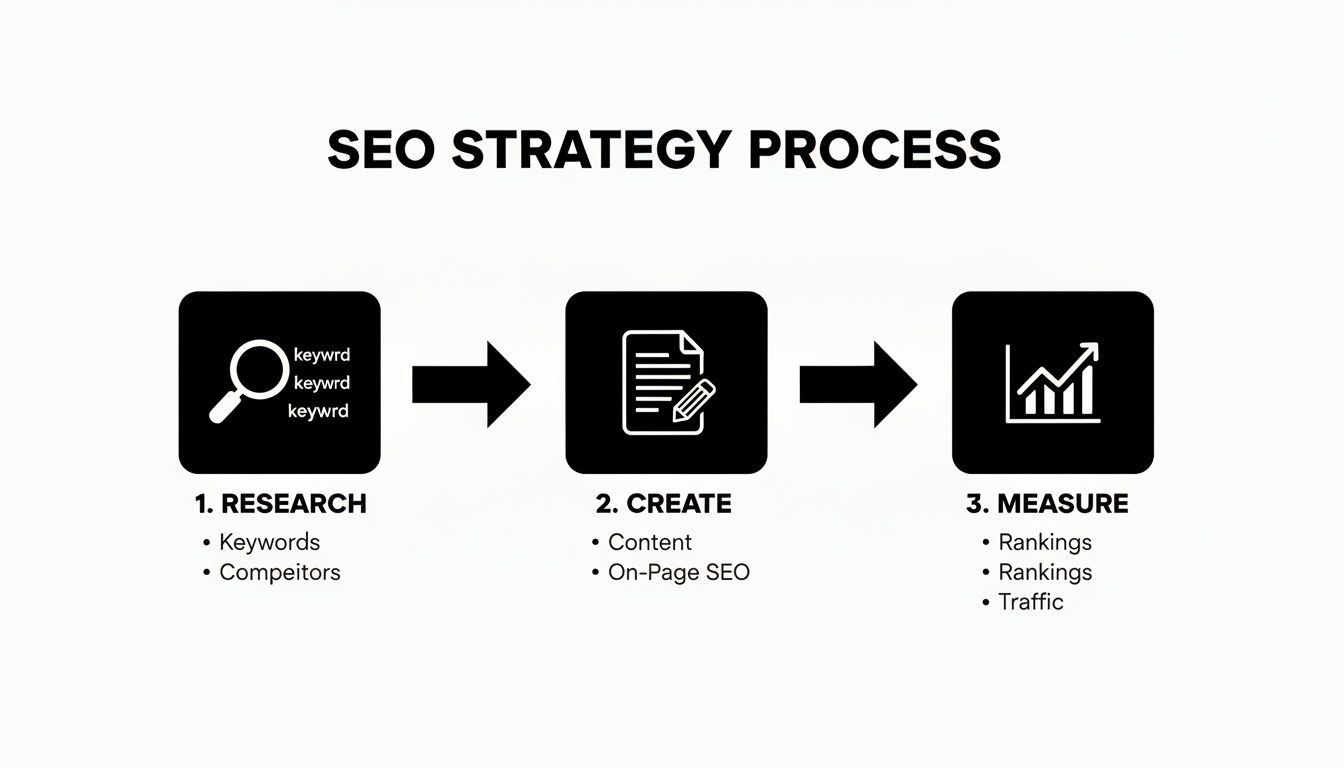
This shows that winning at SEO is all about a continuous cycle: research, create, measure, and repeat.
Find and Fill Content Gaps
Content gap analysis is how you find valuable keywords your competitors rank for, but you don't. It’s like scouting their playbook to find their unguarded routes. Once you spot these gaps, you can create hyper-targeted content to go after their traffic.
The process is surprisingly straightforward but incredibly powerful:
- Identify Top Competitors: List out 3-5 of your direct organic rivals.
- Use an SEO Tool: Pop your domain and a competitor’s into a tool like Ahrefs or Semrush.
- Run a Gap Analysis: Look for a "Content Gap" feature (or something similar) to get a list of keywords they rank for where you’re nowhere to be found.
- Prioritize Opportunities: Sift through the list for keywords with the right intent, solid search volume, and a difficulty level you can actually compete for.
This approach stops you from creating content in a vacuum and instead focuses your efforts on proven topics already driving traffic for others in your space.
Build Authority with Topic Clusters
A topic cluster is a brilliant way to structure your content. You start with a central "pillar" page covering a broad topic, then surround it with multiple "cluster" pages that dive deeper into related subtopics. Critically, all the cluster pages link back to the main pillar page.
This signals to Google that you have deep expertise on the entire subject. Think of the pillar page as the hub of a wheel and the cluster articles as the spokes. This interconnected web builds massive topical authority, making it easier for all your related content to rank higher.
The topic cluster model turns your blog from a random collection of articles into a structured, authoritative library. It tells search engines you’re not just a source—you’re the source.
This model isn't just a nice-to-have; it's a core piece of any modern SEO content strategy because it aligns perfectly with how search engines now reward expertise and comprehensive coverage.
Weave a Strategic Internal Linking Web
Internal linking is easily one of the most underrated—and powerful—tactics in SEO. Every link you place from one page on your site to another passes authority (or "link equity") and helps search engines map out the relationships between your content.
But a strategic approach is more than just dropping links wherever you can.
- Context is Everything: Links need to be on relevant anchor text that clearly tells users and crawlers what the destination page is about.
- Support Your Pillars: Make it a priority to link from your cluster pages back up to their corresponding pillar page.
- Guide the User Journey: Use internal links to logically move visitors through your site, from an informational blog post to a high-intent, conversion-focused page.
Done right, internal linking strengthens your site architecture, keeps users on your site longer, and helps new content get discovered and indexed much faster.
Strengthen Your E-E-A-T Signals
Google's quality guidelines are laser-focused on E-E-A-T, which stands for Experience, Expertise, Authoritativeness, and Trustworthiness. To have any chance of ranking for important topics, your content has to actively demonstrate these signals.
- Author Bios: Show off who's writing your content. Include detailed bios with credentials and links to social profiles.
- Cite Your Sources: Back up your claims by linking out to reputable, authoritative websites.
- Show, Don't Tell: Use first-hand accounts, case studies, and unique data to prove your experience.
- Keep it Fresh: Regularly update your content to ensure it stays factually accurate and current.
Strengthening E-E-A-T isn't a one-and-done task. It's an ongoing commitment to quality and transparency that builds trust with both your audience and the search engines.
Optimize Indexation Workflows
All that amazing content you created? It's completely worthless if Google doesn’t know it exists. An optimized indexation workflow ensures your new and updated pages are crawled and indexed as quickly as possible.
This is more critical than ever. The search landscape is shifting toward fewer, higher-quality clicks. One recent report noted that in March 2025, U.S. Google searches ending without a click hit 27.2%, while organic CTRs dropped to 40.3%. To win that shrinking pool of valuable traffic, your content has to be visible the moment it matters.
To speed things up, always keep your XML sitemap up-to-date and submitted to Google Search Console. You can also use APIs like IndexNow to push your new content directly to search engines the second you hit publish. This is a huge advantage for capitalizing on emerging SERP features opportunities before your competition even knows they exist.
Put Your Strategy into Overdrive with Sight AI

Putting the framework and tactics we've covered into practice takes a ton of time, effort, and expertise. This is where AI steps in—not just as another tool, but as a genuine force multiplier for your entire SEO content strategy. Platforms like Sight AI are built from the ground up to speed up every single stage of the process, from discovery all the way to publishing and measuring results.
Instead of getting bogged down in weeks of manual research, planning, and writing, you can automate the grunt work. This frees up your team to focus on what humans do best: making high-level strategic decisions and turning insights into action. It’s all about blending human creativity with the raw speed and scale of artificial intelligence to really compound your organic growth.
AI-Powered Discovery and Gap Identification
Every great strategy starts with a clear picture of the landscape. Sight AI keeps a close watch on how leading AI models like ChatGPT and Perplexity are talking about your brand, your competitors, and your key topics. This gives you a real-time pulse on your visibility right where modern audiences are turning for answers.
This isn't a manual process; the platform’s continuous monitoring automatically surfaces critical insights. It flags high-value content opportunities by showing you where competitors are ranking but you aren't. It also pinpoints the exact questions users are asking that your current content completely misses.
This goes way beyond just finding keywords. We’re talking about automated opportunity discovery. Sight AI’s system pinpoints the most impactful content gaps, so you can create content that directly serves a proven demand.
This automated gap identification crushes days of manual research into mere minutes, handing you a prioritized roadmap for your content calendar. You're no longer just guessing what to write next—you have a data-backed plan ready to go. And as you bring AI into your content workflow, it's smart to know how to detect AI content like a pro to keep your quality and authenticity in check.
Efficient Content Production at Scale
Let’s be honest: one of the biggest bottlenecks in any content strategy is the actual production. Consistently creating high-quality, long-form content is a massive undertaking. Sight AI tackles this head-on with specialized AI agents designed specifically for creating SEO content.
These agents handle the entire workflow, from conducting in-depth research and building outlines to drafting comprehensive articles between 2,500 and 4,500 words. Every piece is structured from the start with SEO best practices baked right in, including proper headings, smart internal linking suggestions, and optimized meta descriptions.
- Research & Outlining: AI agents pull information from top-ranking sources to construct a detailed, fact-based outline.
- Drafting & Writing: The system then writes a full article designed to be informative and engaging for your target audience.
- On-Page Optimization: All content comes with on-page SEO elements already integrated, saving you hours of manual tweaking.
This process dramatically shrinks the time it takes to get from a simple idea to a publish-ready draft. For a closer look, our guide on AI content for SEO explores how this powerful synergy works in more detail.
Seamless Publishing and Faster Indexing
Creating amazing content is only half the battle. If it doesn't get published and indexed quickly, it’s not driving results. Sight AI integrates directly with your CMS, letting you push finished articles to your site with a single click.
Even better, the platform automates the entire indexation workflow. As soon as your content goes live, Sight AI updates your sitemap and uses IndexNow to ping Google and Bing immediately. This direct line of communication gets your new pages discovered and indexed far faster than just waiting for crawlers to stumble upon them.
This accelerated process is crucial for jumping on timely topics and getting a leg up on the competition. By closing the loop from discovery to indexing, you build a smooth, efficient engine for sustainable organic growth. With features like Autopilot mode, teams can consistently publish high-quality content, turning visibility insights into real, measurable traffic day in and day out.
7. Measuring Success and Proving Content ROI
Creating content without measuring its impact is like flying a plane with no instruments—you might be moving, but you have no idea if you're headed in the right direction. An SEO content strategy is only as good as the results it delivers. To really justify the time and money you're pouring in, you have to look past flashy vanity metrics like page views and zero in on the Key Performance Indicators (KPIs) that actually move the needle for the business.
When you can prove your content's value, it stops being a "cost center" and becomes a predictable growth engine. The moment you can draw a straight line from a blog post to a new lead or a closed deal, you’re not just making content anymore; you’re building a revenue-generating asset. That’s how you get bigger budgets and earn real buy-in from leadership.
Moving Beyond Vanity Metrics
It's tempting to get excited about a traffic spike, but high page views don't always pay the bills. The real story is in the metrics that show people are engaged and taking action. Your mission is to track KPIs that prove your content is contributing to real, tangible growth.
Here are the core metrics that truly matter:
- Organic Traffic Growth: Is your overall organic traffic on a steady upward trend, month after month? This is the high-level pulse check that tells you things are working.
- Keyword Ranking Improvements: Are you climbing the SERPs for the keywords you care about? Tracking your rank shows your content is gaining authority and visibility where it counts.
- Conversion Rates: Of all the organic visitors landing on your content, what percentage is taking that next step? Whether it's signing up for a newsletter or booking a demo, this connects content directly to lead generation.
- Organic Lead Generation: How many new leads came straight from your content? This is a powerhouse metric for proving ROI.
- Customer Acquisition Cost (CAC) from Content: How much are you spending to get a new customer through your organic content? A low CAC from your content efforts is proof of incredible efficiency. For a complete breakdown, explore our guide on measuring content marketing ROI.
Setting Up Your Measurement Framework
To keep a close eye on these KPIs, you need a central hub to monitor performance. A well-organized dashboard gives you a clean, at-a-glance view of how your SEO content strategy is stacking up against your business goals.
Your two best friends here will be Google Analytics 4 (GA4) and Google Search Console.
- Google Analytics 4: Use GA4 to see what users are doing on your site, track organic traffic trends, and—most importantly—measure conversions. You'll want to set up custom events to track key actions like form submissions or free trial sign-ups.
- Google Search Console: This is your direct line of communication with Google. It's where you'll monitor keyword rankings, click-through rates (CTR), and impressions to see exactly how you're performing on the SERPs.
By pulling data from both platforms, you get the full picture of your content's performance. You can see which articles are bringing in the most traffic and which ones are turning that traffic into actual business leads.
The New Frontier of Measurement
Today, measurement goes beyond your own website. Your brand is being talked about and defined on AI platforms like ChatGPT and Perplexity. Keeping tabs on your visibility in these new channels is a critical, modern layer of ROI measurement.
Platforms like Sight AI provide unified dashboards that monitor your brand’s footprint across these AI models. You can track mentions, analyze sentiment, and see where you stand in AI-generated answers. This gives you a powerful new dimension for proving the full value of your SEO content strategy by showing how your content is shaping the conversation and influencing perceptions everywhere.
Here’s the rewritten section, designed to sound natural and human-written, following the provided style guide and examples.
Wrapping It Up: The Future of SEO Content Strategy
When it all comes down to it, a winning SEO content strategy isn't about who can churn out the most articles. The future belongs to those who are obsessed with quality, who meticulously answer what their audience is really asking, and who build undeniable expertise. We're moving away from just playing the keyword game and toward becoming a go-to, authoritative resource for a specific community. And that requires a real plan—one that’s documented, driven by data, and ready to adapt.
Now, while AI platforms like Sight AI are total game-changers, they don't replace the strategic mind behind the curtain. Think of them as a supercharger for your process. They automate the grunt work—the discovery, the production, the indexing—but the human element is what makes it all click. Your deep understanding of your audience, your strategic thinking, and your genuine creativity? Those are still the pillars holding everything up. AI just handles the heavy lifting so you can focus on what actually moves the needle.
A modern SEO content strategy is really a partnership between human insight and machine efficiency. The end goal is to build a sustainable engine for organic growth that people find genuinely valuable, time and time again.
So, what's next? Take a hard look at how you're doing things right now. Audit your workflow, pinpoint the gaps, and start plugging in the frameworks and plays we've talked about. This is how you stop throwing content at the wall to see what sticks and start building a deliberate, measurable system that brings in predictable results and cements your visibility for the long haul.
FAQ
Even the best-laid plans run into questions. When you're rolling out a new SEO content strategy, it's natural for things to pop up. Here are some of the most common ones we hear.
How Often Should I Update My SEO Content Strategy?
Think of your SEO content strategy less like a stone tablet and more like a living, breathing plan. It needs regular check-ups to stay healthy. A solid rule of thumb is to give it a major review every 6 to 12 months.
But don't wait that long to check in. You should be looking at your performance metrics far more often—monthly is ideal. These quick check-ins let you make small, smart adjustments based on what the data is telling you, rather than waiting for a big overhaul.
You'll also want to be ready to revisit the whole strategy when something big happens, like:
- A major Google algorithm update shakes things up.
- Your business goals or product lineup changes direction.
- New competitors suddenly appear on the scene.
Content Strategy vs. SEO Content Strategy
People often use these terms as if they mean the same thing, but there’s a crucial difference.
A content strategy is the big picture. It’s your master plan for all content, everywhere—social media, email newsletters, paid ads, you name it. Its main job is to support your overall brand and marketing goals.
An SEO content strategy is a specialized slice of that bigger plan. Its one and only focus is to create content built specifically to attract, engage, and convert an audience coming from organic search. Every single decision, from the topics you choose to the H2s you write, is made with search engine visibility as the top priority.
How Long Until I See SEO Results?
Patience is everything in SEO. It's not like flipping a switch on a paid ad and watching the traffic roll in. An SEO content strategy is a long-term investment, and it takes time for search engines to find your content, understand its value, and grant it authority.
Generally, you can expect to see the first positive signs—like more impressions and small bumps in rankings—within 3 to 6 months. But for the significant, traffic-driving results you're really after, you should be thinking in terms of 6 to 12 months of consistent, quality work. This timeline can change based on how competitive your industry is, your website's current authority, and how well you execute the plan.
Can I Create a Strategy Without Expensive Tools?
Absolutely. While the premium SEO tools are fantastic for data and can definitely speed things up, you can build a very solid strategy using free and low-cost resources.
The most important part of any strategy is the thinking and planning behind it, not the software you use. A well-researched plan executed with free tools will always outperform a poor plan that uses expensive ones.
You can get an incredible amount of work done with free powerhouses like Google Search Console, Google Analytics, and Google Keyword Planner. These tools alone give you critical insights into your audience, keyword performance, and what people are actually searching for—everything you need to get started.
Ready to put your strategy into overdrive? Sight AI accelerates every step, from AI-powered discovery and automated gap identification to producing SEO-optimized articles at scale. Turn insights into measurable organic growth today.