So, what exactly is SEO rank tracking? In simple terms, it's the process of watching where your website shows up on search engine results pages (SERPs) for the keywords that matter most to your business.
Think of it as the GPS for your entire SEO strategy. It tells you exactly where you are, where you're headed, and how quickly you're making progress.
Understanding SEO Rank Tracking and Why It Matters

Imagine you're the captain of a ship sailing across a vast ocean. You could have the best crew and the fastest sails, but without a compass or a map, you’re just sailing blind, hoping you eventually bump into your destination. That’s precisely what you're doing with your marketing if you skip rank tracking—pouring time and money into content and optimization without knowing if any of it is actually working.
Rank tracking is the fundamental feedback loop for your strategy. It’s how you get answers to the big questions: Is our content actually connecting with our audience? Are we finally gaining ground on our competitors? Where are our biggest growth opportunities hiding? It takes fuzzy goals like "improving our online presence" and turns them into hard, measurable data points.
The Real Value Beyond Just Numbers
At its heart, rank tracking brings clarity and direction to your efforts. It’s not just about popping the champagne when you hit the #1 spot. It’s about understanding the entire journey to get there and the real-world impact that journey has on your business.
By keeping a close eye on your keyword positions, you can:
- Measure SEO Progress: See tangible results from your content updates, link-building campaigns, and technical fixes.
- Spot Hidden Opportunities: Find keywords hovering on the edge of page one that just need a little nudge to start bringing in serious traffic.
- Keep Tabs on Competitors: See who’s climbing the ranks for your most valuable terms and figure out what they’re doing right.
- Actually Demonstrate ROI: Show stakeholders clear, data-backed reports that prove your SEO efforts are worth the investment.
A consistent rank tracking strategy is what separates guessing from a repeatable, scalable process. It gives you the confidence to make informed decisions, put your resources where they’ll have the most impact, and pivot when the data tells you something isn’t working.
Adapting in an Ever-Changing Search World
Let's be real—search engine algorithms are constantly in flux. Historical rank tracking is your secret weapon for understanding how major updates affect you. For example, when you see a sudden, sharp drop in your rankings, it often lines up perfectly with a Google core algorithm update.
We saw this happen in mid-2022 when an update caused an average 15-20% drop in visibility for sites with thin content. By digging into their historical SERP data, teams could see which pages won and lost, adapt their content strategy accordingly, and win back a huge chunk of that lost traffic within just a few months. You can learn more about how historical data can inform your strategy over at seranking.com.
Ultimately, tracking isn't a boring chore you have to do. It’s an active, indispensable tool that connects your keyword performance to what really matters: more traffic, better leads, and increased revenue.
Decoding the Metrics That Actually Drive Results
Real SEO rank tracking is so much more than just looking at a list of keyword positions. Sure, it feels good to see you’re ranking #5 for a target term, but that number is only one piece of a much bigger, more interesting puzzle. To really get a handle on your performance, you have to look at the metrics that tell the complete story of your digital footprint.
Think of it like flying a plane. Your altitude (SERP position) is obviously important, but you wouldn't fly without also checking your fuel levels (visibility) and making sure you’re on the right flight path (share of voice). Let’s break down the metrics that actually matter.
The Foundation: SERP Position
Let's start with the basics. Your SERP Position is just the numerical rank your website holds on a search engine results page for a specific keyword. It’s the ground floor of all SEO analysis, giving you a quick read on whether your efforts are pushing you up or down the ladder.
But a raw position number can be a real vanity metric if you don't add context. Hitting #1 for a keyword that gets 10 searches a month isn’t going to move the needle. On the other hand, jumping from position #12 to #7 for a keyword with huge search volume can open up a massive new channel of traffic.
Beyond Position: Visibility Score
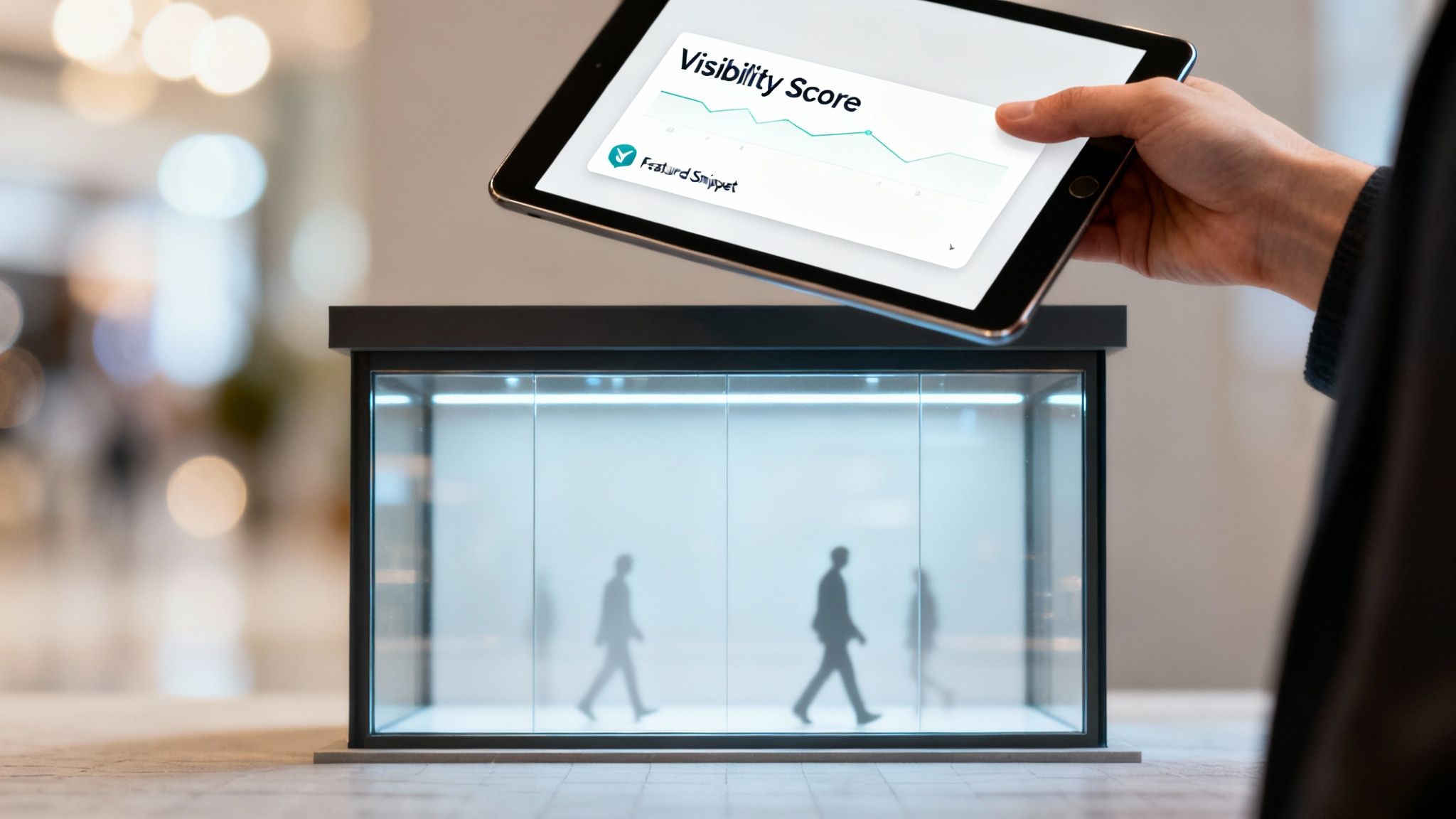
This is where things start to get insightful. A Visibility Score is a broader metric that calculates how often your site shows up across your entire list of tracked keywords. This score is usually weighted by search volume, meaning your high-traffic keywords have a bigger impact on the final number.
Picture your website as a physical store in a huge shopping mall.
- SERP Position: This is your store's exact spot—say, first floor, next to the food court.
- Visibility Score: This represents the total amount of foot traffic that walks past your storefront all day.
A rising visibility score is a fantastic sign that your overall strategy is paying off, even if some individual keyword rankings bounce around from day to day.
Gauging Your Market Impact: Share of Voice
If visibility tells you how many people are walking past your store, Share of Voice (SoV) tells you how that compares to the competition. It measures your visibility as a percentage of the total available visibility for all the competitors you’re tracking.
Share of Voice is the ultimate competitive benchmark. It answers the one question every marketer has: "How much of the digital shelf space do we actually own for the terms our customers are searching for?"
For instance, a 25% Share of Voice means your brand is capturing one out of every four potential impressions for your target keywords. Your competitors are grabbing the other 75%. Tracking SoV over time shows you whether you're gaining or losing ground in your market—an insight that’s pure strategic gold. Understanding the key website metrics to track is how you connect these SEO efforts to actual business growth.
Metrics That Drive Clicks and Conversions
Modern search results are way more than just ten blue links. Winning in SEO today means grabbing attention with special results, or SERP features. Tracking these gives you a much richer view of your true performance.
- Featured Snippets: Often called "position zero," these are the answer boxes that sit right at the top of the page. Owning a snippet can steal a huge number of clicks, even if a competitor technically ranks #1 in the traditional results right below it.
- Local Pack: For any business with a physical address, showing up in the "map pack" is non-negotiable. This block of three local businesses gets the lion's share of engagement for local searches.
- Image & Video Packs: If your content is highly visual—think e-commerce, travel, or DIY projects—ranking in these carousels can unlock traffic opportunities you might be completely missing otherwise.
When you start monitoring these advanced metrics, your rank tracking transforms from a simple report card into a powerful diagnostic tool. You can see exactly where you're winning, where you're falling behind, and where your next big opportunity is waiting.
How Rank Tracking Tools Collect and Analyze Data
Ever peek behind the curtain of your favorite SEO rank tracking tool and wonder how it all works? It’s not smoke and mirrors. It's a surprisingly clever process of data collection designed to give you a clean, unbiased look at where you actually stand on Google.
At its core, a rank tracker acts like a neutral observer. It systematically checks the search engine results pages (SERPs) for your target keywords to see precisely where your website shows up. This is all done automatically, turning a chaotic flood of constantly changing search results into the straightforward reports you rely on.
This whole operation is powered by two main methods: SERP scraping and official APIs. Each has its own way of getting the job done, and understanding the difference helps you trust the data you're seeing.
SERP Scraping: The Digital Detective
Think of SERP scraping as sending out a small army of bots to do your recon work. These bots visit Google, type in a keyword, and then "photograph" the entire results page—every organic link, every ad, every special feature. They do this from specific locations and on different devices to mimic how a real person in your target audience would search.
This approach is fantastic for getting a rich, complete picture of the SERP. It captures not just the #1 spot but also things like Featured Snippets, "People Also Ask" boxes, and Image Packs. It’s the closest you can get to seeing what your customers see. The only catch is that search engines are always tweaking their layouts, which can sometimes throw the scrapers for a loop until they adapt.
Using APIs: The Direct Feed
The other method is using an Application Programming Interface (API). If scraping is like taking a photo of a store shelf, an API is like plugging directly into the store’s inventory system. The tool simply asks the search engine, "Where does this website rank for this keyword?" and gets a neat, structured answer back.
APIs tend to be incredibly fast and reliable because they're an official, supported channel. However, they don't always provide the same visual, in-depth context as scraping. An API might tell you you’re in the top 100, but it won’t show you the rich snippets or other SERP features surrounding your result. This is why many of the best SERP tracking tools use a hybrid model, blending the reliability of APIs with the detailed insights from scraping.
The most critical job of any rank tracking tool is to strip away all the personalization that colors your own search results. Your search history, location, and device all create a bias. These tools give you a neutral baseline to measure your true performance.
Why Data Segmentation Is Crucial
Just getting the raw data is only step one. The real magic happens when you start slicing it up to see the full story. A simple ranking number is useful, but its value skyrockets when you segment it to reflect how different groups of customers actually find you.
Here are the segments that truly matter:
- Tracking Frequency (Daily vs. Weekly): In a fast-moving industry or right after a big campaign launch, daily tracking is a must-have. For more stable markets, weekly check-ins are usually enough to spot trends without getting lost in minor day-to-day blips.
- Device Type (Desktop vs. Mobile): With well over 60% of searches now happening on mobile, your rankings can look completely different from one device to the next. Tracking both isn't just a good idea—it's non-negotiable.
- Geographic Location: You could be ranking #3 in New York City but be completely invisible on page three in Los Angeles. For any local business or national brand with regional targets, geo-specific tracking is absolutely essential.
When you break down your data this way, you stop looking at a simple list of numbers and start uncovering genuine strategic insights. As you look at different rank trackers, you'll find that specialized platforms like the Rank IQ SEO Tool also rely on these fundamental data principles to power their analysis and deliver actionable advice.
Building Your SEO Rank Tracking Strategy
Turning SEO theory into real, tangible results starts with a solid strategy. A smart rank tracking plan isn't about watching every keyword under the sun. It's about strategically picking the terms that actually matter to your business goals and then learning to read the story the data is telling you. This is how you turn a passive report into an active roadmap for growth.
The first step? Get over the obsession with simple search volume. Sure, volume is a piece of the puzzle, but the real gold is in user intent and commercial value. A keyword with 10,000 monthly searches might look tempting, but if it never leads to a sale, it’s just vanity. On the flip side, a long-tail keyword with just 100 searches could be incredibly profitable if it catches users who are pulling out their credit cards.
Selecting and Grouping Your Keywords
To build a keyword list that actually works for you, start by sorting your terms into logical groups or clusters. This approach helps you spot the bigger trends and measure how you're doing at different points in the customer's journey. Think of it like organizing a grocery store—you don't just dump everything in a pile. You group items into aisles like "Dairy," "Produce," and "Bakery" so it's easy for shoppers (and you) to find exactly what they need.
Try creating keyword groups based on:
- User Intent: Are people looking for information ("how to fix a leaky faucet"), trying to find a specific website ("Sight AI blog"), or are they ready to buy something ("buy waterproof hiking boots")?
- Product or Service Line: Lump together all the keywords related to a specific thing you sell. For an online store, that could mean separate clusters for "running shoes," "hiking gear," and "athletic apparel."
- Funnel Stage: Keep your top-of-funnel (awareness), middle-of-funnel (consideration), and bottom-of-funnel (conversion) keywords in separate buckets.
This diagram shows how tracking tools pull in raw search data, either through direct API feeds or by scraping the SERPs themselves, before processing it.
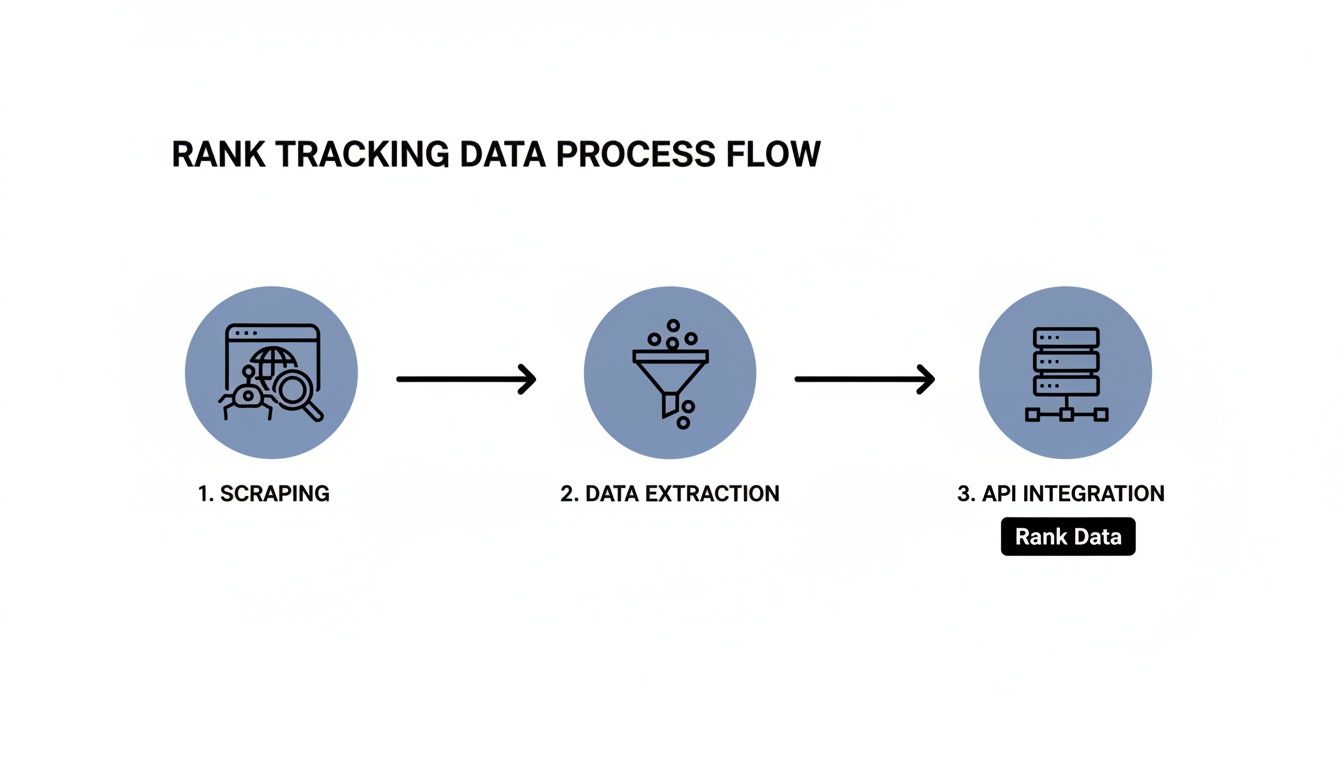
Getting a handle on this flow is important because it shows how the right tool setup gives you the clean, segmented data you need to actually execute your strategy.
Configuring Your Tools and Setting Baselines
Once your keywords are nicely organized, it’s time to set up your tracking tool. Don’t just throw your entire list into the software and hope for the best. Instead, use the groups you just created to set up tags or categories. This lets you filter your dashboard and run reports that show you performance for specific parts of your business, making your analysis way more focused and useful.
Now for a crucial step that people often skip: setting a performance baseline. Before you can track progress, you need a starting line. This means you need to record your initial rankings, visibility score, and share of voice for each keyword group the day you start tracking. This first snapshot is your benchmark. Every report from here on out will be compared against it, giving you a crystal-clear picture of your growth.
A baseline turns your SEO rank tracking from a simple monitoring task into a true measurement of ROI. It's the reference point that proves your content updates, technical fixes, and link-building efforts are actually moving the needle.
Baking in Competitive Analysis
Your performance doesn't happen in a bubble. A huge part of any serious rank tracking strategy is keeping a close eye on what your competitors are doing. Add your top 3-5 rivals into your tracking tool so you can monitor their moves on your most important keyword clusters.
This kind of proactive monitoring helps you answer some critical questions. Did a competitor just leapfrog you for a high-value term? Did they launch a new content hub that’s now hogging the SERPs? By making this a part of your regular check-ins, you can react to threats quickly and even learn from what’s working for them. To go even deeper, check out our complete guide on how to perform a thorough SEO competitor analysis.
Integrating AI and Automation into Your Workflow
Let's be honest: manual SEO rank tracking is a dead end. As you scale, trying to keep up with keyword positions, competitor moves, and endless reporting is a surefire path to burnout. You'll miss opportunities, and your data will be stale before you can even act on it. This is precisely where automation and AI change the game, turning a reactive chore into a proactive growth engine.
The game has changed, too. Modern platforms aren't just looking at the classic blue links anymore. They're built to track your visibility in a world where answers come from AI models like Google's SGE and Perplexity. A high rank on Google doesn't automatically mean you'll even get a mention in an AI-generated response. It's a critical shift.
By bringing in automation, you're essentially hiring a tireless digital assistant who works 24/7, eliminating the tedious tasks that eat up your day and are prone to human error.
The Practical Benefits of Automation
Automating your SEO rank tracking isn't just about efficiency; it delivers real, tangible advantages almost immediately. It’s about letting the machines handle the heavy lifting so you can focus on the big-picture strategy.
The main wins are pretty clear:
- Eliminating Manual Data Entry: Automation tools can pull ranking data, competitor positions, and visibility scores directly into your dashboards, saving you countless hours.
- Preventing Human Error: An automated system never has a bad day. It doesn't make typos or forget to check a keyword, ensuring your data is clean and reliable enough for major decisions.
- Uncovering Hidden Insights: AI algorithms are brilliant at sifting through mountains of data to spot trends and connections a human would miss, like pinpointing exactly which content update caused a jump in rankings.
Creating a Single Source of Truth
The real magic happens when you integrate rank tracking data with the other tools in your marketing stack. By connecting your SEO platform to your CRM, analytics dashboard, or BI software, you create one unified view of performance. This finally closes the loop between your SEO efforts and actual business outcomes.
Imagine setting up a workflow that automatically pings your sales team on Slack whenever a high-intent, bottom-of-funnel keyword breaks into the top three. They can instantly prep for an expected surge in qualified leads, directly tying an SEO win to a business action. Our guide on how to integrate AI into your SEO workflow dives deeper into setting up these powerful connections.
By automating your data pipelines, you transform isolated SEO metrics into a shared business intelligence resource. This allows your entire organization to see how organic search performance directly influences leads, sales, and revenue.
Ultimately, integrating AI and automation isn't just about getting work done faster—it's about survival. In a search environment that changes by the week, the businesses that thrive will be the ones that use technology to gain an edge, make smarter decisions, and scale their efforts effectively. Automation is the foundation for that success.
Troubleshooting Common Rank Tracking Problems
Even the most buttoned-up SEO process hits a little turbulence now and then. Seeing your rankings jump around or finding weird data discrepancies can be maddening, but it’s rarely a reason to hit the panic button. More often than not, these are chances to learn and sharpen your strategy, if you know how to read the signs.
Think of yourself as a detective on a case. A sudden drop in rankings isn’t a dead end; it's a clue. Your job is to sift through the evidence—recent site changes, what your competitors are up to, and whispers of algorithm updates—to figure out what really happened. This methodical approach is how you turn confusing data points into smart, actionable insights.
Identifying the Source of Fluctuations
When your rankings suddenly tank—or shoot to the moon—it’s easy to either assume the worst or pop the champagne too early. The real cause is usually less dramatic. Before you do anything else, start asking the right questions.
- Was there a recent Google algorithm update? Major core updates are known to shake up the SERPs in a big way. Check the usual SEO news outlets or tracker tools to see if there’s widespread chatter about volatility.
- Did we change anything on the page recently? A seemingly small tweak to a title tag, URL, or even an internal link can have an outsized impact on rankings.
- Did a competitor just make a big move? Maybe a rival launched a massive content blitz or landed some monster backlinks, nudging you down a few spots.
Sometimes, a "rank drop" isn't really a rank drop at all—it’s an indexing problem. Your page might have been accidentally de-indexed, or maybe a brand new article is just having trouble getting noticed by the search crawlers. For a deeper dive on this, check out our guide on how to speed up content indexing to get things moving.
Solving Data Discrepancies
One of the most common headaches for any SEO is seeing one thing in your rank tracking tool and something completely different when you search in your own browser. You might look up a keyword and see your site sitting pretty at #3, but your software says you're at #9. This isn't a bug; it’s just how modern search works.
Your personal search results are a bubble, biased by your location, your search history, and the device in your hand. Your rank tracking tool gives you the objective, depersonalized view from a specific location—and that’s the only data you can reliably use to make strategic decisions.
When the data looks off, always trust your tool’s unbiased measurement over your own personalized results. If you’re running into issues with location-based tracking, make sure your tool is configured to monitor the specific cities or countries that actually matter to your business. This focused approach is what gives you the accurate data you need to make confident decisions.
Frequently Asked Questions About SEO Rank Tracking
Navigating SEO rank tracking often brings up some specific, nitty-gritty questions. Whether you're just getting started or fine-tuning your current strategy, getting clear answers is what helps you make decisions with confidence. This section cuts through the noise and tackles the most common queries we hear.
Think of it as a quick cheat sheet to help you sidestep common roadblocks and really squeeze the value out of your tracking efforts. Let's get into the specifics.
How Often Should I Check My SEO Rankings?
For most businesses, weekly tracking is the sweet spot. This rhythm lets you spot meaningful trends and see the real impact of your SEO work without getting whiplash from the minor, daily fluctuations that are just part of the search game.
Of course, there are exceptions. If you're dealing with high-stakes keywords—say, during a big product launch or in a brutally competitive niche—then bumping up to daily tracking is a must. It gives you the agility to react almost instantly to a competitor's move or a sudden algorithm shuffle that could tank your visibility.
Why Do My Rankings Look Different Than What My Tool Shows?
This is probably the most common point of confusion we see, and the short answer is personalization. When you search from your own computer, Google is quietly tailoring the results just for you based on your location, your past search history, and even the device you’re on.
Your SEO rank tracking tool, on the other hand, gives you an objective, depersonalized view. It runs its searches from a neutral browser in a specific data center. This unbiased data is the only reliable way to make strategic decisions because it shows you what a typical user sees, not just what you see.
Can I Track My SEO Rankings for Free?
Sure, you can manually check your rankings in an incognito browser, but it's incredibly inefficient, unreliable, and just falls apart if you're tracking more than a couple of keywords. It’s a bit like trying to count a mall’s foot traffic with a handheld clicker—you’re going to miss the vast majority of the picture.
There are free tools out there, but they’re almost always severely limited in how many keywords you can track or the features they provide. For any serious SEO campaign, a professional rank tracking tool isn't a luxury; it's a necessary investment for gathering accurate, actionable data over time.
What Is the Difference Between SEO Rank and AI Visibility?
This is a critical distinction in the search world we live in today. It's a tale of two different, but equally important, metrics.
- Traditional SEO Rank Tracking is what we've been talking about. It measures your website's exact numerical spot on a classic search engine results page (SERP) from Google or Bing.
- AI Visibility, however, is a newer game. It measures if and how your brand, products, or content get cited or mentioned inside the answers generated by AI models like ChatGPT or Google's SGE.
A high rank on Google doesn't automatically mean your brand will show up in an AI-generated answer. That's why it's becoming vital to track both to get a complete picture of your true online footprint.
Ready to stop guessing and start seeing your true visibility across both traditional search and modern AI answers? Sight AI provides a unified dashboard to monitor your brand mentions, track competitor strategies, and turn those insights into high-ranking content. Discover your AI visibility today.