
Let's be honest, talking about content marketing return on investment (ROI) can feel a little... abstract. But figuring it out is the key to proving that your content isn't just a "nice-to-have" expense. It’s a measurable appreciating asset that fuels real, sustainable growth.
What Is Content Marketing ROI and Why It Matters

Here’s a simple way to think about it: your marketing budget gives you a choice between renting an apartment and buying a house. Paid ads are like renting. The second you stop paying, your presence vanishes. Poof.
Content marketing, on the other hand, is like buying a home. It’s a serious upfront investment, sure, but it builds equity over time. Every article, video, or guide you create is a digital asset that can grow in value, pulling in traffic, leads, and sales for months—sometimes years—after you hit publish.
Nailing your content marketing return on investment is what transforms your marketing from a cost center into a predictable revenue engine. For SEO managers, it’s the proof that their strategy is working. For founders, it’s the confidence to keep investing in long-term growth. And for agencies, it's the ultimate validation of their value.
The Core Components of ROI
Calculating content ROI really comes down to two sides of an equation: what you put in (your investment) and what you get out (your return). But getting it right means you have to look beyond the obvious line items.
Your investment isn't just what you paid a writer. It’s the total cost of bringing that content to life.
- Creation Costs: This includes fees for your writers, designers, video editors—anyone who touches the creative.
- Tool & Software Subscriptions: Think SEO platforms, analytics dashboards, and project management software.
- Team Time: The salaries of your team members who plan, edit, and manage the content pipeline.
- Promotional Spend: Any budget you put behind distributing content through ads or social channels.
And your return? It’s so much more than just direct sales. The return is the total value your content generates, which can be both tangible and intangible. Tangible returns are easy to spot: new leads, direct sales, and customer sign-ups.
But the intangible benefits—like building brand trust and authority—are just as critical. We dive deeper into this in our guide on why brand awareness is important.
By meticulously tracking both inputs and outputs, you can paint a clear picture of your content's financial impact. This isn't just about justifying past efforts; it's about making smarter, data-driven decisions for future growth.
Without a solid grip on these numbers, you’re basically marketing in the dark. You could be pouring money into channels that aren't performing while completely overlooking the assets that could be driving exponential growth. This guide will give you the framework to light the way, making sure every dollar you spend on content is a true investment in your company's future.
How to Calculate Your Content Marketing ROI
Figuring out your content marketing return on investment isn't as complicated as it sounds. You don’t need a finance degree, but you do need to be crystal clear on what you're actually measuring. We can start with the classic formula that gets right to the heart of it.
The Classic ROI Formula:
(Return - Investment) / Investment x 100 = Content Marketing ROI %
This simple equation gives you a percentage that tells you how much value you got back for every dollar you put in. A positive ROI means you're in the green. A negative one? It’s a sign that your costs are higher than your returns.
But here's the catch: the real work is in defining what "Return" and "Investment" actually mean for your business.
Unpacking Your Total Content Investment
Your investment isn't just the invoice you paid a freelancer. It's the total cost of bringing your content to life and getting it in front of people. To get a true number, you have to look at both the obvious and the hidden expenses.
- Content Creation Costs: This is the easy part. It’s what you pay your writers, designers, video editors, and any other creatives who had a hand in the project.
- Tools and Software: Don't overlook the monthly or annual subscriptions for your tech stack. Think SEO platforms like Ahrefs or Semrush, analytics software, project management tools, and your CMS.
- Team Time and Salaries: This is often the biggest hidden cost. You need to calculate the hourly cost of your in-house team members involved in strategy, editing, management, and promotion.
- Paid Promotion Budget: Any cash you spend advertising your content—social media ads, search ads, sponsored posts—is a direct investment that needs to be counted.
Add all of this up, and you get a real, comprehensive picture of your total investment. Accuracy here is everything if you want a meaningful ROI calculation. To get more granular on what numbers to watch, take a look at our guide on the key website metrics you should be tracking.
Assigning a Monetary Value to Your Return
Now for the fun part: the "Return." This isn't just about the final sale. It's about the total financial value your content generates along the way, which often means putting a dollar value on actions like a qualified lead.
First, you have to track the specific conversions that come from your content. This could be someone downloading an ebook, signing up for a webinar, or booking a demo right after reading one of your blog posts.
Next, you need to figure out what a lead is actually worth. A really effective way to do this is by using your average lead-to-customer conversion rate and your average customer lifetime value (LTV).
Key Metrics for Measuring Content Returns
To truly grasp the "Return" on your investment, you need to look beyond surface-level numbers. The following table breaks down the essential metrics that connect your content efforts to tangible business outcomes.
| Metric | What It Measures | How to Calculate or Track | Business Impact |
|---|---|---|---|
| Leads Generated | The number of potential customers your content attracts. | Track form submissions, demo requests, or free trial sign-ups originating from content pages. | Direct pipeline growth; fills the top of the sales funnel. |
| Lead Quality | The percentage of leads that meet your ideal customer profile (ICP). | Use lead scoring in your CRM; track how many MQLs or SQLs come from content. | Higher conversion rates and more efficient sales cycles. |
| Conversion Rate | The percentage of visitors who take a desired action (e.g., sign up, download). | (Conversions / Total Visitors) x 100 | Shows how persuasive and effective your content is at driving action. |
| Customer Lifetime Value (LTV) | The total revenue a single customer is expected to generate over time. | (Average Purchase Value) x (Average Purchase Frequency) x (Average Customer Lifespan) | Connects content-driven acquisitions to long-term profitability. |
| Sales Revenue | The direct revenue attributed to content marketing efforts. | Use attribution models in analytics (e.g., first-touch, last-touch) to link sales to content. | The ultimate bottom-line impact of your content strategy. |
By tracking these metrics, you can move from vague assumptions to a data-backed understanding of how your content is fueling business growth.
Example: Valuing a Lead
Let's put this into practice. Imagine your average customer LTV is $2,000 and your lead-to-customer conversion rate is 10%.
- Value of a Lead = LTV x Conversion Rate
- Value of a Lead = $2,000 x 0.10 = $200
Just like that, every qualified lead your content brings in can be valued at $200. This method beautifully connects your top-of-funnel blog posts and guides directly to bottom-line revenue.
This is especially powerful in the B2B world, where content marketing consistently delivers an average 3:1 ROI. That's a 67% advantage over the typical returns from paid ads. You can dig into more benchmarks like this in this in-depth analysis of content marketing stats.
Choosing the Right ROI Attribution Model
Calculating your content marketing return on investment with a basic formula is a decent starting point, but it rarely tells the full story. A single blog post might not lead directly to a sale, but it could be the crucial first touch in a customer journey that unfolds over weeks or even months. To really get a handle on content's impact, you have to look beyond the final click.
Think of your content as a soccer team. The striker gets the glory for scoring the goal, but what about the defender who started the play or the midfielder who made the perfect pass? Giving all the credit to the striker—the last click—completely ignores the teamwork that made the goal possible.
That’s the fundamental problem with last-click attribution. It gives 100% of the credit for a sale to the very last thing a customer interacted with. It's simple, sure, but it's also dangerously misleading. This model consistently undervalues the top- and middle-of-funnel content that introduces your brand and nurtures leads, which can trick you into cutting the budget for the very assets filling your pipeline.
This decision tree gives you a simple flow for getting started with content ROI, from pulling your data together to applying the right formulas and tracking what matters.
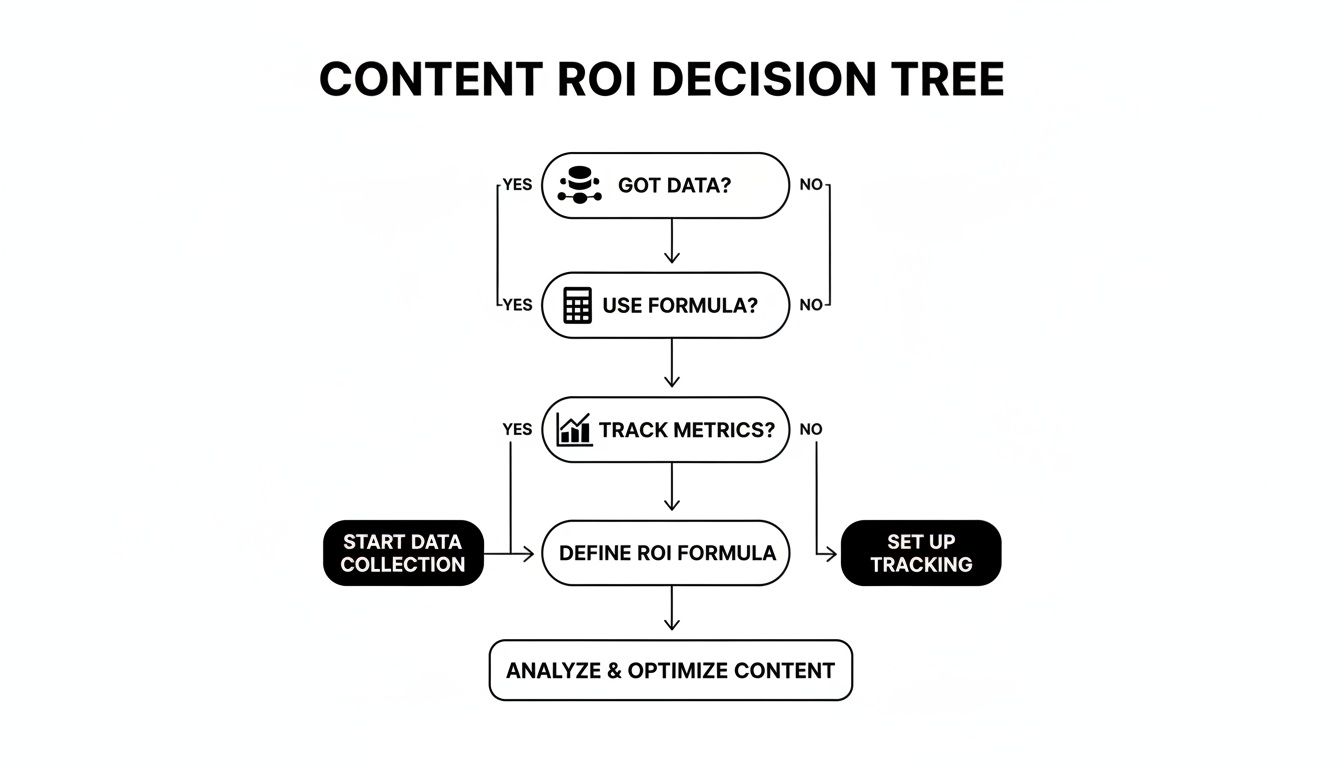
As the chart shows, before you can even think about attribution models, you need to have solid data tracking in place. Garbage in, garbage out.
Exploring Multi-Touch Attribution Models
To get a more honest picture, savvy businesses are moving to multi-touch attribution models. These models work on the premise that multiple pieces of content influence the path to purchase, and they distribute credit across those different touchpoints. Each model splits the credit differently, giving you a unique lens to view your content's performance.
Here are the most common multi-touch models you'll encounter:
- Linear Attribution: This is the simplest of the multi-touch models. It just splits the credit equally among every single touchpoint. If a customer read a blog post, downloaded an ebook, and then clicked an ad before buying, each of those three interactions gets 33.3% of the credit. It’s fair, but it also assumes every touchpoint is equally important.
- Time-Decay Attribution: This model gives more credit to the interactions that happened closer to the sale. The ad they clicked yesterday gets more weight than the blog post they read two months ago. It’s great for shorter sales cycles where momentum is everything, but it can still downplay the value of that initial, awareness-building content.
- U-Shaped (Position-Based) Attribution: This model highlights the importance of the very first and very last touch. It usually gives 40% of the credit to the first interaction (what got them in the door) and 40% to the final touchpoint before the sale. The remaining 20% is spread evenly across all the interactions in between.
Choosing the right attribution model isn’t about finding one "perfect" answer. It's about aligning your measurement strategy with your business goals and how your customers actually buy from you.
Selecting the Best Model for Your Business
So, which one should you pick? It really depends on your typical sales cycle and marketing strategy. There's no single right answer, but this guide can help point you in the right direction.
When to Use Each Model
| Attribution Model | Best For... | Why It Works |
|---|---|---|
| Last-Click | Very short, transactional sales cycles with few touchpoints. | It's simple to set up and works well enough when the customer journey is quick and direct. |
| Linear | Businesses with longer sales cycles that want to value every interaction. | It ensures that all the nurturing content in the middle of the funnel gets the credit it deserves. |
| Time-Decay | Promotional campaigns or B2B businesses with shorter sales cycles (e.g., 30-60 days). | It puts the emphasis on the final interactions that tipped a lead over the edge. |
| U-Shaped | Companies focused on lead generation where the first touch and the final conversion are both critical. | It highlights both what brings new prospects into your orbit and what ultimately convinces them to convert. |
Ultimately, just moving from a single-touch to any multi-touch model is a huge leap forward in accurately measuring your content marketing return on investment. It lets you see the whole playing field, making sure every piece of content—from the first blog post to the final case study—is recognized for the role it played in driving revenue.
Measuring ROI from SEO and AI Content Strategies
Figuring out the ROI for your content has always been a bit of a puzzle. Throw SEO and AI into the mix, and the board changes completely. Suddenly, you have new variables, new complexities, and frankly, some massive opportunities to work smarter, not harder. The fundamental goal, however, hasn't changed: you still need to draw a straight line from abstract wins like organic traffic and keyword rankings to actual, hard revenue.
The path a customer takes from discovering your brand to making a purchase is anything but linear these days. They might find you through a top-ranking blog post, see your name cited by an AI chatbot, or click on a featured snippet. The real trick is tracing these first touchpoints—often powered by a solid SEO foundation—all the way to the final sale. This isn't possible without a robust analytics setup that captures the whole journey, not just the last click.
Think about it: someone lands on your blog from a Google search, browses for a bit, then leaves. Weeks later, they come back directly to your site and buy something. Without multi-touch attribution, the value of that initial SEO-driven visit gets completely lost. To see the full picture, you have to connect the dots between your traffic data in Google Search Console and your customer data in your CRM.
How AI Changes the Investment Side of the Equation
The biggest way AI flips the ROI calculation on its head is by shrinking the 'Investment' part of the formula. For years, content production was the biggest bottleneck and a huge expense. It meant countless human hours spent on research, writing, editing, and optimization.
AI-driven content platforms completely change that game.
- Slashed Production Costs: AI does the heavy lifting, automating the creation of long-form, SEO-ready articles. This drastically cuts down the direct costs of writers and editors. In fact, one study showed AI can boost team productivity by a staggering 40%, freeing up your team for more strategic work.
- Insane Content Velocity: Instead of trickling out a few articles a month, your team can start publishing consistently every day or week. This accelerates how quickly you build topical authority and start capturing those valuable keyword rankings.
- Faster Path to Profit: More content, produced faster, means you start compounding organic traffic growth much sooner. This shortens the timeline to seeing a positive ROI, getting your content engine into the black faster than ever before.
By automating content creation, you can scale your output without scaling your team. That’s a direct and powerful boost to your final content marketing return on investment.
This dashboard from Sight AI, for instance, shows exactly how you can track brand discoverability across different AI models.
Being able to see where and how your brand is getting mentioned allows you to connect that AI visibility directly to downstream marketing efforts and, ultimately, revenue.
Connecting SEO Metrics to Your Bottom Line
Traffic and rankings aren't revenue, but they are powerful leading indicators. To put them in financial terms, you have to model out their potential value.
A top-three ranking for a high-intent keyword isn't just a vanity metric; it's a predictable stream of qualified traffic. The true ROI comes from knowing the conversion rate and average deal size associated with that traffic stream.
Here’s a simple framework for connecting those dots:
- Pinpoint High-Value Keywords: First, zero in on the keywords your ideal customers are using when they're close to buying (think "best CRM for small business" vs. the more general "what is CRM").
- Estimate Your Traffic Potential: Use your favorite SEO tool to estimate the monthly click-through rate (CTR) you'd get for ranking on those keywords. The #1 spot, for example, typically grabs 28-30% of all clicks.
- Apply Your Conversion Rate: Take that estimated traffic and multiply it by your site's average lead conversion rate. If you expect 1,000 monthly visits from a target keyword and your site converts at 2%, you're looking at 20 new leads every month.
- Calculate the Potential Revenue: Finally, multiply those leads by your average value per lead. If each lead is worth $200 to your business, that single keyword ranking is generating $4,000 in potential monthly revenue.
This process turns abstract SEO achievements into a concrete revenue forecast. As you bring AI into your strategy, it's also worth exploring how AI content creation tools can repurpose your written content into engaging videos. You can dive deeper into scaling your production in our guide on using AI content for SEO.
Understanding the Compounding Value of Content

Here’s something you need to understand about content: it’s not an expense like a paid ad. Paid ads disappear the second you stop feeding them money. Content is a business asset that actually appreciates over time.
A single blog post can attract traffic, generate qualified leads, and build your brand's authority for years. That initial investment starts to look smaller and smaller as the returns pile up. This is the compounding effect in action, and it's what makes content such a powerful engine for sustainable growth.
The value of an article rarely peaks on the day you hit "publish." In fact, its journey is just getting started. As it gets indexed, earns backlinks, and starts climbing the ranks for valuable keywords, its ability to generate returns grows exponentially. An article that costs $500 to produce might only bring in a few leads in its first month. But fast forward three years, and that same article could be responsible for thousands of dollars in revenue.
How Content ROI Grows Over Time
Getting a handle on this long-term growth is critical for setting realistic expectations. True content marketing return on investment isn't measured in weeks; it’s measured in quarters and years. The first phase is all about laying the groundwork and building momentum. The later phases are where you really start to cash in on those compounding rewards.
This progression isn't just a theory, either. We see it in the data across virtually every industry—a clear, dramatic spike in ROI over a three-year timeline.
- Year 1: The Foundation. In the first year, you're focused on creating a solid base of quality content. You’re building topical authority and getting your first bits of traction. Your ROI might be modest as you cover the upfront costs of creation and strategy.
- Year 2: The Acceleration. By the second year, your older content is starting to mature. It's ranking for more keywords and pulling in consistent organic traffic. This is when your ROI begins to climb steeply as the returns start to blow past your ongoing investment.
- Year 3: The Payoff. In year three, your content library has become a well-oiled machine. Multiple articles are ranking high, attracting qualified leads around the clock without any extra effort from you. The cumulative value is immense, and your ROI finally reflects the power of this compounding engine.
The key takeaway is that content isn't a short-term tactic; it's a long-term investment strategy. Each piece you create adds to your digital equity, working for you 24/7 long after the initial effort is complete.
Industry Benchmarks: A Look at the Tech Sector
To make this more tangible, let's look at the tech industry. It’s a fiercely competitive space, but the long-term returns from a consistent content strategy are staggering.
For example, a detailed analysis of tech companies reveals a powerful growth curve. In the first year, a solid content program might generate around $1.2 million in returns, which is a 700% ROI. By the third year, that figure can explode to $3.2 million—a 2,033% ROI—as landing page conversion rates climb to over 3%. You can dig into more industry-specific data in this comprehensive ROI report from First Page Sage.
This kind of growth is precisely why patience and consistency are non-negotiable. The initial months require a bit of faith in the process, but the long-term payoff from understanding how blogging grows organic traffic is undeniable. Your content library becomes a powerful, self-sustaining asset that drives predictable business growth.
Common Mistakes That Hurt Content ROI
Knowing the formulas for content marketing ROI is one thing. Actually executing a strategy that delivers is a completely different ballgame. So many well-intentioned efforts fall flat, not because the ideas are bad, but because common, fixable mistakes are quietly sabotaging their potential.
Even with the global content marketing industry projected to hit a staggering $600 billion in 2024, plenty of businesses are still squinting to see a clear payback. But pulling back on investment isn't the answer. History shows that during recessions, 60% of brands that increased media spending saw improved ROI, gaining 17% in incremental sales. Meanwhile, those who cut back lost ground. You can find more on how strategic investment impacts business growth on informatechtarget.com.
Let's break down the most common pitfalls and, more importantly, how to fix them.
The "Publish and Pray" Mentality
Pouring resources into a brilliant article only to hope the right people magically find it is one of the costliest mistakes you can make. This "publish and pray" approach is a surefire way to guarantee your content never lives up to its ROI potential. Creating it is only half the battle.
The Fix: Treat content distribution with the same respect you give content creation. A good framework is the 80/20 rule: spend 20% of your effort on creation and the other 80% on promotion.
- Repurpose aggressively: That single blog post can be sliced and diced into a dozen social media snippets, a short video, an infographic, or the key talking points for your next email newsletter.
- Build an outreach list: Pinpoint influencers, partners, and other publications that would genuinely find your content valuable. Then, actually share it with them.
Targeting the Wrong Keywords
Here's another massive ROI killer: going after keywords that have zero search demand or attract the wrong crowd. Getting to #1 for a term no one is searching for brings you zero traffic. Simple as that. Similarly, ranking for a term that pulls in casual browsers instead of motivated buyers will give you vanity traffic metrics but won't move the needle on revenue.
This can also lead straight into keyword cannibalization, where you have multiple pages fighting each other for the same term. It just confuses search engines and waters down your authority. If you're seeing this, you need to understand what keyword cannibalization is and how to fix it.
The Fix: Your keyword strategy needs to be a mix of relevance, search volume, and commercial intent. Use a good SEO tool to dig into what your ideal customers are actually typing into Google when they're close to making a decision. Long-tail keywords are often your best friend here, as they signal someone is much further down the buying funnel.
Inconsistent Publishing Cadence
Inconsistency is the mortal enemy of compounding growth. When you publish sporadically, you never build momentum with search engines, and you fail to build trust with your audience. Think about it: if a visitor lands on your blog and sees the last post was published six months ago, it sends a clear signal that your brand isn't active or reliable.
The Fix: Build a realistic content calendar and stick to it. Publishing one high-quality, fully optimized article every single week is infinitely more powerful than dropping five articles in one month and then going silent for the next three. Use a project management tool or a dedicated content platform to map out your topics, set deadlines, and keep a steady, valuable stream of content flowing.
Frequently Asked Questions
When you're digging into the nuts and bolts of content marketing ROI, a few common questions always seem to pop up. Let's tackle some of the most frequent ones to help you connect these ideas to your own strategy.
How Long Does It Take to See a Positive Content Marketing ROI?
While you might catch a few quick wins early on, a real, meaningful content marketing ROI usually starts to show up somewhere between 6 to 12 months. Think of the first few months as the foundation-laying phase—you're investing in research, creation, and building credibility with search engines.
The magic really starts to happen when your content gets indexed, begins ranking for keywords that matter, and pulls in a steady flow of organic traffic. Patience and consistency are everything here. Unlike a paid ad that disappears when you stop paying, your content's value grows and compounds over time.
What Are Examples of Non-Monetary Returns from Content Marketing?
It’s not all about direct sales. Content marketing delivers some incredibly valuable returns that don't have an immediate dollar sign attached but are crucial for building a resilient brand.
These intangible wins are the bedrock of long-term success:
- Increased Brand Awareness: More people simply know who you are and what you do. When they have a problem, your name comes to mind first.
- Improved Brand Sentiment: Creating genuinely helpful content builds trust and makes people feel good about your brand.
- Higher Authority and Trust: When other reputable sites link to your content, it signals to everyone that you're an expert in your field.
- A More Engaged Community: Great content gives you something to talk about and a reason to connect with your audience on social media or through email.
Sure, they're harder to quantify, but these assets feed directly into customer loyalty and can slash your customer acquisition costs down the line.
Can I Calculate ROI for a Single Blog Post?
You absolutely can, though it's often more practical to look at your content program as a whole. If you want to calculate the ROI for a single article, you just need to be super diligent with your tracking.
First, add up every cost that went into that one piece—writing, editing, design, even a bit of promotional spend. Then, jump into your analytics and trace the conversions that came directly from that post. Did people sign up for a demo using its unique call-to-action? Was it the first piece of content a new customer ever saw? Once you have that data, you can apply your average lead value and get a pretty clear return figure.
How Does AI Impact the Cost Side of the ROI Calculation?
This is where things get interesting. AI completely flips the script by dramatically lowering the 'Investment' part of the ROI formula. Think about it: AI content platforms can slash the costs tied to manual research, writing, and optimization, which are typically the biggest time-sinks.
By automating a huge chunk of the production for SEO-focused articles, AI frees up your team's time and resources. It means you can publish more high-quality content without blowing your budget, which directly pumps up your final content marketing return on investment percentage.
Ready to turn AI visibility insights into measurable growth? Sight AI helps you get discovered across search and AI by tracking brand mentions, surfacing content opportunities, and automating the production of high-ranking articles. Start compounding your organic traffic today.