To find opportunities in SERP features, you have to get your hands dirty. It starts with analyzing your target keywords to see what features are already popping up, then digging into what your competitors are doing to see where they're winning. From there, it's all about creating laser-focused, structured content that answers a user's question so directly that Google can't help but feature it.
This is a huge mental shift. We're moving away from just chasing that traditional #1 ranking and toward strategically owning the most valuable, eye-catching real estate on the page.
Why SERP Features Are Your Biggest SEO Opportunity

Let’s be real for a second. The classic "ten blue links" are no longer the main event on Google. The search results page has morphed into this dynamic, interactive space crammed with elements designed to give people answers right now.
Ignoring this change is like showing up to a Formula 1 race with a horse and buggy. You're playing an old game with outdated rules. The modern SERP is dominated by rich features that command attention, often pushing that coveted #1 organic result way down the page. Success in SEO today means learning how to play in this new arena and capture that prime real estate for yourself.
The Modern SERP Is a Battle for Attention
Today's search results page is a mosaic of different content formats all vying for a user's click—or even just their attention. Things like Featured Snippets, People Also Ask (PAA) boxes, and video carousels aren't just one-off novelties anymore. They're the new normal.
This changes everything for SEO.
Instead of just clawing your way to the top link, the real goal is to become the most prominent, most helpful answer, whatever form that takes. Your entire content strategy has to be built around answering user intent in the most direct, well-structured way imaginable.
The old model was simple: rank higher, get more clicks. The new model is more complex: occupy the most helpful position on the page—whether it's a snippet, a video, or an AI-generated summary—to build authority and capture qualified traffic.
This isn't just a feeling; the data backs it up. Let's look at how the search page has been carved up.
The Changing Face of Google's Search Results Page
The modern SERP is a far cry from its humble beginnings. A 2025 breakdown from GrowByData shows a startling reality: traditional organic results are no longer the dominant force. Instead, discovery-oriented features are taking over.
| SERP Element | Share of SERP Real Estate (%) | Primary User Intent |
|---|---|---|
| Discovery Features (PAA, etc.) | ~40% | Exploratory, Question-based |
| Traditional Organic Links | ~20% | Navigational, Research |
| Local Pack & Maps | ~15% | "Near Me," Local Transactional |
| Ads & Shopping | ~15% | Commercial, Transactional |
| Image & Video Packs | ~10% | Visual, How-To, Informational |
This data paints a clear picture: if your strategy is solely focused on those traditional blue links, you're competing for just 20% of the available space. The real opportunity lies in the other 80%.
From Zero-Click Threat to Branding Opportunity
I know what you're thinking. The rise of SERP features has fueled the "zero-click search" narrative, where users get their answers on Google and never click through. It sounds scary, but it's actually a massive strategic pivot if you play it right.
Think about it this way: even without a click, having your brand and content showcased in a snippet or AI Overview is a powerful branding play. You become the go-to source for that topic, building authority and recognition in the user's mind.
It’s a win-win:
- Insane Visibility: Owning a SERP feature rockets your brand to "Position 0," the very top of the page. You can't get more visible than that.
- Borrowed Authority: Google is literally pointing to your content and saying, "This is the best answer." That endorsement builds instant trust with users.
- Hyper-Qualified Traffic: When someone does click from a feature, they are often much further down the funnel. Their initial question has been answered, and now they're coming to you for the deeper dive.
And now, with AI Overviews in the mix, this trend is only accelerating. Google is pulling info from multiple top sources to create its own synthesized answers. If you want to learn more about adapting to this, check out our complete guide on Search Generative Experience.
The takeaway is simple: capturing these features isn’t just a "nice-to-have" anymore. It's a critical component of any resilient, long-term SEO strategy.
Your Toolkit for SERP Feature Analysis
Finding SERP feature opportunities means going beyond your standard keyword research playbook. You need a more specialized set of tools. While the theory is great, the right software is what turns those high-level ideas into an actual strategy. It’s time to assemble your digital toolbox.
Your big SEO platforms—think Ahrefs, Semrush, or Moz Pro—are the power tools in this kit. They aren't just for checking keyword rankings anymore. Their feature sets have grown specifically to help you spot these SERP feature gaps. The trick is to dig deeper than the main dashboards and get comfortable with their advanced filtering and competitor analysis functions.
Digging Into Your Core SEO Platforms
These platforms are your workhorses because they tie keyword data directly to what's happening on the SERP. Instead of spot-checking thousands of search results by hand, you can lean on their massive databases to see exactly which features are showing up and who currently owns them. This is how you find opportunities at scale.
A great place to start is by filtering your tracked keywords by the specific features they trigger. In Semrush or Ahrefs, for example, you can apply a filter to instantly see all your keywords that currently generate a Featured Snippet, a People Also Ask box, or a Video Carousel.
This one simple move immediately sorts your keyword list into actionable groups. Now you have a direct line of sight into which queries Google thinks deserve a special result type. That's the first step to building a content plan to go after them.
The real goal isn't just to see if a SERP feature exists. It's to understand the patterns behind why it shows up for certain queries. This is how you shift from just reacting to what competitors do to proactively creating the content Google wants to feature.
For a more aggressive approach, you can reverse-engineer a competitor's strategy. A common workflow is to plug a competitor's domain into your tool of choice and filter for keywords where they own a SERP feature, but you don't. This instantly builds a high-priority target list.
You might find a rival owns the Featured Snippet for "how to choose a project management tool" while you’re ranking right below them on page one. That’s a massive signal. It tells you Google is looking for a concise, well-structured answer, and right now, your competitor is delivering it better than you are.
Adding Specialized and Free Tools to the Mix
While the big platforms are essential, you can get more granular insights by adding some specialized and free tools to your workflow. These are perfect for quick checks, visualizing the SERP in real-time, or zeroing in on one specific type of feature.
Here are a few must-haves for your toolkit:
- SERP Simulators and Browser Extensions: Tools like the SEO Pro Extension by MarketingSyrup (and others like it) give you a live SERP analysis right inside your Chrome browser. They can instantly flag which features are present, let you inspect the schema markup on a competitor's page, and give you a quick snapshot without having to log into a big platform.
- Google Search Console (GSC): Don't sleep on GSC. While it won't explicitly tell you that you own a SERP feature, you can definitely read between the lines. Look for queries where you have high impressions but a low click-through rate (CTR). If you're ranking in the top three but your CTR is in the gutter, it’s often because a SERP feature is answering the user's question before they even have a chance to click your link.
- AnswerThePublic or AlsoAsked: These tools are pure gold for understanding the web of questions people are asking around your main topic. They scrape People Also Ask data directly from Google, handing you a ready-made list of questions to answer in your content. Structuring your articles around these questions is one of the most reliable ways to capture both PAA boxes and Featured Snippets.
Combining these tools gives you a much richer view of the opportunities out there. You might use Semrush to find the initial gap, then pivot to AlsoAsked to map out the exact question-and-answer structure you need to build. To see how these and other tools stack up, check out our complete guide to the best SERP tracking tools on the market. This methodical approach ensures you're making data-driven decisions—not just guessing—to claim that valuable SERP real estate.
Having the right tools is half the battle. But what really separates the pros from the pack is having a systematic way to find and capitalize on SERP feature opportunities.
This isn't about chasing one-off wins. It’s about building a repeatable process that moves from high-level audits to granular, page-level analysis. You need a sustainable engine for capturing that prime SERP real estate, and it all starts with understanding the current landscape. Before you can even think about winning features, you have to know which ones Google is already showing for your most valuable keywords.
Start with a Foundational SERP Audit
First things first, you need a bird's-eye view. This means running a broad SERP audit focused on your core keyword set—all those commercial and informational terms that drive your business. The goal here is to spot patterns.
Are your high-intent commercial keywords constantly triggering Popular Products carousels? Do your informational "how-to" queries almost always pull up Video Packs and Featured Snippets?
This initial audit gives you the strategic direction you've been missing. For example, if you're a SaaS company and discover that 80% of your top informational keywords trigger a People Also Ask box, that's a huge signal. It tells you your content must be structured to directly answer those specific questions.
Here’s a simple way to approach this:
- Gather Your Core Keywords: Pull a list of your top 50-100 commercial and informational keywords. This is your starting point.
- Analyze the SERPs: Use your rank tracker or just manually check the SERPs for each keyword. Make a note of every single feature you see—PAA boxes, snippets, local packs, you name it.
- Tally the Results: Now, do the math. What percentage of your keywords trigger each feature? This data is gold; it tells you where to focus your content efforts first.
This simple workflow helps you track, filter, and analyze your SERP opportunities at scale.
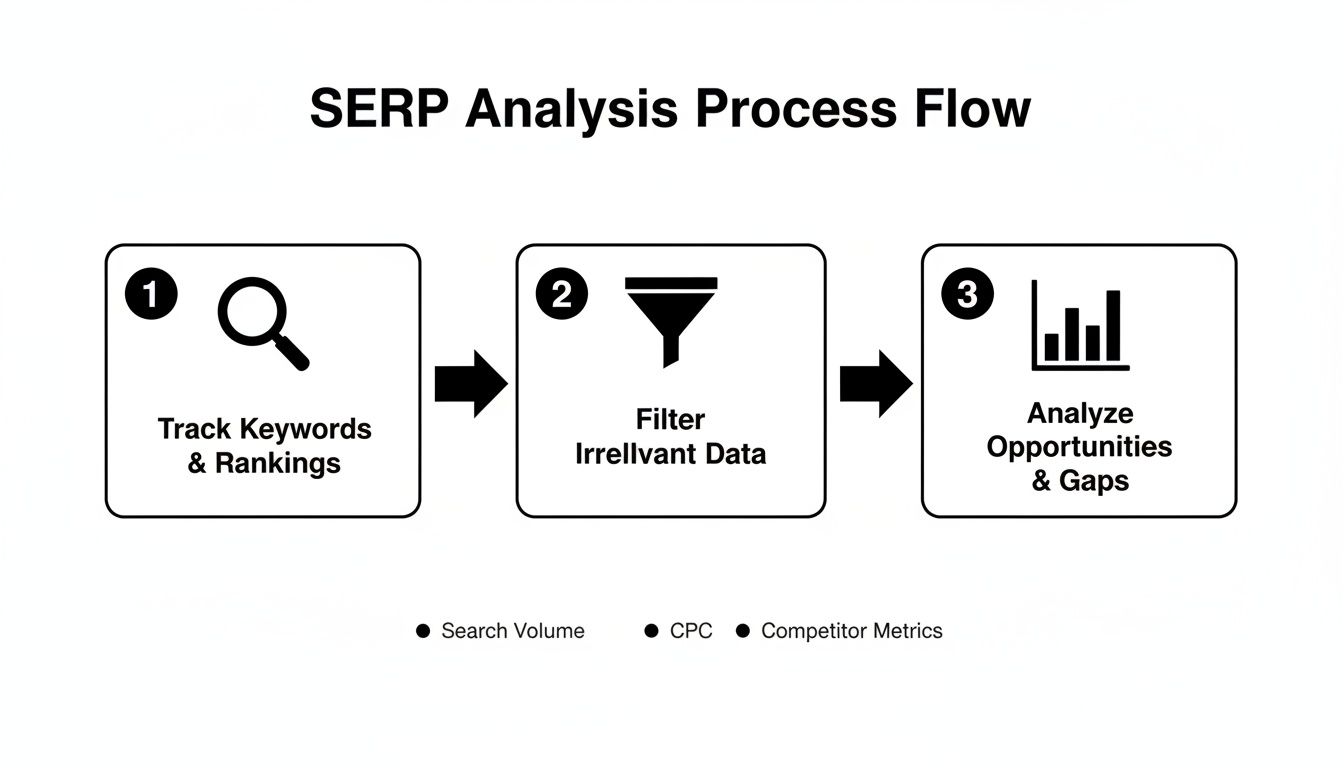
Suddenly, raw keyword data transforms into a prioritized action plan, letting you focus on the features with the biggest potential payoff.
Deconstruct Your Competitors' Wins
Once you know which features are on the table, it’s time to see who’s already winning them. This goes way beyond just seeing a competitor owns a snippet. You need to deconstruct how they got it. It’s like being a detective, running a forensic analysis of their content structure, on-page formatting, and schema markup.
Let's say a competitor holds the Featured Snippet for "best CRM for small business." Don't just skim their article. Pop open the source code. Are they using a clean <table> element for their comparison chart? Is their H2 tag an almost perfect match for the search query? These aren't accidents; they're clues that reveal their optimization strategy.
Your goal isn't to blindly copy your competitors. It's to understand the "rules of the game" Google has laid out for that specific SERP. By analyzing the winners, you learn exactly what type of content and structure Google is rewarding for that query right now.
This level of analysis is what it takes to create content that isn't just "good," but is specifically engineered to be feature-worthy. It's also a critical part of any https://www.trysight.ai/blog/content-gap-analysis, because it shows you not just what topics you're missing, but which content structures and formats you need to build.
Map Query Intent to SERP Features
The final piece of the puzzle is connecting query intent to the SERP features Google is most likely to show. When you get this right, you can prioritize your content efforts with surgical precision, creating the perfect content format for the right query from the get-go.
Think of it as a cheat sheet for your content team. When they understand these connections, they can build their briefs and outlines to match what Google wants to feature, which massively increases your chances of success.
Here's a simplified look at how this intent-to-feature mapping works:
| Query Intent | Likely SERP Feature(s) | Content Action |
|---|---|---|
| Informational (What is...) | Featured Snippet (Definition) | Write a crisp, 40-60 word definition right at the top of the article. |
| Informational (How to...) | Featured Snippet (List), Video Pack | Structure content as a numbered list or step-by-step guide. Create a matching video. |
| Commercial (Best X for Y) | Popular Products, Featured Snippet (Table) | Build out comparison tables and use structured data on product pages. |
| Transactional (Buy...) | Shopping Ads, Local Pack | Dial in your Google Business Profile and run targeted ad campaigns. |
| Navigational (Brand name) | Sitelinks, Knowledge Panel | Ensure a clean site structure and use Organization schema markup. |
This isn't just theory—it’s a practical guide for your content team. When a writer gets a brief for a "how-to" keyword, they know their first job is to structure the content as a numbered list to target that snippet. For those looking to scale these discovery efforts, exploring programmatic SEO can be a game-changer.
By combining a foundational audit, deep competitor deconstruction, and precise intent mapping, you create a powerful, repeatable system for consistently winning valuable SERP features.
How to Create and Optimize Content to Capture SERP Features
Spotting an opportunity is one thing; actually capturing it is where the real work begins. To win SERP features, you need to create and fine-tune content that's specifically engineered to grab Google’s attention. This goes way beyond old-school keyword stuffing. It’s about structuring your information so it's ridiculously easy for search engines to digest and feature.
Every SERP feature has its own preferences. What works for a Featured Snippet won’t do much for a Local Pack. The trick is to match your content’s structure and your technical SEO to the exact feature you're targeting.
Nailing the Featured Snippet
Featured Snippets, or "Position 0," are the holy grail for informational queries. Winning them demands a direct, concise, and almost brutally efficient approach to answering questions. Google is looking for the perfect soundbite it can lift directly onto the SERP.
To give yourself the best shot, lead with the answer. If the query is "what is content marketing," your very first sentence should be a textbook definition: "Content marketing is a strategic approach..." This is the classic inverted pyramid method, and it works wonders.
Beyond the direct answer, think about the format Google seems to love for different types of questions:
- Paragraph Snippets: These are your go-to for "what is" or "why is" questions. Write a clean, 40-60 word definition right under a heading that mirrors the search query.
- List Snippets: Perfect for "how-to" guides or "best of" roundups. Use proper ordered (
<ol>) or unordered (<ul>) lists with clear, actionable items. - Table Snippets: Your secret weapon for comparison queries like "Slack vs. Teams." Use a simple
<table>to structure the data. Google loves a clean table for side-by-side comparisons.
The real secret to winning snippets? Make your content more scannable for Google's crawlers than your competition. Clean headings (H2s, H3s), lists, and tables are like giant signposts that scream, "The best answer is right here!"
Answering the Call of People Also Ask
People Also Ask (PAA) boxes are another massive opportunity just waiting to be tapped. Since one click often reveals even more related questions, they can be a goldmine for exploratory traffic. The optimization strategy here is almost identical to what you’d do for Featured Snippets.
The most effective tactic I've seen is building out a comprehensive FAQ section within your article. Use a tool to scrape the PAA questions for your topic, then create an H2 or H3 heading for each one. Follow it up immediately with a direct, concise answer.
This Q&A format doesn't just target PAA boxes; it also signals to Google that your content is a thorough resource, which is fantastic for building topical authority. This direct-answer approach is a cornerstone of modern content strategy. For a much deeper dive, our guide on Answer Engine Optimization breaks down how to align your entire content strategy with user questions.
Get a Technical Edge with Structured Data
While content structure is the foundation, technical optimization is what often seals the deal. This is where structured data (or Schema markup) becomes your best friend. Schema is essentially a vocabulary of code you add to your site to give search engines explicit context about your content.
It’s the technical layer that tells Google, "Hey, this block of text is a recipe," "This page is an FAQ," or "This number is a product rating." That clarity makes it much easier for Google to confidently award you a rich result.
For example, you can't even be eligible for an FAQ rich snippet without implementing FAQPage schema. The code explicitly labels the question and answer, leaving nothing to chance and dramatically increasing your odds of showing up with those interactive dropdowns in the SERPs.
Content Optimization Cheat Sheet for Top SERP Features
To make this even more practical, here's a quick cheat sheet for aligning your content and technical efforts with the most common SERP features.
| SERP Feature | Optimal Content Format | Required Schema Markup | Key Success Factor |
|---|---|---|---|
| Featured Snippet | Direct answer (40-60 words), lists, or tables. | None required, but Article schema helps. |
Clear structure and concise answers. |
| People Also Ask | Q&A format using headings (H2, H3). | FAQPage schema is highly recommended. |
Answering related questions thoroughly. |
| Image Pack | High-quality, original images with descriptive file names and alt text. | ImageObject schema. |
Image optimization and relevancy to query. |
| Video Carousel | Engaging video hosted on YouTube or embedded on-page. | VideoObject schema. |
Optimized video title, description, and tags. |
| Knowledge Panel | Authoritative, factual content on a dedicated page about the entity. | Organization or Person schema. |
Strong E-E-A-T signals and a Google Business Profile. |
| Local Pack | Location-specific landing pages, customer reviews. | LocalBusiness schema. |
A fully optimized Google Business Profile. |
This table should give you a solid starting point for targeting specific features. Remember, it's about giving Google exactly what it needs, in the format it prefers.
Positioning Your Content for AI Overviews
The arrival of AI Overviews has definitely shaken things up. These AI-generated summaries pull information from multiple high-ranking, authoritative sources to construct an answer. Getting cited here requires your content to be more than just well-structured—it has to be rock-solid and trustworthy.
Optimizing for AI Overviews means doubling down on authority:
- Show Your Work: Include original data, expert quotes, and citations from credible sources.
- Tackle Nuance: Don't just answer simple questions. Go deeper into complex topics that require a comprehensive, well-reasoned answer.
- Attribute Clearly: Make it obvious where your information is from. This reinforces your content's reliability.
Ultimately, content that is already well-structured for traditional snippets and backed by deep, demonstrable expertise is in the best position to get pulled into Google's AI-generated answers.
Measuring Your Success and Proving ROI
Winning a SERP feature is a huge accomplishment, but the celebration is often cut short if you can't actually prove its value. Let's be real: securing budget and getting stakeholder buy-in hinges on connecting these SEO wins to tangible business outcomes. It’s all about moving beyond vanity metrics and building a clear framework for tracking and reporting your success.
The first thing you need to do is establish a baseline. You have to know where you stand before you can show how far you've come. The goal is to tie specific SERP feature ownership directly to performance metrics, proving your hard work is generating more than just visibility.
Key Metrics to Monitor in Your Reporting
Your primary source of truth for raw performance data will almost always be Google Search Console. While it won't hand you a neat "SERP Features Won" report, you can uncover some powerful insights by cross-referencing its data with what you're seeing on the live SERP.
Start by isolating the queries where you've successfully captured a feature. For those specific keywords, you'll want to pay close attention to:
- Impressions: This is your top-of-the-funnel visibility metric. A sudden spike in impressions right after you win a Featured Snippet is a dead giveaway that you’re commanding more SERP real estate.
- Clicks: This tells you how many people are actually clicking through to your site from that SERP feature. It's a direct measure of traffic generation.
- Average Position: This one can be a bit tricky. Owning a snippet might register as position 1, but the real win is in the enhanced visibility and brand authority, not just the raw number.
When you combine these metrics, you can tell a powerful story. For instance, you might see a massive jump in impressions but a slight dip in click-through rate (CTR). This isn't a failure. It could just mean the snippet is answering the user's question right on the SERP, which is still a branding win. Understanding that nuance is what separates good reporting from great reporting.
Interpreting Performance in a Zero-Click World
It’s absolutely critical to frame your results within the reality of modern search. The data doesn't lie: according to SparkToro, 58-60% of all Google searches are zero-click because the SERP features themselves satisfy the query. This means judging your success solely on clicks is a fundamentally flawed strategy.
In a zero-click environment, SERP feature ownership becomes a powerful branding and authority-building tool. Even without a click, your brand is positioned as the definitive answer, building trust and recognition that pays dividends later.
Your reporting needs to reflect this reality. You can frame these "zero-click" wins as massive increases in brand awareness and unaided brand recall. When your company’s name consistently pops up in prominent SERP features, you're building valuable mental real estate with your target audience, and that's incredibly valuable.
Connecting SERP Wins to Business Goals
At the end of the day, the reports that truly matter are the ones that connect your SEO activities to bottom-line business goals like lead generation and revenue. Direct attribution can be tough, I get it, but you can build a very strong business case by correlating SERP feature ownership with downstream conversions.
Analyze the user journey for the traffic that does come from a SERP feature. Do these visitors convert at a higher rate? Do they hang around longer, viewing more pages? Answering these questions helps you articulate the real, tangible business impact of your work.
For a deeper dive, our guide on the ROI of content marketing offers specific frameworks for connecting these content wins to financial outcomes. By tracking the right metrics and telling a compelling story with your data, you can effectively prove the immense value of your SERP feature strategy.
Common Questions About SERP Feature Strategy
Even with a solid game plan, diving into SERP feature optimization brings up a ton of practical questions. The nuances of actually doing the work can get tricky, so let's tackle some of the most common hurdles and "what-ifs" that come up.
Think of this as your quick-reference guide for troubleshooting your strategy on the fly. We'll get straight to the point with actionable answers to keep you moving.
How Long Does It Take to Win a SERP Feature?
There’s no magic number here. How quickly you can snag a SERP feature after you've done the optimization work really boils down to a few things: keyword competition, your site's overall authority, and how fast Google gets around to re-crawling and re-indexing your page.
For less competitive, long-tail queries, you might see results pop up in just a few days or weeks. But if you're going after a high-stakes prize like a Featured Snippet for a major commercial keyword, you're likely looking at several months of consistent effort.
Key Takeaway: This is a marathon, not a sprint. Getting your page indexed quickly helps, but you absolutely need a good rank tracker that specifically monitors SERP features. It's the only way to accurately see if you're making progress.
Can I Lose a SERP Feature After I Win It?
Absolutely. In fact, you probably will. SERP features are notoriously volatile, and it's common to see them change hands for a few key reasons.
- A Competitor Makes a Better Play: Someone else might publish a more comprehensive, better-structured piece of content that Google decides is a superior answer.
- Google's Algorithm Shifts: An algorithm update can completely change how Google evaluates content for a specific feature, and your page might not make the cut anymore.
- User Intent Changes: Over time, what people are looking for when they type in a query can evolve. Google might decide a different type of feature, like a video pack instead of a snippet, now serves that intent better.
This is exactly why continuous monitoring is non-negotiable. If you lose a feature, your first move should be to analyze the new winner. Tear apart their content, structure, and on-page formatting to figure out what Google is rewarding now, and then adapt your page to win back that spot.
Should I Prioritize Featured Snippets or AI Overviews?
This is the big strategic question on every SEO's mind right now. Featured Snippets are a known entity—they're established, and they often drive high-intent clicks directly to your website.
AI Overviews, on the other hand, are a different beast. They can sometimes answer the user's question right on the SERP, which might mean fewer direct clicks. However, being cited in an AI Overview can be a massive boost for your brand's visibility and authority, positioning you as the go-to source.
The smartest approach? Target both at the same time. The great news is that the work you do to win a Featured Snippet—clear headings, concise answers, authoritative info—is the exact same work that positions you to be cited in an AI Overview. Focus on winning snippets for your most valuable keywords, but make sure your content is deep and credible enough to be a source for Google's AI.
What Is the Most Common Mistake to Avoid?
The single biggest mistake I see is focusing on one type of optimization in a vacuum. For example, adding technically perfect schema markup to a page with thin, useless content is a complete waste of time. It’s just not going to work.
Successfully capturing SERP features demands a holistic approach that balances three pillars:
- High-Quality Content: This is your foundation. The content has to be the best, most comprehensive answer that perfectly matches user intent.
- Smart On-Page Structure: Use clear headings (H2s, H3s), lists, and tables. You have to make your content incredibly easy for both people and search crawlers to understand.
- Correct Technical Implementation: This is where you use the right Schema markup to give Google explicit clues about what your content is about.
If you neglect any one of these, your chances of success drop dramatically.
Ready to turn AI and search visibility insights into measurable growth? Sight AI is the all-in-one platform that monitors your brand's presence across leading AI models and helps you dominate the SERPs. From uncovering competitor content gaps to generating high-quality, optimized articles on autopilot, Sight AI gives you the tools to get discovered. Start your journey with Sight AI today.