Answer Engine Optimization (AEO) isn't about climbing a list of blue links anymore. It's about becoming the answer itself. We're talking about optimizing your content so AI tools like ChatGPT, Perplexity, and Google’s AI Overviews cite you as the direct source of truth. The game has changed, and it now rewards clarity, authority, and data that an AI can easily understand and trust.
The New Reality of Search Answer Engine Optimization

For decades, the SEO playbook was straightforward: get to the top of Google. Think of traditional SEO as creating the most detailed, accurate map you could. Success meant users finding your map, picking it over others, and using it to find their way.
But today, people are skipping the map store. They're just asking their GPS—the AI answer engine—for direct, turn-by-turn directions.
This is all happening because of a massive shift in how people look for information. They don't want a list of ten websites to sift through. They want a single, trustworthy answer, right now. Answer Engine Optimization is the strategy that makes you the trusted voice the GPS relies on. It’s about making sure your brand's expertise is the raw material for those AI-generated answers.
Why AEO Is No Longer Optional
The rise of answer engines is completely reshaping how brands get discovered. In fact, some research predicts a massive 25% drop in organic traffic from traditional search engines by 2026. This isn't just a small tweak; it's one of the biggest shifts we've seen in digital marketing, as AI-powered answers become the primary way people find things out.
AEO moves the goalposts from simply being visible to being verifiably credible. In a world of AI-generated summaries, the brands that are cited as sources are the ones that will own the narrative and capture high-intent traffic.
This change impacts every single business because it fundamentally alters where discovery begins. When you're the cited source, you get some serious advantages:
- Direct Authority: Your brand is named as the expert right inside the answer, building instant trust.
- High-Intent Traffic: The people who click through from a citation are already primed. They’ve seen the summary and now want to go deeper with the expert—you.
- Future-Proofing Your Strategy: As more and more people turn to AI for answers, AEO makes sure you’re visible where your audience is actually looking.
To get ahead in this new environment, you have to understand AI SEO strategies for ranking in LLM answers. This isn't a fad. It's the next evolution of search. Brands that start adapting their content now will lock in a powerful competitive edge. To get started, check out our guide on AI search engine optimization.
How AI Answer Engines Actually Work
To really get the hang of answer engine optimization, you first need to peek under the hood. The whole show is run by what are called Large Language Models, or LLMs. The easiest way to think of an LLM is as a super-smart research assistant who has read pretty much the entire internet—every book, article, and research paper you can imagine—and can boil all of that information down into a single, straightforward answer.
This "assistant" doesn't just memorize facts. It learns the incredibly complex patterns, context, and relationships between all those words and ideas. So, when you ask a question, the LLM draws on its massive training to predict the most logical and contextually relevant sequence of words to build a response. It’s a highly sophisticated game of pattern recognition and probability, not genuine understanding.
The Journey From Question To Answer
It might feel like magic, but what happens when you ask a question is actually a structured, multi-step process. Understanding this journey is the key to figuring out where your content can make an impact.
It all unfolds in three main phases:
Query Interpretation: First, the engine has to understand what you're actually asking. It uses Natural Language Processing (NLP) to break down your question, identifying the core intent, key entities (like people, places, or concepts), and the specific piece of information you're after. It's essentially translating your everyday language into a set of instructions for the machine.
Information Retrieval and Synthesis: This is where your content gets its chance to shine. The AI scans its enormous index of the web to find relevant, authoritative, and factually sound information that matches the intent of the question. It’s not just looking for one source; it pulls from several, cross-referencing them to build a complete picture.
Answer Generation and Citation: Finally, the LLM takes all that information it gathered and weaves it into a fresh, human-sounding paragraph. It constructs the answer by predicting the next most likely word, one after another, until the thought is complete. Then—and this is the crucial part—good answer engines cite the sources they used, giving you a direct link back to the original content.
That last step—the citation—is the entire goal of answer engine optimization. Getting your content sourced is how you win this new game. It’s how you turn your brand into a verified authority.
The Critical Role Of Citations
So why are these citations such a big deal? Unlike a simple link in a list of search results, a citation is a direct endorsement. The AI is literally telling the user, "This is where I learned this information; you can trust this source." That endorsement creates a powerful feedback loop.
When your content is cited over and over, it signals to the AI that your domain is a reliable authority on that topic. This makes you more likely to be cited again for similar questions in the future. The most direct path to earning these valuable endorsements is to consistently create high-quality, well-structured, and factually accurate content.
Breaking down this mechanical process makes it clear why AEO strategies are so focused on clarity, structure, and accuracy. You're no longer just writing for a person. You're also creating the perfect, easily digestible data packet for a machine on a constant hunt for trustworthy information. As these systems become a bigger part of our daily lives, learning how to monitor AI model responses will be just as vital as tracking your keyword rankings.
The Big Shift: From SEO to AEO
Making the move from traditional SEO to Answer Engine Optimization (AEO) isn't just a small adjustment—it feels like learning an entirely new language. While both are chasing digital visibility, their philosophies, tactics, and what "success" looks like are worlds apart. Grasping these differences is the first real step in adapting to a world where being the cited source for an answer is far more valuable than simply ranking number one.
Traditional SEO has always been a game of keywords, rankings, and domain authority. The main goal? Secure a top spot on the search engine results page (SERP) and act as a signpost that points users to your website. Success is measured by how well you climb that ranked list and pull in clicks.
AEO, on the other hand, aims to bypass the list altogether. The objective isn't just to be found—it's to become the foundational knowledge an AI uses to build its answer. This requires a huge shift in mindset, moving from targeting keywords to truly owning topics.
From Keywords To Concepts
The most dramatic change is the departure from a rigid keyword focus. Keywords still have their place, but AEO is all about entities and topical authority. An entity is just a well-defined concept an AI can understand in context—a person, a product, a company, a theory. Instead of optimizing for "best running shoes," you're now aiming to become the definitive, trusted source on the concept of running shoe technology, fit, and performance.
This means your content needs to be structured to build an interconnected web of knowledge, not just a series of standalone articles. You're literally building a knowledge base for machines to learn from.
The jump from traditional SEO to this new era requires optimizing for SEO for generative AI search, which completely changes how your content gets discovered and used.
To make this transition clearer, let's break down how the core strategies need to evolve.
Strategic Shift from Traditional SEO to Answer Engine Optimization
| Strategy Element | Traditional SEO | Answer Engine Optimization (AEO) |
|---|---|---|
| Core Objective | Rank high on SERPs for specific keywords. | Become the cited, authoritative source in AI-generated answers. |
| Content Focus | Keyword-driven articles and pages. | Comprehensive, interconnected topic clusters and knowledge bases. |
| Key Metrics | Keyword rankings, organic traffic, click-through rate (CTR). | Citation frequency, brand mentions in answers, share of voice. |
| User Intent | Serve navigational, informational, and transactional queries. | Fulfill the need for a direct, definitive, and synthesized answer. |
This table shows a clear pivot from chasing clicks to establishing authority. AEO isn't about getting a user to your page; it's about getting your information directly into the AI's response.
Shifting User Intent And Content Formats
SEO has always served users with navigational, informational, and transactional intent. Someone might be looking for a specific website, researching a broad topic, or getting ready to buy something. The content we create—from blog posts to product pages—is designed to meet one of those needs.
AEO, however, targets a much more specific intent: the quest for a definitive answer. The user isn’t looking to browse multiple sources and piece things together. They want a direct, synthesized response to their question, right then and there.
AEO thrives on content that provides clear, unambiguous answers. This is why formats like detailed FAQs, structured how-to guides, and data-driven explanations perform so well. The goal is to make your information as easy as possible for an AI to parse, verify, and cite.
This simple diagram shows the high-level process AI models use, from consuming data to generating an answer.
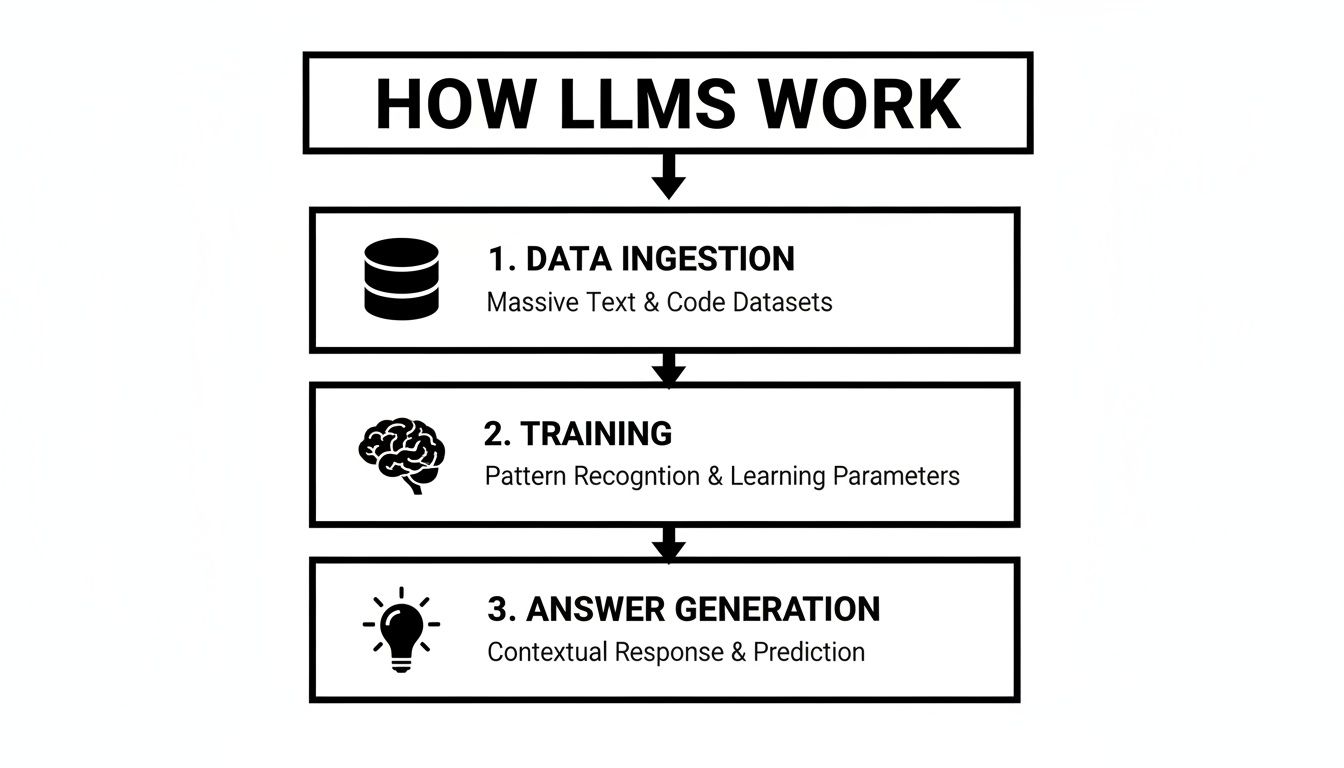
As the flowchart shows, the quality of the data going in is critical, as it directly shapes the final answer coming out. Your content is that data.
Redefining Success With New Metrics
Finally, the way we measure success has to change. Our traditional SEO dashboards are packed with metrics like keyword rankings, organic sessions, and click-through rates (CTR). These are still valuable, but they don’t tell the whole AEO story.
The new KPIs for answer engine optimization look a little different:
- Citation Frequency: How often is your brand cited as a source in AI-generated answers?
- Brand Mentions: Are AI models talking about your brand when discussing relevant topics, even without a direct link?
- Share of Voice: For a given topic or question, what percentage of the AI's answer is informed by your content?
This new measurement framework is all about influence and authority, not just traffic. If you're just getting started with this concept, you might want to dive deeper into what is Generative Engine Optimization and see how it all connects.
Core Strategies for Dominating Answer Engines

Alright, let's move from theory to action. Getting your content cited by AI isn't about finding a single magic bullet. It's about building a repeatable playbook that consistently signals expertise and trustworthiness to AI models. Your goal is to make your content the most logical, reliable, and easily digestible choice for an AI to use.
This means you have to shift your focus. Stop thinking about just winning a keyword and start thinking about becoming the definitive authority on a topic. Below are the essential pillars that will form the foundation of a winning AEO plan. Each one is designed to align with how AI models discover, process, and prioritize information.
Establish Deep Topical Authority
In the world of AEO, breadth is good, but depth is everything. Answer engines are designed to hunt down the single most comprehensive and authoritative source on a given subject. A single, high-level article just doesn't cut it anymore.
Instead, you need to build topic clusters. This strategy involves creating a central "pillar" page that covers a broad topic, which then links out to dozens of "cluster" pages that dive deep into specific sub-topics. Think of a pillar page on "email marketing" that links to detailed articles on deliverability, automation workflows, and list segmentation.
This structure does two things exceptionally well for answer engines:
- It creates a dense web of internal links, helping AI crawlers map out the relationships between your content and recognize the true scope of your knowledge.
- It answers every conceivable question a user might have on a subject, making your domain a one-stop-shop for reliable information.
By systematically covering a topic from every angle, you send a powerful signal to AI models that your brand is the go-to expert, making you a prime candidate for citations.
Prioritize Factual Accuracy and Clear Sourcing
Trust is the currency of the AI-powered web. It's that simple. Answer engines are under immense pressure to provide accurate, reliable information, which means they are actively looking for signals of credibility in the content they analyze. Your content has to be verifiably true and transparently sourced.
An unsourced claim is just an opinion to an AI. A claim supported by data, research, or an authoritative external link becomes a verifiable fact—and facts are what get cited.
You need to bake these practices into every single piece of content you create:
- Cite Your Sources: Always link out to reputable, primary sources like academic studies, government data, or industry reports to back up any statistics or major claims.
- Maintain Freshness: Regularly update your content with the latest data and information. AEO is not a "set it and forget it" game; outdated facts can quickly erode trust.
- Attribute Expertise: Use clear author bylines with credentials. Show that your content is written by genuine experts in the field, not faceless content farms.
These elements provide the hard evidence an AI needs to "trust" your content and feel confident presenting it as part of a factual answer.
Leverage Highly Structured Content and Data
AI models don't "read" content the way you and I do. They parse it, looking for predictable structures and patterns that make information easy to extract and categorize. The more organized your content is, the easier it is for an AI to understand and use.
This is where structured data, specifically Schema markup, becomes an absolute game-changer in your AEO arsenal. Schema is a vocabulary of code you add to your website to help search engines understand the context of your information. For instance, you can use it to explicitly label a section as a "HowTo," "FAQPage," or "Article."
Think of it like adding detailed labels to the files in a filing cabinet. When an AI needs a specific piece of information—like the steps in a process or the answer to a common question—it can instantly find the precisely labeled file. If you're ready to dig into this, check out our detailed article on optimizing content for AI search.
And make no mistake, this shift is happening fast. The latest data shows that 34% of U.S. adults have already used ChatGPT, which has nearly doubled from the previous year. Projections estimate that over 105 million adults will use generative AI in 2025. You can learn more about these trends in zero-click searches and see why AEO is crucial. This rapid user adoption makes structuring your content for machines a non-negotiable part of modern content strategy.
Measuring Success in the Age of AI Answers
In the world of answer engine optimization, the old scorecards just don't cut it anymore. Traditional metrics like keyword rankings and raw organic traffic fail to capture the full picture. When success means being the cited source inside an AI-generated answer, you need a new way to measure what’s actually working.
This requires a fundamental shift in thinking. The new measurement framework is built around influence and authority, not just clicks. Instead of asking, "How high did we rank?" you should be asking, "How often is our expertise being used to shape the definitive answer?" That’s the real goal of modern AEO measurement.
Moving Beyond Traditional SEO Metrics
For years, SEO success was a straightforward numbers game. Climb the SERPs, get the clicks, and watch the traffic grow. But in an AEO world, these metrics can be dangerously misleading. A user might get the perfect answer from an AI—an answer your content helped create—without ever clicking through to your website.
Did you lose? Not at all. Your brand just won. It was positioned as the authority, building trust and recognition at the most critical point in the user's journey. This is why we have to shift our focus to KPIs that reflect this new reality.
These new metrics should include:
- Citation Frequency: The raw count of how many times your domain is cited as a source in AI responses for your target topics.
- Brand Mentions: Tracking every time your brand is mentioned in an answer, even without a direct link. This is a powerful signal of growing authority.
- Share of Voice: For a specific set of topics, what percentage of AI answers are influenced by your content versus your competitors?
The ultimate goal is to measure AI visibility—a term that captures how present, prominent, and authoritative your brand is within the entire AI ecosystem. It's the most accurate indicator of your AEO performance, period.
A Modern Framework for AEO Measurement
So, how do you actually track these new outcomes? It starts with using the right tools—ones built specifically for this new environment. Platforms like Sight AI are designed to monitor how your brand appears across different AI models, giving you a clear, consolidated view of your performance.
Here’s a look at a dashboard from Sight AI, showing how it tracks mentions and citations over time.
A dashboard like this provides an immediate, at-a-glance view of your brand’s presence in AI conversations. It turns abstract concepts like "authority" into hard, measurable data points you can act on.
But adopting a modern measurement framework isn't just about new tools; it's about connecting AEO efforts to tangible business results. The metrics that matter have changed. Success now means aiming for a 10% monthly increase in Answer Engine Citations, keeping time-on-page metrics over 3 minutes with bounce rates under 40%, and hitting click-through rates of 5% from AI sources. You can see more on new AEO performance benchmarks top companies are targeting.
Connecting AEO to Business Goals
Ultimately, the entire point of measuring AEO is to prove its value. By tracking these new metrics, you can draw a straight line from your content strategy to real business outcomes.
Here’s how it all connects:
Increased Citations Lead to Higher Quality Traffic: A user who clicks through from an AI citation is highly qualified. They’ve already seen a summary of your expertise and are coming to your site for a deeper dive, which naturally leads to higher conversion rates.
Greater Share of Voice Builds Brand Equity: When you dominate the conversation on key topics, you establish your brand as the go-to industry leader. This supports long-term growth and builds incredible customer trust.
Positive Sentiment in Mentions Drives Reputation: Monitoring how AI talks about you helps you manage your brand's reputation and ensure the story being told aligns with your core messaging.
By tracking the right KPIs, you can move beyond old-school vanity metrics and clearly demonstrate how your answer engine optimization strategy is building a stronger, more authoritative brand. A great place to start is by learning how to measure AI visibility metrics with a structured, repeatable approach.
Common AEO Questions Answered
As answer engine optimization starts to take center stage, a lot of good questions are popping up. This new way of thinking forces us to challenge some long-held beliefs about digital marketing, so it’s natural to wonder how it all fits together and what it really means for your business. Let's tackle some of the most common questions to help you get your bearings.
Does Answer Engine Optimization Replace Traditional SEO
Not at all. Think of AEO as the evolution of SEO, not its replacement. It’s better to see SEO as the critical foundation of your digital presence. It’s all the essential work—building a technically sound website, ensuring search engines can crawl it easily, and creating high-quality, authoritative content. You simply can't skip these steps.
AEO is what you build on top of that solid foundation. It's the specialized work of fine-tuning your content so AI models can easily understand, process, and cite it. You still need that strong SEO base for crawlers to discover and trust your content in the first place. AEO just makes sure that once you’re found, your content is perfectly structured to become a source.
What Is the Single Most Important Factor for AEO Success
If you have to boil it down to one thing, it’s establishing verifiable topical authority. This isn't just about writing a great article; it's about creating a comprehensive, fact-based, and well-organized ecosystem of content that covers a subject from every possible angle. AI models are wired to prioritize sources that show deep, trustworthy expertise.
This means you need to shift from writing isolated blog posts to building interconnected content clusters. The goal is to answer every conceivable question a person could have about your topic, effectively turning your brand into the definitive digital library on that subject.
Topical authority isn't about having one great article; it's about creating an entire library on a subject so deep and well-organized that an AI has no choice but to recognize you as the expert. This is how you become a primary, citable source.
How Long Does It Take to See Results from AEO
Patience is key here. AEO is a long-term play, just like traditional SEO, so you won’t see results overnight. You can expect it to take several months to see a noticeable increase in citations in AI-generated answers, and the exact timeline depends on a few variables.
- Industry Competitiveness: If you’re in a crowded space, it’s going to take more effort to break through the noise.
- Existing Domain Authority: A well-established website with a history of authority will likely see results faster than a brand-new one.
- Content Consistency: How often you publish high-quality, answer-focused content makes a huge difference.
The trick is to consistently create and publish great content and keep an eye out for early signs of traction. You might start showing up for niche, long-tail questions before you begin capturing the broader, more competitive topics.
Can Small Businesses Compete in Answer Engine Optimization
Absolutely. In fact, AEO can be a massive equalizer. Large corporations with huge budgets might dominate broad keywords in traditional search, but the AEO game is different. It’s not a battle of resources; it’s a showcase of knowledge.
Small businesses can carve out a winning strategy by going deep on niche topics where they have genuine expertise. The focus shifts to the quality, depth, and clarity of your information, not the size of your ad spend. By becoming the undisputed authority on something specific—whether that’s the art of cold-brewing coffee or the compliance standards for a niche manufacturing sector—a small business can become the go-to source that AI models cite again and again.
This opens up a huge opportunity for specialists and boutique firms to punch well above their weight. It’s a chance to build a reputation based on pure expertise and attract highly qualified customers who are looking for specific, trustworthy answers that larger, more general competitors often ignore.
Ready to stop guessing and start measuring your brand's presence in AI answers? Sight AI provides the complete platform to monitor your AI visibility, identify content gaps, and generate optimized articles that get you cited. See how you can turn insights into authority. Discover your AI visibility with Sight AI.