
Content automation is a game-changer. It's about using software and AI to take over the repetitive parts of content marketing—the research, the first drafts, the publishing, and even the analysis. This lets your team create high-quality content at a massive scale, freeing up your strategists to focus on the creative work that actually grows the business. Essentially, it turns your content operation into a predictable, automated machine.
Laying the Groundwork for Automation Success

Jumping into content automation without a solid plan is like building a house without a blueprint. The tools are incredibly powerful, but without clear direction, they won't deliver real business results. Success isn't just about churning out more articles; it's about publishing the right articles that truly connect with your audience and push them to act.
So, the first thing you need to do is define what success actually looks like for you. Are you trying to generate more marketing-qualified leads (MQLs)? Build brand authority in a new niche? Or simply drive more organic traffic to your key service pages? You have to set clear, measurable goals.
Defining Your Core Business Objectives
Before you even think about automating a single task, you need to anchor everything to tangible business goals. Forget vanity metrics like page views. To prove ROI, you have to focus on outcomes that directly impact revenue and growth.
Think about which of these primary objectives you're chasing:
- Lead Generation: Maybe your goal is to boost qualified leads from organic search by 20% in the next six months. If so, every automated article needs a clear path to conversion, whether that’s a demo request or a newsletter signup.
- Brand Authority: Perhaps you want to be seen as a thought leader. A good goal would be to rank for 50 new keywords in a specific topic cluster over the next quarter. This builds trust and attracts an audience that's ready to listen.
- Sales Enablement: You could create an entire library of bottom-of-the-funnel content that helps your sales team close deals faster. Here, the goal is to shorten the sales cycle by giving them the automated resources they need.
Key Takeaway: Your goals will dictate your entire content automation strategy. A lead generation goal demands completely different content and workflows than a goal centered on brand awareness.
Understanding Your Audience and Their Intent
Once your goals are set, it's time to get inside your audience's head. Automated content falls flat when it's generic. It only works when it precisely answers the questions your ideal customers are asking.
This means you need to dig deep into search intent—the "why" behind every search query. Is someone just looking for information (like "what is content automation")? Are they comparing their options ("Sight AI vs. Jasper")? Or are they ready to pull the trigger ("best AI content platform for SEO")? Mapping your content to these distinct stages of the buyer's journey is crucial for meeting them where they are.
If this is new territory for you, getting a handle on the basics of marketing automation for small business can give you a strong foundation. It helps you see how automation fits into the bigger picture of the customer lifecycle.
Uncovering Opportunities with Gap Analysis
You don't have to start from scratch. A competitive content gap analysis is a brilliant way to find proven topics your audience is already interested in—topics you just haven't covered yet. The process is simple: identify the keywords and subjects your top competitors are ranking for where you have no presence.
Modern tools can help you spot these gaps in minutes, revealing high-value opportunities to create content that can snatch up ready-made traffic. Look for topics where your competitors are weak or where you can offer a far more comprehensive, insightful take. This gives your automation engine a clear, targeted direction from day one.
Establishing Your Brand Voice and Governance
Finally, remember that automation should never erase your brand's personality. Before you generate a single word, you absolutely must document your brand voice, tone, and style guidelines. This framework is what ensures consistency, no matter if a human or an AI wrote the first draft.
Your governance plan should be crystal clear on:
- Tone of Voice: Are you authoritative and professional? Or are you conversational and witty?
- Formatting Rules: Define how you use headings, bold text, and bulleted lists.
- Forbidden Terms: Are there any industry buzzwords or phrases you want to avoid?
- Review Process: Who has the final say before anything goes live?
This groundwork is non-negotiable. It's the only way to scale your content production without sacrificing the quality and consistency your brand is known for. To get a better handle on organizing these efforts, check out our guide on creating a content calendar that meshes perfectly with your automation goals.
Assembling Your Content Automation Tech Stack

Once your strategy is locked in, it's time to build the engine that brings it to life. This is your tech stack—the collection of tools that will work in harmony to automate your content creation and distribution from end to end. Getting this right is everything. It's the difference between a clunky, high-maintenance process and a smooth, efficient system that delivers results without someone having to manually push buttons all day.
The goal here isn't just to collect a bunch of cool software. We're building an interconnected system where each piece has a specific job. From the initial spark of an idea to the final click of "publish" and getting indexed, a well-designed stack demolishes bottlenecks and frees you up to think about the big picture.
Let's break down the essential components you'll need.
The table below outlines the core tools you'll need to build a complete content automation system, detailing what each component does and offering some examples.
Essential Components of a Content Automation Stack
| Component | Primary Function | Example Tools |
|---|---|---|
| AI Content Platform | The central hub for research, outlining, generating, and optimizing SEO content at scale. | Sight AI, Jasper, Copy.ai |
| Content Management System (CMS) | The platform where content is published and managed on your website. | WordPress, Webflow, Shopify, Ghost |
| Index/Submission Automation | Tools that automatically notify search engines of new content to speed up indexing. | IndexNow protocol tools, All in One SEO (for WordPress) |
Each of these pieces is crucial for creating a truly hands-off workflow that runs efficiently in the background.
The Core: An AI Content Platform
The absolute heart of any modern content automation system is a powerful AI content platform. And I'm not talking about a simple AI writer. You need a tool built for the entire SEO content lifecycle—something that handles research, outlining, and generating fully optimized, long-form articles.
When you're vetting platforms, here are the non-negotiables:
- Specialized AI Agents: Generic models are fine for whipping up a quick email, but for serious SEO, you need agents trained on specific tasks. Look for platforms that offer dedicated agents for creating SEO blog posts, local landing pages, or even product descriptions.
- Built-in On-Page SEO: The platform must handle on-page optimization automatically. This means intelligently weaving in keywords, structuring content with H2s and H3s, adding internal links, and generating meta descriptions without you having to lift a finger.
- Research and Outlining Tools: A top-tier platform saves you hours by analyzing what's already ranking for your target keyword. It should break down the top results and build a comprehensive outline, ensuring your content covers all the critical subtopics from the get-go.
A classic mistake I see people make is choosing a tool based on price alone. An end-to-end platform like Sight AI, which combines research, generation, and optimization in one place, delivers a far higher ROI by consolidating your workflow and ensuring top-notch content quality from the start.
This central tool is your foundation. The marketing automation industry is already valued at $6.65 billion and is projected to hit $15.58 billion by 2030—that growth tells you just how vital this infrastructure is for any company looking to scale.
Seamless Integration With Your CMS
Your AI content platform can't be an island. For true automation to happen, it needs to talk directly to your Content Management System (CMS). A seamless, native integration with platforms like WordPress or Webflow isn't a "nice-to-have," it's a must.
This connection creates a direct pipeline from generation to publication. Instead of the tedious, error-prone process of copying text, pasting it into your CMS, formatting everything, and uploading images, the platform should push the finished article straight to your site as a perfectly formatted draft. This one integration can literally save your team dozens of hours every month.
If you're mapping out your system, take some time to explore different content marketing automation platforms to get a feel for the integration capabilities out there.
Automating Sitemap and Indexing Submissions
Creating amazing content is just step one. If search engines can't find it, it might as well not exist. The final, critical piece of your tech stack is automating the discovery process. Manually submitting new URLs to Google Search Console is a massive time-sink, especially when you're publishing content at scale.
This is where index/submission automation tools come into play. You need a system that automatically updates your sitemap the second a new article is published. Even better are platforms that use the IndexNow protocol to instantly ping search engines like Google and Bing the moment new content goes live.
This last step dramatically shrinks the time it takes for your new pages to get indexed and start climbing the ranks. By automating this crucial—but so often overlooked—task, you complete your end-to-end content machine. Now your content can start driving value almost immediately.
Weaving AI into Your Content Creation Workflow
Having the right tools is just the starting line. Real content automation isn't about hitting a button and letting a machine churn out articles. It’s about thoughtfully integrating AI across the entire content lifecycle to create stuff that’s not just scalable, but genuinely helpful and trustworthy. The goal here is to treat technology as a strategic partner, not just a text generator.
This means looking beyond basic writing tools. The most effective AI platforms get involved much earlier in the process. They're designed to sniff out high-value content gaps by digging into search results and analyzing what your competitors are doing. From there, they help you build comprehensive, data-driven outlines, ensuring your content is set up to be competitive before a single word is written. This initial intelligence-gathering is what separates high-performing automated content from the generic filler that clogs up the internet.
Adopting the Human-in-the-Loop Model
One of the most powerful ways to approach content automation is the human-in-the-loop model. This isn’t about replacing your writers and editors; it’s about giving them superpowers. In this workflow, the AI does all the heavy lifting—the mind-numbing research, the data crunching, and the first draft. This frees up your human experts to focus on what they do best.
Think of it as an 80/20 split. The AI handles about 80% of the grunt work, and your team swoops in for that crucial final 20%. This is where the real value gets added.
Your team’s job evolves into strategic oversight, which includes:
- Fact-checking and validation to make sure everything is accurate and builds trust.
- Injecting unique insights, personal stories, or company data that an AI could never have.
- Refining the brand voice to ensure every piece sounds like it truly came from you.
- Adding smart calls-to-action that are perfectly aligned with your campaign goals.
This hybrid approach delivers the best of both worlds: you get the speed and scale of automation, but with the nuance, creativity, and authority that only a human can provide.
The point isn't to remove people from the process. It's to remove the tedious, repetitive work so your best people can focus on being creative strategists, not just content producers. This shift is fundamental to scaling successfully.
Deploying Specialized AI Agents for Specific Jobs
Not all content serves the same purpose, so a one-size-fits-all AI model is rarely the best choice. A much smarter way to automate your content marketing is to use specialized AI agents, each trained for a specific type of content. It’s like having different experts on your team—you wouldn’t ask your video editor to write your privacy policy.
For instance, a marketing team might use different agents for different tasks:
- An SEO Blog Post Agent: This agent is an expert in SERP analysis, figuring out user intent, and structuring long-form articles with perfectly optimized headings, keyword placement, and smart internal linking suggestions.
- A GEO-Targeted Landing Page Agent: This one specializes in creating copy for specific locations, weaving in local landmarks or terminology to connect with an audience in a particular city or region.
- A Product Description Agent: Trained on the principles of e-commerce, this agent would whip up persuasive, benefit-driven copy designed to turn shoppers into customers.
Using specialized agents means the first draft is far more tailored to the specific goal, which makes the final human review process much faster and more efficient. To get a better sense of the landscape, you can explore the different types of AI content generation tools available today.
Protecting Quality and Trust at Scale
At the end of the day, your content automation efforts will live or die based on trust. If your audience thinks your content is cheap, generic, or flat-out wrong, you’ll do more damage than good. And the stakes are getting higher. The use of AI in marketing is exploding—today, 95% of B2B marketers are using AI applications, and an incredible 76% of all marketers are now using generative AI for creating content. That’s a seismic shift in how things get done. You can find more details on these content marketing stats on thedigitalelevator.com.
With this much AI-generated content flooding the internet, the only way to stand out is with an unwavering commitment to quality. Your human review process is your last line of defense, ensuring that every article you publish is a credible, valuable resource that reinforces your brand’s authority. By pairing smart AI with sharp human oversight, you build a system that produces content that is both scalable and trustworthy.
Designing Automated Workflows That Actually Work
So, you've got your strategy locked in and your tech stack is ready to go. Now for the fun part: building the assembly line. A solid content automation marketing workflow isn't just a to-do list; it's a repeatable, predictable system that turns ideas into traffic with as little friction as possible. This is where you connect the dots between your tools and your goals to create a process that just works.
The real trick is to treat it like a living system, not a static checklist. The best workflows are built around a continuous feedback loop. You need to take the performance data from your published articles—rankings, clicks, conversions—and feed it right back into the system. This makes future content smarter and more effective, turning your setup into a machine that learns and improves on its own.
Mapping the Content Journey from Idea to Impact
To really get this process humming, you have to map out every single stage of the content lifecycle. It’s not just about drafting an article. It's about building an end-to-end pipeline that handles everything from the initial spark of an idea to post-publication analysis.
Here’s what a standard operating procedure (SOP) might look like in practice:
- Automated Keyword Discovery: Your system should be constantly on the lookout, scanning for new, high-value keywords based on what your competitors are doing and what your audience is searching for.
- Intelligent Topic Clustering: Instead of just chasing one-off keywords, a smart system groups them into logical topic clusters. This is how you build topical authority—a huge ranking factor—way faster.
- AI-Powered Brief Creation: For every keyword you target, the AI should generate a detailed content brief. It does this by analyzing the top-ranking pages to figure out the ideal structure, word count, and key subtopics you need to cover.
- First-Draft Generation: With that brief as its guide, a specialized AI agent gets to work, generating a complete, SEO-optimized first draft. This isn't just a block of text; it includes the intro, conclusion, headings, and formatting right out of the gate.
This kind of structured approach takes the guesswork out of the equation and makes sure every piece of content is strategically sound from the very beginning.
The diagram below gives you a simple, high-level view of the core production workflow, breaking it down into three essential phases.
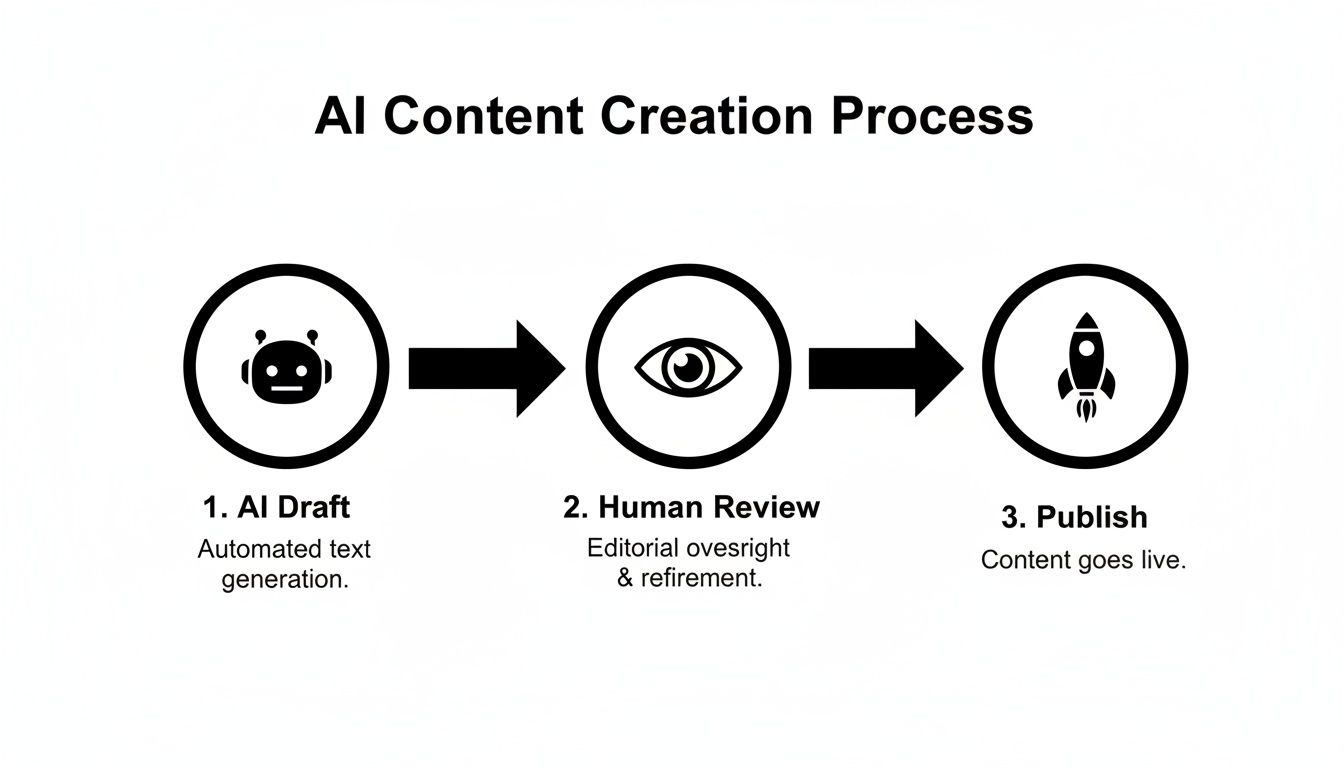
This visual drives home a critical point: while AI can handle the heavy lifting of the initial draft, the human review step is absolutely non-negotiable. It’s the final quality check that ensures accuracy and brand alignment before anything goes live.
Building a Continuous Improvement Loop
A "set it and forget it" mindset is the fastest way to fail with content automation. The real magic happens when you create a closed-loop system where performance data actively refines your strategy. This is what separates a basic content mill from a true growth engine.
Your feedback loop should automatically track the metrics that matter for every single article you publish.
- Indexing Speed: How quickly are new articles showing up in search results?
- Ranking Velocity: How fast are your pages climbing the SERPs for their target keywords?
- Organic Traffic: Which articles are actually bringing in the visitors?
- Conversion Rates: Are readers taking the action you want them to, like signing up for a demo or making a purchase?
By feeding this data back to your AI platform, you start to spot patterns. Maybe articles with a certain structure rank faster. Or maybe posts that hit on specific customer pain points convert at a higher rate. This kind of insight allows the AI to adjust its approach, creating a system that gets progressively smarter over time.
This data-driven refinement is the cornerstone of sustainable success. You're not just creating content anymore; you're building an intelligent system that adapts to what the market actually wants. This transforms your content marketing from a series of one-off campaigns into a predictable, ever-optimizing asset for your business.
Measuring Performance and Optimizing for Growth
Putting out content at scale is one thing, but it’s just noise if you can't tie it back to real results. How do you actually prove that your investment in content automation marketing is generating tangible value? The secret is to look past the surface-level vanity metrics and zero in on the key performance indicators (KPIs) that draw a straight line from your content to business growth.
This data-driven mindset does more than just get your budget approved. It kicks off a powerful cycle of continuous improvement. When you know what’s working and what’s falling flat, you can sharpen your strategy, optimize your workflows, and make smarter decisions that actually move the needle. The goal is to see a clear path from a published article all the way to a closed deal.
Tracking Core Content and Visibility Metrics
Before you can even think about business impact, you need a solid handle on how your content is performing out in the wild. These foundational metrics are your first signal that the automation engine is doing its job—building your digital footprint and grabbing your audience's attention.
Start by keeping a close eye on these essential visibility KPIs:
- Organic Visibility: What's your overall share of voice for your target keyword clusters? This number gives you a sense of your market presence and authority.
- Keyword Ranking Velocity: How fast are new articles climbing the search engine results pages (SERPs)? A high velocity is a great sign that your SEO and indexing automation are firing on all cylinders.
- New Pages Indexed: Keep a running tally of how many new articles search engines are finding and adding to their index. A consistently high number here means your technical setup is sound.
Don't get hung up on the initial ranking for a single keyword—that's a classic rookie mistake. What you're really looking for is collective momentum. Are you seeing consistent upward trends across dozens of articles and entire topic clusters? That's the real sign of a healthy, scaling strategy.
Connecting Content Directly to Business Goals
Visibility is nice, but revenue is what really matters. The ultimate test for your content automation is whether it can actually influence the bottom line. This means connecting your content performance directly to your sales and marketing funnels. It's the only way to calculate a true return on investment.
To make this happen, you have to track the metrics that bridge the gap between someone reading an article and becoming a customer.
- Marketing-Qualified Leads (MQLs) from Automated Content: Make sure you can tag and track every single lead that comes from an article produced by your automation system. This gives you a hard number to show how many potential customers your content is bringing in.
- Pipeline Impact: Take it a step further. How many of those MQLs turn into sales-qualified leads (SQLs) and, eventually, paying customers? This is how you demonstrate the direct revenue contribution of your automated content.
- Conversion Rate per Article: Dig into the data to see which specific articles or topic clusters are the real conversion workhorses. This is gold—it tells you exactly where to double down to get more results.
Getting these numbers right is absolutely crucial. If you want to go deeper, our guide on measuring content marketing ROI lays out a complete framework for proving its value from the ground up.
Monitoring Your Footprint in AI Chatbots
These days, content discovery isn't just happening on Google anymore. A huge and rapidly growing number of people are turning to AI chatbots like ChatGPT, Perplexity, and Gemini for answers. If your brand isn't showing up in these conversations, you're becoming invisible to a massive audience.
That's why a critical, modern piece of performance measurement is monitoring your brand’s presence inside these AI models. You need to know how, where, and why your brand is being mentioned.
Pay close attention to:
- Brand Mentions and Citations: Is your content being used as a source to answer relevant user prompts? Getting cited directly is a powerful way to establish authority in this new space.
- Sentiment Analysis: When AI models mention your brand, is the context positive, negative, or neutral? This is the new frontier of brand reputation management.
By actively keeping tabs on this space, you can spot opportunities to create content that directly answers the kinds of questions people are asking AI. It’s a data-backed approach that keeps you visible where discovery is happening now, allowing you to prove ROI and make intelligent decisions that fuel sustainable growth.
Answering Your Toughest Content Automation Questions
Stepping into content automation marketing always kicks up a few big questions. And they're good ones. You should be asking about SEO, how to keep your brand voice, and where the heck to even start. Getting straight answers is the only way to build a system that actually works and delivers results you can take to your boss.
Let's break down the most common questions we hear from teams looking to scale up with AI. Nailing these details early on will help you sidestep the usual mistakes and get the most out of your investment from the get-go.
Will Automated Content Tank My SEO Rankings?
This is always the first question, and the answer is a hard "no"—if you do it the right way. Google doesn't care how your content is made. Its one and only mission is to serve up high-quality, genuinely helpful content that solves a searcher's problem. The real danger isn't the automation; it's the quality of what you publish.
If you're using a cheap, basic AI writer that just spits out generic, thin articles, then yes, you're going to have a bad time. But the more sophisticated platforms built for SEO are a different beast entirely. They produce well-researched, original articles that are already structured to perform well in search.
When you combine that kind of technology with a smart SEO strategy—one that targets the right keywords and user intent—you've got a massive advantage. It gives you the power to publish truly valuable content at a scale humans could never match, helping you build topical authority faster than your competitors.
The one thing you can't skip is the human review. Always have an editor check the facts, weave in unique insights or personal stories, and make sure it sounds exactly like your brand before hitting publish. That final polish is what separates great AI-assisted content from the noise.
How Much Human Involvement Is Actually Required?
Let’s be clear: content automation isn’t about replacing your team. It’s about elevating them. The goal is to make them more strategic and far more efficient. The best way to do this is with a "human-in-the-loop" model, where your people and the AI work together. Your team's job shifts from the daily grind to high-level strategic guidance.
Humans are absolutely critical at two points:
- At the very beginning: Setting the strategy, defining what success looks like, researching your audience, and crafting the initial content briefs.
- At the very end: Reviewing and editing the AI-generated draft, fact-checking everything, injecting your brand's unique voice, and adding perspectives that only a human can.
The AI handles all the heavy lifting in between, like the initial research and churning out that first draft. This frees your team from the tyranny of the blank page so they can focus on high-impact work that AI can't touch—like building industry relationships, running original research, or dreaming up the next big creative campaign.
What's the Best Way to Get Started?
The key here is to start small and prove the concept. Don't fall into the trap of trying to automate your entire editorial calendar on day one. Pick a focused pilot project to work out the kinks in your process and show that it works.
A great starting point is to focus on a single content cluster or a specific business goal, like driving organic traffic to a new product page. Choose an end-to-end platform that makes the workflow simple, from ideation all the way to publishing.
Your main goal with this pilot is to track the results of your first 10-20 automated articles. Watch key metrics like a hawk. Pay close attention to how quickly your new content gets indexed, as this can be a common hurdle. You can learn more about this in our guide on why your content might not be indexing. Once you have hard data showing the system is working, you can confidently hit the accelerator and scale up production.
How Do I Keep Our Brand Voice Consistent With AI?
This is a big one. Keeping your brand voice consistent across hundreds of AI-generated articles isn't something you can leave to chance; it demands a clear, documented governance framework.
The first step is creating a detailed brand style guide. This document should spell out everything: your tone, specific terminology you use (and what you avoid), and even your formatting preferences.
Many of the better AI platforms let you input these rules directly, giving the AI guardrails to produce a more on-brand first draft. But the most critical piece of the puzzle is still that final human review. Your editor's main job is to ensure every single article sounds like it came from you before it ever sees the light of day. This combination of AI-driven guidance and sharp human oversight is how you achieve both scale and brand consistency.
Ready to turn AI visibility insights into measurable growth? Sight AI helps you get discovered across search and AI chatbots. Our platform tracks your brand's presence, surfaces high-value content opportunities, and uses specialized AI agents to create SEO-optimized articles that drive traffic. Learn more at https://www.trysight.ai.