The proliferation of AI content generation tools has fundamentally changed how marketing and SEO teams approach content creation. What was once a manual, time-consuming process can now be accelerated, scaled, and optimized with unprecedented efficiency. However, the sheer volume of available platforms makes choosing the right one a significant challenge. Navigating feature sets, pricing models, and integration capabilities can feel overwhelming, leading to analysis paralysis or a poor-fit investment.
This guide cuts through the noise. We provide a comprehensive, hands-on analysis of the top AI content generation tools available today, from foundational models like OpenAI's ChatGPT and Google's Gemini to specialized platforms like Jasper, Surfer, and our own Sight AI. Our goal is to move beyond marketing claims and offer a practical resource that helps you make a confident, informed decision for your specific workflow. To truly harness the power of these tools, understanding the core principles of how machine learning for businesses drives AI integration is crucial.
Inside this resource, you will find:
- Detailed breakdowns of each tool's core features and ideal use cases.
- Honest pros and cons based on real-world application.
- Direct links and screenshots to help you evaluate each platform.
- Actionable insights on how to integrate these tools into your content operations.
We've done the research so you can quickly identify the solutions that align with your team's goals, whether you're focused on SEO, long-form content production, e-commerce copywriting, or content localization. Let's find the perfect tool for your needs.
1. Sight AI
Sight AI positions itself as a uniquely comprehensive platform, moving beyond simple text creation to offer an end-to-end visibility and content generation workflow. It’s engineered for marketing teams who need not only to produce content but also to understand and react to their brand’s presence within major AI models like ChatGPT, Gemini, and Perplexity. This makes it one of the most forward-thinking ai content generation tools available, connecting the dots between AI-driven discovery and content strategy.
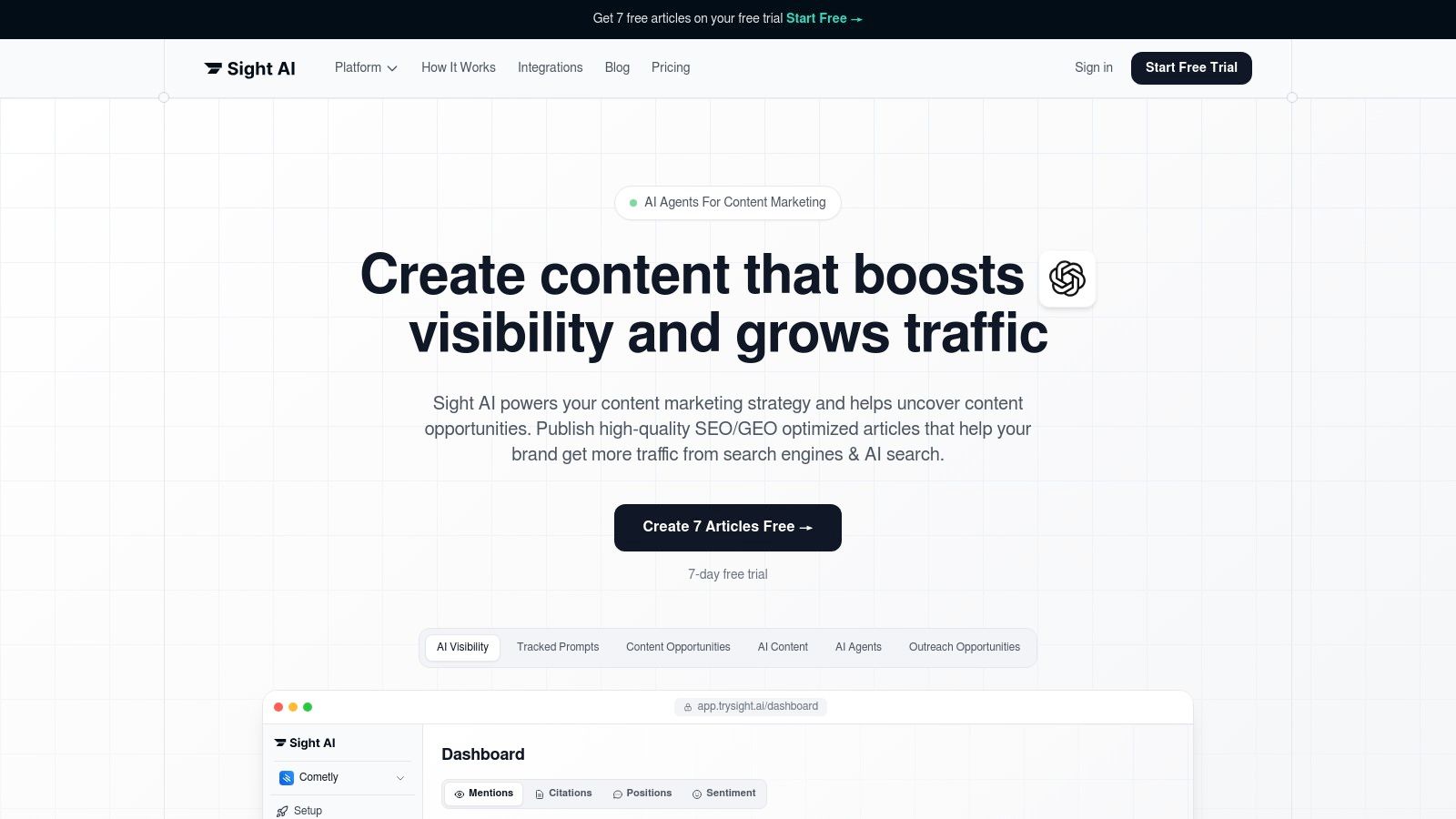
The platform’s core strength lies in its ability to translate AI visibility data, such as brand mentions, citations, and sentiment across LLMs, into actionable content opportunities. Instead of guessing what to write about, users receive prioritized briefs based on real-time signals, ensuring content is both relevant and impactful.
Key Features and Workflow
Sight AI’s feature set is built to automate and scale a modern content marketing program.
- AI Visibility Monitoring: The platform provides a unified dashboard to track how your brand is represented in AI model responses, offering a crucial feedback loop for content and brand strategy.
- Specialized AI Writing Agents: With over 13 specialized AI agents, Sight AI produces detailed, long-form articles between 2,500 and 4,500 words. These articles are not just text; they come complete with images and are structured around on-page SEO best practices.
- Automated Publishing and Indexing: A standout feature is its direct CMS integration, which allows it to push finished articles to your site, update the sitemap, and auto-submit new URLs to Google and Bing via IndexNow for faster discovery.
- Autopilot Mode: For teams focused on consistency, Autopilot mode can generate and publish one high-quality article per day, creating a powerful engine for compounding organic traffic growth with minimal manual intervention.
Ideal Use Cases
Sight AI is particularly well-suited for SEO managers, agencies, and SaaS teams aiming for high-volume, high-quality content production. Its ability to generate GEO-optimized content also makes it a strong choice for businesses targeting local markets. The hands-off nature of its publishing and indexing features provides significant operational efficiency.
Our Take: Sight AI is an exceptional choice for teams that want to move from a reactive to a proactive content strategy. By integrating AI visibility monitoring with a powerful, automated content production and publishing engine, it solves multiple challenges in a single, streamlined workflow.
Pros:
- Unified platform for AI monitoring and content creation.
- Scales long-form, SEO-optimized content production effectively.
- Fully automates publishing and accelerates indexing.
- Autopilot mode enables consistent content velocity.
Cons:
- Pricing is not publicly listed, requiring a demo or direct contact to assess cost.
- As with any AI tool, content still benefits from a final human review to ensure brand voice alignment and technical accuracy.
Website: https://www.trysight.ai
2. OpenAI — ChatGPT for work
ChatGPT has become a foundational tool for content teams, moving far beyond its initial perception as a simple chatbot. For businesses, its real power lies in the ChatGPT for work plans (Business and Enterprise), which provide the administrative controls and security features necessary for professional use. These plans transform the popular assistant into a secure, collaborative workspace for ideation, drafting, and data analysis.
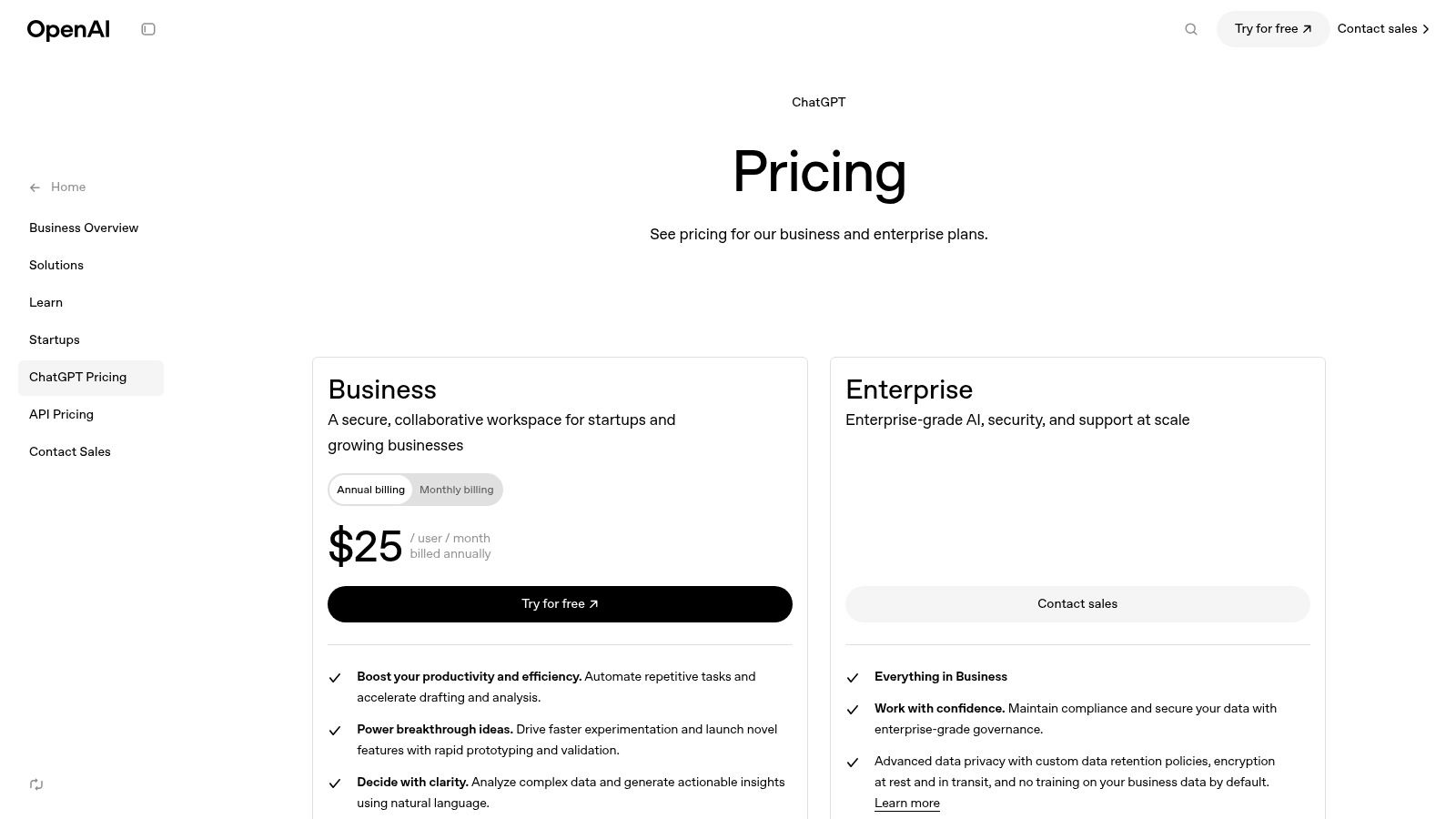
Unlike the consumer versions, the Business tier offers an admin console, SSO, and usage analytics, giving managers oversight into how their teams leverage the platform. Enterprise plans add further customization, including service level agreements and priority support. However, it's crucial to understand its limitations. While versatile, ChatGPT may not be the optimal choice for highly specialized tasks. For example, when evaluating specific platforms for content creation, it's insightful to consider user experiences, such as why Reddit users are abandoning ChatGPT for novel translation and what they're using instead, to understand real-world performance and alternatives.
Key Features and Pricing
The platform's strength is its constant evolution with access to OpenAI's latest models. Pricing can be complex, with different caps and features across Free, Plus, Team, and Enterprise tiers.
- Pricing: The Team plan is priced per user, per month. Enterprise pricing is custom and requires contacting sales.
- Key Differentiator: Robust enterprise-grade security, admin controls, and the strong, familiar OpenAI ecosystem.
Pros:
- Excellent for general-purpose ideation, drafting, and editing.
- Strong security and administrative features in paid business plans.
- Widely adopted, making team onboarding relatively easy.
Cons:
- Pricing tiers and message caps can be confusing to navigate.
- May be less specialized than other purpose-built AI content generation tools.
Website: https://openai.com/business/chatgpt-pricing
3. Anthropic — Claude
Anthropic's Claude family of models has emerged as a powerful alternative, excelling in tasks that require deep contextual understanding and nuanced writing. Its strength lies in its long-context reasoning and steerability, making it an exceptional choice for drafting research-heavy articles, summarizing lengthy documents, or refining complex narratives. Available through both a web interface and an API, Claude is designed for professionals who need coherent, high-quality output for long-form content generation.
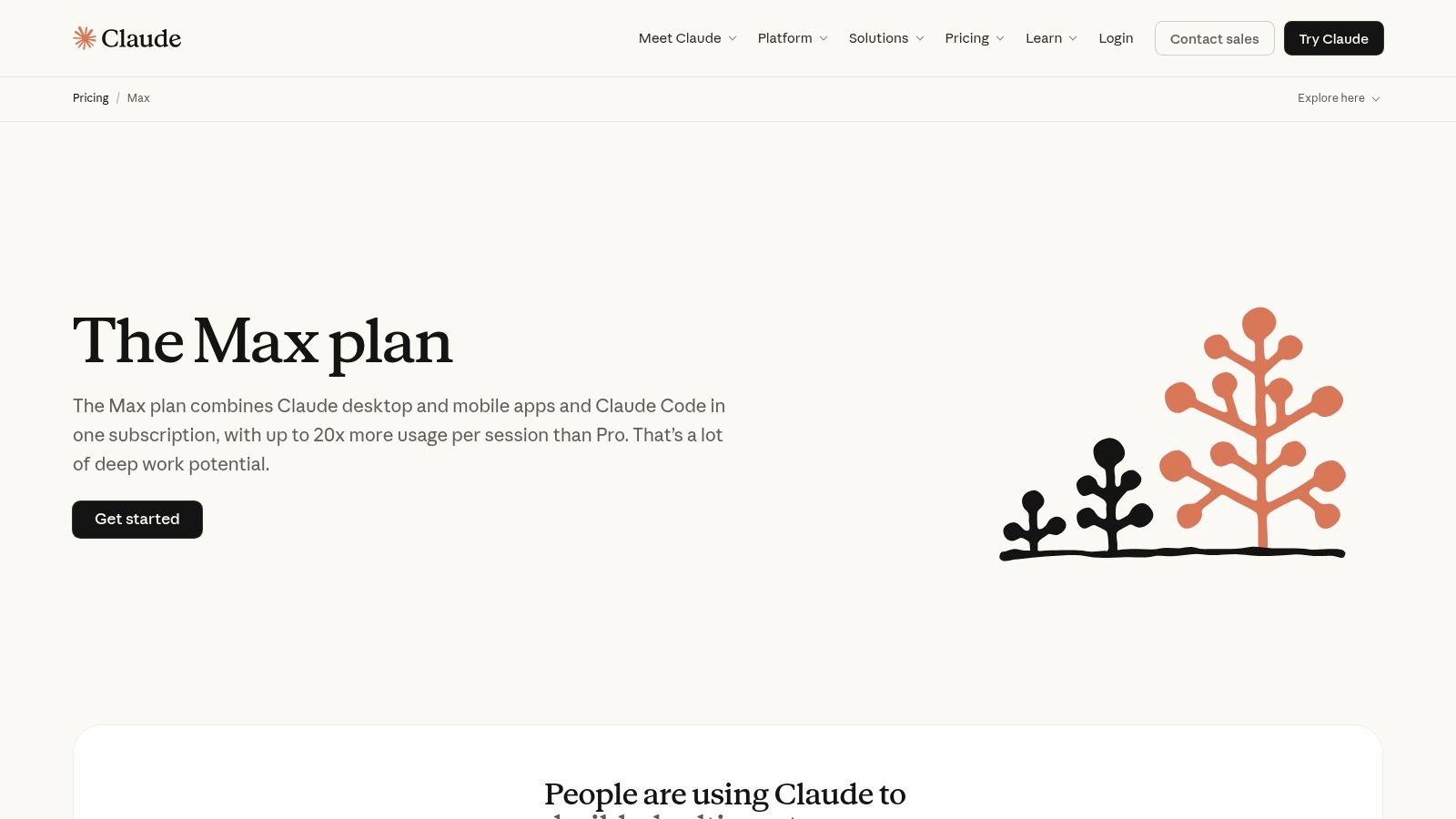
Unlike some general-purpose models, Claude is often praised for maintaining a consistent voice and logical flow across extensive text, a critical feature for long-form content creators. The Pro and Team plans offer higher usage limits, making them suitable for content teams with substantial workloads. Its capabilities also extend beyond pure content creation; for instance, its ability to analyze large volumes of text makes it a valuable asset for tasks like AI brand monitoring and sentiment analysis. This makes it one of the more versatile ai content generation tools for teams that need both creative and analytical power.
Key Features and Pricing
Claude’s architecture, featuring models like Sonnet and the more powerful Opus, is built to handle complex instructions and large documents effectively. The pricing structure is split between consumer-facing plans and a separate per-token model for API access.
- Pricing: The Team plan is priced per user, per month, with a minimum of 5 seats. API access is priced per million tokens.
- Key Differentiator: Superior long-context window and coherent output, making it ideal for in-depth research and long-form content.
Pros:
- Praised for coherent and high-quality long-form drafting and editing.
- Clear per-token API pricing is beneficial for automation and engineering teams.
- Excellent steerability for handling research-intensive tasks with large data inputs.
Cons:
- Plan names and limits for the web app (Pro/Team) differ from API pricing, which can be confusing.
- Differences between plans require careful evaluation of expected team usage.
Website: https://www.anthropic.com/max
4. Google — Gemini (AI Pro / Ultra)
Google has positioned Gemini as a powerful contender in the AI content generation tools space, particularly for users deeply embedded in the Google ecosystem. The AI Pro and Ultra subscription plans bundle its advanced assistant features with specialized writing and research tools like NotebookLM. This integration makes Gemini an excellent choice for mixed-media content production, from ideation and research to drafting within Google’s familiar application suite.
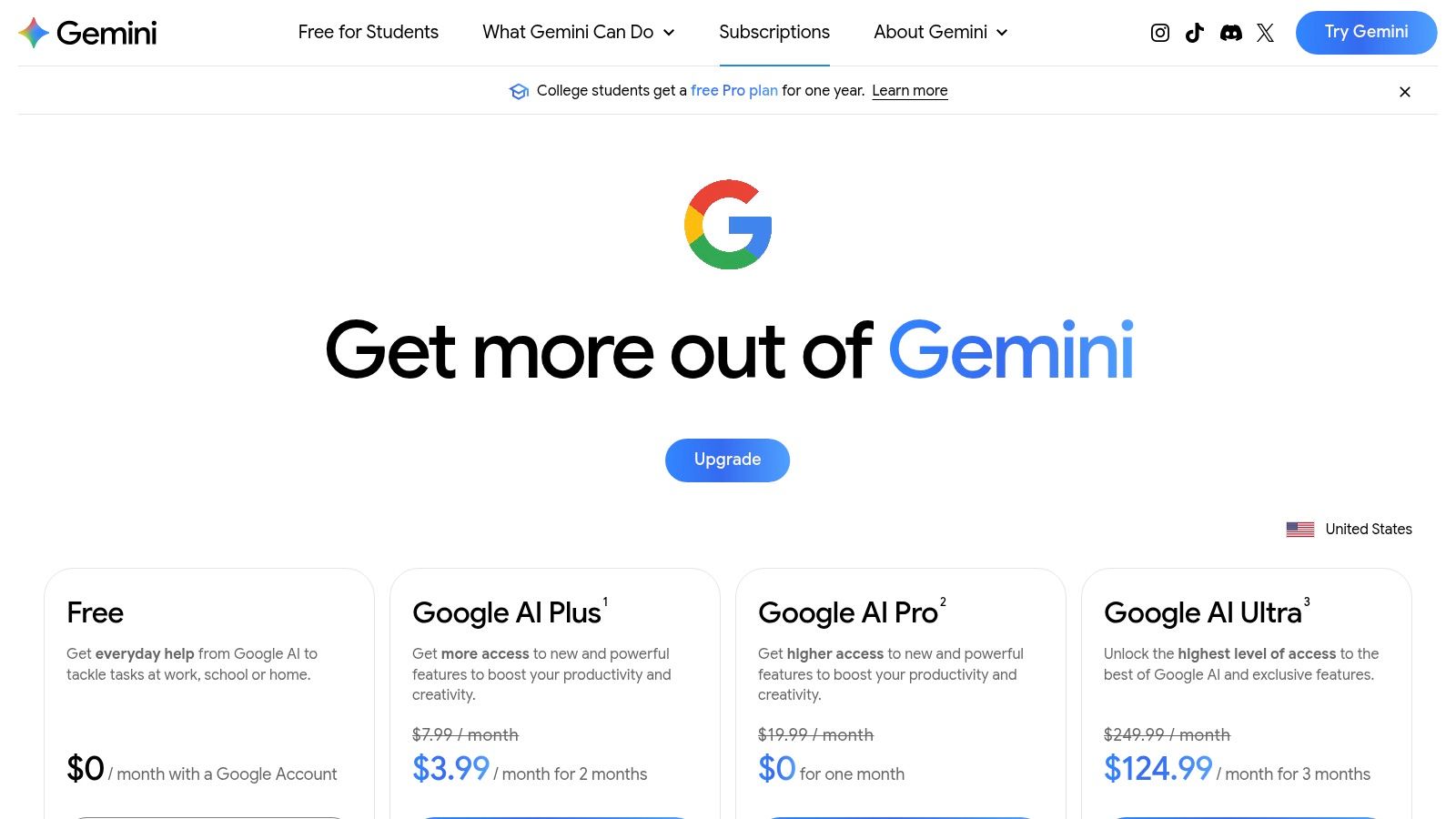
Unlike standalone writers, Gemini's value comes from its seamless connection with Google Docs, Gmail, and other services, creating a cohesive and efficient workflow for teams. The Pro plan provides access to the capable Gemini 2.5 Pro model and Deep Research capabilities, while the Ultra plan unlocks higher usage limits and more advanced features. However, potential users should be aware that some features and quotas can vary between the web and mobile versions, with certain capabilities remaining US-only for now.
Key Features and Pricing
The platform’s strength is its native integration with Google Workspace, turning familiar apps into AI-powered content hubs. Pricing is structured into different tiers, offering a clear path for scaling usage.
- Pricing: The AI Pro plan is available for a monthly fee. The Ultra plan is offered at a higher price point with expanded features and limits.
- Key Differentiator: Unmatched integration with the Google ecosystem, making it a natural choice for teams using Google Workspace.
Pros:
- Excellent value for mixed-media (text, image, video) content in one system.
- Tight integration with Google apps speeds up team workflows significantly.
- Generous usage limits are well-suited for teams producing regular assets.
Cons:
- Feature availability and quotas can differ between web and mobile platforms.
- Some of the most advanced capabilities are currently restricted to the US.
Website: https://gemini.google/us/subscriptions/
5. Jasper
Jasper has positioned itself as a premier AI platform specifically for marketing teams, moving beyond general content generation to focus on campaign orchestration and brand consistency. It is designed for creating cohesive marketing assets like briefs, landing pages, and ad copy, all while adhering to a defined brand voice. Its suite of tools is geared toward streamlining multi-asset launches and ensuring every piece of content aligns with strategic goals.
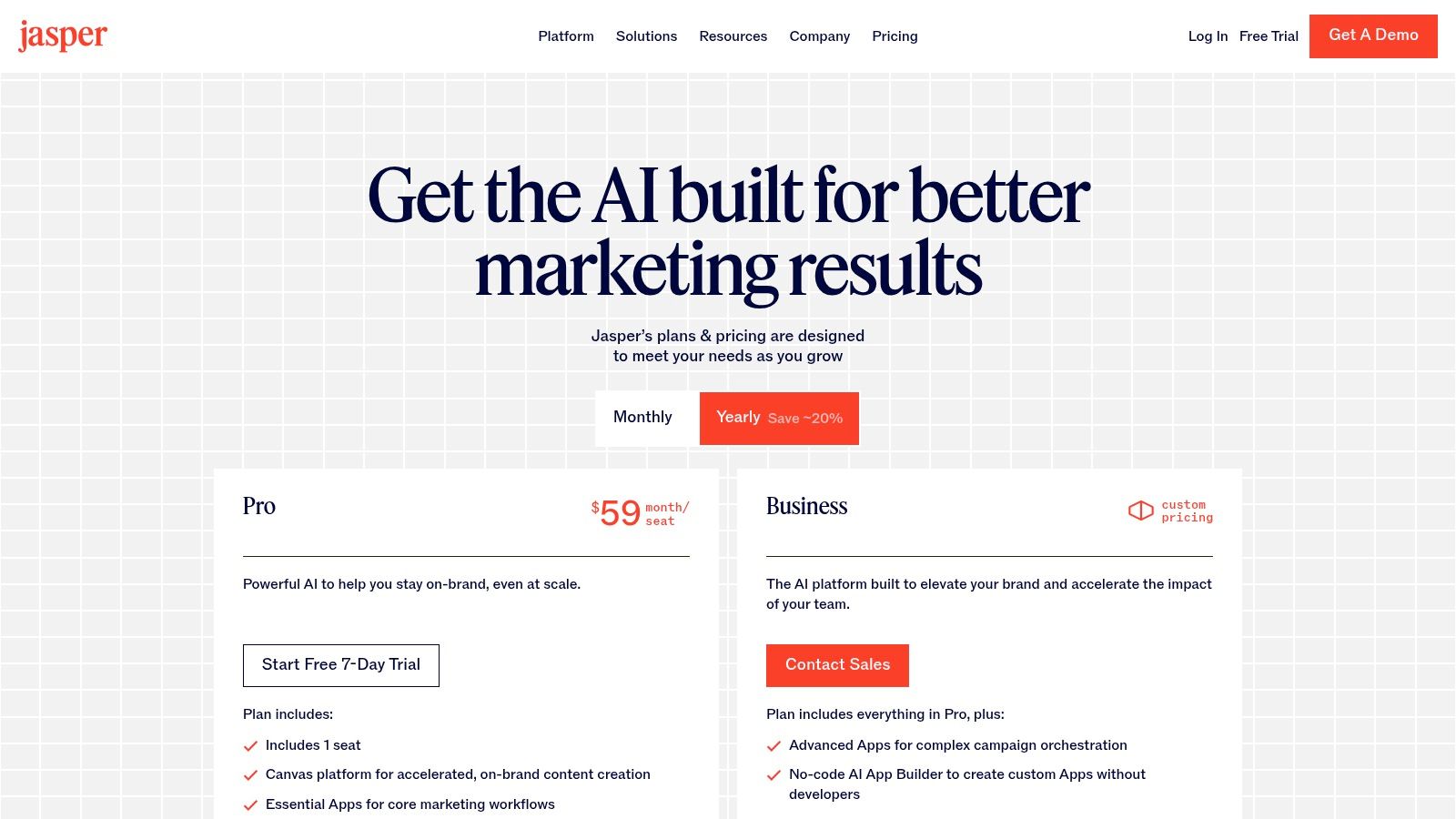
The platform’s strength lies in its marketing-centric workflows, like the Canvas workspace for collaborative planning and creation. With features for brand voice and knowledge controls, teams can ensure outputs are consistently on-brand. While Jasper excels at marketing content, it's important to pair its creative capabilities with a robust technical strategy. For instance, integrating its content into a workflow that prioritizes AI search engine optimization ensures that beautifully crafted campaigns also perform well in search. Its no-code app builder and API access provide further customization for advanced teams.
Key Features and Pricing
Jasper’s LLM-agnostic approach means it isn't tied to a single model, allowing it to adapt to the best technology available. Pricing is structured around team size and feature access, with a 7-day free trial available to test its fit.
- Pricing: Plans are billed per seat, with Creator, Pro, and Business tiers offering scaling features. Business plans require custom pricing.
- Key Differentiator: A comprehensive suite of tools built specifically for marketing campaign execution, from ideation to multi-channel asset creation.
Pros:
- Built from the ground up for marketing teams and their specific workflows.
- Strong brand voice and knowledge controls for consistent content.
- LLM-agnostic platform with robust enterprise-grade governance features.
Cons:
- Per-seat pricing can become expensive for larger marketing departments.
- Advanced governance and API access are locked behind higher-tier plans.
Website: https://www.jasper.ai/pricing
6. Copy.ai
Copy.ai positions itself as a versatile AI writing and workflow platform designed to scale content operations for marketing, sales, and operations teams. It moves beyond simple text generation by offering agent-style automations, allowing users to create reusable workflows for repetitive tasks like content brief creation, email campaign drafting, and social media post generation. This workflow-centric approach makes it a strong contender for businesses looking to systematize their content processes.
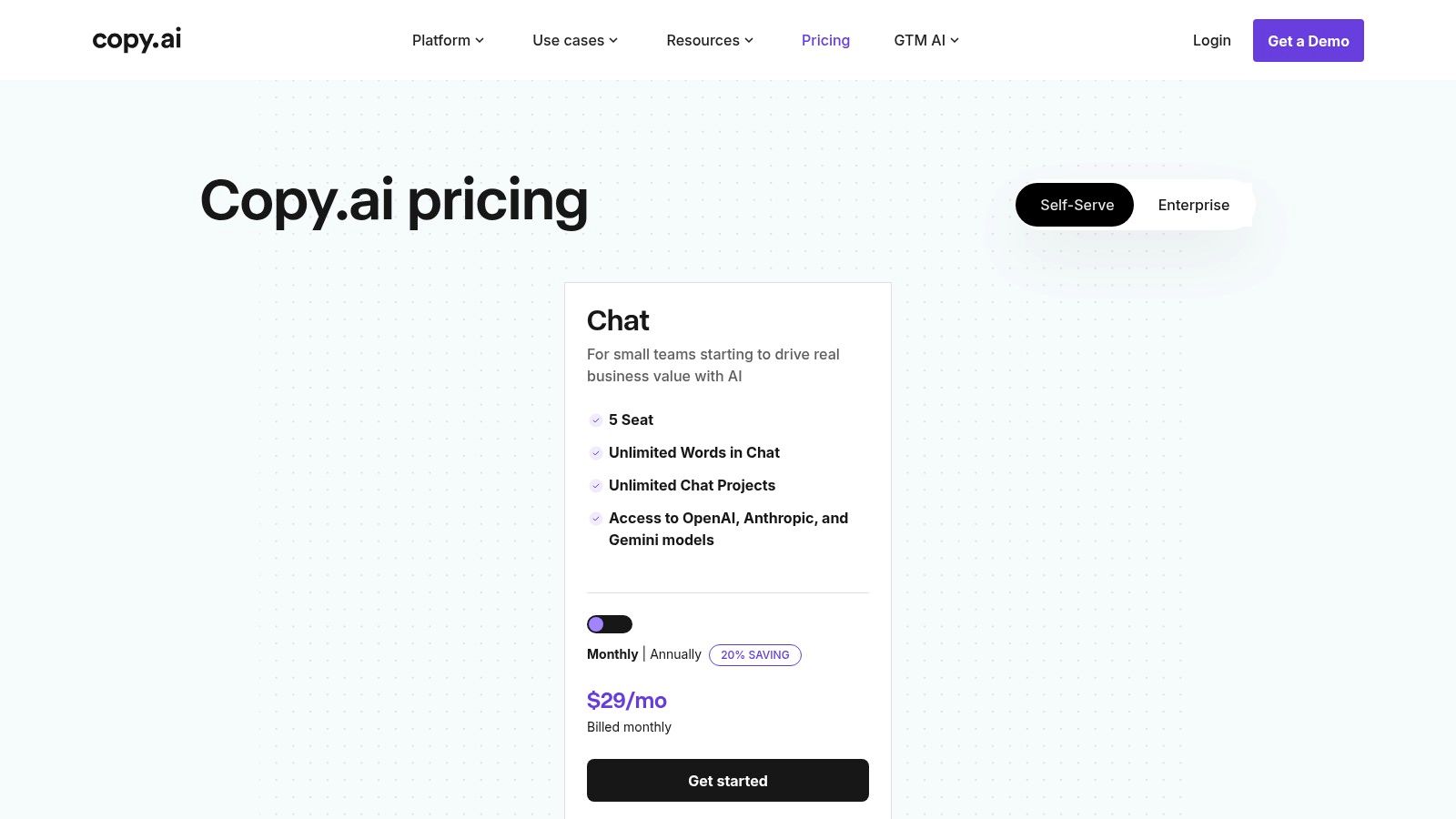
The platform provides access to multiple leading AI models, giving users the flexibility to choose the best engine for a specific task. While it offers a wide range of templates for common marketing needs, its real power is unlocked in the Agents plan. This tier introduces an "Agent Studio" and workflow credits, enabling teams to build and deploy custom AI agents that automate complex content creation and marketing sequences, making it a powerful tool for those who understand what is AI copywriting and want to scale its application.
Key Features and Pricing
Copy.ai's tiered pricing model is designed to support users from individuals to large enterprises, with advanced features reserved for higher plans. The guided implementation offered helps teams accelerate their time-to-value.
- Pricing: A free plan is available with a word limit. Paid plans start with a Pro tier for individuals and scale up to Team, Growth, and Scale plans with increasing features and workflow credits.
- Key Differentiator: The Agent Studio for building custom, reusable workflow automations and multi-model access (OpenAI, Anthropic, Gemini).
Pros:
- Low starting price point makes it accessible for individuals and small teams.
- Extensive template library covers a broad range of content marketing types.
- Access to multiple AI models provides flexibility and reduces vendor lock-in.
Cons:
- Advanced automation and scaling features are locked behind higher-priced plans.
- The credit-based system for workflows on certain tiers can be a limiting factor.
Website: https://www.copy.ai/prices
7. Writesonic
Writesonic positions itself as an all-in-one AI content platform, with a strong focus on generating SEO-optimized articles and blogs. What sets it apart is the integration of traditional AI content creation with advanced visibility tracking. Its unique GEO (Generative Engine Optimization) feature allows businesses to monitor how their brand is mentioned within AI-generated results across platforms like ChatGPT, Gemini, and Google’s AI Overviews, bridging the gap between content creation and its impact in the new AI-driven search landscape.
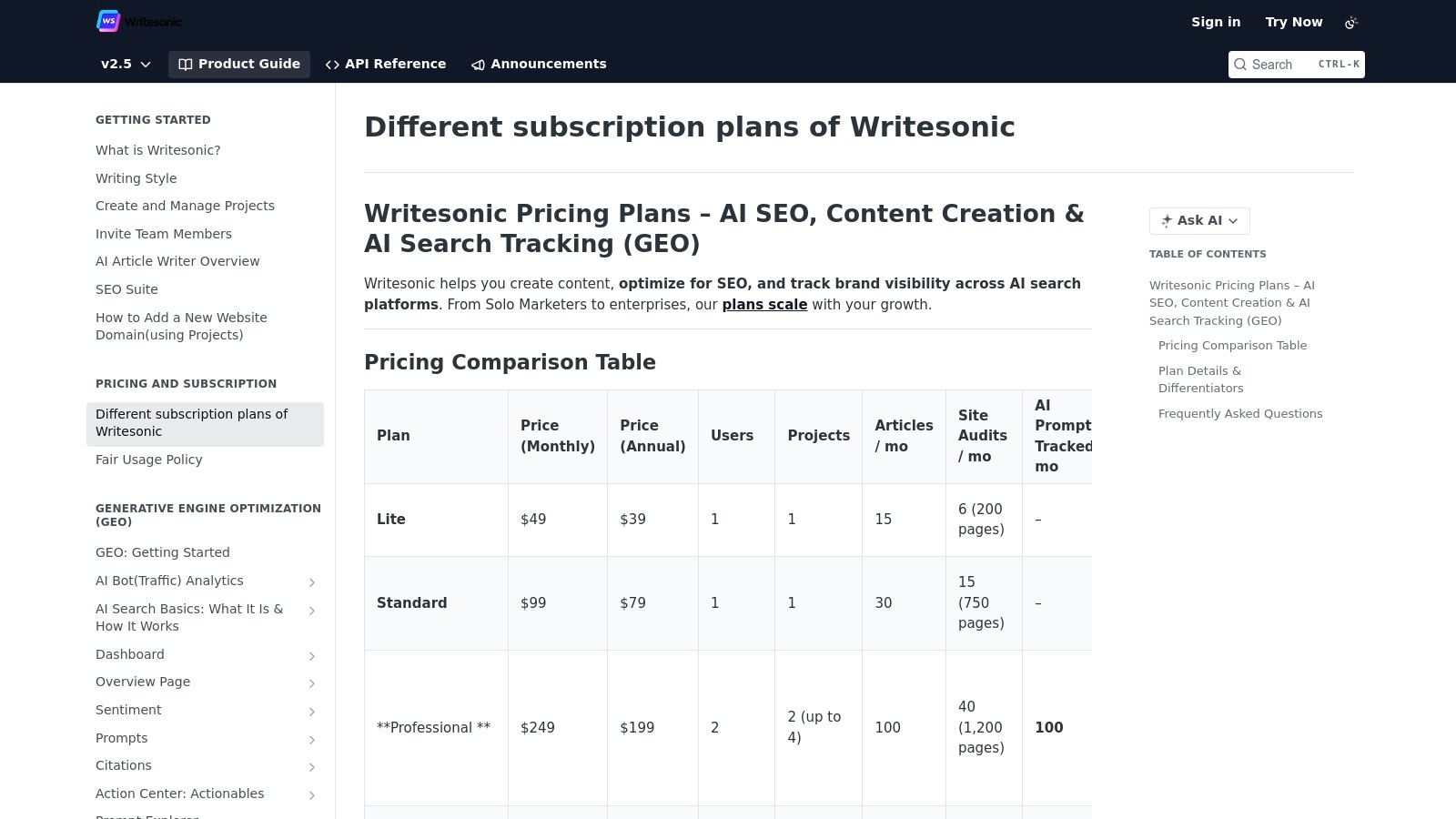
This platform is more than just a writer; it’s a strategic tool for content managers who need to ensure their output performs well in both traditional and generative search engines. By bundling site audits, SEO integrations, and AI analytics, Writesonic provides a cohesive workflow. However, users should carefully evaluate the plans, as access to its most powerful features like GEO tracking and significant API usage is reserved for the higher-priced tiers, which may be a barrier for smaller teams or individual creators.
Key Features and Pricing
Writesonic’s pricing structure is tiered, offering different quotas and feature sets from a Free plan up to Enterprise solutions. This makes it one of the more adaptable ai content generation tools for various budget levels, provided you select the right plan for your needs.
- Pricing: Plans range from a limited Free forever option to Business and Enterprise tiers. Substantial discounts are available for annual billing.
- Key Differentiator: Integrated Generative Engine Optimization (GEO) tracking to monitor brand presence in AI-powered search results.
Pros:
- Combines content creation, SEO auditing, and AI visibility tracking.
- Helps align content strategy with what generative AI models surface.
- Flexible pricing tiers with annual discounts available.
Cons:
- Feature limits and AI credit systems vary widely between plans.
- Advanced GEO capabilities are restricted to more expensive tiers.
Website: https://docs.writesonic.com/docs/different-subscription-plans-of-writesonic
8. Anyword
Anyword is a data-driven AI copywriting tool designed for performance marketers. Its standout feature is the Predictive Performance Score, which analyzes and scores copy variations for their potential to convert before you spend a dollar on A/B testing. This allows growth teams to generate and prioritize ad copy, email subject lines, and landing page headlines based on data-informed predictions, not just creative intuition.
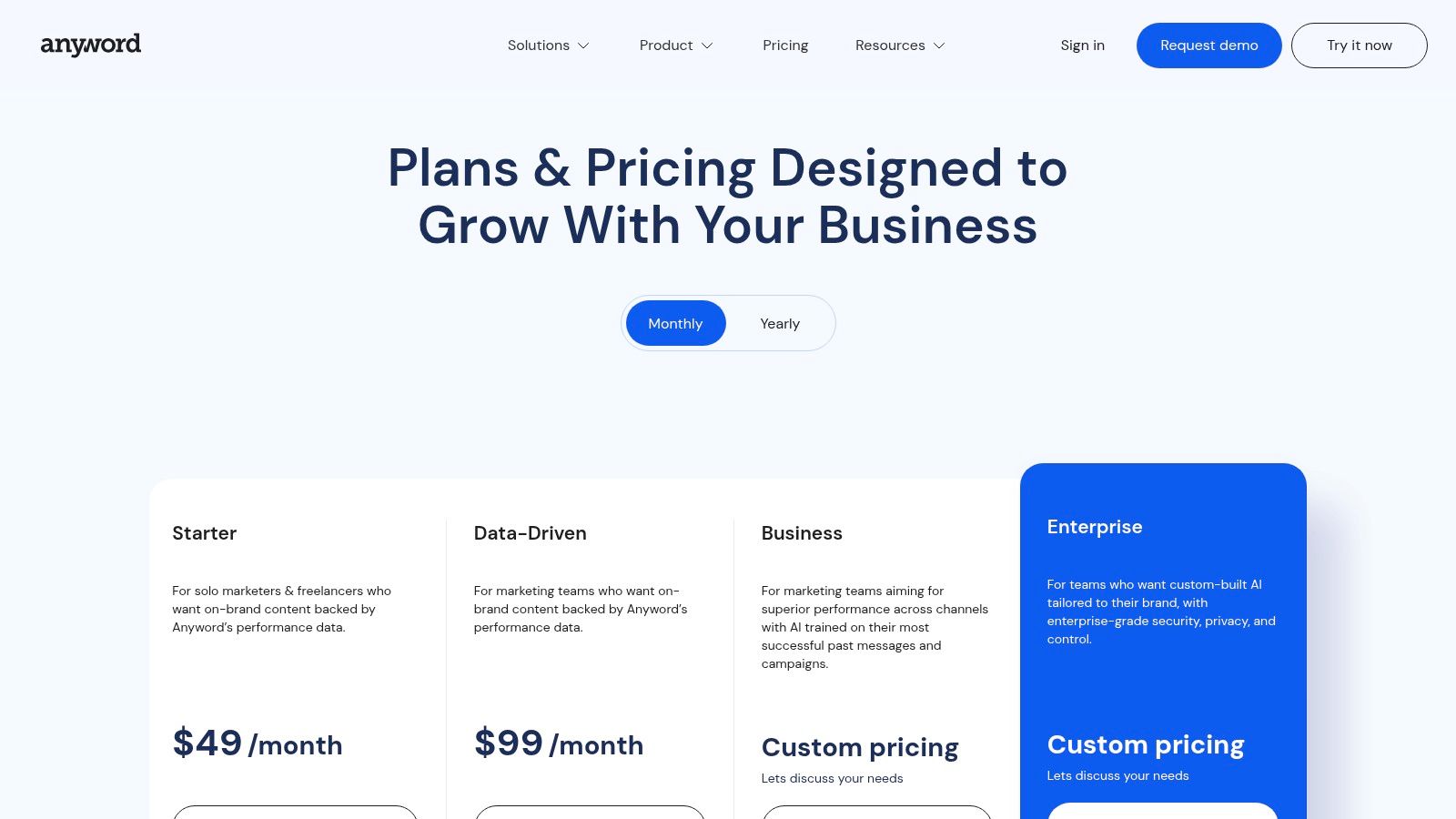
The platform connects to your marketing channels, like Meta and Google Ads, to train on your past campaign data and brand voice, improving the relevance and effectiveness of its suggestions over time. While other AI content generation tools focus on volume, Anyword focuses on impact, making it a strategic choice for teams where conversion rates are the primary KPI. Its templates and real-time copy intelligence guide users to create content that resonates with specific target audiences.
Key Features and Pricing
Anyword's plans are built around scaling performance-driven content creation. The free plan and trial options are generous enough to test its core functionality and workflow fit before committing.
- Pricing: A free starter plan is available. Paid plans include Starter, Team, and Business, with custom pricing for Enterprise needs.
- Key Differentiator: The unique Predictive Performance Score that helps forecast copy effectiveness and de-risk campaign launches.
Pros:
- Helps prioritize high-likelihood winners before running paid A/B tests.
- Free plan and trial options allow for workflow testing.
- Excellent for performance-driven marketing content (ads, landing pages, emails).
Cons:
- Best value requires connecting channels and importing performance data.
- Some advanced scoring and analytics features are locked to higher-priced plans.
Website: https://www.anyword.com/pricing
9. Writer (Writer.com)
Writer is an enterprise-grade writing platform built for organizations that prioritize brand consistency, governance, and secure AI adoption. Unlike more general-purpose AI content generation tools, Writer excels in creating a controlled environment where all content adheres to specific style guides, terminology, and legal standards. It is designed for large teams in regulated industries that require repeatable, compliant content workflows rather than just one-off generation.
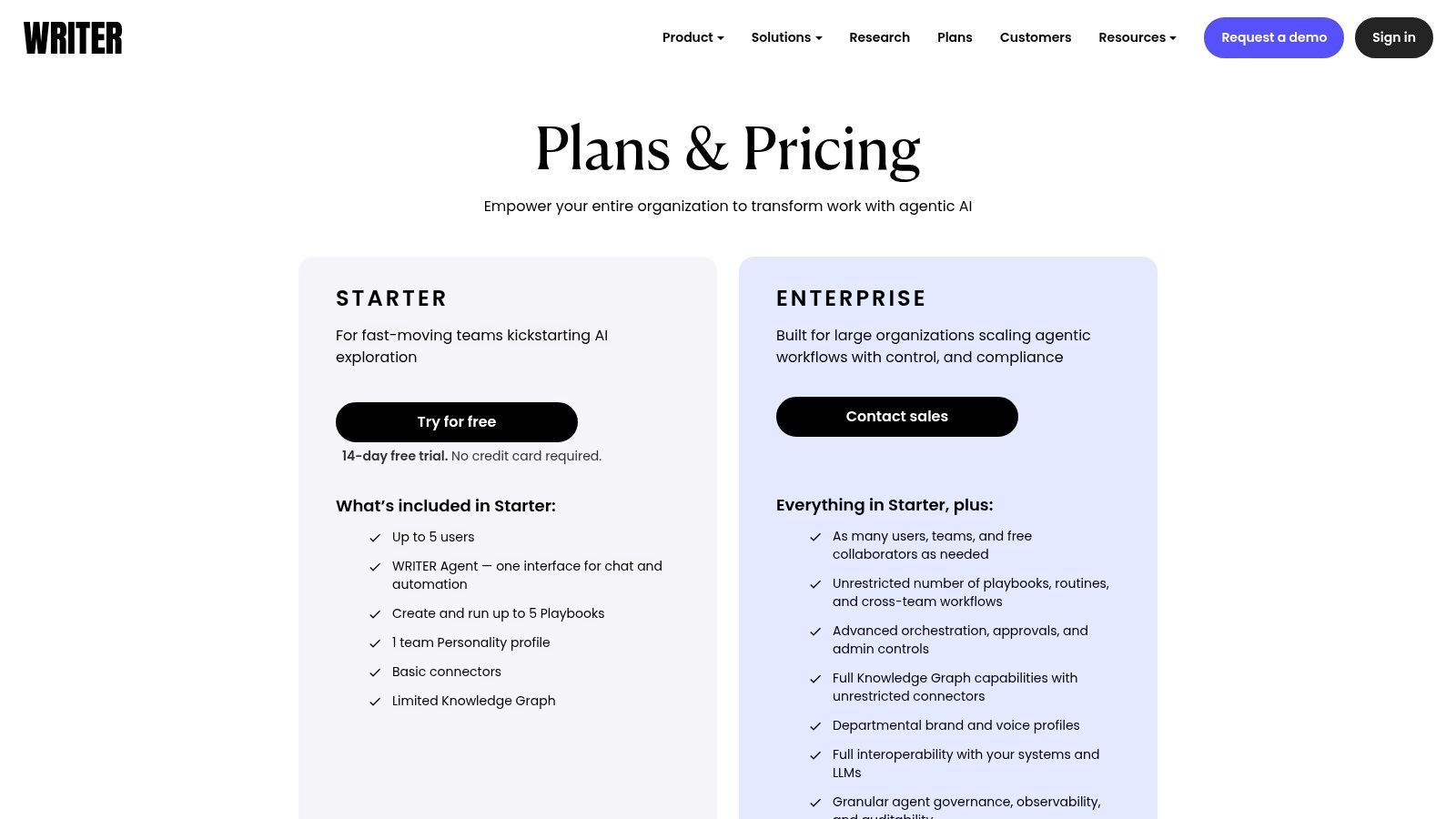
The platform’s power lies in its brand governance features and ability to ground outputs in a company’s own knowledge graph. This ensures that the AI generates on-brand, factually accurate content by referencing internal data sources. Writer also offers "Playbooks," which are agentic, repeatable workflows that can be connected to other business applications, automating complex content tasks from start to finish. This focus on orchestration and compliance makes it a strategic choice for businesses looking to scale content operations safely.
Key Features and Pricing
Writer’s architecture is built around control and customization, making it ideal for teams with strict content requirements. Public pricing is limited, reflecting its enterprise focus.
- Pricing: The Starter plan is available for teams, but full enterprise features require a custom quote from their sales team.
- Key Differentiator: Unmatched brand governance, knowledge graph grounding, and enterprise-level security (SOC 2, HIPAA).
Pros:
- Excellent for governance and scale, especially in regulated industries.
- Agentic workflows and orchestration go beyond simple generation.
- Offers a 14-day trial to evaluate its core features.
Cons:
- Public pricing is limited; full capabilities are sales-led.
- Enterprise features require custom engagement and can be complex to set up.
Website: https://writer.com/plans/
10. Surfer (Surfer AI + Content Editor)
Surfer has carved out a distinct niche among ai content generation tools by tightly integrating its AI writer with a powerful SEO optimization suite. It's built for content teams focused on search engine performance, helping them plan topics, generate drafts designed to rank, and optimize existing content with its live Content Editor. This end-to-end workflow is engineered to produce content that is not just written, but strategically aligned with current SERP data.
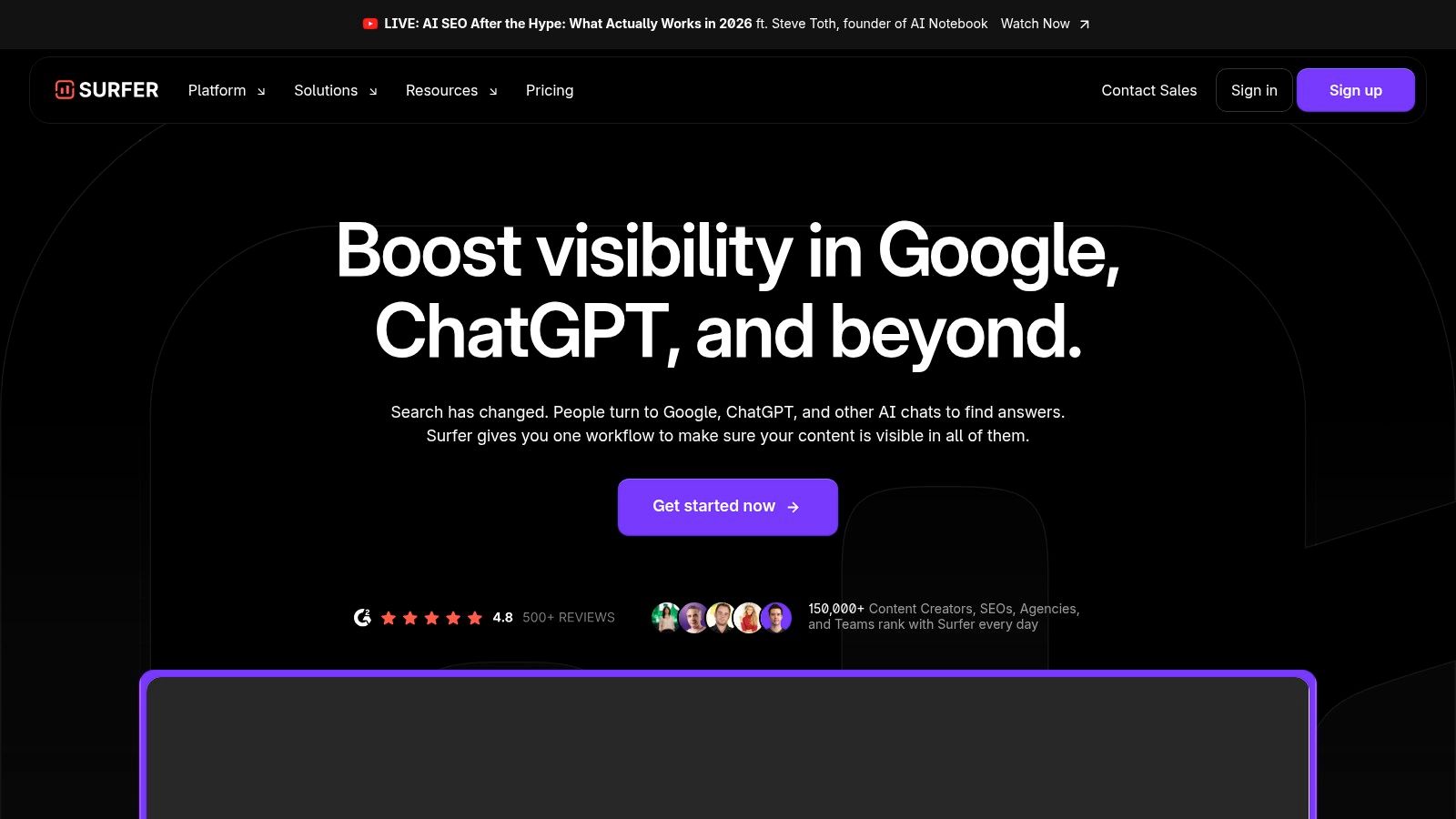
The platform's core strength is this combination of drafting and optimization. After Surfer AI generates a draft based on a target keyword, the user moves into the Content Editor, a dynamic interface that provides a live Content Score and actionable suggestions. It analyzes top competitors to recommend terms, headings, and structures, making the optimization process tangible and data-driven. This approach bridges the gap between raw AI output and a polished, competitive article ready for publication.
Key Features and Pricing
Surfer's plans are structured to support everyone from individual creators to large agencies, with features scaling accordingly. Higher-tier plans add valuable tools like rank tracking that includes visibility in AI chats and Google’s AI Overviews.
- Pricing: Plans are offered on a tiered subscription model, with costs varying based on the number of AI article credits and Content Editor queries.
- Key Differentiator: A unified workflow that combines SERP-analyzed AI drafting with a real-time, on-page SEO optimization editor.
Pros:
- Excellent for SEO teams needing on-page guidance tied to live SERP analysis.
- Combines content generation and optimization into a single, efficient workflow.
- Clear plan differentiation for solo creators versus scaling agencies.
Cons:
- AI article credits and Content Editor query limits can be restrictive on entry-level tiers.
- Pricing can vary; users should confirm final costs at checkout.
Website: https://www.surferseo.com
11. G2 — AI Writing Assistants category
While not a generation tool itself, G2’s AI Writing Assistants category is an essential research hub for any team evaluating these platforms. G2 acts as a peer-review-driven marketplace, aggregating user reviews, trend data, and direct comparisons to help businesses shortlist vendors. It provides a crucial layer of social proof and due diligence before committing to a specific tool.
The platform allows you to filter and compare tools based on company size, industry, and specific features, moving beyond marketing claims to see how these tools perform in the real world. This is particularly useful when weighing the pros and cons of different platforms for specific tasks, such as understanding the best practices for creating AI-generated SEO content that actually ranks. However, remember that some listings are sponsored, so it's always wise to cross-reference top contenders on their own websites.
Key Features and Pricing
G2's value lies in its structured, community-verified data, which simplifies the complex vendor selection process for AI content generation tools.
- Pricing: Free to use for research, vendor comparison, and shortlisting.
- Key Differentiator: Aggregates real-world user reviews, sentiment data, and side-by-side feature comparisons in a single, searchable interface.
Pros:
- Excellent for due diligence with fresh review volume and sentiment summaries.
- Helps compare multiple credible options to avoid vendor lock-in.
- Free to use for initial research and creating vendor shortlists.
Cons:
- Some listings are sponsored and may require additional validation.
- Acts as an evaluation layer; purchasing still happens on vendor sites.
Website: https://www.g2.com/categories/ai-writing-assistant
12. AppSumo — AI writing and content tools (deal marketplace)
AppSumo is not a single tool but a marketplace for lifetime and heavily discounted software deals, making it a unique resource for content teams on a budget. It frequently features a wide array of ai content generation tools, from niche AI writers to specialized SEO optimizers. For teams looking to experiment without committing to expensive monthly subscriptions, AppSumo offers a low-risk environment to test emerging platforms.
The platform is ideal for discovering and acquiring supplementary tools that can complement a core content stack. However, the transient nature of these deals means it’s not suitable for mission-critical operations, as some lifetime deals come from early-stage startups that may pivot or shut down. Its strength lies in its 60-day refund policy, which allows for genuine, hands-on evaluation of a tool's capabilities. For those just starting, exploring these deals alongside established platforms can be a cost-effective way to build a toolkit; many even start with a free AI writer before investing.
Key Features and Pricing
The core value is the access to lifetime deals (LTDs) on up-and-coming software, offering significant potential savings over subscription models. Pricing is deal-specific and varies widely.
- Pricing: One-time payments for lifetime access are common, though pricing depends entirely on the specific software deal available at any given time.
- Key Differentiator: A constantly rotating marketplace of lifetime software deals, backed by a generous 60-day money-back guarantee for low-risk experimentation.
Pros:
- Low-risk trials of niche tools via refund policy.
- Occasional strong value on evergreen utilities and one-time purchases.
- Useful for one-off needs or experimenting with tools that complement a core stack.
Cons:
- Lifetime AI deals can be risky as some tools later shut down or restrict features.
- Deals are opportunistic and often not suitable for mission-critical tooling.
Website: https://appsumo.com
Top 12 AI Content Generation Tools — Feature Comparison
| Product | Core capabilities | AI visibility & monitoring | Content scale & publishing | Best for / Pricing |
|---|---|---|---|---|
| Sight AI | End-to-end AI visibility + content platform; prioritized briefs | Monitors ChatGPT, Gemini, Claude, Perplexity, Grok & Google; tracks prompts, mentions, positions, citations, sentiment | 13+ AI agents produce 2.5–4.5k SEO/GEO articles; CMS push, sitemap updates, IndexNow; Autopilot (1/day) | SEO managers, content teams, agencies, e‑commerce, SaaS; 7 free articles trial; contact sales |
| OpenAI — ChatGPT for work | General-purpose assistant, multimodal models, analytics | No native brand-AI visibility tracking | Strong drafting/ideation; data analysis; team workspace (no direct CMS push) | Teams needing flexible assistant & enterprise controls; Business/Enterprise pricing varies |
| Anthropic — Claude | Steerable writing, long-context models, API/web access | No built-in brand visibility features | Suited to long-form drafting and research workflows; Max tiers for higher capacity | Research-heavy writers, engineering/automation teams; per‑token API pricing |
| Google — Gemini (Pro/Ultra) | Mixed-media assistant, NotebookLM, creative apps | Limited AI visibility features; integrates with Google data | Good for multimedia content; Google Docs/Gmail integration and usage credits | Teams in Google ecosystem; Pro/Ultra tiers with varying quotas |
| Jasper | Marketer-focused content platform, brand voice controls | Not focused on AI-source visibility | Campaign orchestration, on‑brand assets, collaboration, API | Marketing teams; per-seat pricing, 7‑day trial |
| Copy.ai | Templates, multi-model access, agent-style automations | No specialized AI visibility monitoring | Unlimited words (Chat tier); Agents plan for workflow automation | Small teams, low starting price; paid tiers for advanced agents |
| Writesonic | AI content + SEO/GEO features, site audits | GEO tracking across AI sources (higher tiers) | Article generation, SEO integrations, analytics, API | SEO-aware teams wanting creation + visibility; GEO on pro plans |
| Anyword | Data-driven copywriting with predictive scores | No native AI-brand monitoring (focus on performance) | Templates, predictive scoring for ads/emails/landing pages | Performance marketers; free plan/trial; best with channel data connected |
| Writer (Writer.com) | Brand governance, terminology, knowledge grounding | Not an AI-source monitor—focus on governance | Playbooks, orchestration, connectors, enterprise security/compliance | Regulated enterprises; sales‑led pricing beyond Starter |
| Surfer (Surfer AI + Content Editor) | SEO-first drafting + live Content Editor | Rank & visibility tracking (AI Overviews on higher tiers) | Ready-to-rank drafts, live content score, site audits, WP/Docs integration | SEO teams focused on on-page optimization; tiered credits apply |
| G2 — AI Writing Assistants | Review marketplace, category rankings, comparisons | Provides user sentiment & review trends (research layer) | N/A (evaluation/research tool) | Vendor shortlisting and due diligence; free to use |
| AppSumo — deals marketplace | Time-limited software deals, refunds | N/A | N/A (deal marketplace for tools) | Budget/experiment buyers; 60‑day refund policy; opportunistic purchases |
Building Your AI-Powered Content Engine with Sight AI
We've explored a comprehensive landscape of AI content generation tools, from foundational large language models like GPT-4 and Gemini to specialized platforms like Jasper and Surfer AI. The journey from manual content creation to an AI-augmented workflow is no longer a futuristic concept; it's a strategic imperative for any team aiming for scale, efficiency, and competitive SERP visibility. The key takeaway is that there is no single "best" tool, only the right tool for your specific operational needs, budget, and strategic goals.
The sheer variety can be overwhelming, but this diversity is also the industry's greatest strength. Your choice hinges on a clear understanding of your primary use case. Are you a solo creator needing a versatile writing assistant? A platform like ChatGPT or Claude might be your ideal starting point. Are you an SEO agency managing dozens of clients? A solution like Surfer AI, with its deep integration of content optimization and generation, becomes invaluable. For enterprise teams focused on brand consistency and compliance, a platform like Writer.com offers the necessary guardrails.
Synthesizing Your AI Content Strategy
As you move from evaluation to implementation, several core principles should guide your decision. Don't chase the tool with the most features; instead, focus on the one that solves your most significant bottleneck. The most powerful AI is useless if it doesn't integrate smoothly into your existing processes.
Reflect on these critical questions before committing:
- Workflow Integration: How will this tool fit into our current content lifecycle? Does it connect with our CMS (like WordPress or Webflow), project management software, and SEO tools? A disjointed process creates more work, not less.
- Team Adoption and Training: What is the learning curve? A simple, intuitive interface is often more valuable than a complex one that requires extensive training and discourages team-wide adoption.
- Scalability vs. Control: Do we need to produce a high volume of content quickly, or is our priority meticulous brand voice control and factual accuracy? Your answer will push you toward either high-output generative tools or more controlled, brand-specific platforms.
- Total Cost of Ownership: Look beyond the monthly subscription. Consider the time cost of training, editing, and fact-checking the AI's output. A cheaper tool that produces lower-quality content may ultimately be more expensive in terms of human hours.
The Human-in-the-Loop Imperative
Ultimately, the most successful content teams don't replace humans with AI. They empower humans with AI. The most effective use of these ai content generation tools involves a "human-in-the-loop" model. Use AI to conquer the blank page, conduct initial research, generate outlines, and handle the repetitive, structural aspects of content creation. This frees up your human strategists, writers, and editors to focus on higher-value tasks: infusing content with unique insights, authentic brand storytelling, expert perspectives, and rigorous fact-checking.
This collaborative approach is the foundation of a modern content engine. It transforms AI from a simple automation tool into a strategic partner, enabling you to produce higher-quality content at a scale that was previously unimaginable. The future of content isn't just about speed; it's about leveraging technology to amplify human creativity and expertise. By choosing wisely and integrating thoughtfully, you can build a formidable content operation that not only meets but exceeds your growth objectives.
Ready to move from theory to execution? Sight AI is designed as the operational hub for your entire content strategy, integrating the creative power of AI with the structured workflows your team needs to scale. See how Sight AI can streamline your research, creation, and optimization processes to build a truly efficient content engine.