Your marketing team just launched a major campaign. Within hours, thousands of mentions appear across social media, review sites, and discussion forums. The volume looks impressive in your analytics dashboard—but what are people actually feeling? Are they excited? Skeptical? Frustrated? The gap between raw mention counts and genuine emotional understanding can make the difference between doubling down on a winning strategy and pouring budget into a messaging approach that's quietly alienating your audience.
This is where AI sentiment analysis transforms marketing from a numbers game into an emotional intelligence operation. Instead of manually reading through hundreds of comments or waiting weeks for survey results, modern sentiment analysis tools decode customer emotions at scale—processing thousands of text sources in real time to reveal not just what people are saying, but how they feel about your brand, products, and campaigns.
In this guide, we'll break down how AI sentiment analysis actually works, explore five high-impact marketing applications that deliver immediate value, and show you how to build a sentiment tracking workflow that turns emotional data into strategic action. You'll also discover why tracking sentiment across AI platforms like ChatGPT and Claude has become just as critical as monitoring traditional social channels.
The Science Behind Emotional Intelligence at Scale
Think of early sentiment analysis tools as blunt instruments—they scanned text for words like "love" or "hate" and assigned a positive or negative score accordingly. If someone wrote "I love how this product fails constantly," the system would flag it as positive because it spotted the word "love." Crude, right?
Modern AI sentiment analysis operates on an entirely different level. Natural language processing (NLP) models now understand context, syntax, and semantic relationships between words. These systems recognize that "This feature is sick!" expresses enthusiasm in consumer tech contexts, while the same word signals a problem in healthcare discussions. They catch sarcasm, detect hedging language like "I guess it's okay," and identify the emotional difference between "The update fixed everything" and "The update supposedly fixed everything."
The evolution happened in stages. Rule-based systems relied on manually coded dictionaries—if a word appeared on the "positive" list, the text got a positive score. These systems couldn't adapt to new slang, industry jargon, or contextual nuances. Then came machine learning models trained on millions of labeled examples, learning patterns that humans might miss. Today's transformer-based models like BERT and GPT variants understand relationships between words across entire sentences, capturing subtlety that earlier systems couldn't touch.
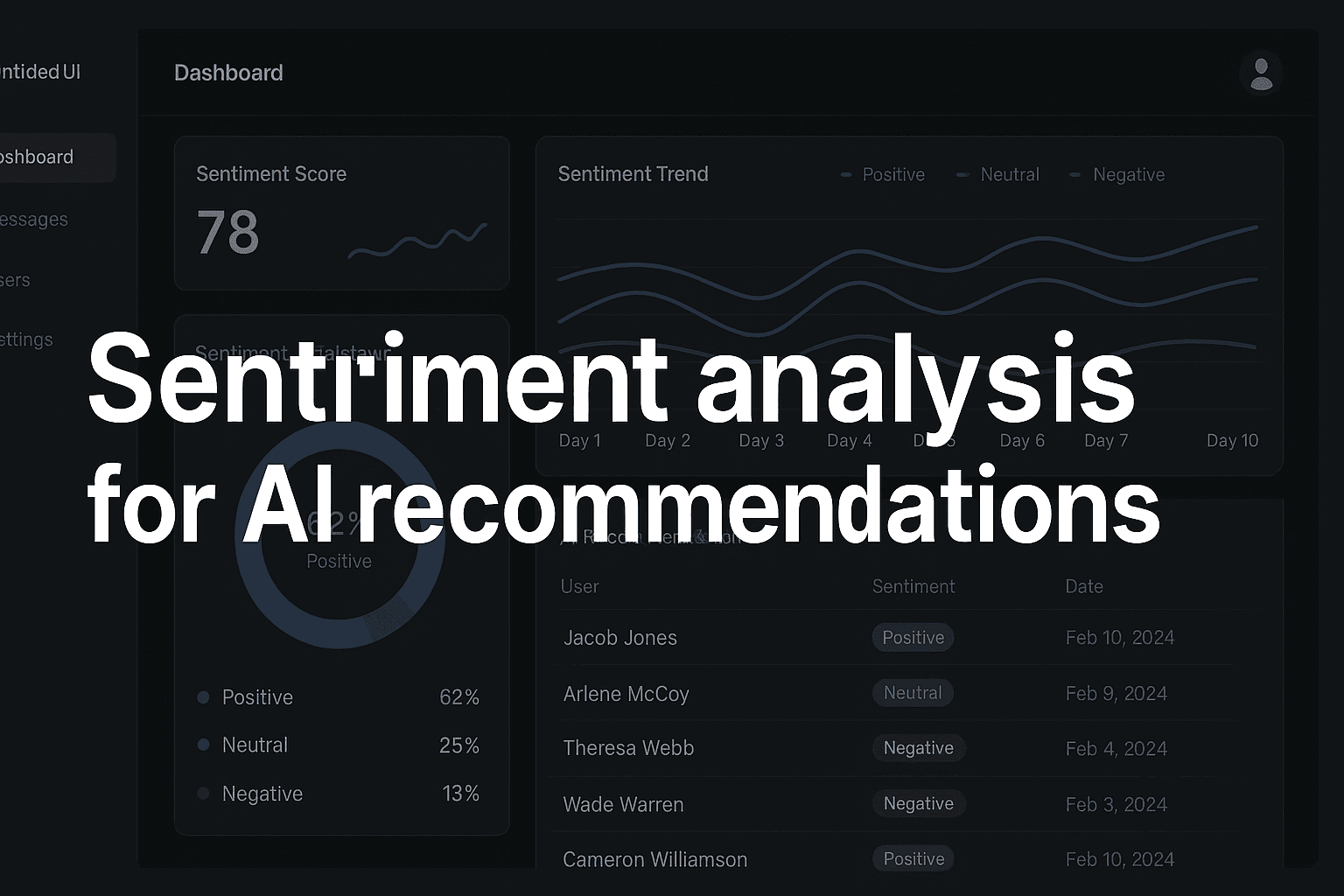
Here's what makes this revolutionary for marketing: these AI models don't just classify text as positive, negative, or neutral. They detect specific emotions—frustration, excitement, trust, skepticism, disappointment, anticipation. When customers write "I've been waiting months for this feature and it finally works exactly as promised," the system recognizes both the initial frustration and the ultimate satisfaction, providing marketing teams with nuanced emotional intelligence. Understanding how sentiment analysis powers AI recommendations reveals why this technology has become essential for modern marketing strategies.
The scale advantage is equally transformative. Traditional market research methods like surveys and focus groups provide depth but lack speed and breadth. By the time you've recruited participants, conducted sessions, and analyzed results, market conditions have shifted. Focus groups might capture insights from 50 people over two weeks. AI sentiment analysis processes feedback from 50,000 people in two hours—across social media, review sites, support tickets, forum discussions, and increasingly, AI platform responses.
This technology also adapts to your specific context. Generic sentiment models might misread industry-specific terminology, but modern systems can be fine-tuned on your category's language patterns. A phrase like "aggressive pricing" might signal negativity in luxury goods but positivity in budget retail. AI models learn these contextual distinctions, delivering accuracy that generic tools can't match.
Five High-Impact Marketing Applications
Campaign Performance Monitoring: Launch day used to mean crossing your fingers and waiting for end-of-week reports. AI sentiment analysis changes that equation entirely. Within hours of launching a campaign, you can detect whether your messaging resonates emotionally or falls flat. When a major brand launches a product video, sentiment tracking reveals whether viewers respond with excitement, confusion, or indifference—before significant budget gets committed to amplification. Marketing teams that monitor sentiment in real time can pivot messaging, adjust targeting, or double down on winning creative while campaigns are still fresh.
The insight goes beyond aggregate scores. Sentiment analysis breaks down emotional responses by audience segment, channel, and specific campaign elements. You might discover that your video's first 15 seconds generate excitement, but sentiment drops when the pricing reveal happens. Or that LinkedIn audiences respond positively while Reddit communities express skepticism. This granular emotional intelligence enables optimization that aggregate metrics like impressions and clicks simply can't provide. Teams running a digital marketing campaign find that sentiment data transforms their ability to iterate quickly.
Competitive Intelligence: Understanding your own brand sentiment matters, but knowing how audiences feel about competitors creates strategic advantage. Sentiment analysis tracks emotional responses to competitor product launches, pricing changes, and marketing campaigns. When a competitor's new feature generates frustrated comments about complexity, your marketing team can emphasize your solution's simplicity. When competitor messaging shifts trigger positive sentiment, you can analyze what resonated and adapt your approach.
This intelligence extends to identifying competitor weaknesses before they become public knowledge. A gradual increase in frustrated sentiment around a competitor's customer service, even without major news coverage, signals an opportunity to emphasize your support quality. Learning how to do competitive analysis in SEO combined with sentiment tracking creates a powerful intelligence advantage that most competitors simply don't have.
Product Feedback Mining: Product teams drowning in review data and support tickets need a way to extract signal from noise. Sentiment analysis doesn't just tell you that customers are unhappy—it identifies which specific features generate frustration and which delight users. When analyzing thousands of app store reviews, the system might reveal that users love your interface design but express consistent frustration with export functionality. This feature-level emotional intelligence informs roadmap prioritization with real user emotion, not just feature request counts.
The same approach applies to support ticket analysis. Instead of manually categorizing complaints, sentiment analysis automatically identifies which product areas generate the most negative emotion, helping teams focus improvement efforts where they'll have the greatest impact on customer satisfaction.
Crisis Detection: Brand crises rarely explode without warning—they usually simmer as negative sentiment builds across channels. AI sentiment analysis acts as an early warning system, alerting communications teams to negative sentiment spikes before they escalate into major reputation damage. When a product issue starts generating frustrated comments in niche communities, sentiment tracking catches it before mainstream media picks up the story.
The key is setting intelligent alert thresholds. A small increase in negative sentiment might be normal noise, but a sharp spike or sustained negative trend signals something requiring immediate attention. Teams with sentiment monitoring can respond to emerging issues while they're still manageable, often preventing full-blown crises entirely. Implementing AI model sentiment tracking software ensures you catch these signals across both traditional and AI-powered channels.
Content Optimization: Content marketers often guess which topics and tones will resonate with audiences. Sentiment analysis removes the guesswork by revealing which content themes generate emotional engagement. When analyzing audience reactions to your content library, you might discover that how-to guides generate positive sentiment and high engagement, while industry news posts trigger neutral or skeptical responses. This emotional intelligence shapes content strategy, helping teams produce more of what genuinely resonates.
The insight extends to tone and messaging. Sentiment analysis can reveal whether your audience responds better to authoritative expert positioning or conversational peer-to-peer communication. Some audiences engage positively with data-heavy analytical content, while others respond to storytelling and emotional narratives. Understanding these emotional preferences transforms content from generic to genuinely resonant.
Beyond Social Media: Tracking Sentiment Across AI Platforms
Here's a shift most marketing teams haven't fully grasped yet: millions of potential customers now ask ChatGPT, Claude, and Perplexity for product recommendations instead of searching Google or scrolling social media. When someone asks "What's the best project management tool for remote teams?" they're getting AI-generated responses that shape purchasing decisions—and these responses carry sentiment.
The emotional tone of AI-generated content matters enormously. An AI model might mention your brand but frame it with caveats: "While Brand X offers robust features, users often report a steep learning curve." That's technically a mention, but the embedded sentiment is mixed at best. Another brand might get described as "intuitive and highly rated by teams of all sizes"—same mention count, vastly different emotional impact.
Traditional sentiment analysis focuses on human-generated content—social posts, reviews, comments. But as conversational AI becomes a primary research channel, tracking how these models discuss your brand becomes critical competitive intelligence. Are AI platforms recommending your product enthusiastically or mentioning it as an afterthought? Do they highlight your strengths or lead with limitations? This sentiment shapes brand perception among an increasingly influential audience segment. Understanding how AI models choose information sources helps you influence the sentiment they express about your brand.
The challenge is that AI platform responses aren't publicly indexed like social media posts. You can't simply search Twitter for mentions—you need tools specifically designed to track how AI models respond to prompts related to your category. This requires systematically testing relevant queries and analyzing the sentiment embedded in AI-generated responses.
Smart marketing teams now track sentiment across both traditional channels and AI platforms, recognizing that brand perception is increasingly shaped by how conversational AI discusses and recommends products. A brand might have stellar social media sentiment but discover that AI platforms describe them with neutral or cautious language—a disconnect that directly impacts conversions as more buyers rely on AI-assisted research. Learning how to optimize for AI search becomes essential for improving how these platforms perceive and present your brand.
Building Your Sentiment Analysis Workflow
Data Source Selection: The first mistake marketing teams make is trying to track sentiment everywhere. Focus matters more than breadth. Identify the channels where your target audience actively discusses your product category. For B2B SaaS, that might be LinkedIn, industry-specific Slack communities, and review sites like G2. For consumer brands, Instagram, Reddit, and product review platforms might be primary. The goal is comprehensive coverage of high-signal channels, not superficial monitoring of every possible platform.
Include both owned and unowned channels. Track sentiment in your social media comments and customer support interactions, but also monitor third-party review sites, forums, and discussion communities where unfiltered opinions emerge. The most valuable insights often come from spaces where customers speak freely without brand oversight. Exploring the best sentiment analysis tools helps you identify platforms that cover your priority channels effectively.
Establishing Baselines: Sentiment scores mean nothing without context. A 65% positive sentiment rating sounds mediocre, but if your industry average is 50%, you're actually outperforming competitors. Before launching sentiment tracking, establish baseline measurements across your key channels. Track sentiment for several weeks to understand normal fluctuation ranges—this prevents false alarms when sentiment dips slightly due to routine variation rather than genuine issues.
Define meaningful alert thresholds calibrated to your baselines. If your typical positive sentiment hovers around 70%, a drop to 65% might warrant investigation, while a spike to 80% signals something worth amplifying. These thresholds should reflect your specific context, not generic industry standards.
Integration with Marketing Workflows: Sentiment analysis delivers maximum value when integrated into existing decision-making processes, not treated as a standalone tool. Connect sentiment dashboards to your marketing analytics platform so teams see emotional intelligence alongside traditional metrics like traffic and conversions. When reviewing campaign performance, sentiment data should appear next to CTR and conversion rates, providing emotional context for quantitative results.
Create regular sentiment review cadences. Weekly sentiment summaries help teams spot emerging trends, while real-time alerts for significant shifts enable rapid response. Effective marketing workflow management ensures sentiment insights flow to the right people at the right time, enabling faster decisions.
Turning Sentiment Data into Strategic Action
Response Playbooks: Raw sentiment data becomes valuable when it triggers specific actions. Develop documented playbooks for different sentiment scenarios. When positive sentiment spikes around a campaign, the playbook might include amplifying high-performing content, engaging with enthusiastic commenters, and capturing testimonials while momentum is strong. When negative sentiment trends upward, the playbook outlines investigation steps, response protocols, and escalation paths for serious issues.
These playbooks prevent analysis paralysis. Instead of debating how to respond each time sentiment shifts, teams follow established protocols that ensure consistent, timely action. The playbooks should specify who owns each response type, what approval processes apply, and how quickly action should occur.
Content Strategy Alignment: Sentiment trends should directly inform content planning. If sentiment analysis reveals that audiences respond enthusiastically to educational content but express skepticism toward promotional messaging, shift your content mix accordingly. When specific topics generate positive emotional engagement, create more content in those areas. When certain messaging angles trigger negative or neutral sentiment, test alternative approaches.
This creates a feedback loop where content strategy continuously evolves based on actual emotional response rather than assumptions about what audiences want. Teams that align content planning with sentiment intelligence produce material that genuinely resonates, driving stronger engagement and business outcomes. Implementing content marketing automation allows you to scale this sentiment-informed approach across your entire content operation.
Measuring ROI: Sentiment analysis justifies its investment when connected to business outcomes. Track correlations between sentiment improvements and metrics like engagement rates, conversion rates, customer retention, and lifetime value. Many marketing teams discover that positive sentiment increases predict conversion rate improvements weeks later—emotional connection precedes purchase behavior.
Establish clear measurement frameworks that connect sentiment metrics to business goals. If improving brand sentiment is a strategic objective, define what "improved" means quantitatively and track progress over time. Connect sentiment shifts to specific marketing initiatives to understand which actions most effectively move emotional perception. Understanding measuring content marketing ROI helps you build frameworks that demonstrate sentiment analysis value to stakeholders.
Putting It All Together
AI sentiment analysis fundamentally transforms marketing from a reactive discipline into a predictive one. Instead of waiting for quarterly surveys or end-of-campaign reports to understand how audiences feel, marketing teams gain real-time emotional intelligence that enables rapid optimization and strategic pivots. The technology has evolved far beyond simple positive/negative classification—modern NLP models detect nuanced emotions, understand context and sarcasm, and process feedback at a scale that traditional research methods can't match.
The most successful implementations focus on high-impact applications: monitoring campaign performance in real time, extracting competitive intelligence from audience sentiment, mining product feedback for feature-level insights, detecting crises before they escalate, and optimizing content based on emotional response patterns. These applications deliver immediate value by connecting emotional intelligence to concrete marketing decisions.
As more consumers rely on AI platforms like ChatGPT, Claude, and Perplexity for product research, tracking sentiment extends beyond traditional social channels. How these AI models discuss and recommend brands increasingly shapes purchasing decisions, making AI platform sentiment monitoring as critical as social media tracking. Marketing teams that only monitor traditional channels miss a growing source of brand perception that directly impacts conversions.
Building an effective sentiment analysis workflow requires focused data source selection, establishing meaningful baselines, and integrating emotional intelligence into existing marketing processes. The goal isn't tracking sentiment everywhere—it's comprehensive monitoring of high-signal channels where your audience actively engages, with alert thresholds calibrated to your specific context.
Ultimately, sentiment data becomes valuable when it drives action. Response playbooks ensure consistent handling of different sentiment scenarios, content strategy aligns with emotional response patterns, and clear ROI measurement connects sentiment improvements to business outcomes. Teams that master this approach don't just understand how audiences feel—they use that emotional intelligence to build stronger brands, create resonant content, and drive measurable business growth.
Stop guessing how AI models like ChatGPT and Claude talk about your brand—get visibility into every mention, track content opportunities, and automate your path to organic traffic growth. Start tracking your AI visibility today and see exactly where your brand appears across top AI platforms, complete with sentiment analysis that reveals not just mentions, but how these influential systems actually feel about your brand.