
Let's be honest, modern marketing can feel like a kitchen full of brilliant chefs who all have different ideas and no shared recipes. The result? Chaos, missed deadlines, and a final dish that's... inconsistent at best. This is where marketing workflow management steps in. It's the essential operating system that turns random acts of marketing into a predictable, scalable engine for growth.
Transforming Your Team From Reactive to Strategic

In a fast-paced environment, it's easy for marketing teams to get stuck in a constant state of reaction. A competitor makes a surprise move, a TikTok trend explodes overnight, or a last-minute request from sales derails the entire week's plan. Without a solid system, this cycle leads to burnout and a frustrating feeling that you're always playing catch-up instead of actually driving the strategy.
Marketing workflow management is the definitive answer to this chaos. It’s a systematic approach to organizing, executing, and measuring every marketing task, from the first spark of an idea to the final performance report. Think of it less like a rigid set of rules and more like a clear, repeatable roadmap that guides every single project.
What Does This System Actually Do?
At its core, a well-defined workflow clarifies who does what, by when. This simple formula eliminates the ambiguity that causes so many bottlenecks and so much friction. No more tapping a designer on the shoulder for an update or digging through endless email threads to find out who has final approval. The process itself dictates the next step.
This system is built on a few powerful ideas:
- Visibility: Everyone on the team can see a project's status at any given time. Total transparency.
- Accountability: Roles and responsibilities are crystal clear, so there’s never confusion about ownership.
- Consistency: Every campaign, blog post, or social media update follows a proven process, guaranteeing a high standard of quality.
- Efficiency: Repetitive tasks get standardized or automated, freeing up your team's brainpower for more strategic work.
By documenting and standardizing processes, teams can slash the time spent on administrative tasks by up to 20%. That reclaimed time gets reinvested straight back into creative and strategic initiatives that actually move the needle.
More Than Just a Project Plan
It’s crucial to distinguish workflow management from simple project management. A project plan outlines the tasks and deadlines for a single initiative, like your "Q3 Campaign Launch." A workflow, on the other hand, is the underlying process you use to complete those tasks—a process that's repeatable for every similar project.
In other words, your "New Campaign Workflow" is the reusable blueprint you'll use for the Q3 launch and all the launches that come after it.
By establishing these blueprints, you build an operational backbone that supports real scalability. As your team grows, new members can get up to speed in record time because the "how-to" is already documented. When you're managing a high volume of content and assets, a defined workflow isn't just nice to have; it's essential. Larger organizations often rely on specialized software to manage this structure, which you can learn more about in our guide on enterprise content management solutions.
This guide will walk you through the practical steps to put this system in place, transforming your team from overwhelmed to highly effective.
The Four Pillars of Effective Workflows
To get a real handle on marketing workflow management, you have to understand its core components first. Think of it like building a house—you need a solid foundation and a clear blueprint before you even think about putting up walls. Skip that part, and you end up with a chaotic, unstable mess.
A successful marketing operation is held up by four essential pillars. Each one answers a critical question, and together, they create a complete framework for turning your strategy into consistent, measurable results. Let's break down each one.
Pillar 1: Processes — The Blueprint for Action
The first pillar, Processes, defines what gets done and how it gets done. These are the repeatable, step-by-step recipes your team follows for specific marketing tasks. A well-defined process gets rid of the guesswork and makes sure every crucial step is followed, every single time.
For instance, a solid content creation process might look something like this:
- Ideation & SEO Research: A strategist pins down a target keyword and topic.
- Brief Creation: The strategist builds a detailed content brief outlining the angle, structure, and key points.
- Writing & Drafting: A writer takes the brief and produces the first draft.
- Editing & Review: An editor combs through it for clarity, grammar, and brand voice.
- Design & Formatting: A designer creates visuals and gets the post ready for the CMS.
- Final Approval: The marketing manager gives the final sign-off.
- Publishing & Promotion: The post is scheduled and pushed out across all channels.
This documented sequence ensures nothing slips through the cracks, from the initial keyword deep dive to the final promotional tweet.
Pillar 2: People — The Engine of Execution
Once your processes are mapped out, the People pillar clarifies who is responsible for each step. This goes beyond just assigning tasks. It’s about defining roles, establishing clear ownership, and giving individuals the authority they need to act.
When roles are fuzzy, projects grind to a halt. Team members might hang back, waiting for someone else to take the lead, or worse, multiple people might unknowingly tackle the same task. Proper workflow management assigns clear accountability.
A RACI (Responsible, Accountable, Consulted, Informed) chart is a fantastic tool for this. It maps out every task in a process and assigns a specific role to each team member involved, wiping out any confusion over who needs to do what.
For a new product launch, the roles could be:
- Campaign Manager (Accountable): Owns the overall strategy and its success.
- Content Writer (Responsible): Creates all copy for ads, landing pages, and emails.
- Graphic Designer (Responsible): Produces all visual assets.
- Paid Media Specialist (Responsible): Sets up and runs the ad campaigns.
- Sales Team Lead (Consulted): Provides input on messaging and offers.
- Executive Team (Informed): Gets regular updates on progress.
Pillar 3: Tools — The Technology That Connects Everything
The Tools pillar represents the software and technology that bring your processes to life and empower your people. This is the gear your team uses to get things done, collaborate, and automate their work. The right tools act as the connective tissue holding your entire marketing operation together.
Picking the right tech is huge. Your tech stack should support your workflows, not force you to bend your processes to its will. This includes everything from project management platforms like Asana or Trello, to your CMS, analytics dashboards, and automation software. For a deeper look at evaluation, our guide on what to look for in SEO tools offers great criteria that apply to most marketing tech.
The move toward these tools is only speeding up. As of 2025, about 75% of businesses use some form of marketing automation, and marketing teams use it 76% more than sales departments. With the market for this tech projected to hit $13.97 billion by 2030, it’s clear these tools are no longer optional. You can find more stats on marketing automation trends on inbeat.agency.
Pillar 4: Measurement — The Scorecard for Success
Finally, the Measurement pillar answers the most important question of all: Is it working? This pillar is all about defining key performance indicators (KPIs) to track how effective your workflows are and what outcomes your marketing is actually producing. Without measurement, you're just flying blind.
This is where you connect your day-to-day activities to real business results. For a lead generation workflow, you might track metrics like:
- Lead Conversion Rate: The percentage of website visitors who become leads.
- Cost Per Lead (CPL): How much you're spending to acquire each new lead.
- Lead-to-Customer Rate: The percentage of leads that actually turn into paying customers.
By keeping a close eye on these KPIs, you can identify bottlenecks, spot opportunities to improve, and prove the ROI of your marketing to stakeholders. This data-driven feedback loop is what lets you constantly refine and optimize your workflows, ensuring your team isn't just busy, but truly effective.
These four pillars—Processes, People, Tools, and Measurement—are the bedrock of any high-performing marketing team. Let's quickly summarize how they fit together.
Core Components of Marketing Workflow Management
| Pillar | Core Function | Marketing Example |
|---|---|---|
| Processes | Defines what gets done and how. | A documented, 7-step process for creating and publishing a blog post. |
| People | Clarifies who is responsible for each task. | A RACI chart for a product launch assigning ownership to specific roles. |
| Tools | Provides the technology to execute and automate work. | Using a project management platform to track tasks and a CMS to publish content. |
| Measurement | Tracks performance and business impact. | Monitoring Cost Per Lead and Conversion Rate for a lead generation campaign. |
By mastering each of these components, you build a system that’s not just efficient but also resilient and scalable. It’s the difference between a team that’s constantly putting out fires and one that’s methodically driving growth.
How to Map Your Core Marketing Processes
It’s one thing to talk about workflow management in theory, but putting it into practice is where the real wins happen. The magic kicks in when you stop thinking in abstract terms and start creating a tangible, visual map of how your team actually gets work done. This is called workflow mapping.
Imagine your marketing department is a busy city. Right now, there's a ton of traffic, but no street signs or stoplights. People eventually get where they're going, but it’s a mess of traffic jams, wrong turns, and pure confusion. Mapping your workflows is like drawing the city map, installing the traffic signals, and painting lanes on the road. It brings order to the chaos.
This visual blueprint does more than just look organized; it immediately shines a light on all the hidden friction points slowing your team down. You’ll instantly see where handoffs are clumsy, approvals get stuck, and repetitive tasks are draining everyone’s time.
Start With High-Impact Workflows
Don't try to map every single thing your team does at once. That's a recipe for overwhelm. Instead, zero in on the core, repeatable processes that have the biggest impact on your results. For most marketing teams, that means starting with three critical areas.
- Content Creation and Publishing: This is the engine of any good inbound strategy. Mapping it out clarifies every single step, from the first spark of an idea to the moment you hit "publish."
- New Campaign Launch: From initial concept and creative briefs to ad deployment and post-launch analysis, this workflow ensures all the moving parts—copy, design, ads, and email—are perfectly in sync.
- Lead Nurturing and Handoff: This is a big one. A clear map shows exactly how a new contact is engaged, qualified, and eventually passed over to the sales team, preventing valuable leads from slipping through the cracks.
By focusing on these three, you’ll tackle the most common sources of bottlenecks and build a strong foundation for optimizing everything else.
This infographic breaks down the four pillars that support any well-mapped workflow, guiding you from defining the process to measuring its success.
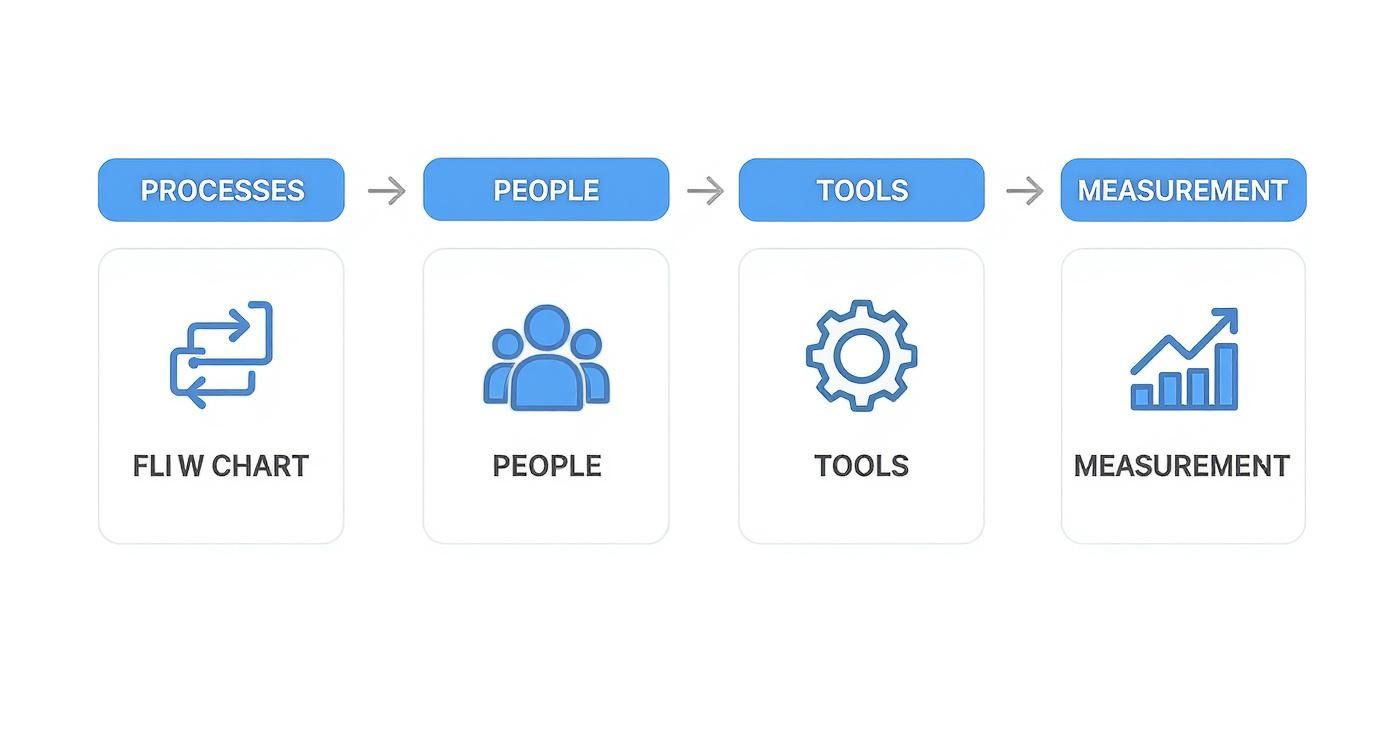 This visual flow makes it clear that a great workflow isn't just a to-do list (Processes); it's a complete system that depends on the right People, Tools, and Measurement.
A Simple Template for Mapping Your Content Workflow
Let's get practical and map out one of the most fundamental processes: creating and publishing a blog post. You don't need a complex flowchart to start. A simple, step-by-step list identifying the task, the owner, and the tools is all you need.
Example Content Creation Workflow Map
Task: Keyword Research & Topic Selection
Task: Create Content Brief
- Owner: SEO Strategist
- Tool: Google Docs/Notion
- Output: A detailed brief for the writer.
Task: Write First Draft
- Owner: Content Writer
- Tool: Google Docs
- Output: Completed draft ready for review.
Task: Edit and Review Draft
- Owner: Editor
- Tool: Google Docs (with Track Changes)
- Output: Edited and proofread article.
Task: Design Graphics and Visuals
Task: Final Approval
- Owner: Content Manager
- Tool: Project Management Software (e.g., Asana)
- Output: "Approved for publishing" status.
Task: Upload and Format in CMS
Task: Publish and Promote
This simple format gives everyone on the team total clarity. Getting this granular is non-negotiable if you want to learn how to scale content marketing without quality falling off a cliff.
Once you visualize each step, you can start asking the important questions: "Does the editor always wait days for the first draft?" or "Is the final approval from the manager a consistent bottleneck?" This is where real optimization begins.
Identifying Bottlenecks and Friction Points
With your core processes mapped out, it's time to put on your detective hat and look for weaknesses. You're searching for the common problem areas that grind work to a halt.
A huge part of this is focusing on streamlining workflow approvals in marketing campaigns. More often than not, this is where projects go to die, sitting idle for days while waiting for one person’s sign-off.
Here’s what to hunt for:
- Long Wait Times: Pinpoint any step where a task just sits in someone's queue. Is that person overloaded, or is the handoff process just plain confusing?
- Redundant Steps: Are three different people reviewing the same thing without adding unique value? It might be time to consolidate those review cycles.
- Lack of Clarity: Look for steps where team members constantly ask, "What's next?" or "Who owns this now?" That's a clear signal you need better instructions or automated notifications.
- Manual, Repetitive Tasks: Flag any soul-crushing, repeatable actions. Think manually moving a card on a Trello board or sending a "ready for review" email. These are prime candidates for automation.
Mapping your workflows isn't a one-and-done project. It’s an ongoing practice. By creating this visual blueprint, you give your team a shared language for how work gets done—and a clear path to making it better.
Boosting Team Efficiency with Automation

Once your core marketing processes are mapped out, you’re ready to unlock their real power through automation. This isn't about replacing your talented marketers; it's about giving them a serious upgrade. Think of automation as the ultimate assistant, the one who happily takes over all the repetitive, low-impact tasks that drain your team's time and creative energy.
By automating key steps in your workflow, you free up your people to focus on what humans do best: crafting brilliant strategy, dreaming up creative campaigns, and building genuine relationships with customers. It's like putting your workflows on autopilot. The system handles the logistics, so your team can focus on the big ideas.
High-Impact Automation Opportunities
You don't need to automate everything all at once. The trick is to start with the tasks that are frequent, rules-based, and notorious time-sucks. These small wins deliver immediate value and build the momentum you need for more sophisticated automation down the road.
Here are a few high-impact areas to get you started:
- Task Handoffs and Notifications: Forget the endless Slack messages. Instead of a designer manually pinging an editor that a graphic is ready, the system does it for them. When a task is marked "complete," the next person in the chain is instantly notified and assigned their part.
- Lead Nurturing Sequences: When a user downloads an ebook, an automated email sequence can kick in immediately. This setup delivers personalized, relevant content over time without anyone lifting a finger, guiding prospects through the funnel while they're most engaged.
- Performance Reporting: Manually compiling data for weekly reports is a classic time-sink. Automation can generate these reports on its own, pulling key metrics from your analytics tools and dropping them into stakeholders' inboxes every Monday morning.
This is how you turn a disconnected series of tasks into a seamless, self-propelling system. It connects your people, processes, and tools, dramatically cutting down on manual errors and speeding up project timelines from start to finish.
The Business Case for Workflow Automation
The numbers behind marketing workflow automation are hard to ignore. It’s a direct path to boosting lead quantity by 80% and conversions by 75%. The effect on lead quality is even more stunning, with some companies reporting a 451% increase in qualified leads.
Beyond lead generation, businesses that automate see productivity jump by 14.5% while cutting marketing overhead by 12.2%. This makes for a quick return on investment.
By connecting different parts of your workflow, you create a system where the sum is greater than its parts. An automated workflow can reduce errors by 40-75% compared to manual processing, ensuring consistency and quality at scale.
This kind of efficiency is absolutely essential for teams aiming for high-volume output, which you can read more about in our article on automating content creation.
From Marketing to Operations
The principles of automation don't stop at the marketing department's door. To boost efficiency even further, specialized tools like commission management software can automate complex payout workflows for sales teams, minimizing errors and freeing up even more operational capacity. It's a perfect example of how optimizing one workflow can create positive ripple effects across the whole organization.
Implementing Your First Automations
Ready to jump in? The best way to start is to pick one painful bottleneck from your workflow maps and tackle that first.
- Identify the Trigger: What specific event kicks off the automation? (e.g., A form is submitted, a task status changes to "In Review").
- Define the Action: What happens right after the trigger? (e.g., Send a specific email, create a new task for the editor, add a tag to a contact).
- Add Conditions (If/Then Logic): How can you make the automation smarter? (e.g., If the lead source is "Webinar," add them to the "Webinar Follow-Up" sequence; if not, add them to the general nurture sequence).
- Test and Refine: Always run a small test to make sure the automation works as planned before you roll it out. Keep an eye on its performance and tweak it over time to make it even better.
By starting small and building on your successes, you can introduce powerful automations that make your team more productive without causing chaos. Each automated task is another step toward a more efficient, strategic, and impactful marketing operation.
Choosing the Right Workflow Management Tools
https://www.youtube.com/embed/007HX8AAtok
A perfectly mapped workflow is only as good as the technology holding it all together. Without the right tools, even the most brilliant processes fall flat, leaving you with manual workarounds and a frustrated team.
It’s easy to get lost in the sea of marketing software out there. But remember, the goal is to build a tech stack that simplifies your life, not one that adds another layer of complexity. Your software should bend to your processes, not the other way around. Think of it like a professional chef's kitchen—every tool has a purpose and works in harmony to create something great.
Core Tool Categories for Marketing Teams
While every team’s needs are a little different, most marketing workflows boil down to a combination of tools from three essential categories. Nailing this mix is key to managing projects, talking to your audience, and actually seeing what works.
Project Management Platforms: This is the central nervous system of your entire operation. Tools like Asana, monday.com, or Trello give your team a shared space to assign tasks, check on progress, and keep everyone in the loop across all your projects. They’re the foundation for bringing your workflows to life.
Marketing Automation Software: Think of platforms like HubSpot or Mailchimp as your tireless assistants. They handle all the repetitive communication, from email nurture sequences to scoring new leads, letting you engage your audience at scale without lifting a finger for every single interaction.
Analytics and Reporting Tools: How do you know if any of this is actually working? That’s where analytics comes in. Tools like Google Analytics, Semrush, or other specialized social media platforms give you the hard data you need to track KPIs, spot trends, and prove your marketing is worth the investment.
Key Evaluation Criteria for Any Software
When you start looking at different options, it’s tempting to get sidetracked by flashy features that sound cool but you’ll never use. Don’t fall for it. Instead, focus on the practical things that will directly impact your team’s day-to-day efficiency and your ability to grow. This is a long-term investment, not a quick fix.
The right technology acts as a force multiplier for your team. It shouldn't just be a place to track tasks; it should actively make your processes smoother, faster, and less prone to human error.
Here are the non-negotiables to keep in mind:
Integration Capabilities: Your tools have to play nice with each other. A project management tool that syncs up with your email platform and your analytics dashboard creates a single source of truth. Without solid integrations, you’re just creating data silos and forcing your team to waste time manually copying and pasting information.
Scalability and Growth Potential: The software that’s perfect for a team of three might completely buckle under the pressure of a thirty-person department. Pick tools that can grow with you. That means looking at the pricing tiers, feature limits, and whether it can handle more complex projects down the road.
User-Friendliness and Adoption: A powerful tool is completely useless if no one on your team wants to use it because it’s too complicated. Make an intuitive interface and a gentle learning curve a top priority. Getting your whole team to actually use the software is half the battle. Similarly, as teams expand, it's smart to check out different AI content tools for large teams that make complex creation workflows much simpler.
An Actionable Checklist for Making Your Decision
To avoid making a gut decision you'll regret later, use a simple scorecard to evaluate your top contenders. This turns a subjective choice into an objective comparison based on what actually matters to your team.
Below is a simple checklist to help you get started. Rate each criterion based on how important it is to your team, then score each tool you’re considering. It’s a straightforward way to see which option truly fits best.
Evaluation Checklist for Marketing Workflow Tools
| Evaluation Criterion | Importance (1-5) | Tool A Score | Tool B Score |
|---|---|---|---|
| Ease of Use & Adoption | 5 | 4 | 3 |
| Core Feature Set | 5 | 5 | 5 |
| Integrates with Our Stack | 4 | 3 | 5 |
| Reporting & Analytics | 3 | 4 | 3 |
| Scalability & Future-Proofing | 4 | 5 | 4 |
| Pricing & Overall Value | 4 | 3 | 4 |
| Total Score | 24 | 24 |
In this example, the scores are tied! This is where you’d dig into the qualitative differences or maybe run a trial with a small group for each tool. By using a structured process like this, you can confidently pick a tech stack that not only supports your workflows today but also helps your team succeed for years to come.
Common Questions About Marketing Workflows
Whenever you're about to change the way your team works, questions are going to pop up. It's totally normal to hit a few bumps when shifting gears, especially with something as core as your workflows. This section is your go-to guide for the most common hurdles and concerns we see marketers face.
Think of it as the FAQ for building a more efficient marketing machine. We'll give you straight-up answers to help you sidestep potential roadblocks and make sure your move to a more organized operation is a smooth one.
Where Should I Even Start?
Looking at your entire marketing operation and thinking "I need to map all of this" is a recipe for paralysis. Don't try to boil the ocean. The key is to start small and zero in on the one area that’s causing the most headaches or holding back your results.
For most teams, that means picking one of three places to begin:
- Content Creation: This is a classic starting point because it's a tangled web of writers, designers, editors, and approvers. The sheer number of handoffs makes it a goldmine for quick improvements.
- Campaign Launches: These are high-stakes, time-sensitive sprints where one dropped baton can throw the whole race. Adding structure here pays off immediately.
- Lead Handoff to Sales: A leaky funnel is like setting piles of money on fire. Fixing how marketing passes leads to sales delivers immediate, measurable value to the business.
Pick one. Map it out. Find the easy wins, get them done, and let that success build momentum. Once you’ve proven the value in one spot, getting everyone on board for the next one becomes a whole lot easier.
How Do I Get My Team on Board?
Let's be honest: people don't love change. Your team is probably used to the current system, even if it's pure chaos. Dropping a new process on them from on high is guaranteed to fail. You have to sell the why and, more importantly, involve them directly.
The best way to do this is to frame workflow management not as another task from management, but as the solution to their biggest daily frustrations. It’s about killing annoying bottlenecks, automating boring tasks, and ending the constant "Is this done yet?" pings on Slack.
Get your team in a room for a workshop and have them map out a current process. When they're the ones pointing out the friction and brainstorming the fixes, they stop seeing it as "more work" and start seeing it as "our new, better way of doing things." They become co-authors of the solution, not just subjects of a new rule.
Is This Only for Big Marketing Teams?
Not at all. While a huge enterprise team would collapse without solid workflows, the principles are just as critical for small teams—and even solo marketers. In fact, getting your workflows straight from the beginning is a massive advantage for any startup or small business.
For a smaller crew, a workflow isn't about navigating a complex org chart; it's about squeezing every last drop of value out of your limited resources. When you only have a few people, you can't afford to waste a single second on disorganized handoffs or manual follow-ups. A simple, documented workflow helps a team of two operate with the precision of a team of twenty, building a rock-solid foundation for when you're ready to grow.
What’s the Difference Between Workflows and Projects?
This trips people up all the time, but the distinction is actually pretty simple—and powerful. Think about it like you're in the kitchen.
A project is the specific, one-time meal you’re making. Let's call it "Cook Thanksgiving Dinner for Ten People." It has a firm start and end date, a unique goal, and a specific shopping list of tasks.
A workflow, on the other hand, is the recipe for a dish within that meal, like "The Perfect Roast Turkey Recipe." It's a repeatable, standardized process you can pull out and use again and again, whether it's for Thanksgiving, Christmas, or just a random Tuesday.
In your marketing world, the "Q4 Product Launch" is your project. Your "New Campaign Workflow" is the repeatable recipe you use to nail that launch and every single one that comes after it.
Ready to stop managing chaos and start building a predictable growth engine? IndexPilot turns your entire SEO content strategy into an automated workflow. From keyword research and AI-powered writing to auto-publishing on your CMS, our platform handles the heavy lifting so you can focus on results. Publish SEO content at scale with IndexPilot.