A digital marketing campaign isn't just a collection of random social media posts or ads. Think of it as a coordinated online assault designed to hit a specific business goal, whether that's boosting sales or just getting your name out there. It’s all about making sure every piece of your strategy works together. To keep every channel stocked with fresh creative, many teams now lean on an AI ad generator.
The Anatomy Of A Modern Campaign
Forget about scattered, disconnected tactics. A successful digital marketing campaign today is a living, breathing ecosystem. It's meticulously planned to guide someone from the moment they first hear about you all the way to becoming a loyal fan. The whole thing runs on data, agility, and a genuine understanding of what makes your customers tick.
This is a huge leap from old-school advertising. The global digital ad industry is expected to rocket to $1.16 trillion by 2030—a massive jump from its current $667 billion valuation. That number alone tells you everything you need to know: if you're not mastering the digital space, you're falling behind.
Core Pillars Of Campaign Success
A modern campaign isn't just one thing; it's a few core pillars all working in harmony. You can see a lot of these principles in action within a solid SaaS product marketing strategy, and they apply almost universally.
Here are the key components you absolutely have to nail:
- Foundational Strategy: This is your blueprint. It defines your goals, who you're talking to, and how you stack up against the competition.
- Multi-Channel Execution: You need to pick the right mix of channels—from SEO and paid ads to email and social media—and make them work together seamlessly.
- High-Impact Creative: This is the fun part. It’s about developing compelling content and visuals that actually connect with your audience and get them to do something.
- Intelligent Optimization: The work isn't done at launch. You have to constantly use data and analytics to measure what's working and tweak your approach for better results.
This flowchart shows how all these pieces connect, moving from the initial strategy into execution and then into a continuous cycle of optimization.
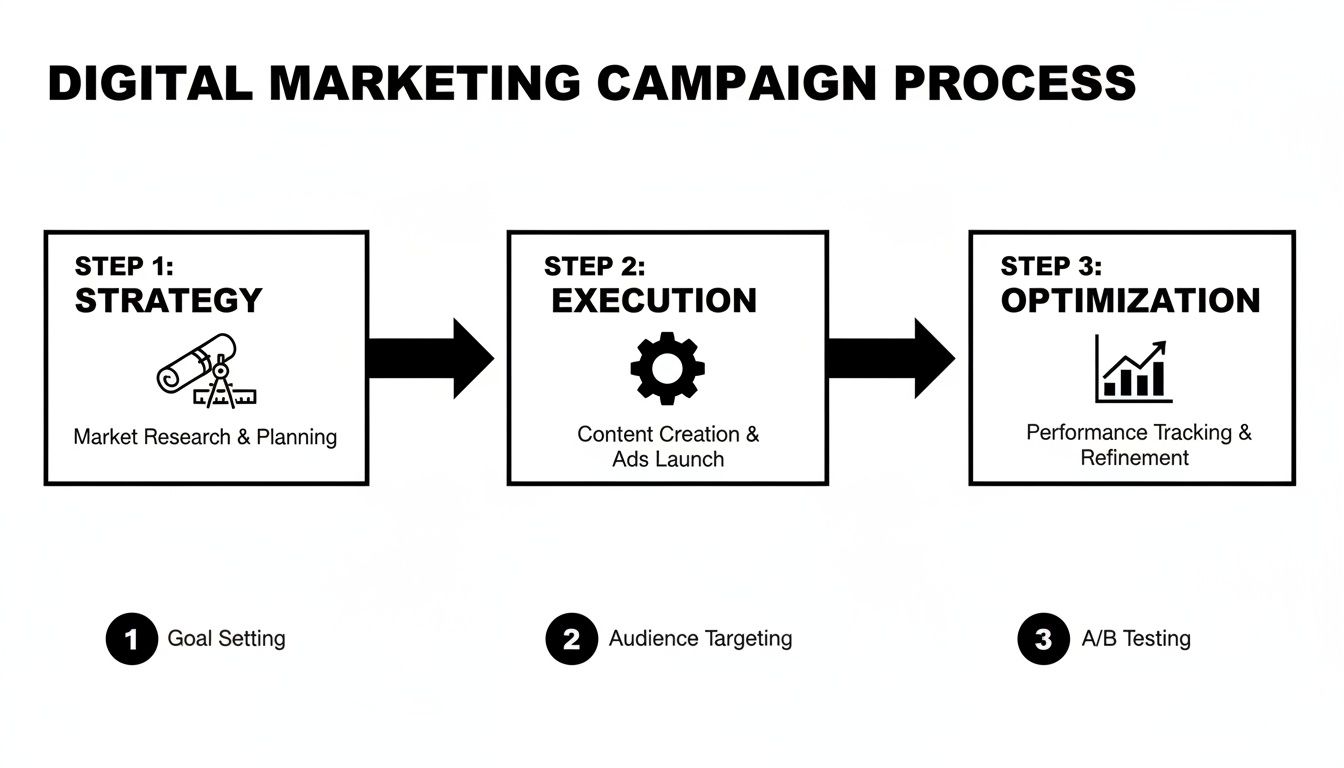
The big takeaway here is that a campaign is a loop, not a straight line with a finish line. What you learn from the optimization phase should feed directly back into your next strategy. Modern tools can also give you a leg up; for example, understanding what answer engine optimization is can give you a serious edge right from the planning stage.
Laying the Foundation for Your Campaign
Before a single ad goes live or a blog post gets published, the fate of your campaign is already being decided. It's all in the prep work. Rushing this foundational stage is the fastest way I've seen to burn through a budget and completely miss the mark. A solid plan ensures every dollar you spend and every action you take is strategic, targeted, and actually tied to your business goals.
This early phase is really about asking the tough questions. What are we really trying to accomplish here? Who are we talking to? And what’s everyone else in our space doing? Answering these honestly gives you the clarity to build a campaign that doesn’t just make noise, but delivers real results.
Setting Goals That Actually Matter
I can't tell you how many campaigns I've seen fail because the goals were mushy. "Increase brand awareness" or "get more traffic" sound nice, but they're basically wishes, not goals. Your objectives need to be specific, measurable, and directly linked to something the business actually cares about. This is where the SMART framework (Specific, Measurable, Achievable, Relevant, Time-bound) is more than just a buzzword—it’s your best friend.
A SMART goal takes a vague idea and turns it into a clear target.
- Weak Goal: "We want more leads."
- SMART Goal: "Generate 200 marketing-qualified leads (MQLs) from organic search for our new software feature within Q3, keeping our cost per lead under $75."
See the difference? That level of detail transforms a wish into a concrete plan. It gives your team a finish line to sprint towards and a clear benchmark to measure success. Your campaign goals should flow directly from what the business needs, whether that’s growing revenue by 15% or stealing 5% of market share from your biggest rival.
Uncovering Your True Audience
You can’t write a message that resonates if you don’t know who you’re talking to. And I mean really know them. Deep audience research goes way beyond basic demographics like age and location. The real goal is to build out detailed buyer personas that feel like real people, because they’re based on their actual problems and motivations.
What’s keeping them up at night? What are their biggest headaches at work? Where do they hang out online when they’re looking for answers? Figuring this stuff out helps you understand the why behind their clicks and purchases.
The biggest mistake I see teams make is assuming they already know their audience. The most powerful insights always come from talking to actual customers, digging through support tickets, and just listening to conversations on social media. Don't guess—go find out.
This research informs everything. It dictates the keywords you target, the tone of voice in your emails, and the creative you use in your ads. For a closer look at how this research connects directly to your content, check out our deep dive on what an SEO content strategy is and how to build one from the ground up.
Sizing Up the Competition
You aren’t operating in a vacuum. A thorough competitive analysis is non-negotiable for spotting opportunities and sidestepping threats. Start by identifying your top three to five competitors—both the direct ones and the companies solving the same problem in a different way. Then, it’s time to play detective.
Here's a simple framework to guide your analysis:
- Channel Presence: Where are they playing? Are they crushing it in organic search, running aggressive paid campaigns on Google, or have they built a die-hard community on LinkedIn?
- Messaging and Positioning: What’s their core value prop? How are they framing their solution, and what specific pain points are they hitting on?
- Content Strengths: What kind of content are they known for? Is it super in-depth whitepapers, slick video tutorials, or maybe a popular podcast?
- Identifiable Weaknesses: Where are the chinks in their armor? Maybe their website is a nightmare on mobile, their social media engagement is dead, or their blog content feels like it was written in 2015.
Those weaknesses are your openings. If a competitor has a weak organic game, that's your cue to double down on SEO. If their messaging is bland and corporate, you can win by being more human and relatable. This isn't about copying what they do; it's about finding your unique angle to stand out and deliver something better.
Allocating Your Budget Across The Funnel
Okay, now that you have clear goals, a defined audience, and a good read on the competition, you can finally start talking about money. A smart way to allocate your budget is to map it directly to the marketing funnel: top, middle, and bottom.
| Funnel Stage | Primary Goal | Common Channels |
|---|---|---|
| Top (ToFu) | Awareness & Discovery | SEO, Content Marketing, Social Media Ads |
| Middle (MoFu) | Consideration & Trust | Email Nurturing, Webinars, Case Studies |
| Bottom (BoFu) | Decision & Conversion | Retargeting Ads, Search Ads, Sales Demos |
A balanced budget ensures you're not just chasing immediate sales (BoFu) while your pipeline of future customers runs dry (ToFu). If you're launching a new product, you might throw a bigger chunk of your budget—say, 50%—at the top of the funnel to build that initial buzz. An established brand, on the other hand, might invest more in the middle to nurture the leads they already have. This strategic approach makes sure your entire campaign works together, guiding people smoothly from "who are you?" to "take my money!"
Crafting A Multi-Channel Execution Strategy
Once your goals are locked in and you know who you’re talking to, it’s time to pick your battlegrounds. A truly effective digital marketing campaign isn't about throwing spaghetti at the wall to see what sticks. It’s a calculated, strategic choice of channels that work in concert with one another.
Think of it like an orchestra. Your SEO isn’t just doing its own thing over in the corner while paid media bangs a drum. Each channel is an instrument, and when played together, they create something much more powerful than any single one could alone.
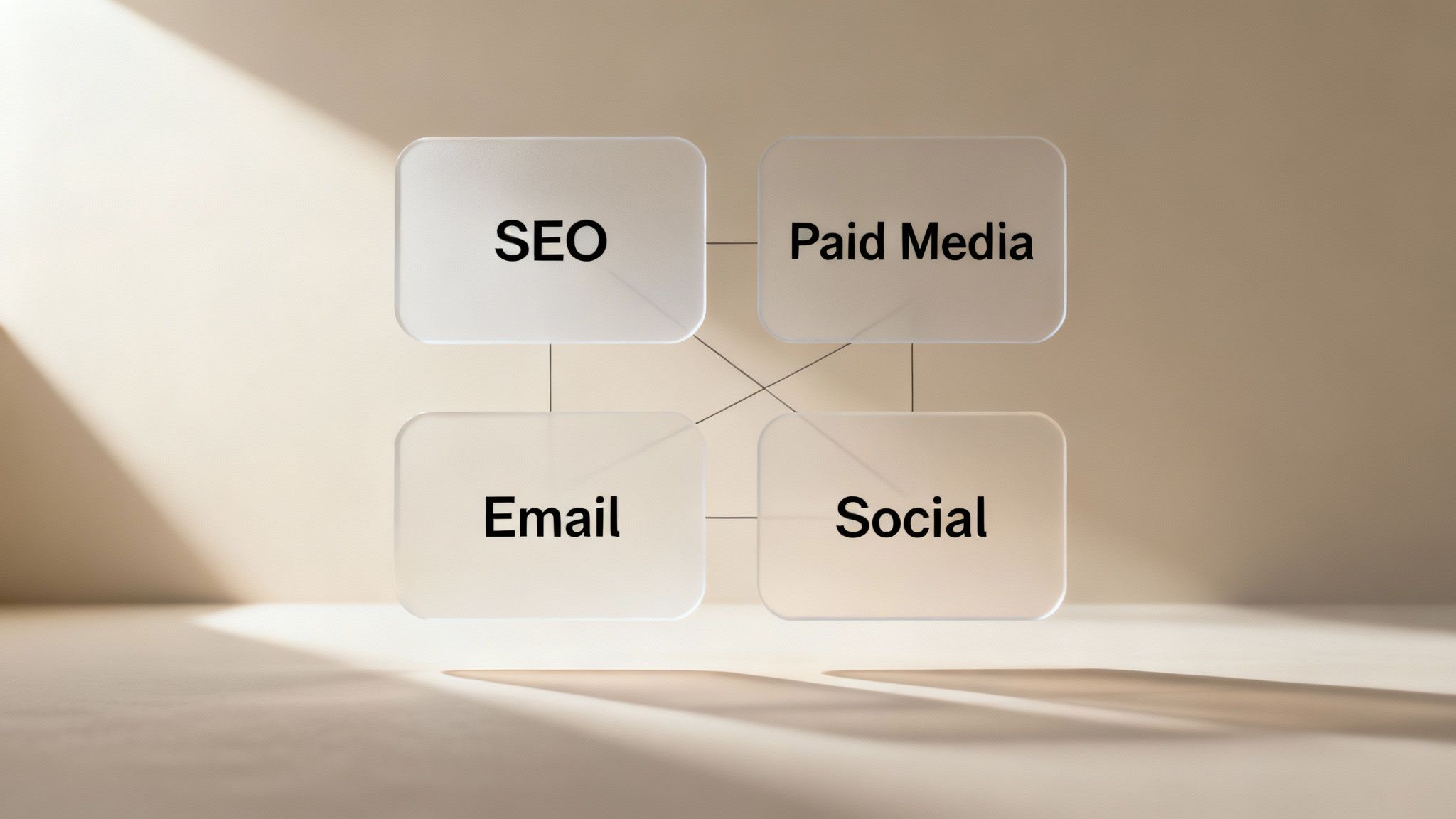
The real magic happens when these channels stop being siloed departments and start amplifying each other. This integrated approach is what gives your audience a consistent, seamless experience, no matter where they find you.
The Four Pillars Of Channel Strategy
While there are dozens of channels you could use, most winning campaigns are built on a foundation of four core pillars. Getting the interplay between these right is what drives sustainable growth and gets you closer to hitting your campaign goals.
Each pillar has its own unique job, but they're exponentially more powerful when they work together.
- Search Engine Optimization (SEO) is your long game. It’s the engine that earns you organic visibility in search results, builds your brand’s authority, and pulls in high-intent traffic month after month without paying for every click.
- Paid Media (PPC & Social Ads) delivers immediate, laser-focused impact. It’s perfect for getting in front of specific demographics, testing messages on the fly, and driving traffic to key landing pages from day one.
- Email Marketing is your relationship-builder. Nothing beats email for nurturing leads, boosting customer retention, and speaking directly to your most engaged audience.
- Social Media Marketing is where you build community and give your brand a human voice. It's the place for conversations, sharing your brand's personality, and forging real connections with followers.
The key is seeing how they overlap. For example, you can run a paid social ad to get more eyeballs on your top-performing organic blog post. Or, you could send an email to your subscriber list to drive a burst of traffic to a new pillar page, signaling to Google that it's a piece of content worth noticing.
The most effective digital marketing campaign isn't about being on every channel; it's about being on the right channels and making them work together. The goal is synergy, where the combined effect is far greater than the sum of the individual parts.
Choosing the right mix depends entirely on your specific goals. The table below breaks down the primary strengths of each core channel to help you decide where to focus your efforts.
Digital Marketing Channel Selection Guide
| Channel | Primary Goal | Speed to Results | Best For |
|---|---|---|---|
| SEO | Long-Term Authority & Traffic | Slow (3-6+ months) | Building sustainable, organic growth and capturing high-intent searchers. |
| Paid Media | Immediate Traffic & Conversions | Fast (Hours to Days) | Launching new products, lead generation, and testing offers quickly. |
| Nurturing & Retention | Immediate | Converting leads into customers and increasing customer lifetime value. | |
| Social | Brand Awareness & Community | Varies (Weeks to Months) | Building a brand personality, engaging with customers, and top-of-funnel reach. |
This isn't an either/or decision. The strongest campaigns layer these channels, using the speed of paid media to support the slow-burn growth of SEO, and the relationship-building power of email to convert the traffic both channels generate.
Integrating Paid And Organic Social Media
In today's market, social media is a non-negotiable. It acts as both a discovery platform and a conversion channel. The global social media ad market is set to grow by 12% in 2025, with spending in 2024 already hitting nearly a quarter of a trillion US dollars.
Why the massive investment? Because it works. 50% of consumers found new products through social media, and a whopping 76% say social content has swayed a purchasing decision. For more insights on these trends, you can explore more digital marketing statistics from 2025.
A smart social strategy blends organic content with paid promotion. Use your organic feed to build your community, share genuinely useful content, and have real conversations. Then, put a budget behind your best-performing organic posts to amplify their reach, target hyper-specific audiences, and drive direct conversions.
A Real-World Scenario In B2B Tech
Let’s see how this all comes together. Imagine a B2B SaaS company launching a new project management tool. A siloed approach would be a mess of disconnected tactics. An integrated one, however, is a well-oiled machine.
- Pre-Launch (SEO & Content): Weeks before the launch, they publish a series of deep-dive blog posts optimized around terms like "agile workflow automation" and "collaborative project tools." This builds an organic foundation and starts capturing search interest early.
- Launch Week (Paid & Social): The day it goes live, they launch targeted LinkedIn and Google ads aimed squarely at project managers and CTOs. These ads push traffic to a dedicated landing page with a compelling free trial offer. At the same time, their social channels are buzzing with video demos and customer testimonials.
- Post-Launch (Email & Automation): Every new trial sign-up is automatically dropped into an email nurture sequence. This series delivers helpful tips, case studies, and eventually, a special offer to nudge them toward a paid plan. Automating this follow-up is crucial for scaling, and you can learn more about how to set this up by exploring our guide to content marketing automation.
This coordinated effort creates a seamless customer journey. A prospect might first find the company through a helpful blog post (SEO), see a targeted ad later that week (Paid), and finally be convinced to buy after a persuasive email sequence (Email). That's the power of a truly integrated digital marketing campaign.
Developing High-Impact Creative And Content
A brilliant strategy is just a theory until you bring it to life with compelling creative. Your audience doesn't see your spreadsheets or your competitive analysis; they see the ads, the blog posts, and the videos. This is where your campaign truly connects with people, and getting it right is the difference between being memorable and just being more noise.
It all starts with a rock-solid creative brief. This isn't just a formality. It’s the single source of truth that aligns everyone—from copywriters and designers to video editors—on the campaign's core message. A good brief clearly outlines the objective, target audience, key message, tone of voice, and the specific call to action. Without it, you're just hoping everyone is on the same page.
Translating Strategy Into Assets
With an aligned team, you can get down to building the assets that will fuel your campaign. The goal is to create content that doesn't just look good but actually performs. This means every piece of creative—from a single headline to a five-minute video—is purposefully designed to move the audience one step closer to your goal.
This is where you balance art and science. The "art" is the storytelling, the visuals, and the emotional hook. The "science" is understanding what formats and messages resonate on each platform. An Instagram Reel needs a different energy than a LinkedIn whitepaper, and your ad copy on Google needs to be far more direct than a brand-building YouTube video.
Your creative isn't just there to fill space on a channel. Each asset has a job to do. Ask yourself, "What is this specific piece of content supposed to make someone think, feel, or do?" If you can't answer that, it's not ready.
Mapping Content To The Buyer's Journey
One of the most common mistakes I see is creating content without considering when a person will see it. Someone just discovering they have a problem needs a completely different message than someone who is ready to pull out their credit card.
This is where content mapping becomes essential. It’s the practice of creating specific assets tailored to each stage of the buyer's journey.
Let's walk through how this works in a real-world scenario:
Top of Funnel (Awareness): At this stage, people are looking for answers and education, not a sales pitch. Your content should be helpful and address their broad pain points. Think SEO-optimized blog posts, infographics, or short educational videos. For example, a cybersecurity firm might create a blog post titled "5 Common Mistakes That Put Your Small Business at Risk."
Middle of Funnel (Consideration): Now, your audience knows they have a problem and are actively researching solutions. Your content should demonstrate your expertise and build trust. This is the perfect place for in-depth case studies, webinars, or detailed comparison guides. The same cybersecurity firm might offer a downloadable guide on "How to Choose the Right Security Software for Your Team."
Bottom of Funnel (Decision): Here, your prospects are ready to make a choice. The content needs to be highly specific and persuasive, showing them exactly why your solution is the best one. This includes product demos, free trials, customer testimonials, and detailed pricing pages. The final push could be an offer for a "Free Security Audit and Personalized Quote."
By mapping content this way, you guide prospects through their journey naturally instead of hitting them with a hard sell way too early. Each piece builds on the last, creating a cohesive and convincing narrative.
Accelerating Creation Without Sacrificing Quality
Developing high-quality content for every stage of the funnel is a massive undertaking. The demand for well-researched, optimized, and engaging material can quickly overwhelm even the most efficient marketing teams.
This is where modern tools are changing the game.
Artificial intelligence, for instance, can drastically speed up the content creation process. AI agents can research complex topics, generate detailed outlines, and even draft entire long-form articles that are optimized for search engines right from the start.
This frees up your human experts—the strategists, editors, and creatives—to focus on the high-level work that truly sets your brand apart. They can refine the AI-generated drafts, inject that unique brand personality, and ensure the final product is polished and authoritative.
For teams looking to scale their efforts, exploring a guide on content creation with AI can provide a practical framework for integrating these powerful tools into your workflow. By handling the heavy lifting of research and initial drafting, AI enables your team to produce more high-impact content, faster.
Launching, Measuring, And Optimizing Your Campaign
Going live with your campaign is the starting line, not the finish. All the strategic planning, audience research, and creative development has led to this moment. But now, the real work begins—the continuous cycle of monitoring performance, measuring results, and making smart adjustments.
This is where your campaign evolves from a well-researched plan into a dynamic, results-driven machine. By listening to the data, you can double down on what’s working, cut what isn't, and consistently improve your return on investment.

Identifying Your Essential Key Performance Indicators
You can't optimize what you don't measure. Before you can make any meaningful improvements, you need to define the specific Key Performance Indicators (KPIs) that actually connect back to your campaign goals. Generic metrics like "traffic" are fine, but true optimization demands a much sharper view.
Every channel tells a different part of the story through its own critical KPIs.
- Paid Media (PPC): Look at Click-Through Rate (CTR) and Cost Per Click (CPC), but your north star should be Cost Per Acquisition (CPA). A high CTR is great, but if it's not leading to cost-effective conversions, it's just a vanity metric.
- SEO and Content: Keep an eye on Organic Rankings for your target keywords, Organic Traffic, and the Conversion Rate from that traffic. A KPI that’s often overlooked but incredibly valuable is Brand vs. Non-Brand Search Volume—it’s a great indicator of growing awareness.
- Email Marketing: Your big three are Open Rate, Click-Through Rate, and Unsubscribe Rate. Together, they paint a clear picture of your list’s health and whether your content is hitting the mark.
- Social Media: You have to look beyond likes. Measure Engagement Rate (comments, shares), Reach, and especially Website Clicks to see if your social content is actually driving action.
Setting up tracking for these KPIs isn't optional. Tools like Google Analytics are the foundation for monitoring website behavior and conversion goals. On top of that, advertising platforms from Google Ads to Meta have their own robust dashboards for digging into channel-specific performance.
Mastering The Optimization Loop
Once your data starts flowing in, it's time to enter the optimization loop. This isn't about random guesswork; it's a structured, repeatable process for turning insights into better results.
- Analyze the Data: Get into your dashboards regularly. Look for trends, outliers, and anything that surprises you. Where is performance blowing past expectations? Where is it falling flat?
- Form a Hypothesis: Based on what you see, make an educated guess about why the results look the way they do. For example: "I believe changing our ad headline to focus on the free trial will increase our CTR because our audience seems price-sensitive."
- Run a Test: Now, put that hypothesis to the test. The classic method is A/B testing, where you compare two versions of an asset—like an email subject line or a landing page headline—to see which one performs better.
- Measure and Implement: Once the test wraps up, analyze the results. If your new version won, fantastic—it becomes the new control, and you can start the cycle over with a fresh hypothesis. If it lost, you still learned something valuable about what your audience doesn't respond to.
This iterative process ensures your campaign is always getting smarter. A small lift in conversion rate here or a slight drop in CPA there might seem minor, but those incremental gains compound over time, leading to huge improvements in your overall campaign ROI.
Turning Data Into Actionable Decisions
Data is just noise if you don't act on it. The final, most crucial step is translating what you've learned into tangible changes that directly impact your campaign’s success. The day-to-day grind of managing a digital marketing campaign is really just making these data-informed decisions over and over again.
A successful campaign isn’t one that’s perfect from day one. It’s one that’s built to learn. The ability to quickly adapt based on real-world performance data is what separates the winners from the campaigns that fade into obscurity.
Think about how this plays out in the real world:
- Shifting Budgets: You notice your LinkedIn ad campaign has a CPA of $50, while your Google Ads campaign is bringing in the same type of lead for $120. The decision is clear: reallocate a chunk of your Google budget to LinkedIn to maximize your lead volume.
- Refining Content: Your email analytics show that subject lines phrased as a question get a 25% higher open rate than statements. That insight should immediately inform the subject line strategy for every email you send from now on.
- Optimizing Landing Pages: You're looking at heatmap data and see that 70% of visitors aren't scrolling past the halfway point on your main landing page. That's a huge signal to move your primary call-to-action much higher on the page to make sure people see it.
Effectively managing all these moving parts requires a deep understanding of performance metrics. For those interested in a higher-level view, understanding the strategic oversight for online channels and performance metrics can provide context on how these tactical decisions roll up into a broader marketing strategy. Ultimately, optimization is about being relentlessly curious and letting the data guide you toward better and better results.
Answering Your Top Campaign Questions
Even the most buttoned-up plan runs into real-world questions once you're in the trenches. It’s one thing to map out a campaign on a whiteboard, but it’s another thing entirely to manage it day-to-day. Let’s tackle some of the most common questions that pop up when theory meets reality.
Getting straight answers to these can save you a ton of headaches, help you set the right expectations with stakeholders, and make smarter decisions on the fly.
How Long Should A Digital Marketing Campaign Last?
There’s no magic number here. The right duration for your campaign is completely tied to what you’re trying to accomplish and the channels you’re using. A short, intense push can be just as powerful as a long-term initiative, as long as the timeline fits the goal.
For example, if you’re trying to generate buzz for a Black Friday sale, a focused four to six-week campaign makes perfect sense. But if you're building an organic presence with SEO-driven content, that’s a long-term investment that never really "ends." It’s an ongoing effort that builds on itself over months, even years.
Here are a few common timelines to give you a feel for it:
- Product Launches: These typically run for one to three months. You need time to build pre-launch hype, drive those critical first sales, and get early customer feedback.
- Paid Media Campaigns: I almost always recommend a three-month initial commitment. This gives you enough runway to gather meaningful data, run A/B tests, and start optimizing your cost per acquisition.
- Brand Awareness Pushes: These are the long game. Expect them to last six months or more. Changing how people perceive your brand takes time, consistency, and a lot of repetition.
The key is giving your channels enough time to actually do their job. Killing a paid campaign after two weeks because the returns aren’t massive is a classic mistake—the ad algorithms are often still in their learning phase.
What Is A Good ROI For A Digital Marketing Campaign?
This is the million-dollar question, isn't it? Everyone wants to know if what they're doing is "good." While a 5:1 ratio—making $5 for every $1 spent—is often thrown around as a great benchmark, that number is pretty meaningless without context.
What counts as "good" ROI is wildly different depending on:
- Your Industry and Profit Margins: A SaaS company with cushy 80% margins can be thrilled with a 3:1 ROI. On the flip side, an e-commerce store with razor-thin margins might need to hit a 10:1 ratio just to break even.
- The Campaign's Goal: Not every campaign is about driving immediate sales. If your goal is brand awareness, you might measure success in share of voice or a spike in branded searches. The financial ROI is a lagging indicator, not the main event.
- The Channel Mix: You can't hold every channel to the same standard. SEO can deliver an incredible ROI over the long haul, but it’s an upfront investment. Paid search, meanwhile, usually offers a more immediate and directly measurable return.
Instead of getting hung up on a universal benchmark, figure out your own. Calculate your current baseline ROI and make it your mission to beat that number with every new campaign. That’s a much more practical—and powerful—way to think about it.
How Do You Measure The Success Of A Campaign?
This one’s simple: you measure success against the SMART goals you set from the very beginning. If you didn't define what winning looks like before you started, you have no real way to know if you've won. Your measurement framework has to tie directly back to your initial objectives.
Success looks different for different goals.
If your goal was lead generation, you’d be measuring:
- The total number of new leads you brought in.
- Your Cost Per Lead (CPL) to make sure you’re being efficient.
- The lead-to-customer conversion rate to see if the leads are any good.
If your goal was brand awareness, you’d be tracking metrics like:
- An increase in website traffic from new visitors.
- Higher social media engagement rates and a wider reach.
- Growth in branded search volume over the life of the campaign.
The most important step is connecting these marketing metrics to real business outcomes. A truly successful campaign doesn't just rack up clicks or likes; it drives revenue, steals market share from competitors, and contributes to the overall health of the business. Always, always ask, "How did this campaign move the needle on what actually matters?"
Uncover what your audience is asking and find high-value content gaps before your competitors do. With Sight AI, you can monitor brand mentions across leading AI models, discover new outreach opportunities, and generate SEO-optimized articles with specialized AI agents to accelerate your organic growth. Turn visibility insights into action at https://www.trysight.ai.