
When you hear "content creation with AI," what comes to mind? For a lot of folks, it's a mix of excitement and maybe a little uncertainty. The way I see it, it’s all about using artificial intelligence to handle the heavy lifting—research, outlining, writing, and even optimizing—while humans guide the process with creativity and strategic oversight.
It’s a partnership. You’re combining the raw speed and data-crunching power of AI with the crucial nuance, expertise, and unique brand voice that only a human can provide. The result? High-quality content, produced at a scale that was previously unimaginable.
Rethinking Your Content Workflow with AI
Welcome to the new normal for content marketing. AI is no longer a novelty; it's a core part of the daily grind. This isn't about the hype. We're going to walk through a practical, end-to-end framework that shows you how to actually use AI to build an efficient content engine—one that marries the speed of machines with the strategic mind of a human.
The goal here isn't to replace marketers. It's to give you superpowers, helping you create better, more relevant content faster than ever before. This modern roadmap starts with finding high-value content gaps and ends with tracking performance. Platforms like Sight AI are built for this, monitoring what AI models are producing to show you what your brand is missing and where your competitors are pulling ahead.
From Manual Effort to an Automated Engine
The move toward AI-powered content isn't just a fleeting trend; it’s a fundamental change in how marketing teams get work done. In just a couple of years, AI has gone from a niche experiment to an everyday workhorse.
An incredible 71% of organizations are now using generative AI for creating content, a massive jump from just 33% the previous year. Marketers are finding that these tools slash production time. On average, employees are seeing productivity boosts around 40%, saving about 3 hours on every single piece of content they create.
This diagram breaks down a modern, three-stage AI workflow into Strategy, Creation, and Performance. It’s a simple but powerful way to visualize the process.
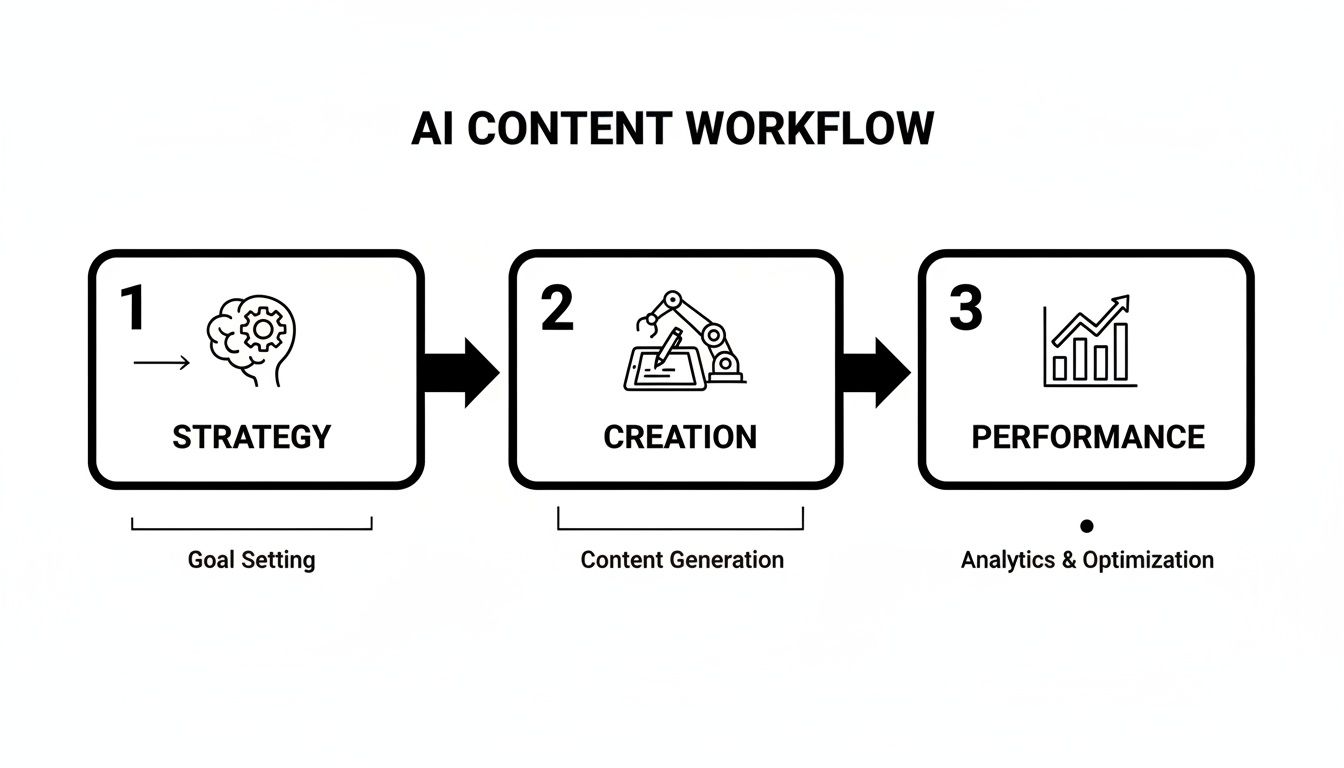
This isn’t about just hitting "generate." A structured approach is everything. It ensures you’re using AI strategically at every stage to get the best of both worlds: efficiency and quality.
Building a Scalable System
To scale your content without letting quality slide, you need a structured workflow. Stop thinking about each article as a one-off project and start thinking about building a repeatable system. Adopting an AI workflow for batch content creation can completely change the game for how your marketing team operates.
The key is to systematize the repetitive parts of content creation so you can give yourself more time to focus on what you do best—strategy, creativity, and unique insights.
When you think in terms of systems, you can:
- Maintain Consistency: Every piece of content hits your brand and quality standards, every time.
- Increase Velocity: You can publish more high-quality articles in far less time.
- Improve Over Time: Use performance data to constantly refine your process and get better results.
By setting up this kind of solid foundation, AI stops being just another tool and becomes a core part of your growth strategy. If you're looking to dive deeper into setting up these kinds of processes, check out our detailed guide on how to create workflows for your content team.
Turning AI Insights into a Winning Content Strategy
Great content doesn't just happen because you wrote a clever prompt. It's born from a rock-solid strategy, and the most effective content creation with AI starts long before you ask it to write a single word. This is the planning phase—the part where you use AI's analytical muscle to build a data-backed roadmap for everything you publish.
Forget guessing what your audience wants. Modern platforms now give you a direct line of sight into how AI models like ChatGPT and Gemini see your brand versus your competitors. This process, often called AI visibility monitoring, is all about uncovering the high-intent questions and topics your audience is already digging into.

This flips the script entirely. AI stops being just a writing assistant and becomes your most powerful research partner. You shift from making reactive content to building a proactive strategy grounded in real, actionable insights.
Uncovering High-Value Content Gaps
Your content strategy should be laser-focused on owning the conversations that matter most to your audience. The first move is to figure out where those conversations are happening and, more importantly, where your brand is completely missing. It’s all about finding the gaps between what people are asking and what you’re currently offering.
Platforms like Sight AI automate this entire discovery process. By analyzing how AI models cite sources and respond to user prompts, it pinpoints the exact topics where your competitors get mentioned, but you don't. This is a goldmine for strategic content planning.
Imagine someone asks an AI, "What are the best tools for remote team collaboration?" If the AI names three of your competitors and leaves you out, that's a massive content gap. It’s a bright, flashing sign telling you to create an authoritative article on that exact topic. This data-driven method cuts through the noise and directs your energy where it'll actually make a difference.
The goal is to stop creating content in a vacuum. Use AI insights to find the specific questions and keywords that will attract high-intent traffic, then build your content calendar around those opportunities.
Armed with these insights, you can pull together a prioritized list of topics that you know are relevant. This ensures every piece of content you create serves both your audience's needs and your business goals, setting the perfect stage for successful AI-driven content creation.
Building a Data-Backed Content Calendar
Once you’ve identified your content gaps, the next step is to get them organized into a structured content calendar. This isn't just a random list of blog post ideas. It's a strategic plan that maps topics to specific keywords, audience segments, and publishing dates.
Start by grouping related topics into clusters. For instance, if your research uncovers questions about "remote team productivity," "virtual meeting best practices," and "asynchronous communication tools," you can bundle them under a broader "Remote Work" pillar. This approach is key to building topical authority, a huge ranking factor for search engines.
A solid content plan should include:
- Pillar Topics: The big-picture subjects you want to be known for.
- Cluster Content: The specific articles that dive deep into each pillar.
- Target Keywords: Primary and secondary keywords for every single article.
- Audience Intent: What the user is trying to accomplish (e.g., learn, buy, compare).
Taking the time to structure your plan like this makes the actual content creation process incredibly efficient. When it’s time to generate a draft, your AI model gets a crystal-clear brief, complete with the target keyword, related concepts, and the core problem you're solving for the user. For a deeper look at building these roadmaps, our guide on effective content planning strategies lays out the whole framework.
This methodical approach ensures every article serves a purpose and contributes to your larger SEO and marketing objectives. It's the strategic foundation that lets AI content production scale without sacrificing quality or relevance.
Crafting and Refining High-Quality AI Drafts
Once your strategic plan is locked in, it's time to move from insights to execution. This is where the real magic happens, turning outlines and keywords into a tangible first draft using the power of AI. But let's be clear: getting a high-quality output isn't as simple as firing off a one-line prompt and hoping for the best.
Success hinges on a skillful partnership between your strategic direction and the AI's generative power. It takes thoughtful prompt engineering to guide the model and a meticulous human review process to refine, fact-check, and inject your unique brand personality. This dual approach ensures the final product is not just fast, but also valuable and distinct.
The Art of Prompt Engineering for Long-Form Content
A generic prompt leads to generic content. It’s that simple. To get a draft that's actually useful, you need to give the AI a detailed and structured brief. Think of yourself as a creative director giving crystal-clear instructions to a talented but inexperienced writer. The more context you provide upfront, the better the initial output will be.
Your prompt should act as a comprehensive project brief. Don't just ask for a blog post; tell the AI everything it needs to know to succeed.
Here are the essential components of a powerful prompt for long-form content:
- Define the Role: Start by giving the AI a persona. "Act as an expert SEO content strategist with 10 years of experience writing for a B2B SaaS audience." This sets the tone and expertise level right from the start.
- Specify the Goal and Audience: Clearly state the article's objective and who it's for. "Your goal is to write a 2,000-word guide for marketing managers on how to use AI for content planning. The audience is knowledgeable about marketing but new to AI tools."
- Provide the Structure: Include the full outline you developed, complete with H2s and H3s. This ensures the AI follows your intended narrative flow and covers every subtopic.
- Include Keywords and Entities: List your primary and secondary keywords, plus any important related concepts (entities) that should be mentioned. This is crucial for solid on-page SEO.
By front-loading your prompt with this level of detail, you dramatically reduce the heavy lifting needed later. You're steering the AI toward a specific outcome rather than letting it wander.
To make this even more practical, here is a structured framework you can adapt for your own prompts.
AI Prompt Engineering Framework
This table provides a structured guide to crafting effective prompts for different stages of AI content creation, ensuring consistent and high-quality outputs.
| Stage | Prompt Goal | Key Components to Include | Example Snippet |
|---|---|---|---|
| Outline Generation | Create a logical, SEO-friendly structure for an article. | Target keyword, audience persona, key questions to answer, desired word count, competitor articles for reference. | "Create a detailed outline for a blog post titled 'The Ultimate Guide to AI Content Planning'. The target audience is marketing managers at mid-sized tech companies." |
| Draft Generation | Write a full first draft based on a detailed outline. | Full outline with H2/H3s, target keyword, brand voice instructions (e.g., "conversational yet authoritative"), negative constraints (e.g., "do not mention our competitors by name"). | "Using the provided outline, write the full article. Maintain a helpful and expert tone. Weave in the primary keyword 'AI content planning' naturally throughout." |
| Content Refinement | Improve a specific section for clarity, tone, or depth. | The specific paragraph or section, clear instruction (e.g., "rewrite this to be more concise," "add a real-world example"), desired tone. | "Rewrite this introduction to be more engaging. Start with a relatable problem that our target audience faces before introducing the solution." |
| SEO Optimization | Integrate keywords and entities into existing text. | The draft text, list of primary and secondary keywords, list of related entities to include. | "Review the following article and suggest where to naturally incorporate these secondary keywords: [list of keywords]. Ensure the text remains fluent." |
Following a framework like this helps turn prompting from a guessing game into a repeatable, strategic process.
The Human-in-the-Loop Editing Workflow
An AI-generated draft is just that—a draft. It's a fantastic starting point, but it's never the finished article. The human-in-the-loop process is where you elevate the content from good to great, ensuring it's accurate, authentic, and genuinely helpful.
This editing phase is non-negotiable for producing high-quality content that builds trust. It involves several critical layers of review that an AI simply cannot replicate on its own.
The most common mistake in AI content creation is publishing without a thorough human review. This leads to generic, factually incorrect, or soulless content that can damage your brand's credibility.
Your editing workflow should be a systematic checklist, not a quick skim. Treat the AI as a junior writer who delivered a solid first version that now needs an experienced editor's touch.
Key Editing and Refinement Stages
- Fact-Checking and Verification: AI models can "hallucinate" or present outdated information as fact. Your first job is to meticulously verify every claim, statistic, and data point. Cross-reference sources and remove anything that isn't 100% accurate.
- Narrative Strengthening: Read through the entire article for flow and coherence. Does the intro hook the reader? Do the arguments build logically? Add transitions, rephrase clunky sentences, and make sure the conclusion provides a clear, actionable takeaway.
- Injecting Brand Voice and Personality: This is perhaps the most important step. The AI can mimic your tone, but it can't replicate your unique perspective or share personal anecdotes. Weave in your brand's specific terminology, share real-world examples from your own experience, and adjust the language to sound genuinely like you. If you need a complete walkthrough, our guide on using an AI article generator effectively covers this in detail.
- Adding Unique Insights: What's your contrarian take on the topic? What unique data or experience can you add that no one else can? This is what separates your content from the sea of generic AI articles and demonstrates true expertise.
This hands-on approach is becoming the new standard. AI isn't just changing how content is produced—it's redefining team workflows. In marketing, 83% of professionals say AI frees them up for more strategic tasks, letting humans prioritize brand voice and narrative. As AI takes on more executional work, some organizations report that 75% of staff work has shifted toward strategy.
Ultimately, this human-AI collaboration is about using technology for the initial heavy lifting, freeing you to focus on the high-value tasks that build brand authority. The drafting process can even extend beyond text. For a deep dive into generating visual content, a practical guide on how to create AI videos can help you craft high-quality drafts for other media formats, following this same principle of guided generation and human refinement.
Automating Optimization and Publishing at Scale

A perfectly crafted, human-refined draft is a huge win, but its value is zero until your audience can actually find it. This is where the final, crucial steps of optimization and publishing come into play. It’s all about taking that amazing content and making sure it's perfectly tuned for search engines before you send it live.
This stage is practically begging for automation. By systemizing this process, you can move content from a finalized document to a live, indexed URL with almost no manual effort. You'll eliminate the tedious admin tasks that slow content teams down and stop them from hitting a consistent, growth-driving pace.
Conducting the Final SEO and GEO Pass
Before you even think about hitting publish, every article needs one last check to ensure it nails on-page SEO best practices. While you embedded keywords during the drafting phase, this final pass is about fine-tuning the small but critical details that search engine crawlers obsess over.
This isn’t about keyword stuffing; it’s about structural and contextual optimization. AI tools are exceptionally good at this, quickly scanning your content to spot opportunities you might have missed during the creative editing process.
Your final SEO checklist should include:
- Meta Title and Description: Is your primary keyword in there? Is the copy compelling enough to actually earn a click in the search results?
- Internal Linking: Have you identified relevant existing articles on your site to link to? This distributes page authority and keeps users clicking around.
- Image Alt Text: Double-check that all images have descriptive alt text for accessibility and a shot at ranking in image search.
- URL Slug: Confirm the URL is short, clean, and includes the main keyword.
For businesses targeting specific regions, a GEO optimization pass is just as important. This means weaving in location-specific keywords, landmarks, or regional terms to capture that valuable local search intent.
Seamless Publishing to Your CMS
Manually copying and pasting content from a document into your Content Management System (CMS) is a classic time-wasting bottleneck. It’s a low-value task that’s notorious for creating formatting errors and slowing down your entire publishing engine.
Modern AI content platforms solve this headache with direct CMS integrations. With a platform like Sight AI, a finalized and optimized article can be pushed straight to WordPress, Webflow, or another CMS in a single click. And this isn't just a text dump—it's a complete transfer.
The real power of an integrated workflow is turning your content production into a predictable system. When you remove manual handoffs, you can confidently scale up to publishing high-quality content daily, compounding your organic growth over time.
This automated push includes all the essential elements, preserving your formatting and structure perfectly:
- All headings (H2s, H3s) are correctly tagged.
- Images, complete with their alt text, are uploaded and placed exactly where they should be.
- Internal and external links are kept intact.
- Meta titles and descriptions get populated in the right fields.
This kind of automation transforms the publishing process from a 30-minute chore into a 30-second task, freeing up your team to focus on the next strategic article.
Accelerating Indexing for Faster Visibility
Publishing an article is only half the battle. Getting it indexed by search engines is what actually makes it visible to your audience. Historically, this could take days or even weeks, leaving your fresh content sitting in the dark.
Fortunately, modern protocols can speed this up dramatically. An automated system can handle these final technical steps the instant you publish.
- Sitemap Updates: The platform automatically updates your website's sitemap to include the new URL, signaling to search engines that new content is ready for crawling.
- Indexing API Submissions: Using protocols like IndexNow, the system can directly ping search engines like Google and Bing, telling them to crawl and index the new page almost immediately.
This combination of automated publishing and accelerated indexing removes the final hurdles in your content workflow. It closes the loop, ensuring your AI-assisted content gets discovered by your audience as quickly as possible. To truly maximize these efficiencies, check out our comprehensive guide to automate content marketing and build a self-sustaining growth engine.
Measuring Performance and Governing AI Use

So you’ve published your AI-assisted article. Job done, right? Not even close. Hitting "publish" is the starting gun, not the finish line. The real test of your content creation with AI is what happens next—its actual impact. This final phase is all about tracking what works, ditching what doesn’t, and setting up smart guardrails to keep your quality high and your brand trusted.
An AI content engine can churn out articles at an incredible clip, but speed without a feedback loop is just noise. You have to know which pieces are resonating and why. At the same time, you need clear governance to make sure AI is sharpening your brand’s authority, not watering it down with generic, or worse, inaccurate content.
Defining Your Key Performance Indicators
To figure out if your AI-assisted content is actually working, you need to look past the vanity metrics. It’s all about connecting your publishing schedule to real business outcomes. Your Key Performance Indicators (KPIs) need to paint a full picture, covering both your search visibility and how your audience is interacting with the content.
Let's start with the foundational SEO metrics. These are your bread and butter for knowing if your content is reaching people through organic search.
- Organic Traffic: The most straightforward sign of whether you're pulling in visitors from search engines.
- Keyword Rankings: Are you climbing the SERPs for your target keywords? And what about all the related long-tail terms?
- New Referring Domains: Great content earns backlinks. Tracking this shows if other credible sites find your work valuable enough to link to.
But standard SEO is only part of the story now. The rise of generative AI search introduces a whole new set of metrics to watch. With a platform like Sight AI, for instance, you can monitor your AI visibility—how often models like ChatGPT and Perplexity are mentioning your brand and citing your content in their answers. This is the new frontier of brand discovery. If you want to go deeper on this, our guide on measuring content marketing ROI breaks down a complete framework.
By tracking both traditional search rankings and AI mentions, you get a holistic view of your content's performance. This data is the fuel for continuous improvement, helping you double down on successful topics and refine your approach for underperforming ones.
Finally, don’t forget about the metrics that tell you what people do after they click. Engagement and conversion KPIs show if your content is truly connecting.
- Time on Page: Are people actually sticking around to read, or are they bouncing right away?
- Conversion Rate: Is your content driving actions that matter, like a newsletter signup or a demo request?
- Social Shares: Is the article compelling enough for readers to pass it along to their own networks?
Establishing AI Governance and Editorial Standards
As you start producing more and more content with AI, setting up clear governance becomes absolutely essential. Think of AI as a powerful but inexperienced junior writer—it needs a human-led framework to ensure consistency, accuracy, and brand alignment. Without these guardrails, you risk pumping out content that feels bland or, even worse, contains factual errors that can sink your credibility.
Your AI governance policy doesn't have to be some dense, 50-page legal document. It can be a simple, straightforward set of principles that guides every single piece of content you produce.
Core Pillars of AI Content Governance
| Pillar | Description | Actionable Step |
|---|---|---|
| Human Oversight | Every single AI-generated draft must be reviewed, edited, and signed off on by a qualified human editor before it ever sees the light of day. | Create a multi-stage review checklist covering fact-checking, brand voice, and narrative flow. |
| Fact-Checking Protocol | All statistics, data points, and factual claims from the AI must be independently verified against reputable, primary sources. | Designate a team member as the final fact-checker and keep a running list of approved sources for your industry. |
| Brand Voice Consistency | The final, published content must sound like it came from your brand—adhering to your specific tone, style, and terminology. | Develop a detailed brand style guide. You can even feed this to the AI in prompts and use it as a north star during human editing. |
| Transparency and Disclosure | Decide on a clear, consistent policy for if and when you will disclose the use of AI in your content creation process. | Add a simple, standardized disclosure statement to articles where AI played a significant role in the initial drafting. |
This framework creates the perfect balance. It lets you tap into the speed and efficiency of AI for the heavy lifting, while guaranteeing the final product is polished, trustworthy, and unmistakably yours. This human-in-the-loop model is the only way to scale quality content production for the long haul.
Frequently Asked Questions About AI Content Creation
Whenever teams bring new tools into the mix, questions are bound to come up. This is especially true for AI content creation, where a few key concerns seem to pop up constantly. Getting these questions answered is the first step to confidently weaving these powerful tools into your workflow.
Let's tackle the big one right away: can this stuff actually perform?
Can AI-Generated Content Really Rank on Google?
Yes, without a doubt. And that's not just my opinion—that's straight from Google.
Their official stance is simple: they reward high-quality, helpful content, no matter how it’s made. The focus isn't on the tool; it's on the value you give the reader.
If your AI-assisted article is accurate, insightful, and creates a great experience for the user, it has every chance of ranking. The trick is to use AI to build a more comprehensive and well-structured piece of content that a human expert then polishes to meet Google's E-E-A-T (Experience, Expertise, Authoritativeness, and Trustworthiness) standards.
How Do You Keep a Unique Brand Voice with AI?
This is a huge—and very valid—concern. Your brand voice is what connects you with your audience, and the last thing you want is to sound like a robot.
Keeping your voice intact comes down to a two-part process. First, you have to get good at prompting. Feed the AI your style guide, show it examples of your best-performing content, and give it crystal-clear instructions on the tone you're after. The more context you provide upfront, the closer the first draft will be to what you want.
But the second step is where the magic really happens: the human touch. An AI can give you a fantastic starting point, but only a human editor can weave in those brand-specific nuances and make sure the final piece truly sounds like you. Think of the AI as a brilliant junior writer who still needs an editor's final polish to nail the brand's personality.
What Are the Biggest Mistakes People Make?
Jumping into AI can unlock massive efficiencies, but a few common slip-ups can just as quickly tank your efforts and even hurt your brand's reputation.
Here are the biggest pitfalls to watch out for:
- Publishing Without a Human Review: This is by far the most damaging mistake. It’s a fast track to generic, factually incorrect, or soulless content that will chip away at the trust you’ve worked so hard to build.
- Using Vague, Generic Prompts: If you don't give the AI enough unique context, a sharp angle, or a detailed outline, you'll get derivative content that just rehashes what's already out there. Garbage in, garbage out.
- Skipping the Strategy: Diving straight into content generation without the foundational work—like content gap analysis and keyword research—is like building a house with no blueprint. You're creating content without purpose, and it’s a waste of time, no matter how fast you produce it.
Ready to turn AI visibility insights into high-ranking content? Sight AI monitors how AI models see your brand, uncovers high-value content gaps, and automates the production of SEO-optimized articles. See how it works at https://www.trysight.ai.