Something fundamental has changed about how people find brands, products, and services. Millions of users now open ChatGPT, Claude, or Perplexity and ask a direct question: "What's the best project management tool for remote teams?" or "Which CRM should a growing startup use?" They get a confident, synthesized answer, and they often act on it without ever visiting a search results page. The era of AI-powered answers has arrived, and it's reshaping brand discovery in ways that most marketing teams haven't fully reckoned with yet.
Here's the uncomfortable truth: if an AI model doesn't mention your brand in response to a relevant query, you effectively don't exist for that user in that moment. No ranking, no impression, no click. And if a competitor gets cited while you're absent, they've just earned an implicit endorsement from one of the most trusted interfaces in modern technology. The stakes are real, and they're growing.
Yet most brands have zero visibility into this channel. They don't know whether AI models mention them at all, how often, in what context, or how they compare to competitors. That's exactly the blind spot that AI citation tracking is designed to close. This article is a comprehensive explainer covering what AI citation tracking is, why it matters, how it works technically, what insights you can extract from the data, and how to turn those insights into a content strategy that earns more AI mentions over time.
The Rise of AI-Powered Answers and Why Brand Mentions Matter
To understand why AI citation tracking matters, you first need to understand how AI models actually "cite" brands. When a user asks ChatGPT to recommend the best email marketing platforms, the model synthesizes information from its training data and retrieval systems, then produces a conversational response that typically names specific products. That naming is a citation, even if there's no hyperlink attached. The brand gets mentioned, described, and often positioned with a brief rationale.
This is fundamentally different from a Google ranking. When your website appears on page one of a search results page, the user still has to click, evaluate, and decide. The search engine is a neutral directory. But when an AI model mentions your brand in a recommendation, it's speaking in first person, with apparent confidence and authority. The implicit message is: "I think this is a good option for you." That carries a very different kind of persuasive weight.
Think of it like the difference between a billboard and a personal recommendation from a trusted advisor. Google rankings are billboards: visible, but passive. AI citations are recommendations: active, contextual, and often decisive. A user who asked a direct question and received a confident answer naming your brand is already primed to convert. A user who scrolled past your listing on a search results page is still browsing.
The user base for AI search tools has grown rapidly and continues to expand. ChatGPT, Perplexity, Claude, and Gemini have collectively attracted hundreds of millions of users, and usage patterns suggest that AI-assisted research is becoming a default behavior, particularly for product discovery, software evaluation, and service comparisons. Effective AI recommendation tracking for businesses is becoming essential as these are high-intent use cases where brand mentions translate directly into consideration and purchase.
Brands that ignore this channel face a compounding disadvantage. Competitors who actively optimize for AI citations will earn mentions more frequently, get positioned more favorably, and accumulate a share of voice advantage that grows over time. The brands that wait to act will find themselves playing catch-up in a channel that rewards early movers with better training data representation and more consistent citation patterns.
The natural question is: how do you even begin to manage a channel you can't see? That's where AI citation tracking comes in. It transforms an invisible channel into a measurable one, giving brands the data they need to compete deliberately rather than hope passively.
What AI Citation Tracking Actually Measures
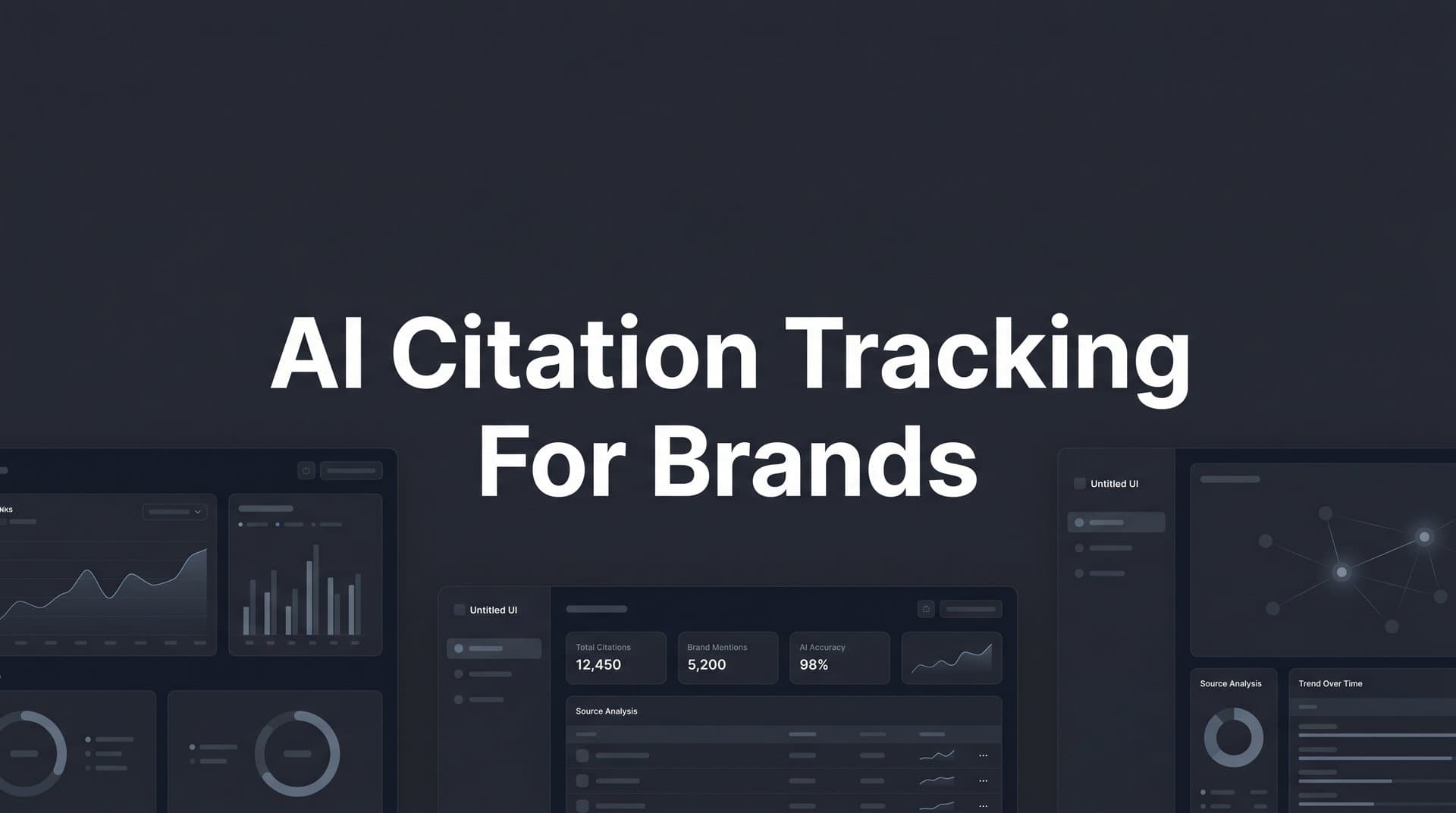
AI citation tracking is the systematic monitoring of when, where, and how AI models mention a brand across platforms. In practice, this means regularly querying AI models with relevant prompts, capturing their responses, and analyzing those responses for brand mentions, context, sentiment, and competitive positioning. It's an active intelligence-gathering discipline, not a passive data feed.
The core metrics in any robust AI citation tracking system include several distinct dimensions worth understanding clearly.
Mention Frequency: How often does your brand appear in AI responses to relevant queries? This is the baseline metric, equivalent to impressions in traditional media. High frequency means AI models are consistently drawing on your brand as a reference point. Low frequency means you're largely absent from AI-driven conversations in your category.
Sentiment Analysis: Not all mentions are equal. An AI model might cite your brand as the leading solution in a category, as a budget-friendly alternative, or as a product with known limitations. Dedicated sentiment tracking for AI responses layers on top of raw mention data to classify the nature of each citation: positive, neutral, or negative, with nuance about how your brand is being framed and positioned.
Prompt-Level Tracking: Different queries produce different results. Tracking at the prompt level means understanding which specific questions or topics trigger your brand to appear and which don't. This granularity is essential for identifying content gaps and optimization opportunities.
Competitor Comparison: AI citation tracking isn't just about your brand in isolation. Understanding how your mention frequency and sentiment compare to direct competitors reveals your relative share of voice in AI-driven discovery and highlights where competitors are winning conversations you should be part of.
AI Visibility Score: Some platforms aggregate these metrics into a composite score that gives a single, trackable number representing your overall AI presence. This makes it easier to monitor trends over time and communicate performance to stakeholders who don't need the full granular breakdown.
It's important to be clear about what AI citation tracking is not. It is not traditional media monitoring, which tracks mentions in news articles and online publications. It is not social listening, which monitors brand mentions on social platforms. Both of those disciplines rely on crawling publicly available text. AI citation tracking is fundamentally different: it requires purpose-built tooling that actively queries AI models, captures live responses, and analyzes unstructured conversational text in real time.
This distinction matters because many brands mistakenly assume their existing monitoring tools cover the AI channel. They don't. AI responses are generated dynamically, vary by prompt phrasing and platform, and don't exist as indexable web pages. You can't crawl them after the fact. You have to query for them directly, which is exactly what dedicated tools for tracking AI mentions are built to do.
How AI Citation Tracking Works Under the Hood
The technical process behind AI citation tracking is more nuanced than it might first appear. It's not simply a matter of asking an AI model "do you know about Brand X?" and recording the answer. Effective tracking requires a systematic approach across multiple dimensions simultaneously.
The process begins with prompt engineering. A comprehensive tracking system needs a library of relevant prompts that reflect how real users actually query AI models. For a B2B software brand, this might include prompts like "what are the best tools for [use case]," "compare [your category] options for [user type]," "what should I look for in a [product category] platform," and dozens of variations. The goal is to map the full landscape of queries where your brand could plausibly appear. Understanding AI prompt tracking for brands is foundational to getting this right.
Those prompts are then sent to multiple AI models at regular intervals. Different platforms have different training data, retrieval mechanisms, and response tendencies, so a brand might appear frequently on Perplexity but rarely on Claude, or vice versa. Investing in multi-platform AI tracking solutions provides a complete picture rather than a narrow slice.
The responses are then parsed for brand mentions. This sounds straightforward, but it requires sophisticated text analysis. AI responses use natural language, so mentions can be explicit ("Brand X is a popular option") or implicit ("the platform known for its integrations"). A robust system needs to catch both, along with variations in brand name spelling, abbreviations, and contextual references.
Sentiment analysis then layers on top of the raw mention data. This is where the system distinguishes between a citation that frames your brand as a category leader versus one that positions you as a secondary option or notes a specific limitation. Modern sentiment analysis in this context goes beyond simple positive/negative classification: it captures positioning language, comparative framing, and the specific attributes AI models associate with your brand.
One of the most significant technical challenges in AI citation tracking is prompt variability. The same underlying question, phrased differently, can produce meaningfully different responses from the same AI model. "What's the best CRM for startups?" and "Which CRM do you recommend for early-stage companies?" might yield different brand mentions even though they're asking the same thing. This means comprehensive tracking requires broad prompt coverage, including multiple phrasings of similar queries, to avoid false confidence from a narrow sample.
The result of this process is structured data: a record of which prompts triggered mentions, on which platforms, with what sentiment, and how your brand compared to competitors in each response. That structured data is what transforms AI citations from a vague, unobservable phenomenon into something you can measure, track over time, and act on strategically.
Five Actionable Insights You Can Extract from Citation Data
Raw citation data is only valuable if you can translate it into action. The good news is that well-structured AI citation tracking data is rich with strategic signal. Here are five categories of insight that brands consistently find most actionable.
Content Gap Identification: This is often the highest-value insight. When you track citations at the prompt level, you can identify specific queries where competitors appear in AI responses but your brand doesn't. Each of those prompts represents a content opportunity: a topic where you're not yet authoritative enough for AI models to reference you. These gaps give your content team a precise, data-driven brief rather than educated guesses about what to write next.
Sentiment and Positioning Analysis: Understanding how AI models frame your brand is strategically critical. Are you consistently positioned as the premium option, the user-friendly choice, or the enterprise-grade solution? Are there recurring limitations or caveats that AI models attach to your brand? This positioning data reveals how your content and PR efforts have shaped AI perception, and where you need to shift the narrative. If AI models keep citing a competitor as "the easiest to implement" and you know your product is just as easy, that's a clear signal to create more implementation-focused content.
Competitive Benchmarking: Citation tracking gives you a share-of-voice metric for the AI channel. Leveraging brand tracking for competitive analysis lets you see whether your mention frequency is growing or declining relative to competitors, which platforms favor which brands, and how your AI visibility correlates with content publishing activity or PR campaigns. This benchmarking turns AI visibility from an abstract concept into a competitive metric you can track quarterly.
Trend Correlation: By tracking citations over time and correlating changes with your own activities, you can start to understand what actually moves the needle. Did a cluster of new articles improve your mention frequency on Perplexity? Did a product launch announcement shift your sentiment scores? This causal analysis is early-stage for most brands, but it's exactly the kind of feedback loop that separates systematic AI visibility management from guesswork.
Platform-Specific Strategy: Different AI platforms have different citation patterns. A brand might have strong visibility on one platform and weak visibility on another. Understanding these platform-specific patterns allows you to prioritize your optimization efforts and tailor your content strategy to the retrieval tendencies of each major AI model. Exploring brand tracking across AI platforms helps you identify exactly where to focus.
From Tracking to Action: Building a GEO Content Strategy
Tracking citations is the intelligence-gathering phase. Acting on that intelligence is where the real competitive advantage gets built. This is where Generative Engine Optimization (GEO) enters the picture.
GEO is the practice of creating content specifically designed to earn AI citations. Just as traditional SEO involves optimizing content so that search engines rank it highly, GEO involves optimizing content so that AI models reference and recommend your brand in relevant responses. The two disciplines share some foundations, but GEO has distinct requirements rooted in how AI models learn and retrieve information.
The feedback loop that connects citation tracking to GEO looks like this: you track your current AI citations, identify the prompts where you're absent or underperforming, create content that directly addresses those topics with the depth and authority that AI models favor, index that content quickly so it gets discovered and absorbed, and then re-track to measure whether your citation frequency improves. Using a dedicated AI visibility tracking platform makes running this loop consistently far more manageable.
The content formats that tend to earn AI citations share some common characteristics. Comprehensive, well-structured articles that directly answer specific questions tend to perform well. Content that establishes clear expertise signals, uses precise terminology, and covers a topic with enough depth to be genuinely useful is more likely to be drawn upon by AI retrieval systems. Listicles, comparison guides, and how-to explainers are particularly effective because they map closely to the question formats users bring to AI models.
Indexing speed matters more in the GEO context than many marketers realize. AI models are updated and their retrieval systems evolve continuously. Getting new content indexed quickly means it has a better chance of being incorporated into the data sources that AI models draw upon. This is where tools like IndexNow become strategically relevant: by pushing new content URLs to search engines immediately upon publication, you accelerate the discovery process and reduce the lag between publishing and potential citation.
Structured content formats also help. Clear headings, well-defined sections, and explicit answers to specific questions make it easier for AI retrieval systems to identify and extract relevant information from your content. Think of it as writing for an audience that includes both human readers and AI systems that need to quickly assess what your content covers and how authoritatively it covers it.
The brands that will win in AI-driven discovery are those that close the loop between tracking and publishing continuously, treating GEO as an ongoing discipline rather than a one-time project.
Choosing the Right AI Citation Tracking Platform
As AI citation tracking matures as a category, more platforms are emerging to serve this need. Evaluating them requires clarity about what actually matters for your use case.
Number of AI Models Tracked: The more platforms covered, the more complete your picture. A platform that only tracks one or two AI models will miss significant portions of the AI search landscape. Look for coverage across ChatGPT, Claude, Perplexity, Gemini, and ideally additional emerging platforms. A thorough review of the best AI visibility tracking platforms can help you compare coverage across providers.
Prompt Coverage Depth: How many prompts does the platform track, and how customizable is the prompt library? Broad, customizable prompt coverage is essential for catching the full range of queries relevant to your brand and category.
Sentiment Analysis Quality: Basic positive/negative classification isn't enough. Look for platforms that provide nuanced positioning analysis, competitive framing detection, and the ability to track how your brand's perceived attributes evolve over time.
Reporting and Dashboard Quality: The data is only as useful as your ability to interpret and act on it. Clear visualizations, trend tracking, competitive benchmarking views, and exportable reports are practical requirements, not nice-to-haves.
Integration with Content Workflows: This is where the all-in-one advantage becomes significant. A platform that connects citation tracking directly to content generation and indexing tools creates a compounding advantage. When your tracking data feeds directly into your content creation workflow, and your published content gets indexed automatically, the feedback loop operates with much less friction. Disconnected point solutions require manual handoffs at every stage, which slows the cycle and introduces gaps.
Sight AI is built around exactly this integrated model: AI visibility tracking across 6+ platforms connects to an AI content writer with specialized agents for generating SEO and GEO-optimized articles, which connects to automatic indexing via IndexNow. Each component reinforces the others, and the whole system is designed to accelerate the citation-tracking-to-content-publishing loop that drives AI visibility growth. You can also explore how AI citation tracking software fits into this broader workflow.
On pricing and scalability, look for platforms that offer transparent pricing tied to the number of prompts tracked, platforms monitored, and reporting frequency. As the category matures, pricing will likely become more competitive, but the platforms that invest in tracking accuracy, prompt breadth, and workflow integration will maintain a meaningful advantage over simpler tools.
The New Standard for Brand Visibility
AI citation tracking is not a niche technical experiment. It's the new equivalent of rank tracking for the AI search era, and it's quickly becoming a standard component of any serious organic growth strategy.
The brands that will dominate AI-driven discovery are not necessarily the ones with the biggest budgets. They're the ones that monitor their AI presence systematically, identify the content gaps where competitors are getting cited and they're not, publish optimized content that fills those gaps, and run that loop continuously. That's a discipline, and like most disciplines, it rewards consistency over time.
The shift happening right now in search behavior is real and accelerating. Users are increasingly turning to AI models for the kinds of high-intent queries that used to flow through traditional search: product recommendations, software comparisons, service evaluations. Brands that treat this channel as a priority today will build a compounding advantage that becomes harder for late movers to close.
The tools to do this properly now exist. The strategy is clear. The only variable is whether you act on it.
Start tracking your AI visibility today and see exactly where your brand appears across top AI platforms. Stop guessing how AI models like ChatGPT and Claude talk about your brand: get visibility into every mention, track the content opportunities your competitors are already exploiting, and automate your path to organic traffic growth with Sight AI.