Using AI for SEO content means tapping into artificial intelligence to help create, fine-tune, and get content in front of people so it ranks higher on search engines. Think of it this way: traditional SEO is like navigating with an old paper map. It gets the job done, but it’s slow and clunky. AI is your real-time GPS, constantly recalculating the fastest, most efficient route to your audience.
Why AI for SEO Content Is No Longer Optional

The entire conversation around search is changing, and holding onto the old ways of doing things just isn't cutting it anymore. Weaving AI into your content workflow isn't just a nice-to-have; it's a necessary adjustment to stay in the game. The core idea is simple: AI shifts content creation from a manual, guesswork-heavy task into a data-driven, incredibly efficient system.
This isn't about letting robots take over. It's about augmenting human creativity. AI becomes a strategic partner, helping you make smarter, faster decisions at every turn. It's not just a speedier typewriter; it’s a powerful research assistant, a sharp-witted strategist, and a tireless optimization tool all rolled into one.
The Shift from Manual Guesswork to Data-Driven Precision
For years, building an SEO content strategy was a mix of art and science, with a heavy dose of educated guessing. You’d dig into keywords, peek at what competitors were doing, and write what you thought would click with both people and search algorithms. It worked, but the process was slow and often missed the subtle nuances of what users were truly looking for.
AI completely flips that script by bringing speed and precision to the table.
- Uncovering Hidden Opportunities: AI can sift through thousands of data points to pinpoint niche topics and specific user questions your competitors have completely missed.
- Achieving Unprecedented Scale: It lets your team produce high-quality, fully optimized content at a volume that was once unimaginable, allowing you to cover more ground and capture more long-tail traffic.
- Adapting in Real Time: As search engine algorithms get updates, AI tools can quickly pivot your strategy to align with the new rules of the game.
Key Takeaway: The biggest change is moving from a reactive content model to a proactive, predictive one. Instead of just chasing what has already worked for someone else, AI helps you anticipate what your audience will be searching for next.
Responding to a New Kind of Search Traffic
This strategic shift is crucial because how people search is changing, too. The explosion of AI-driven search is one of the biggest shake-ups in digital marketing since the smartphone. Traffic from large language models has skyrocketed by an incredible 527% year-over-year, as platforms like ChatGPT and Perplexity become go-to sources for discovery.
Some websites are already seeing over 1% of their total sessions coming directly from these AI platforms. This trend, highlighted in Elementor's AI statistics report, sends a clear signal: your content now needs to appeal not just to human readers, but also to the AI models that are increasingly guiding their searches. By embracing AI now, you're positioning your brand to be a clear, authoritative voice in this new environment.
Thriving in the New Era of AI Overviews

Google's AI Overviews have completely shaken up the search results page, and a lot of old-school SEO tactics are quickly becoming irrelevant. We've officially entered a 'zero-click' world where AI-powered snippets answer questions directly, often making a click through to a website feel unnecessary.
This might sound like a threat, but it’s actually a massive opportunity. The goal is no longer just about clawing your way to the top of the traditional blue links. Now, the real prize is becoming a cited, authoritative source inside these AI-generated answers. Earning that citation is the new gold standard for visibility.
The New Gold Standard is Citation
Think of it this way: getting cited in an AI Overview is the modern equivalent of having your research quoted by a major publication. It instantly positions your content as the definitive source—the one AI models trust enough to feature. That's a powerful endorsement that signals authority to both Google and your potential customers.
The logic is simple. If an AI, built to sift through the internet for the best possible information, chooses your content to answer a question, it’s a huge vote of confidence in your content's quality and trustworthiness. What was once a traffic threat is now a direct channel for attracting highly qualified, high-intent visitors.
Navigating the Zero-Click Reality
The numbers tell the story. Google AI Overviews have fundamentally changed search behavior, with 60-65% of queries now ending without a single click to an external site. For searches that show an AI Overview, click-through rates have plummeted by over 61%.
But here’s the interesting part: research shows that while traffic from AI answers makes up only 0.5% of total visitors, those users drive 12.1% more signups. That’s a huge jump in conversion rate.
This means the visitors who do click through from an AI summary are much more serious. They've already gotten the quick answer and are now coming to you for the deeper dive, making them incredibly qualified leads. Your job is to give them that next level of detail and turn their intent into action.
The screenshot below shows exactly how these AI Overviews synthesize information from different places and present it with citations—those are the clickable links your content needs to earn. This is the new prime real estate on Google.
Strategies to Win the Citation
To get your content cited, you need to shift your thinking from just keywords to providing comprehensive, well-structured, and genuinely authoritative answers. This is the heart of a modern AI for SEO content strategy.
You need to become an expert in what’s now called Answer Engine Optimization. This involves:
- Answering Questions Directly: Structure your content to give clear, concise answers to specific questions. Use your headings and subheadings to break topics down into logical, bite-sized pieces.
- Demonstrating Real Expertise: Go beyond just scratching the surface. Include unique data, expert insights, and real-world examples that an AI model will recognize as valuable and distinct.
- Building Topical Authority: Create comprehensive content clusters around your core topics. This signals to search engines that you are the go-to resource for your niche.
When you adopt these practices, you're no longer just optimizing for algorithms; you're creating content that is genuinely helpful for people. And that’s exactly the kind of material AI models are designed to find and feature. This is how you win in the new era of search.
Weaving AI Through Your Entire Content Lifecycle
Let's move from the "what" to the "how." The real magic of AI for SEO content happens when you stop seeing it as a one-off tool and start treating it like a current that powers your entire workflow. It’s about creating a single, intelligent system that connects every stage, from the first spark of an idea all the way to tracking how it performs after you hit publish.
This fully integrated approach means AI is there from the start, informing your research, shaping your outlines, drafting your content, and even monitoring its success. Every decision is backed by data, every action is efficient, and every article is built for maximum SEO impact right out of the gate.
Let's walk through how this looks at each step.
Stage 1: AI-Powered Research
Every great SEO strategy starts with deep, insightful research. We've all been there—spending hours digging through keyword tools, manually spying on competitor pages, and trying to piece together what users actually want. It’s a grind. AI turns this laborious chore into your secret weapon.
AI models can chew through massive datasets in seconds, spotting profitable content gaps and high-value user questions that you'd likely miss otherwise. They can even sniff out emerging trends before they blow up, giving you a chance to be the first one to the party. Instead of just spitting out keywords, AI helps you understand the entire conversation happening around your topic. If you're looking to get started, exploring different AI tools for content creators is a great first step to see what’s possible.
Stage 2: Intelligent Outlining
A solid outline is the skeleton that holds your article together. A well-structured piece doesn't just guide your reader; it makes it incredibly easy for search engines to understand what your content is about and why it's an authoritative source. This is where AI shifts from researcher to architect, helping you build a blueprint that makes both humans and bots happy.
AI can instantly analyze the top-ranking articles for your keyword to see what’s working. It identifies the common structures, key subtopics, and frequently asked questions you absolutely need to cover.
- Logical Flow: It arranges sections to build a reader's understanding step-by-step.
- Topical Completeness: It makes sure you've covered all the critical angles, turning your article into a comprehensive resource.
- SEO Elements: AI suggests keyword-rich H2s and H3s that perfectly match what people are searching for.
This process ensures your content is not just thorough but perfectly structured for SEO before a single sentence is written. With a platform like Sight AI, this is completely automated. It generates outlines based on real-time SERP data, saving your team hours of painstaking manual planning.
Stage 3: Assisted Drafting
With a smart, AI-generated outline in hand, the actual writing becomes so much faster and more focused. This isn’t about hitting a button and walking away. It’s about using AI as an expert assistant to knock out a high-quality first draft. Think of it as pairing your top strategist with a world-class writer who never needs a coffee break.
You feed the detailed outline and your brand's voice guidelines into an AI writer, and in minutes, you have a cohesive, well-written article. This draft becomes the perfect starting point, freeing up your team to do what they do best: add unique insights, polish the tone, and fact-check the important stuff. For a deeper dive, our guide on content creation with AI shares some practical workflows you can use today.
Stage 4: Automated Optimization
Once the draft is done, the optimization work begins. Traditionally, this meant running through a manual checklist: Is the keyword density right? Are the meta descriptions written? Are there enough internal links? AI automates this entire phase, acting as your tireless optimization specialist.
An AI-powered system can scan your draft and instantly flag areas for improvement. It can suggest better on-page elements, check for readability, and find the perfect spots for internal links to build topical authority and spread link equity across your site.
This automated fine-tuning ensures every piece of content follows SEO best practices without all the manual effort. For instance, Sight AI's specialized agents handle on-page optimization automatically—from meta tags to image alt text—making sure every article is ready to rank from the moment it’s drafted.
To put the time savings into perspective, here’s a quick look at how the workflows compare:
Manual vs AI-Powered Content Workflow Comparison
The table below breaks down the typical time and effort involved at each stage of the content lifecycle, contrasting the old-school manual method with a modern, AI-assisted approach.
| Content Stage | Traditional Manual Approach (Time and Effort) | AI-Powered Approach (Time and Effort) |
|---|---|---|
| Research | 4-6 hours: Manual keyword research, SERP analysis, and competitor reviews. High cognitive load. | 15-30 minutes: Automated gap analysis, trend identification, and user intent mapping. Low effort. |
| Outlining | 2-3 hours: Manually structuring content, identifying subtopics, and mapping out headings. | 5-10 minutes: Instant generation of SEO-optimized outlines based on top-ranking content. |
| Drafting | 6-10 hours: Writing from scratch, requiring deep focus and creative energy. | 1-2 hours: Generating a first draft, followed by human refinement, editing, and fact-checking. |
| Optimization | 1-2 hours: Manually checking on-page elements, meta tags, internal links, and readability. | Under 15 minutes: Automated analysis and implementation of on-page SEO best practices. |
| Publishing | 30 minutes: Manual formatting, uploading to CMS, and submitting sitemaps. | 5 minutes: One-click publishing, automated CMS sync, and instant indexing notifications. |
| Monitoring | Ongoing (1-2 hours/week): Manually tracking ranks, checking analytics, and looking for decay. | Automated: Real-time rank tracking, performance alerts, and continuous monitoring with zero manual input. |
As you can see, the difference is stark. AI doesn't just make the process faster; it fundamentally changes the nature of the work, allowing teams to focus on strategy and creativity instead of repetitive tasks.
Stage 5: Scalable Publishing and Monitoring
The final step is getting your content in front of people and seeing how it does. AI streamlines this by integrating directly with your Content Management System (CMS) for one-click publishing. But more importantly, it automates the critical post-publication tasks that get your content seen.
Advanced platforms can automatically update your sitemap and use protocols like IndexNow to ping search engines like Google and Bing, letting them know new content is ready. This can drastically speed up indexing, meaning your articles start ranking faster.
After publishing, the AI keeps working for you. It can monitor your keyword rankings, analyze traffic, and even send you an alert when a competitor sneaks past you in the search results. This constant feedback loop gives you the insights you need to refine your strategy and double down on what works, turning your content lifecycle into a self-improving engine for growth.
Actionable AI Workflows That Drive SEO Results
Knowing the theory behind AI for SEO content is a good start, but putting that theory into practice is where you really get an edge. It's time to go beyond the concepts and jump into specific, battle-tested workflows you can start using today. Think of these less as ideas and more as mini-playbooks for getting real results.
Each of these workflows uses AI to solve a different, high-impact SEO problem. Whether it's snagging valuable citations in AI Overviews or cementing your site as a topical authority, these strategies are designed to turn AI into a systematic engine for organic growth.
The process below shows how AI fits into the core stages of content production, from the first spark of an idea all the way to hitting "publish."
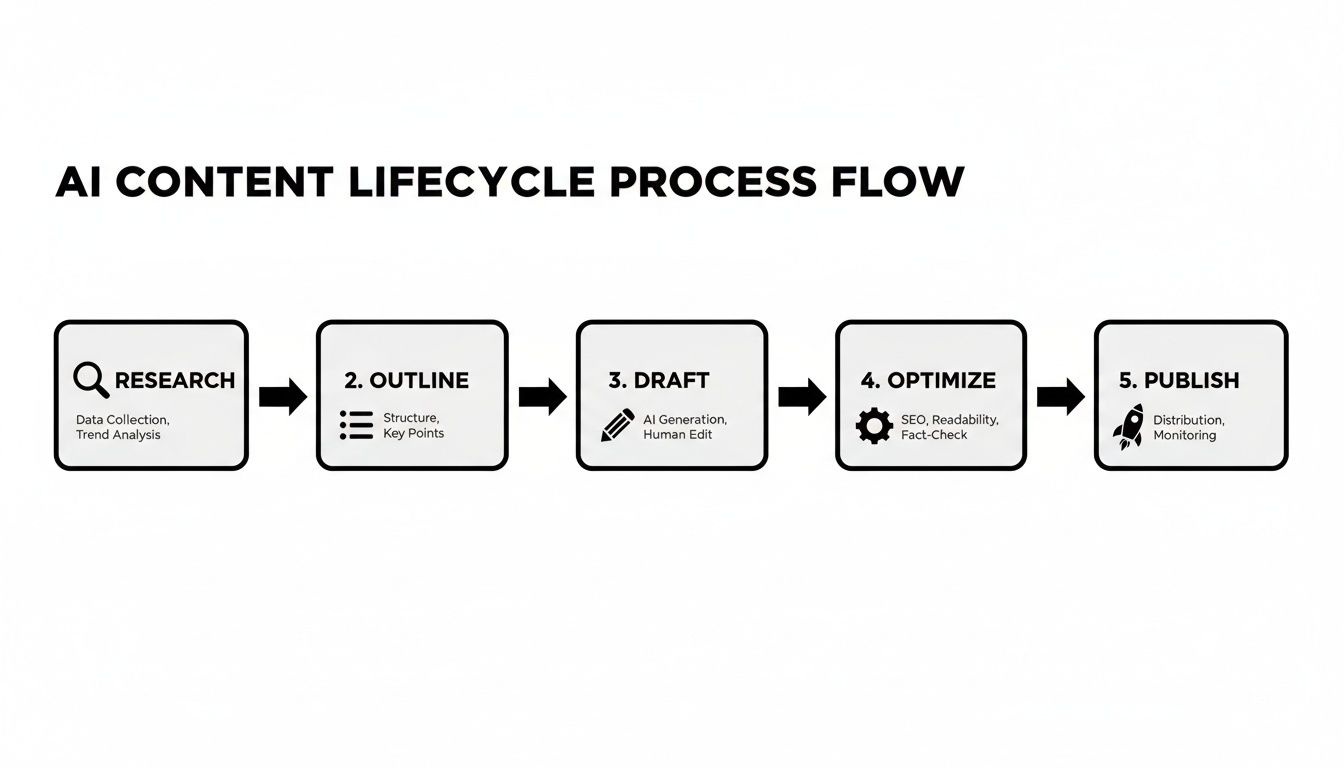
You can see how each step logically flows into the next. This creates a repeatable and efficient system for churning out high-quality content that actually performs.
The Citation Capture Workflow
In the new world of search, getting your content cited in an AI Overview is like hitting the jackpot. This workflow is laser-focused on one thing: finding your competitors' cited sources and creating better content to steal those spots.
- Identify Target Queries: First, find informational keywords in your niche that consistently bring up AI Overviews. You can use a tool like Sight AI to keep an eye on prompts where your competitors are getting featured.
- Analyze Cited Sources: Once you have a target, use AI to break down the content that's currently being cited. What’s its structure? What specific facts or data points does it include? How deep does it go?
- Create Superior Content: Now, direct your AI to produce an article that's more comprehensive, more current, and better organized. The goal is to provide a more definitive answer than what's already out there. For a deeper look at crafting killer AI instructions, check out this guide on Prompt Engineering.
- Publish and Promote: After your superior content goes live, make sure it gets indexed right away. This focused method lets you systematically replace competitor citations with your own.
Key Insight: This isn't about outranking in the traditional sense. It's about becoming the single most reliable source for a specific question, making your content the obvious choice for AI models to feature.
The Topical Authority Builder Workflow
Search engines love websites that show deep expertise on a topic. This workflow uses AI to systematically plan and build out comprehensive pillar pages and interconnected article clusters, establishing your brand as the undisputed expert.
Think of it like building a library. Your pillar page is the main reference book on a big topic, and your cluster articles are the individual chapters that dive deep into every related subtopic.
- Step 1 Pillar Page Ideation: Use AI to pinpoint a broad, high-value topic in your industry that has plenty of search volume and lots of potential sub-topics.
- Step 2 Cluster Topic Generation: Ask your AI to generate a list of 20-30 closely related long-tail keywords and questions that branch off from your pillar topic. These will be your cluster articles.
- Step 3 Content Creation: Use an AI article generator to draft the main pillar page and all the supporting cluster articles from SEO-optimized outlines.
- Step 4 Strategic Interlinking: As you publish, create a web of links. The pillar page should link out to every cluster article, and each cluster article must link back to the pillar. This creates a powerful network of content that signals deep authority to search engines.
The Programmatic SEO Engine Workflow
Programmatic SEO is all about creating high-quality content at a massive scale. It often involves targeting thousands of similar long-tail keywords, like "best accounting software for [industry]" or "how to fix [error code]." This workflow uses AI to put the whole process on autopilot.
It kicks off by identifying a scalable keyword pattern and building a template. You then feed a dataset—like a list of industries or error codes—into the AI, which generates hundreds or even thousands of unique, optimized pages from your template.
This strategy allows a small team to compete for a huge volume of very specific, low-competition keywords that would be impossible to target manually. The result? A steady, compounding stream of organic traffic from users who are incredibly close to making a decision. By automating this with a platform like Sight AI, you can put this entire engine on Autopilot, consistently publishing content that builds momentum over time.
Sidestepping the Common Traps in AI Content Creation
Using AI for SEO content is a massive shortcut, but it's not a self-driving car. Thinking you can just set it and forget it is the fastest way to crash. The right way to see AI is as an incredibly skilled co-pilot, not the pilot. It does the heavy lifting, but a human expert always needs to be in the driver's seat, navigating the tricky parts like quality, accuracy, and brand voice.
Ignoring this simple rule leads to predictable—and often costly—mistakes. You might publish something that's just plain wrong, or you could end up with generic articles that completely fail to connect with your readers. The risks are real. Let's break down the most common traps and, more importantly, how to sidestep them to create content that’s both high-performing and trustworthy.
Blindly Trusting What the AI Spits Out
The single biggest mistake is assuming the AI is always right. It’s not. Large language models are built to generate text that sounds plausible based on the mountain of data they were trained on. They don't have a real "understanding" of facts, and they can't check them in real-time. This is how we get what experts call "AI hallucinations"—confidently stated inaccuracies that can absolutely shred your credibility.
For example, an AI might invent a statistic out of thin air, misattribute a famous quote, or describe a product feature that doesn't even exist.
Crucial Reminder: The "human-in-the-loop" isn't just some buzzy best practice; it's a non-negotiable part of any responsible AI content workflow. Your team's expertise is the final, essential quality check.
Every single claim, number, and key fact an AI generates has to be manually verified by a human expert before it even thinks about going live. This one step is your brand's best defense against spreading bad information and is absolutely vital for building and keeping your audience's trust.
Pumping Out Generic, Soulless Content
Another all-too-common pitfall is creating content that ticks every SEO box but has zero personality. AI is fantastic at pulling together information from all over the web, but this often leads to articles that just read like a boring summary of what everyone else has already said. It’s missing a unique point of view, a distinct brand voice, and the personal stories that actually make people care.
To avoid this trap, you have to treat the AI's output as a high-quality first draft, never the final product. It's your team's job to breathe life into it.
- Inject Your Brand Voice: Go through the draft and edit it to match your brand's unique personality—whether that's witty, authoritative, or super inspirational.
- Add Real Experience: Weave in firsthand stories, customer case studies, or real-world examples that only your team could possibly provide.
- Layer in Unique Insights: Add your own expert opinions and strategic takeaways that offer value way beyond what someone could find with a quick Google search.
This is how you turn a generic, machine-written article into a valuable piece of thought leadership that builds a real connection with your audience.
Forgetting About E-E-A-T Signals
Google’s quality guidelines put a huge emphasis on E-E-A-T, which stands for Experience, Expertise, Authoritativeness, and Trustworthiness. AI-generated content, on its own, can't demonstrate any of these things. If you fail to layer these signals into your articles, you’re setting yourself up to struggle in competitive search results, especially for sensitive "Your Money or Your Life" (YMYL) topics like finance or health.
Think of the AI as your research assistant and your human experts as the credited authors who own the content.
- Credit a Real Human Expert: Always publish content under the name of a qualified person on your team. Make sure they have a detailed author bio that shows off their credentials and relevant experience.
- Cite Your Sources: Link out to credible studies, official reports, and expert sources to back up your claims. This signals trustworthiness to both your readers and the search engines.
- Show Your Work: Don't be afraid to explicitly mention real-world experience. Use phrases like, "In our own testing..." or "From our experience working with dozens of clients..." to add a layer of authenticity that an AI simply cannot fake.
To make it even clearer, here’s a quick rundown of the dos and don'ts for getting the most out of your AI content efforts.
AI for SEO Content Best Practices
| Do | Don't |
|---|---|
| Use AI as a starting point for research, outlines, and first drafts. | Publish AI-generated content without significant human review and editing. |
| Fact-check every statistic, claim, and key piece of information. | Blindly trust the AI's output as factually correct or complete. |
| Inject your unique brand voice, perspective, and firsthand experience. | Create generic content that just rehashes what's already ranking. |
| Credit a qualified human author with a detailed bio to build E-E-A-T. | Forget to add author bios or other signals of human expertise. |
| Add original insights, expert opinions, and real-world examples. | Rely solely on the AI for strategy and creative direction. |
| Review and refine the content to ensure it meets your quality standards. | Treat AI as a "set it and forget it" automation tool. |
Following these guidelines will help you avoid the most common pitfalls and ensure you're creating content that is not only optimized for search but also valuable and trustworthy for your human audience.
Measuring the True Impact of Your AI SEO Strategy

Putting a sophisticated AI for SEO content strategy into motion is a huge step, but it’s really only half the battle. To prove its worth and make smarter decisions down the road, you need to show it’s actually working. This means looking beyond the usual suspects like keyword rankings and organic traffic, which just don't paint the full picture anymore.
The new landscape of AI-driven search calls for a new set of key performance indicators (KPIs). These modern metrics help you measure what truly matters now: your brand's visibility inside AI models and the real business results that come from it. By tracking these, you can finally connect your content efforts directly to your bottom line.
Key Metrics for the AI Era
To get the complete story on your performance, your reporting needs to include KPIs built for this new world of AI-powered search. These are the metrics that give you a clear view of how your content is doing where it counts most.
Here are the essential KPIs you should start tracking immediately:
- AI Visibility Score: This metric shows you how often your brand gets mentioned or cited across different AI models like ChatGPT and Gemini for relevant queries. Think of it as a direct measure of your brand's authority and presence in this new search ecosystem.
- Citation Rate: This is the percentage of AI-generated answers that include a direct link back to your website. A high citation rate is a clear signal that you’re becoming a go-to, trusted source for the AI models themselves.
- AI-Referred Conversions: This tracks how many users click a citation link from an AI answer and then complete a goal on your site, like signing up for a demo or buying a product. It's the ultimate proof of ROI.
Monitoring these metrics isn't just a "nice-to-have" anymore. Platforms like Sight AI are designed to track this data automatically, giving you a unified dashboard that shows your brand's performance across all major AI models. It takes all the guesswork out of measurement.
Connecting AI Metrics to Business Goals
Data is only useful if you can tie it back to your core business objectives. Sure, tracking your citation rate is interesting, but showing how those citations are bringing in new customers? That’s powerful. The goal is to draw a straight line from your AI visibility work to bottom-line results.
For example, a rising AI Visibility Score should correlate with an increase in brand awareness and, over time, a higher volume of direct traffic. In the same way, a steady flow of AI-Referred Conversions provides solid evidence that your content isn’t just being seen—it's actively driving business growth. You can dive deeper into this topic in our guide to measuring content marketing ROI.
By focusing on these forward-thinking metrics, you can shift the conversation from "Are we ranking?" to "Are we driving revenue?" This data-driven approach lets you show the tangible impact of your work, justify your investment in AI, and make much smarter, more strategic decisions for the future.
Frequently Asked Questions About AI for SEO Content
Let's clear the air. When it comes to using AI for SEO content, a few common questions always pop up. Here are the straightforward answers you're looking for.
Does Google Penalize AI Content?
Nope. Google doesn't care if you used AI to create your content. What they do care about is whether your content is helpful, high-quality, and genuinely serves the person searching.
As long as your articles hit the mark on E-E-A-T (Experience, Expertise, Authoritativeness, and Trustworthiness) and solve a real problem for the user, it doesn't matter how they were made. It's all about value, not the vehicle that got you there.
How Do I Maintain Brand Voice with AI?
This is a big one, and it's mission-critical. The key is to think of AI as a brilliant first-draft assistant, not the final author.
You can't just press a button and expect perfection. You need to feed the AI your brand's style guides, core principles, and examples of your best work. Then, your human editors step in to polish the output, weaving in your brand’s unique personality, stories, and insights. That's the secret sauce.
Can Small Businesses Benefit from AI for SEO?
Absolutely. In fact, AI is one of the biggest advantages a small business can have right now. It levels the playing field in a way we've never seen before.
Tools like this give smaller teams the ability to scale their content and conduct strategic research that was once reserved for massive companies with huge budgets. By automating the heavy lifting of research, drafting, and optimization, you free up your most valuable resource—your time—to focus on actually growing the business.
Ready to turn AI visibility into measurable growth? Sight AI gives you the insights and automation needed to dominate in the new era of search. Discover what AI models are saying about your brand and start publishing high-performing content on Autopilot. Explore Sight AI today!