Brand awareness is the invisible foundation of your entire marketing strategy. The simplest answer to why brand awareness is important is that it builds the trust and familiarity needed to hit every single business goal—from getting your first customer to fostering lifelong loyalty. It cuts through the noise for consumers, builds a defensive moat around your business, and, most importantly, makes sure you’re even in the running when a purchase decision is being made.
What Brand Awareness Really Means and Why It Matters

Before we get into the weeds, let’s clear up what brand awareness actually is. It's so much more than just having people recognize your logo.
Think of it like owning a piece of real estate in your customer's mind. When a problem you solve pops into their head, your brand is the first name that comes to mind—almost like a reflex. They think of you first, like a trusted friend they’d call for advice without a second thought.
This "mental availability" is the secret weapon working for you long before someone is ready to pull out their credit card.
The Foundation of Customer Choice
Brand awareness is the bedrock of every purchasing decision. Simple recognition can be the deciding factor, with studies showing that 50% of consumers are more likely to buy from brands they already know. That figure gets even more stark when you realize a whopping 77% of consumers make purchases based on the brand name alone.
In a marketplace overflowing with options, buyers are looking for shortcuts. Your brand's familiarity is that shortcut. Faced with two nearly identical products on a shelf, the one they recognize almost always wins.
"Awareness is the first step toward building brand equity. Without it, you’re just another option. With it, you become the option."
That initial familiarity creates fertile ground for everything else. It means your messaging, your values, and your unique features are heard instead of being tuned out as noise from a stranger. Consistently showing up with a clear voice helps shape how people see you—something you can dig into by exploring the different tones of voice you can adopt.
More Than a Vanity Metric
It's easy to write off brand awareness as a "soft" metric in a world obsessed with hard data. But that's a huge mistake. Its impact is very real and directly fuels the numbers that matter most to your bottom line.
Just look at how awareness turbocharges your other marketing efforts:
- Paid Advertising: Ads from a brand people already know get more clicks and cost less. That pre-existing trust does half the work for you.
- Content Marketing: An article or video from a familiar name is far more likely to get opened, read, and shared. Your audience already assumes it has value.
- Search Engine Optimization: When scrolling through Google results, people instinctively click on brands they recognize. This boosts your organic click-through rate and signals to search engines that you're a relevant authority.
- AI Visibility: As more people ask AI chatbots for recommendations, brands that are well-known and frequently mentioned online are the ones that get suggested. This is the new frontier of discovery.
At the end of the day, being known isn't just about being seen—it's the critical first step to being chosen. It directly fuels lead generation, customer loyalty, and sustainable, long-term growth.
Connecting Brand Awareness to Your Bottom Line
A lot of marketers get this wrong. They see brand awareness as a "soft" metric, some fuzzy concept that lives on a different planet from the hard numbers that run the business. But that couldn't be further from the truth.
Strong brand awareness is the powerful, often invisible engine that directly fuels revenue, profitability, and sustainable growth.
Let's connect the dots. I'll show you exactly how building your brand translates into real, measurable financial gains. Think of it this way: awareness isn't the end goal. It's the starting point that makes every other part of your marketing funnel cheaper and more effective.
It’s the difference between shouting into a void and speaking to a room of people who already know your name and are actually leaning in to listen. That familiarity is where the financial magic really begins.
Driving Demand and Organic Discovery
One of the most direct financial impacts of brand awareness shows up in your organic search demand. When people know you and trust you, their search behavior completely changes.
Instead of typing a generic query like "best project management software," they search for your name. This "branded search" is one of the most powerful signals you can send to Google. It screams authority and brings in some of the highest-intent traffic you could ever ask for. These people aren't just browsing; they're actively looking for you.
This halo effect even extends to non-branded searches. When your name pops up in a list of search results, a user is far more likely to click on the brand they recognize. In fact, studies show a well-known brand can see a 2-3x higher click-through rate on organic search results than an unknown competitor, even if they rank a bit lower.
Reducing Customer Acquisition Costs
Look at any marketing budget, and you'll find a huge line item for Customer Acquisition Cost (CAC)—the total amount you spend to win a new customer. A strong brand is one of the most reliable ways to push that number down.
Here’s how it works:
- More Efficient Paid Ads: When people recognize your brand in a paid ad, they're more likely to trust it and click. This boosts your ad's quality score, which can lower your cost-per-click (CPC) and make your entire ad budget work harder.
- Higher Conversion Rates: Whether it's a landing page or a product page, visitors who already know and trust your brand are simply more likely to convert. You get more customers from the same amount of traffic, which directly slashes your CAC.
- Reduced Reliance on Paid Channels: As your branded search volume and direct traffic grow, you become less dependent on expensive top-of-funnel ads to fill your pipeline.
Investing in brand awareness is a direct investment in making every other marketing dollar you spend work harder. It creates a powerful tailwind that boosts the performance of all your acquisition channels.
Increasing Customer Lifetime Value
The benefits don't stop once a customer makes a purchase. That’s actually where brand awareness starts to impact your Customer Lifetime Value (LTV). The key here is trust. It's the foundation of loyalty and repeat business.
A customer who buys from a brand they already know and trust is far more likely to become a repeat purchaser. They feel more confident in their decision, experience less buyer's remorse, and are more receptive to your future marketing. This trusted relationship makes it easier to upsell, cross-sell, and retain them for the long haul, dramatically increasing their lifetime value. For a deeper dive into financial metrics, you can learn more about measuring content marketing ROI and how these concepts connect.
When someone asks "why is brand awareness important?" the answer is right there in the numbers. It directly builds a more profitable business by lowering the cost to get customers while increasing how much they're worth over time. This isn't just fluffy marketing—it's a smart, sustainable financial strategy.
7 Strategies to Build Lasting Brand Awareness
Knowing why brand awareness matters for your bottom line is one thing. Actually building it is a whole different ballgame. This is where we shift from theory to practice, moving into the playbook of strategies that carve out that essential mental real estate in your audience's mind.
This isn't about launching a single splashy campaign and calling it a day. It's about building a consistent, multi-channel presence that constantly reinforces who you are. The goal is to be the first name that pops into someone's head the moment they have a problem you can solve.
Let's break down the core strategies modern marketing teams are using to make a real impact, from the foundational tactics to the new frontier of brand visibility.
1. Lay the Foundation with Content Marketing
Content marketing is the absolute bedrock of building a brand today. It’s your chance to prove you know your stuff, answer your audience's most urgent questions, and build trust long before they're even thinking about opening their wallet.
Think of every blog post, video, or guide as a helpful conversation, not a sales pitch. You're giving away value and establishing your brand as a go-to authority. A potential customer who finds the solution to their problem on your blog is far more likely to remember and trust you when it’s time to buy.
This is also how you get found. High-quality, helpful content is what puts you on the map when people are actively searching for information on Google. It's the ultimate "pull" strategy, drawing an interested, relevant audience right to your digital doorstep.
2. Earn Credibility Through Digital PR and Partnerships
While your own content builds authority, getting a stamp of approval from others builds massive credibility. Digital PR and strategic partnerships are all about getting other respected voices in your industry to talk about you.
This can happen in a few key ways:
- Guest Posting: Writing for other well-known blogs in your space puts your brand in front of a fresh, highly relevant audience.
- Podcast Appearances: Sharing your expertise on podcasts is a powerful way to connect with listeners on a more personal level.
- Collaborations: Teaming up with complementary brands for a webinar or co-branded guide exposes both of your audiences to new, valuable solutions.
- Media Mentions: A feature in an industry publication is a powerful signal that you're a legitimate and trustworthy player.
Every mention acts as a vote of confidence. This "earned media" often carries more weight than paid ads because it comes with an implicit third-party endorsement.
As you build this kind of awareness, you'll see a direct financial upside. Stronger brand recognition naturally leads to a lower Customer Acquisition Cost (CAC) and a higher Lifetime Value (LTV).
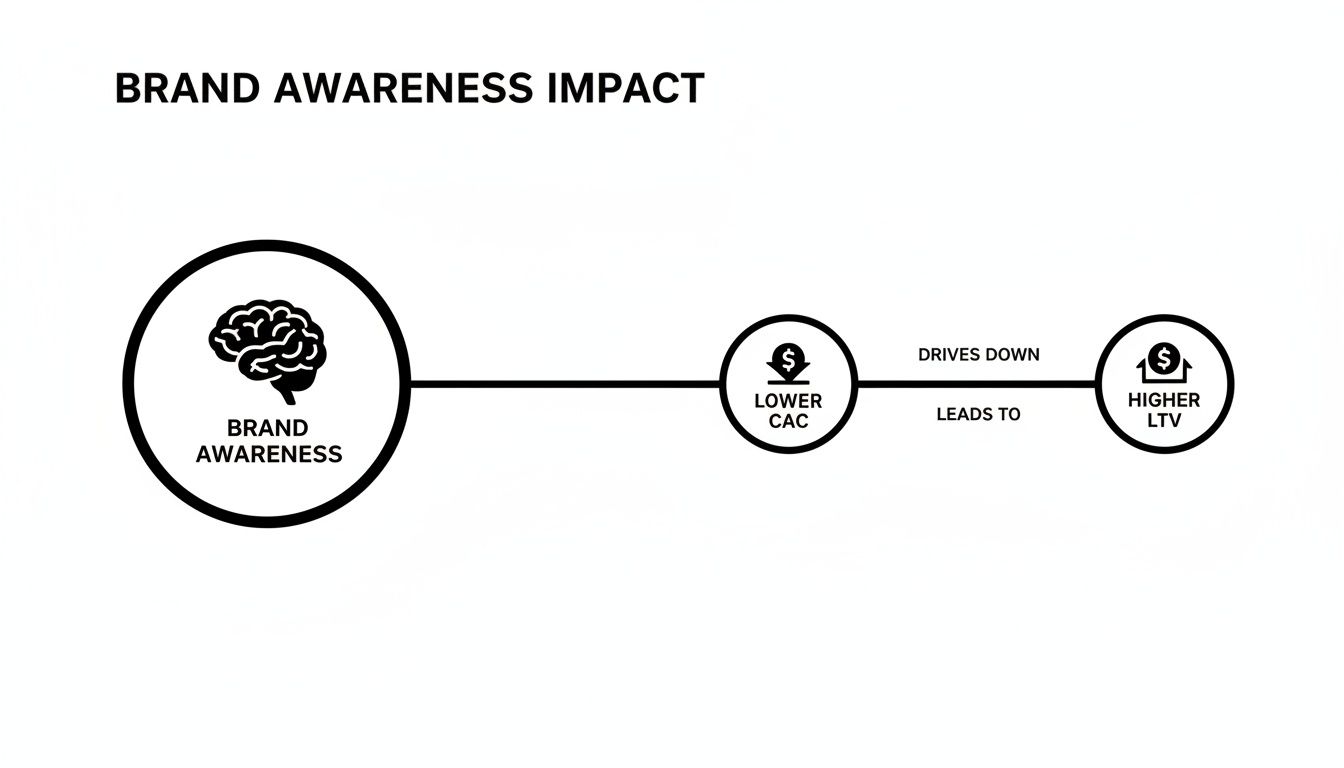
This process shows how your marketing becomes more efficient and your customer relationships more profitable as your brand's presence grows stronger.
3. Engage and Humanize on Social Media
Social media is where your brand stops being a logo and starts being a personality. It’s less about hard selling and more about building a community, joining conversations, and showing the human side of your business.
Consistency is everything here. Sharing valuable content, actually responding to comments, and participating in relevant discussions keeps you top-of-mind in your audience’s daily feeds. It creates a sense of familiarity and connection that's hard to replicate anywhere else.
One of the smartest ways to keep your feed fresh is by repurposing your big content pieces into bite-sized formats. For instance, learning how to create YouTube Shorts from existing videos is a perfect example of this. It's a simple, efficient way to get more mileage out of your best content across different platforms.
4. Drive Visibility with Paid Media
Paid media, like social media ads or search ads, acts as an accelerant for all your other efforts. While organic strategies build momentum over time, paid campaigns can deliver immediate visibility and put your brand directly in front of a targeted audience.
The key is to use it strategically. It's not just about clicks; it's about reach and frequency. You can use paid ads to:
- Promote your best content to a wider audience.
- Run brand awareness campaigns targeting specific demographics or interests.
- Retarget website visitors to stay top-of-mind after they've left your site.
When your paid strategy works hand-in-hand with your organic content, it creates a powerful feedback loop that builds awareness much faster.
5. Capture Demand with SEO
Search Engine Optimization (SEO) is the technical backbone of brand discovery. While content marketing creates the value, SEO ensures that value can be found by the people who need it most.
It's about making sure your website is structured in a way that search engines can understand and trust. When someone types a problem into Google, you want to be the solution that appears on the first page.
Strong SEO means you're not just building a brand; you're building a brand that captures existing demand. It's the difference between shouting into the void and showing up at the exact moment a customer is looking for you.
6. Get Found in the AI Era with AI Visibility
Finally, we have to talk about the next frontier of brand discovery: AI Visibility. More and more people are turning to AI chatbots like ChatGPT and Gemini for answers, recommendations, and product suggestions. Getting your brand mentioned in these conversations is quickly becoming a non-negotiable part of any modern awareness strategy.
So, how does it work? These AI models are trained on the vast ocean of information available on the public web.
Every time you execute a strong content, SEO, and PR strategy, you're effectively "teaching" these models that your brand is a relevant, authoritative, and trustworthy source in your field.
The payoff is huge. When a user asks a question related to your industry—"what's the best software for project management?"—the AI is far more likely to mention or recommend your brand in its response.
This is no longer some futuristic idea; it's happening right now. For teams serious about building a durable brand, figuring out how to generate high-quality AI content for SEO provides a direct path to increasing your footprint in the datasets these models rely on.
7. Stay Consistent with a Documented Brand Strategy
All these tactics are great, but they can fall flat without a unifying thread. A documented brand strategy ensures that every piece of content, every ad, and every social media post feels like it's coming from the same company.
This document should outline your:
- Mission and Vision: Why do you exist?
- Target Audience: Who are you talking to?
- Brand Voice and Tone: How do you sound?
- Visual Identity: What do you look like?
- Core Messaging: What are the key points you always want to communicate?
This isn't just a branding exercise. It’s a practical tool that ensures consistency across your entire team and every channel, which is the secret ingredient to building a brand that people truly remember.
How to Measure Brand Awareness Effectively
Measuring brand awareness can feel like trying to catch smoke. How do you slap a number on something that lives inside someone's head? The good news is, you don’t have to. Instead, you can track a collection of digital signals that, when you put them all together, paint a surprisingly clear picture of your brand's growing influence.
The trick is to look past the simple vanity metrics. We need to focus on data that actually reflects your presence in the market. This means looking at a mix of direct and indirect signs that show not just if people are seeing your brand, but how they're actually engaging with it. By keeping an eye on these signals, you can finally prove the ROI of your brand-building efforts and make smarter moves.
Let's demystify this whole process and break down the specific, actionable metrics you can start tracking today.
Tracking Direct Signals of Awareness
Direct signals are the clearest proof that people know your brand by name. These metrics show your audience is actively looking for you, which is a powerful sign that all your hard work is paying off.
Start by digging into your website analytics. A jump in direct traffic—that’s people typing your URL right into their browser—is the gold standard. It means they didn't just stumble upon your site; they remembered you and came looking for you on purpose.
Another huge one is branded search volume. This is simply the number of people searching for your company or product name on Google. When this number climbs, it’s a sign that your brand is becoming a known player in your field, shifting from just another generic solution to a specific destination in customers' minds.
Brand awareness isn't just about being seen; it's about being sought after. When people start searching for you by name, you've moved from being one of many options to being the specific solution in their mind.
Monitoring Indirect Indicators of Influence
Indirect metrics are all about understanding your brand’s place in the wider industry conversation. They show you how you stack up against the competition and how much authority you really have in your space.
One of the best ways to see how you measure up against competitors is through Share of Voice measurement. This metric tells you exactly how much of the conversation in your industry is about your brand versus your rivals. It’s an essential benchmark for seeing if you’re cutting through the noise.
On top of that, keep a close watch on these two indicators:
- Social Media Mentions: Track how often your brand gets mentioned across platforms like LinkedIn, X (formerly Twitter), and niche industry forums. Don't just count the mentions; look at the sentiment. Are the conversations positive, negative, or just neutral?
- Backlinks from Reputable Sources: When other high-authority websites link to your content, it’s like a powerful stamp of approval from a trusted third party. Every quality backlink is a vote of confidence that tells search engines—and your audience—that you're a credible source.
To get a handle on all these moving parts, it helps to see them in one place. Here’s a quick-start toolkit for organizing your measurement strategy.
Your Brand Awareness Measurement Toolkit
This table breaks down the essential metrics you should be tracking, sorted by direct and indirect signals, along with some great tools to get the job done.
| Measurement Type | Key Performance Indicator (KPI) | Recommended Tool |
|---|---|---|
| Direct | Branded Search Volume | Google Search Console, Ahrefs |
| Direct | Direct Website Traffic | Google Analytics |
| Indirect | Social Media Mentions & Sentiment | Brand24, Sprout Social |
| Indirect | Share of Voice (SoV) | Brandwatch, Talkwalker |
| Indirect | Backlink Profile Growth | Ahrefs, Semrush |
| Indirect | AI Engine Visibility | Sight |
By using a mix of these tools, you can move from guessing to knowing, with real data to back up your brand's growth story.
Leveraging Modern Tools for a Complete Picture
In the past, measurement was stuck in traditional channels. Today, you need to see your brand's footprint everywhere your audience hangs out, and that now includes the conversations happening with AI. The game has changed, and your measurement toolkit needs to change with it.
Modern platforms now give you a complete view of your brand’s presence that goes way beyond basic web traffic. For example, you can now track how your brand is being mentioned by AI models like ChatGPT and Gemini, which are rapidly becoming the go-to sources for people researching products and looking for recommendations.
This gives you a truly holistic understanding of your digital footprint. To manage this effectively, many teams are turning to a unified dashboard. You can learn more about how to pull all these metrics together with the right multi-platform brand tracking software. Combining these traditional and new-school metrics is the only way to get the 360-degree view you need to accurately measure brand awareness in today’s world.
Real-World Examples of Winning Brand Strategies
Theory is one thing, but seeing brand awareness in action is where the real lessons are. Abstract ideas like "mental availability" and "share of voice" suddenly click when you see how real companies used them to drive tangible growth.
Let’s break down how a few different brands—from B2B software giants to disruptive consumer startups—masterfully built their presence. Each story has a unique challenge, a specific strategy, and the hard numbers to prove it worked, showing why a strong brand is non-negotiable for any business with big ambitions.
How HubSpot Became the King of Inbound
The Challenge: Back when SaaS was just taking off, the marketing software world was a noisy mess. Most companies were just shouting at potential customers with aggressive outbound sales tactics. HubSpot was a small startup that needed to get noticed without a giant ad budget to play with.
The Strategy: Instead of trying to shout louder, HubSpot decided to teach. They basically invented the concept of inbound marketing by creating incredibly useful, high-quality educational content. Their playbook included:
- The Ultimate Blog: They didn't just write articles; they built the go-to resource for everything a marketer needed to know about digital marketing, SEO, and sales.
- Free Tools & Certifications: They gave away valuable tools like the Website Grader and offered free certification courses. This move cleverly embedded their brand directly into the daily life of their target audience.
The Result: HubSpot became synonymous with "inbound marketing." Marketers started searching directly for "HubSpot" instead of generic marketing terms, a clear sign their brand had taken hold. Today, they're a $4.7 billion company built on a foundation of educational content that created massive brand authority and trust.
How Liquid Death Made Water Exciting
The Challenge: Let's be honest, the bottled water market is boring. It's dominated by a few corporate giants with massive distribution deals. Trying to launch another water brand felt like a fool's errand.
The Strategy: Liquid Death simply refused to play by the rules. They took on the branding, tone, and marketing style of a heavy metal band or an energy drink, complete with the tagline "Murder Your Thirst." Their approach was anything but conventional:
- Edgy Social Media: Their content on Instagram and TikTok was shocking, hilarious, and impossible not to share.
- Unconventional Partners: They teamed up with icons like Tony Hawk and Travis Barker, which amplified their rebellious, counter-culture image.
- Must-Have Merch: They sold merchandise that was so cool it constantly sold out, effectively turning their customers into walking billboards.
The Result: Liquid Death exploded. They built a cult-like following, earned a ridiculous amount of social media engagement, and got more media coverage than any CPG brand has a right to expect. All that buzz allowed them to land the major retail deals they needed to compete, proving a killer brand story can disrupt even the most established industries.
Brand building is about being memorable. Whether you do it through education like HubSpot or entertainment like Liquid Death, the goal is to own a specific, unforgettable space in your audience’s mind.
How Notion Built a Community-Led Movement
The Challenge: The productivity software space is absolutely saturated. You've got giants like Microsoft and Google owning the territory. Notion came in with a product that was incredibly flexible but also a bit complex, and they had to figure out how to get it in front of the right people.
The Strategy: Notion did something brilliant: they let their users become their marketing team. They focused on building a passionate community from the ground up.
- User-Generated Templates: They made it easy for users to create and share their own Notion templates. This created a massive ecosystem of content that perfectly showcased how versatile the product was.
- Community Ambassadors: They identified their most dedicated users and officially named them "Notion Ambassadors." These power users then created tutorials and championed the product on platforms like YouTube and Reddit.
The Result: Notion ignited a powerful, organic growth engine. The brand spread like wildfire through pure word-of-mouth, driven by a community that felt a true sense of ownership. This bottom-up strategy was the key to them reaching a $10 billion valuation with very little traditional marketing spend. It just goes to show that sometimes, the best way to build a brand is to step back and let your customers do it for you.
The Future of Brand Building Is AI Visibility

The way people discover brands is going through a massive shake-up. For decades, the path was simple: someone had a question, and they’d head straight to Google. Now, more and more people are skipping the search bar and turning to conversational AI for direct answers and product recommendations.
This isn't some far-off trend. It's happening right now. Getting your brand mentioned by AI models like ChatGPT, Gemini, and Perplexity isn’t a futuristic nice-to-have; it's a real-world requirement for staying relevant. This is the new ground where brand awareness is won or lost.
How AI Models Learn About Your Brand
AI language models don’t have opinions or personal preferences. At their core, they’re incredibly sophisticated pattern-recognition machines trained on the public web—that means billions of articles, forum discussions, product reviews, and websites.
When an AI recommends a brand, it’s because its training data has repeatedly linked that brand with authority, relevance, and positive sentiment around a specific topic. Think of it as the AI connecting the dots. Your job is to make sure your brand is one of those dots.
Your presence in these AI-powered conversations is a direct echo of your existing digital footprint. Every high-quality blog post, every glowing review, and every authoritative backlink is a signal that teaches these models that you're a credible answer to someone's question.
The question "why is brand awareness important?" has a whole new layer now. It’s not just about being known by people. It’s about being recognized as a credible source by the AI systems people are turning to for advice.
Failing to show up in AI-generated answers is the modern version of being buried on page 10 of Google. You’re effectively invisible to a huge and growing slice of your audience.
Securing Your Place in the Conversation
Getting your brand into the AI conversation isn’t about tricking an algorithm. It's about consistently creating the kind of signals that AI models interpret as authority and trustworthiness. This isn't a whole new marketing discipline; it's an evolution of what great brand-building has always been about.
Your strategy should double down on a few key areas:
- High-Quality Content: Go deep. Create expert-led content that genuinely answers your audience's questions and establishes you as the go-to resource in your space.
- Digital PR and Link Building: Earn mentions and backlinks from reputable, authoritative websites. These are powerful votes of confidence.
- A Positive Online Reputation: Encourage customer reviews and foster positive discussions about your brand on forums and social media.
This new reality also demands a new kind of measurement. Just like you track search rankings, you now need to monitor how and where your brand appears in AI responses. Understanding your AI visibility has become a non-negotiable part of any modern marketing strategy. It gives you a clear picture of how your brand is perceived and where your next big opportunities for awareness lie.
Frequently Asked Questions
When you start digging into brand awareness, a few practical questions always pop up. How long will this take? Can my small business even compete? And what’s the actual difference between this and just getting leads? Let's clear those up.
How Long Does It Take to Build Brand Awareness?
Building real, lasting brand awareness is a long game, not something you check off the list with a single campaign. You might see some encouraging signs—like a bump in social media mentions—within a few months, but carving out a permanent space in your audience’s mind usually takes 6-12 months of consistent work.
Think of it as a marathon, not a sprint. The goal is to build sustainable mental real estate with your ideal customers, and that simply requires patience and persistence.
Can Small Businesses Compete with Large Brands?
Absolutely. You just can't compete by trying to outspend them. Instead, you have to be smarter and more focused. The trick is to stop trying to win over the entire market.
Small businesses can punch way above their weight by becoming the go-to brand within a specific community. Here's how:
- Target a very specific niche where you can become the undisputed expert.
- Create exceptional, high-value content on topics the big players are too broad to cover well.
- Show up and engage authentically with your community on social media, in forums, and wherever they hang out.
The winning move isn’t to be a small fish in a big pond; it's to become the biggest fish in a small, well-defined pond.
Brand awareness isn't about being known by everyone—it's about being known, liked, and trusted by the right people. For a smaller business, that focused approach is infinitely more powerful.
What Is the Difference Between Brand Awareness and Lead Generation?
Brand awareness and lead generation are two different, but deeply connected, parts of your marketing funnel. Think of awareness as a top-of-funnel play. It’s all about making your audience familiar with who you are and what you stand for, building trust long before they’re ready to buy.
Lead generation, on the other hand, is a mid-funnel goal. It’s about turning that familiarity and trust into something tangible, like an email address or a demo request. When you have strong brand awareness, lead generation becomes so much easier (and cheaper) because your audience already knows you. They trust you. That makes them far more willing to take the next step.
Ready to see how visible your brand is in the new era of AI search? Sight AI monitors your brand's presence across models like ChatGPT and Gemini, turning visibility insights into actionable content strategies that drive real growth. Get started with Sight AI today.