
Calculating the return on investment (ROI) of content marketing is all about a simple comparison: how much revenue did your content bring in versus how much it cost to create and promote? This single metric transforms content from a fuzzy "nice-to-have" expense into a measurable, revenue-driving asset that justifies its own budget and proves its worth to the higher-ups.
Why Proving Content Marketing ROI Matters

Let's be honest. For a lot of marketing teams, trying to pin a dollar value on a blog post or a whitepaper feels like catching smoke. Unlike a paid ad with a direct click-to-buy path, content often plays the long game, influencing customers across a winding journey. This ambiguity can lead stakeholders to see it as a soft, brand-building activity rather than a core business driver.
But that view misses the forest for the trees. Content marketing isn't just about generating awareness; it's about building a compounding asset. Every article, video, or case study you publish can keep attracting organic traffic, nurturing leads, and building your authority for months—sometimes even years—after you hit publish.
From Cost Center to Growth Engine
The ability to measure your content marketing ROI is what separates the high-performing teams from those just making noise. When you can draw a clear line from your content efforts to real business outcomes, everything changes.
Suddenly, you can:
- Secure Bigger Budgets: Nothing justifies a bigger investment like showing a positive return on the last one.
- Make Smarter Decisions: ROI data is your roadmap. It tells you exactly what’s working so you can double down on high-impact topics and formats.
- Align with Business Goals: Tying content to revenue ensures your team is laser-focused on activities that actually move the needle for the company.
- Earn a Seat at the Table: When you start talking the language of ROI, you gain credibility and real influence within the organization.
This strategic shift is why the content marketing industry is booming, projected to hit $107 billion by 2026. A massive 82% of businesses now rely on it as a core strategy. And for good reason: it costs 62% less than traditional marketing while pulling in three times more leads.
The real power of calculating content ROI is that it forces you to think like a business owner, not just a creator. You start asking strategic questions: "Which topics will attract high-intent buyers?" instead of "What should we write about this week?"
A Quick Look at the Math
Before we dive deep, let's get a bird's-eye view of what goes into this calculation. Understanding these components is the first step toward building a predictable growth engine.
Key Components for Calculating Content Marketing ROI
| Component | Description | Example Metric |
|---|---|---|
| Investment | The total cost to produce and promote your content. | Freelancer fees, software subscriptions, ad spend. |
| Return | The total revenue generated that can be attributed to your content. | New sales from blog-sourced leads, upsells from case studies. |
| Attribution | The method used to connect a conversion back to a specific piece of content. | First-touch, last-touch, or multi-touch models. |
| Metrics | The specific data points you track to measure performance along the way. | Organic traffic, conversion rate, lead quality score. |
This table gives you a clear roadmap for the rest of this guide, where we'll break down each component with formulas, examples, and tools to make it happen.
The Modern Approach to Measurement
Thankfully, measuring this impact is no longer a guessing game. Modern platforms have made it easier to connect the dots. Tools like Sight AI help bridge the gap between content creation and business performance by turning visibility insights into an actionable strategy. By monitoring how your brand is discussed across search engines and AI models, you can spot high-value opportunities and create content that speaks directly to customer needs.
This guide will walk you through everything you need to accurately calculate and improve your content marketing ROI. You'll gain the practical knowledge to not only understand why brand awareness is important but also how to connect it directly to your bottom line.
Aligning Your Goals With The Right KPIs

Before you can even think about calculating your content marketing ROI, you have to get brutally honest about what "return" actually means for your business. Success isn't one-size-fits-all. A huge win for an e-commerce brand is going to look completely different from a win for a B2B SaaS company.
This is where a lot of teams get tripped up. They dive headfirst into creating content without a clear, measurable goal tied back to the bigger business picture.
It's easy to get caught up chasing vanity metrics like social media likes or a spike in page views. They feel productive, but they rarely tell the whole story about financial impact. An article can get thousands of shares and still bring in zero revenue. The trick is to stop obsessing over broad awareness metrics and start focusing on Key Performance Indicators (KPIs) that actually reflect business growth.
You first need to understand how to define success for your team. Getting this alignment right from the start ensures every blog post, video, and whitepaper has a real purpose.
Connecting Goals to Actionable KPIs
Your main business objective should be the North Star for the KPIs you track. Let's see how this plays out. If your goal is to generate new business, you need to look past simple traffic numbers and zero in on metrics that signal someone is ready to buy.
For a Lead Generation goal, your primary KPIs might look like this:
- Marketing Qualified Leads (MQLs): How many leads did you get from content downloads like ebooks or webinars?
- Conversion Rate: What percentage of people who read a blog post actually filled out your contact form?
- Cost Per Lead (CPL): How much did you spend on a content campaign divided by the number of leads it brought in?
If your goal is Customer Acquisition, the focus gets even sharper and moves further down the funnel. Here, your content is judged by its ability to directly drive sales.
Your go-to KPIs would be:
- Customer Acquisition Cost (CAC): What’s the total marketing cost to get a new customer, and can you trace it back to specific content channels?
- Sales Attributed to Content: Using your CRM, you can see how many new customers first found you through a piece of content.
- Trial or Demo Sign-ups: For SaaS companies, this is a massive bottom-of-funnel metric that proves your content is pushing prospects toward a purchase.
A classic mistake is treating all content like it has the same job. Top-of-funnel blog posts should be measured by how well they attract organic traffic and subscribers. On the other hand, bottom-of-funnel case studies should be judged purely on their power to turn leads into paying customers.
Tailoring KPIs for Your Business Model
The right KPIs also hinge on your specific business model. A generic approach just won't give you the clarity you need to make smart decisions. You have to pick metrics that mirror how your company actually makes money.
Here’s a quick breakdown of how different businesses might set this up:
| Business Model | Primary Content Goal | Key KPIs to Track |
|---|---|---|
| SaaS Company | Generate qualified leads | Demo requests, Free trial sign-ups, Lead-to-customer conversion rate |
| E-commerce Store | Drive direct sales | Average order value (AOV) from content readers, Cart conversion rate, Product page views from blog |
| Marketing Agency | Attract high-value clients | Consultation form submissions, Proposal requests, Client Lifetime Value (CLV) |
When you select KPIs that line up with your specific goals and business model, you create a solid framework for measurement. This not only makes calculating content marketing ROI much simpler but also gives you actionable insights to improve your strategy.
For a deeper look into this, you can learn more about the key website metrics to track in our other guides. Getting this foundational step right ensures you’re measuring what truly matters.
The Formula for Calculating Content Marketing ROI
At its heart, the math behind content marketing ROI is refreshingly simple. You don't need a degree in data science or some mystical algorithm—just a clear formula that pits what you gained against what you spent. This clarity is what turns content from a creative "nice-to-have" into a predictable business driver.
The standard formula is as straightforward as it gets:
ROI = [ (Return - Investment) / Investment ] x 100
While the equation is easy, the real work is in accurately defining and tracking the "Return" and "Investment" variables. Nailing these two components is how you truly prove your content's financial impact. Let's break down each element so you can calculate your ROI with confidence.
Tallying Up Your Total Investment
One of the most common mistakes I see marketers make is underestimating the true cost of their content. A proper investment calculation goes way beyond just paying a freelance writer. To get an accurate picture, you have to account for every single resource that went into bringing a piece of content to life.
This includes both the obvious and the not-so-obvious costs:
- Content Creation Costs: This is the easy part. It covers payments to freelance writers, designers, and videographers, or the prorated salaries of your in-house content team.
- Software and Tool Subscriptions: Don't forget the monthly fees for your SEO tools (like Ahrefs or Semrush), your content management system (CMS), graphic design software (like Canva or Adobe Creative Cloud), and any project management platforms.
- Promotional Spend: Did you boost a post on social media or run a PPC campaign to drive traffic to your new guide? All advertising costs associated with that specific piece of content need to be included here.
- Time as a Resource: This is the hidden cost that trips people up. You have to account for the hours your team spends on strategy, editing, countless meetings, and even just uploading the content. A simple way to do this is to calculate an hourly rate for each team member and multiply it by the time they spent on the project.
By meticulously tracking these expenses, you build an honest, solid foundation for your ROI calculation.
Quantifying Your Financial Return
Defining your "Return" can feel a bit more complex because content generates value in multiple ways, not all of which are direct sales. The goal here is to translate your key performance indicators (KPIs) into tangible dollar amounts.
Once you have the formula, it's crucial to apply it correctly. For a comprehensive approach to calculating and proving your marketing's financial return, explore this guide on how to measure marketing ROI the right way.
The biggest unlock in calculating ROI is realizing that "Return" doesn't just mean immediate revenue. It’s also about quantifying the value of assets your content creates, like organic traffic and qualified leads, which fuel future growth.
Here’s how you can assign a monetary value to different types of returns:
1. Direct Revenue from Conversions
This is the cleanest metric of them all. If a customer clicks a CTA in a blog post and makes a purchase, that revenue is directly attributable to your content. This is easiest to track for e-commerce brands or businesses with direct online sales funnels.
2. The Value of New Leads
For most B2B and service-based businesses, content is a lead generation machine, not an immediate sales tool. To calculate the value of these leads, you need two key figures:
- Lead-to-Customer Rate: What percentage of your leads eventually become paying customers?
- Average Customer Lifetime Value (CLV): What is the average total revenue a single customer brings in over their entire relationship with your company?
The formula is simple: Value of a Lead = CLV x Lead-to-Customer Rate
So, if your CLV is $5,000 and 10% of your leads convert, each and every lead generated by your content is worth $500.
3. The Value of Organic Traffic
Top-of-funnel content is fantastic for building an audience and driving organic traffic, which has inherent value. A practical way to quantify this is to figure out its equivalent cost in paid advertising. In other words, how much would you have to spend on PPC ads to get the same number of visitors?
Just check the average cost-per-click (CPC) for your target keywords and multiply it by the organic traffic your content generates. For a deeper dive, check out our guide on how to measure SEO success, which covers valuing traffic in more detail.
A Quick Example Calculation
Let's walk through how this works in the real world with a sample campaign. This table breaks down the ROI calculation step-by-step, showing how to connect your costs to the revenue your content is actually generating.
Sample Calculation for a Content Marketing Campaign
| Metric | Description | Example Value |
|---|---|---|
| Total Investment | Combined cost of creation, tools, promotion, and team time. | $2,500 |
| Leads Generated | Number of new leads captured directly from the content. | 40 leads |
| Value per Lead | Calculated using your CLV and lead-to-customer rate. | $500 |
| Total Lead Value (Return) | Leads Generated x Value per Lead (40 x $500). | $20,000 |
| Net Return | Total Lead Value - Total Investment ($20,000 - $2,500). | $17,500 |
| Content Marketing ROI | (Net Return / Total Investment) x 100. | 700% |
As you can see, a $2,500 investment turned into $20,000 in potential revenue, yielding an impressive 700% ROI. This is the kind of math that gets budgets approved.
The real power of this model becomes clear over time. Content marketing delivers exceptional long-term ROI because a single article can keep generating leads and traffic for years. Research on high-performing B2B campaigns shows that while Year 1 ROI might be $0.7 million (367%), it can jump to $1.6 million (656%) by Year 3 as the content matures and ranks. In some sectors like manufacturing, Year 3 returns can hit a staggering $3.5 million (2,314%). You can discover more insights about these industry benchmarks.
Building Your Tracking and Attribution System
Let's be honest: you can't calculate ROI with fuzzy data. The formula itself is straightforward, but the numbers you plug into it are only as good as your ability to connect content to real customer actions. This is where your tracking and attribution system comes into play—it's the technical backbone that lets you prove your content marketing efforts are actually working.
Without a solid system, you're just guessing. Sure, you might see leads and revenue going up, but you'll have no concrete way to prove your content was the catalyst. It's time to build a framework that connects those dots.
The whole process boils down to tracking what you spend, measuring what you get back, and then running the numbers.
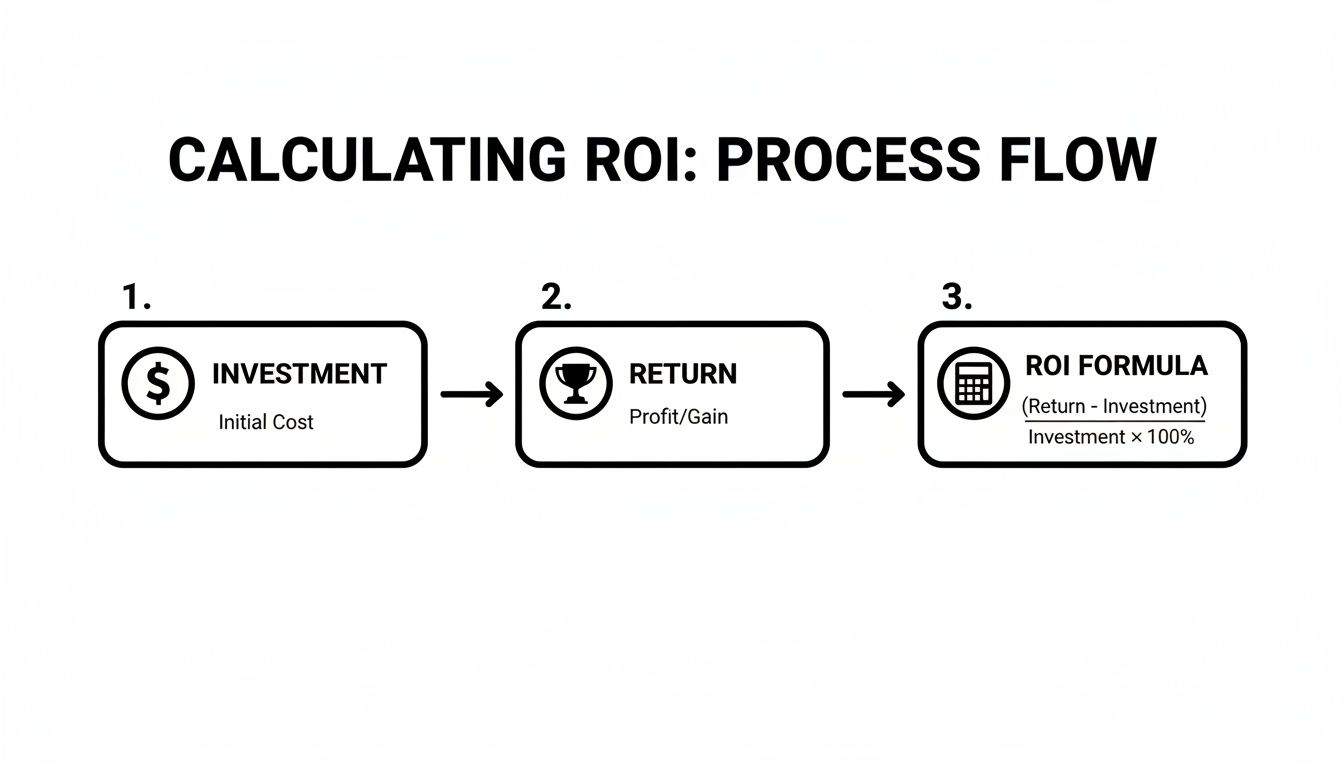
This simple visual breaks it down, but each stage depends entirely on the tracking systems we're about to set up.
Setting Up Your Core Tracking Tools
First things first, you need to make sure your foundational analytics are actually capturing the actions that matter. This goes way beyond page views. We're talking about tracking the moments that signal a visitor is moving closer to becoming a customer.
Your essential toolkit should include:
- Conversion Goals in GA4: Don't just rely on the default metrics. You need to set up specific events for key actions, like a "demo_request" when someone fills out your demo form or a "newsletter_signup" for your email list. This is how you turn simple website activity into measurable business KPIs.
- UTM Parameters: These are completely non-negotiable for campaigns. By adding unique UTM tags to the links in your social posts, emails, or ads, you tell Google Analytics exactly where that traffic came from. This allows you to attribute conversions to specific content pieces, not just broad channels like "social media."
- Tracking Pixels: If you're putting money behind promoting your content on social media, you absolutely need to install the Meta Pixel or LinkedIn Insight Tag. These little snippets of code track what users do after clicking your ad, creating a direct line between your ad spend and conversions.
It's easy to get bogged down in "analysis paralysis" with dozens of tools. My advice? Start simple. Get really good at setting up Google Analytics 4 goals and using UTM parameters first. These two things alone will give you 80% of the data you need to start connecting your content to conversions.
Choosing the Right Attribution Model
Attribution is just a fancy way of saying "who gets the credit." A customer might read three of your blog posts, see a retargeting ad, and finally convert after clicking a link in your newsletter. Which piece of content gets the credit for that sale? The attribution model you choose provides the answer.
Here are the most common models and where they make sense:
| Attribution Model | How It Works | Best For |
|---|---|---|
| First-Touch | The very first piece of content a user interacts with gets 100% of the credit for the conversion. | Businesses focused on top-of-funnel awareness and figuring out which content first brings new people into their world. |
| Last-Touch | The final piece of content a user interacts with before converting gets 100% of the credit. | Companies with short sales cycles where that last touchpoint is what really pushes someone to buy. |
| Multi-Touch (Linear) | Credit is distributed evenly across every single touchpoint in the customer's journey. | Marketers who want a balanced view of the entire customer journey, giving equal value to every interaction. |
For most businesses I've worked with, a multi-touch model gives the most realistic picture of what's happening. It acknowledges that content plays different roles at various stages of the funnel. This prevents you from overvaluing your bottom-of-funnel assets while completely ignoring the brilliant blog post that brought the customer to your site in the first place.
You can explore these models in tools like HubSpot or within the advertising reports section of Google Analytics 4.
The real magic happens when you connect these systems. By integrating your analytics platform with your CRM, you can finally see the complete journey—from the first article a person read all the way to the final sales call that closed the deal. This is the level of detail that allows you to build a compelling SEO performance dashboard that tells a full story to stakeholders, proving the undeniable value of your content.
Actionable Tactics To Boost Your Content ROI
Knowing your content marketing ROI is one thing. Making that number climb is where the real fun begins.
Improving your ROI doesn't mean you have to tear down your entire strategy and start from scratch. In my experience, the biggest wins often come from a few smart, targeted adjustments. It’s all about working smarter, not just harder, to turn your existing efforts into a more powerful growth engine.
This means shifting your focus from the endless content treadmill to maximizing the value of every single asset you create. By being strategic, you can amplify your returns without bloating your budget. Let's dive into some practical, field-tested tactics that will help you do just that.
Optimize Your Low-Hanging Fruit
Before you even think about writing another word, take a hard look at what you already have. Your existing content is a goldmine of untapped potential.
Chances are, you have older blog posts that are already getting a trickle of organic traffic but were never really built to convert. This is your lowest-hanging fruit, and it's ripe for the picking.
Instead of letting those posts just sit there, give them a conversion-focused refresh. This could mean:
- Adding compelling calls-to-action (CTAs) within the text that guide readers to a logical next step.
- Embedding a lead magnet—like a downloadable checklist or an exclusive template—in exchange for an email.
- Updating outdated information, stats, and examples to make the content more valuable and trustworthy today.
A simple content audit will quickly show you which posts have the highest potential for a quick ROI boost. Zero in on pages that are hovering on the second page of Google or targeting high-intent keywords. A few small tweaks can often be enough to push them onto the first page and start turning passive readers into active leads.
For a deeper dive, you can explore more about improving website conversion rates in our detailed guide.
Systematically Repurpose Your Winners
You don't have to build every piece of content from the ground up. Your top-performing assets—those blog posts that drive tons of traffic or the webinars that generate the most leads—are begging to be repurposed. This strategy stretches your initial investment much, much further by reaching new audiences on entirely different platforms.
Think of it this way: one high-value asset can become the source for an entire content ecosystem.
- A data-heavy whitepaper can be sliced into a dozen shareable infographics for social media.
- A long-form blog post can be transformed into a script for a short-form video series on TikTok or YouTube Shorts.
- A killer customer quote from a case study can become a compelling audio clip for a podcast.
This approach not only saves an incredible amount of time and resources but also reinforces your core message across multiple channels, which is fantastic for brand recall.
The goal isn't just to recycle content; it's to adapt it for a new context. A successful webinar recording isn't just uploaded to YouTube—it's edited into digestible clips, each optimized with a title and description tailored for that platform's audience.
Scale High-Quality Production With AI
One of the biggest levers for improving ROI content marketing is to increase the velocity of high-quality content production without scaling your costs at the same rate. This is where AI-driven platforms like Sight AI become a complete game-changer.
By using AI agents to handle the heavy lifting of research, outlining, and writing SEO-optimized drafts, your team can finally step back and focus on high-level strategy and final polish.
This allows you to publish consistently, which is absolutely critical for building topical authority and getting that sweet, compounding organic traffic over time. Plus, tools that integrate with IndexNow can submit new articles directly to search engines, helping them get indexed and start ranking faster.
The data backs this up. Marketers report a 68% average increase in content marketing ROI when using AI tools. In fact, 70% of marketers using AI for personalization achieve 200%+ ROI, and 23% see AI-generated content ranking even better than human-written content. You can read the full research about these content marketing statistics to learn more.
Prioritize Bottom-Of-Funnel Content
While top-of-funnel content is great for attracting a new audience, bottom-of-funnel (BOFU) content is what actually closes deals. These assets are built for prospects who are on the verge of making a purchase decision, and they often deliver a much higher and more immediate ROI.
Make sure your content plan has a healthy mix of these BOFU assets:
- Case Studies: Nothing builds trust like showcasing real-world success stories from your happy customers.
- Comparison Pages: Directly pit your product against competitors to clearly highlight your unique advantages.
- Pricing Guides: Be transparent and answer one of the most critical questions every potential buyer has.
These pieces directly support your sales team and can dramatically shorten the sales cycle. By tracking who engages with this content, you can easily identify highly qualified leads who are signaling strong purchase intent. A sharp focus on these conversion-driven assets is key to demonstrating a direct financial return from all your content efforts.
Common Questions About Measuring Content ROI
Even with a solid plan, trying to pin down your content marketing ROI can feel a bit like wrestling with a ghost. It's that classic tug-of-war: the long-term, slow-burn nature of content versus the business's need for results now.
Let's clear the air and tackle some of the most common hurdles I see marketers face. These aren't just hypotheticals; they're the real-world roadblocks that can bring a brilliant content strategy to a screeching halt.
How Long Does It Take To See ROI From Content Marketing?
This is the big one, isn't it? The honest answer is that it takes patience. Content marketing is a marathon, not a sprint. While you might see some encouraging signs—like a bump in organic traffic or more social shares—within the first 3-6 months, a meaningful financial return usually takes a bit longer.
Think somewhere in the 6-12 month range.
Your initial work is all about laying the groundwork. You're building assets, earning backlinks, and carving out your space as a topical authority. All of that effort compounds.
It’s like planting a tree. You don't get apples the first season. But with consistent care, that tree will bear fruit for years. Your evergreen content works the exact same way, pulling in leads and customers long after you’ve hit "publish."
Some of the most successful campaigns I've seen show an initial Year 1 return of 367%, which then skyrockets past 600% in Year 2. That's because those content assets mature, climb the search rankings, and keep generating leads without any new investment. Consistency is everything.
What Are The Best Tools For Tracking Content ROI?
You absolutely need the right tech stack to measure this stuff accurately. The good news is you don't need a dozen expensive platforms. A few core tools are non-negotiable if you want to connect your content efforts to actual business results.
A solid, no-fluff toolkit typically looks like this:
- Google Analytics 4: This is your command center. It's where you'll track web traffic, user behavior, and—most importantly—conversion events. It’s the best free tool out there for figuring out how people find and engage with your content.
- A CRM (like HubSpot or Salesforce): Your CRM is the missing link. It’s how you connect a specific blog post to a real lead and, eventually, a closed deal. This is how you trace revenue right back to its source.
- SEO Tools (like Ahrefs or Semrush): These are essential for keeping tabs on your keyword rankings, peeking at what competitors are doing, and even estimating the dollar value of your organic traffic.
- An End-to-End Content Platform: For a truly unified view, a platform like Sight AI can manage the whole lifecycle. It helps you generate optimized content at scale and then track your brand's visibility across AI models, giving you a full picture of modern content impact.
How Do You Measure ROI For Top-Of-Funnel Content?
Ah, the classic challenge. Top-of-funnel (TOFU) content—like a broad, educational blog post—is designed to attract an audience, not close a deal on the spot. Its value is often indirect, which means you have to get a little creative with how you measure it.
One of the best ways is to calculate its equivalent media value. Just ask yourself: What would it have cost to get this same traffic from paid search ads? You can use the average cost-per-click (CPC) for your target keywords to put a tangible dollar figure on your organic traffic.
Another smart approach is using a multi-touch attribution model. This shows you how many people who first found you through a TOFU blog post eventually became customers down the line, even if they converted through another channel. It finally gives your awareness-building content the credit it deserves for starting that customer journey. You can also track leading indicators like new email sign-ups or backlinks earned, since both have clear long-term financial value.
What Is A Common Mistake When Calculating Content ROI?
The single biggest mistake I see, time and time again, is underestimating the "Investment" side of the equation. So many marketers only count the obvious external costs, like paying a freelance writer or buying stock photos.
This leads to a wildly inflated and misleading ROI number.
A true, honest calculation has to include all the costs. That means factoring in:
- Prorated salaries for your in-house team (the time they spent on strategy, editing, promoting, etc.).
- Every software subscription used in the process.
- Any ad budget used to boost the content.
Forgetting these internal costs gives you a false sense of victory. If you want to make smart budget decisions for the future, you need a painfully honest picture of what your content really costs to create and promote.
Ready to turn AI visibility insights into a powerful, ROI-driven content strategy? With Sight AI, you can monitor your brand across AI models, uncover high-value content opportunities, and scale production with specialized AI agents.
Start building your content engine with Sight AI today.