
Keyword research is just the fancy term for figuring out the exact words and phrases your audience types into Google.It's how you make sure every single article you write actually connects with people who are looking for what you have to say. No more guessing. It’s the absolute foundation of a blog that grows organically.
Why Keyword Research Is Your Blogging Superpower
Forget thinking of keyword research as some tedious SEO chore. It’s the single most important skill that connects what you love writing about with what your audience is dying to know. Good keyword research for bloggers is less about pleasing algorithms and more about simple empathy—understanding the person on the other side of the screen.

Once you get this down, you stop publishing content into a black hole. You start creating articles that have a built-in, eager audience waiting for them. It’s what turns your blog from a personal journal into a valuable resource that search engines are excited to show people.
From Random Recipes to Raving Fans
I see this all the time. A food blogger starts out publishing posts based on whatever they feel like cooking that day—"My Favorite Lasagna" or "Tuesday's Tacos." They’re passionate, sure, but those posts get next to no traffic because nobody is searching for those exact titles.
Then they shift their strategy. They start doing keyword research and creating content for what people are actually looking for, like "easy 30-minute vegan dinner ideas" or "best gluten-free chocolate chip cookie recipe." All of a sudden, their articles aren't just recipes; they are direct answers to real questions. This simple pivot almost always leads to a massive boost in traffic because they finally started serving their audience's needs first.
Keyword research is the difference between writing for yourself and writing for an audience. It ensures your hard work gets discovered, read, and shared by the people who need it most.
The Proven Impact of a Keyword-Driven Strategy
This isn't just a nice idea; the data backs it up completely. Recent stats show that 39% of bloggers who do keyword research for every single post report getting "strong results." That number plummets to just 19% for those who never bother. A methodical approach to keywords literally doubles your chances of success.
At the end of the day, keyword research gives your content purpose. It's the roadmap that guides your entire editorial calendar, helps you structure your articles, and is a huge factor in how blogging grows your organic traffic over the long haul. When you invest time upfront to understand your audience’s language, you set every post up for success before you even write a single word.
Brainstorming Your Core Content Pillars
Forget fancy keyword tools and intimidating spreadsheets for a moment. Good, solid keyword research—the kind that actually drives traffic—doesn't start there. It begins with a simple, creative brainstorming session to nail down your blog's core content pillars.
Think of these pillars as the main, overarching topics that define your blog. They're the big categories your entire site will be built on.

These are your "seed" keywords—broad, one-to-three-word phrases that act as the foundation for everything you'll write about. If you're a personal finance blogger, your pillars might be "budgeting for beginners," "investing," and "saving money." For a travel blog, maybe it's "solo female travel" or "backpacking Southeast Asia."
The goal is to land on 5-10 core pillars. This simple structure is what keeps your blog from becoming a random mess of disconnected articles. Instead, you'll be building a cohesive, authoritative resource that both your readers and search engines will absolutely love.
Uncovering Your Niche's Big Ideas
The best content pillars are born at the intersection of what you love to talk about and what your audience is dying to know. You need to find that sweet spot between your genuine passion and their active curiosity.
Start by asking yourself a few straightforward questions:
- What topics could I talk about for hours without getting bored? That passion will come through in your writing and keep you from burning out.
- What problems am I uniquely qualified to solve for my readers? Lean into your personal experience, skills, and unique point of view.
- If my blog was a book, what would the chapter titles be? This is a great way to think about the main categories you'd use to organize everything.
These questions help you get specific. You'll go from a vague idea like "a food blog" to concrete pillars like "30-minute meals," "weekly meal prepping," and "sourdough baking." This initial brainstorming gives your keyword research a much-needed sense of direction.
Once you have some ideas, go hang out where your ideal readers are. Forums like Reddit and Quora are absolute goldmines for this. Just search for a potential pillar topic and read through the discussions. What are the most common questions? What frustrations do people keep bringing up?
A quick search in a subreddit like
r/frugalcan surface hundreds of real-world content ideas around a core pillar like "saving money." You'll see real people asking the exact questions you can answer with a blog post.
Analyzing Competitors to Find Gaps
With a few pillar ideas in hand, it's time for a little friendly recon. See what your competition is up to. This isn't about copying their strategy—it's about understanding the landscape and spotting opportunities they've missed.
Pick three to five blogs in your niche that seem to be doing well in search results.
Take a look at their navigation menus and category pages. What are their main content categories? Those are almost certainly their content pillars. When you see the same broad topics appearing across multiple sites, you can be confident they're important in your niche.
For example, if you're starting a blog about film photography, you'll probably notice that the top sites all consistently cover pillars like:
- Film Stock Reviews: Posts breaking down different types of film.
- Camera Gear Guides: Articles on choosing the right cameras, lenses, and scanners.
- Developing & Scanning: How-to guides for processing film at home.
This analysis not only validates your own ideas but can also spark new ones you hadn't even considered. If you want a more structured way to think about this, you can check out our guide on where to find blog content ideas and even map out competitor pillars in a simple spreadsheet.
Ultimately, taking the time to define your pillars first provides the strategic framework for your entire blog. It ensures every single piece of content you create is building your topical authority, making your keyword research more focused, intentional, and way more effective.
Finding Long-Tail Keywords That Actually Convert
Once you’ve got your big content pillars sketched out, it’s time to get granular. We’re moving from the broad, foundational ideas to the super-specific phrases that bring ready-to-act readers straight to your blog. This is where we dig up long-tail keywords, and if you're a new blogger, they are an absolute game-changer.

These longer, more detailed search queries—usually three words or more—have way less competition and attract people who know exactly what they need. Someone searching for "skincare" is just window shopping. But someone searching for "best morning skincare routine for oily skin"? They're looking for answers and are ready to buy. That's your ideal reader.
Don't underestimate the power of going niche. Long-tail keywords account for a staggering 70% of all search traffic, which just goes to show how specific most of us get when we use Google. On top of that, these detailed searches have conversion rates around 2.5 times higher than short, generic keywords. For any blogger trying to build a real audience or a business, that’s huge.
Mine Google Search for Hidden Gems
You really don't need a wallet full of expensive software to start unearthing these golden nuggets. Google itself is one of the best keyword research tools out there, and it costs absolutely nothing. You just have to know where to look.
Your first stop is the search bar. Start typing one of your main "seed" keywords, like "sourdough baking," and watch what Google Autocomplete suggests.
These aren't just random phrases; they're the most common searches people are actually typing in. It’s a direct line into your audience’s brain and can spark a ton of ideas you’d never have thought of on your own.
Here are a couple of my favorite tricks to squeeze even more value from this:
- The Alphabet Soup Method: Type your seed keyword, hit the spacebar, and then type a letter of the alphabet ("sourdough baking a," "sourdough baking b," etc.). Google will show you a whole new set of popular long-tail queries for every letter.
- Use Question Words: Pop words like "how," "what," "why," or "best" in front of your keyword. This immediately surfaces the exact questions your audience is asking. Something like "how to feed a sourdough starter" is a perfect, ready-made blog post title.
After you search, scroll down the page and look for the "People Also Ask" (PAA) box. This thing is an absolute goldmine. Each question is a topic you can build on, either as a subheading in a bigger post or as its very own article.
Leveraging Free Tools for Deeper Insights
While Google gives you a fantastic start, a couple of free tools can add another layer of data to your research. They'll help you expand your keyword list and get a quick feel for which ones are worth your time.
One of the easiest to use is Ahrefs' free Keyword Generator. Just pop in a seed keyword, and it will return a list of ideas along with their estimated monthly search volume. This helps you quickly see the relative popularity of different long-tail phrases.
Another brilliant tool is AnswerThePublic. It visualizes search queries around a keyword, breaking them down into questions, comparisons, and prepositions. It’s an incredibly creative way to see the human curiosity behind the search bar and can easily generate dozens of content ideas in just a few minutes.
The goal right now is all about quantity. Don't start judging or filtering your keywords yet. Your mission is simply to build a massive, messy list of potential long-tail phrases for each of your content pillars. We'll sort through and prioritize them later on.
If you want to go even deeper on this, check out this guide on how to find long tail keywords that actually convert. It’s packed with more methods for building out your list.
This whole process takes a single, broad idea and spins it out into a full-blown content strategy. A simple pillar like "skincare" quickly becomes a long list of specific, high-intent topics that your audience is actively looking for. For a more detailed look at how these phrases work, our guide to organic search keywords breaks it down. By focusing on these specific queries, you're not just doing keyword research for bloggers; you're building a direct connection to your perfect reader.
You’ve done the creative work. You've brainstormed your content pillars and dug up a mountain of potential long-tail keywords. This is where a lot of bloggers hit a wall, stare at their massive list, and just… stop. But a long list of topics is just noise until you have a smart way to prioritize it.
So, let's switch gears from creative discovery to strategic analysis. This part of keyword research for bloggers is all about turning that messy spreadsheet into a crystal-clear, actionable content plan. To get there, we need to look at every single keyword through three critical lenses: Search Volume, Keyword Difficulty, and the big one—Search Intent.
Decoding the Core SEO Metrics
Think of these metrics as a keyword's vital signs. They tell you how many people are looking for a term, how tough the competition is, and what the searcher is actually trying to accomplish. Nailing these three is how you stop guessing and start making smart, data-driven decisions for your blog.
Search Volume: This is the estimated number of people searching for a keyword each month. It’s so tempting to chase those big, flashy numbers, but high-volume terms almost always come with brutal competition. For a new blogger, a keyword with just 50-200 monthly searches can be a goldmine, bringing in super-targeted traffic that you can actually win.
Keyword Difficulty (KD): Usually scored from 0-100, this metric gives you an idea of how hard it’ll be to crack the first page of Google. It’s calculated by looking at the authority and backlink profiles of the pages that are already ranking. When you're starting out, stick to keywords with a KD score under 20. This is your sweet spot for gaining early traction.
Search Intent: This is the why behind the search. Honestly, understanding intent is probably the single most important skill in modern SEO. Is someone trying to learn, buy, or find a specific site? If your content doesn't match their intent, you simply won't rank. It's non-negotiable.
Understanding the Four Types of Search Intent
Every search query fits into one of four main buckets. Once you can spot them, you'll know exactly what kind of content to create to make searchers happy.
Informational Intent: The user wants to learn. These are all your "how to," "what is," and "best way to" searches. For bloggers, this is home base. A query like "how to repot a monstera" is practically begging for a detailed, helpful blog post.
Navigational Intent: The user is just trying to get to a specific website, like searching for "YouTube" or "Facebook login." You can pretty much ignore these.
Commercial Intent: The user is in research mode, weighing their options before a purchase. Keywords like "best running shoes for flat feet" or "Ahrefs vs Semrush" fit here. These are perfect for in-depth reviews and comparison posts.
Transactional Intent: The user has their wallet out and is ready to buy now. Think "buy iPhone 15" or "Grammarly discount code." Unless you're running an e-commerce site, these are less of a priority for most bloggers.
For 90% of bloggers, your time is best spent on informational and commercial intent keywords. This is where you can deliver massive value, build trust with your readers, and establish your blog as the go-to resource in your niche.
Creating Your Prioritization Framework
Okay, let's bring this all together. Your new best friend is a simple spreadsheet. Seriously. Make columns for your keyword, its monthly search volume, its KD score, and your best guess at its primary intent. This turns your messy list into a decision-making dashboard.
The table below breaks down how to think about this.
Keyword Prioritization Framework for Bloggers
Deciding where to start can feel overwhelming. This framework compares different keyword types to help you zero in on the low-hanging fruit and build momentum for your blog.
| Keyword Type | Example Query | Primary Intent | Typical Volume | Competition Level | Best For Bloggers? |
|---|---|---|---|---|---|
| Head Term | "running shoes" | Commercial | 100k+ | Very High | No, too broad |
| Long-Tail | "best running shoes for flat feet women" | Commercial | 500-2k | Medium | Yes, very specific |
| Question | "how to choose running shoes" | Informational | 200-1k | Low-Medium | Absolutely! |
| Navigational | "nike website" | Navigational | 50k+ | Irrelevant | No |
| Transactional | "buy brooks adrenaline gts 22" | Transactional | 100-500 | High | Only if you sell them |
As you can see, the sweet spot for most bloggers lies with specific long-tail and question-based keywords. They hit the perfect balance of decent search volume and manageable competition.
To really nail this, you have to know what you're up against. Digging into competitive intelligence will help you understand the landscape and find those gaps where your blog can win.
Once you have your ranked list, you can start slotting these keywords into an editorial calendar. Seeing your topics laid out visually makes it so much easier to stay consistent. And after your posts go live, the work isn’t done. You'll need to know how to track your keyword rankings to see what's hitting the mark. This feedback loop is what turns good bloggers into great ones.
Turning Your Research Into a Content Plan
You’ve done the hard part—you brainstormed your core topics, dug up some gold-standard long-tail keywords, and sorted them all using real data. So, what’s next? It's time to turn that raw research into an actual roadmap for your blog. This is where a simple spreadsheet of ideas transforms into a content machine that builds momentum and drives consistent growth.
A prioritized list of keywords is a great start, but without a system, it's way too easy to slip back into just writing about whatever pops into your head. The real goal here is to build an editorial calendar that functions as a strategic blueprint, making sure every single article you publish works together to create something much bigger than the sum of its parts.
Adopting the Topic Cluster Model
One of the most powerful ways to organize your content is with the topic cluster model. This isn't just some clever organizational hack; it's a legitimate SEO strategy that signals your authority to search engines like Google. It shows them you're not just dabbling in a subject—you're the expert who has covered it inside and out.
The model really just boils down to two key pieces:
- Pillar Page: This is your big, comprehensive guide on a broad topic from one of your core content pillars. Think of it as the central hub for that subject on your blog.
- Cluster Content: These are shorter, more specific blog posts that zoom in on the long-tail keywords related to your pillar topic. Crucially, every one of these posts links back to the main pillar page.
This structure creates a tightly woven network of internal links, which funnels authority back to your most important pages and gives your entire site a ranking boost.
A Real-World Blogging Example
Let's say you run a travel blog and one of your core content pillars is "Solo Travel in Japan." Instead of just writing random posts, you can build a killer topic cluster.
Your pillar page could be a massive, all-in-one guide titled something like "The Ultimate Guide to Solo Travel in Japan." This article would touch on all the essential aspects of the topic from a high-level perspective.
From there, you’d create a series of in-depth cluster posts, each targeting a specific long-tail keyword you uncovered during your research. These might look like:
- "Best Hostels in Tokyo for Solo Female Travelers"
- "Is a Japan Rail Pass Worth It for Two Weeks?"
- "Navigating the Tokyo Subway System Alone"
- "Safest Neighborhoods in Kyoto for Solo Travelers"
Each of these detailed articles would link back to your main "Solo Travel in Japan" pillar page. This tells Google that your pillar page is the definitive source on the topic, backed up by a ton of specific, expert-level content. This is where analyzing those keywords really comes into play.
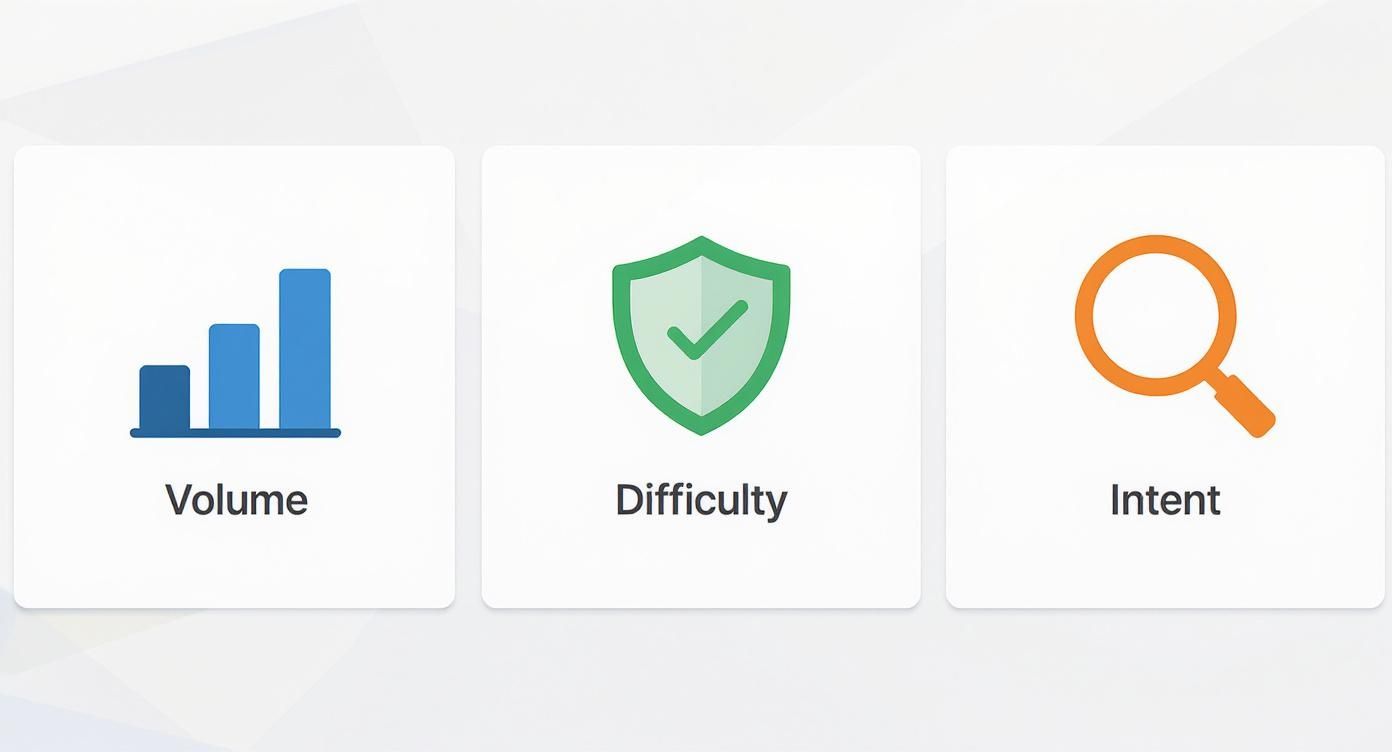
It's this simple, three-part analysis of volume, difficulty, and intent that helps you decide which long-tail keywords are juicy enough to become their own dedicated cluster posts.
Building Your Editorial Calendar
Once your topic clusters are mapped out, you can start plugging everything into an editorial calendar. You don't need anything fancy; a simple Google Sheet, Trello board, or Notion page works perfectly. The key is to make it more than just a list of dates and titles.
I recommend creating columns to keep your workflow organized:
- Publish Date: The day you want the article to go live.
- Focus Keyword: The main keyword you're targeting.
- Cluster/Pillar: A quick note on whether it's a pillar or part of a cluster.
- Status: A way to track progress (e.g., Outline, Writing, Editing, Published).
- Notes: A catch-all for details like secondary keywords or internal linking ideas.
When you group your content into topic clusters, you bring a ton of clarity to your creation process. You're no longer staring at a blank page wondering what to write next. Instead, you're systematically building out your expertise, one targeted article at a time. This strategic approach is fundamental if you want to understand how to scale content marketing effectively.
An organized plan like this does more than just keep you on schedule. It transforms your blog from a random collection of articles into a cohesive, authoritative resource. When you strategically build topical authority, your entire site becomes more powerful in Google's eyes, leading to better rankings, more traffic, and an audience that truly sees you as the go-to expert in your niche. All that diligent keyword research for bloggers finally pays off—not in a single ranking, but in sustainable, long-term growth.
Got Questions About Keyword Research? I’ve Got Answers.
Alright, let's talk about what happens when the rubber meets the road. It's one thing to read a guide like this, but it’s another thing entirely to start digging into keyword research for your own blog. That’s when the real questions pop up.
This is where we tackle those common head-scratchers. Think of this as the FAQ section I wish I’d had when I was starting out—just straight, practical answers to get you unstuck and back to creating content that actually gets seen.
How Often Should I Really Be Doing Keyword Research?
Keyword research isn't a one-and-done task you tick off your to-do list and never think about again. The best bloggers I know treat it like a garden; it needs constant attention. Search trends shift, your audience asks new questions, and your niche is always evolving.
I find it helps to break it down into two different rhythms:
- The Big Deep Dive: This is the massive research session you do right at the start—either when you launch your blog or decide to build out a whole new category. This is your chance to map out your core topics and build that foundational list of article ideas.
- The Regular Tune-Up: For all your existing content, you'll want to do a keyword audit every 6 to 12 months. Pop open your articles and see what’s going on. Have your rankings slipped? Has the search intent for a keyword changed? Are there new long-tail keywords you could add to give an old post a fresh coat of paint?
This cycle keeps your content strategy from getting stale and ensures you’re always in sync with what your readers are looking for.
What Are the Best Free Tools for a New Blogger?
Let me be clear: you do not need to drop hundreds of dollars on fancy tools when you're just getting started. You can get an incredible amount of valuable data without spending a dime, mostly by using the tools Google gives you for free.
Here’s your starting toolkit:
- Google Search Itself: Seriously, this is your secret weapon. Use the Google Autocomplete feature as you type to see what people are searching for. Mine the "People Also Ask" boxes for perfect H2 and H3 subheadings. Scroll down to the "Related Searches" at the bottom for a goldmine of long-tail keyword ideas.
- Google Search Console: This is non-negotiable. Once your blog has been live for a bit, GSC will show you the exact search queries people are using to land on your site. It’s like a cheat sheet for finding keywords you’d never think of on your own.
- Google Trends: This is perfect for seeing what’s hot and what’s not. You can compare the popularity of a few keyword ideas over time, which is especially useful for spotting seasonal topics in your niche.
Outside of Google's universe, AnswerThePublic is amazing for finding question-based keywords. The free versions of tools like Ahrefs' Keyword Generator or Ubersuggest can also give you a quick peek at search volume and difficulty scores to help you make decisions.
The most valuable keyword research skill isn't mastering a tool. It's developing a deep sense of curiosity about what your audience truly needs. The tools just help you put numbers to that curiosity.
Can a Brand-New Blog Actually Rank for Anything?
Yes, a thousand times yes! But you have to be smart about it. You can't play the same game as the big, established websites.
A new blog with zero authority isn’t going to rank for a massive keyword like “vegan recipes.” Forget it. Behemoths like the Food Network have that on lockdown. Going head-to-head with them is a fast track to burnout.
Your secret weapon is specificity.
You win by targeting the low-competition, long-tail keywords the big guys ignore. Instead of going after "vegan recipes," you target something like "gluten-free vegan breakfast muffins for toddlers." The search volume is way lower, sure, but the competition is a tiny fraction of what you'd face otherwise. More importantly, the person who finds your post gets the exact answer they were desperate for.
Each time you create the best resource for one of these ultra-niche queries, you earn a little bit of trust and authority in Google's eyes. These small wins stack up over time, building the foundation you'll need to eventually go after those bigger, more competitive keywords.
What’s the Difference Between a Focus Keyword and Secondary Keywords?
Getting this right is what separates a thin, one-note article from a comprehensive resource that ranks for dozens of different phrases.
Your focus keyword is your main target. It's the North Star for your article. This phrase should show up naturally in your title, your URL, the first paragraph, and a subheading or two. It’s the primary search query you want Google to associate with that page.
Secondary keywords (sometimes called LSI or semantic keywords) are all the related terms, subtopics, and synonyms that give your article context and depth. They prove to Google that you know what you're talking about.
Let’s say your focus keyword is “how to bake sourdough bread.”
Your secondary keywords would be things like:
- "sourdough starter feeding schedule"
- "best flour for sourdough"
- "autolyse sourdough method"
- "what is a dutch oven"
Weaving these related terms into your content helps you create a complete guide. It signals to Google that your article is a one-stop-shop on the topic, which can help you rank for a whole constellation of related searches and pull in way more traffic from a single post.
Ready to put your content plan on autopilot? IndexPilot uses trainable AI Agents to handle your entire SEO workflow—from keyword discovery and content strategy to writing, optimization, and publishing. Stop the manual busywork and start compounding your organic traffic.