Creating content for a website is the whole shebang: the research, the planning, the actual writing, and finally, publishing it all with a clear business goal in mind. It’s about getting inside your audience's head, figuring out the exact words they're searching for, and then delivering high-quality, optimized content that pulls them in and keeps them engaged.
Building Your Content Foundation for Success
It’s so tempting to just jump straight into writing. I get it. But this is the single biggest mistake I see, and it almost always leads to content that collects dust. The most powerful content strategies are always built on a solid foundation of real research and meticulous planning.
This isn't about throwing spaghetti at the wall to see what sticks. It's a methodical process of understanding who you're talking to, scoping out the competition, and pinpointing the exact opportunities where you can win. Doing this foundational work upfront means every article, video, or guide you create has a purpose and a direct line to driving results.
The digital content creation market is absolutely exploding—it's projected to hit USD 63.0 billion by 2030. With over 1.13 billion websites out there and 252,000 new ones popping up daily, just hitting "publish" is nowhere near enough. But here's the kicker: businesses that keep an active blog see 55% more website traffic. That stat alone proves that a consistent, strategic approach is what separates the winners from the noise.
The flowchart below breaks down this foundational stage into a simple, but incredibly powerful, workflow.
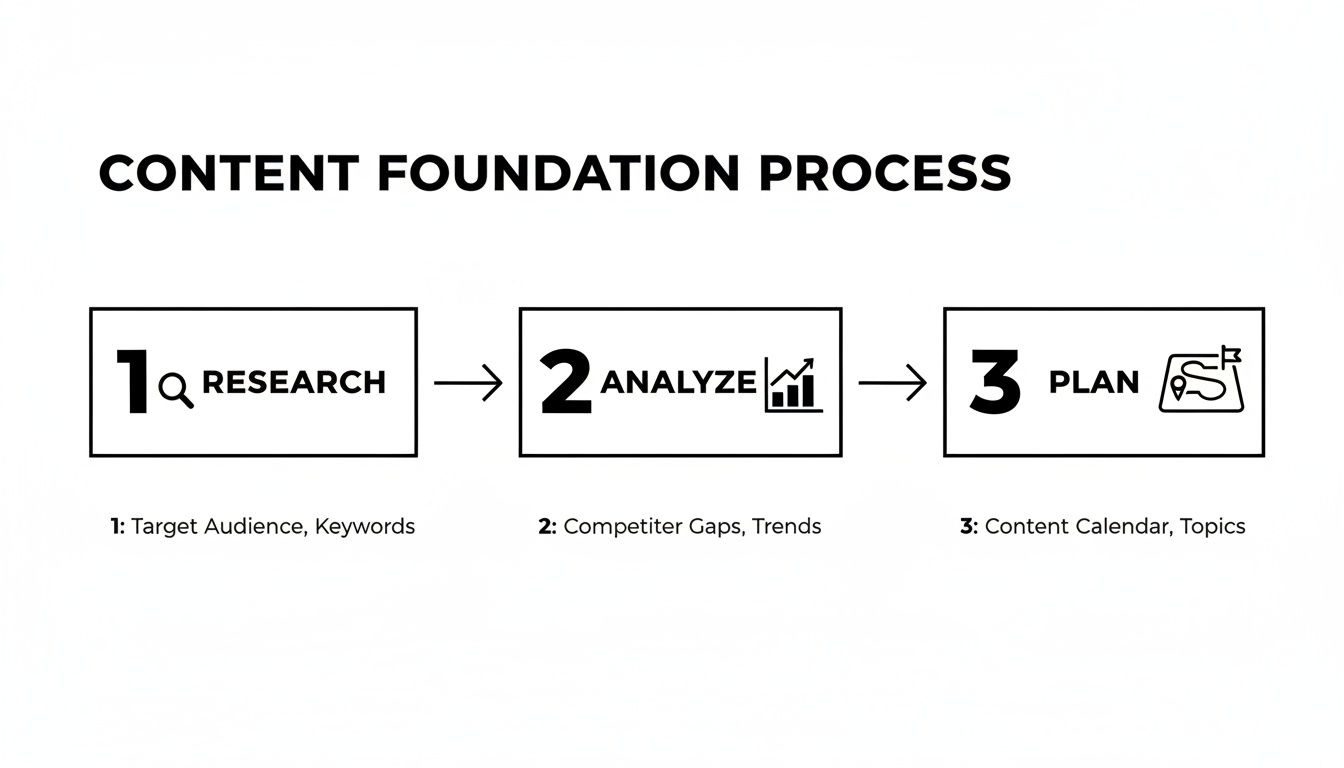
This simple flow—from broad research to sharp analysis and finally to a rock-solid plan—is how you turn random ideas into a targeted content strategy that actually works.
To give you a clearer picture, let's break down the core components of building this foundation. The table below outlines what each piece involves and why it's so critical to get right from the start.
Key Elements of a Content Foundation
| Component | Objective | Key Actions |
|---|---|---|
| Audience Personas | To deeply understand the target reader's motivations, challenges, and goals. | Define psychographics (pain points, goals), identify information channels (blogs, social media), map out their journey. |
| Keyword Research | To identify high-intent search terms that align with audience needs and business goals. | Analyze search volume and difficulty, differentiate between informational and transactional intent, group keywords by topic. |
| Content Gap Analysis | To find topics your competitors have overlooked or failed to cover in depth. | Audit top competitor content, identify underserved subtopics, and find "what's missing" from the conversation. |
Each of these components feeds into the next, creating a comprehensive picture that guides every piece of content you produce.
Getting to Know Your Audience—Really
Great content feels like it's written for one person. It speaks directly to their problems, their goals, and their motivations. This is where creating detailed audience personas is a game-changer. A truly useful persona goes way beyond basic demographics like age and location.
You need to dig into the psychographics:
- What are their biggest pain points? For a B2B software company, this isn’t just "needs software." It's "drowning in inefficient manual reporting processes that eat up 10 hours a week."
- What are their ultimate goals? Their goal isn't just "buy a tool." It’s "find a solution that automates my weekly reports so I can get 5 hours back to focus on strategy."
- Where do they hang out online for information? Do they religiously follow industry blogs, binge-watch YouTube tutorials, or lurk in specific subreddits asking for advice?
Answering these questions forces you to stop writing for a faceless crowd and start creating content for a real person. This insight dictates everything—your tone, the topics you choose, and the unique angles you take.
Uncovering Keywords That Actually Matter
Too many people think keyword research is just about finding terms with the highest search volume. That's a rookie mistake. The real goal is to find phrases that reveal strong user intent—the "why" behind their search.
Think about it. Someone searching for "marketing automation" is just browsing. But the person searching for "best marketing automation for small e-commerce" is on the verge of making a decision.
Your job is to find a healthy mix of keywords that cover the entire journey:
- Informational Keywords: Questions like "how to improve email open rates" attract people at the very beginning of their search.
- Navigational Keywords: Searches for your brand name or specific product names.
- Transactional Keywords: High-intent terms like "buy email marketing software" or "HubSpot alternative" capture users ready to convert.
By targeting the questions your audience is actually asking, you align your content perfectly with their journey. This is the difference between attracting passive readers and engaging active buyers. For a deeper dive, you should explore our complete guide to content planning strategies.
Finding the Gaps Your Competitors Missed
Finally, analyzing your competitors isn't about copying what they're doing. It’s about finding what they aren't doing. A content gap analysis is your secret weapon for discovering topics your competitors have completely overlooked or questions they've only answered superficially.
For instance, you might find that while your top three competitors all have basic blog posts on "social media scheduling," none of them have a comprehensive, data-backed guide on "how to analyze social media ROI."
That's your opening.
By creating the single best resource on that topic, you can capture an underserved part of the audience and immediately establish your brand as the go-to expert.
Creating Actionable Content Blueprints
You've done the hard work. You’ve dug into the research, uncovering your audience’s pain points, identifying high-value keywords, and pinpointing exactly where the content gaps are. But all that strategic insight is just data until you turn it into a repeatable, scalable process.
This is where actionable content blueprints—what we often call editorial briefs—become the absolute backbone of your content creation for website success.
A solid brief is so much more than a simple topic idea. It’s the instruction manual for a specific piece of content. When done right, it cuts down on guesswork, slashes revision cycles, and makes sure every single article perfectly aligns with your strategy. Flying without one is a risky bet on quality and consistency.
From Strategy to A Detailed Brief
The whole point of a content brief is to give your writer everything they need to knock it out of the park before they even start writing. It’s the bridge connecting your high-level strategy to the person actually typing the words. This front-loading of information is what separates content that consistently performs from the articles that just fall flat.
A truly effective brief is a living document that needs to include:
- Primary & Secondary Keywords: State the main target keyword and then list a handful of related LSI keywords to weave in naturally.
- Target Audience Profile: Who is this for? Give a quick summary of the persona, focusing on the specific problem or question this content solves.
- Key Questions to Answer: What does the reader absolutely need to know by the end? List out the essential questions they’re coming with.
- Internal Linking Targets: Pinpoint at least 2-3 existing pages on your site that this new article should link out to. This is huge for building topical authority.
This level of detail means the writer doesn't just know what to write, but why they’re writing it and who they’re writing it for. If you want to go deeper, we've put together a comprehensive blog post outline template you can adapt for any topic.
Structuring a Logical Content Flow
Once the core pieces are in the brief, the next job is to build out a logical outline. An outline isn't about boxing a writer in; it’s a roadmap that guides the reader on a clear journey from their first glance to the final takeaway. It's also your first real chance to strategically place keywords and structure the post for both humans and search engine crawlers.
A well-structured outline ensures your content flows logically, making complex information easy to digest. It helps the writer stay on track and prevents the final piece from feeling disjointed or rambling.
Let's say you're creating a post on "cold brew coffee makers." A logical outline might look something like this:
- Introduction: Hook the reader by tapping into that desire for smooth, low-acidity coffee right at home.
- What Makes Cold Brew Different? A quick, simple explanation of the science behind it.
- Types of Cold Brew Makers: Break down the main categories (like immersion vs. slow drip) and list the pros and cons of each.
- Top 5 Cold Brew Makers Reviewed: This is the meat of the article, with detailed reviews.
- How to Choose the Right One for You: A mini buyer's guide based on budget, counter space, and how much coffee they drink.
- Conclusion: Wrap up the key points and give a final, confident recommendation.
This structure naturally incorporates on-page SEO by organizing information with clear, descriptive headings (your H2s and H3s). To really make this system work at scale, consider hiring a blog writer virtual assistant who can take these detailed blueprints and consistently turn them into polished articles. This is how you scale content operations without your quality or strategy taking a nosedive.
Making Sure Your Content Gets Found by People and Search Engines
Look, creating incredible content is a huge achievement, but it's only half the job. If no one can find it, did it even really happen? This is where on-page SEO comes in—it’s the bridge between your hard work and the people who need to see it. It’s all about finding that sweet spot where your content flows naturally for readers but is also perfectly structured for search engines to understand and reward.

Effective content creation for a website has moved way beyond old-school tricks like stuffing keywords everywhere. Today, it’s all about creating a fantastic user experience. Search algorithms are smart enough to recognize and reward content that’s readable, well-structured, and genuinely helpful.
Crafting Titles and Descriptions That Earn Clicks
Your title tag and meta description are your first impression in the search results. Think of them as a digital billboard for your article. A good one can seriously boost your click-through rate (CTR), even if you’re not ranking number one.
A great title should be:
- Short and Sweet: Keep it under 60 characters so it doesn’t get awkwardly cut off in the results.
- Keyword-Focused: Naturally weave your main keyword in, ideally near the beginning.
- Benefit-Driven: Tell people what’s in it for them. Instead of "A Guide to X," try "How to Achieve Y with Our X Guide."
While your meta description isn't a direct ranking factor, it's your sales pitch. You've got about 150-160 characters to expand on the title and convince someone to click. A strong call-to-action like "Learn how" or "Discover the steps" works wonders here.
Weaving in Keywords and Building Topical Authority
Yes, strategic keyword placement still matters. You’ll want your primary keyword in your title, within the first 100 words or so, and in at least one H2 subheading. But modern SEO is far less about repetition and much more about topical relevance.
This is where semantic SEO comes into play. Instead of hammering a single keyword, you need to cover a topic from all angles. Use related terms, synonyms, and answer the questions people are actually asking. For example, a blog post about "email marketing" should naturally touch on things like "automation," "segmentation," "open rates," and "subject lines."
When you cover a topic this comprehensively, you’re signaling to search engines that your content is the real deal—a definitive resource. This builds your topical authority over time, making it easier for all your related content to rank.
This approach proves you know your stuff and does a much better job of satisfying what the user was looking for in the first place.
Your On-Page SEO Checklist
Before you hit publish, it’s always a good idea to run through a quick on-page SEO check. It’s easy to miss a small detail that could make a big difference in how your content performs.
This table is a simple but effective reference to make sure all your bases are covered.
| Element | Best Practice | Impact |
|---|---|---|
| Title Tag | Under 60 chars, primary keyword near start | High |
| Meta Description | 150-160 chars, compelling CTA | High (CTR) |
| URL Slug | Short, descriptive, includes keyword | Medium |
| Headings (H1, H2s) | One H1, logical H2 structure, keywords included | High |
| Keyword Placement | In first 100 words, subheadings, naturally | Medium |
| Internal Links | 2-3+ links to relevant internal pages | High |
| External Links | 1-2 links to authoritative, non-competing sites | Medium |
| Image Alt Text | Descriptive text for all images | Medium |
| Readability | Short paragraphs, lists, bold text | High |
Making these optimizations a standard part of your workflow ensures every piece of content has the best possible shot at ranking and driving traffic.
Prioritizing Readability and User Experience
Here’s a simple rule: what’s good for your readers is almost always good for SEO. Search engines pay close attention to engagement signals, and nothing makes a user hit the "back" button faster than a massive, intimidating wall of text.
Here are a few practical ways to make your content more inviting:
- Use Short Paragraphs: Seriously, stick to 1-3 sentences max. This creates white space and makes the content feel so much more approachable, especially on a phone.
- Break It Up with Headings: Use H2s and H3s to create a clear, scannable structure. Readers can quickly jump to the section that interests them most.
- Embrace Lists: Bullet points and numbered lists are your best friends for breaking down complex ideas into easy-to-digest bites.
These aren't just aesthetic choices. They have a direct impact on how long people stay on your page, which is a powerful signal to Google that your content is valuable.
Using Links to Build a Stronger Web
Internal and external links are the connective tissue of your content. They’re essential for building a well-structured and authoritative article.
Internal links are when you link from your new article to other relevant pages on your own website. This does a few great things: it helps search engines discover your other content, shows them how your pages are related, and spreads ranking power (link equity) throughout your site.
External links, which point to other reputable websites, demonstrate that your content is well-researched and credible. Linking out to an authoritative source is like citing your work—it reinforces that you're providing trustworthy information.
Getting these on-page elements right is non-negotiable. The content marketing industry is projected to become a $1.95 trillion powerhouse by 2032, and businesses that blog consistently see 55% more visitors. But it all comes down to quality; high-spenders on content are 2.6 times more likely to succeed. As you can see from these content marketing statistics on Reboot Online, investing in a high-quality production process is what separates the winners from the rest.
Crafting Content with AI-Powered Workflows
With your strategic blueprints in place, it’s time to move on to the fun part: actually creating the content. For years, the process was a familiar grind—staring at a blank page, battling writer's block, and slowly churning out paragraphs. That old way of working is just too slow. Today, the smartest teams are using a hybrid approach, blending human creativity with the raw power of AI to produce top-tier content at a pace that was once unthinkable.
Let's be clear: this isn't about replacing writers with robots. It’s about giving them superpowers. When you use AI as a high-speed research assistant and a first-draft partner, your team is free to focus on the things only a human can do—adding unique insights, telling great stories, and injecting your brand's personality into every single word.
Using AI as Your Creative Co-Pilot
The real magic of AI in content production isn’t about having it write a full article from scratch. Instead, its value comes from demolishing the most time-consuming parts of the workflow. Forget spending hours digging for stats or trying to structure an outline; you can prompt an AI tool to handle that heavy lifting in a matter of minutes.
Here are a few ways we put this into practice:
- Accelerated Research: Ask an AI to summarize the top-ranking articles for your target keyword. Have it pull out key statistics or find common questions people are asking on Reddit and Quora.
- Outline Generation: Feed your content brief into an AI and ask for a logical, SEO-friendly outline, complete with H2s and H3s. This gives your writer a rock-solid foundation to build from.
- Angle Discovery: Prompt the AI to brainstorm some unique angles or even a few counterintuitive arguments for your topic. This is a great way to make sure your content doesn't just rehash what everyone else is already saying.
The goal is to treat AI as a collaborator. It delivers the raw materials and a solid framework, which frees up your creative energy for strategy, storytelling, and expert analysis.
This hybrid model lets you keep your quality and originality standards sky-high while dramatically increasing your output. For a deeper dive into this, check out our complete guide on how to approach content creation with AI.
The Human Touch Is Non-Negotiable
An AI can spit out a technically correct draft, but it almost always lacks the nuance, empathy, and lived experience that makes content truly connect with a reader. The human editing and enrichment stage is where a piece transforms from a generic pile of information into a valuable, memorable resource.
This is where your team’s real talent shines. Focus their efforts here:
- Injecting Brand Voice: Go through the AI-generated text and edit it to perfectly match your brand’s tone—whether that's witty, authoritative, or deeply empathetic.
- Adding Personal Stories: Weave in real-world examples, customer case studies, or personal anecdotes that an AI could never come up with. This is how you build trust and make your content feel genuine.
- Fact-Checking and Verification: Never, ever trust AI-generated data without verification. Always double-check any stats, facts, or claims. This step is absolutely critical for maintaining your credibility.
To get your content production humming and really tap into this technology, it's worth exploring the best AI Content Creation Tools available for busy business owners. The right platform can make this entire workflow feel practically seamless.
Balancing Quality, Speed, and Authenticity
The rise of AI in content creation is here to stay, with 94% of marketers planning to integrate it into their processes for things like blog articles by 2026. This huge shift is happening for one simple reason: the need to scale efficiently in a digital world with over 1.1 billion websites.
The key is to build a workflow that perfectly balances AI's incredible speed with the indispensable human touch. A hybrid system like this ensures every article you publish isn’t just optimized for search engines but is also genuinely valuable and authentic for the people you want to reach.
Publishing and Promoting Your Content for Reach
Hitting the publish button feels like the finish line, but in reality, it's just the starting gun. The most brilliant article in the world is useless if no one ever sees it. This final phase is all about getting your hard work out of your content management system (CMS) and into the hands of your audience.

This part of the process breaks down into two connected jobs: first, getting your content properly indexed by search engines, and second, actively promoting it to kickstart that first wave of traffic. Skipping these steps is like throwing a great party but forgetting to send any invitations.
The Technical Launch: Your CMS and Search Console
Before you can even think about promotion, you need to make sure your content is technically sound and discoverable. Start with a final quality check right inside your CMS.
Here’s a quick pre-publish checklist I run through every time:
- Formatting Check: Do all my headings, lists, and blockquotes look right on the live site?
- Image Review: Are all images uploaded with descriptive alt text for accessibility and SEO?
- Link Verification: Do all internal and external links actually work? Do they open in a new tab?
Once everything looks perfect, publish it. But don't walk away just yet. You need to give search engines a direct heads-up that your new content exists. While they’ll find it on their own eventually, you can seriously speed things up.
The fastest way is to submit the new URL through Google Search Console's "URL Inspection" tool and request indexing. This puts your content right at the front of the line. Modern protocols like IndexNow are also a game-changer, automatically pinging search engines like Google and Bing the second you hit publish.
Hitting publish is just the first step. Proactively submitting your new content to search engines via tools like Google Search Console can slash the time it takes to get indexed and start ranking, turning a weeks-long wait into a matter of days or even hours.
Fueling Discovery with Strategic Promotion
With your content live and on its way to being indexed, it's time to build momentum. Passively waiting for organic traffic is a slow, painful game. Strategic promotion is how you get the ball rolling and gather those crucial early engagement signals that search engines love.
A single, high-quality piece of content, when promoted correctly, can be an asset for your business for months or even years. The trick is to treat promotion as a core part of the creation process, not just an afterthought.
Start with the low-hanging fruit: your owned channels.
- Email Newsletter: Your email list is gold. Send a dedicated email announcing the new post. Don't just share a link; pull out a key takeaway and explain why it's a must-read for them.
- Social Media Channels: Dropping a link is lazy. Tailor the message for each platform. Create a compelling graphic for Instagram, pose a thought-provoking question on LinkedIn, or build a quick summary thread for X (formerly Twitter).
Extending Your Reach Through Repurposing
The effort you poured into one great blog post can be multiplied by slicing and dicing it into different formats. This is one of the smartest ways to reach new audience segments on the platforms where they actually spend their time.
Here are a few quick wins:
- Create an Infographic: Pull out the most important stats and key points and hand them over to a designer to create a super-shareable infographic.
- Produce a Short Video: Use the article’s outline as a script for a quick YouTube or TikTok video that breaks down the core concepts.
- Craft Quote Graphics: Isolate a few powerful quotes or takeaways from the article and turn them into simple, branded images perfect for social sharing.
This multi-channel approach guarantees your content gets the maximum possible visibility. As you get more advanced, you can explore AI-powered content distribution strategies to automate and scale your promotional efforts even further. The goal is to make sure your valuable content isn’t just sitting on your site—it should be out there working for you, attracting and engaging your audience across the web.
Measuring Performance to Scale and Refine
Hitting "publish" isn't the finish line. Far from it. A truly effective content strategy is a living thing, constantly evolving based on what the real-world data tells you. This is where you close the loop, measuring what works (and what doesn't) to sharpen your future efforts and scale your success.
If you're not tracking performance, you're just guessing. The entire goal here is to shift from making assumptions to making data-backed decisions. You can start by focusing on just a few key performance indicators (KPIs) that tie directly back to your original goals. These are the metrics that tell the real story of your content's impact.
Identifying Your Core Metrics
It's easy to get lost in a sea of data. Don't. Zero in on the numbers that actually matter for your website content.
- Organic Traffic: This is the big one. How many people are finding your content through search engines? You can track this in Google Analytics. A steady climb here is a fantastic signal that your SEO efforts are paying off.
- Keyword Rankings: Are you actually moving up the search engine results pages (SERPs) for the keywords you targeted? Keep an eye on your positions over time with Google Search Console or a dedicated rank tracker.
- Conversion Rate: Is your content actually getting people to do something? This could be signing up for a newsletter, requesting a demo, or buying a product. This is the metric that connects your content directly to business results.
One high-quality piece of content, when done right, can support a business for months, even years. Measuring its performance is what allows you to understand that long-term value and replicate its success.
When you analyze these numbers, your top-performing articles will jump out at you. These are your content champions—the posts that truly resonate with your audience and with search engines. Your job is to figure out why they work so well and apply those lessons to everything else you create.
Taking Action on Your Insights
Data is useless if you don't act on it. The real value in measurement comes from using what you learn to make your entire content library stronger. Often, this means breathing new life into older, underperforming posts.
Start by finding articles with high potential but stagnant traffic. Sometimes, a simple content refresh—updating a few statistics, adding a new section, or improving the on-page SEO—can deliver a huge ranking boost. This is a much faster win than creating an entirely new article from scratch. For a deep dive into this process, you can learn more about measuring content marketing ROI and turning those insights into real growth.
From there, you can build a sustainable content calendar that prioritizes the topics and formats you know work for your audience. Remember, consistency is more important than intensity. By focusing on quality and constantly refining your approach based on data, you create a powerful, self-sustaining engine for organic growth that truly compounds over time.
Frequently Asked Questions

Diving into website content always stirs up a few questions. Let's clear up some of the most common ones we hear from teams trying to get it right.
How Often Should I Publish New Content on My Website?
Honestly, consistency beats frequency every time. For most businesses, aiming for 1-2 high-quality articles per week is a fantastic and sustainable starting point.
This rhythm tells search engines your site is active and fresh, while also giving your audience a steady diet of valuable information. Of course, if you're in a cutthroat niche, publishing more can give you an edge, but you should never let your quality drop just to hit a number.
One excellent, well-researched article will always outperform five mediocre ones. Focus on creating the best resource possible, and then find a publishing rhythm you can realistically maintain over the long term.
A steady, reliable pace is what builds real trust and authority.
What Is the Difference Between Content Creation and Content Marketing?
This one trips a lot of people up, but the distinction is actually pretty simple.
Content creation is the act of making the thing—writing the blog post, shooting the video, designing the infographic. It's the what.
Content marketing, on the other hand, is the entire strategic framework. It’s the why and the how—using that content to attract, engage, and ultimately win over an audience. Think of creation as just one crucial piece of the bigger marketing puzzle.
How Can AI Help with Website Content Without Sounding Robotic?
The secret is to treat AI as a powerful assistant, not the final author. You get the best results with a hybrid workflow where machine efficiency meets human expertise.
Here’s a practical way to pull it off:
- Let AI do the heavy lifting: Use it for the grunt work like initial research, pulling data, or generating a solid first draft or detailed outline.
- A human expert must take the wheel: This is where the magic happens. A real person needs to step in to inject your brand’s voice, add unique insights, share personal anecdotes, and weave it all into a compelling story.
This approach gives you the speed of AI combined with the authenticity that only a person can bring, leading to top-tier content creation for website that you can scale effectively.
At Sight AI, we turn AI-driven insights into a powerful content engine. Our platform helps you monitor brand mentions across leading AI models, uncover high-value content gaps, and automatically produce long-form, SEO-optimized articles to build rankings and authority. Learn how Sight AI can scale your content strategy.