Let's be honest, there's no single magic number for blog post length that guarantees SEO success. But if you're looking for a solid starting point, the data points in one clear direction: longer, more comprehensive content consistently outranks shorter pieces.
For topics that require real depth, aiming for the 1,500 to 2,500-word range is a great benchmark. This gives you enough room to unpack a topic thoroughly, deliver genuine value, and satisfy both your readers and the search engines that connect you with them.
Why Blog Post Length Became an SEO Game Changer
It wasn't that long ago that blog post length was almost an afterthought. The prevailing wisdom was often about quantity over quality. Many marketers would churn out short, 500-word articles just to keep the content calendar full and the blog looking active. But that game is long over.
As search engine algorithms got smarter, the content strategy needed to win the top spots had to evolve right along with them.
Think of it this way: you have a quick-start pamphlet versus a detailed owner's manual. The pamphlet gives you the basics, sure. But the owner's manual provides comprehensive instructions, troubleshooting guides, and a deep understanding of the product. Google wants to be the "owner's manual" for the internet, providing the most complete and authoritative answers. That's why it almost always rewards the more in-depth resource.
The Shift from Keywords to Comprehensive Answers
In the early days of SEO, you could sometimes get away with shorter articles stuffed with keywords because search engines relied heavily on keyword density. Today's algorithms are vastly more sophisticated. They're looking for signals of user satisfaction and genuine content quality, focusing on metrics like:
- Dwell Time: This is how long a visitor stays on your page. It's simple logic—longer, more engaging content naturally keeps people reading, signaling to Google that you've provided a good answer.
- Topical Authority: When you publish a comprehensive article, you're not just covering a keyword; you're demonstrating deep expertise. This signals to Google that your site is a credible, authoritative source on that subject. (If you want to go deeper on this, understanding the principles of semantic SEO is a great next step).
- Backlink Acquisition: Let's face it, truly in-depth, valuable resources are the ones that get shared and linked to. Other authoritative websites are far more likely to link to your "owner's manual" than they are to a brief pamphlet, and backlinks remain a powerhouse of a ranking factor.
This evolution isn't just theory; you can see it in the data. Back in 2014, the average blog post hovered around 800 words. Fast-forward to 2023, and that number has shot up by 77% to an average of 1,427 words. This isn't a fluke. It's a direct reflection of what search engines have been rewarding for years. Time and again, top-performing articles have a higher word count than their lower-performing counterparts.
The core idea is simple: the ideal blog post length isn't about hitting an arbitrary word count. It's about comprehensively covering a topic in a way that provides so much value that today's sophisticated search algorithms can't help but recognize and reward it.
To really nail this in your own strategy, it can be helpful to work with providers of professional SEO services. They can help you map out a content plan where depth and business goals align perfectly, making sure every word you publish is pushing your site's authority and visibility forward. This shift toward depth is exactly why understanding blog post length is no longer just a good idea—it's an essential piece of the SEO puzzle.
Finding the Strategic Word Count for Your Content
Chasing some universal "magic number" for blog post length is a fool's errand. The real win doesn't come from hitting a specific target, but from building a smart framework to decide on the right word count for your specific goals, topic, and audience. This is how you move from guesswork to data-driven decisions.
To nail down the right blog post length for SEO, you need to look at three core pillars: Search Intent, Topic Complexity, and the Competitive Landscape. Once you get the hang of analyzing these, you'll be creating content that doesn't just rank, but actually leaves the reader satisfied.
Unpacking the Three Pillars of Content Length
Before you even think about writing, you have to understand the "why" behind your article. These three factors will be your guide from the very beginning.
Search Intent: This is the big one—the most critical pillar. What is a person really trying to accomplish when they type something into Google? Are they looking for a quick, straightforward answer (like "what is the capital of Australia")? Or are they settling in for a comprehensive, in-depth guide (like "how to start a vegetable garden")? Understanding what search intent is in SEO is the key to matching your content's length to what the user actually expects. A quick answer might only need 800 words, but that deep dive could easily top 2,500 words.
Topic Complexity: How much detail does the subject really need? A simple tutorial explaining one software feature is a world away from an "ultimate guide" that breaks down an entire marketing strategy. The more complex, nuanced, or technical a topic is, the more words you'll naturally need to cover it properly and prove you know what you're talking about.
Competitive Landscape: SEO doesn't exist in a bubble. You have to see what you're up against. Go look at the content that's already ranking on the first page for your target keyword. What's the average word count of the top 3-5 results? This gives you a data-backed baseline for what Google currently sees as a complete answer for that search. Your goal is to meet that standard or, even better, blow it out of the water with more depth and value.
This flowchart gives you a simplified look at how length often correlates with traffic potential. You can see that posts under 1,000 words tend to have a tough time, while those that push past 1,400 words are in a much better position to perform well.
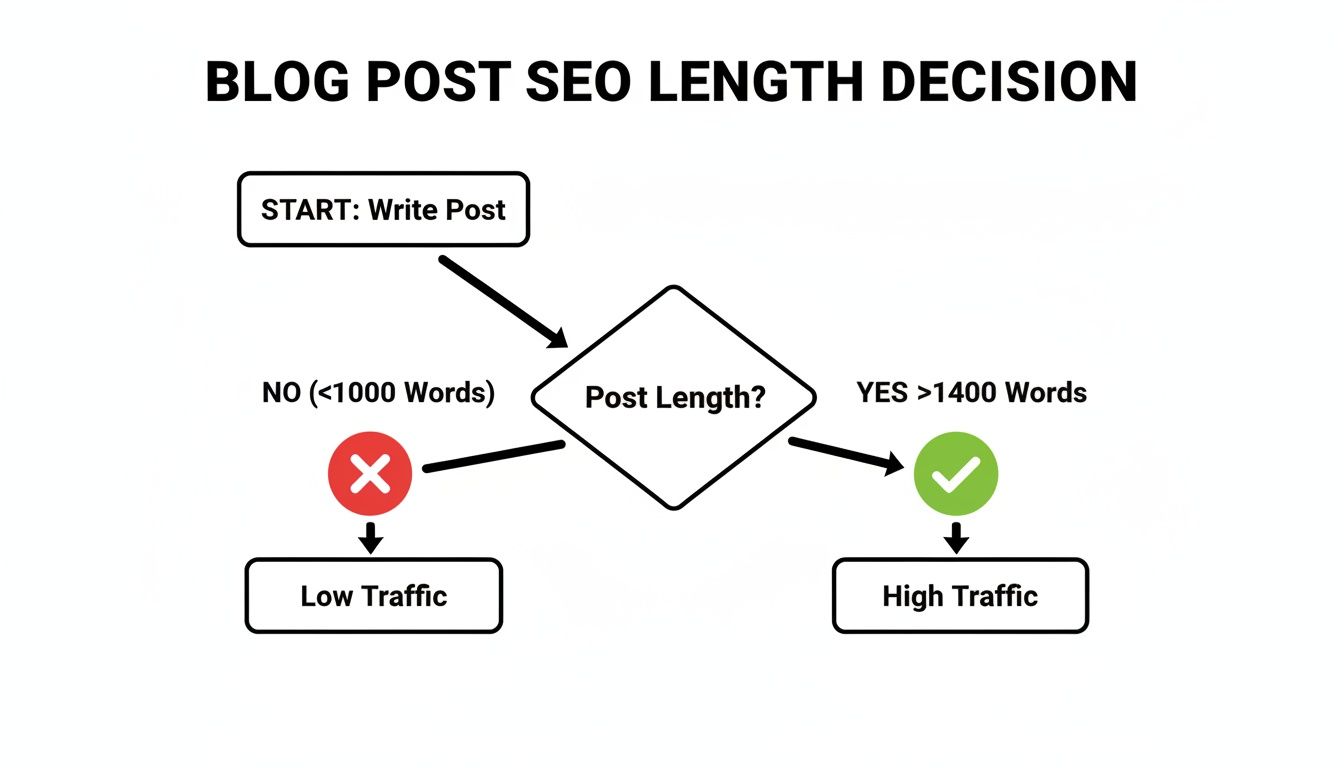
Ultimately, the visual drives home a key insight: while it's no guarantee, a higher word count is often a strong signal of the depth required to pull in significant organic traffic.
From Analysis to Actionable Word Count
Once you’ve weighed these three pillars, you can start setting a practical word count target. The data often points to a sweet spot for the highest-ranking articles: to crack the top of Google, you should often aim for 2,450 words or more.
This isn't about padding your articles with fluff. Longer posts tend to rank better because they do a more thorough job of satisfying user intent. That thoroughness, in turn, helps them earn more shares and valuable backlinks.
The takeaway is clear: don't start with a word count in mind. Start by understanding the user's need and the competitive bar. Your ideal word count is simply the number of words it takes to create the most comprehensive, valuable, and well-structured resource on that topic.
This approach ensures your content is built for performance from the ground up.
Of course, different types of blog posts will naturally land in different word count ranges. A quick news update serves a completely different purpose—and has a different word count—than a foundational pillar page designed to be the definitive resource on a subject.
To make this easier, here’s a quick-reference table to help you align your content format with a typical word count and its main SEO goal.
Recommended Blog Post Length by Content Type and Goal
| Content Type | Typical Word Count Range | Primary SEO Goal |
|---|---|---|
| Listicles ("Top 10") | 1,500 - 2,500 words | Attract a broad audience, high shareability, earn backlinks. |
| How-To Guides | 1,700 - 2,100 words | Solve a specific user problem, rank for long-tail keywords. |
| What-Is Posts (Explainers) | 1,300 - 1,700 words | Build topical authority, capture informational search queries. |
| Case Studies | 1,500 - 2,500 words | Build trust and authority, convert bottom-of-funnel readers. |
| Pillar Pages / Ultimate Guides | 3,000 - 5,000+ words | Become the go-to resource, dominate a core topic, build internal links. |
| News/Announcement Posts | 500 - 1,000 words | Provide timely updates, target trending keywords, drive immediate traffic. |
Think of these numbers as starting points, not strict rules. Always let your analysis of the three pillars—intent, complexity, and competition—be your final guide.
Structuring Long-Form Content for Maximum Engagement
Let's be honest: publishing a 3,000-word article is only half the battle. If that content is just a dense, intimidating wall of text, your readers are going to hit the back button in seconds. That bounce sends a negative signal to Google, tanking the very rankings you were trying to improve.
A high word count on its own means nothing. The real secret to making long-form content work for SEO lies in a smart, scannable structure that keeps people hooked from the first sentence to the last.
Think of your long-form post less like a novel and more like a well-organized reference guide. Your reader should be able to pop in, instantly find the section they care about, and pull out the information they need. This approach transforms a potentially overwhelming article into a user-friendly resource, which is exactly what boosts dwell time and keeps readers happy.
The Anatomy of a Scannable Article
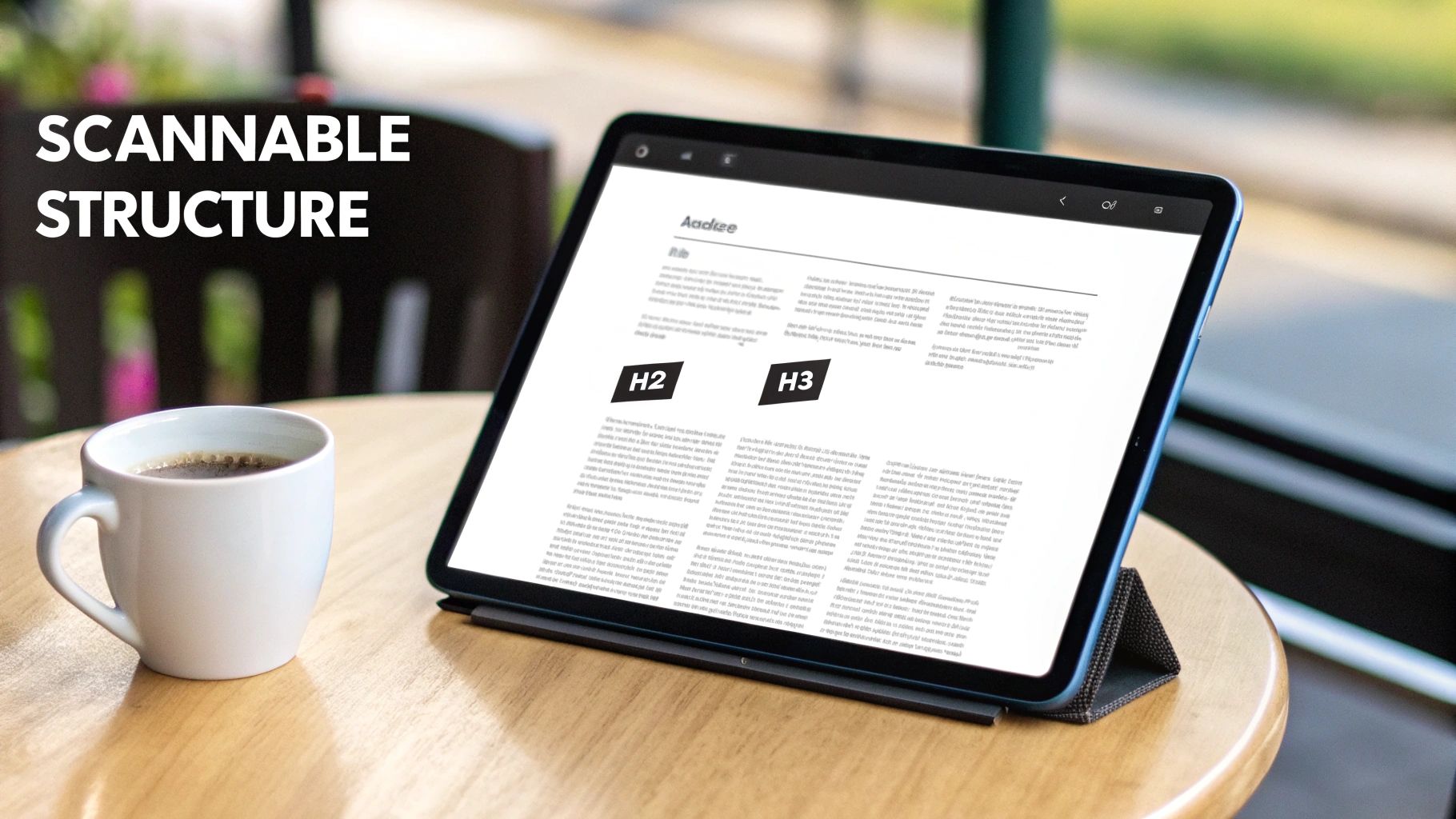
A well-structured article is a roadmap for both your readers and for search engine crawlers. It guides them through your content, making it ridiculously easy to understand the hierarchy and flow of information. This isn’t about making things look pretty; it's about making your content more accessible and effective.
Here are the absolute essentials for structuring your long-form content:
- A "Table of Contents" with Jump Links: For any post clocking in over 2,000 words, this is non-negotiable. It lets readers see the entire scope of your article at a glance and jump directly to the section that answers their burning question.
- Clear Headings (H2s and H3s): Headings are the signposts of your article. They break your content into logical, thematic sections and should be descriptive enough to tell the reader exactly what they'll learn in each part.
- Extremely Short Paragraphs: People don't read online; they scan. Keep your paragraphs to 1-3 sentences, maximum. This technique creates tons of white space, making the content feel less dense and way easier to digest, especially on a phone.
The goal is to make a 2,500-word post feel as easy to navigate as a 500-word one. Strategic formatting empowers the reader, allowing them to consume a large amount of information without feeling overwhelmed, which directly contributes to longer on-page engagement.
Breaking Up the Text for Readability
Beyond the basic structure, you need to actively fight the visual monotony of plain text. Even short paragraphs can cause reader fatigue if they go on and on. The key is to sprinkle in different visual elements to maintain interest and highlight the most important takeaways.
For a deep dive into this, check out our resource on creating a powerful blog post outline template that helps you build these structural elements in from the very start.
Essential Formatting Tools for Engagement
To keep readers scrolling, you need to mix and match different formatting techniques. This simple variety can make a huge difference in how your content is consumed.
Use these tools strategically:
- Bulleted and Numbered Lists: These are perfect for breaking down complex ideas, steps, or features into simple, digestible points. They naturally draw the eye and make information easier to process.
- Blockquotes: As you saw above, blockquotes are fantastic for emphasizing key takeaways, expert quotes, or important stats. They pop out from the main text and add some much-needed visual flair.
- Bold Text: Use bolding to make crucial terms, statistics, or the main point of a paragraph jump off the page. It’s a scanner’s best friend.
- Images and Videos: Visuals are your most powerful tool for breaking up text. Use relevant images, charts, infographics, and embedded videos to illustrate your points and give the reader’s eyes a break.
By weaving together a logical heading structure with these varied formatting elements, you create a reading experience that's actually enjoyable. This strategic approach ensures your investment in a high word count pays off, satisfying both your audience and the search algorithms that reward great user engagement.
Using AI to Scale High-Quality Long-Form Content
Let's be honest: consistently pumping out the kind of in-depth, long-form content that actually ranks is a massive undertaking for any marketing team. The hours spent on research, outlining, writing, and optimizing a single 3,000-word article can feel like a marathon. This production bottleneck is exactly where modern AI platforms are changing the game.
These tools have evolved far beyond just spitting out text. Today, they function more like strategic partners across the entire content lifecycle. They give teams the leverage to scale up the creation of high-quality, competitive articles without ever having to sacrifice depth or performance.
Moving Beyond Basic AI Text Generation
The real magic of today's advanced AI content platforms isn't just about writing words—it's about streamlining the complex, often messy, processes that lead to a truly great article. They take on the critical, time-sucking tasks that used to be 100% manual.
This integrated approach helps teams produce comprehensive content much faster by automating key parts of the workflow:
- In-Depth Research: AI agents can instantly analyze the top-ranking content for any keyword. They’ll identify the common themes, structures, and must-have subtopics your article needs to even have a chance at competing.
- Content Gap Identification: By scanning the search landscape, these platforms can spot the questions and topics your competitors completely overlooked. This gives you a golden opportunity to create a more complete, authoritative resource.
- SEO-Optimized Drafting: Forget the blank page. AI can generate well-structured first drafts in the 2,500-4,500 word range, with proper headings, keyword placement, and on-page best practices baked in right from the start.
The goal of using AI isn't just to write more; it's to arm your team with the insights and automation to produce better, more strategic long-form content at a sustainable pace. It transforms a multi-day slog into a task that takes just a few hours.
This screenshot shows how a platform like Sight AI can turn raw visibility insights into actionable content opportunities, effectively streamlining the entire production pipeline from start to finish.
The crucial takeaway here is the shift from tedious manual analysis to automated opportunity discovery, which then feeds directly into the content creation engine.
Automating the Entire Content Workflow
Often, the biggest hurdles in scaling content pop up after the writing is done. Manual tasks like formatting, uploading to your CMS, and submitting for indexing can create huge delays, especially for smaller teams. For anyone looking to put their foot on the gas, understanding how to scale SEO content production can provide a clear roadmap.
Modern AI platforms tackle these bottlenecks head-on. By integrating directly with your systems, they eliminate the manual friction that kills publishing velocity.
Key Automation Features:
- Direct CMS Integration: AI-generated articles can be pushed straight to your CMS (like WordPress or Webflow) as a perfectly formatted draft. This completely eliminates the soul-crushing work of copy-pasting and reformatting.
- Automated Indexing Submissions: The moment an article goes live, the platform can automatically update your sitemap and use protocols like IndexNow to ping search engines like Google and Bing. This helps your new content get discovered and indexed in a fraction of the usual time.
By handling these vital but time-intensive steps, AI acts as a true force multiplier. It liberates marketers to focus on what humans do best: high-level strategy, promotion, and analysis. You can rest easy knowing the foundational work of producing and publishing comprehensive, SEO-driven content is being handled efficiently. This makes achieving the ideal blog post length for SEO a scalable reality, not just an occasional win.
Busting the Biggest Myths About Blog Post Length
Let's be honest, getting tangled up in word count debates can completely derail a good content strategy. In the world of SEO, chasing the wrong numbers is a fast way to burn through your budget and time. It’s time we put some of the most common myths about blog post length to rest with some straight talk and data.
Too many marketers are still stuck on these old fallacies, and it's holding their content back. Once you see through them, you can build a smarter, more effective plan.
Myth 1: Longer Is Always Better
This is easily the most widespread—and most damaging—myth out there. While it's true that data often shows a link between longer content and higher rankings, correlation isn't causation. A bloated, 3,000-word article stuffed with fluff is going to get crushed by a sharp, focused 1,500-word post that nails the searcher's intent.
Google's one and only goal is to make the user happy, not to hand out trophies for the highest word count. If a person's question can be answered completely in 1,200 words, stretching it to 2,500 just to hit an arbitrary target is a recipe for a high bounce rate. Relevance and thoroughness beat raw length every single time.
The real goal isn't just to be long; it's to be the most complete answer available. Your word count should be a natural byproduct of covering a topic so thoroughly that the reader has no questions left.
Think of it this way: a mechanic doesn't grab every single tool in the shop just to do an oil change. They use the right tools for the job. Your blog post should be the right size to solve the user's specific problem—nothing more, nothing less.
Myth 2: People Don’t Read Long Articles
This one is a classic half-truth that leads people to exactly the wrong conclusion. It’s true that most people don't read long articles from top to bottom like a novel. But that's not the point. They scan for information. And this is precisely why a well-structured, long-form post works so well.
A long article broken up with clear headings, short paragraphs, bullet points, and bolded text is a scanner's dream. It lets someone jump in, find the exact piece of information they need in seconds, and get out. They might only read 20% of the entire piece, but if that 20% gives them the perfect answer, they leave happy.
Effective long-form content isn't built to be read from start to finish. It’s engineered to be a scannable, user-friendly resource. That structure is what keeps people on the page, signaling to Google that your content is a quality result.
Myth 3: You Have to Hit an Exact Word Count
Another trap is getting fixated on a specific number, like insisting "all our posts must be 2,450 words." This kind of rigid thinking completely ignores the reality that every topic and every search query is different. The ideal length for a blog post isn't a hard number; it's a flexible range.
Instead of obsessing over a magic number, let your research guide you:
- Look at the SERPs: What's the average word count for the top five results for your keyword? This gives you a data-driven starting point.
- Consider the Topic: Are you answering a simple "what is" question, or are you creating a complex "how-to" guide? The depth required will naturally determine the length.
- Focus on Value: The most important question is, "What can I add that my competitors missed?" This might be original data, quotes from experts, or a unique angle that makes your article better, no matter the final word count.
At the end of the day, your job is to create the best possible resource on the internet for that topic. Stop chasing word counts and start delivering comprehensive value. When you do that, the right blog post length will take care of itself.
How to Measure the ROI of Your Content Length Strategy
A content strategy is only as good as the results it gets you. Let's be honest—investing in longer, more comprehensive articles takes serious time and resources, so you absolutely have to prove its value. The good news is, you can track the performance of your long-form content and show a clear return on investment by keeping an eye on just a few key metrics.
This isn't about guesswork; it's about using free, powerful tools to see exactly how your hard work is paying off. Your two best friends here are going to be Google Analytics and Google Search Console. They give you the raw data you need to confirm whether your longer articles are hitting the mark.

Key Metrics to Monitor in Your Analytics
To know if you're winning, you have to know what to look for. Forget vanity metrics and focus on the handful of data points that tell a clear story about user engagement and search visibility.
These are the primary metrics you should be tracking:
- Organic Traffic Growth: Are your longer articles actually bringing more people from search engines over time? Look for a steady upward trend for the specific URLs of your in-depth posts.
- Average Time on Page: This one is huge. It shows you how long people are sticking around to read what you've written. A higher time on page for longer articles is a massive signal to Google that readers are engaged and finding real value.
- Keyword Rankings: Jump into Google Search Console to see which keywords your long-form articles are ranking for. A successful piece won't just rank for its main keyword; it will start pulling in traffic from a whole bunch of long-tail variations you didn't even target.
- Backlinks Acquired: Great, in-depth content is a natural link magnet. Use a tool to watch for new backlinks pointing to your pillar pages and ultimate guides. This is a powerful stamp of authority.
Understanding the full picture of content marketing return on investment can help you connect these performance indicators to your bigger business goals.
To make this even easier, here’s a quick-reference table summarizing what to track, where to find it, and what a "win" looks like.
Key Metrics for Evaluating Long-Form Content Performance
| Metric | Tool for Tracking | What Success Looks Like |
|---|---|---|
| Organic Traffic | Google Analytics | A consistent, upward trend in sessions from organic search to specific long-form URLs. |
| Time on Page | Google Analytics | Significantly higher than your site average, indicating deep reader engagement. |
| Keyword Rankings | Google Search Console | Growth in rankings for primary keywords and an expanding list of long-tail variations. |
| Backlinks | Ahrefs, Semrush, Moz | A steady flow of new, high-quality backlinks without manual outreach. |
| Conversion Rate | Google Analytics | An increase in goal completions (e.g., sign-ups, downloads) from the article's page. |
Tracking these metrics consistently will give you a clear, data-backed story to tell about the impact of your content length strategy.
A Simple Framework for Proving Value
Tracking metrics is one thing, but proving a direct cause-and-effect relationship is what really gets people to listen. One of the most powerful ways to do this is by updating an old, short piece of content and measuring what happens next.
A/B testing your content length strategy by refreshing underperforming articles is a powerful way to generate undeniable proof of its effectiveness. It isolates the variable of content depth, making the performance lift easy to attribute.
Here’s a simple, step-by-step process you can follow right now:
- Identify an Underperforming Post: Dig through your analytics and find an older, shorter article (say, around 800 words) that ranks poorly but targets a keyword with good potential.
- Establish a Baseline: Before you touch anything, record its key metrics for the last 90 days. Note its organic traffic, average time on page, and its top 10 keyword rankings.
- Expand and Relaunch: Give that article a major facelift. Double its length to 1,600+ words, adding more depth, new sections, fresh examples, and better visuals.
- Measure the Lift: Relaunch the post and wait. After another 90 days, compare the new performance data against your original baseline.
When you can walk into a meeting and show a clear "before and after" scenario with concrete data—like a 150% increase in organic traffic and 25 new keyword rankings—the value of your strategy becomes impossible to ignore. This method provides the hard evidence you need to justify every future investment in high-quality, long-form content.
Got Questions? We've Got Answers
Even with a solid game plan, you're bound to have a few questions when it comes to figuring out the ideal length for your blog posts. Let's tackle some of the most common ones I hear from content teams so you can move forward with total confidence.
Is It Worth Updating Old, Short Posts?
Yes, a thousand times yes. Going back to an old, short post and beefing it up with new, relevant info is one of the smartest SEO plays you can make. It’s often called a "content refresh," and it works wonders.
When you expand and deepen an older article, you're sending a huge signal to Google that your content is more comprehensive and current than ever. This often results in a nice little ranking bump and a fresh wave of organic traffic. Plus, it gives that page a chance to rank for a whole new set of long-tail keywords. It's usually way more effective than starting from scratch because the original URL already has some history and authority built up.
What’s the Minimum Word Count in a Tough Niche?
There's no single magic number, but let's be realistic. If you're writing in hyper-competitive spaces like marketing, finance, or health, posts under 1,500 words are going to have a really tough time cracking the first page. A much safer target to aim for in these arenas is somewhere in the 2,000-2,500 word range.
Your best bet is always to do a quick competitive analysis. Seriously, just Google your main keyword and look at the word count and structure of the top 5 articles. Your mission is to create something even more valuable, and that often means matching or beating their length.
How Does a Post's Length Impact User Engagement?
When done right, long-form content has an incredibly positive effect on the engagement metrics that search engines care about. A truly comprehensive, well-structured article naturally keeps people on your page longer, boosting your "dwell time"—a powerful positive signal for Google.
Longer articles also tend to have a lower "bounce rate" because visitors find everything they were looking for in one spot, so they have no reason to leave. And finally, these deep-dive pieces that become the definitive resource on a topic are far more likely to earn valuable backlinks from other sites, building up their SEO authority for the long haul.
Sight AI is an AI visibility and content platform that helps your brand get discovered across search. It surfaces high-value content gaps and uses specialized AI agents to produce 2,500–4,500 word SEO-optimized articles, so you can publish consistently without the heavy lifting. Learn how Sight AI can scale your content strategy.