
Programmatic SEO is a powerful way to use data and automation to create hundreds, or even thousands, of optimized web pages at scale. Instead of writing one article at a time, you use a template-based system to go after a massive number of very specific, long-tail keywords that most people ignore.
Unlocking Traffic at Scale

Let's break down programmatic SEO with a simple analogy. Think of it like you're running a high-tech LEGO factory.
- Your Data: This is your giant box of bricks—all the raw information you have, like product specs, city names, user reviews, or service details.
- Your Template: This is the instruction manual for building one perfect model car. It has designated spots for the wheels, doors, and engine, all laid out perfectly.
- Automation: This is a sophisticated machine that takes the instruction manual (template) and the bricks (data) to build thousands of unique cars, each with a different color, wheel type, or feature.
This process lets you move far beyond the slow, manual grind of traditional content creation. Instead of one person spending days writing a single blog post, you can generate thousands of valuable, targeted pages in a fraction of the time.
How It Differs from Manual SEO
The real difference comes down to scale and intent. Manual SEO usually targets broader, high-volume keywords with long, in-depth articles. Programmatic SEO, on the other hand, is all about capturing the "long tail" of search—those countless specific queries that, when added up, drive a huge amount of traffic. These are often high-intent searches from users who are close to making a decision.
The goal isn't to create spammy, low-value pages. It’s about strategically answering thousands of niche user questions with highly relevant, data-driven content that solves a specific problem.
A great real-world example of this in action is the rise of AI-powered listing description generators. These tools take structured data about a property and turn it into unique, readable descriptions. That’s the essence of programmatic execution: turning raw data into useful content at scale.
To make it even clearer, this table breaks down the core differences between the two approaches.
Programmatic SEO vs Manual Content Creation
| Aspect | Programmatic SEO | Manual SEO |
|---|---|---|
| Scale | Generates thousands of pages automatically | Creates one page at a time |
| Speed | Extremely fast; pages created in minutes/hours | Slow; days or weeks per article |
| Keywords | Targets thousands of specific, long-tail keywords | Targets a few broad, high-volume keywords |
| Content | Data-driven, template-based, and consistent | In-depth, narrative-driven, and unique |
| Resources | Requires initial technical setup and data | Requires significant, ongoing writing and editing |
The table really highlights how programmatic SEO focuses on efficiency and breadth, while manual SEO prioritizes depth and narrative. Both have their place, but only one can achieve true scale.
The Strategic Advantage
Ultimately, programmatic SEO is a force multiplier. It lets you cast a massive net to catch users searching for exactly what you offer, often before your competitors even realize those search terms exist.
By using an SEO automation platform, even small teams can manage a huge and effective content footprint that would otherwise be impossible. This strategy turns your website into an authoritative resource that dominates its niche, one automated page at a time.
The Three Pillars of Programmatic SEO
To really get what programmatic SEO is all about, you have to understand its three core parts. Think of them as the legs of a stool—if one is missing, the whole thing topples over. These pillars are Data, Templates, and Automation. Together, they turn a simple concept into thousands of valuable, high-ranking pages.

This synergy is what allows even a tiny team to manage a massive content footprint, pulling off results that would otherwise be completely out of reach. Let's break down each pillar to see how it fits into this powerful strategy.
Pillar One: Data Is The Fuel
Data is the lifeblood of any programmatic SEO project. It's the raw material—the structured information—that gives your pages their unique value and relevance. Without a clean, organized dataset, you’re just spinning your wheels.
Picture an e-commerce site that sells sneakers. Their data isn't just a messy list of shoe names. It’s a beautifully structured database with specific fields for things like:
- Brand: Nike, Adidas, New Balance
- Model: Air Force 1, Stan Smith, 550
- Color: White, Black, Red
- Material: Leather, Canvas, Suede
- Use Case: Running, Basketball, Casual
Every row in this database is a unique product, and each column is a modifier you can combine to target incredibly specific search queries. This is the fuel that makes the whole engine go.
Pillar Two: Templates Are The Blueprint
If data is the fuel, the template is the blueprint—or maybe the vehicle itself. A template is just a pre-designed page layout with a consistent structure but with empty slots for your dynamic content. It dictates exactly where all that data goes, making sure every single generated page looks great, is consistent, and is properly optimized for search engines.
This master template has all the static elements that show up on every page, like your navigation menu, footer, and branding. But the real magic is in the variables that pull information straight from your database.
For instance, a product page template might have variables that look something like this:
<h1>{Brand} {Model} in {Color}</h1><p>Discover our {Material} {Use Case} shoes.</p><meta name="description" content="Shop for the {Brand} {Model} in {Color} today. Perfect for {Use Case}.">
This structure ensures that a page for "Nike Air Force 1 in White" is just as perfectly formatted as one for "Adidas Stan Smith in Green." The template is the reusable mold that gives shape to all your data. Getting the logic behind grouping this data is key; our guide on what is keyword clustering offers a much deeper look into how to organize these concepts.
Pillar Three: Automation Is The Engine
Automation is the engine that brings the first two pillars to life. It’s the technical process that programmatically smashes your data and templates together to spit out hundreds or even thousands of unique pages at scale. This is where it all comes together.
Automation isn't just about making pages fast. It's about systematically building unique combinations of data and content, which lets you target a huge landscape of long-tail keywords that would be impossible to go after by hand.
This process is usually handled by some custom scripts or specialized software that reads each row of your database and fills in a new copy of your template. The result? A massive collection of pages, each perfectly tailored to a very specific search intent. Many modern pSEO strategies also lean on advanced tech to generate the content itself. For anyone curious about the AI behind this, you can learn more about how Large Language Models (LLMs) work.
Together, these three pillars create a scalable system for dominating search results. Data provides the substance, Templates provide the structure, and Automation provides the scale.
How Zillow Built a Real Estate Empire with Programmatic SEO
If you want to see what programmatic SEO looks like in the wild, just look at Zillow. The real estate giant is more than just a website; it’s a masterclass in turning a colossal dataset into an untouchable authority in search engines. Their entire strategy is a perfect, real-world blueprint for executing programmatic principles at the highest level.
Zillow’s power comes from its massive pool of real estate data, mostly pulled from the Multiple Listing Service (MLS). But instead of just showing you that data, they use it as fuel to create millions of hyper-specific landing pages. Each one is built to answer a very precise search query.
We're not talking about a few pages for major cities. We're talking about generating a unique, valuable page for almost any real estate search you could dream up.
The Anatomy of a Zillow Page
Think for a second about how real people search for homes. They don’t just type "houses for sale." Their searches are much more specific:
- "3-bedroom homes in Seattle under $800k"
- "apartments for rent in Austin with a pool"
- "new construction townhomes in Denver’s LoHi neighborhood"
For every one of these long-tail keywords, Zillow has a perfectly tuned page ready and waiting. They pull this off by creating a master page template and then programmatically plugging in variables from their database—things like {Number of Bedrooms}, {City}, {Price Range}, and {Property Type}. The result is a page that feels custom-built for that user’s exact search, because, in a way, it is.
The image below shows a classic Zillow search results page, which is itself a programmatically generated page based on the filters a user selects.
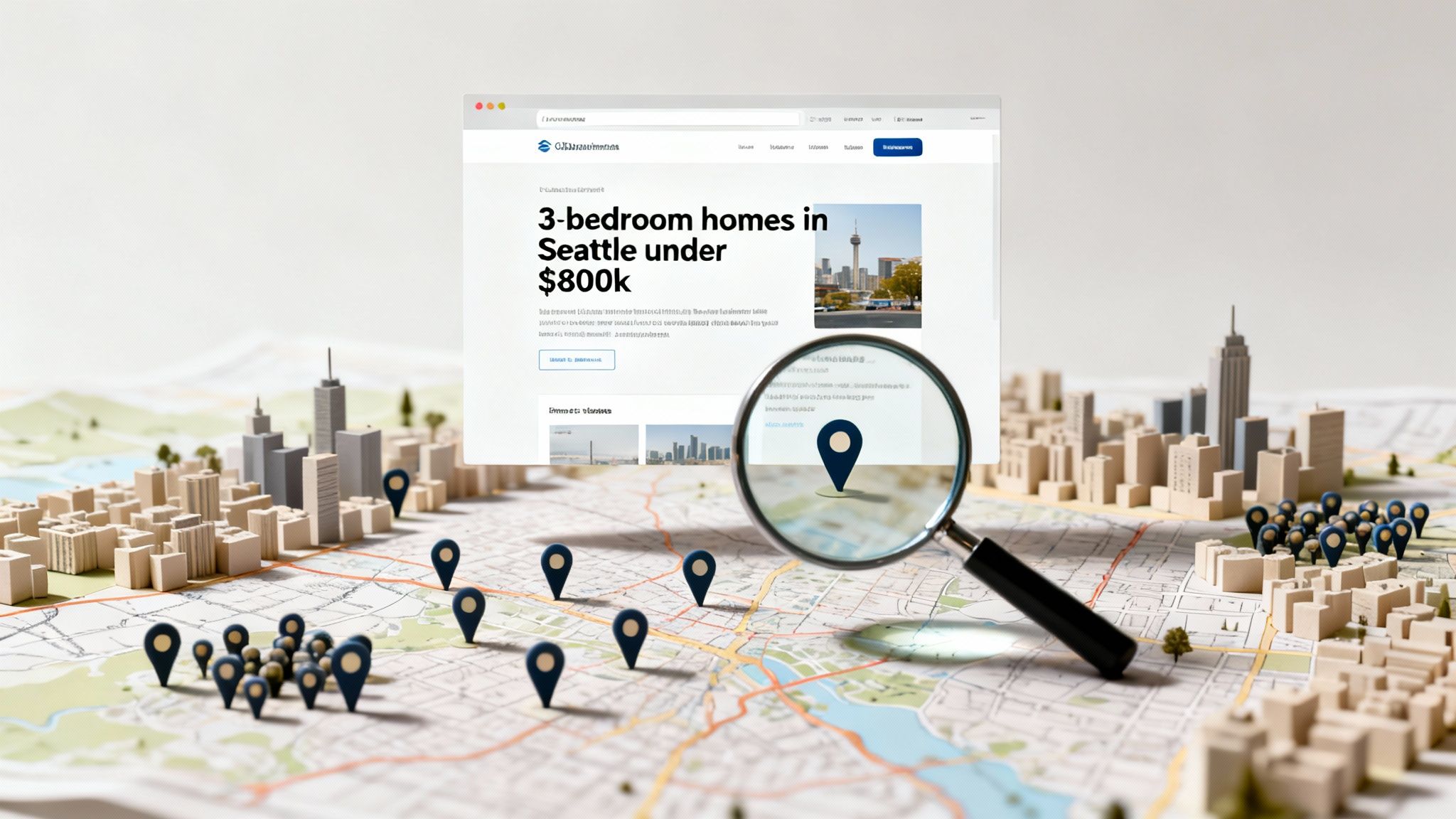
This page isn't some static article. It's a living, breathing collection of data—listings, maps, filters—all presented within a consistent template. That’s the hallmark of a killer programmatic strategy.
Scale Combined with Authority
What truly makes Zillow’s approach so dominant is the combination of mind-boggling scale and sky-high domain authority. They don't have thousands of pages; they have millions. A human content team could never, ever hope to keep up. It's a textbook case of weaponizing data to capture the entire long-tail search market.
The impact is staggering. According to Backlinko, Zillow’s data-driven page strategy is on track to pull in 243 million organic visits every single month by 2025. This traffic isn’t an accident. It's the direct outcome of automating millions of property pages from MLS data. When you pair that scale with their Authority Score of 97, those automated pages have nearly unbeatable ranking power—a synergy that search engines absolutely love to reward.
This approach creates a massive competitive moat. A new competitor can't just write a few blog posts to challenge them. They'd have to replicate Zillow's data infrastructure, its templating system, and its decades-built authority. That’s a monumental task.
By programmatically targeting millions of transactional keywords, Zillow transforms its website from a simple directory into an essential utility that dominates search results for nearly any real estate query imaginable.
The strategy is a lot like what massive e-commerce sites do to manage and promote their vast product catalogs. For businesses trying to optimize their own product listings, our guide on ecommerce category page SEO breaks down similar principles that Zillow uses to great effect.
In the end, Zillow’s success gives us a crystal-clear blueprint for how programmatic SEO works in the real world. They found a huge dataset, figured out the thousands of ways people search for it, and built an automated machine to serve up the perfect page for every single one.
More Programmatic SEO Success Stories
While Zillow provides a masterclass in using programmatic SEO for real estate, the strategy’s true power lies in its versatility. It’s not just for property listings; it’s for any business with a structured dataset and a creative vision for how people might search for it. To prove this, let's explore two completely different companies that have built massive organic traffic engines using these same principles.
One of the most powerful examples is the travel giant, TripAdvisor. Their entire business model hinges on programmatically creating pages that answer an almost infinite number of specific travel queries. They don't just have a page for "Things to do in Paris"; they have pages for "best family-friendly hotels near the Eiffel Tower" or "top-rated Italian restaurants in Montmartre."
How do they pull this off? Their core data source isn't an MLS feed; it's user-generated content (UGC). Every review, rating, and photo submitted by a traveler becomes a new data point they can use to build out hyper-specific pages.
This approach has shown what's possible when it comes to scaling organic traffic, with giants like TripAdvisor showing its power through sheer volume and dominance in search results. By 2023, TripAdvisor had generated a staggering 71 million pages using programmatic techniques, pulling data automatically from their massive database to create optimized landing pages for hotels, restaurants, and attractions worldwide. This automation allowed them to rank for an incredible 5.6 million keywords, capturing long-tail searches that manual content teams could never touch. You can find more insights about TripAdvisor's SEO strategy on mangools.com.
How Zapier Wins With SaaS Integrations
Now, let's pivot to a completely different industry: Software as a Service (SaaS). Zapier, an automation platform, uses programmatic SEO to target high-intent, bottom-of-the-funnel users who are ready to solve a problem right now. Their strategy is brilliant in its simplicity.
Zapier’s "data" is their massive list of app integrations. They understood that their customers weren't just searching for "automation software." They were searching for specific solutions to their workflow problems, like:
- "Connect Google Sheets to Slack"
- "How to automate Trello cards from Gmail"
- "HubSpot and Mailchimp integration"
For every possible combination of the thousands of apps on their platform, Zapier programmatically generates a unique landing page. Each page uses a master template that dynamically inserts the names and logos of the two apps being connected. The page explains exactly how the integration works, providing immediate value and a clear call-to-action to build the "Zap."
This strategy is a perfect example of targeting transactional intent at scale. The user isn't just looking for information; they are looking for a tool. Zapier meets them at the final step of their journey with a purpose-built page that converts.
Programmatic SEO Use Cases Across Industries
The contrast between TripAdvisor and Zapier shows just how adaptable this approach is. One uses a vast, ever-growing pool of user-generated content, while the other leverages a structured database of software integrations. Both are executing the core principles of what programmatic SEO is: identifying a dataset, understanding user search patterns, and automating page creation to meet that demand.
This table illustrates how different business models apply these same principles to drive growth.
| Industry | Example Company | Data Source | Page Type Example |
|---|---|---|---|
| Real Estate | Zillow | MLS property listings | Homes for sale in [City], [ZIP Code] |
| Travel | TripAdvisor | User-generated reviews | Best [Cuisine] restaurants in [Neighborhood] |
| SaaS | Zapier | App integration directory | How to connect [App A] to [App B] |
| E-commerce | G2 | Product specs & user reviews | Best [Software Category] for [Business Size] |
| Finance | NerdWallet | Financial product data | Compare [Credit Card Type] credit cards |
| Local Services | Thumbtack | Service provider profiles | Find top-rated [Profession] near me |
Ultimately, these success stories prove a critical point: if you have a structured dataset that your audience cares about, you have the raw material for a successful programmatic SEO campaign. Whether you're in travel, tech, e-commerce, or finance, the opportunity to capture the "invisible demand" from highly specific searches is immense.
Your Step-by-Step Implementation Blueprint
Knowing the theory behind programmatic SEO is one thing. Actually building your own engine is another. It can feel like a huge leap, but the process is more methodical than you might think. By breaking it down into a clear, actionable framework, you can turn a daunting concept into a very achievable project.
This blueprint will walk you through the five essential stages of launching your first programmatic campaign. Think of this as your roadmap, guiding you from a raw idea to thousands of live, traffic-driving pages.
Phase 1: Find Your Core Data Source
Every successful programmatic SEO project starts with data. This is the foundation—the raw material you'll shape into countless unique pages. Your first job is to find a structured, valuable dataset you can build on.
This data could be anything from:
- A product catalog with detailed specs like brand, model, color, and size.
- A list of services you offer, combined with all the locations you serve.
- User-generated content, such as reviews, ratings, or business listings.
- Proprietary data your company has gathered, like industry stats or performance metrics.
The key is that the data must be structured and comprehensive enough to create meaningful combinations. Honestly, a simple spreadsheet is often enough to get started.
Phase 2: Conduct Keyword Research at Scale
Once you have your data, you need to figure out how real people search for it. This step is all about identifying a "head term" and the "modifiers" that combine to create thousands of long-tail variations. For example, if your head term is "homes for sale," your modifiers could be {city}, {zip code}, and {number of bedrooms}.
Your goal is to find the patterns in how your customers search. Tools like Ahrefs or Semrush are invaluable here, but you can also just start by thinking like your customer. What specific questions are they asking that your data can answer? This research defines the entire scope of your project.
Phase 3: Design Your Master Page Template
With your data and keywords mapped out, it's time to design the blueprint for your pages. This master template is a single page layout that will be used for every single page you generate. It contains static elements like your site’s header and footer, along with dynamic placeholders for your data.
Think of it like a mail merge. The structure is the same for everyone, but the names and details ({product_name}, {city_name}, {price}) are pulled from your database. A well-designed template is crucial for both user experience and on-page SEO, ensuring every generated page is clean, consistent, and optimized.
A common mistake is creating a template that’s too thin. Make sure your template has enough unique content sections—like FAQs, user reviews, or related data points—to provide real value and avoid Google flagging the pages as low-quality.
Phase 4: Handle the Technical Setup
This is where the magic of automation happens. You need a system to programmatically combine your data (Phase 1) with your template (Phase 3) to generate all the final pages. The technical stack can range from simple no-code tools to complex custom scripts.
A popular no-code approach involves using:
- Airtable or Google Sheets to act as your database.
- Webflow or another CMS to host your page template.
- A connector tool like Whalesync or Zapier to sync the data and generate the pages.
For more complex projects, developers might use Python scripts or frameworks like Next.js. Regardless of the tools, the goal is the same: automate the creation of thousands of optimized pages based on your data. This is where you can truly automate content marketing and achieve incredible scale.
Phase 5: Launch, Monitor, and Iterate
Finally, it's time to go live. But the work doesn't stop once the pages are published. You need to create and submit a sitemap to Google Search Console to make sure your new pages get discovered and indexed.
From there, it’s all about monitoring performance. Track key metrics like indexation rate, organic traffic, and keyword rankings for a sample of your new pages. For instance, companies like Zapier and Wise show just how powerful this strategy can be. Zapier pulls in 5.8 million monthly organic visits, and Wise attracts over 60 million by targeting specific user queries at an immense scale. You can discover more insights about their approach to programmatic SEO on guptadeepak.com.
The most important piece of advice? Start small. Launch a pilot project with a limited dataset to prove the concept, learn from the results, and then iterate and expand from there.
Common Pitfalls and How to Avoid Them
Getting a programmatic SEO project off the ground feels like a huge accomplishment, but the real work starts the moment your pages are live. It's so easy to fall into common traps that can completely torpedo your hard work. Success isn't just about publishing pages at scale; it’s about creating an ecosystem of pages that Google trusts and, more importantly, that people find genuinely useful.
If you're not careful, you can run into a few critical mistakes that plague many programmatic campaigns. These issues can sink your rankings, get your pages de-indexed, and waste a ton of resources, turning a promising project into a frustrating dead end.
Thin and Duplicate Content Issues
One of the biggest red flags for any search engine is thin content. This is what happens when your programmatic pages don't offer much unique value. If your pages are just lazy copies of each other with a different city or product name swapped in, Google's going to see right through it and label them as low-quality.
Just as dangerous is duplicate content. When you have thousands of pages with nearly identical text, you're not just confusing search engines—you're watering down your own ranking potential. This is usually a sign of a poorly designed template that leans too heavily on static, repeated text instead of unique data.
The fix? Make sure your template is designed to pull in multiple, unique data variables for every single page. Think about weaving in user-generated content like reviews, unique images for each entry, or even custom data-driven charts to make every page feel distinct and valuable.
This workflow shows how the whole process fits together, from gathering your data to the final launch.
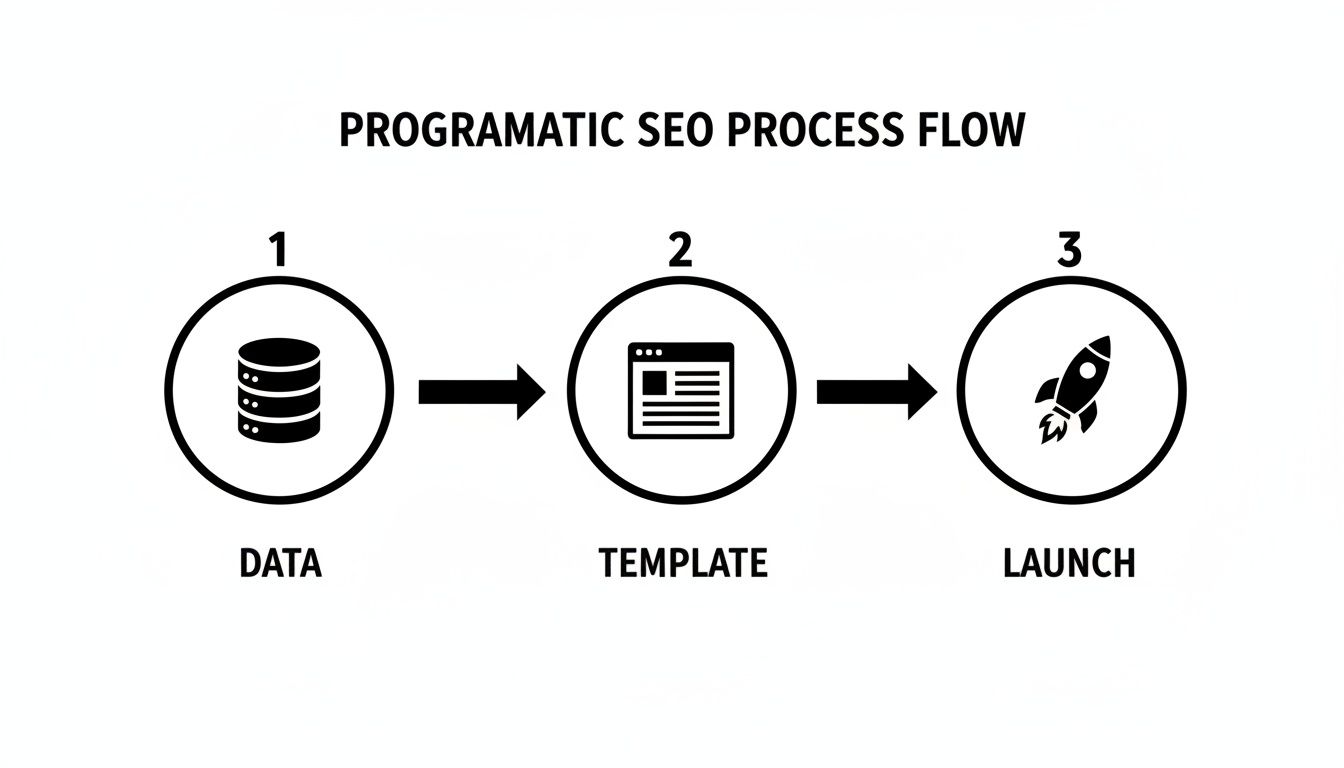
As you can see, a rock-solid foundation in both your data and your template design is non-negotiable before you even think about hitting "launch."
Poor Internal Linking and User Experience
Another pitfall I see all the time is a weak internal linking structure. Just publishing thousands of pages without connecting them in a logical way is like building a city with no roads. You end up with a bunch of "orphan" pages that have no internal links pointing to them, making it nearly impossible for search engines to find them or understand how they fit into your site's bigger picture.
A smart internal linking strategy does two critical things:
- It distributes authority: It passes link equity from your stronger, established pages to your new programmatic ones, giving them a much-needed boost to help them rank faster.
- It improves navigation: It guides users to related content, keeping them on your site longer and improving overall engagement.
On top of that, completely ignoring the user experience (UX) is a fatal mistake. If your pages are slow to load, ugly, or a nightmare to navigate, people will bounce immediately. That sends a huge negative signal to Google.
Key Takeaway: Programmatic SEO is not a "set it and forget it" machine. The goal is to create a seamless experience where every automated page feels like it was handcrafted specifically for the user’s search.
A messy implementation can also lead to your own pages competing against each other for the same keywords. It’s absolutely crucial to prevent this. To get ahead of the problem, check out our guide that explains what is keyword cannibalization and how to make sure your pages are working together, not in conflict. By focusing on high-quality data, unique content, smart linking, and a user-first design, you can dodge these common mistakes and build a programmatic engine that drives real, sustainable growth.
Frequently Asked Questions About Programmatic SEO
Even with a clear blueprint, diving into programmatic SEO can bring up some valid questions. It's a different way of thinking about content, so it's natural to have a few concerns. Let's tackle the most common ones to help you move forward with confidence.
Is Programmatic SEO Considered Spam by Google?
Not at all—as long as you do it right. Google’s number one job is to give a user the best possible answer for their search.
High-quality programmatic SEO does exactly that. It creates valuable, hyper-specific pages that are a perfect match for what someone is looking for. Think of a Zillow page with unique data for one specific property, or a Zapier page detailing a very specific software integration. These pages serve users extremely well because they're tailored to a precise need.
The strategy only gets a bad rap when people use it to churn out thin, low-value, or repetitive content without any real data or user benefit. That's not programmatic SEO; that's just spam.
How Much Data Do I Need to Start?
You probably need less than you think. You don't need a massive, perfectly polished database to get a successful pilot project off the ground. A surprisingly small but well-structured dataset can be incredibly effective for proving the concept.
For instance, a local business with 15 distinct services that operates in 10 different neighborhoods could instantly generate 150 highly targeted pages. That's a solid start.
The key isn't the raw quantity of data but its structure and potential to create meaningful, user-focused combinations. Start small, validate the approach, and then scale your efforts.
What Tools Do I Need for This?
The toolset can range from simple and accessible to highly complex, depending on your goals. A basic setup might just use Google Sheets as a database and a no-code platform like Webflow to build and generate the pages.
More advanced operations often involve custom scripts, dedicated databases, and a headless CMS. But the good news is that modern platforms are making this entire process far more accessible for everyone.
AI-powered platforms can now manage the entire workflow, from:
- Finding keyword opportunities at scale.
- Generating high-quality, unique content for each page.
- Publishing pages and getting them indexed by search engines.
Ready to turn AI and search visibility insights into measurable growth? Sight AI is the all-in-one platform that helps you get discovered. From monitoring your brand's presence in AI chat to generating high-ranking articles on autopilot, we provide the tools to build your authority and drive organic traffic. Start your journey at https://www.trysight.ai.