Automating content marketing simply means using tech to handle the repetitive, everyday tasks that bog down your content workflow. It’s all about swapping out the manual grind of things like scheduling social posts, sending out email blasts, or pulling performance reports with smart, efficient systems. This frees up your team to do what they do best: focus on big-picture strategy and creativity.
Why You Need to Automate Content Marketing Now

The demand for great, personalized content never stops. Marketing teams are stretched thin, constantly fighting against tight deadlines, shrinking budgets, and the ever-present pressure to show ROI. When you’re doing everything by hand, these pressures just get worse, creating huge bottlenecks that kill growth and burn out your most talented people.
Think about it. Your team might be spending hours every single week manually posting on social media, copy-pasting data into spreadsheets for reports, or chasing down approvals in a never-ending email thread. Each of these tasks, while necessary, pulls them away from the work that actually makes an impact—like brainstorming a new campaign, digging into audience behavior, or coming up with fresh ideas. It's not just inefficient; it's a strategic weakness.
The Hidden Costs of Manual Workflows
Manual content processes are more than just a time-suck. They open the door to human error, create brand inconsistencies, and make it nearly impossible to scale your content engine. A single typo in a URL that gets shared everywhere or a missed deadline because an email got buried can have real, damaging consequences.
The proof is in the numbers. The marketing automation software market is on track to hit around $47 billion by 2025. And with 76% of marketers already using some form of automation, it’s obvious this is more than just a trend—it's a fundamental shift in how modern marketing gets done.
The real goal here isn't just to save time. It's to empower your team to think and act strategically. When you remove the friction of tedious administrative work, you unlock the creative potential that drives real business growth and builds a stronger connection with your audience.
Moving from Reactive to Proactive
Without automation, marketing teams are often stuck in a reactive loop, just trying to keep up with the content calendar. This leaves almost no time for planning ahead or jumping on new market opportunities. Automation is what gives you the breathing room to be strategic.
For example, an automated system can schedule an entire month of social media content in just an hour, freeing up days of cumulative time. That newfound bandwidth can be put back into activities that actually move the needle. If you want to see how this fits into the bigger picture, this an ultimate guide to business automation is a great resource for building a powerful business case.
Making the switch from manual busywork to strategic execution isn't a luxury anymore; it's a competitive must. As we'll explore, the future of automated content management is only going to get more deeply woven into successful marketing operations. Adopting these systems now is what will position your brand to scale effectively and stay ahead of the curve.
Blueprint Your Content Process for Automation

Before you even think about shopping for software, you need a crystal-clear map of your content marketing engine. The goal isn't to collect a bunch of shiny new tools; it's to apply them surgically to the biggest points of friction in your current workflow. The best automation strategies always start with a deep-dive audit of your entire content lifecycle, from that first spark of an idea all the way to the final performance report.
This blueprinting phase is all about deconstructing your process to find those hidden time-sinks and repetitive tasks that are quietly killing your team's productivity. Think of it as a diagnostic check-up for your entire content operation.
Uncovering Automation Hotspots in Your Workflow
Every content strategy, no matter how complex, can be broken down into core stages. By walking through each one, you can pinpoint exactly where automation will give you the most bang for your buck. A great first step? Just ask your team where they feel the most drag—their answers will often point you straight to the perfect candidates for automation.
Here’s a practical breakdown of what to look for at each stage:
- Ideation and Research: Is someone manually tracking competitor content or drowning in keyword lists? AI can discover content gaps and sniff out trending topics on its own.
- Creation and Collaboration: Is your team stuck in endless email chains just to get a draft approved? Automated approval workflows in a project management tool can completely eliminate that back-and-forth.
- Optimization: How much time gets burned formatting blog posts, adding internal links, or writing meta descriptions? These are highly repetitive tasks practically begging for an AI assistant.
- Distribution and Promotion: Do you manually schedule every single social media post whenever a new article goes live? This is a classic, high-value task that automation can handle without breaking a sweat.
- Measurement and Reporting: Are you still pulling data from five different sources into a clunky spreadsheet each month? Automated dashboards can pull all that information together for you, delivering insights without the manual grunt work.
A common mistake is trying to automate everything all at once. Don't do it. Instead, find the one or two manual tasks that eat up the most hours or cause the worst delays. Solving just one major bottleneck can free up a surprising amount of strategic brainpower for your team.
From Manual Tasks to Automated Systems
Once you’ve identified your biggest pain points, it's time to visualize the new, automated workflow. This doesn't need to be complicated. A simple flowchart can do wonders to clarify how information and tasks will flow from one step to the next without a human having to push a button.
Think about a typical manual content process. It's often a chaotic mess of Google Docs, spreadsheets, Slack DMs, and emails. An automated system could bring all of that into a single platform where finishing one task automatically triggers the next, notifying the right person at exactly the right time.
This kind of structured approach is the key to building an operation that can actually scale. Many successful teams model their processes on proven frameworks. For a little inspiration, check out these content marketing strategy examples. They offer great insight into how structured, repeatable systems lead to better results. The goal is to turn a series of disjointed actions into a cohesive, self-propelling machine.
Prioritizing Your Automation Efforts
With a list of potential automation opportunities in hand, you have to prioritize. Not all automations are created equal. To figure out where to start, weigh each one against two simple criteria: time saved and strategic impact.
A task that’s high in repetition but low in strategic thinking is often the perfect place to start. For example, automatically publishing a new blog post to all your social media channels saves a measurable chunk of time every week and directly impacts your content's visibility. That’s a clear win.
On the other hand, while AI can definitely help write a first draft, the strategic edit and creative polish from a human editor has a massive impact on quality. In that case, you might automate the initial draft but keep the final review as a manual step. This balanced approach ensures you get more efficient without sacrificing the quality that builds trust with your audience.
This deliberate strategy—mapping your process, finding the bottlenecks, and prioritizing thoughtfully—is the bedrock of any successful content marketing automation plan.
Building Your Smart Content Automation Stack
Once you've mapped out your content process, it's time for the fun part: picking the tools to make it all happen. But let's be honest, staring at the massive landscape of marketing software can be completely overwhelming. Every platform promises the moon, and it's easy to end up with a random collection of subscriptions that don't really talk to each other.
The goal isn't just to collect software. It's to build a cohesive tech stack—a set of tools that work together, each with a clear, strategic job to do. A smart stack is less about flashy features and more about how well the tools solve your specific problems, integrate with each other, and actually get used by your team.
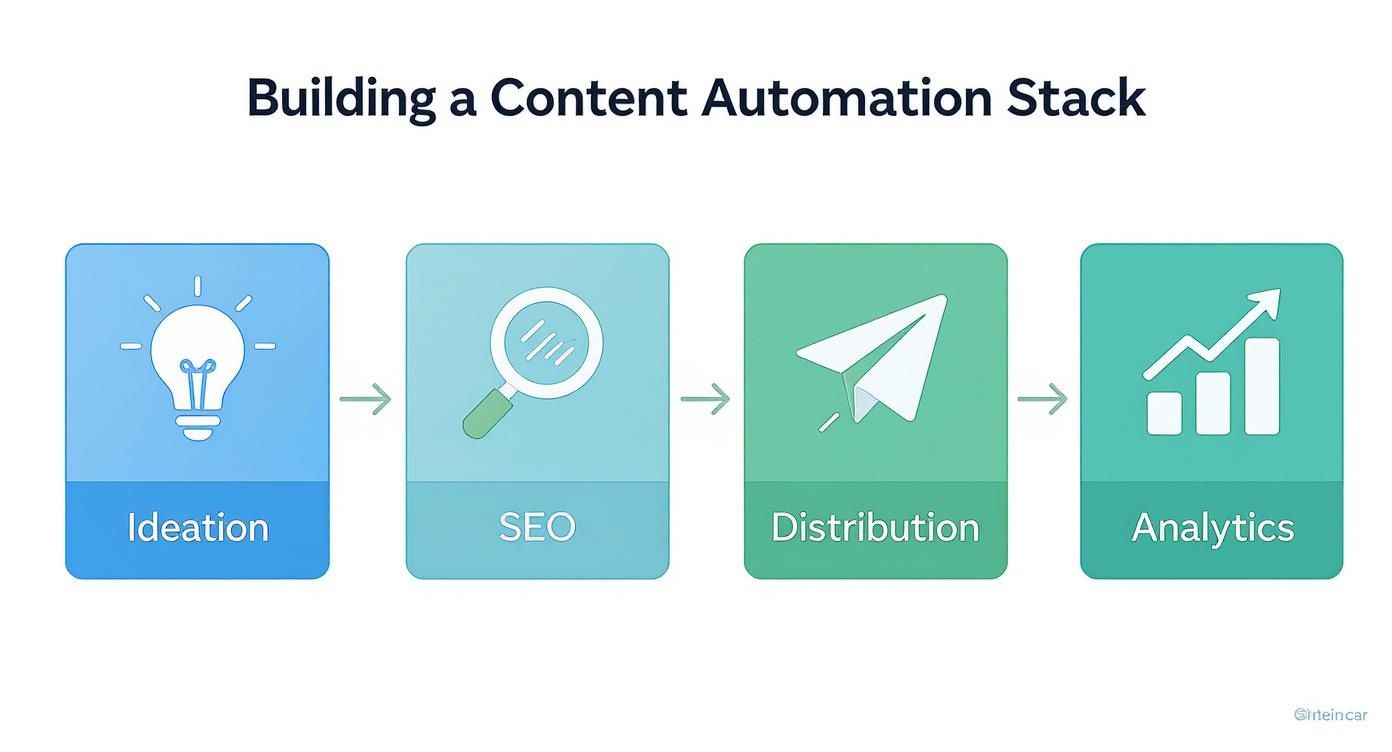
The Four Pillars of a Content Automation Stack
To cut through the noise, I find it helpful to think about the content lifecycle in four distinct stages. This way, you can ensure you have the right tech backing you up from start to finish.
- Ideation and Creation: This is where the magic starts. Automation tools in this bucket are all about kicking off the creative process faster. Think AI writing assistants that can whip up a solid outline, research tools that pinpoint trending topics, or platforms that analyze search intent to build data-driven content briefs.
- SEO and Optimization: A first draft is just the beginning. Now you need to get it ready for search engines. This is where you bring in tools that handle on-page SEO analysis, suggest smart internal links, and fine-tune your metadata to help you climb the search rankings.
- Distribution and Promotion: Brilliant content means nothing if no one ever sees it. Distribution tools take the manual labor out of getting your work in front of the right eyeballs. This category includes everything from social media schedulers and email marketing platforms to tools that cleverly repurpose your content for different channels.
- Analytics and Reporting: Finally, you have to know what's working and what's not. These tools connect to your key platforms—like Google Analytics and your CMS—to pull all your performance data into one clean dashboard. It’s about ending the nightmare of manually building reports every month.
How to Choose the Right Tools for Your Team
Just knowing the categories isn't enough. The perfect stack for a solo entrepreneur looks worlds different from what a 20-person marketing team at a large company needs. Your choices have to be grounded in your reality.
Before you pull out the company card, run through these questions:
- What’s our budget? Get real about what you can spend, including monthly fees and any setup costs. Many of the best tools have pricing tiers that can grow with you.
- What’s our team's size and skill set? An intuitive, user-friendly tool is often a much better bet for a small team than a beast of a platform that needs a dedicated expert to run it.
- Will it play nice with our existing software? New tools must integrate with what you already use, like your CMS or CRM. If they don't, you're just creating more manual work and defeating the entire purpose of automation.
- Does it solve a real, high-priority problem? Look back at that workflow map you made. Your first tool purchases should directly attack the biggest bottlenecks you found.
Stop chasing the "perfect" tool. The real win is building a "perfect-for-you" stack. A well-integrated set of good tools that your team genuinely uses will always beat a single, overly complex platform that just sits there gathering digital dust.
Key Automation Tool Categories and Examples
To help you visualize your stack, here’s a quick breakdown of the essential tool categories, what they do, and some popular examples to get you started.
| Automation Category | Primary Function | Example Tools |
|---|---|---|
| Ideation & Research | Discovering topics, analyzing keywords, and creating data-driven content briefs. | Ahrefs, Semrush, AnswerThePublic |
| AI Content Creation | Generating outlines, first drafts, and optimizing copy for tone and style. | IndexPilot, Jasper, Copy.ai |
| SEO & Optimization | Analyzing on-page SEO, finding linking opportunities, and optimizing metadata. | Surfer SEO, Frase, MarketMuse |
| Distribution & Promotion | Scheduling social media posts, managing email campaigns, and repurposing content. | Buffer, Mailchimp, Zapier |
| Analytics & Reporting | Consolidating performance data from multiple sources into unified dashboards. | Google Analytics, Databox, Hotjar |
This table should give you a solid starting point for identifying the specific tools that will fill the gaps in your content workflow.
Assembling Your Stack with AI at the Core
Let’s be clear: modern content automation runs on artificial intelligence. AI has moved way beyond just being a writing assistant; it’s now a strategic partner in every phase of the content lifecycle. As you build your stack, consider incorporating responsible AI tools for visual content creation to boost both your efficiency and the quality of your output.
If you really want to see how AI can transform your creation process, diving into the best content AI tools available today is a great place to start. These platforms can handle everything from discovering your next big topic to producing a structured first draft, dramatically speeding up your entire pipeline.
Ultimately, building your stack is a journey, not a one-time task. Start with the tools that solve your most painful problems right now. Master them, measure the results, and then expand your stack as your strategy and team grow. This thoughtful, needs-first approach is how you turn a simple software subscription into a powerful, automated engine for growth.
Theory is great, but let's be honest—it's putting automation into practice that really makes a difference. It's time to move beyond the concepts and actually build three high-impact workflows you can set up today.
Think of these as your starter kit. These examples show you how to stitch different tools together to create a content engine that practically runs itself, saving you a ton of time while boosting quality and reach.
Workflow 1: The Instant Distribution Machine
Imagine this: you hit "publish" on a new blog post, and instead of spending the next hour manually posting it everywhere, you just watch as it automatically fans out across all your key channels.
This workflow kills the tedious, soul-crushing task of promoting new content. It ensures your hard work gets seen by the widest possible audience the second it goes live. This is usually the first workflow teams build because the return on time saved is immediate and obvious.
Here’s the basic recipe:
- The Trigger: It all starts when you publish a new article in your CMS, whether that's WordPress, Webflow, or something else.
- The Action Chain: That "publish" event is the signal. An integration tool like Zapier or Make.com catches it and kicks off a sequence of actions you've defined.
- The Outputs: The tool automatically creates and schedules posts for LinkedIn, X (formerly Twitter), and Facebook. It pulls the title, a quick summary, and the featured image right from the blog post. No copy-pasting required.
You can even get fancier by adding steps like creating unique tracking links for each platform or pinging your team's Slack channel to announce the new post is live.
Here’s a glimpse of how Zapier can connect different apps to automate your content distribution. It’s all about making disparate tools talk to each other without writing a single line of code.
Workflow 2: AI-Powered Content Brief Generation
Let's be real: one of the biggest bottlenecks in content creation is the research and briefing phase. A vague, flimsy brief leads to unfocused drafts that miss the mark on SEO and what users are actually looking for.
This workflow automates the creation of comprehensive, data-driven content briefs. It gives your writers everything they need to produce articles that actually have a shot at ranking. The goal is to ditch the guesswork for a structured, repeatable process—a non-negotiable step if you want to scale up content without the quality tanking.
For a deeper dive into the mechanics, check out our guide on how to automate content creation for more advanced tips.
Here’s how it works:
- Input: You start with just a target keyword. Pop it into an SEO tool like Ahrefs, Semrush, or a platform like IndexPilot.
- AI Analysis: The tool gets to work, analyzing the top-ranking pages for that keyword. It figures out the key subtopics, common questions people are asking, and the ideal word count.
- Automated Outline: From that analysis, it generates a structured brief. This isn't just a list of keywords; it’s a full-blown roadmap with a recommended H1, a complete outline with H2s and H3s, and even suggestions for internal links.
- Delivery: The finished brief is then automatically sent to your project management tool—think Asana or Trello—as a new task, already assigned to a writer.
This workflow doesn't just shave hours off manual research. It fundamentally improves the quality of your first drafts. Writers start with a clear, strategic plan based on what's already winning in the search results, which slashes revision cycles.
Workflow 3: The Content Repurposing Engine
A single, well-researched blog post is a goldmine. It holds enough material for dozens of smaller content pieces. But manually slicing and dicing a long article into social media snippets, email newsletters, and video scripts is a massive time sink.
This workflow automates that entire repurposing process, turning one asset into many with minimal effort.
Here’s how to build this engine:
- The Input: Simply feed the URL of a published blog post into an AI content tool.
- The AI Transformation: The AI reads and actually understands the entire article, identifying the core arguments and key takeaways.
- The Automated Outputs: From there, you just tell it what you need.
- Social Snippets: Ask for five snappy, engaging hooks for X, each highlighting a different point from the article.
- LinkedIn Post: Have it write a longer, more professional post for LinkedIn that summarizes the core argument and ends with a strong call to action.
- Email Newsletter: Let it draft a newsletter that introduces the blog post's main idea, teasing just enough to make your subscribers want to click through.
- Video Script Outline: Need a video? It can generate a script outline for a short YouTube or TikTok clip that summarizes the key points in a visual-friendly format.
This system lets you multiply the value of every cornerstone piece you create. You can reach different audience segments on the platforms they prefer, all from one initial investment of time. By starting with these three workflows, you'll build a powerful foundation for your content automation and win back precious time for bigger-picture thinking.
Supercharge Your Strategy with AI Automation
Truly automating your content marketing in today's world means going way beyond just scheduling social media posts. The real revolution is happening at the strategic level, where artificial intelligence has stopped being a simple helper and is now a core decision-making partner. This isn't just about efficiency; it's about using AI to make smarter, faster, and more data-backed choices across your entire content lifecycle.
We've moved past just managing repetitive tasks. Modern automation is about seeing what your audience needs and what the market is doing before it happens. It’s the difference between scheduling content and creating content that the market is just about to demand.
Moving from Execution to Prediction
One of the most powerful ways to use AI is through predictive analytics. Imagine knowing which topics are about to trend in your industry before they blow up. AI models can chew through millions of data points—from search trends and social media chatter to what your competitors are up to—to find those emerging patterns and identify breakout topics.
This lets you stop reacting to what's already popular and start setting the agenda yourself. For example, an AI tool might flag a niche keyword that’s suddenly getting a ton of search volume. This gives your team a massive head start to create authoritative content that will capture traffic as the trend peaks. This proactive approach is a total game-changer for SEO and establishing thought leadership.
The most impactful AI automation doesn't just do tasks faster. It gives you insights that were basically impossible to find by hand. It's about boosting human strategy with machine-level intelligence to make way better decisions.
Scaling Personalization with Generative AI
Personalization at scale has always been the holy grail for marketers, but generative AI is finally making it a reality. You can now create highly specific email sequences, ad copy, and even different landing page versions for all your audience segments—automatically.
Think about an in-house marketing team that needs to ramp up its content pipeline without blowing the budget. Instead of hiring an expensive agency for research and first drafts, they bring in an AI agent. The agent’s job is to analyze the top-ranking articles for a target keyword, spot content gaps, and generate a comprehensive first draft, complete with headings and internal link suggestions.
What used to take weeks now takes a few hours. The human team then steps in for the most important parts: strategic editing, fact-checking, and weaving in their unique brand insights. This hybrid workflow slashes costs and shortens the content creation cycle, letting the team publish high-quality content way more often.
The integration of AI has fundamentally reshaped the content marketing industry. Around 77% of organizations are now using AI in their content workflows, and companies using it report getting back $5.44 for every dollar spent.
This shift to AI-powered workflows is also leading to major cost savings. In fact, 73% of teams that have adopted AI agents report a significant drop in what they spend on agencies. By handling the heavy lifting of research and initial creation, AI empowers smaller teams to compete with much larger operations. To stay ahead, it's critical to understand the latest trends in AI content generation and figure out how they apply to your strategy. This is how you really supercharge your efforts and turn content into a predictable growth engine.
Answering Your Content Automation Questions
Stepping into automated content marketing is smart, but it's natural to have a few questions. I get it. You're wondering how this shift will really impact your quality, your budget, and your team's day-to-day. So, let's tackle the big ones head-on.
The most common fear I hear is that AI and automation will strip the soul out of the content, making everything sound robotic. It’s a totally valid concern. Nobody wants to lose the brand personality and creative spark that actually connects with people.
The trick is to stop thinking of these tools as replacements for your team. They’re not here to take over strategic thinking. Instead, they’re designed to crush the repetitive, data-heavy tasks, which frees up your creators to do what they do best: add nuance, inject personality, and make sure every single piece of content truly hits the mark.
Will the Quality of Our Content Suffer?
Honestly? No—not if you do it right. In fact, I’ve seen automation dramatically improve content quality and consistency when it's implemented thoughtfully.
Think of it this way: AI is an absolute powerhouse for the foundational work. It can knock out keyword research, analyze the top-ranking articles for a topic, and spit out a data-driven outline in minutes. This means every article starts with a solid, SEO-friendly skeleton. Your writers can then pour their energy into the good stuff—crafting compelling stories and adding unique insights—instead of getting bogged down in tedious research.
The sweet spot is a hybrid model. Use AI to build the strategic framework, but always, always have a human editor add the heart and soul. This blend of machine efficiency and human creativity is how you produce top-tier content at scale.
This balanced approach is the key to keeping your content from feeling cold or impersonal. Your brand’s unique voice is still the star of the show; automation just helps you get to the creative part much faster.
Is This Only for Big Companies with Big Budgets?
Absolutely not. That might have been true a few years ago, but the game has completely changed. While there are definitely expensive enterprise platforms out there, the automation space is now packed with accessible and scalable tools. Many of the best ones offer pricing tiers perfect for small businesses, scrappy startups, and even solo operators.
The real question isn't about the monthly fee, but about the return on your investment (ROI). Just think about how much time your team burns on manual tasks every week.
- Manually scheduling every single social media post.
- Copying and pasting data into spreadsheets for monthly reports.
- The endless email chains for draft approvals and feedback.
Automating even one of those processes can free up hours every single week. That’s time you can pour back into big-picture strategy, customer conversations, or dreaming up your next campaign. More often than not, the productivity boost you get pays for the tool's subscription cost many times over.
How Technical Do I Need to Be to Get Started?
You definitely don't need to be a developer to automate content marketing. Modern tools are built for marketers, not engineers. They come with clean, intuitive interfaces that are easy to navigate.
Platforms like Zapier, for example, run on simple "if this, then that" logic. This lets you connect different apps and build workflows without touching a single line of code.
Most tools also have fantastic tutorials, searchable knowledge bases, and responsive customer support to help you get going. You can likely set up your first workflow—like automatically sharing a new blog post to social media—in under an hour. The learning curve is surprisingly gentle, and you'll feel the efficiency gains almost right away.
Ready to stop the manual grind and start scaling your SEO? IndexPilot puts your entire content workflow on autopilot. Our AI Agents handle everything from keyword discovery and writing to publishing and internal linking, so you can transform your SEO into a predictable growth engine. Get started with IndexPilot today.