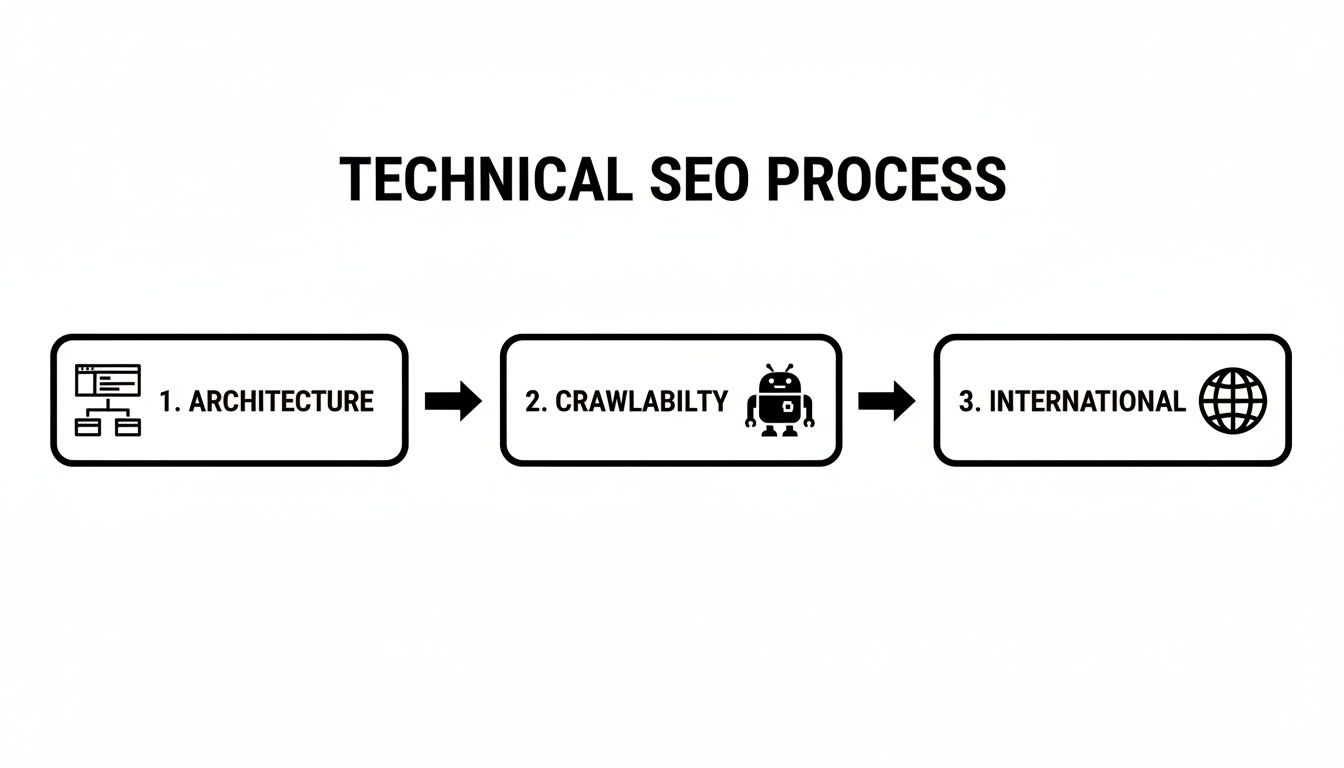
Your travel site's SEO success hinges on a solid technical foundation. This is the behind-the-scenes work that makes sure search engines can actually find, crawl, and make sense of all your amazing content. We're talking about a logical site architecture, managing the crawlability of potentially thousands of pages, and getting your international signals (like hreflang) right. If you skip this, even the most beautifully written travel guides will never see the light of day.
Building Your Technical SEO Foundation
Before you even start thinking about ranking for "luxury Bali villas" or "guided tours of Rome," you have to build the house your content will live in. A shaky technical foundation will sabotage every other marketing effort you make, rendering your site invisible to the very travelers you’re trying to reach. This isn't about becoming a master coder; it's about setting up a logical, accessible structure that both search engines and real people can navigate without a second thought.
Think of your website's architecture like a well-designed airport. Clear signs (your navigation), logical terminals (category pages), and direct pathways (internal links) get travelers to their gates (your booking pages) smoothly. A messy site is like a chaotic terminal with no signs—users get frustrated and leave, and search engine crawlers just get lost and give up.
Crafting a Scalable Site Architecture
Travel websites can balloon to thousands of pages in a hurry, so a scalable architecture isn't just nice to have—it's essential. A flat, organized structure usually works best. For a tour operator specializing in European travel, it might look something like this:
- Homepage -> Europe (Continent Page)
- Europe -> Italy (Country Page)
- Italy -> Tuscany (Region Page)
- Tuscany -> Florence Food Tour (Specific Tour/Product Page)
This kind of hierarchy creates clean, logical URL paths (like yourwebsite.com/europe/italy/florence-food-tour). It also helps pass link equity down from your broader, high-authority pages to the specific ones that drive conversions. Plus, it makes adding new destinations a breeze without needing to re-engineer your entire site.
This flow is critical. Each step builds on the last; without a solid structure, managing crawlability becomes a nightmare.
Mastering Crawlability and Indexing
Crawlability is all about letting search engine bots access your content. Indexing is the next step: getting that content into their database so it can actually show up in search results. A huge pitfall for large travel sites is accidentally creating "crawler traps"—think endless loops of paginated pages or faceted navigation filters that burn through your crawl budget on unimportant URLs.
Your
robots.txtfile is your first line of defense here. It tells search engine bots which parts of your site to ignore, like admin pages or duplicate internal search results. This saves your crawl budget for the pages that actually matter.
Make sure your XML sitemap is clean, up-to-date, and submitted to Google Search Console. It’s a direct roadmap you hand to search engines, pointing them straight to your most valuable pages. For new content, like a last-minute tour package or a new blog post, you can learn more about how to speed up website indexing to get it discovered faster.
Targeting Global Audiences with Hreflang
If you cater to travelers from different countries or who speak different languages, hreflang tags are non-negotiable. These simple HTML attributes tell Google which version of a page to serve to a user based on their language and location. For example, you can show a U.S. version of a tour page with prices in USD and a separate E.U. version with prices in EUR.
Getting hreflang right prevents tricky duplicate content issues and gives international visitors a much better experience by showing them the most relevant content. It’s a clear signal to Google that you have legitimate, alternate versions of your pages, not just cheap copies.
And on that note, remember that a more inclusive and higher-ranking site often comes down to the details. It's worth understanding how SEO and accessibility go hand-in-hand, as many of the technical elements overlap and work together to improve performance for everyone.
Crafting a Content Strategy That Actually Drives Bookings
A solid technical foundation gets your travel site on the playing field, but a killer content strategy is how you win. Let's be honest: content is the real engine for travel SEO. It's what pulls people in, builds your authority, and ultimately, drives the bookings that keep the lights on.
This means getting serious and moving past sporadic blog posts. We're talking about building a strategic content machine.
The goal is simple: become the go-to resource for travelers at every point in their journey. You need to be there for the initial "where should I go?" daydreaming just as much as the nitty-gritty "best hotel near the Eiffel Tower?" planning. Become their trusted guide, and they'll keep coming back.
The Pillar and Cluster Model: Your Content Blueprint
One of the most powerful ways to structure your content is the pillar and cluster model. I've seen this work wonders for travel sites because it helps both users and search engines see you as an expert on a destination. It’s a cornerstone of any effective travel SEO plan.
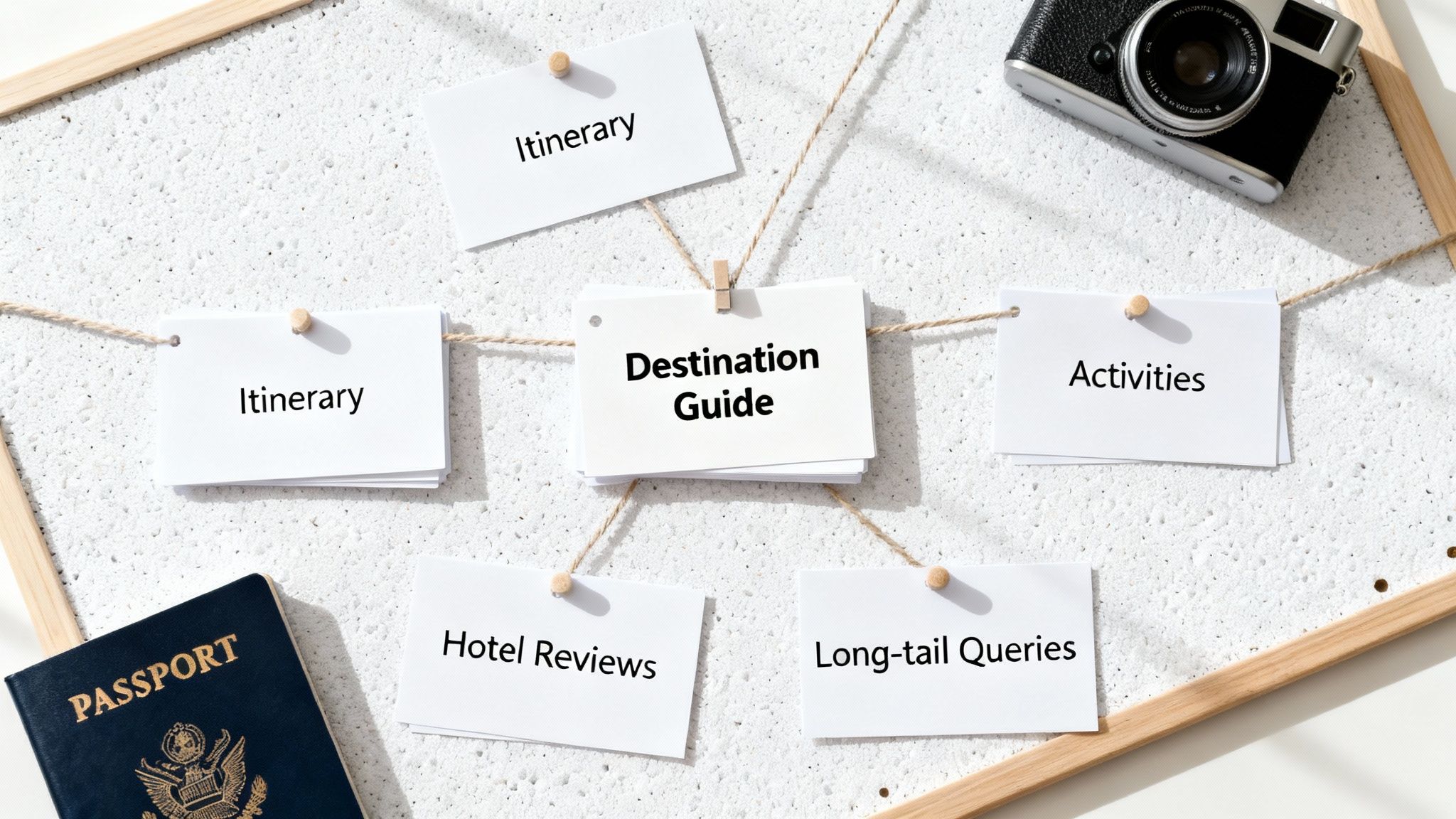
Here’s the breakdown: a pillar page is your massive, comprehensive guide to a broad topic—like a major city or country. The cluster content is made up of more specific, detailed articles that all link back to that main pillar.
Let's imagine you run a travel agency that specializes in Italy. Here's how it would look in practice:
Pillar Page: "The Ultimate Travel Guide to Italy"
- This isn't just a blog post; it's an epic, in-depth resource. It should cover everything from the best times to visit and getting around to regional food guides and cultural do's and don'ts. It's your central hub for all things Italy.
Cluster Content:
- "A 7-Day Food Lover's Itinerary for Tuscany"
- "Top 10 Boutique Hotels in Rome with Rooftop Bars"
- "Is the Colosseum Night Tour Worth It? A Detailed Review"
- "How to Navigate Italy's Train System Like a Local"
Each of these cluster articles takes a deep dive into one specific aspect. The magic happens with the linking. Every single cluster post must link back up to your main Italy pillar page. This signals to Google that you have a deep well of authoritative content on the subject, which helps your entire Italy-related content ecosystem rank better. If you want to get deeper into structuring these elements, our guide on what an SEO content strategy entails is a great next step.
Find Out What Travelers Actually Search For
Great content doesn't come from guesswork. It starts with understanding what real people are typing into Google. This means moving beyond the obvious, hyper-competitive keywords and digging for valuable long-tail queries.
Sure, "Paris hotels" is a keyword, but it's dominated by the giants. A long-tail keyword like "best family-friendly hotels in Le Marais Paris" is pure gold. The person searching for this is much further down the planning funnel and has a very clear intent. They are a highly qualified lead for your business.
Don't just guess what people are searching for. Use keyword research tools to uncover queries with decent search volume and manageable competition. Look for questions, comparisons, and location-specific searches that you can build content around.
The travel search world is brutally competitive. Organic search drives a staggering 40% of travel website revenue, but giants like Booking.com and Expedia gobble up 60% of top travel search results. This is why focusing on specific, long-tail keywords is your secret weapon to carve out a niche and attract motivated traffic.
Answering Questions Across the Entire Travel Funnel
A truly successful content strategy meets travelers wherever they are in their planning journey. You need content tailored to each distinct stage.
Top of Funnel (The "Dreaming" Stage): This is all about inspiration. Your content should answer broad questions and spark ideas. Think articles like "Best Tropical Destinations in December" or "Cheapest European Countries to Visit."
Middle of Funnel (The "Planning" Stage): They've picked a destination and are now sorting out the logistics. This is where your itineraries, "best things to do" lists, and guides on transportation or where to stay come into play.
Bottom of Funnel (The "Booking" Stage): They are ready to pull the trigger. Content here needs to be highly specific and commercially focused. This includes things like "Review of the XYZ All-Inclusive Resort" or "Comparing Tour Packages for Costa Rica."
By creating a healthy mix of content for each stage, you build a comprehensive resource that captures traffic from a huge range of queries. More importantly, you establish your brand as the go-to authority in your niche.
Optimizing For AI Search And Local Discovery
The way people plan travel has fundamentally changed. Gone are the days of sifting through ten blue links. Today, travelers are firing up AI-powered engines like Perplexity and leaning on Google’s Search Generative Experience (SGE) for quick, conversational answers. This isn't just a trend; it's a seismic shift that requires a whole new SEO playbook.
This new game is called Generative Engine Optimization (GEO). As AI becomes the go-to trip planner, "zero-click" searches are becoming the norm. Queries that used to return a list of websites now trigger a single, AI-generated summary. If your brand isn't featured in that summary, you're effectively invisible. More on this evolving SEO trend can be found on beaconpointhq.com.
To win here, you have to make what you offer crystal clear—not just to your customers, but to the machines that guide them.
Using Schema Markup To Speak AI’s Language
This is where structured data, or schema markup, becomes your secret weapon. It used to be a "nice-to-have" for getting a few fancy stars in the search results. Now, it's how you have a direct conversation with AI. By wrapping your content in specific schema, you're spoon-feeding search engines the exact details of your offerings.
For a travel website, this is an absolute goldmine. Instead of letting an AI guess the details of your "Florence Food Tour," you can spell it out with precision: this tour costs this much, lasts this long, and visits these specific places.
This turns your website's content from a block of text into a structured, queryable database that AI models love to pull from for their answers. Implementing it is non-negotiable for visibility in modern search.
We've put together a table of the most critical schema types you should be using. Think of this as your cheat sheet for telling search engines exactly what your pages are about, making it far more likely you'll get featured in those rich, AI-powered results.
Key Schema Types for Travel Websites
| Schema Type | What It's For | Key Properties to Include |
|---|---|---|
TouristAttraction |
Landmarks, museums, or natural wonders featured in your guides. | name, description, geo, photo, review |
Tour |
Specific guided tours you offer. | name, provider, itinerary, duration, price |
Flight |
For flight booking functionalities on your site. | flightNumber, departureAirport, arrivalAirport, airline |
Hotel |
All accommodation-related pages. | name, starRating, priceRange, amenityFeature, address |
Event |
One-off events like festivals or special local happenings. | name, startDate, endDate, location, performer |
By implementing these, you're not just optimizing a webpage; you're creating a machine-readable entry for every single product you offer. You can get more practical advice in our guide to optimizing your content for AI search.
Demonstrating E-E-A-T In The AI Era
Google's E-E-A-T framework—Experience, Expertise, Authoritativeness, and Trustworthiness—is more critical than ever. AI models are explicitly trained to find and prioritize information from sources that ooze credibility. To make the cut, you have to prove you know your stuff.
Show, don't just tell. An AI can scrape and summarize facts from a thousand websites, but it can't replicate your unique, on-the-ground experience. This is where you win.
So, how do you put your E-E-A-T on full display?
- Author Bios That Matter: Forget just a name. Create detailed bios for your writers and guides that showcase their years in the industry, specific destination expertise, and any relevant credentials.
- Real Customer Stories: Ditch the generic "Great tour!" testimonials. Feature detailed stories. "Our guide, Kenji, took us to a hidden temple in Kyoto we never would have found on our own..." is infinitely more powerful.
- Original Photos and Videos: Stop using stock photos. Nothing screams "I've actually been there" louder than your own unique, high-quality photos and videos from the trips you're selling.
Connecting AI Optimization With Local Discovery
While you're busy optimizing for globe-spanning AI engines, don't forget the power of local search. So many travel queries have local intent, especially from travelers already on the ground ("best restaurants near me," "last-minute tours in Rome").
Your Google Business Profile (GBP) is the anchor for your entire local strategy. A well-maintained profile is a direct data feed into Google Maps and the Local Pack—both of which are heavily featured in SGE results.
Make sure your GBP is dialed in:
- Rock-Solid Info: Your name, address, phone number (NAP), and hours must be 100% accurate and consistent across the web.
- List Your Wares: Use the "Products" and "Services" features to add your specific tours and packages directly to your profile. This makes your offerings visible at a glance.
- Engage, Engage, Engage: Actively ask for reviews and respond to every single one. Proactively answer questions in the Q&A section to build a resource for potential customers.
By weaving together robust schema, powerful E-E-A-T signals, and a meticulously managed local presence, you'll be perfectly positioned to capture valuable traffic from both broad AI queries and high-intent local searches.
Building Authority with Strategic Link Building
Content and technical SEO get you to the starting line, but in the cutthroat travel industry, real authority is what wins the race. Google measures that authority largely through your backlink profile. Think of backlinks as votes of confidence from other reputable sites. The more high-quality votes you get, the more Google sees you as a credible source, and the higher you'll climb in the rankings.
For a travel website, this isn't about chasing thousands of junk links. It’s about building a natural, trusted footprint through genuine relationships and creating content that's actually worth linking to. A single link from a national tourism board can easily be worth more than a hundred links from irrelevant blogs. Getting this right is a make-or-break part of any serious travel SEO campaign.
Forging High-Value Partnerships
Your most powerful links will almost always come from partners who are already established players in your niche. The trick is to think collaboratively, not just transactionally. Who can you team up with to create a true win-win?
Start by mapping out potential allies in the destinations you serve:
- Local Tourism Boards & CVBs: These groups are always hungry for quality content to show off their location. Offer to write a guest post for their blog about a unique local experience, or let them use your amazing photos in exchange for a credit and a link back to your site. It’s a simple, effective trade.
- Complementary Businesses: Team up with non-competing businesses that cater to the same travelers. If you sell tours, connect with boutique hotels, popular local restaurants, or car rental agencies. You can cross-promote each other’s services, which often leads to valuable, contextually relevant links.
- Influential Travel Bloggers: Find established travel bloggers with an engaged following. Offer them a complimentary tour or a free stay for an honest review and some coverage. This not only scores you a great link but also delivers powerful social proof from a trusted voice.
The foundation of modern link building is real relationships. Blasting out impersonal, templated emails is a complete waste of time. Personalize your outreach, show you've actually looked at their brand, and pitch a collaboration that gives them genuine value.
Creating Link-Worthy Digital PR Campaigns
Sometimes, the best way to get links is to create something so interesting that people can't help but talk about it and link to it. That's the essence of digital PR. For travel companies, your own data is often a hidden goldmine for these kinds of campaigns.
Instead of pumping out another generic "Top 10" list, dig into your internal booking data to tell a unique story. For example, you could publish a data-driven piece like:
- "The Rise of Solo Female Travel to Southeast Asia: Booking Trends from 2024"
- "Data Reveals the Most Underrated European Cities for Foodies"
- "How Remote Work is Reshaping Peak Travel Seasons in the Caribbean"
Journalists, bloggers, and industry publications love this kind of original research because it gives them fresh insights they can't find anywhere else. It instantly positions you as an expert and naturally attracts authoritative backlinks. To sharpen your approach, you can learn a lot from a deep dive into conducting competitor SEO research to see what's already earning links for others in your space.
By combining direct partnership outreach with creative digital PR, you build a backlink profile that's both robust and defensible. This strategy takes you beyond just optimizing pages and into the realm of building true online authority—an absolute must if you want to outrank the major OTAs and capture your piece of the travel market.
Turning Traffic into Bookings with Better UX
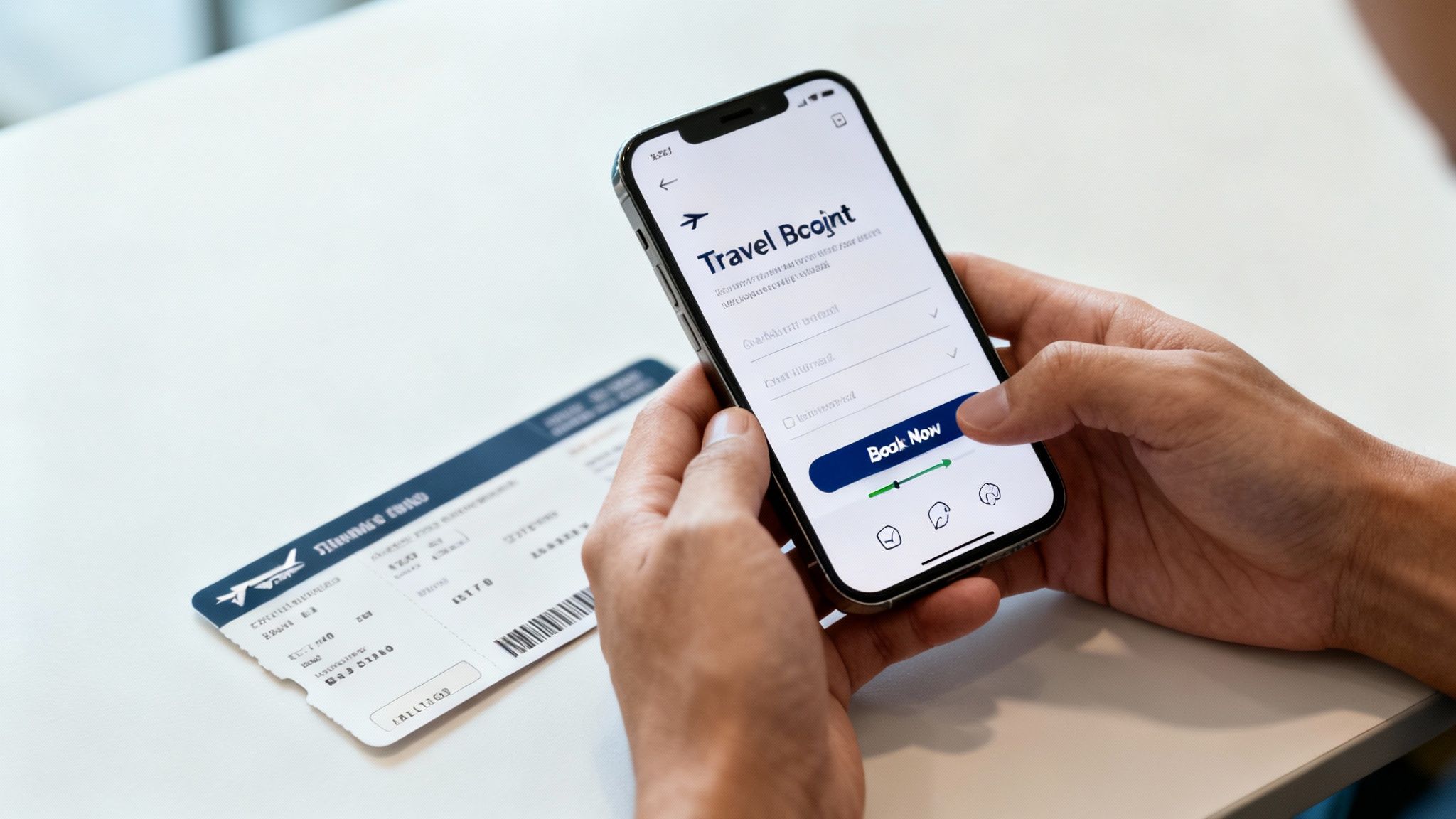
Getting visitors to your site with smart travel SEO is a massive win, but it’s only half the battle. The real goal isn't just traffic; it's turning those lookers into bookers. This is where user experience (UX) and site performance stop being technical afterthoughts and become core business drivers.
Think about it from your customer's shoes. They’re dreaming of their next vacation, they land on your site, and... the page takes forever to load. Or the booking form is a nightmare on their phone. That excitement instantly sours into frustration. They won’t wait. They’ll just hit the back button and book with a competitor whose site just works. A clunky website is the fastest way to lose a customer you worked so hard to attract.
Mastering Core Web Vitals for a Faster Site
Google’s Core Web Vitals (CWV) are more than just a ranking factor. They’re a set of metrics that measure the real-world experience a user has on your site, focusing on loading speed, interactivity, and visual stability. Getting them right isn't about pleasing Google; it's about delighting your visitors.
Here’s what you need to nail down:
- Largest Contentful Paint (LCP): How long does it take for the main event—usually that stunning hero image of a beach or city skyline—to appear? You need to aim for under 2.5 seconds.
- First Input Delay (FID): When someone clicks "Check Availability," how quickly does the site react? Anything over 100 milliseconds feels sluggish.
- Cumulative Layout Shift (CLS): Ever try to click a button, only for an ad to load and push it down, making you click the wrong thing? That’s CLS. It measures how much your page elements jump around while loading, and it’s incredibly annoying for users.
Fixing these often starts with the low-hanging fruit. Compress those beautiful, high-resolution destination photos. Use modern image formats like WebP, and implement lazy loading so images below the fold only load when a user actually scrolls to them. It makes a huge difference.
Removing Friction from the Booking Process
A lightning-fast site is fantastic, but if the path to purchase is a maze, you're still going to lose people. Your booking process needs to be seamless, intuitive, and dead simple. This is where you put proven conversion rate optimization best practices to work.
Your booking form should be a masterclass in simplicity. Ask only for what you absolutely need. Break the process into small, digestible chunks to avoid overwhelming the user—traveler details first, payment next, then confirmation.
The vast majority of travel planning and booking now happens on a phone. If your booking flow isn't flawless on a small touchscreen, you are actively turning away business. Test it. Test it again. Then have someone else test it.
Finally, make your calls-to-action (CTAs) impossible to miss. Use clear, direct language like "Book Your Tour Now" or "Reserve Your Room," not a vague "Submit." Make the buttons big, use a contrasting color, and place them where the user’s eye naturally goes. The user should never have to wonder what the next step is.
For a deeper look into optimizing these crucial actions, our guide on improving website conversion rates offers more great strategies. By combining a speedy site with a frictionless booking experience, you create a powerful engine for turning all that hard-earned organic traffic into real revenue.
Of course. Here is the rewritten section, crafted to sound like an experienced human expert and aligned with the provided style guide.
Common Questions About Travel SEO
When you're deep in the weeds of building a travel SEO strategy, a lot of questions pop up. It's totally normal. Whether you're launching a brand-new site or trying to breathe life into an old one, you're bound to hit a few roadblocks. Let's tackle some of the most common questions I hear from travel brands.
How Long Does It Take for SEO to Work?
This is the million-dollar question, and the honest-to-goodness answer is... it depends. I know, not what you wanted to hear, but it's the truth.
If you're starting from scratch with a brand-new website, you need to play the long game. Expect it to take a solid 6 to 12 months before you start seeing any meaningful, consistent traffic from Google. Search engines are cautious with new players; they need time to crawl your site, figure out what you're all about, and see if you're trustworthy.
But the story is different if you're working with an established site that already has some authority. A well-executed content cluster or fixing a nagging technical issue could start moving the needle in just a few weeks or a couple of months. Patience is your best friend here. SEO is a marathon, not a sprint.
What Is the Best Length for a Travel Blog Post?
There’s no magic word count that unlocks the top spot on Google, but the data is pretty clear: long-form content consistently wins, especially for those big, competitive travel keywords.
- For Pillar Content: For your massive destination guides, you should be aiming for 2,000+ words. These are the foundational pieces that prove your expertise and give you a fighting chance to rank for broad, high-traffic terms.
- For Cluster Content: When you're writing more specific articles like "7-Day Bali Itinerary" or "Best Boutique Hotels in Paris," a target of around 1,500 words is a great starting point. It gives you enough room to be genuinely helpful without turning into a novel.
The goal isn't just to hit a word count; it's to be the most comprehensive resource on the web for that specific query. A 3,000-word post that's full of fluff will get crushed by a laser-focused 1,500-word article that answers the user's question perfectly. Value over volume, always.
Is Local SEO Important for a Travel Website?
One hundred percent, yes. Even if you're selling bucket-list trips to Antarctica, local SEO is absolutely vital. Think about how travelers search. They're often looking for things with local intent, like "tours near me" on their phone or "best restaurants in downtown Rome" once they've already arrived.
Getting your Google Business Profile in order is non-negotiable. Make sure every detail is accurate, list your tours and packages as "Products," and stay on top of your reviews and the Q&A section. This is what gets you seen in Google Maps and the coveted "Local Pack," which is pure gold in travel search results.
Should I Focus on Keywords or User Experience?
This is a trick question. The real answer is you have to nail both. In the past, you could get away with one or the other, but modern SEO is all about that perfect marriage between satisfying search engine bots and delighting actual humans.
Keyword research is your map—it tells you what people are actually searching for. But user experience (UX) is the vehicle that gets them to their destination. If your site is slow, impossible to navigate on a phone, or has a clunky booking process, people will leave. And Google notices.
Signals like bounce rate and time on page are powerful indicators of user satisfaction. A terrible user experience will torpedo your rankings, no matter how perfectly you've optimized your keywords.
Ready to turn AI visibility insights into measurable growth for your travel brand? Sight AI is the platform that helps you get discovered across AI and search. Monitor mentions, find content gaps, and generate SEO-optimized articles effortlessly. See how it works at https://www.trysight.ai.