At its core, a keyword search is just the simple act of typing words or phrases into a search engine like Google or Bing to find something. It's the most fundamental way we interact with the internet—the bridge between a person with a question and a practically infinite library of answers.
Those words you type are a direct instruction, telling the search engine exactly what you're looking for.
Understanding Keyword Search in Plain English
Think of it like having a conversation with the world’s smartest librarian. You wouldn't just walk up and say, "Tell me everything you know." That's way too broad.
Instead, you’d be specific. "Show me books on ancient Roman history," or maybe, "Where can I find vegetarian lasagna recipes?" Those specific phrases are your keywords, and the librarian's response is the search results page.
This entire process feels instant, but behind the scenes, four distinct steps flash by in the blink of an eye. Each one builds on the last, transforming a simple thought into a curated list of relevant web pages. This isn't just about how we find information anymore; it's the engine that powers how businesses connect with their customers.
The Four Core Components
To really get what a keyword search is, let's trace its journey from a thought in someone's head to the results on their screen. This simple action is the starting point for almost everything we do online.
- The User’s Need: It all starts with a need—a problem to solve, a question to answer, or just plain curiosity. This could be anything from "how to fix a leaky faucet" to "best coffee shops near me."
- The Search Query: The user then translates that need into a tangible string of words, which we call the search query. This is the text they physically type (or speak) into the search bar.
- The Search Engine's Interpretation: Google's complex algorithms kick into high gear, analyzing the query to figure out the user's underlying search intent. It's looking for clues. Does the person want to learn something, buy something, or find a specific location? You can learn more about how search engines group related topics in our guide on what is keyword clustering.
- The Results Page (SERP): Finally, the engine delivers the Search Engine Results Page (SERP), which is its best guess at a ranked list of web pages that will satisfy the user's query.
This same fundamental process applies in other digital spaces, too. Just as SEO experts work to get websites discovered, mobile app developers use a similar approach in app stores. To see how these principles work elsewhere, it’s helpful to understand what is App Store Optimization (ASO).
This simple four-step cycle is the machine that drives trillions of searches every year, making it the single most important process to understand in the world of digital marketing.
The Journey From Simple Keywords to Smart Search
It might feel like keyword searches have been around forever, but they haven't always been this smart. Back in the early days of the internet, search engines were the Wild West—chaotic, clunky, and incredibly easy to game.
Marketers would just cram their pages with the same keywords over and over. This trick, known as keyword stuffing, was a blunt-force attempt to trick primitive search algorithms into ranking their site higher.
This strategy led to a terrible user experience, dumping people on irrelevant, low-quality pages. It was all a numbers game where keyword density mattered more than genuine value. The system was clearly broken, and the search engines knew it was time for a change.
The Shift Toward Quality and Intent
The real turning point came with major algorithm updates, especially Google's Panda update in 2011. This was a seismic shift. For the first time, Google started actively penalizing sites with thin, spammy content and those using manipulative tactics like keyword stuffing.
Suddenly, the game changed. The focus was no longer on matching keywords but on understanding and rewarding real quality. This was the moment search engines started to think.
They moved beyond just matching words and started digging into the user's true intent. The goal was no longer to just find pages with a specific keyword, but to deliver the most helpful, authoritative answer to the question behind the search. You can get a deeper look at how search engines understand context in our article on what is semantic SEO.
This evolution really highlights the journey of a keyword search, from a user's initial thought to the final results they see on the screen.
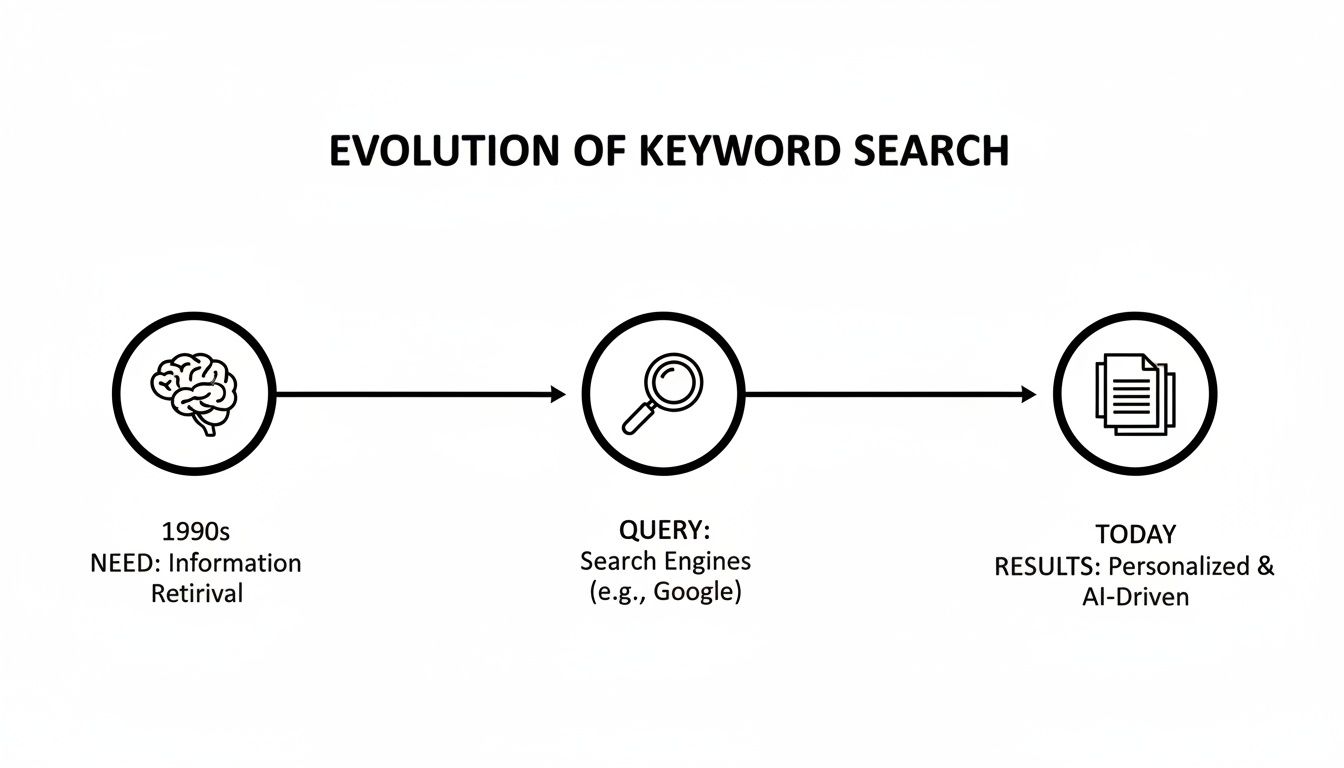
This visual breaks down how a person's abstract need gets translated into a specific query, which the search engine then has to interpret to pull up the right results.
The Explosive Growth of Search
The public’s appetite for this new way of finding information was insatiable. When Google Search first launched in September 1998, it was handling about 10,000 queries a day. Just one year later, that number had exploded to 3.5 million daily searches.
That's a staggering 17,000% increase that cemented keyword searching as the way to navigate the web. That growth never stopped. Today, Google processes over 1.2 trillion searches annually, proving the incredible staying power of this simple action.
Understanding this history is so important because it explains why modern SEO works the way it does. The journey from keyword stuffing to semantic understanding shows that search engines are constantly getting better at rewarding content that genuinely helps people.
This history reveals a fundamental truth about modern SEO: it’s no longer about trying to trick a machine. It's about aligning your content with the search engine's core mission of satisfying the user.
Keyword Search vs. Keyword Research: A Marketer's Guide
Even though "keyword search" and "keyword research" sound nearly identical, they represent two totally different sides of the SEO coin. It's a common mix-up, but getting the distinction right is the bedrock of any successful content strategy.
A keyword search is simply what a user does. It's the act of typing a phrase into Google to find an answer, a product, or a local service. This is the starting point—the raw, unfiltered demand coming directly from your potential audience.
Keyword research, on the other hand, is the strategic deep dive a marketer takes. It’s all about analyzing those user searches to spot opportunities, figure out what an audience really wants, and build a data-backed plan for creating content that meets that demand head-on.
The User vs. The Strategist
Let's put it this way: a customer walking into a coffee shop and ordering a "large iced latte" is performing a keyword search. They have a specific, immediate need and they're using a few key words to get it.
The coffee shop owner who digs into months of sales data to see that "iced lattes" are their top-selling drink, especially on warm days, is doing keyword research. They use that data to stock up on milk and espresso, train their baristas, and maybe even run a special promotion to capitalize on that customer demand.
One is an action driven by immediate need; the other is a strategic analysis designed to anticipate and meet that need at scale. The user asks the question, and the researcher builds the answer.
This is the fundamental split that separates just watching what happens from actively making something happen. One is a single event, the other is a continuous process of discovery and fine-tuning. For a deeper dive, check out our in-depth guide on how to do effective keyword research for organic SEO.
Keyword Search vs. Keyword Research At a Glance
To make the distinction crystal clear, let's break down the core differences between what the user does and what the marketer does. This table lays it all out, highlighting the unique purpose, actor, and outcome for each.
| Aspect | Keyword Search (The User's Action) | Keyword Research (The Marketer's Process) |
|---|---|---|
| Who Does It | The end-user, customer, or reader. | The SEO specialist, content marketer, or business owner. |
| Primary Goal | To find an immediate answer, solution, or resource. | To uncover content opportunities and understand market demand. |
| The Outcome | A list of search results (SERP) that satisfies a query. | A strategic plan and a prioritized list of target keywords. |
| The Mindset | Reactive and driven by a specific, current need. | Proactive and focused on long-term growth and visibility. |
Ultimately, a marketer’s job is to master keyword research to create content that perfectly lines up with what users are looking for when they perform a keyword search. The two concepts are deeply connected, but knowing which hat you're wearing is the first step toward creating content that actually ranks.
The Modern Toolkit for Mastering Keyword Strategy

Alright, let's move from theory to practice. You can't execute a killer keyword strategy without the right gear. Thankfully, there's a whole arsenal of tools out there to help you turn raw search data into a winning content plan. These range from completely free starting points to powerful, all-in-one suites that give you an incredible depth of insight.
For those just dipping their toes in, tools like Google Trends and Google Keyword Planner are your entry point. They’re fantastic for gauging public interest in a topic and getting a rough estimate of search volume. Think of them as your initial brainstorming buddies—perfect for validating a broad idea without spending a dime.
But to really compete, you'll need to graduate to the heavy hitters.
Diving Deeper with Advanced SEO Platforms
This is where the real magic happens. Comprehensive SEO platforms are the workhorses of any serious marketer. They don't just show you basic search numbers; they peel back the curtain on the entire search landscape, revealing keyword difficulty, competitor performance, and backlink data.
Three of the most trusted names in the game are:
- Ahrefs: Famous for its massive backlink index and incredibly detailed competitor analysis features.
- SEMrush: An all-encompassing toolkit that covers everything from SEO and content to paid ads and social media.
- Moz Pro: A super user-friendly option with solid keyword research tools and its well-known "Domain Authority" metric.
These platforms let you reverse-engineer what’s already working for your rivals. You can pinpoint the exact keywords they rank for, spot glaring gaps in their content strategy, and uncover those juicy, high-intent long-tail keywords they might have missed. It’s a data-driven approach that takes all the guesswork out of what to write next.
The real power of these tools is context. They don’t just tell you what people are searching for. They show you how hard it will be to rank for that term and exactly who you'll be up against.
The Rise of AI in Keyword Analysis
Artificial intelligence is adding a whole new dimension to keyword strategy. AI doesn’t just look at past search data; it helps you see around the corner by analyzing how people interact with large language models like ChatGPT and Gemini. This is opening up completely new ways to find content ideas.
We're now seeing platforms emerge that track how brands and topics get mentioned inside AI-generated answers. This is huge. It means you can see the questions people are asking AI and figure out how to become a cited source in those responses. This is the next frontier for anyone trying to understand the full scope of a modern what is a keyword search analysis. The best AI search optimization tools are already changing the game in this area.
And don't forget the power of looking back. Since 2006, tools like SpyFu have been archiving ranking history, giving us over 18 years of performance data. This historical context is an absolute goldmine. It lets you trace the evolution from PageRank's simple keyword matching in 1998 to Hummingbird's semantic shift in 2013, all while Google's query volume exploded to 100 billion per month by 2012. You can learn more about how to explore this ranking history on SpyFu's site.
Building a Keyword Strategy That Actually Wins

A winning keyword strategy isn't about chasing a magic list of terms. It’s about building a smart, sustainable framework for your content. The old days of just targeting the highest-volume keywords you could find are long gone.
Today, success means understanding the entire customer journey and creating content that meets people's needs at every single stage. This requires a big shift away from the narrow, exact-match mindset of the past.
Instead of only focusing on "best running shoes," a modern strategy looks at the whole ecosystem of related searches. What questions do people ask before they're ready to buy? What products do they compare? The goal isn't just to match their words; it's to answer their underlying needs.
This is where building topic clusters comes into play, and it’s a total game-changer.
Establish Authority with Topic Clusters
Think of a topic cluster like a mind map for your website. In the center, you have your main "pillar" topic—a big, broad subject you want to own, like "digital marketing."
From that central pillar, you create multiple "cluster" articles that dive deep into specific subtopics. These could be things like "email marketing tactics" or "social media analytics." Each of these cluster articles links back to your main pillar page, creating a powerful, interconnected web of content.
This structure does something amazing: it signals to search engines that you have deep expertise on the subject. This helps you build authority and rank for a much wider range of related terms. Our complete guide shows you how to build an effective SEO keyword strategy using this exact model.
Prioritizing quality over quantity is the foundation of this approach. It’s a lesson many learned the hard way. Before Google's Panda update in 2011, it was common practice to manipulate rankings with keyword stuffing—in fact, over 75% of websites were doing it.
Panda completely changed the game. It penalized thin, low-quality content, affecting a staggering 12% of all search queries and causing traffic for some sites to plummet by up to 90%.
Target High-Intent Traffic with Long-Tail Keywords
Broad keywords might have huge search volumes, but they also come with insane competition and pretty vague user intent. That’s why long-tail keywords are the secret weapon for any savvy marketer.
These are longer, more specific phrases that people use when they're much closer to making a decision.
A person searching for "shoes" is just browsing. But someone searching for "women's waterproof trail running shoes size 8" is ready to buy.
Targeting these super-specific phrases attracts visitors who are way further down the buying funnel. While each one has a lower search volume, the combined traffic from all your long-tail keywords can be massive. More importantly, this traffic converts at a much higher rate.
Basing your strategy around these high-intent terms is how you turn search traffic into real, measurable business growth.
Got Questions About Keyword Search? We've Got Answers.
Even after you get the hang of the basics, a few specific questions always seem to pop up once you start putting keyword concepts into practice. Let's clear up some of the most common ones so you can build your strategy with total confidence.
Think of this as your go-to spot for quick, straightforward answers to navigate all the little details.
What Is the Difference Between a Keyword and a Search Query?
People throw these terms around interchangeably all the time, but there's a subtle yet important difference. A keyword is the specific term or phrase you, as a marketer, decide to target. It's a strategic asset in your content plan.
A search query, on the other hand, is the exact string of words a real person types into a search engine. It's often messy, conversational, and completely unfiltered.
For example, your team might target the keyword "best running shoes." But the actual search queries people use to find that information could be all over the map:
- "what are the best shoes for running a marathon"
- "nike vs adidas running shoes for flat feet"
- "most comfortable running shoes 2024"
Getting a handle on all the different search queries related to your target keyword is how you create truly comprehensive content that answers user needs from every possible angle.
How Does Search Intent Affect My Keyword Strategy?
Search intent is the "why" behind what someone types into that search bar, and honestly, it's one of the most critical factors in modern SEO. If your content doesn't align with the user's goal, you simply won't rank. It's non-negotiable.
There are four main types of search intent you'll run into:
- Informational: The user just wants to know something ("how to bake bread").
- Navigational: The user is trying to get to a specific website ("YouTube login").
- Transactional: The user has their wallet out and is ready to buy ("buy iPhone 15 case").
- Commercial Investigation: The user is in research mode, comparing options before a purchase ("best 4k tv under 500").
Imagine you target a keyword like "buy iPhone 15" (clearly transactional intent) but create a blog post about the history of Apple. That page is destined to fail. It's a complete mismatch with the user's goal, which creates a bad experience and gives you almost no chance of ranking.
Are Keywords Still Important with the Rise of AI Search?
Yes, one hundred percent. While AI-powered search features like Google's AI Overviews are designed to give direct answers, they still have to understand the core topics and keywords in a user's question to function. Keywords aren't dead; they're just evolving.
Your strategy now needs to get a little bigger. It has to include the kinds of questions and long-tail phrases that AI models are likely to pull from. The new game is to make your content so authoritative and crystal-clear that it gets cited as a source inside those AI-generated summaries.
AI visibility platforms are quickly becoming essential. They help businesses see exactly how they're being mentioned in AI answers for their most important keywords. This makes tracking keyword performance more important than ever in this new era of search.
The fundamental rule hasn't changed: be the most helpful and trusted source of information, whether it's for a traditional search engine or a new AI model.
How Often Should I Revisit My Keyword Research?
Keyword research is definitely not a "set it and forget it" activity. Think of it as a living, breathing part of your strategy that needs regular check-ins to stay effective.
You should always do a massive deep dive when you're launching a new website or a big content project. After that initial push, it's smart to review your keyword strategy quarterly, or at the very least, twice a year.
Markets change. Search trends come and go, new competitors pop up, and your own business goals will shift. By regularly analyzing what's working, finding new opportunities, and trimming the fat from underperforming terms, you keep your SEO efforts sharp and perfectly aligned with what your audience is looking for right now.
At Sight AI, we help you move beyond just tracking keywords. Our platform monitors how your brand is mentioned across leading AI models like ChatGPT and Gemini, turning visibility insights into a data-driven content strategy. We surface the exact questions your audience is asking and use specialized AI agents to create high-quality, SEO-optimized articles that get you discovered. Learn how Sight AI can build your AI visibility and drive organic growth.