A thought leadership strategy is really about one thing: building authority and trust by consistently putting out expert, insightful content that solves your audience's biggest headaches. It’s a shift away from old-school marketing. Instead of just talking about yourself, you focus on providing genuine value and a unique perspective, making your brand the go-to resource in your field.
Why Thought Leadership Is Your New Sales Team

Let's be real: the term "thought leadership" gets thrown around a lot, often bringing to mind generic blog posts and recycled ideas. But when you get it right, it’s not just a branding exercise—it's one of the most powerful engines for B2B growth you can have.
Think of it as your invisible salesperson, working around the clock. It builds trust and credibility with potential clients long before they ever think about contacting you.
In a market flooded with look-alike solutions, decision-makers are completely numb to sales pitches. What are they doing instead? They're actively hunting for deep, insightful content to vet potential partners. They want to see how you think, how you solve problems, and if you truly get the nuanced challenges of their industry. This is where your thought leadership strategy becomes your secret weapon.
Building Trust Before the First Call
Let's walk through a real-world scenario. A fast-growing SaaS company is looking at two project management software providers. Provider A floods their inbox with demo requests and feature lists. Provider B, on the other hand, has been consistently publishing in-depth articles that break down workflow inefficiencies specific to the SaaS world, offering up actionable frameworks to fix them.
The decision-makers at the SaaS company have been reading these articles for months. They've shared them internally and have even started implementing some of the ideas. By the time they're actually ready to buy, Provider B isn't just another vendor; they're a trusted advisor. The sale is already halfway made because the content did all the heavy lifting of establishing expertise and building a relationship.
Thought leadership is your chance to answer a prospect's unasked questions and prove your value before they ever raise their hand. It shifts the entire dynamic from "selling to" them to "partnering with" them.
The Data Behind the Strategy
This move from traditional marketing to trust-based education isn't just a gut feeling; it's a documented shift in how people buy. Between 2018 and 2024, thought leadership went from being a niche PR play to a core pillar of B2B strategy.
Recent findings show that a staggering 73% of decision-makers believe a company's thought leadership is a more trustworthy indicator of its capabilities than its own marketing materials. Even more telling, two-thirds of C-suite executives admitted they've reconsidered a current supplier after reading a competitor’s powerful thought leadership piece.
This means your content isn't just for building brand awareness anymore—it's a direct driver of high-stakes business decisions. You can learn more about the crucial role of brand perception in our guide on why brand awareness is important.
Ultimately, a strong thought leadership strategy accomplishes two critical things:
- It educates and empowers: You give your audience the tools and insights to solve their problems, which builds incredible goodwill.
- It qualifies and persuades: You showcase your unique expertise, making your company the obvious and logical choice when it's time to make a purchase.
Defining Your Audience and Content Pillars
A real thought leadership strategy isn't built on guesswork or chasing trends. Before you even think about writing, you need a rock-solid foundation. It all comes down to two things: knowing exactly who you're talking to and defining the core themes you want to own.
This is the part where you stop throwing content at the wall to see what sticks. Instead, you start methodically building a library of expertise that pulls in the right people, keeps them engaged, and ultimately, helps them see you as the solution. It’s the difference between being another voice in the crowd and becoming the go-to authority.
Go Deeper Than Demographics
Defining your audience has to go way beyond just job titles and company size. While that stuff gives you a starting point, the real gold is in their psychographics—their ambitions, their frustrations, what actually motivates them. You need to get to the heart of the problems that keep them up at night.
What are they secretly Googling at 10 PM on a Tuesday? What kind of pressure are they getting from their boss or the board? A vague persona like "Marketing Manager" is totally useless. But a persona like, "Marketing Manager at a B2B SaaS startup who's struggling to prove content ROI to a skeptical CEO"? Now that is a goldmine for content ideas.
To get this kind of detail, you have to do the legwork:
- Interview your best customers: Don't just ask about your product. Ask them what podcasts they never miss, which newsletters they actually read, and what finally pushed them to look for a solution like yours in the first place.
- Talk to your sales team: These folks are on the front lines every single day. They hear the raw, unfiltered objections and pain points straight from the source. Their insights are invaluable.
- Lurk in online communities: Spend time in the LinkedIn groups, Slack channels, Reddit threads, and industry forums where your audience hangs out. Pay attention to the exact language they use and the questions that pop up over and over again.
This isn't just a one-and-done task. Think of it as an ongoing conversation that keeps your content strategy firmly planted in the real world, ensuring every single piece you create actually lands with impact.
Translate Audience Insights into Content Pillars
Once you have a crystal-clear picture of your audience, it’s time to translate their challenges into your core content pillars. These are not just blog categories. They are the 3-5 strategic themes your brand is going to be known for. Think of them as the major highways on your content map—broad enough to house plenty of specific topics, but focused enough to signal your deep expertise.
For a company like Sight AI, which is all about AI and search visibility, our pillars might look something like this:
- AI Visibility Strategy
- Authoritative Content Production
- Content Performance Measurement
See how each pillar speaks directly to a major challenge our target audience (like SEO managers and content marketers) faces? And, just as importantly, they all tie back perfectly to what our product does. This is how you make sure your content serves your audience and your business.
The screenshot below from Semrush shows this idea in action. It’s a great visual of how a central pillar page anchors a whole ecosystem of related content.
This structure does two things brilliantly: it establishes topical authority for search engines and creates a logical, helpful journey for your readers.
Your content pillars are the promise you make to your audience. They set the expectation that if they have a problem in one of these areas, you are the most credible source for the solution.
Aligning Pillars with Business Objectives
The final gut check for your content pillars is making sure they connect directly back to your business. Ask yourself this critical question: "If we become the absolute best resource for this topic, will it naturally lead ideal customers to our product or service?"
The answer has to be a firm "yes."
This alignment is what saves you from creating content that, while maybe interesting, only brings in traffic from people who will never, ever become customers. For a deeper look at building out this structure, our guide on what a pillar page is breaks down the framework for organizing your expertise.
To really drive this home, let's look at the difference between a scattergun content approach and a focused, pillar-based strategy.
Generic Content vs. Pillar-Based Strategy
| Aspect | Generic Content Approach | Pillar-Based Strategy |
|---|---|---|
| Topic Selection | Chases trending keywords and random ideas. | Focuses on topics that support core pillars. |
| Audience | Attracts a broad, unfocused audience. | Attracts a specific, high-intent audience. |
| Authority | Remains a generalist; "jack of all trades." | Builds deep expertise and becomes an authority. |
| Business Impact | Generates vanity metrics (e.g., traffic). | Drives qualified leads and sales opportunities. |
The contrast is pretty stark. One approach feels like shouting into the void, while the other is about building a powerful magnet for your ideal customers.
By meticulously defining your audience and building out these strategic pillars, you create a powerful filter for every content decision you make. You stop being just a content creator and become a strategic publisher, building a valuable asset that drives real, sustainable growth.
Building an AI-Powered Idea Engine
Great ideas for your thought leadership content don't just appear in a conference room brainstorm; they’re uncovered with data. For too long, content strategy has relied on gut feelings, which is a surefire way to create content that completely misses the mark. The modern playbook involves building a powerful idea engine, one that uses AI to discover what your audience is actually asking search engines and AI assistants.
This simple shift changes the game. You move from guessing what your prospects want to knowing what they need. By digging into search queries, competitor content, and online discussions, you can pinpoint the nuanced, high-intent questions that signal someone is deep in the buying cycle. This is how you build a backlog of validated topics that perfectly support your content pillars.
Tapping into Audience Intent with AI
Your first move is to use AI to listen at scale. Forget spending days on manual keyword research. AI platforms can tear through thousands of search queries, forum discussions, and competitor articles in minutes. This process uncovers the precise language your audience uses and, more importantly, the intent hiding behind their searches.
Think of it this way: a prospect searching "what is CRM" is in a totally different stage than someone searching "HubSpot vs Salesforce integration for B2B SaaS." The second query screams sophistication and purchase intent. AI tools are brilliant at flagging these high-value, long-tail questions that your sales team would kill to answer.
- Analyze Competitor Gaps: Point an AI tool at top-ranking articles for your core topics. It can instantly show you which questions competitors failed to answer or what angles they completely overlooked.
- Monitor "People Also Ask": These little sections in search results are an absolute goldmine. AI can aggregate this data across hundreds of queries, revealing the most common follow-up questions tied to your expertise.
- Track AI Assistant Queries: This is the new frontier. Understanding what users ask AI assistants like ChatGPT and Gemini is critical. Specialized platforms can show you how these models talk about your industry and competitors, revealing some incredible content opportunities.
Validating Topics Before You Write
Once you have a list of potential ideas, you need to validate them. Not every question warrants a 3,000-word deep dive. The goal is to prioritize topics that have a clear line back to your business goals and show real audience interest.
This is where you blend AI insights with human strategy. Let the data show you search volume and trends, but use your own expertise to gauge the strategic value of owning a particular conversation. A topic with lower search volume might be incredibly valuable if it's a question only C-suite executives are asking.
The goal is to build a content backlog where every single topic has a data-backed reason to exist. This ensures that every piece you create directly addresses a proven market need, positioning you as the definitive authority.
The link between a thought leadership content strategy and AI is becoming unbreakable. While 40% of marketers plan to increase their investment in AI for content optimization, the real advantage comes from using it to find and answer these high-intent questions. For platforms monitoring how AI assistants describe brands, companies that consistently publish authoritative, long-form thought leadership are far more likely to be cited and recommended.
Creating Your Idea Backlog
With a list of validated topics, it’s time to get organized. This isn't just a spreadsheet; it's a dynamic roadmap for your entire content operation. For a deeper look at the mechanics, check out our guide on streamlining content creation with AI.
Your backlog should track a few key details for each topic:
- Primary Target Keyword: The main search query you're going after.
- Associated Content Pillar: Which of your core themes does this support?
- Audience Intent: Is the user trying to learn, compare, or buy?
- Proposed Title: A working headline that nails the core idea.
- Priority Level: How critical is this topic to your business goals right now?
This system flips your content process from reactive to proactive. No more scrambling for ideas each month. Instead, you’ll have a validated queue of topics just waiting for your team. To really get the most out of your new idea engine, explore how AI can help us be more creative and act as a powerful collaborator. This approach makes sure every article is a strategic asset designed to attract, engage, and convert your ideal customer.
Scaling High-Quality Content Production
Let's be honest. The hardest part of any thought leadership strategy isn't brainstorming ideas—it’s the relentless grind of producing in-depth, high-quality content over and over again. If you really want to scale, you need a workflow that lets you create those high-impact, long-form articles without completely torching your team.
This means moving past the old-school, writer-centric model. It's time to embrace a more structured, almost assembly-line approach. By breaking the process down and smartly weaving in AI, you can build a true content engine that ramps up your output while making every single piece more authoritative.
Adopting The Producer And Talent Model
Think about your content creation process like you’re making a movie. You have a "Producer" (your content lead or strategist) who orchestrates the entire workflow, and you have "Talent" (your subject matter experts) whose time is gold, reserved only for high-value input.
The Producer handles all the operational heavy lifting: the keyword research, SERP analysis, crafting detailed briefs, and juggling the editorial calendar. The Talent’s job is to inject the magic—the unique insights, personal stories, and strategic thinking that AI simply can't fake. This division of labor frees up your experts from tasks that don’t require their specific genius.
This model is a direct answer to a huge shift happening right now. High-quality thought leadership is winning budget battles over high-volume blogging. In fact, 83% of marketers now believe it’s more effective to publish better content less often. The catch? Only 47% of B2B marketers actually have a documented strategy. With 85% of marketers already using AI, the real way to stand out is the depth of insight you bring to the table.
A Five-Stage Production Workflow
A scalable workflow breaks the marathon of content creation into manageable sprints, each with a clear owner and goal. This system stops bottlenecks before they start and keeps your quality consistent.
Brief Creation: The Producer builds an exhaustive content brief. This is way more than a topic and a keyword; it's the article's blueprint. It should include the target audience, key questions to answer, a proposed outline, internal linking opportunities, and a look at what competitors are doing.
AI-Assisted First Draft: Using that super-detailed brief as a prompt, an AI writing assistant generates the initial draft. This step handles about 70-80% of the foundational writing, getting the structure down and populating it with the initial research. To see how this works in practice, you can learn how to automate your content marketing workflow.
Expert Review and Enhancement: The AI-generated draft lands with your subject matter expert. Their mission isn't to write from scratch but to enrich what's there. They add their unique perspectives, challenge common industry assumptions, and weave in real-world stories that prove they know their stuff.
SEO and Editorial Polish: From the expert, the draft goes to an editor or SEO specialist. They'll sharpen the language for clarity and tone, optimize all the on-page SEO elements (headings, meta descriptions, image alt text), and make sure the whole piece flows perfectly.
Final Review and Publication: The Producer does one last check before hitting publish and kicking off the distribution plan.
This workflow is laid out in the process flow below, showing how AI helps analyze the landscape, identify the best ideas, and create the foundational content.
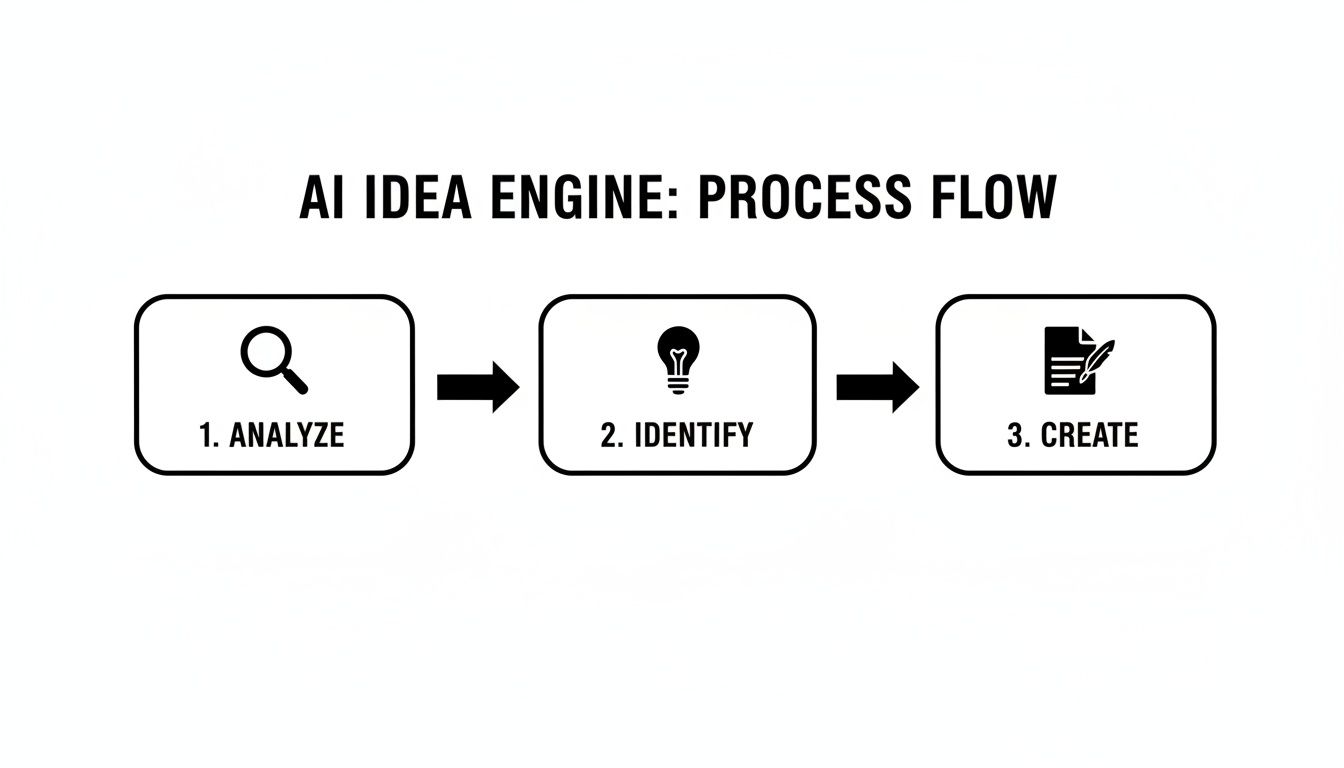
This structured system turns content creation from a chaotic art form into a repeatable science, letting your team scale output without ever compromising on quality.
Optimizing And Repurposing Your Core Assets
Pouring your resources into a 3,000-word pillar article is a major investment. Its job isn't over the moment you publish it. Scaling your thought leadership content strategy is all about squeezing every last drop of value from each core asset you create.
True content scaling isn’t just about producing more; it’s about getting more mileage from what you’ve already produced. One pillar article should fuel an entire ecosystem of micro-content.
Here are just a few ways to extend the life and reach of your big-ticket content:
- Social Media Threads: Carve out the key arguments into a punchy, must-read thread for LinkedIn or X.
- Short-Form Video Scripts: Every major heading in your article is a ready-made script for a 60-second video for TikTok or YouTube Shorts.
- Webinar Outlines: That comprehensive article is the perfect skeleton for a deep-dive webinar, where you can engage your audience with a live Q&A.
- Newsletter Content: Pull out key takeaways or compelling excerpts for your email newsletter to drive your subscribers back to the full piece.
To really get efficient with this, you can even explore tools that help you repurpose existing blog content into dynamic Instagram Reels. When you build a system that not only produces but also repurposes, you create a content engine that works smarter, not just harder.
Distributing Your Content for Maximum Impact

Let's be honest. Pouring your soul into a brilliant piece of content only to have it sit there collecting digital dust is a gut-wrenching feeling. It's a massive waste of time, expertise, and resources. The hard truth is that creation is only half the battle. A truly effective thought leadership content strategy lives and dies by its distribution plan.
The old "publish and pray" method is a recipe for failure. To get your expertise in front of the right people, you need a repeatable, multi-channel system designed to amplify your message. This is what turns your content from a static asset into an active force that reaches, engages, and influences your audience, wherever they happen to be.
Building Your Multi-Channel Amplification Engine
A smart distribution strategy isn't about being everywhere at once; it's about using different channels for different jobs. By blending owned, earned, and paid media, you create a powerful flywheel where each channel feeds and strengthens the others.
Owned Channels: These are the platforms you own and operate. Think of your email newsletter, the company blog, and your corporate social media profiles. You use these to engage your loyal followers and point them directly to your new pillar content.
Earned Channels: This is where digital PR comes into play. It’s all about getting your content featured or mentioned by others—industry publications, respected influencers, or other experts in your field. Earned media is gold for building credibility and reaching entirely new audiences.
Paid Channels: When you absolutely need to guarantee reach and nail a specific demographic, paid promotion is the way to go. This could be anything from LinkedIn ads to targeted placements that put your content squarely in front of high-value prospects.
Imagine it playing out: you announce your new article to your dedicated newsletter list (owned), pitch a few industry bloggers with a unique angle for a feature (earned), and run a hyper-targeted ad campaign to C-suite executives in your key verticals (paid). Each move amplifies the others, creating a genuine wave of visibility.
The Power of Strategic Content Repurposing
Scaling your impact isn't about burning yourself out creating more, more, more. It's about getting more mileage out of what you’ve already poured so much effort into. Your in-depth pillar articles are absolute goldmines that can be sliced, diced, and repackaged into dozens of smaller assets for different platforms.
This "create once, distribute forever" mindset is the key to a sustainable thought leadership strategy. It honors the work that goes into your core pieces and makes them work tirelessly for your brand.
Your pillar article should be the sun in your content solar system. Every repurposed piece—from a social media post to a video—is a planet orbiting it, drawing new audiences back to the source of authority.
Here’s how one beefy, 3,000-word article can fuel your content calendar for weeks on end:
Create a LinkedIn Thread: Pull out the 3-5 most compelling arguments or takeaways. Turn each one into a punchy, standalone post within a thread, using the final post to link back to the full article for the deep dive.
Develop a Webinar Outline: The main sections of your article are practically a ready-made blueprint for an engaging webinar. This format is perfect for interacting directly with your audience through a live Q&A.
Produce Short-Form Videos: Find the most surprising stats, actionable tips, or "aha" moments. Each one can be the script for a 60-second video for TikTok, YouTube Shorts, or Instagram Reels.
Design a Visual Infographic: Condense the core data, framework, or process from your article into a slick, shareable infographic. It’s perfect for platforms like Pinterest and can be easily embedded in other posts.
Repurposing allows you to meet people where they are. Some love a long read, others want a quick video, and many prefer to scan a visual. This approach makes sure your core message connects with the widest possible segment of your audience.
Executing Targeted Outreach for Earned Media
While your owned channels are your home base, earned media is how you break into new circles and build that priceless third-party validation. This calls for a thoughtful, personalized outreach strategy—not a generic email blast to a list you bought.
Start by identifying relevant publications, podcasts, or influencers whose audience is a dead ringer for yours. When you reach out, lead with value. Don't just ask for a link. Explain how your content offers a fresh take on a topic they’ve already covered or solves a specific problem their audience wrestles with.
This methodical approach to distribution is the final, crucial step. It’s what transforms your content from a static document into a dynamic tool for building your brand and growing your audience. It's how your thought leadership actually starts to lead.
Measuring Success and Refining Your Strategy
Pushing great content out the door is one thing. Knowing if it's actually working is another game entirely. A killer thought leadership strategy isn't just about creating; it's about a relentless focus on performance and a willingness to adapt. If you're not measuring, you're just guessing—and you can't tell the difference between content that builds real authority and assets that just fall flat.
It's time to stop chasing vanity metrics like page views and start connecting your content efforts to real, tangible business results. The right key performance indicators (KPIs) are your compass, telling you exactly what’s resonating and what isn't.
Identifying Your Core KPIs
Don't drown yourself in data. Instead, lock in on a handful of metrics that directly tie back to your business goals. For most B2B companies, these KPIs tend to fall into three main buckets.
Audience Engagement and Authority: This is so much more than traffic. Are people actually sticking around? Look at metrics like time on page for your core pillar articles, the number of newsletter sign-ups your content is driving, and how many high-quality backlinks you’re earning. These are signs you're not just getting clicks—you're capturing attention.
Search Visibility and Rankings: Keep a close eye on your organic rankings for the valuable, long-tail keywords you're targeting. Are you climbing the search results for the very questions your ideal customers are asking? A steady increase in organic traffic to your main content pillars is one of the strongest leading indicators of success you can have.
Business Impact: This is where the rubber meets the road. You need to be tracking the marketing-qualified leads (MQLs) generated from content downloads, demo requests coming from your blog, and, most importantly, the new sales opportunities you can trace directly back to your thought leadership.
A winning strategy is defined by its ability to generate qualified conversations, not just clicks. The ultimate measure of success is whether your content is helping your sales team close more deals, faster.
Establishing a Quarterly Review Process
Your market isn't static, and neither is your audience. That means your strategy can't be either. Setting up a quarterly review is your non-negotiable ritual for refining your approach and making sure your efforts compound over time. During this review, you'll dive into your performance data to answer some hard questions. We've got a whole framework for this in our guide on measuring your content marketing ROI.
These regular check-ins are your chance to double down on what’s working and cut what’s not. Maybe one content pillar is blowing the others out of the water, or a specific format is driving insane engagement. Use those insights to tweak your content calendar, sharpen your distribution tactics, and continuously level up your thought leadership for the long haul.
Of course. Here is the rewritten section, crafted to sound completely human-written and natural, following all your requirements.
A Few Lingering Questions
You've got the playbook, but a few questions might still be bouncing around in your head. That's completely normal. Let's tackle some of the most common ones I hear from teams just starting out with thought leadership.
Okay, Realistically, How Long Until This Actually Works?
Patience is the name of the game here. While you might start seeing some early signs of life—like better engagement on your posts or a few more comments—within 3-4 months, thought leadership is a long game.
For the results that really move the needle, like a noticeable jump in organic traffic and a steady stream of qualified leads, you should plan for 6-12 months of consistent, high-quality publishing. Think of it less like a campaign and more like building a library; each piece you add makes the entire collection more valuable over time.
Isn't This Just a Fancier Term for Blogging?
Not quite. While both involve putting words on a page, their core purpose is different.
Regular blogging often plays a numbers game, focusing on a higher volume of shorter, top-of-funnel articles to cast a wide net for traffic. Thought leadership, on the other hand, is all about depth over breadth. We're talking about substantial, in-depth pieces—often 2,500 words or more—that present a unique viewpoint, share original research, or solve a complex problem in a new way.
The real difference comes down to intent. Blogging is about attracting eyeballs. Thought leadership is about earning trust and becoming the undeniable go-to resource on the topics that matter most to your ideal customers.
Can a Small Team or Business Really Pull This Off?
Absolutely. In fact, a smaller team can have an advantage: focus.
The secret for a small business isn't to try and be everything to everyone. It's about picking your battles. Zero in on just one or two content pillars where you have genuine, deep-seated expertise that your competitors can't match.
Instead of churning out shallow posts every week, aim for one incredibly insightful, authoritative article per month. Modern tools can help streamline the research and production, making it entirely possible for a small but mighty team to punch way above its weight. That one powerful piece will do more for your authority than a dozen forgettable ones ever could.
Ready to turn AI visibility insights into a powerful content engine? Sight AI monitors how AI models talk about your brand and uses those insights to generate authoritative articles that drive measurable growth. Learn more at https://www.trysight.ai.