
When someone talks about using AI content for SEO, they're talking about a strategy that brings artificial intelligence tools into the mix to help research, write, and fine-tune articles for search engines. It’s not about kicking human writers to the curb. Far from it. It's about giving them a serious upgrade, blending machine-level speed with human creativity and strategic thinking.
How AI Content Actually Ranks Today

Let's get real for a moment. The chatter around AI content tends to be all or nothing—it's either the end of content as we know it or a magic bullet for instant rankings. The truth is much more practical and lives somewhere in the middle. AI isn't here to make SEO strategists obsolete; it’s here to be their new secret weapon.
Think of an AI tool as the world's fastest research assistant and first-draft writer rolled into one. It absolutely crushes the grunt work—all those time-sucking tasks that slow down content teams. We're talking about SERP analysis, finding keyword gaps, building a logical article structure, and spitting out foundational text to get you started.
The Synergy of Human and Machine
The smartest SEO teams I see today are all running on a hybrid model. They let AI handle the first 80% of the content creation, which frees up their human experts to nail the final 20%. And that last 20% is what makes all the difference.
This human touch is where the magic happens, and it involves a few things that AI just can't replicate on its own:
- Injecting Unique Insights: AI models are built on existing data from the web, so they're great at summarizing what's already out there. But a human expert? They add original ideas, personal stories, and perspectives that deliver real, unique value.
- Refining Brand Voice: Sure, an AI can mimic your brand's tone pretty well. But a human writer ensures that voice feels authentic and connects with your audience on an emotional level. That's how you build a loyal following.
- Ensuring Factual Accuracy: Let's be honest, AI can sometimes "hallucinate" or pull up outdated info. Human oversight is absolutely critical for fact-checking and upholding the E-E-A-T principles (Experience, Expertise, Authoritativeness, and Trustworthiness) that Google values so much.
By automating the heavy lifting, AI lets your team shift its focus from tedious production to high-level strategy. The result isn't just more content; it's better content, created at a speed that was once unimaginable.
A Foundation for Scalable SEO
This human-AI partnership creates an incredibly powerful and scalable engine for any modern SEO strategy. It leads directly to real, measurable organic growth.
Your team can cover topics more comprehensively, leaving no stone unturned for a user's query. You can also go after long-tail keywords much more effectively, scooping up all that valuable niche traffic your competitors are probably ignoring.
At the end of the day, using AI is about boosting your team's output without compromising the quality that both your audience and search engines demand. As you dig into the latest trends in AI content generation, you'll see this human-machine collaboration isn't just a trend—it's the key to winning at SEO today.
The Real Impact of AI on the SEO Landscape
Artificial intelligence isn't some far-off concept anymore—it's become the new standard operating procedure in the world of search engine optimization. AI-powered tools have officially moved from being an industry secret to a must-have in the modern SEO toolkit. This isn't just another trend that'll fade away; it's a fundamental change in how we build and run our strategies.
The rapid adoption of ai content for seo is shaking up workflows from the ground up. Think about all the hours spent manually digging through competitor content or pulling SERP data. Now, strategists can automate these grunt-work tasks. This automation carves out precious time, letting teams get back to high-level thinking, creativity, and strategic planning. It’s all about working smarter, not just harder.
Why AI Integration Is No Longer Optional
If you're not adapting to this shift, you're already falling behind. AI tools can chew through massive datasets in seconds, spotting patterns, keyword gaps, and content opportunities that even a seasoned pro might overlook. This means you can make smarter, data-driven decisions faster than ever before.
For example, an AI can break down the top-ranking articles for a keyword and spit out a detailed outline covering every crucial subtopic—instantly. This ensures your content is comprehensive right out of the gate. The benefits are crystal clear and have a direct impact on performance. You can learn more about the advantages of AI-driven SEO strategies in our 2025 guide.
The real value of AI in SEO isn't just about cranking out content faster. It's about making every single piece more intentional, better researched, and perfectly aligned with what both search engines and real people are looking for.
This isn't just a hunch; the industry data backs it up. The use of AI in SEO is exploding, with 86% of SEO professionals already using these tools in their day-to-day work. A whopping 67% of experts point to task automation—like keyword research and competitor analysis—as the biggest win. And the results speak for themselves: around 65% of businesses have seen a boost in SEO performance, with more than half reporting specific gains from AI-assisted on-page optimizations. You can read more about these AI SEO statistics to get the full picture.
The New Competitive Edge in Search
With adoption this widespread, any team still stuck doing everything by hand is at a serious disadvantage. While they're bogged down in foundational research, teams armed with AI are already optimizing drafts, building internal links, and scaling up their publishing calendars.
Here’s how this sets a new competitive standard:
- Speed to Market: AI dramatically shrinks the content lifecycle, from initial idea to hitting "publish." This agility allows teams to jump on trending topics and react to market shifts in real-time.
- Depth of Coverage: AI-powered analysis ensures content isn't just long for the sake of it. It's deep, tackling user intent from every angle and leaving no informational gaps.
- Strategic Precision: By offloading the repetitive stuff, SEO managers can focus their brainpower where it truly counts—crafting unique brand stories, building authority, and fine-tuning the big-picture strategy.
At the end of the day, using AI for SEO content isn't about replacing human experts. It's about amplifying their skills. It gives professionals the firepower needed to thrive in an increasingly complex search environment. Embracing this technology is the key to unlocking a more efficient, scalable, and impactful SEO program.
Thriving in Google's New AI-Powered Search
The ground is shifting beneath our feet. Google's own AI features, especially the prominent AI Overviews, are fundamentally rewriting the rules of organic search. These instant-answer boxes pop up right at the top, designed to give users a direct response without them ever needing to click through to a website.
For any SEO pro, this presents a brand-new challenge.
For years, the game was simple: get to page one. Now, that's not enough. The new battleground is for a coveted spot within Google's AI-generated answer. When these overviews appear, they can seriously slash the number of clicks flowing to the traditional blue-link results, forcing a major strategic pivot for anyone who relies on organic traffic.
The New Click-Through Rate Reality
This isn't just some far-off threat; the data shows a huge impact is already here. Recent analysis reveals that the presence of an AI Overview completely changes user behavior. Clicks that used to go to organic results are being swallowed up as users find their answers right at the top of the SERP.
This shift means that just ranking well no longer guarantees traffic. It might sound scary, but this change also opens up a massive opportunity. The goal has evolved from just ranking on the page to being featured by the page. You can get a deeper sense of why using AI for SEO is now more critical than ever in our detailed guide.
Securing a feature within an AI Overview can transform your brand's visibility, positioning you as the definitive authority on a topic directly within Google's own interface. It’s the new digital storefront.
How to Get Featured in AI Overviews
So, how do you create ai content for seo that Google's AI will actually trust and feature? It all comes down to producing content that is so authoritative, well-structured, and genuinely helpful that it becomes an indispensable source for the algorithm.
The strategy is simple: become the citation.
To put this in perspective, let's look at how AI Overviews affect click-through rates.
Impact of AI Overviews on Click-Through Rates
This table breaks down the average click-through rates (CTR) for organic and paid search results, showing just how much user behavior shifts when an AI Overview is present.
| Scenario | Organic CTR | Paid CTR |
|---|---|---|
| No AI Overview Present | 1.41% | 3.25% |
| AI Overview is Present | 0.64% | 2.89% |
As you can see, the drop in organic CTR is significant. Organic clicks can plummet by more than 50%, falling from 1.41% to 0.64% when an overview appears.
Here's the real kicker: one study found that only about 25% of websites ranking in the first organic position actually appear as a source in these AI answers. This statistic reveals a stark new reality—your success now depends on creating highly authoritative, well-cited content that's built to be featured. For a full breakdown, you can discover more insights about SEO content predictions on Conductor.com.
This tells us that the old ranking factors aren't enough anymore. You have to focus on a few key areas to win that featured spot.
Actionable Strategies for AI-Powered SEO
To thrive in this new environment, your entire content creation process has to adapt. The goal is to make your content the most logical and credible choice for Google's AI. Here are the pillars of that approach:
- Relentless Focus on E-E-A-T: Experience, Expertise, Authoritativeness, and Trustworthiness are no longer just "best practices." They are non-negotiable. Every claim must be backed by data, every article must scream genuine expertise, and your author bios and "About Us" page need to prove you know your stuff.
- Cite Credible, Primary Sources: Link out to authoritative studies, government reports, and industry-leading publications. This doesn't just build trust with your readers; it also signals to Google that your content is well-researched and grounded in fact.
- Structure Content for Direct Answers: Organize your content with clear, descriptive headings (H2s and H3s) that directly answer user questions. Use formatting like bullet points and numbered lists to present information in a clean, digestible format that an AI can easily parse and repurpose. Think of your article as a database of clear, ready-to-use answers.
By embracing these principles, you're not just creating content that ranks; you're creating content that answers. And that's the essential shift required to succeed in Google’s new AI-powered search world.
Building Your AI-Powered Content Workflow
Jumping into AI content for SEO doesn't mean you have to flip your entire operation on its head. The smart way to do it is to build a repeatable, four-stage assembly line—one that blends the raw power of machine efficiency with the crucial touch of human expertise. A solid workflow is what takes you from chaos to consistency, ensuring quality and scale from the first flicker of an idea to the final published piece.
When you break the process down into distinct phases, you can play to everyone's strengths. You let the tools handle the grunt work and free up your people to do what they do best. This isn't about random experiments; it's about building a predictable content engine that actually moves the needle on your SEO.
Stage 1: Ideation and Research
Every great piece of content starts with a solid idea backed by real data. This is where AI shines right out of the gate. Think of it as a tireless research assistant that can spot opportunities a human might scroll right past. Forget spending hours manually digging through keyword tools and sizing up competitors—let the AI do the heavy lifting.
You can use AI tools to get a full picture of the SERPs for your target topics. Ask it to break down the common questions people are asking, figure out the user intent behind the queries, and pinpoint the content gaps in what’s already ranking. This gives you a clear, data-driven roadmap before you've even typed a single word.
The real goal here is to move beyond just a list of keywords and actually understand the entire conversation happening around them. A good AI can map out topic clusters and related concepts, giving you a blueprint for content so comprehensive it answers questions the reader didn't even know they had.
This infographic paints a clear picture of the new reality of AI in search, showing how to navigate the world of AI Overviews and become a trusted, featured source.
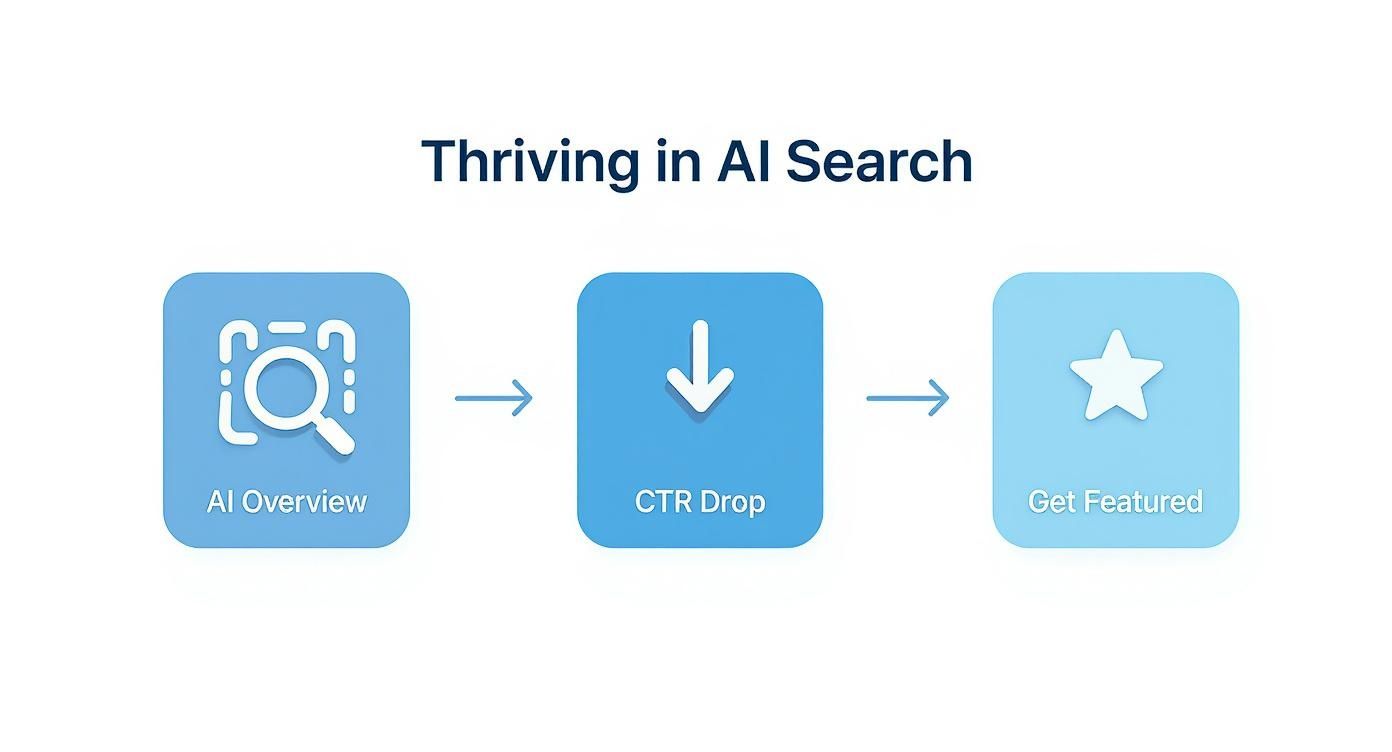
The big takeaway? AI Overviews might gobble up some direct clicks, but getting your content featured inside them is the new gold standard for authority and visibility.
Stage 2: Structured Outlining
Once you've got your research locked down, it's time to build the skeleton of your article. A well-structured outline is the backbone of any piece of content that hopes to rank, and AI is fantastic at helping you create one that’s perfectly tuned for both readers and search engines.
Just feed your primary keyword and all those research findings into your AI tool and ask it to generate a detailed outline. Try a prompt like: "Create an SEO-optimized article outline for '[Your Keyword]', including H2s, H3s, and bullet points that cover key subtopics like [Subtopic 1] and [Subtopic 2]." What you get back is a solid framework ready for you to build on.
Stage 3: First Draft Generation
Alright, let's get some words on the page. This is where you really cash in on AI's incredible speed, turning out a solid first draft in minutes instead of hours. Hand the AI your detailed outline and tell it to start fleshing out each section. Don't stress about perfection at this stage—the goal is just to get a strong foundation in place.
Think of that AI-generated text as raw clay. It has the basic shape and all the core material is there, but it’s missing the soul—the unique voice, sharp insights, and personal stories that will make people actually want to read it. For teams looking to scale this step, truly understanding the process of automating content creation is key. You can dive deeper into how platforms like IndexPilot handle this entire phase in our guide on automating content creation.
Stage 4: Human Review and Optimization
This last step is where the magic happens, and it's completely non-negotiable. An AI draft is never a finished product. This is where your expertise transforms a generic block of text into a genuinely valuable, trustworthy asset that actually deserves to rank.
This human-in-the-loop process is absolutely essential and involves a few key moves:
- Fact-Checking: Go through every single statistic, claim, and data point with a fine-tooth comb. AI models can "hallucinate" or pull from old, outdated sources, and it's on you to guarantee 100% accuracy.
- Injecting E-E-A-T: This is where you add the parts of you the AI can't replicate. Weave in your personal experience, unique insights, and expert opinions. Tell a story, share a case study, or include original data that no one else has.
- Refining Tone and Voice: Now, make it sound like you. Edit the text until it perfectly matches your brand's unique voice. Hunt down and destroy any robotic or clunky phrasing to make sure the content feels authentic and connects with your audience.
- Adding Strategic Elements: Polish it off by adding the finishing touches. Drop in custom images, create internal links to other relevant articles on your site, and write a compelling call-to-action that guides the reader on what to do next.
This hybrid workflow gives you the best of both worlds. You get the mind-blowing speed and scale of AI married to the critical thinking, creativity, and authority that only a human expert can provide. Follow these four stages, and you'll have a system for consistently producing top-ranking AI content for SEO.
Best Practices for AI Content That Actually Ranks

Getting raw text from an AI is the easy part. The real skill—and where the ranking magic happens—is in turning that output into genuinely helpful content that people and search engines actually trust.
Hitting "publish" on a first draft is a surefire way to add to the internet's noise. It just won't cut it.
The principle is pretty simple: Google rewards helpfulness and authority, not just the fact that you used a machine. We've seen a huge spike in AI-written pages hitting the top of search results, but it's been a rollercoaster. Many of those gains vanished after major algorithm updates, which tells us one thing loud and clear: quality is everything.
Think of this section as your pre-flight checklist. It's here to help you catch the common AI slip-ups and add the human touch that’s essential for ranking today.
Fortify Your Content With E-E-A-T
Google’s E-E-A-T guidelines—that’s Experience, Expertise, Authoritativeness, and Trustworthiness—are the gold standard. AI-generated text, by its very nature, has zero real-world experience. Your job is to inject it.
Here’s how to bake these crucial signals into every single article:
- Inject Real-World Experience: Weave in personal stories, client case studies, or firsthand accounts. If you’re reviewing a product, talk about what it was actually like to use it.
- Demonstrate True Expertise: Don’t just list facts. Explain the why behind them. Offer the kind of unique insights that only come from someone who’s been in the trenches.
- Build Authority: Back up your claims. Cite credible research, link out to authoritative studies, and sprinkle in quotes from recognized experts in your field. This builds a web of trust.
Your goal is to make it painfully obvious that a knowledgeable human was in the driver's seat. AI is just the vehicle; your expertise is the destination.
Hunt Down And Eliminate AI Hallucinations
One of the biggest landmines with AI content is its tendency to "hallucinate." It will state completely wrong facts or make up statistics with absolute confidence. This is poison for your credibility and your E-E-A-T score.
A rigorous fact-checking process isn't optional; it's mandatory.
Every single claim, number, or data point has to be checked against a reliable source. This human oversight is what stops the spread of bad information and protects your brand’s reputation. If you can’t verify something, cut it.
Inject Unique Human Elements
To break through the noise, your content needs to offer something that can’t be scraped or replicated by a machine. This is where you truly leave the AI’s capabilities behind.
- Original Data and Research: Run your own surveys, analyze your company's internal data, or create a one-of-a-kind infographic. This instantly makes your article a primary source people will want to link to.
- Personal Stories and Brand Voice: Share your company’s origin story, highlight a customer's success, or talk about a lesson you learned the hard way. This is how you build a real connection with your readers.
- A Distinctive Tone: Edit with a heavy hand. Get rid of robotic phrasing and bland, generic statements. Your content should sound like it was written by a person, for a person. This often means focusing on creating undetectable AI content that reads naturally.
By weaving in these human-centric practices, you'll learn how to optimize content for SEO in a way that truly connects. The smartest workflows don’t see it as human vs. machine; they see it as a partnership.
Human vs AI Content Creation Strengths
The best approach combines the unique strengths of both human writers and AI tools. Each plays a critical role in producing top-tier content.
| Task | Human Strengths | AI Strengths |
|---|---|---|
| Strategy & Ideation | Deep audience understanding, creativity, nuance | Data analysis, keyword clustering, identifying content gaps |
| Drafting & Structure | Storytelling, crafting a compelling narrative | Generating outlines, first drafts, summarizing complex topics |
| Fact-Checking | Critical thinking, source verification, judgment | Quickly flagging potential claims (but requires verification) |
| Editing & Polishing | Injecting brand voice, tone, personal experience | Grammar checks, rephrasing for clarity, consistency |
| Original Insights | Firsthand experience, unique analysis, opinions | Synthesizing information from vast datasets |
Ultimately, AI is a powerful assistant that handles the heavy lifting of research and drafting, freeing you up to focus on the high-level strategy, storytelling, and unique insights that only a human expert can provide.
Answering Your Questions About AI and SEO
Diving into the world of AI content for SEO naturally brings up some big questions. As this technology weaves its way into our daily workflows, it's completely normal to wonder about the risks, how to maintain quality, and frankly, where to even begin.
Let’s cut through the noise and tackle these common questions head-on. We'll stick to Google's official guidance and proven industry practices to give you the clarity and confidence you need to build a smart, sustainable AI content strategy.
Will Google Penalize My Site for Using AI Content?
This is the number one question on everyone's mind, and the answer is refreshingly simple: No, Google will not penalize you just for using AI to create content.
Google has been crystal clear on this. Their main concern isn't how your content was made, but whether it’s genuinely helpful and created for people, not just for search engine rankings. Their entire system is built to reward high-quality content, regardless of its origin.
"Our focus on the quality of content, rather than how it is produced, is a useful guide that has helped us deliver reliable, high quality results to users for years." - Google Search Central
In other words, content designed purely to manipulate search rankings—like thin, spammy, or useless articles—will get buried, whether a human or an AI wrote it. On the flip side, a well-researched and insightful article produced with AI's help can absolutely dominate the SERPs. The tool is irrelevant; the final product is everything.
How Do I Prevent Factual Errors in AI Drafts?
This is a huge one. AI models are infamous for "hallucinations"—they can state incorrect information with baffling confidence, sometimes even inventing statistics out of thin air. Publishing an unverified AI draft is a direct threat to your credibility and E-E-A-T signals.
The only way to combat this is with a non-negotiable human review process. Think of the AI as a brilliant but sometimes unreliable intern. It can pull together a first draft in record time, but a human expert must be the final gatekeeper for accuracy.
Here’s a simple checklist to make fact-checking routine:
- Question Every Statistic: Treat every number or percentage as guilty until proven innocent. Hunt down the primary source—a research paper, an official report, a reputable study—before you let it go live.
- Verify All Claims: If the AI claims "Product X boosts productivity by 40%," you need to find the case study or report that proves it. If you can't, the claim gets cut.
- Check the Date: AI models often pull from older data. A statistic from 2018 might be completely irrelevant today. Always look for the most current information available.
- Cross-Reference with Authorities: For complex topics, sanity-check the AI's explanation against trusted industry sources to make sure it lines up with the expert consensus.
For businesses aiming to deeply integrate AI into their marketing, bringing in specialized AI SEO services can provide that crucial layer of expert oversight to guarantee both accuracy and top-tier performance.
What Is the Best First Step for Integrating AI?
You don't need to blow up your entire content workflow to get started. The smartest way to begin is to start small, find a low-risk area to experiment, and build momentum from there.
For most teams, the perfect first step is using AI to automate the research and outlining phase.
This is the ideal entry point for a few key reasons:
- Low Risk, High Reward: An AI-generated outline is just a starting framework. It doesn't put your brand's voice or factual accuracy on the line, but it dramatically speeds up one of the most tedious parts of content creation.
- Instant Time Savings: You can immediately shave hours off the time you spend analyzing SERPs, researching competitors, and structuring your articles. It’s a huge efficiency win right out of the gate.
- Builds Team Confidence: This approach lets your team get comfortable with the tools and see their value firsthand. Once they see how much time it saves, they'll be more open to adopting AI for other tasks, like drafting.
Try it out: give your AI tool a target keyword and ask it to generate a detailed article outline, complete with H2s, H3s, and bullet points answering common user questions. This one simple step can be a game-changer, setting a solid foundation for scaling your AI content for SEO efforts.
Ready to turn your SEO strategy into a predictable growth engine? With IndexPilot, you can automate the entire content workflow—from keyword research and strategy to writing, optimizing, and publishing. Our trainable AI Agents work around the clock, so you can scale your organic traffic while you focus on your business. Discover how IndexPilot can transform your content creation at https://www.indexpilot.ai.