Persuasive techniques are the secret ingredients that turn plain text into something that truly connects with a reader. They're the strategies you use to gently guide someone's beliefs, feelings, or actions, not through force, but through compelling arguments and genuine emotional hooks. Think of them as the tools that transform simple words into content that informs, connects, and converts.
Why Persuasive Writing Is Your Most Valuable Asset
Ever written a piece of content you were proud of, only to see it fall completely flat? You're not alone. The difference between content that gets results and content that gets ignored isn't just about the quality of the information—it's about persuasion. Effective writing is the bridge that takes your audience from passive readers to active, loyal customers.
It's a classic marketing problem: a well-researched blog post pulls in tons of traffic, but not a single conversion. The information is solid, so what’s missing? The magic lies in the lack of a compelling argument that nudges the reader toward a specific outcome. This is exactly where the art and science of persuasion come into play.
Moving Beyond Information to Influence
Just laying out the facts is rarely enough. To make a real impact, your writing has to build a connection between your message and the reader’s own needs, motivations, and emotions. Persuasive content does a few key things that standard informational writing just can't:
- Builds Trust: It establishes you as a credible, authoritative voice, making your audience more open to what you have to say.
- Creates Connection: It taps into how the reader feels, making your message more memorable and relatable on a human level.
- Drives Action: It gives a clear, logical reason to take the next step, whether that's clicking "buy," signing up for a newsletter, or simply changing their mind.
Persuasion isn't about tricking people. It's about communicating with clarity. The goal is to present your case so effectively that your audience naturally arrives at your desired conclusion because it truly aligns with their own best interests.
The Foundation of Effective Arguments
This guide won't just throw academic theory at you. We're here to give you practical, real-world tools. We’ll break down timeless principles like ethos, pathos, and logos not as abstract classroom concepts, but as the fundamental building blocks for content that delivers actual business results.
Getting these fundamentals right is crucial for everything you write, from a high-stakes sales page to a simple daily email. To see how these ideas apply on the page, check out our practical guide on effective copywriting for a website.
Think of these techniques as your roadmap. They give you the structure to build trust (ethos), forge powerful emotional connections (pathos), and construct logical arguments (logos) that are simply too compelling to ignore. Once you master these skills, your content won't just be seen—it will get results. This is your first step in turning your writing from an information delivery system into your most powerful engine for growth.
The Three Pillars of Persuasion: Ethos, Pathos, and Logos
At the heart of every persuasive argument, you'll find three core principles that have been shaping influence for over two thousand years. These aren't just stuffy academic concepts from a textbook; they are the fundamental building blocks for connecting with any audience today. Getting a handle on this trio—ethos, pathos, and logos—is your first real step toward writing content that doesn’t just sit on the page but actually inspires people to act.
Think of it like a three-legged stool. If one leg is wobbly or missing, the whole thing topples over. Ethos is the stability that comes from credibility. Pathos creates the crucial emotional bond. And logos provides the solid, logical support that holds it all together.
This concept map shows how these pillars work in tandem to guide your reader from initial interest to final conversion.
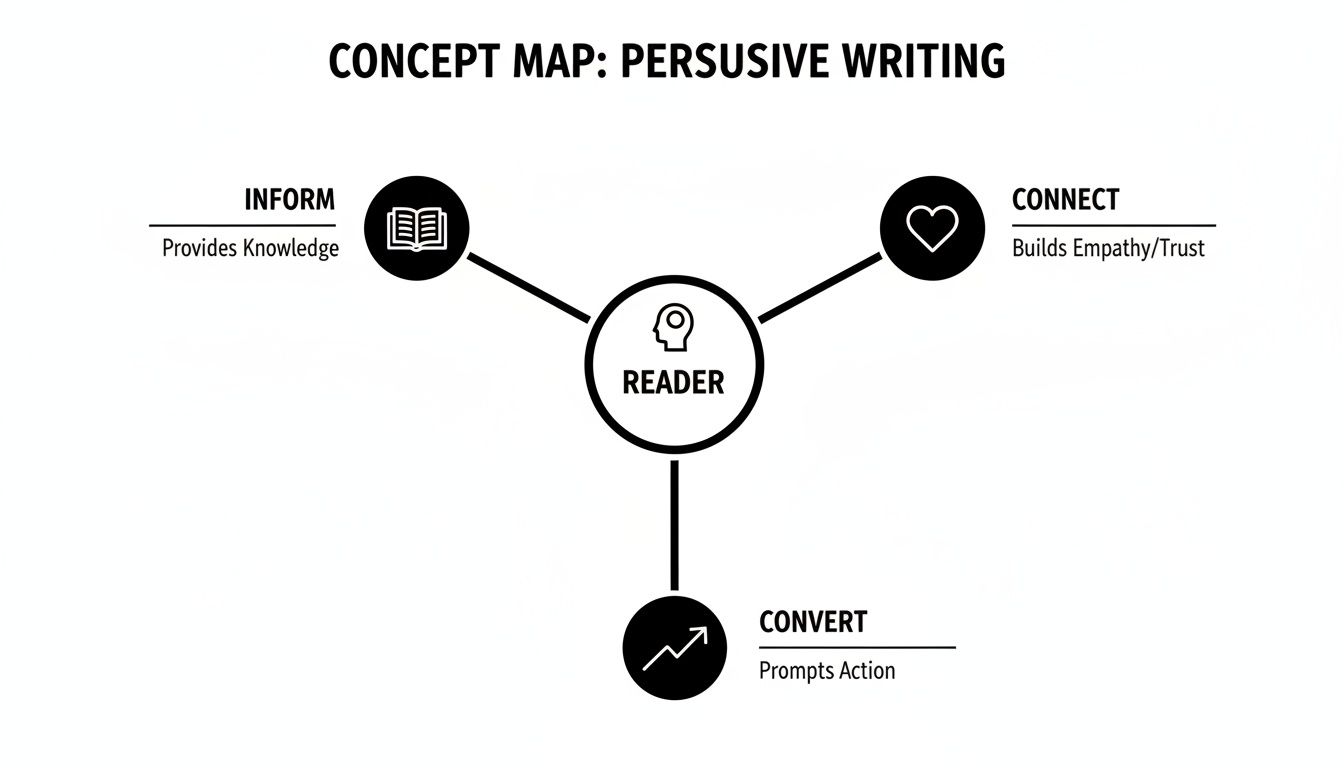
As you can see, informing with facts, connecting with emotion, and leading to a conversion aren't separate tasks. They're all deeply intertwined parts of a single, powerful persuasive strategy.
Ethos: Building Unshakeable Credibility
Ethos is all about your authority. It's the "why you should listen to me" factor. When you establish ethos, you’re showing your audience that you’re a trustworthy, knowledgeable source whose message is worth their time and attention.
You can't just claim you're an expert; you have to prove it. This is where tangible evidence of your experience and character becomes absolutely critical.
Here’s how you can build ethos into your writing:
- Showcase Social Proof: Nothing builds trust faster than seeing others vouch for you. Feature testimonials from happy customers, highlight glowing reviews, or drop the names of well-known brands you've worked with.
- Cite Expert Endorsements: Reinforce your points by including quotes or mentions from respected figures in your industry.
- Publish Case Studies: Present detailed success stories with real, measurable results. Show, don't just tell, that what you do actually works.
When you consistently deliver value and back up what you say, you build a reputation that makes every new piece of content instantly more persuasive.
Pathos: Forging a Powerful Emotional Connection
Pathos is the heart of your message. It’s the appeal to emotion that can turn a dry, logical argument into something that truly sticks with a person. We all know that people often make decisions based on feelings and then use logic to justify them later, which makes pathos an essential tool in your kit.
This doesn't mean you need to be overly dramatic or sentimental. It's about tapping into your audience's real-world pain points, their biggest aspirations, and even their fears, then using language that resonates on that emotional level. A compelling story often hits harder than a spreadsheet full of facts.
Pathos works because it creates empathy. When a reader feels that you genuinely understand their struggles or share their hopes, they become allies in your argument, not just passive observers.
A huge part of using pathos effectively is mastering your tone. The right emotional appeal demands a specific voice—whether that’s inspiring, empathetic, urgent, or reassuring. For a deeper dive, you can learn about the impact of different tones of voice in our detailed guide.
Logos: The Irrefutable Power of Logic
Logos is the appeal to reason. It’s the structured, evidence-based part of your argument that speaks to the rational mind. While ethos builds trust and pathos forges a connection, logos is what seals the deal by proving your point is sound, sensible, and the most logical choice.
This is where you bring out the hard evidence. Solid data, clear statistics, and well-constructed arguments make your claims difficult, if not impossible, to dispute. You're building a case so thoroughly that your conclusion feels like the only natural outcome.
Here are a few ways to beef up the logos in your writing:
- Incorporate Data and Statistics: Use relevant, up-to-date numbers to quantify your claims. Instead of saying a strategy is "effective," say it "increases conversions by 35%." The specificity makes it real.
- Use Logical Progressions: Structure your argument so each point builds on the last, guiding the reader step-by-step toward your conclusion.
- Reference Authoritative Sources: Link out to credible studies, industry reports, or articles from well-respected institutions to show your claims are backed by more than just your own opinion.
Applying Ethos, Pathos, and Logos in Digital Content
These ancient principles are more relevant than ever in today's content-driven world. Let's break down how you might apply each appeal across different formats to see how they work in practice.
| Appeal | Definition | Website Copy Example | Email Marketing Example |
|---|---|---|---|
| Ethos | Establishing authority and credibility. | "Trusted by over 10,000 businesses, including Microsoft and Slack." | "As seen in Forbes, our founder, Jane Doe, shares her top 3 productivity secrets." |
| Pathos | Appealing to the reader's emotions. | "Stop wasting weekends on paperwork. Get your life back." | "Imagine closing the month stress-free. Our new tool can make that a reality." |
| Logos | Using logic, facts, and data. | "Our platform helps teams finish projects 30% faster. See the case study." | "Customers who switch to our service save an average of $500/year." |
While Aristotle laid the groundwork for ethos, pathos, and logos over 2,300 years ago, their power hasn't faded. In fact, modern research shows that content incorporating all three elements sees 42% higher engagement rates, and emails that blend emotional stories with hard data can achieve open rates 25% above average. For a deeper look at these foundational concepts, you can explore the broader field of understanding rhetoric in writing.
Advanced Persuasive Strategies That Drive Action

While the classic trio of ethos, pathos, and logos gives you a solid foundation, some persuasive techniques go a step further. They tap directly into human psychology to nudge people from passive interest to immediate action.
These aren't tricks or manipulation. It’s all about understanding the deep-seated triggers that guide our decisions. When you layer these strategies onto your core message, you create a compelling pull that guides your audience exactly where you want them to go.
Let's break down four of the most effective strategies modern marketers rely on: Scarcity, Social Proof, Reciprocity, and Framing.
Creating Urgency with Scarcity
Ever notice how you suddenly want something more when you find out it's almost gone? That’s scarcity in action. It’s built on the simple principle that we value things more when we think they're limited. This is driven by the classic fear of missing out (FOMO), a powerful motivator that pushes people to act now.
When an offer or product is presented as scarce, its perceived value skyrockets. This isn't just a sales gimmick; it's a reflection of how our brains are wired to assess opportunities. A "limited-time offer" isn't just a deadline—it's a closing window.
You can put scarcity to work in a couple of key ways:
- Time-Based Scarcity: This is the most common approach. Think phrases like "Offer ends Friday," "Last chance," or a live countdown timer ticking away on a sales page.
- Quantity-Based Scarcity: Highlighting limited stock creates a sense of friendly competition. Messages like "Only 3 left!" or "Limited edition" do the job perfectly.
A great example is a travel site showing "Only 2 rooms left at this price!" Suddenly, the user isn't just casually browsing anymore. They're faced with the immediate possibility of losing a fantastic deal, which speeds up their decision.
Building Trust Through Social Proof
At its core, social proof is the idea that people tend to follow the actions of the masses. It's a mental shortcut we all use to figure out the "right" way to behave. If it seems like everyone else is doing it, it must be a good idea, right?
In your writing, this means showing—not just telling—that your product is already loved and valued by others. This technique is incredibly powerful because it basically outsources the hard work of building trust. Instead of just making your own claims, you let the positive experiences of real people do the persuading for you.
Social proof works because it reduces uncertainty. Seeing testimonials, case studies, or user counts assures a potential customer that others have already taken the risk and found value, making their own decision feel safer and more validated.
There are countless ways to weave social proof into your content:
- Testimonials and Reviews: Feature glowing quotes from happy customers. For extra authenticity, include their photos and titles.
- User Counts: Displaying a simple stat like "Over 50,000 users trust us" provides instant, powerful validation.
- Case Studies: A detailed story about a customer's success offers in-depth, logical proof of the value you provide.
When you start implementing these strategies, you can begin the process of https://www.trysight.ai/blog/improving-website-conversion-rates, as that feeling of validation often leads directly to action.
The Power of Reciprocity
Have you ever gotten a free sample and felt a little nudge to buy the full product? That's reciprocity. It's the social norm of responding to a positive action with another positive action. When you give something valuable to someone for free, they feel a natural, subconscious obligation to give something back.
In the world of content marketing, this means providing genuine value upfront without asking for anything in return. Think of a free ebook, a helpful checklist, or an insightful blog post that solves a real problem for your reader.
By doing this, you build goodwill and create a subconscious desire for them to "repay" you, whether that's by signing up for your newsletter or eventually making a purchase. The trick is to make the initial gift feel authentic and selfless. Getting this right often involves mastering elements like crafting high-converting email subject lines to ensure your value gets seen in the first place.
Shaping Perception with Framing
Framing is all about context. The way you present information can completely change how it's perceived, even if the core facts remain the same. By framing your offer to highlight its benefits and downplay its costs, you can make it exponentially more appealing.
Just look at these two ways of presenting the exact same offer:
- Negative Frame: "This software costs $50 per month."
- Positive Frame: "For less than the price of your daily coffee, you can streamline your entire workflow."
See the difference? The second option frames the cost against a small, everyday expense, making the price seem much more manageable and the value much clearer. It reframes the decision from a major business expense to a minor, easily justifiable investment. This technique guides your reader's perspective without changing any facts, making your argument far more persuasive.
Putting Persuasion into Practice with Real Examples
Theory gives you the map, but seeing these techniques in action is like driving the car. This is where it all starts to click—when you watch persuasive writing transform real-world copy from bland to brilliant. Let’s stop talking concepts and start applying them by rewriting a few common marketing pieces to make them far more powerful.

We'll dissect a few "before" and "after" scenarios to show you how a handful of strategic tweaks can turn forgettable text into something that demands action.
Transforming a Product Description with Pathos
A product description should never be just a list of features. It needs to tell a story that connects with a user's frustrations and ambitions. This is the perfect place to inject a dose of pathos.
Before: A Bland Feature List
Our new project management software includes a task scheduler, team collaboration tools, and progress tracking dashboards. It is designed for efficiency.
This is pure information. It's dry, completely forgettable, and does nothing to connect with the real problems a project manager is actually dealing with.
After: A Compelling User Story
Stop letting deadlines sneak up on you and drowning your team in chaotic email threads. Imagine a workflow where every task is clear, every team member is in sync, and you can see project progress at a single glance. Our software gives you that control back, turning workplace stress into effortless efficiency.
Why It Works:
- Empathy: It kicks off by hitting on common pain points ("chaotic email threads," "drowning").
- Aspiration: It paints a picture of a better, calmer future ("effortless efficiency").
- Emotional Language: Words like "drowning," "stress," and "control" create a much deeper connection.
Boosting a Call-to-Action with Urgency
A generic Call-to-Action (CTA) is a massive missed opportunity. By layering in urgency (a cousin of scarcity) and smart framing, you can give people a reason to click right now.
Before: A Generic Button
Sign Up
This is passive. It's uninspiring. It gives the user zero reason to act immediately instead of putting it off until "later."
After: A High-Converting Button
Claim Your 50% Discount – Offer Ends Friday!
Why It Works:
- Urgency: The deadline ("Offer Ends Friday!") triggers a fear of missing out (FOMO).
- Framing: "Claim Your Discount" frames the action as gaining something valuable, not just signing up for another service.
- Specificity: The 50% discount provides a clear, concrete benefit for taking action now.
The most effective persuasive writing doesn't just present information; it presents a choice. It makes the desired action feel like the most logical, beneficial, and urgent option available to the reader at that moment.
Adding Credibility to Data with Ethos and Logos
Simply throwing numbers out there isn't enough; you have to frame them in a way that builds trust. When you combine logos (the data) with ethos (credibility), your argument becomes rock-solid. If you're looking to build a more authoritative brand voice, you might find these real-world company bio examples useful.
Before: An Unsupported Claim
Our marketing strategies help businesses grow. Many of our clients have seen great results and increased their revenue after working with us.
This is completely vague. It asks the reader to trust the company without offering a shred of proof. Why should they believe these claims?
After: A Data-Driven Proof Point
We empower businesses to achieve measurable growth. In 2023, clients using our strategies saw an average revenue increase of 47%. Read the full case study from our work with Acorn Inc., a company that doubled its lead generation in just six months.
Why It Works:
- Logos: The specific statistic (47% revenue increase) provides hard, undeniable evidence.
- Ethos: Mentioning a real client ("Acorn Inc.") and offering a case study adds a powerful layer of social proof and transparency.
- Clarity: It swaps out fuzzy phrases like "great results" for tangible, concrete outcomes.
Research shows that using vulnerability-to-victory narratives—a potent form of pathos—can increase audience action rates by a whopping 50-60%. This storytelling structure, which walks the reader from a pain point to a triumphant solution, builds deep empathy and can boost retention 37% higher than content that relies on logic alone. These examples give you a clear blueprint for applying persuasive techniques in your own writing.
How to Build an Unshakeable Argument
Real persuasion isn't about flashy claims or emotional pleas. It's about building an argument so solid it can withstand any pushback. This is where you bring in the heavy hitters: hard evidence, relevant statistics, and credible sources to fortify your content's logical foundation (logos). A truly strong argument doesn't just convince someone in the moment; it builds lasting authority.
Anyone can make a claim. Proving it is what separates flimsy content from an authoritative resource. Your goal isn't just to tell your audience something is true, but to guide them to that conclusion on their own. You do this by laying out a logical, evidence-based case that feels undeniable.
But the real secret weapon for creating an unshakeable argument? Mastering one of the most powerful persuasive techniques out there: tackling the counterarguments head-on.
The Power of Acknowledging the Other Side
It sounds backward, but bringing up potential objections to your own argument is one of the fastest ways to build credibility (ethos). When you acknowledge a reader’s skepticism right out of the gate, you're sending a powerful message: "I’ve thought this through from every angle, and I get why you might be hesitant."
This simple act immediately disarms your audience. Instead of letting them poke holes in your argument in their own minds, you bring their doubts out into the open and resolve them yourself. It shows confidence and positions you as a fair, thorough guide—not a biased salesperson trying to pull a fast one.
By addressing counterarguments, you control the conversation. You get to frame the potential weaknesses on your own terms and immediately pivot back to the strengths of your position, making your core message even stronger.
This isn't just a strategy for formal debates. It's an essential tool for any content marketer who wants to establish genuine authority and build a loyal following.
A Simple Framework for Handling Objections
You don’t need to get lost in complex debate tactics. Getting ahead of skepticism can be surprisingly simple. Here's a quick framework you can apply to just about any piece of content:
- Identify the Objection: Put yourself in your reader’s shoes. What’s their biggest hesitation? Is it too expensive? Too complicated? Do they just plain doubt your claims? Make a list of these hurdles.
- Acknowledge It Gracefully: Address the concern directly in your writing. Use natural transitional phrases like, "You might be thinking..." or "I know a common concern here is..." This builds rapport and shows you're on their side.
- Refute with Evidence: Counter their objection with logic, data, or a compelling example. If the concern is price, reframe the conversation around long-term value. If it’s complexity, show them how simple the onboarding process really is.
- Pivot Back to Your Core Message: Once you've put their doubt to rest, smoothly transition back to your main point. This reinforces your argument and leaves the reader feeling confident and understood.
Integrating Evidence Without Being Dry
Bolstering your argument with evidence is non-negotiable, but it shouldn't turn your blog post into a snooze-fest. The trick is to weave facts and statistics into your narrative naturally. Use them to add weight, not just to fill space. For instance, instead of just dropping a statistic, frame it within a customer success story. A well-organized argument is the backbone of all persuasive content, a concept we explore further in our guide on creating a solid structure in writing.
This whole approach of integrating evidence and tackling counterarguments isn't just theory—it's proven to be incredibly effective. Studies have actually shown that teaching writers to build claims and rebut opposing views can improve the quality of their arguments by 42%. This method transforms a simple claim into a well-reasoned, authoritative statement that holds up to scrutiny, making your content not just persuasive, but truly unshakeable.
Got Questions About Persuasive Writing? Let's Dig In.
Alright, so you’ve got the theory down. You know what ethos, pathos, and logos are. But putting these persuasive techniques into practice is a whole different ballgame, and it's normal to hit a few snags.
It’s one thing to understand the concepts, but it's another to weave them into your day-to-day work without feeling clunky or, worse, unethical. We'll tackle some of the most common hurdles writers run into—from toeing the line between persuasion and manipulation to figuring out what actually works for a B2B crowd. Think of this as your field guide for the real-world challenges ahead.
How Can I Be Persuasive Without Sounding Manipulative?
This is a big one, and it really comes down to intent and transparency. The line between persuasion and manipulation is drawn right there. Ethical persuasion is all about empowering your audience. You're guiding them to an informed decision that genuinely makes their life better. It’s a win-win.
Manipulation? That’s about deception. It’s about manufacturing false urgency, hiding the fine print, or promising the moon when you know you can't deliver.
To make sure you always stay on the right side of that line, keep these principles front and center:
- Be Radically Honest: Your claims need to be backed by real evidence, authentic testimonials, and accurate data. This is where your ethos and logos really shine.
- Connect Genuinely: Tap into the real emotions and pain points your audience experiences every day, not some trumped-up fantasy (that’s authentic pathos).
- Deliver Real Value: At the end of the day, your goal should be to solve a problem or help someone achieve a goal. Full stop.
Ethical persuasion builds trust for the long haul. Manipulation torches it. Always choose to be a guide, not a trickster, because your audience's trust is the most valuable thing you have.
What's the Best Persuasive Technique for B2B Content?
While every technique has its moment, Ethos (credibility) and Logos (logic) are the undisputed heavyweights in the B2B arena. Why? Because business decisions are almost always rooted in cold, hard numbers: ROI, efficiency, reliability, and proven results. Your content has to speak that language.
This means you need to lead with undeniable proof and build a case for your solution that’s practically airtight.
For a B2B audience, your argument needs to be bulletproof. These folks are analytical and naturally skeptical. Your claims must be propped up by irrefutable proof that spells out clear business value.
Here are your go-to assets for B2B persuasion:
- In-Depth Case Studies: Nothing beats a detailed success story packed with quantifiable results. This is the gold standard of B2B social proof.
- Data-Driven White Papers: Use original research and hard statistics to plant your flag as an authority on the topic.
- Expert Testimonials: A quote from a respected industry figure can lend massive credibility to what you’re saying.
But don't write off Pathos entirely. Remember, you're still writing for human beings who have professional pressures, career ambitions, and daily frustrations. Blending a logical, data-backed argument with genuine empathy for their specific challenges? That can be a powerful way to cut through the noise.
How Can I Measure the Impact of My Persuasive Writing?
If you're not measuring, you're just guessing. Tracking the impact of your persuasive writing is the only way to know what's actually working and what's falling flat. The trick is to connect your writing to tangible business outcomes with clear Key Performance Indicators (KPIs).
The most direct way to do this is with A/B testing. It's simple, really. You create two versions of your copy with one specific change. Maybe one headline leans on urgency, while the other uses social proof. By seeing which one performs better, you get a clear signal on which persuasive hook resonates most with your audience.
Here’s what you should be tracking:
- Conversion Rates: This is the bottom line. Are more people taking the action you want them to take, like signing up or buying?
- Click-Through Rates (CTR): For emails, ads, and CTAs, this shows you how compelling your copy is at sparking that initial interest.
- Time on Page & Engagement: For blog posts and articles, metrics like shares, comments, and how far people scroll can tell you how engaging your argument is.
Tools like Google Analytics, your marketing automation platform, or even website heatmaps will give you the hard data you need to turn your writing from a pure art into a data-informed science.
Can AI Tools Help Me Write More Persuasively?
Absolutely. Think of AI tools not as a replacement for a great writer, but as a powerful assistant that helps you execute proven strategies way more efficiently. They can be your brainstorming partner, research assistant, and copy editor all rolled into one.
Used correctly, AI is a force multiplier for your own skills, freeing you up to focus on the bigger picture—the core message and the story you’re trying to tell.
Here are a few ways you can put AI to work:
- Brainstorm Emotional Angles: Prompt an AI to explore different ways to connect with your audience’s specific pain points (pathos).
- Dig Up Supporting Data: Ask it to find relevant stats or studies to beef up your claims with hard evidence (logos).
- Generate A/B Test Variations: Need three different headlines for a landing page? AI can spin them up in seconds, each using a different persuasive technique.
For instance, a simple prompt like, "Rewrite this product description to frame the price as a small daily investment," immediately puts the framing technique into action. AI can help you apply these strategies faster and more effectively than ever before.
At Sight AI, we help you turn these persuasive techniques into measurable growth. Our platform gives you the insights to find high-value content gaps and the AI-powered tools to create SEO-optimized articles that rank and convert. Stop guessing what works and start building a content engine that drives real results. Discover how Sight AI can transform your content strategy.