In a crowded market, your company bio is often the first, and sometimes only, chance you get to make a real impression. It's far more than a simple summary; it's a strategic asset that can attract top talent, secure new customers, and solidify your brand's authority. Too often, however, it's treated as an afterthought, filled with generic language that fails to connect or stand out.
This guide is designed to change that. We will dissect 10 powerful company bio examples from diverse platforms and industries, revealing the specific tactics that make them effective. Forget vague advice; you'll get a behind-the-scenes look at the strategic formulas that work.
You will learn how to:
- Craft a compelling narrative for any platform, from a concise LinkedIn summary to a detailed 'About Us' page.
- Adapt your message for different audiences, whether you're targeting investors, customers, or potential partners.
- Optimize your bio for visibility, ensuring it gets discovered by search engines and AI models like ChatGPT.
We've included actionable templates and breakdowns for each example, so you can immediately apply these lessons. It's time to transform your company bio from a passive description into a powerful narrative that drives measurable business growth.
1. Tech/SaaS Professional Bio - LinkedIn Platform
On LinkedIn, your company bio isn't just a description; it's a strategic elevator pitch designed for a professional audience of potential clients, partners, and talent. A powerful Tech/SaaS bio on this platform cuts through the noise by immediately establishing its value proposition. It concisely answers the crucial question: "What problem do you solve, and for whom?"
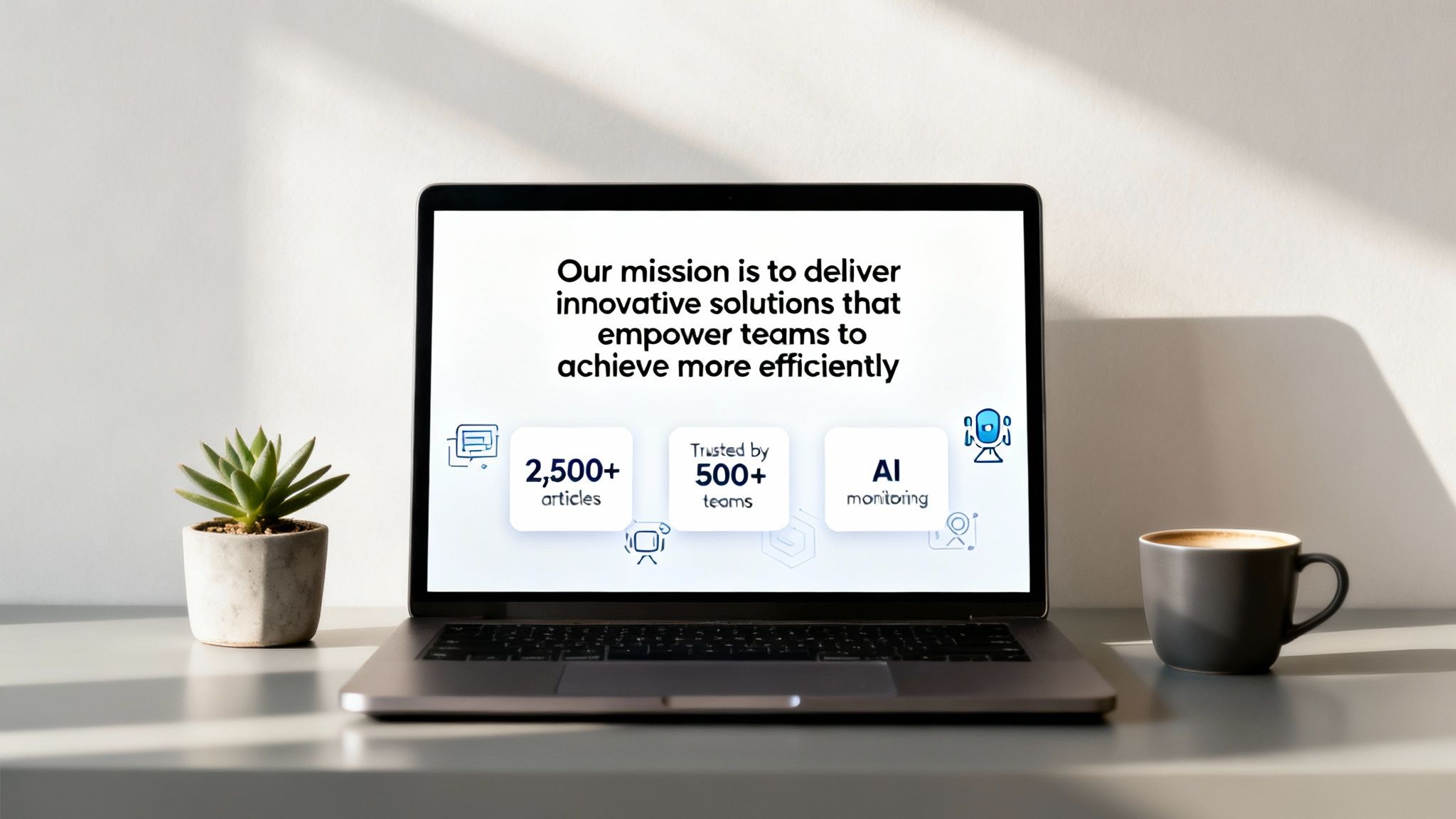
This format thrives on brevity and impact, often leading with a bold claim or a clear outcome rather than the company name. The goal is to hook the reader instantly and communicate core competency in seconds.
Strategic Breakdown
- HubSpot: "Helping millions grow better. The #1 CRM platform for scaling companies."
- Stripe: "Financial infrastructure for the internet."
- Slack: "Slack is your productivity platform."
These examples are brilliant because they avoid technical jargon and focus entirely on the solution or outcome. Stripe doesn't list payment gateways; it positions itself as a foundational utility. Slack doesn't mention "asynchronous messaging channels"; it sells a universal benefit: productivity. This approach transforms a feature list into a powerful identity.
Key Insight: The best LinkedIn bios function as a tagline and a mission statement in one. They are definitive, confident, and centered on the user's benefit.
Actionable Takeaways
To create compelling company bio examples for LinkedIn, focus on these tactics:
- Lead with the Differentiator: Start with what makes you unique or the primary benefit you offer.
- Quantify Your Impact: Use specific data, like "Trusted by 100,000+ businesses" or "Powering 3M+ transactions daily," to build immediate credibility.
- Integrate Keywords: Include terms your target audience is searching for, such as "AI-powered analytics," "CRM platform," or "DevOps solutions."
- Add a Clear CTA: Guide visitors on what to do next. A simple "Learn more at our website" or "See our solutions" can significantly increase engagement.
For those specifically focused on perfecting their professional story on the platform, these 8 LinkedIn About section examples offer excellent inspiration and templates.
2. Startup Founder Bio - Twitter/X Platform
On a fast-paced platform like Twitter/X, a founder's bio is more than a professional summary; it's a 160-character manifesto. This space demands a punchy, personality-driven statement that blends personal identity with the company's mission. It’s a delicate balance of conveying vision, authority, and approachability to attract followers, investors, and early adopters.
The goal is to stop the scroll and communicate a powerful idea in an instant. A great founder bio on X often uses wit, bold claims, or a unique combination of roles to create an unforgettable personal brand that is inseparable from their startup's identity.
Strategic Breakdown
- Elon Musk (Tesla, SpaceX, X): A fluid bio, previously "Technoking of Tesla, Imperator of Mars."
- Naval Ravikant (AngelList): "Building and funding companies."
- Paul Graham (Y Combinator): "I work on Y Combinator. Before that I was a programmer."
These examples excel by reducing complex careers into powerful, simple identifiers. Musk’s bio uses humor and grandiosity to reflect his ambitious ventures. Ravikant's is a direct, no-frills statement of his core functions, establishing him as a key figure in the startup ecosystem. Graham’s bio is humble and factual, building credibility through his past and present roles. They all project a distinct persona that aligns with their professional reputation.
Key Insight: A founder's Twitter/X bio is a strategic tool for personal branding that directly fuels their company's narrative. It should be memorable, concise, and authentically reflect their role and vision.
Actionable Takeaways
To craft effective company bio examples for a founder's X profile, apply these tactics:
- Marry Persona with Mission: Combine a personal trait or hobby with your company's goal (e.g., "Obsessive builder. Making AI content automation accessible for all.").
- Use Role Stacking: List your key roles or passions to create a multi-dimensional persona (e.g., "Investor. Programmer. Writer.").
- Add a Credibility Marker: Include your company handle (@YourCompany), a key achievement, or your founding date to ground your profile in reality.
- Include a Targeted Link: Don't just link to your homepage. Use this high-visibility space to direct followers to a product waitlist, a demo video, or a recent funding announcement.
- Incorporate Relevant Emoji: Use a single, relevant emoji to add visual personality and summarize your mission (e.g., 🚀 for growth, 🤖 for AI, ✍️ for content).
3. Enterprise B2B Bio - Corporate Website/About Page
For an enterprise B2B company, the "About Us" page bio is a cornerstone of corporate identity. It moves beyond a simple tagline to build a comprehensive narrative focused on trust, scale, and long-term vision. This format is designed for stakeholders, potential enterprise clients, and top-tier talent who need to understand a company's heritage, market position, and core values before engaging.
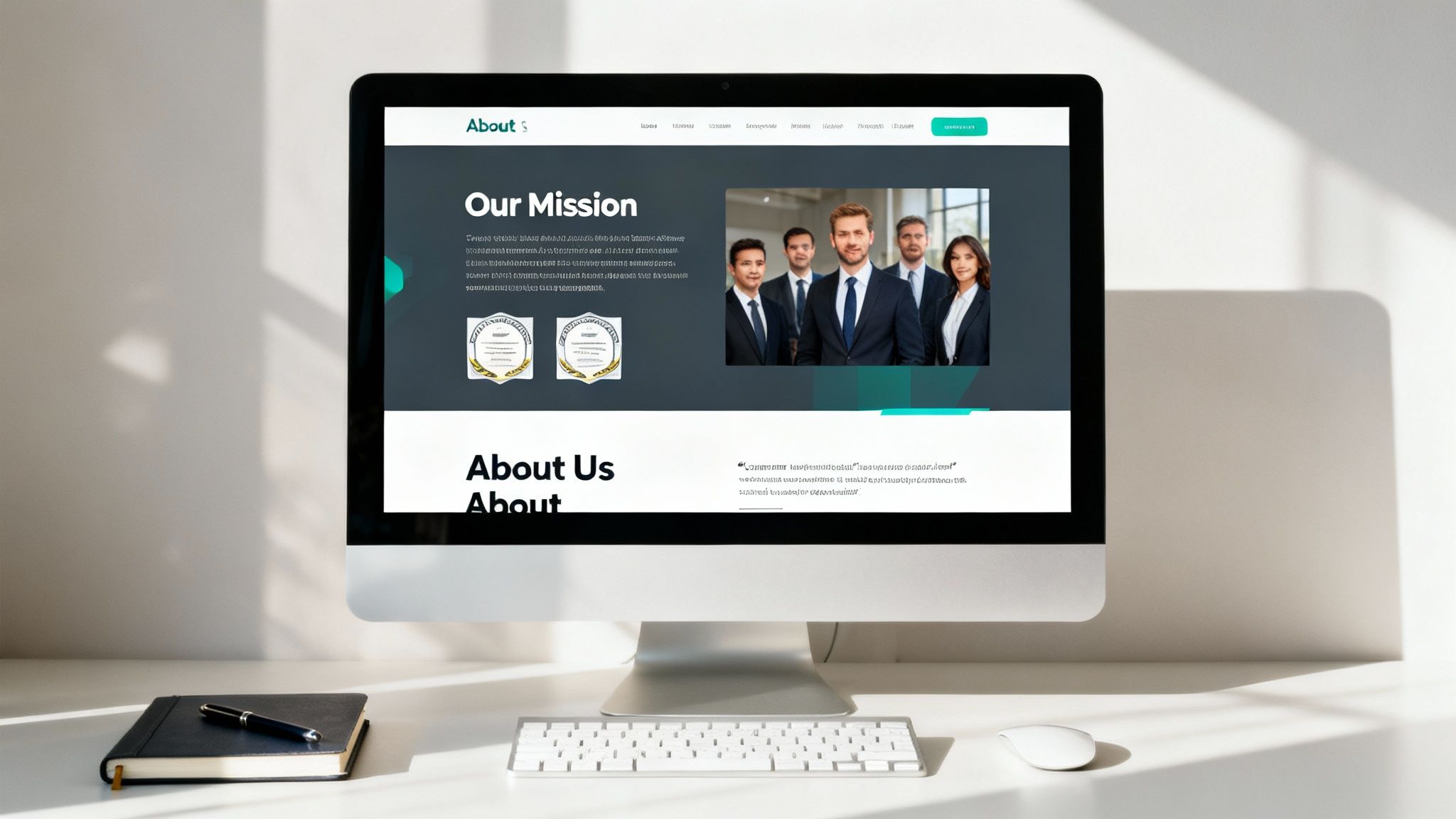
This bio isn't just a description; it’s a detailed credential. It often includes the founding story, mission, team expertise, and social proof to establish credibility and differentiate the brand in a crowded marketplace. The tone is professional, confident, and authoritative.
Strategic Breakdown
- Salesforce: "We bring companies and customers together... We're the world's #1 AI CRM, empowering companies of every size and industry to connect with their customers in a whole new way."
- HubSpot: "There's this notion that to grow a business, you have to be ruthless. But we know there's a better way to grow. One where what's good for the bottom line is also good for customers."
- Notion: "We’re a small team, building a tool we feel is missing in the world. We want to rethink how we work with computers..."
These examples succeed by connecting their products to a larger purpose. Salesforce isn’t just selling software; it’s enabling connections. HubSpot challenges a negative business stereotype, positioning itself as the ethical choice for growth. Notion uses a storytelling approach to create a personal, mission-driven connection with its users, even at an enterprise scale.
Key Insight: The best enterprise bios balance corporate authority with a human-centric mission. They use storytelling and value statements to transform a company profile into a compelling brand narrative.
Actionable Takeaways
To build effective company bio examples for your corporate site, focus on these elements:
- Lead with the Problem: Frame your company's origin story around the problem you solve. For example, "Brands are invisible to AI models like ChatGPT."
- Use Subheadings for Scannability: Organize your bio with clear H2 or H3 sections like "Our Mission," "Our Story," and "The Team" to improve readability.
- Highlight Social Proof: Build trust by mentioning key clients or partners, such as "Used by top agencies and SaaS companies," or quantify your user base with "Trusted by 500+ marketing teams."
- Include Specific Metrics: Add concrete numbers to demonstrate scale and expertise, like "Our platform includes 13+ AI agents" or "We’ve helped clients in over 50 countries."
Crafting this narrative is a key part of your overall brand strategy, and the principles of effective content creation for websites can provide a strong foundation.
4. Agency/Service Provider Bio - Google Business Profile & Local SEO
For service-based businesses and agencies, the Google Business Profile (GBP) bio is a critical, location-aware asset. It’s not just a description; it’s a direct line to local customers actively searching for your expertise. This bio must be optimized for local search, clearly stating what you do, where you do it, and why you’re the best choice in that specific geographic area.
This format prioritizes clarity, service offerings, and local keywords. The goal is to answer a searcher's query instantly, build trust through social proof like reviews, and drive high-intent local traffic, whether that means a phone call, a visit, or a click to your website.
Strategic Breakdown
- Local SEO Agency: "Your top-rated SEO agency in Austin, TX. We specialize in local SEO, Google Ads, and AI-powered content automation to get your business seen. Serving Austin, Round Rock & Cedar Park. Call for a free audit!"
- Digital Marketing Agency: "Chicago's premier digital marketing agency. Our certified team delivers expert social media management, PPC, and web design. We help local businesses dominate online. Offices in Chicago & Naperville."
- Content Creation Studio: "Award-winning video production and content creation studio in Miami. We help brands tell their story with stunning visuals and data-driven strategy. Ask about our AI content monitoring services."
These examples excel by weaving location and services together. They use geo-specific keywords ("Austin, TX," "Chicago") and service-specific terms ("local SEO," "AI-powered content automation") that match user search intent. They also build credibility by mentioning certifications or awards.
Key Insight: A Google Business Profile bio is a conversion tool disguised as a description. It should be packed with keywords, service areas, and trust signals to capture and convert local searchers immediately.
Actionable Takeaways
To create powerful company bio examples for your GBP, focus on these tactics:
- Front-Load Keywords & Location: Start with your primary service and main city, like "Denver's leading web design agency..."
- List Core Services: Clearly itemize your main offerings. Use terms potential clients are searching for, such as "PPC management," "content automation," or "AI visibility."
- Define Your Service Area: Explicitly name the cities, neighborhoods, or regions you serve to capture "near me" searches. For agencies and service providers, optimizing your presence on platforms like Google Business Profile is key to local SEO, and you can learn more from a complete guide to local listings on Google.
- Incorporate a CTA: Encourage action with phrases like "Call for a free consultation," "Visit our downtown office," or "Get a quote today." For agencies looking to expand their service offerings, exploring white-label SEO services can be a strategic way to scale without increasing overhead.
5. SaaS Product Bio - Product Hunt & AppSumo Platforms
On product discovery platforms like Product Hunt and AppSumo, your bio is a high-stakes, conversion-focused tool. Users are actively looking for solutions and making quick judgments. An effective bio here must be benefit-driven, immediately communicating the problem it solves and why it’s the superior choice for a discerning, tech-savvy audience.
This format prioritizes speed and clarity. It's built for rapid scanning, using strong action language and a direct problem-solution framework to grab attention instantly. The goal is to stop the scroll and compel a click by showcasing immediate value.
Strategic Breakdown
- Loom: "Async video communication for hybrid teams."
- Zapier: "Connect your apps and automate workflows."
- Grammarly: "Your AI writing partner."
These examples excel by reducing a complex product into its core, transformative benefit. Loom doesn’t talk about screen recording software; it sells a new way of working for a specific audience (hybrid teams). Zapier avoids technical API jargon and instead promises the universal desire for automation and efficiency. This laser-focus on the outcome is what makes these bios so effective in a competitive discovery environment.
Key Insight: On launch platforms, your bio isn't just a description; it’s the headline of your value proposition. It must be brutally concise, outcome-oriented, and tailored to an audience seeking immediate utility.
Actionable Takeaways
To craft compelling company bio examples for product marketplaces, apply these tactics:
- Lead with Transformation: Start with the "before and after." Frame your solution around the pain point it eliminates, like "Stop manually updating spreadsheets."
- Highlight a Key Metric: Use specific, tangible benefits to build trust. Phrases like "Generate reports 10x faster" or "Reduce support tickets by 40%" are powerful.
- Showcase Social Proof: A short testimonial can be incredibly persuasive. For instance, "'A game-changer for our workflow' - CEO @ StartupX."
- Mention Critical Integrations: If your product connects to popular tools like Slack, WordPress, or Webflow, state it upfront. This immediately signals utility and compatibility. For startups seeking an edge, exploring the best AI tools for optimizing product visibility can provide data-driven insights for crafting the perfect bio.
6. Thought Leadership/Executive Bio - Industry Publications & Speaking Engagements
When an executive speaks at a conference or contributes to an industry publication, their bio serves a dual purpose. It must establish personal credibility while simultaneously reinforcing the company's authority and mission. This type of bio is a strategic tool for building brand reputation, positioning an individual as an expert, and framing the company as a leader in its field.

Unlike a general company overview, this format is centered on the individual’s unique perspective and accomplishments. It’s crafted to answer the question, "Why should I listen to this person?" The goal is to build trust in the expert, which then extends to the organization they represent.
Strategic Breakdown
- Satya Nadella (Microsoft): Often introduced with phrases like, "the engineer and business executive who has led Microsoft's transformation into a cloud computing powerhouse, championing a culture of empathy and a growth mindset."
- Jensen Huang (NVIDIA): Described as "the founder and CEO of NVIDIA, a pioneer in graphics processing units (GPUs) who foresaw their potential to revolutionize AI and high-performance computing."
- Sheryl Sandberg (Meta): Frequently presented as "a technology executive, activist, and author, renowned for her work in scaling global technology operations and her advocacy for women in leadership through her book, Lean In."
These examples masterfully blend individual achievements with broader company narratives. Nadella's bio connects his personal philosophy of a "growth mindset" directly to Microsoft's strategic pivot to the cloud. Huang is positioned not just as a CEO, but as a visionary who anticipated the AI revolution, making NVIDIA synonymous with innovation. This approach makes the executive the human embodiment of the company's mission.
Key Insight: An effective executive bio is a narrative that connects a person's expertise to a major industry trend or problem, positioning their company as the solution.
Actionable Takeaways
To craft powerful company bio examples for thought leadership platforms, use these strategies:
- Define Your Niche: Open with a clear expert identifier, such as "AI computing pioneer," "workplace culture expert," or "B2B SaaS growth strategist."
- Show, Don't Just Tell: Mention specific credentials like speaking engagements ("Keynote at INBOUND 2023"), publications ("Contributor to Forbes"), or media features ("Featured in VentureBeat").
- Connect to the Company: Explicitly link the executive’s expertise to the company's value proposition. For example, "His 10+ years in AI content inform [Company]'s mission to..."
- Maintain Consistency: Use a standardized version of the bio across all platforms (LinkedIn, conference websites, bylines) to build a recognizable personal and company brand.
Developing a strong narrative is central to this effort, and you can learn more about building a thought leadership content strategy to amplify your message.
7. Influencer/Partnership Bio - Instagram, TikTok, YouTube Platforms
On highly visual and personality-driven platforms like Instagram, TikTok, and YouTube, a company bio transforms from a corporate statement into a dynamic pitch for collaboration and community. This type of bio is crafted to attract brand partners, influencers, and a loyal follower base by showcasing personality, authority, and engagement potential. It immediately signals what the channel is about and who it serves, all while leaving the door open for business.
This format prioritizes connection and credibility. It tells potential collaborators that you are not just a brand, but a content creator with a valuable, engaged audience. The bio becomes a media kit summary, designed to spark interest for partnerships.
Strategic Breakdown
- Neil Patel: "Digital marketing influencer across YouTube, Instagram, Twitter. Founder of @NPdigital. Let's grow your traffic."
- Gary Vaynerchuk (GaryVee): "CEO of VaynerMedia... 5-Time NYT Bestselling Author... I talk a lot about business, entrepreneurship & the internet."
- Ahrefs: "We help you rank higher and get more traffic. Not another boring corporate account."
These examples excel because they blend personal branding with corporate authority. Neil Patel clearly states his expertise and value proposition ("grow your traffic"). GaryVee lists his impressive credentials to build credibility. Ahrefs injects personality ("Not another boring corporate account") to differentiate itself and attract an audience that craves authentic, useful content, not just sales pitches. They effectively position themselves as creators, not just companies.
Key Insight: On social platforms, the most effective company bios are not about what you sell, but about the value and personality you bring as a content creator. They build a bridge between brand and audience, making partnerships a natural next step.
Actionable Takeaways
To craft powerful company bio examples for social media partnerships, implement these tactics:
- State Your Niche and Expertise: Clearly define your focus, such as "AI-powered marketing tips" or "B2B SaaS growth hacks," to attract the right followers and partners.
- Highlight Your Audience: Mention key demographics or professional roles, like "Helping 50K+ SEO managers and marketers," to show potential partners the value of your reach.
- Include a Clear Partnership CTA: Don't be subtle. Add a line like "For collabs, DM us" or provide a dedicated contact email to streamline partnership inquiries.
- Showcase Social Proof: Mention follower counts, partnerships with known creators like @garyvee or @ahrefs, or feature user-generated content to build instant trust and credibility.
8. Niche Community Bio - Slack, Discord, Reddit & Niche Forums
Unlike a public-facing website, a company bio within a niche community on platforms like Slack, Discord, or Reddit serves a different purpose. It's not about a hard sell; it's about building trust and fostering a sense of belonging among a highly curated audience of enthusiasts, customers, or industry peers. This bio acts as a welcome mat and a community charter rolled into one.
This format prioritizes shared values, community guidelines, and member-centric benefits. The goal is to establish the space as a valuable resource and a hub for connection, positioning the company as a facilitator of conversation rather than just a vendor. It's a key part of creating a genuine brand ecosystem.
Strategic Breakdown
- Content Marketing Collective (Slack): "Welcome to CMC! A space for content pros to share wins, tackle challenges, and grow together. Check out #rules-and-faq to get started and #intros to meet the community."
- AI Marketers Club (Discord): "Your go-to server for all things AI in marketing. Share tools, discuss strategies, and find collaborators. Our goal: help each other stay ahead of the curve."
- r/growthmarketing (Reddit): "A community for marketers to discuss and share growth marketing tactics, strategies, and case studies. No self-promotion outside of the dedicated threads. Let's learn and grow."
These company bio examples excel by putting the community first. They clearly state the purpose of the group, outline the expected behavior (like "no self-promotion"), and direct new members on how to engage. The language is casual, collaborative, and focused entirely on the value the members will receive from participating.
Key Insight: In a niche community, the company bio is not about your product, it's about the members' shared identity and purpose. Your brand wins by becoming the host of an indispensable conversation.
Actionable Takeaways
To write an effective company bio for a niche community, focus on these tactics:
- State the "Why": Immediately clarify the community’s purpose. Is it for learning, networking, support, or beta testing?
- Set Clear Expectations: Link directly to rules, FAQs, or getting-started guides to ensure a positive and productive environment from day one.
- Use Inclusive Language: Employ words like "we," "together," and "our community" to foster a sense of shared ownership.
- Highlight Member Benefits: Emphasize what members gain, such as exclusive access to experts, early feature releases, or a network of peers. This is a crucial element for these specific company bio examples.
9. Immigrant/Founder Story Bio - Personal Branding & Narrative Marketing
Beyond features and metrics, some of the most powerful company bios are rooted in a deeply human narrative. The founder story bio connects a brand's mission to the personal journey, struggles, and triumphs of the person who created it. This approach transforms a business from a faceless entity into a passion-driven venture, building an emotional bridge with the audience.
This format is particularly effective on "About Us" pages, in founder interviews, and across personal branding platforms. It answers the question: "Why does this company exist, and why should I care?" by sharing the vulnerable, relatable story behind the business.
Strategic Breakdown
- Sara Blakely (Spanx): The narrative of a fax machine salesperson with just $5,000, who was rejected by countless manufacturers before revolutionizing an industry, is central to the Spanx brand identity.
- Chobani: The story of Hamdi Ulukaya, a Turkish immigrant who bought a defunct yogurt factory with a small business loan to create opportunities in his new community, defines the brand's ethos of quality and social responsibility.
- Oprah Winfrey: Her journey from poverty and adversity to becoming a media mogul is not just her personal story; it is the foundational narrative of her entire brand, which focuses on empowerment and overcoming challenges.
These examples succeed because they anchor the business mission in a compelling human experience. Blakely's story isn't just about shapewear; it's about perseverance. Chobani isn't just about yogurt; it's a testament to the American dream. This narrative marketing creates a "why" that customers can believe in and champion.
Key Insight: A founder story bio sells the mission, not just the product. It builds brand loyalty by aligning the company's purpose with universal human values like resilience, hope, and determination.
Actionable Takeaways
To craft impactful company bio examples using a founder-led narrative, focus on these tactics:
- Pinpoint the 'Aha Moment': Clearly articulate the moment of insight when the founder realized the problem their business now solves.
- Connect Mission to Origin: Explicitly link your personal mission to the company's purpose. Use phrases like, "I built this to solve the problem I faced myself."
- Balance Vulnerability and Credibility: Share authentic struggles to build connection, but pair them with professional achievements and milestones (e.g., "From a garage startup to serving 10,000+ customers") to establish authority.
- Weave in Key Values: Ensure the story reflects the core values of your company, whether it's community, innovation, or sustainability.
10. Partnership/Integration Bio - Developer Platforms & Integration Marketplaces
When your business thrives on connectivity, your company bio on a partner marketplace or developer portal becomes a crucial technical handshake. This bio isn't for a general audience; it's a specialized, function-first description for developers, IT managers, and technically-savvy users looking to connect systems. It must immediately communicate your tool's capabilities, integration points, and the problems it solves through automation.
This format prioritizes clarity, technical accuracy, and utility over creative storytelling. The primary goal is to show a potential partner or developer how your service fits into their existing tech stack, what it enables, and how to get started as quickly as possible. It’s a bio that functions as a mini-documentation.
Strategic Breakdown
- Zapier Integration: "Connect [Your App] to 6,000+ apps. Automate your work by linking [Your App] to the tools you use every day."
- Slack API: "Build bots, apps, and workflow automations inside Slack. Our APIs provide the tools to create richer experiences."
- Stripe API: "A payments platform for businesses of all sizes. Use our API to accept payments, send payouts, and manage your business online."
These examples succeed by being direct and action-oriented. Zapier immediately frames the benefit around its massive ecosystem. Slack and Stripe use simple, powerful verbs like "Build" and "Use" that speak directly to a developer audience. They cut the marketing fluff and get straight to the functional value, which builds instant credibility with technical users.
Key Insight: A partnership bio is a tool, not a story. It should be built for quick reference, highlighting API capabilities, triggers, actions, and key use cases to help a developer instantly assess compatibility and value.
Actionable Takeaways
To write effective company bio examples for integration marketplaces, focus on these technical details:
- State the Core Function: Begin with a clear statement of what your API or integration does. "Trigger content generation from keyword data" is better than "Enhance your content workflow."
- Highlight Key Integrations: Mention specific, high-value platforms you connect with, such as "Direct publishing to WordPress, Webflow, and HubSpot."
- Be Specific About Triggers/Actions: Detail what users can do. For example, "Triggers: New Lead Created, Form Submitted. Actions: Create Document, Send Summary."
- Provide Developer Resources: Link directly to API documentation, sample code snippets (Python, Node.js), and mention technical specs like rate limits to answer developer questions upfront.
For businesses looking to showcase their connectivity, exploring various integration possibilities provides a blueprint for what to highlight in these specialized bios.
10 Company Bio Examples — Comparison
| Format / Platform | Implementation complexity | Resource requirements | Expected outcomes | Ideal use cases | Key advantages |
|---|---|---|---|---|---|
| Tech/SaaS Professional Bio — LinkedIn | Low — short, structured copy | Low — copywriting, occasional updates, analytics | Improved discoverability, B2B leads, credibility | B2B outreach, SEO/marketing teams, partnerships | Native search optimization, measurable metrics, A/B-testable |
| Startup Founder Bio — Twitter/X | Low — punchy, high-signal copy | Low–Medium — ongoing engagement, profile updates | Personal brand growth, virality, investor interest | Founders, early adopters, investor/community outreach | High shareability, thought leadership, community building |
| Enterprise B2B Bio — Corporate Website/About Page | Medium–High — multi-section, polished content | High — content, design, legal review, SEO effort | Enterprise trust, longer sales enablement, organic traffic | Enterprise sales, partner trust-building, SEO-driven lead gen | Comprehensive credibility, rich media support, SEO benefits |
| Agency/Service Provider Bio — Google Business Profile & Local SEO | Low–Medium — localized copy and attributes | Medium — review management, photos, local pages | Local visibility, client inquiries, foot traffic | Local agencies, service businesses, multi-location firms | Dominates local search, review prominence, free optimization |
| SaaS Product Bio — Product Hunt & AppSumo | Medium — conversion-focused, asset-rich | Medium — demo videos, screenshots, community engagement | Early adopters, launch traction, conversions, press | Product launches, growth teams, founders seeking users | High conversion potential, viral/FOMO mechanics, review virality |
| Thought Leadership / Executive Bio — Publications & Speaking | Medium — credentialed, narrative polish | Medium — PR, content creation, speaking prep | Speaking invites, media coverage, authority building | Executives, founders, speakers, PR-driven positioning | Establishes expertise, attracts press/partnerships, credibility |
| Influencer / Partnership Bio — Instagram, TikTok, YouTube | Medium — visual-first, consistent branding | High — regular content creation, media kit, engagement | Brand partnerships, sponsorships, audience growth | Creators, brand collaborations, awareness campaigns | High reach, authentic recommendations, monetization potential |
| Niche Community Bio — Slack, Discord, Reddit | Low–Medium — casual, rules and onboarding | High — active moderation, events, community management | High engagement, retention, product feedback, advocacy | Beta users, retention programs, advocacy building | Direct access to ideal customers, strong word-of-mouth, rapid feedback |
| Immigrant / Founder Story Bio — Personal Branding | Medium — narrative-driven, sensitive tone | Medium — storytelling, PR, consistent cross-channel use | Emotional connection, media interest, loyalty | Founder-focused marketing, investor narratives, brand storytelling | Differentiation, press-friendly narrative, deep audience bonds |
| Partnership / Integration Bio — Developer Platforms | High — technical accuracy, API details | High — documentation, developer support, maintenance | Developer adoption, integrations, ecosystem growth | APIs, marketplaces, technical partnerships and automations | Enables automation, network effects, technical credibility |
From Bio to Business: Putting These Examples into Action
We've explored a diverse landscape of company bio examples, from the concise impact of a Twitter/X profile to the detailed narrative on a corporate "About" page. The journey through these distinct formats reveals a core truth: there is no one-size-fits-all solution. A powerful company bio is not a static block of text; it's a dynamic, context-aware messaging toolkit.
The most effective brands treat their bios as strategic assets, not afterthoughts. They understand that a bio on LinkedIn serves a different purpose than one on a Product Hunt launch page or a Google Business Profile. The former builds professional credibility and attracts talent, while the latter two are designed to drive immediate user action and local foot traffic, respectively.
Synthesizing the Core Strategies
As you move from inspiration to implementation, let's distill the most critical takeaways from the examples we analyzed. Your brand's ability to craft compelling narratives hinges on mastering these three pillars:
Audience and Platform Alignment: The foundational principle is simple yet crucial. Always ask: Who is reading this, and where are they reading it? A bio for a developer on an integration marketplace must be technically precise, while a bio for a potential customer on Instagram should be relatable and benefit-driven. Misalignment here is the most common point of failure.
The Mission-to-Mechanism Framework: Great bios seamlessly connect the "why" (your mission, vision, and values) with the "how" (your product's features, services, or mechanism for delivering value). Slack's bio doesn't just say it's a communication tool; it frames itself as a productivity platform that makes working life simpler. This elevates the brand beyond a mere utility.
Keyword and Intent Optimization: Visibility is non-negotiable. Every bio is an opportunity to be discovered. This means strategically weaving in relevant keywords for search engines and platform algorithms. More importantly, it means aligning your language with user intent. What problem is your audience trying to solve when they find you? Your bio should immediately confirm they are in the right place.
Your Actionable Roadmap to a Better Bio
Reading about great company bio examples is the first step. Now it's time to build your own. Use this structured approach to audit, refine, and deploy your brand's story across every digital touchpoint.
Step 1: Conduct a Cross-Platform Bio Audit
Create a simple spreadsheet listing every platform where your company has a presence (LinkedIn, website, Twitter/X, Instagram, Google Business Profile, etc.). Copy and paste your current bio from each.
- Analyze for Consistency: Is your core message consistent?
- Check for Relevance: Is the bio on each platform tailored to its specific audience?
- Evaluate for Freshness: Is the information outdated? Does it reflect recent milestones or product updates?
Step 2: Define Your Core Messaging Components
Before you write a single word, break down your brand's story into reusable components. Think of these as your "Lego bricks" for building any bio.
- The "What": A clear, one-sentence description of what you do.
- The "Who For": Your ideal customer profile.
- The "Why": The core problem you solve or the mission that drives you.
- The "How": Your unique mechanism, technology, or approach.
- The "Proof": A key statistic, award, or social proof element (e.g., "trusted by 100,000+ users").
- The "Call to Action": The specific next step you want the reader to take.
Step 3: Draft, Test, and Iterate
Using your messaging components, rewrite the bio for each platform. Don't be afraid to experiment with different tones and angles. Share them with your team or a trusted group of customers for feedback. Remember, a bio is a living document. It should evolve as your company grows, your products mature, and your brand story sharpens.
Investing this time and strategic effort into your company bio is one of the highest-leverage marketing activities you can undertake. It's the first handshake, the elevator pitch, and the foundation of your digital identity all rolled into one. By moving beyond a simple description to a strategic narrative, you build a stronger foundation for customer connection, improved visibility, and sustainable business growth.
Ready to ensure your brand's story is consistently powerful and perfectly optimized everywhere it appears? Sight AI uses advanced analytics to monitor your brand's narrative across the web and generates on-brand, performance-driven content, including tailored company bios for every platform. Take the guesswork out of brand messaging and see how AI can amplify your story by visiting Sight AI today.