Website copywriting isn't just about stringing words together. It's the art of using persuasive text to guide visitors toward a specific action—whether that's buying a product, signing up for a newsletter, or booking a demo. It’s a blend of brand storytelling and user psychology that can turn a simple online brochure into your most powerful conversion tool.
Building Your Copywriting Foundation
Before you even think about writing a headline, you need to lay the groundwork. Great website copy is built on a solid strategic foundation. Skipping this part is like trying to build a house without a blueprint—you'll end up with something unstable, confusing, and unlikely to stand the test of time.
This initial phase is all about getting crystal clear on what you're going to say, how you're going to say it, and who you're saying it to. It's where you stop making assumptions and start making deliberate choices that will shape every headline, product description, and call to action on your site. The effort you put in here will pay off tenfold later.
Find Your Brand Voice and Tone
Your brand voice is your website's personality. It’s how you sound to your audience. Are you the wise, knowledgeable expert? The friendly, approachable guide? Or the energetic, disruptive innovator? Whatever it is, it needs to be consistent everywhere.
Tone, on the other hand, is the emotional inflection you apply to that voice in different contexts. For example, you’d use a supportive, reassuring tone on a help page, but an exciting, urgent tone for a new product launch.
To start pinning down your voice, think about where you fall on these spectrums:
- Formal vs. Casual: Do you use professional language like "inquire" and "solutions," or are you more conversational with phrases like "check it out" and "give it a shot"?
- Serious vs. Humorous: Is your content straight-to-the-point and authoritative, or do you use a bit of wit to connect with your readers?
- Modern vs. Traditional: Does your language feel current and fresh, or does it convey a sense of heritage, reliability, and time-tested quality?
- Enthusiastic vs. Reserved: Are you openly passionate and energetic, or do you take a more measured, calm, and understated approach?
To formalize this, you can map out your choices in a simple table. This becomes an invaluable guide for anyone writing for your brand, ensuring consistency across the board.
Brand Voice and Tone Attribute Spectrum Use this table to define where your brand's voice lands on key communication spectrums, helping to guide your website copywriting style.
| Attribute | Spectrum End A | Spectrum End B | Your Brand's Position |
|---|---|---|---|
| Personality | Formal | Casual | |
| Humor | Serious | Humorous | |
| Style | Modern | Traditional | |
| Energy | Enthusiastic | Reserved |
Defining your voice and tone isn't just a branding exercise; it's about building trust. When your messaging feels consistent, customers feel like they know you, which makes them much more comfortable doing business with you.
A well-defined brand voice doesn't just make you memorable; it builds trust. When your messaging is consistent, customers feel like they know who you are, making them more comfortable engaging with your business.
Get to Know Your Ideal Customer
You can’t write compelling copy if you don't have a deep, almost personal understanding of who you're writing for. This is where creating detailed customer personas is a game-changer. A persona isn't just a list of demographics; it's a fictional character representing your ideal customer, complete with goals, challenges, and motivations.
Give your persona a name, a job, and a backstory. What problem is keeping them up at night? What are they trying to accomplish in their career or personal life that your product can help with?
Answering these questions allows you to shift from writing about your product to writing for your customer. That empathetic approach is the secret to crafting copy that truly connects. For a deeper dive into this, check out this excellent guide on how to write website copy that sells.
Scope Out the Competitive Landscape
Your website doesn't exist in a bubble. Your prospects are looking at your competitors, and your copy needs to make it painfully obvious why you're the better choice. Start by pulling up the websites of your top three to five competitors.
Put on your customer hat and pay close attention to their:
- Headlines and Value Propositions: What’s the main benefit they’re leading with?
- Tone of Voice: How are they positioning themselves? Are they the premium option, the budget-friendly one, or the innovator?
- Calls to Action (CTAs): What specific actions are they pushing visitors to take?
- Common Themes: Are there certain words, phrases, or angles that keep popping up across all their sites?
This isn't about copying them. It's about finding the gaps. If every competitor is drowning their audience in technical jargon, you have a massive opportunity to win by being simple and clear. If they all focus on features, you can stand out by focusing on the emotional outcomes and benefits.
Understanding their playbook is the first step to writing a better one. And as you start developing your own unique angle, you'll find that having the right copywriting tools can accelerate your workflow and help you execute your strategy flawlessly.
Writing High-Impact Copy for Core Pages
Think of your website like a physical store. Your homepage is the front window and the friendly greeter at the door. Your product pages are the knowledgeable salespeople ready to give a detailed demo. And your About page? That's the owner sharing their story over a cup of coffee. Each page has a very different job to do.
If you use the same approach for all of them, you'll confuse and lose people. A first-time visitor on your homepage needs to know what you do and why they should stick around—fast. Someone who clicked through to a product page is already interested; they're looking for the nitty-gritty details that will convince them to buy.
Let's break down how to nail the copy for these core pages, one by one.
This isn't about just stringing words together. Great copy starts with a solid foundation: understanding your own voice, deeply knowing your customer, and being crystal clear on the value you provide.
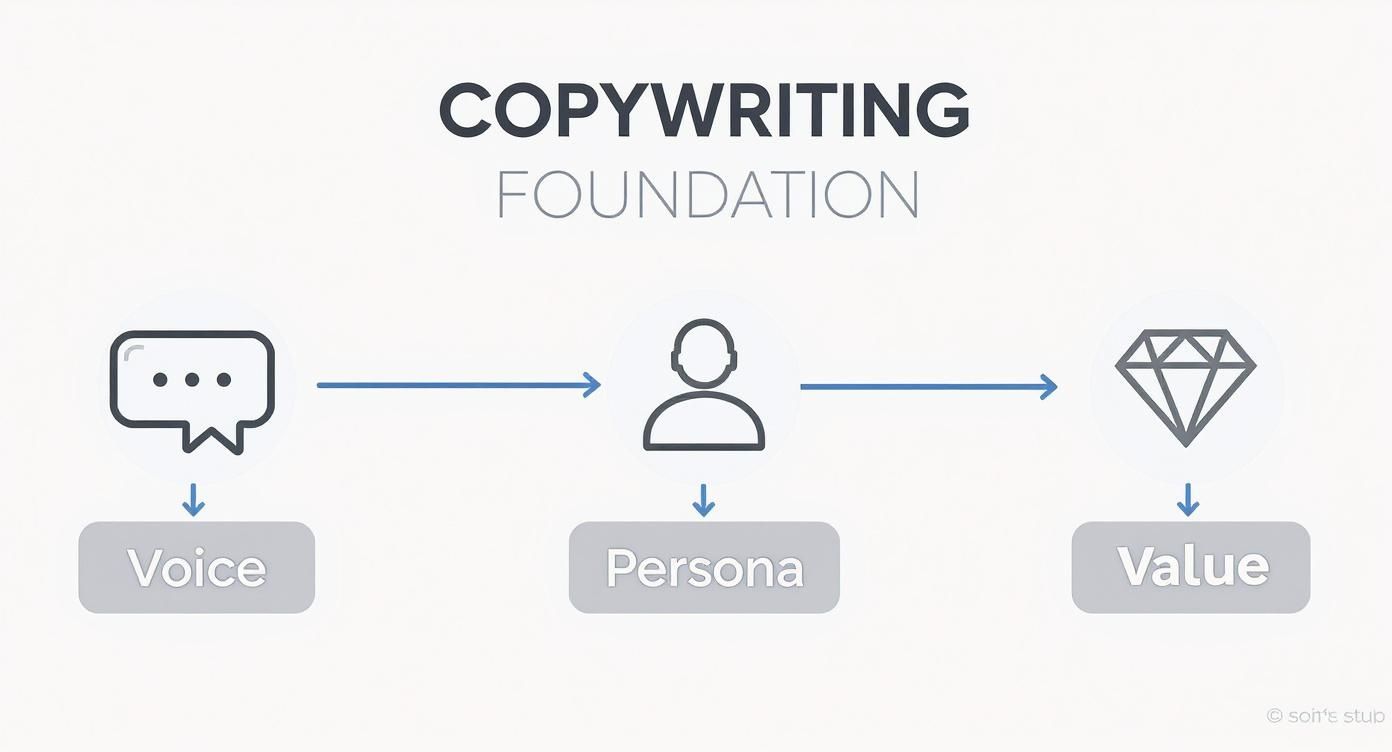
Get these three things right, and the words will practically write themselves.
Mastering the Homepage Copy
You have about three seconds. That's it. When someone lands on your homepage, the "above the fold" section—what they see without scrolling—has to work instantly. It must answer three questions without making the visitor think:
- What do you offer?
- Who is this for?
- Why should I care?
If they have to scroll and hunt for those answers, they're gone. This is where clarity crushes cleverness. Your main headline needs to be a sharp, focused value proposition that hits on a major pain point your customer experiences. Ditch the corporate jargon like "synergistic solutions" and get straight to the point.
That first headline is everything. In fact, websites with clear, benefit-driven headlines see a 25% higher conversion rate on average. That single sentence is your most powerful conversion tool. For more stats that drive this point home, you can discover more insights about copywriting statistics on jeremymac.com.
Pro Tip: Read your headline out loud. Does it sound like something you'd actually say to a person to explain how you can help them? If it sounds like a robot wrote it, start over. Keep tweaking until it sounds natural and compelling.
Just below your main headline, a short sub-headline can add a little more context or a secondary benefit. Follow that with a can't-miss Call to Action (CTA) button like "Get Started for Free" or "Book a Demo." To really seal the deal, sprinkle in some social proof right there—a row of client logos or a powerful customer quote builds instant trust.
Writing Compelling Product and Service Pages
Okay, so they clicked from the homepage to a product page. This is a huge step! Their interest level is high, and they are actively considering what you offer. Now's the time to zoom in from the big-picture value prop to the specific, tangible benefits.
The single biggest mistake I see here is just listing features. Nobody cares about the features themselves.
People don't buy a drill because they want a drill; they buy a drill because they want a hole. Your copy has to make that connection for them, translating every feature into a real-world outcome.
- Feature: "Our software includes a collaborative dashboard."
- Benefit: "Stop digging through messy email chains. Our dashboard brings your whole team's work into one place so you can track progress and hit deadlines without the chaos."
See the difference? The benefit paints a picture of a better life. Use clear subheadings to break the page into scannable chunks, with each section solving a specific problem for the customer. For a deeper dive, check out our guide on how to write product descriptions that truly sell.
Transforming Your About Us Page
Your "About Us" page is probably one of the most-visited pages on your entire site, yet so many businesses treat it like a dusty old filing cabinet for their corporate history. This is a massive missed opportunity.
People want to connect with other people, not with faceless corporations. This page is your chance to build that human connection and earn their trust on a deeper level. It’s not just about you; it's about why your story should matter to them.
Use this space to do three things:
- Tell your origin story. What was the "aha!" moment that sparked this business? People are drawn to purpose. Share the problem you were obsessed with solving.
- Show off your team. Put a face to the name! A few professional (but not stuffy) photos and short, personality-filled bios make your company feel real and approachable.
- State your values. What do you stand for beyond just making money? This is how you attract customers who aren't just buying a product, but buying into your mission.
When you tell a good story, your About page stops being a formality and starts being a core part of your sales funnel. It can be the very thing that convinces someone you're the right company to do business with.
Crafting Headlines and CTAs That Convert
Your headline is the digital handshake. Your Call to Action (CTA) is the signature on the dotted line. If you get these two things wrong, even the most persuasive, well-written copy on your website will fall flat.
Think of them as the bookends of your page. The headline’s job is to grab a visitor’s attention and make a powerful promise. The CTA’s job is to give them a dead-simple, compelling way to claim that promise. Get these right, and you’re not just writing words—you’re engineering a specific response from your ideal customer.

Decoding High-Performing Headlines
A great headline does way more than just describe the page's content. It needs to instantly connect with a reader's problem, make them feel seen, and promise a solution. It’s the hook that convinces them to keep reading instead of hitting the back button.
While your headline needs to work with your page's overall SEO, its number one job is to engage the human looking at the screen. To learn more about how your on-page headline and SEO page title work together, check out our complete guide on crafting the perfect SEO page title.
To get you started, here are a few battle-tested headline formulas you can start using right away.
It's helpful to see these formulas side-by-side to understand where each one shines.
Headline Formula Comparison
| Formula Type | Structure/Template | Example | Best Used For |
|---|---|---|---|
| Benefit-Driven | [Achieve Desired Outcome] without [Common Pain Point] | "Finish Projects On Time, Every Time" | Homepage heroes, feature pages, and any copy where the primary goal is to sell a solution. |
| Question | Are You [Struggling with a Common Problem]? | "Are Manual Spreadsheets Slowing Down Your Team?" | Blog posts, landing pages, and top-of-funnel content designed to agitate a pain point. |
| How-To | How to [Achieve a Specific Goal] | "How to Write a Website Brief That Gets Results" | Educational content like guides, blog posts, and tutorials where you're promising a clear takeaway. |
Each of these formulas forces you to think from the customer's perspective, which is the golden rule of copywriting.
When you're working on making these messages pop, exploring strategies for concise, impactful copywriting can give you an edge in making every single word pull its weight.
The Anatomy of a Call to Action That Works
Your CTA is arguably the most important snippet of copy on the entire page. It’s the moment of truth. This is where a visitor decides to take the next step or bounce.
Vague, lazy CTAs like "Submit" or "Learn More" are absolute conversion killers. They don't inspire action because they don't communicate value. What am I submitting? What will I learn? It’s a dead end.
A truly effective CTA has three key ingredients: a strong verb, a clear outcome, and zero friction.
Kick it off with an action verb. Words like Get, Try, Start, Build, or Join immediately tell the user what to do. They’re direct and motivating.
State the outcome clearly. What happens when they click that button? They should know exactly what they’re getting. "Download Your Free Ebook" is infinitely better than just "Download."
Kill the anxiety. Address their hesitations right then and there. Little phrases like "Free 14-day trial," "No credit card required," or "Cancel anytime" can dramatically boost clicks by removing any perceived risk.
A great CTA doesn't just ask for a click; it confirms the value the user will receive by clicking. It's the final, reassuring nudge that turns a passive reader into an active lead or customer.
Let’s look at a few quick makeovers.
Weak CTA: Subscribe
Strong CTA: Get Weekly SEO Tips
Weak CTA: Download
Strong CTA: Download Your Free Ebook
Weak CTA: Submit Form
Strong CTA: Request a Free Demo
See the difference? The stronger versions are specific, packed with value, and leave no room for doubt. That kind of clarity builds the trust needed to guide someone smoothly toward your conversion goal. By nailing these small but mighty pieces of copy, you can see a huge lift in your website’s performance.
Blending SEO and Copywriting Seamlessly
Incredible copy is worthless if no one ever sees it. This is where the powerful partnership between compelling writing and search engine optimization kicks in. SEO isn’t some dark art of stuffing pages with awkward keywords until they sound like a robot wrote them; it's about making it dead simple for search engines like Google to understand what your page is about and who it’s for.
Think of it like this: great copy is what persuades the visitor, but smart SEO is what brings that visitor to your digital doorstep in the first place. These two aren't at odds. In fact, when you get it right, they work together to create content that’s both easy to find and genuinely persuasive. The golden rule? Write for people first, then make smart tweaks for the search engines.
Understanding Search Intent
Before you can even think about blending SEO and copy, you have to get your head around search intent—the "why" behind what someone types into that search bar. A person searching for "best running shoes" is in a completely different headspace than someone searching "how to clean running shoes." The first person is ready to buy; the second just wants information.
Your copy has to match that intent. If you try to hard-sell a product on a page meant to inform, you’ll just annoy visitors and send your bounce rate through the roof. On the other hand, if you don't give clear buying options on a page targeting commercial intent, you're leaving money on the table. It’s that simple.
Finding the Right Keywords
Keyword research is your window into your audience's mind. It shows you the exact words and phrases they use when they’re looking for the solutions you offer. Sure, powerful tools like Ahrefs or Semrush are great, but you can uncover some real gems for free.
- Google Autocomplete: Just start typing a phrase related to your business into Google. The suggestions you see are real, popular searches people are making right now.
- "People Also Ask" Box: This little section in the search results is a goldmine. It shows you the related questions people are asking. Answering these directly in your copy is a brilliant way to add value and snag relevant traffic.
- Related Searches: Scroll to the bottom of any search results page. That list of similar queries can help you discover long-tail keywords and related subtopics you hadn't even thought of.
Your aim is to create a list of primary and secondary keywords for every page. Your primary keyword is the main target, while secondary keywords add context and depth. This whole process is the foundation of great content, and to really level up, check out these detailed SEO copywriting best practices for creating content that actually ranks.
SEO gives your copy visibility, but great copy gives that visibility a purpose. One without the other is a wasted opportunity. You need both to turn search engine traffic into actual business results.
Weaving Keywords into Your Copy Naturally
Once you have your keywords, the real art is placing them strategically without making your writing sound clunky or forced. Forgetting that a human has to read this is a surefire way to create content no one wants to read or share.
Here’s a quick checklist for on-page keyword placement:
- Title Tag: This is your prime real estate. Get your primary keyword in here, ideally near the beginning.
- Meta Description: It's not a direct ranking factor, but a killer meta description with your keyword will convince people to click from the search results.
- H1 Heading: Your main on-page headline needs to include that primary keyword.
- Subheadings (H2, H3): Sprinkle your primary and secondary keywords into subheadings where they feel natural and make sense.
- Body Content: Try to include your primary keyword within the first 100 words. After that, let it and your secondary keywords appear naturally throughout the text.
- Image Alt Text: This is for accessibility and SEO. Describe your images for visually impaired users and slip in a keyword if it’s relevant.
The key is to avoid "keyword stuffing" at all costs. If a sentence sounds unnatural, rewrite it. Modern search engines are smart enough to understand synonyms and related concepts—what we call semantic keywords. You don't need to hammer the exact same phrase over and over again.
Ultimately, seamless SEO copywriting feels effortless to the reader. It answers their questions, solves their problems, and guides them smoothly to the next step, all while sending the right signals to Google.
Refining and Testing Your Copy for Results
Here’s a hard truth for you: the first draft is never the final draft. It’s just the starting point. The real magic, where decent copy turns into something that actually drives sales, happens when you start editing and testing.
Think of it this way: writing is the art, but refining is the science. This is where you shift from, "I think this sounds pretty good," to, "I know this works because the numbers prove it." It means being your own toughest critic and letting your audience’s actions tell you what’s truly effective.

Practical Self-Editing Techniques
Before you even think about showing your copy to someone else, you need to put on your editor hat. Solid self-editing is what elevates your writing from okay to outstanding, making it punchier, clearer, and way more persuasive. Your goal is to trim the fat and make every single word fight for its spot on the page.
One of the best tricks in the book is simply reading your copy out loud. Seriously. It forces you to slow down and actually hear the rhythm of your sentences. You'll immediately spot the awkward phrasing and clunky sentences. If you find yourself stumbling over a line, you can bet your readers will, too.
Then, it's time for the ruthless trim. Go through your draft line by line and challenge everything.
- Can you say it more simply? (e.g., "utilize" just becomes "use")
- Is that adverb adding anything? (e.g., "really important" is just "important")
- Are you using passive voice? (e.g., "The button was clicked by the user" becomes "The user clicked the button")
This isn't about just making your copy shorter. It’s about making it denser and more impactful.
Using Data to Optimize Your Words
Once your copy is polished, it’s time for the real test: putting it in front of an actual audience. This is where A/B testing, or split testing, becomes your best friend. It’s the process of creating two versions of your copy (a Version A and a Version B) and showing them to different segments of your audience to see which one performs better.
A/B testing takes the guesswork out of copywriting. Instead of going with your gut, you’re using cold, hard data to make decisions that directly boost your conversion rates.
You don’t have to test everything all at once. That would be overwhelming. Instead, focus on the elements that are likely to have the biggest impact on your goals.
High-Impact Elements to A/B Test:
- Homepage Headlines: Pit a benefit-driven headline against one that asks a compelling question.
- Call to Action (CTA) Buttons: Test something simple like "Get Started for Free" against a more active phrase like "Create Your Free Account."
- Value Propositions: Try framing your core benefit in two completely different ways to see what resonates.
Tools like Google Optimize or Optimizely make this surprisingly easy to set up. The golden rule is to only change one variable at a time. If you change both the headline and the CTA copy, you’ll have no idea which change actually made the difference.
To measure your results properly, you need to know which numbers to watch. Understanding the key website metrics to track—like conversion rate, click-through rate, and bounce rate—is non-negotiable. This creates a powerful feedback loop where every test teaches you a valuable lesson, helping you iterate your way to copy that flat-out works.
Your Website Copywriting Questions, Answered
Even with the best playbook in hand, questions always come up in the trenches of a real copywriting project. Let's tackle some of the most common ones I hear from clients and colleagues to clear things up.
How Long Should My Website Copy Be?
The real answer? It depends. I know that's not what you want to hear, but there's truly no magic word count.
A landing page for a simple, free browser extension might only need 150-300 words to seal the deal. But a long-form sales page for a $5,000 coaching program? That might need upwards of 2,000 words to build enough trust, explain the value, and handle every single objection a potential buyer might have.
The right length is whatever it takes to make your case persuasively, and not one word more. Don't chase word counts; chase clarity and impact.
The goal is to match the depth of your copy to the complexity of what you're asking the visitor to do. The more commitment (money, time, data) you're asking for, the more you need to write. Always prioritize answering your reader's questions over hitting some arbitrary number.
Can I Use AI for Website Copywriting?
Absolutely, but think of AI as a very smart, very fast intern—not the final decision-maker. AI writing tools like Jasper or Copy.ai are brilliant for busting through writer's block or getting a first draft on the page.
They can spit out dozens of headline ideas in seconds, structure a blog post, or summarize a competitor's features. They're fantastic for the grunt work.
But here's the catch: AI models are trained on the entire internet. That means they tend to produce safe, generic, and often soulless copy that sounds like a mashup of everything else out there. Studies even show that relying too heavily on AI can dampen original thought.
- Lean on AI for: Brainstorming, outlining, and drafting basic descriptions.
- Rely on a human for: Nailing your core value proposition, telling your unique brand story, and injecting personality that actually connects with another human.
Your brand's soul, your customer war stories, and your quirky personality are your biggest competitive advantages. AI can't fake that.
How Do I Write for a Niche Audience?
This is where the real fun begins. Writing for a niche is a superpower because you can drop the generic corporate speak and get hyper-specific. You don't have to water down your message for everyone; you get to talk directly to your people.
To do this right, you have to become one of them. Go hang out where they hang out online. Read the industry blogs they swear by, lurk in their favorite subreddits, and join the same Slack communities. Pay close attention to the language, the acronyms, and the inside jokes.
When you can use their lingo and reference their specific pain points—the ones that a generalist would never know about—you build instant credibility. It makes them feel understood. That's the moment a casual browser thinks, "Okay, these people get it," and starts to become a real fan.
Ready to transform your SEO content strategy into a powerful growth engine? IndexPilot uses trainable AI Agents to automate everything from keyword discovery and content creation to optimization and publishing, helping you scale organic traffic without the manual busywork. Start compounding your traffic today.