Low-competition keywords are simply search queries that are easier to rank for on Google, usually because they have a lower keyword difficulty score. Think of them as long-tail keywords—those longer, more specific phrases people type in when they know exactly what they’re looking for. They attract highly targeted traffic without forcing you to go head-to-head with the industry giants.
Why Low Competition Keywords Are Your Secret SEO Weapon

Let’s be honest: the old SEO myth that high search volume is the only thing that matters is just plain wrong. Too many businesses burn through their budgets battling for broad, hyper-competitive keywords, only to get stuck on page five of the search results.
There’s a much smarter way to play the game.
Low-competition keywords are the strategic backdoors into the SERPs. They represent pockets of high user intent with far lower barriers to entry. Instead of fighting for a tiny sliver of a massive pie, you get to claim the entire slice of a smaller, more relevant one. For any small business, mastering these terms is a core part of a winning small business content marketing strategy.
The Power of Untapped Potential
The data paints a clear picture of a massive, overlooked opportunity. A staggering 92% of all keywords get fewer than 10 searches per month. These aren't worthless—they're goldmines.
Because so few websites bother targeting them, the door is wide open for you. Going after these terms is a proven way to drive real results and get a better handle on what is organic search traffic in the first place.
Don't just take my word for it. The numbers show that long-tail keywords, which make up the vast majority of all searches, are reported to convert 2.5 times better than short, broad terms. Why? Because they capture users who are much further along in the buying process and are searching with very specific needs.
A Smarter Path to Growth
Focusing on low-competition keywords is simply a more efficient path to organic growth, especially if you're trying to make a name for yourself in a crowded market.
This strategy helps you:
- Achieve Quicker Wins: It’s far more realistic to hit page one for a less competitive term in a few months, not the years it might take for a high-difficulty keyword.
- Build Topical Authority: When you consistently rank for related, specific queries, you send powerful signals to Google that you're an expert in your niche. This authority makes it easier to rank for bigger keywords down the road.
- Attract Qualified Traffic: The intent behind long-tail searches is crystal clear. Someone searching for "best waterproof running shoes for flat feet" is a much hotter lead than someone just typing "running shoes."
High Competition vs Low Competition Keywords At a Glance
To make the distinction even clearer, here's a quick side-by-side comparison. This table breaks down the core differences between chasing high-volume head terms and strategically targeting low-competition phrases.
| Metric | High Competition Keywords | Low Competition Keywords |
|---|---|---|
| Search Volume | Very High | Low to Medium |
| Keyword Difficulty (KD) | High (70+) | Low (<30) |
| Ranking Effort | Intense (requires strong domain authority, many backlinks) | Minimal to Moderate |
| Time to Rank | Long (6-12+ months) | Short (2-6 months) |
| User Intent | Broad, often informational | Specific, often transactional or commercial |
| Conversion Rate | Generally Low | Generally High |
| Ideal For | Established brands with high authority | New websites, small businesses, niche blogs |
As you can see, the path of least resistance often leads to the most qualified traffic and the quickest wins. While high-competition keywords have their place, a strategy built on low-competition terms provides the foundation for sustainable growth.
Learning to Spot Genuine Ranking Opportunities
This is where the real work begins—moving past theory and learning how to find low-competition keywords that you can actually rank for. While metrics like Keyword Difficulty (KD) and Domain Authority (DA) are handy for a first pass, relying on them alone is like trying to navigate with only half a map. True opportunities aren't just found in spreadsheets; they're hiding in plain sight on the search engine results pages (SERPs).
The skill you need to build is learning to read a SERP like a seasoned pro. It's about looking past the numbers and spotting signs of weakness in the top-ranking pages. These are the cracks in the armor your content is designed to break.
Reading Between the Lines of the SERP
Next time you search for a potential keyword, don't just glance at the titles and call it a day. Really scrutinize the top five to ten results. You're looking for tell-tale signs that the competition is much softer than the metrics might suggest.
So, what are the dead giveaways?
- Forum and Community Posts: Seeing a Reddit or Quora thread on page one is a massive green light. User-generated content often ranks by default simply because no one has bothered to create a dedicated, authoritative article to answer the question.
- Low-Authority Websites: If you spot a site with a low Domain Authority (DA) hanging out in the top results, it’s a clear sign that Google is willing to rank smaller or newer players for that term. That means you have a real fighting chance.
- Outdated or Thin Content: Click into the top-ranking articles. Are they from 2018? Is the advice stale? If the content is short, poorly written, or obviously outdated, a fresh, comprehensive piece can easily knock it off its perch.
Here's the key insight: Google's number one job is to give the user a great answer. If the current top results are full of weak, outdated, or user-generated content, it signals a "content gap." A well-crafted article can fill that gap and climb the rankings surprisingly fast.
Metrics as a Starting Point, Not the Finish Line
Keyword tools are indispensable for sifting through mountains of data, but their metrics always need a human touch. A low KD score is a great starting point, but it's no guarantee of an easy win if the SERP is still stacked with household-name brands.
On the flip side, a keyword with a medium difficulty score might be a hidden gem if your SERP analysis reveals the weaknesses we just talked about. Your manual review is the final, crucial step in qualifying a keyword. This deeper dive helps you understand not just who is ranking, but why they are ranking—and how you can do it better. To really get into the weeds on this, our guide on a comprehensive SEO competitor analysis breaks down the entire framework.
This hands-on approach is how you uncover the keywords that the tools, and your competitors, will almost certainly miss.
The Power of Topical Clusters
Instead of hunting for a single "perfect" keyword, start thinking in terms of topics. The most powerful strategy is to build a cluster of related low-competition keywords around a central theme. When you target several of these interconnected queries, you build topical authority at a much faster pace.
For example, instead of just going after "best coffee beans," you could build a cluster that includes:
- "what is light roast coffee good for" (KD 15)
- "how to store whole bean coffee" (KD 12)
- "arabica vs robusta taste difference" (KD 20)
By creating great content for each of these, you send a strong signal to Google that you're an expert on the broader topic of coffee. Over time, this interconnected authority helps all of your related pages rank higher.
This isn't just theory; it's backed by real-world data. Low-competition keywords, often those with a Keyword Difficulty under 30%, exist outside the chaotic battle for broad terms. Agency benchmarks consistently show that pages targeting these terms can start ranking months faster than their high-competition counterparts—a huge advantage when SEO is a long game. This strategy doesn't just pull in traffic; it builds a defensible moat of expertise around your core business topics.
Your Workflow for Uncovering Hidden Keyword Gems
Finding low-competition keywords isn't about getting lucky; it's about having a repeatable process. A solid workflow is what separates chaotic guesswork from a systematic hunt for real ranking opportunities. It's how you make data-backed decisions on where to put your content efforts.
The whole idea is to start with broad concepts and whittle them down to a validated, prioritized list. You're combining creative brainstorming with cold, hard analysis to find the terms your competitors have completely missed.
Generating Your Initial Seed List
Every keyword research project I've ever run starts with a "seed list." These aren't your final targets. Think of them as the broad topics and starter phrases that will fuel the entire discovery process. The goal here is to cast a wide net, so don't get hung up on judging ideas just yet.
Often, the best ideas come from listening, not searching.
- Dig into Customer Feedback: Your support tickets, sales call notes, and customer reviews are pure gold. They're filled with the exact language your audience uses. Look for the questions that keep popping up—those are your seed keywords.
- Explore Google's Own Clues: Type a broad topic into Google and look closely at the "People Also Ask" box and the "Related searches" at the bottom. Google is literally telling you what people are looking for next.
- Brainstorm Like a Customer: Get inside your customer's head. What problem are they trying to solve right now? A query like "how to integrate project management software with calendar" is a much stronger seed than just "project management software."
Once you have this initial list, the analysis begins. This process flow chart breaks down the core steps.
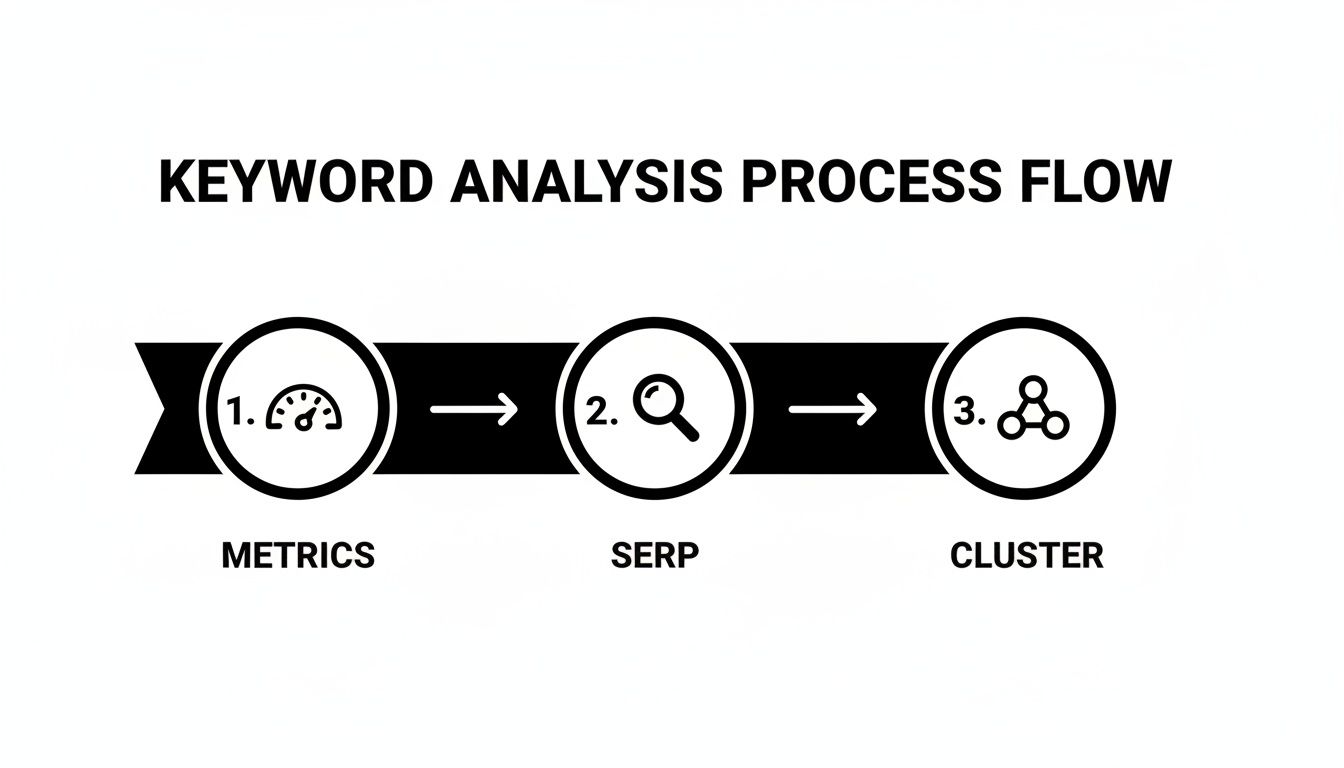
As you can see, good analysis isn't a single step. It's a journey from checking the metrics to diving deep into the SERP, and finally, grouping keywords into smart, strategic clusters.
Expanding and Filtering Your Ideas
With your seed list ready, it's time to blow it up into a massive pool of potential keywords and then ruthlessly filter out the high-competition noise. This is where keyword research tools like Ahrefs or Semrush are indispensable.
These tools can take one of your seed terms and spit out thousands of related phrases, questions, and long-tail variations. Even free tools like Google Keyword Planner can give you some decent ideas, though it's built more for advertisers. Your goal is simple: build a huge list that you can then systematically chop down.
My personal pro-tip is to filter aggressively from the get-go. Set a maximum Keyword Difficulty (KD) of 20 or 30 in your tool. This one move can instantly eliminate 80-90% of the keywords that are just too tough for a new or growing site. It will save you hours.
This filtering stage is all about efficiency. Nobody has time to manually sift through thousands of keywords. For teams looking to streamline this, looking into an SEO automation platform can automate a lot of the heavy lifting in discovery and filtering, freeing you up to focus on strategy.
Mastering Manual SERP Vetting
Okay, you've got a filtered list of promising, low-KD keywords. Now for the most important step: manual vetting. This is where you look past the tool's numbers and use your own expert judgment to analyze the actual, live search results page.
A keyword might have a low KD score, but if the first page is packed with household names, it’s still going to be a tough climb. On the flip side, a medium-KD term could be a golden opportunity if the top results are all forum posts and weak articles.
A great tactic here is using Google search operators—simple commands that refine your search.
intitle:"your keyword": This shows you exactly how many pages have your keyword phrase in their title tag. A low number of results, say under 500, is a fantastic sign of low on-page competition.inurl:"your keyword": This works the same way but checks the URL. If very few sites have created a dedicated page for that specific term, you've likely found a gap.
For example, if you're vetting "content marketing for plumbers," run a search for intitle:"content marketing for plumbers". If you only see a couple of dedicated articles and the rest are generic marketing posts, you've found an angle you can own.
Uncovering Opportunities with Competitor Gap Analysis
One of the sneakiest—and most effective—ways to find proven, low-competition keywords is to see what's already working for your competitors. I'm not talking about the industry giants, but the sites that are just a little bigger than you.
A competitor gap analysis is all about finding the keywords your competitors rank for that you don't. SEO tools make this dead simple. You just plug in your domain and a few competitor domains, and the tool will spit out a list of "keyword gaps."
From there, you just apply the same filters we've already discussed: look for terms with low KD scores and decent search volume. This takes all the guesswork out of the process. You're left with a list of keywords that are not only relevant but are already proven to drive traffic for a business just like yours.
Advanced Tactics for Finding Untapped Keywords
When you're ready to move past the standard keyword research workflow, you’ll discover a world of opportunity your competitors are completely ignoring. Going deep isn't about staring at a tool's dashboard; it’s about understanding human behavior—where your audience talks, what they're struggling with, and the exact words they use to describe their problems. This is how you find genuinely low-competition keywords before they even hit the SEO radar.
These unconventional sources often unearth queries that are raw, unfiltered, and packed with intent. By tapping into them, you’re not just finding keywords. You’re discovering the authentic voice of your customer, which is a massive advantage for creating content that truly connects and ranks.
Mine Real Conversations in Online Communities
Your audience is already having detailed conversations online about their needs, frustrations, and ideal solutions. Places like Reddit, Quora, and niche industry forums are absolute goldmines for keyword ideas because the language is completely natural and specific. People don’t use marketing jargon; they describe their issues in their own words.
I often spend time lurking in subreddits related to my industry, filtering posts by "New" or "Hot." Pay close attention to the titles of threads where people are asking for help or advice.
- Look for problem-based language: Phrases like "how do I fix," "best way to connect," or "is it possible to integrate" are perfect seeds for how-to content.
- Identify product or service comparisons: Users constantly ask for opinions like "[Product A] vs [Product B] for small teams." These are high-intent keywords just waiting for a detailed comparison post.
- Note the specific terminology: You might discover long-tail phrases that SEO tools would never suggest because they are so niche, yet they represent a highly motivated searcher.
The Untapped Gold of Zero-Volume Keywords
It sounds completely backward, but some of the most valuable keywords are the ones your SEO tools report as having "zero" search volume. These are often brand new, hyper-specific long-tail queries that the tools just haven't caught up with yet. A "zero-volume" keyword doesn't mean no one is searching for it; it just means not enough people are searching for it to hit a tool's reporting threshold.
The real value here is in the specificity. A query like “integrating [Your Product] with Salesforce for lead scoring” might show zero volume, but the person searching for it is at the bottom of the funnel, ready to make a decision. One conversion from that single search can be worth more than a thousand visits from a broad, informational term.
This strategy is especially potent in fast-moving industries like tech and SaaS. You're basically capitalizing on the fact that 15% of daily Google searches are brand new queries that have never been seen before. You can discover more fascinating SEO statistics and how to use them on keyword.com.
Uncover Clues in Your Own Backyard
Sometimes the best keyword ideas are hiding in plain sight. One of the most overlooked sources is your own internal site search data. The queries people type into the search bar on your website are a direct line into their minds. They are telling you exactly what they're looking for and, more importantly, what they can't easily find.
Analyzing this data can expose huge content gaps. If you see multiple searches for "how to export reports to PDF" and you don't have an article on that topic, you've just been handed a perfect, low-competition keyword on a silver platter.
| Data Source | What It Reveals | Actionable Step |
|---|---|---|
| Internal Site Search | What users can't find on your site. | Create content to fill the most common search gaps. |
| Podcast Transcripts | Emerging trends and conversational phrases. | Search transcripts for keywords and questions from experts. |
| Customer Support Tickets | The most pressing and recurring user problems. | Turn common support questions into detailed blog posts. |
By weaving these advanced methods into your process, you shift from simply finding keywords to truly anticipating your audience's needs. This allows you to group related ideas together effectively, which is a key part of what is keyword clustering and building real topical authority. The goal is to create content that answers questions before they are even widely asked, establishing you as the go-to resource in your space.
Turning Your Keywords into High-Ranking Content

Finding a killer list of low-competition keywords feels like a major win. But let's be honest—that's just the halfway point. The real work begins now. You have to take that promising keyword from a line in your spreadsheet and turn it into a high-quality, traffic-driving piece of content that Google wants to rank.
This is where a lot of SEO strategies completely fall apart. It’s not enough to just find an "easy" keyword. You have to build content that nails the user's search intent so perfectly they have no reason to hit the back button.
Aligning Content with Search Intent
Every keyword, especially a specific long-tail query, carries a clear search intent. It's the "why" behind the search. Before you even think about writing, you have to play detective and figure out what the user is actually trying to accomplish.
Are they trying to learn something? Compare options? Buy something right now? The answer to that question will shape everything—the format, the tone, and the entire structure of your article.
- Informational Intent: These are your classic "how to," "what is," or "why" searches. Your job is to be the teacher. The content needs to be educational, providing step-by-step instructions or crystal-clear explanations.
- Commercial Intent: Think phrases like "best X for Y," "product reviews," or "brand alternatives." Here, you're the trusted advisor. The content must be comparative and balanced, helping people make a smart decision.
- Transactional Intent: Keywords with terms like "buy," "pricing," or "discount" signal someone is ready to pull out their wallet. This calls for a direct landing or product page that makes buying as frictionless as possible.
Getting the intent wrong is the fastest way to fail, even with a keyword that has zero competition. If a user is looking for a product comparison and you serve up a history lesson, they're gone. That bounce sends a loud and clear signal to Google: this page isn't helpful.
Building Your On-Page SEO Foundation
Once you've got a lock on the search intent, it's time to build your content with on-page SEO best practices. These are the technical and structural cues that help search engines understand what your page is all about and why it's a worthy result.
Think of them as signposts for Google's crawlers. The clearer your signposts, the easier it is for Google to do its job. It's a fundamental part of the process, which we cover in-depth in our complete guide on how to write SEO-friendly blog posts.
The most successful content for low-competition terms is often the piece that is simply the most organized and user-friendly. You don't always need to reinvent the wheel; you just need to build a better, smoother road for the user to travel on.
Your on-page SEO checklist should always have these core elements covered:
- Optimized Title Tag: Your title tag is arguably the single most important on-page factor. It needs to include your primary keyword (ideally near the start) and be interesting enough to actually earn a click in the search results.
- Engaging Meta Description: While it's not a direct ranking factor, your meta description is your ad copy on the SERP. It should quickly summarize the value of your page and give users a compelling reason to click.
- Logical Heading Structure (H1, H2, H3): Use one—and only one—H1 for your main title. Then, break up the content with descriptive H2s and H3s that include related terms and make the article a breeze to scan.
- Descriptive Image Alt Text: Alt text isn't just for accessibility; it helps search engines "see" your images. Describe what's in the image, and if it feels natural, include a relevant keyword.
- Strategic Internal Linking: Link out to other relevant articles on your own site. This is huge for spreading authority around your website and keeping users engaged, which tells Google you're an expert on the topic.
Expanding Beyond the Main Keyword
To truly own a topic, even a low-competition one, you have to think bigger than a single keyword. The best content is comprehensive. It covers related subtopics, uses synonyms, and answers the follow-up questions users will inevitably have. This is how you build real topical authority.
After you've found your low-competition keywords, the mission is to create content that dominates. If you're creating video, for example, mastering YouTube SEO best practices is what turns a good idea into a high-ranking asset. The same principle applies here—go deep, not just wide.
One of the easiest ways to find these related topics is to look at the "People Also Ask" and "Related searches" sections on Google. These are literally free insights from Google about what else people are looking for. Weave these questions and topics into your content, and you’ll create a one-stop resource that fully satisfies the user's entire journey.
Common Questions About Low Competition Keywords
Diving into a strategy built around low-competition keywords always brings up a few practical questions. It’s one thing to get the theory, but it’s another to feel confident putting it into practice.
Think of this section as your quick-reference guide. We'll tackle the most common questions and hurdles people face, from timing and new websites to zero-volume terms and balancing your overall SEO efforts.
How Long Does It Take to Rank for These Keywords?
This is the million-dollar question, and the answer is usually a pleasant surprise. While there's no magic number, pages targeting genuine low-competition keywords often start seeing real movement—and even hitting the first page—within 2 to 4 months.
That’s a world away from the 6 to 12 months (or much, much longer) you’d wait for highly competitive terms. Of course, a few things can speed this up or slow it down:
- Your Website's Authority: An established site with some history will naturally rank faster than a brand-new one.
- Content Quality: A truly comprehensive, well-structured article that nails user intent will always outperform thin, generic content.
- Technical SEO Health: A fast, mobile-friendly site with no crawl errors gives you a huge head start.
The goal here isn't just about speed. It’s about securing quick wins that build momentum, traffic, and long-term authority.
Can a Brand New Website Rank for These Keywords?
Absolutely. In fact, this is the single best SEO strategy for a new website.
Trying to go head-to-head with established industry giants for broad, high-volume keywords is a recipe for frustration. You'll spend months creating content that goes nowhere.
Instead, when you target keywords where the SERP is already weak—filled with forums, outdated articles, or other low-authority sites—a new site has a real fighting chance.
A high-quality, intent-focused article from a brand-new domain can break into the top 10 for these terms. It's the most effective way to build that initial topical authority and generate your first crucial wave of organic traffic.
Should I Target Keywords with Almost Zero Search Volume?
Don't dismiss them out of hand. What a tool reports as a "zero-volume" keyword can often be a hidden gem.
Keyword tools are notoriously slow to pick up on new trends or hyper-specific long-tail queries. But these ultra-specific searches often signal incredibly strong user intent. The key is to look for commercial or transactional modifiers in the query.
If a keyword includes terms like "pricing," "alternative," "integration," or a specific feature name, it represents someone who is very close to making a decision. One highly qualified lead from a "zero-volume" keyword can easily be more valuable than hundreds of casual visitors from a broader, more informational term.
How Do I Balance Low Competition and High Volume Keywords?
A smart, mature SEO strategy doesn't choose one over the other; it uses both in a tiered approach. Think of it like building a strong foundation before you start trying to put up a skyscraper.
Start by focusing on low-competition keywords to secure those quick ranking wins. This builds a base of topical authority and brings in your initial traffic. As your site's overall authority grows from this traffic—and the backlinks it naturally attracts over time—you can start to aim higher.
Use your foundational content as a launchpad. Internally link from your successful low-competition articles to your new pages that are targeting more competitive, higher-volume keywords. This strategy creates a powerful, interconnected web of authority that helps your entire site rise in the rankings.
Ready to turn AI and search insights into a steady stream of high-ranking content? Sight AI is the platform that helps you get discovered. We analyze what leading AI models say about your brand, uncover your competitors' ranking secrets, and then generate SEO-optimized articles to fill those gaps—all on autopilot. Start building your authority with Sight AI today.