
An SEO competitor analysis is simply the process of digging into the websites that rank for your target keywords to figure out what they're doing right—and where they're dropping the ball. It means analyzing their keywords, content, backlinks, and even their technical SEO to find opportunities you can use to climb the rankings yourself.
Mapping Your SEO Competitive Landscape

Before you can even think about building a winning strategy, you need a clear map of the battlefield. The very first step in any worthwhile SEO competitor analysis is identifying who you’re really up against.
This sounds obvious, but your true SEO competitors are often not who you think they are. They aren't just the direct business rivals you trash-talk in sales meetings. In the world of search, your competitors are any website, blog, or publisher that takes up real estate on the search engine results pages (SERPs) for the keywords you want to own.
This distinction is everything. A local plumbing company’s direct competitor is the plumbing business across town. But their SEO competitors might include Forbes, This Old House, or some popular home improvement blog that ranks for "how to fix a leaky faucet." Getting this right is the foundation of a successful analysis.
The Three Types of SEO Competitors
To build a realistic map, you need to sort your competitors into a few different buckets. This helps you see the different kinds of threats and opportunities each one brings to the table. A truly thorough analysis will look at these three distinct groups.
Here’s a quick breakdown to help you categorize who you’re up against and how to spot them in the wild.
Identifying Your True SEO Competitors
| Competitor Type | What It Means for You | How to Find Them |
|---|---|---|
| Direct Competitors | These are the businesses offering the same products or services to your exact audience. You're fighting them for both customers and rankings. | Your sales team already knows them. You can also find them by searching your main product/service keywords. |
| Indirect Competitors | They solve the same customer problem but with a different solution. They aren't selling a competing product, but they are stealing traffic from potential customers. | Think about alternative solutions. For a meal kit service, this could be a blog with quick dinner recipes. Search for "problem-based" keywords. |
| SERP Competitors | This is anyone who consistently ranks for your target keywords, regardless of their business model. This could be news sites, forums, or review aggregators. | Use an SEO tool like Ahrefs or Semrush. Enter your domain and look at the "Competing Domains" report to see who ranks for the same keywords. |
This table gives you a framework, but remember the goal isn't just to make a list. It's about figuring out why Google is rewarding these sites.
Your goal is not just to identify these players but to understand why Google rewards them. It's about deconstructing their success to find a blueprint for your own.
Analyzing SERP competitors is especially eye-opening. They show you the exact type of content and level of authority Google expects for a specific query. For example, if you see that video tutorials are all over page one for a keyword, stubbornly writing another blog post is probably a waste of time and money.
Establishing Your Pillars of Analysis
Once you have a solid list of competitors, it's time to decide what you're going to analyze. This framework keeps you focused and ensures you gather data that actually leads to smart decisions.
There are four essential pillars to look at:
- Keywords: What terms are they ranking for that you aren't? Where do your keyword sets overlap?
- Content: What topics do they cover in-depth? What formats (blogs, videos, free tools) are getting them the most traction?
- Backlinks: Who is linking to them and why? Where are their most powerful, authoritative links coming from?
- Technical SEO: How is their site structured? Is it fast? Is the user experience clean? Little things add up, and knowing how to improve on-page experience can give you an edge. In fact, digging into tactics for how to lower bounce rate can reveal a lot about a competitor's site quality.
This initial recon mission sets the stage for everything else. By understanding how competitors build topical authority through a smart mix of content and links, you start to see the bigger picture of what is semantic SEO and how it all connects to rankings. This groundwork turns your analysis from a simple data-dump into a strategic planning session, getting you ready to find—and exploit—the gaps they’ve left wide open.
Reverse Engineering Your Competitors' Keyword Strategy

Here's a little secret: your competitors have already done a lot of the heavy lifting for you. They've spent time and money figuring out what works, leaving behind a trail of valuable keyword data. The real art of SEO competitor analysis is learning how to follow this trail to uncover their entire keyword strategy—not just a spreadsheet of terms.
This process starts with a keyword gap analysis. Think of it as finding pockets of unguarded territory on the SERPs. These are the valuable keywords your competitors are ranking for, but you aren't. By pinpointing these terms, you can directly target their audience with content you already know has a proven demand. It’s one of the quickest ways to find actionable opportunities.
In fact, businesses that regularly conduct keyword gap analyses see up to 30% higher organic traffic growth than those who don't. Tools like Semrush and Ahrefs are indispensable here. Semrush's Keyword Gap tool, for example, lets you compare up to five competitors side-by-side, often revealing 40-50% of untapped traffic opportunities. You can also find a great list of competitor analysis tools to enhance your insights on Metricool.com.
Prioritizing Your Keyword Opportunities
So, you've run the analysis and now you have a massive list of keywords. A list of 500 keywords is just noise without prioritization. The next step is to filter this raw data through a strategic lens to find the true gems.
I always evaluate potential keywords based on a few key metrics:
- Search Volume: How many people are actually searching for this term each month? Higher volume isn't always the goal, but it's a critical starting point.
- Keyword Difficulty: How hard will it really be to rank? The score in a tool is one thing, but you have to manually check the SERP. Are the top spots all held by massive authority sites? Or is there room for you?
- User Intent: What is the searcher actually trying to accomplish? Are they trying to learn something, buy something, or just find a specific website?
- Business Relevance: Is this keyword going to attract your ideal customer? Ranking for a high-volume term that brings in the wrong audience is a complete waste of resources.
This filtering process is what separates the high-impact opportunities from the distracting vanity metrics. You'll often discover that lower-difficulty, long-tail keywords offer a much faster path to relevant traffic than trying to battle it out for highly competitive head terms.
Decoding the Strategy Behind the Keywords
Knowing what your competitors rank for is just the first layer. The real strategic insight comes from understanding why. This means looking at the types of keywords they target to deconstruct how they map content to the customer journey.
I like to categorize their keywords by user intent:
- Informational Keywords: These are your "how-to," "what is," and "best ways to" queries. They target users at the top of the funnel who are looking for answers and education, not necessarily a product—at least not yet.
- Transactional Keywords: These are the money terms. They include words like "buy," "pricing," or specific product names. They capture users at the bottom of the funnel who have their wallets out.
- Navigational Keywords: These are simply searches for a specific brand or website. While you can't really rank for a competitor's brand name, looking at their branded search volume gives you a solid idea of their brand equity.
Analyzing this mix reveals their entire content playbook. Are they investing heavily in top-of-funnel informational content to build authority and capture an audience early? Or are they laser-focused on bottom-funnel transactional pages? This understanding helps you spot the strategic gaps they've left wide open.
A competitor with a strong transactional keyword presence but weak informational content has left a massive opening for you to become the go-to educational resource in your niche.
For instance, a B2B SaaS startup might find its bigger rivals totally dominate high-volume transactional keywords like "project management software." But a deeper dive could show they completely ignore long-tail informational queries like "how to create a project timeline for a marketing campaign."
By creating the single best guide on that topic, the smaller company can start siphoning off a highly relevant audience their competitors missed. This is how a simple keyword list transforms into a powerful roadmap for creating content that actually ranks and converts. And of course, keeping a close eye on your progress is critical, which is where understanding what is rank tracking comes in to measure the real impact of your efforts.
Finding Your Next Big Win with Content Gap Analysis
Great content is your strongest weapon in the SEO wars, and a thorough content gap analysis tells you exactly where to aim it. Once you've reverse-engineered your competitors' keyword strategy, the next logical step is to dissect the actual content they've created.
This isn't just about finding topics you've missed. It's about deeply understanding what resonates with your shared audience and spotting clear opportunities to build something far better.
Dissecting Top-Performing Content
The first move is to identify your competitors' home-run articles. Using a tool like Ahrefs or Semrush, you can simply plug in a competitor's domain and see which pages are pulling in the most organic traffic.
This list is a goldmine. Seriously. It’s a data-backed blueprint of what your target audience already loves to read, watch, or engage with.
Once you have this list, the real analysis begins. Don't just glance at the topics—you need to break down why each piece is so successful. Your goal is to deconstruct their success so you can build a superior version.
Look for patterns in a few key areas:
- Content Format: Are their top pages massive long-form guides, quick video tutorials, interactive calculators, or simple listicles? This tells you what format Google seems to prefer for these topics and what users find most valuable.
- On-Page SEO: How are they using headers (H1, H2, H3s)? What does their internal linking look like? Are their images optimized? Pay attention to how they structure information for both readability and for search engine crawlers.
- Depth and Uniqueness: Is their content genuinely insightful with original data or a unique perspective? Or is it just a generic summary of information you can find anywhere else? This is often where you can find an easy win.
A competitor might be ranking well with a decent article that's a few years old and starting to feel stale. This is a prime opportunity for you to create a more current, in-depth, and visually engaging piece that can steal their spot.
Your Competitor Content Analysis Checklist
To make this process more systematic, use a checklist. This helps you grade your competitors' content objectively and, more importantly, turns your findings into a concrete plan for creating something that blows their work out of the water.
| Element to Analyze | Key Questions to Ask | Your Action Item |
|---|---|---|
| Headline & Intro | Does the headline grab attention? Is the intro compelling and clear? | Brainstorm 5+ superior headlines. Write an intro that hooks the reader faster. |
| Content Depth | Is the information comprehensive or surface-level? Are key subtopics missing? | Outline a more thorough piece. Identify 3-4 subtopics they missed or covered poorly. |
| Uniqueness/Angle | Does it offer original research, expert quotes, or a unique perspective? | Plan to include proprietary data, interview an expert, or approach from a fresh angle. |
| Format & Readability | Is it a wall of text? Does it use images, videos, or custom graphics? | Plan for better formatting: short paragraphs, bullet points, custom visuals, and maybe a video. |
| On-Page SEO | How is it structured with H2s/H3s? Is the keyword usage natural? | Create a logically structured outline with SEO-friendly headers. |
| Internal Linking | Do they link to other relevant resources on their site? | Identify 3-5 of your existing articles to link to from your new piece. |
| Call to Action (CTA) | Is there a clear next step for the reader? | Define a clear, relevant CTA for your content (e.g., download a template, book a demo). |
By the end of this exercise, you won't just have notes—you'll have the blueprint for a piece of content that's engineered from the ground up to be better than what's currently ranking.
Uncovering the Gaps Your Competitors Missed
Analyzing what your competitors do have is only half the battle. The real magic happens when you find what they're missing entirely.
This is where a true content gap analysis comes into play. You're looking for the intersection of what your audience is searching for and what your competitors have either ignored or covered poorly. It’s more than a keyword gap; it's a topical gap.
For a more detailed walkthrough, our guide on performing a comprehensive content gap analysis provides a step-by-step framework you can follow. These gaps often represent underserved segments of your audience whose questions are going completely unanswered.
Dashboards like this one in Sight AI can instantly surface insights about competitor visibility, helping you spot these exact gaps at a glance.
This kind of visualization helps you quickly see where competitors are getting mentioned and where your brand is absent, pointing you directly toward immediate opportunities.
The Emerging Frontier: Brand Gaps in AI Answers
The very nature of content gaps is changing with the rise of AI-powered search and answer engines. The new competitive frontier isn't just about ranking on a SERP; it's about being mentioned and cited in AI-generated responses.
A brand gap occurs when a user asks a question and an AI model like ChatGPT or Perplexity mentions your competitors but not you.
This is a critical blind spot for most traditional SEO strategies. Platforms like Sight AI are specifically designed to tackle this challenge. They monitor how leading AI models talk about your brand and competitors, identifying prompts where you are conspicuously absent.
For example, imagine a user asks, "What are the best CRMs for small businesses?" If the AI answer lists three of your competitors but leaves you out, that's a significant brand gap. Sight AI surfaces this insight, allowing you to create content that specifically targets the information sources the AI is likely using. In essence, you can "train" the AI to include your brand in future answers.
This prepares your content strategy not just for today's search results, but for the future of user discovery where conversational AI plays a central role.
Decoding Your Competitors' Backlink Profile
Backlinks are the currency of authority online. Think of them as votes of confidence from other websites, and yes, they’re still one of the most powerful ranking factors Google looks at. Your competitors' backlink profiles are essentially a public ledger showing exactly how they built their credibility. Learning to read that ledger gives you a blueprint for building your own.
This isn't just about counting links. A real analysis goes deeper, focusing on the quality, relevance, and velocity of the links they're earning. It’s about understanding the story their link profile tells about their strategy.
The difference between a strong and weak backlink profile can absolutely make or break your rankings. We consistently see that sites with three times more referring domains can command 25-40% more organic visibility than their rivals. When you dig into these profiles, you’re not just looking at numbers; you’re uncovering the quality of their links, which is what Google’s algorithms care about more and more. If you want to see how these comparisons drive real growth, check out this detailed competitor comparison guide.
Pinpointing High-Authority Domains
First things first, you need to identify the heavy hitters linking to your competition. This is where tools like Ahrefs, Semrush, or Majestic become your best friends. Pop a competitor’s URL into one of these tools, head to their referring domains report, and sort by a metric like Domain Rating (DR) or Authority Score (AS).
Instantly, you’ll see the pillars holding up their authority. Are they getting mentions from major industry publications? Top-tier news sites? Respected university pages? This list becomes your first-pass target list for outreach.
But don't just stop at making a list. You have to look for the patterns.
- Industry Blogs: Are they consistently showing up in guest posts on the same few influential blogs?
- News & PR: Do they have a knack for getting picked up in news roundups or digital PR campaigns?
- Resource Pages: Are they often cited on educational or ".edu" resource pages as a go-to source?
This isn’t just about who is linking to them; it’s about figuring out how they’re doing it.
The real goal isn't just to see who links to your competitors. It's to reverse-engineer why they earned that link in the first place. This is what turns link building from a guessing game into a repeatable, data-driven strategy.
Reverse-Engineering the "Why" Behind Each Link
Once you know where the links are coming from, you need to dig into the context. This part is a bit more manual but incredibly valuable. Go look at their most powerful backlinks. What specific page or piece of content on their site actually earned that link?
What was the "linkable asset"? Was it...
- Original Research or Data: Did they publish a unique study or survey that everyone in the industry is now citing?
- A Free Tool or Calculator: Maybe they built a useful, interactive tool that other sites link to as a resource for their own audiences.
- Expert Commentary: Are their executives frequently quoted in articles, earning a link back to their site as the source?
- A Comprehensive Guide: Did they create the definitive "ultimate guide" on a topic that has become the standard resource?
By dissecting their best links, you’re uncovering their most successful content plays. This intel is gold because it tells you exactly what kind of content earns authority and trust in your specific niche. Use these insights to brainstorm your own "link magnet" content.
Uncovering Your Link Gap Opportunities
The final step is where the real opportunities lie: the link gap analysis. This is the process of finding authoritative websites that link to two or more of your competitors but don’t link to you.
These sites are your warmest possible outreach prospects. Why? Because they’ve already proven they’re willing to link to sites just like yours. They are clearly interested in your niche and see the value in what companies in your space offer.
For example, if you see that three of your main competitors all have a link from "IndustryReviewSite.com," that site should shoot to the top of your outreach list. Your pitch is no longer a cold email; it's a targeted, informed request: "I saw you featured competitors A, B, and C. We actually offer a unique feature they don't, which I think your readers would find really valuable."
A comprehensive SEO audit report sample will almost always highlight these link gaps as a key area for strategic growth. It transforms outreach from a shot in the dark into a data-backed campaign with a much, much higher chance of success.
Turning Your Analysis Into an Actionable SEO Roadmap
All the data you’ve gathered—keyword gaps, content weaknesses, backlink opportunities—is just trivia until you turn it into a plan. This is where your entire SEO competitor analysis comes together, transforming a spreadsheet of insights into a prioritized strategy that drives real growth.
An effective plan isn’t about tackling everything at once. The real goal is to focus your resources where they’ll have the biggest impact. Without a clear roadmap, you risk spreading your efforts too thin and never gaining traction on any single front.
Prioritizing Your Opportunities
A simple but incredibly powerful way to bring clarity to your plan is to use a prioritization matrix. This helps you weigh each opportunity (a new keyword, a content idea, a backlink target) based on two critical factors: its potential traffic impact versus the resources required to execute.
You can build this quickly right in a spreadsheet:
- List Opportunities: Create a list of all potential actions you've identified, like "Write a comprehensive guide on X," "Target Y long-tail keyword," or "Get a link from Z publication."
- Score Potential Impact (1-5): How much valuable traffic could this actually drive? A high-volume keyword with clear commercial intent would easily score a 5, while a niche long-tail keyword might be a 2.
- Score Required Effort (1-5): How much time, money, and expertise will this take to get done? Writing a simple blog post might be a 1, but building an interactive tool could be a 5.
- Calculate Priority Score: A simple formula like Impact / Effort works beautifully. The highest scores represent your quick wins—high-impact, low-effort tasks that should jump to the top of your list.
This method moves you from a chaotic list of ideas to a clear, ranked action plan. It gets your whole team aligned and focused on the activities that will actually move the needle.
From Roadmap to Content Calendar
With your priorities locked in, the next step is to translate them into a tangible content calendar. This is where your roadmap gets real. For each high-priority content idea, you need to create a detailed brief that includes:
- Primary and Secondary Keywords: The main terms you’re going after.
- Target Audience and Intent: Who is this for, and what problem are they trying to solve?
- Competitor Content to Outperform: Link directly to the top-ranking articles you analyzed.
- Key Talking Points and Outline: A solid structure based on your content gap analysis.
As you build out this roadmap, don't forget that detailed optimization goes beyond just text. For instance, thinking about optimizing content for SEO with captions can give you an edge in both accessibility and search performance.
Building Your Targeted Outreach Plan
Your backlink analysis also feeds directly into this roadmap. Those "link gap" opportunities you found—the authoritative sites linking to competitors but not you—become your initial outreach list.
This flow shows a simple, effective way to turn that analysis into action.
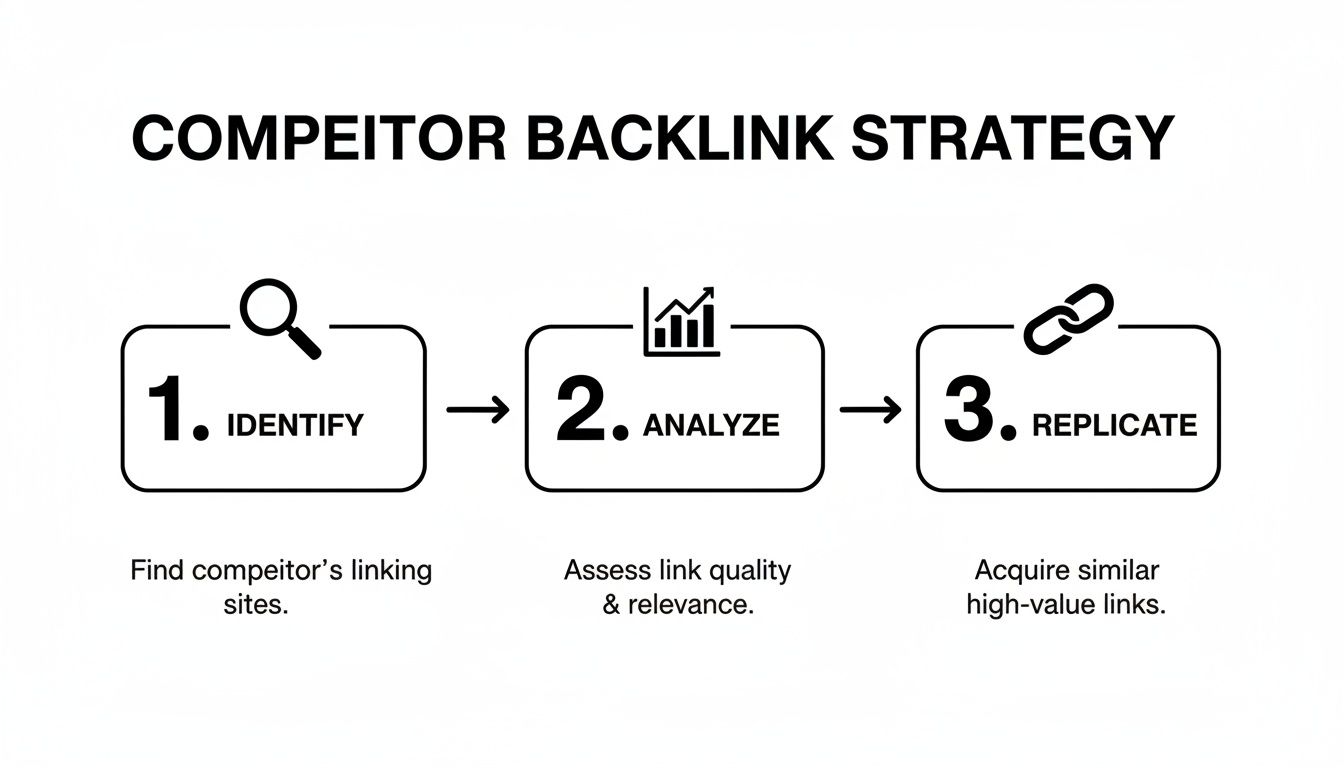
The process moves logically from identifying high-value targets to analyzing their linking patterns and, finally, replicating their success with a targeted approach.
A great outreach plan isn't about volume; it's about relevance. Your pitch to each site should be tailored, referencing the specific content they've linked to in the past and explaining why your resource offers unique, additional value.
This data-driven approach dramatically increases your success rate compared to generic, cold email blasts. You're starting the conversation with a huge advantage: you already know these sites are receptive to content in your niche.
Closing the Loop From Analysis to Action
The final, and perhaps most critical, piece is execution. This is often where even the best-laid plans fall apart due to resource constraints or workflow bottlenecks. It's also where modern AI platforms are completely changing the game.
Tools like Sight AI are designed to close this exact gap between analysis and action. After you identify content gaps, the platform can use specialized AI agents to generate the long-form, SEO-optimized articles needed to fill them. It turns an insight from your analysis directly into a published asset, complete with images and on-page best practices. By automating so much of this, you can learn how to create workflows that consistently turn competitive insights into measurable organic growth.
This is especially powerful when you consider the stakes. Data shows organic search drives a massive 46.98% of global traffic, and the click-through rate for the #1 position is a staggering 39.8%. Mimicking what the top pages do is crucial, and AI-driven content generation makes it possible to do so at scale. This acceleration transforms your SEO competitor analysis from a quarterly research project into a continuous engine for growth.
Common Questions About SEO Competitor Analysis
Even with a solid plan, jumping into SEO competitor analysis always brings up a few questions. I've heard them all over the years. Getting these cleared up from the get-go helps make sure your efforts are sharp and effective, not just busywork. Let's walk through some of the most common ones.
How Often Should I Analyze My SEO Competitors?
This is a classic balancing act. You want to stay on top of things without getting stuck in "analysis paralysis."
From my experience, a full-blown, deep-dive analysis is perfect to run quarterly. This timing lines up nicely with most business planning cycles, letting your findings actually shape the content and SEO strategy for the next three months.
But you can't just set it and forget it. For your closest rivals, you need to keep a closer eye on things—monthly is a good rhythm.
You're basically looking for any big, sudden moves they make. Keep an eye out for:
- Major new content pieces that seem to be getting traction right out of the gate.
- Big-time new backlinks from high-authority sites you'd love to get a link from.
- Sudden jumps or drops in their rankings for the keywords you care about most.
Most modern SEO tools let you set up alerts for this stuff. It’s a great way to stay agile and react quickly without having to pull a full report every other week.
What Are the Best Free Tools for This Analysis?
Look, the premium tools like Ahrefs or Semrush are fantastic and worth the investment if you're serious. But you can absolutely get a strong start without dropping a single dollar.
Honestly, start with Google Search in incognito mode. It’s the simplest way to see what the real, unbiased SERPs look like for your target keywords. This lets you manually see who’s ranking and what their content actually looks like. Paired with Google Keyword Planner, you can even plug in a competitor’s URL to get a sense of the keywords they're targeting.
The free versions of tools like Ubersuggest are also pretty handy. They'll give you a decent peek at a competitor's top pages, keyword profile, and overall domain authority. It's more than enough for some initial digging and can help you build the case for getting a budget for a more powerful paid tool later on.
Don't ever underestimate just looking at the search results yourself. Free tools tell you what is ranking, but a manual review is the only way to really understand the why—the content quality, the user experience, the little details that Google is clearly rewarding.
How Can I Compete with Massive Brands in My Niche?
This is a big one. The trick is to stop trying to fight them head-on. Don't try to out-spend or out-muscle them on their strongest keywords. Your competitor analysis is your treasure map to find the gaps they've ignored because of their sheer size. You have to be smarter and more nimble.
I always tell smaller teams to focus on three key areas:
- Go after hyper-specific, long-tail keywords. The big brands often see these as too small to be worth their time, but for you, they can add up to significant, high-intent traffic.
- Completely own a sub-niche. Instead of being a small fish in a big pond, become the undisputed expert in one specific corner of your industry.
- Create content formats they aren't touching. Large corporations can be slow to adopt new things. Can you create in-depth video guides, interactive tools, or original research that they can't be bothered to produce?
Your biggest weapon is speed. You can jump on a new trend and have an expert piece of content published before a massive company has even finished its first round of internal meetings. Use that to your advantage.
How Is AI Changing SEO Competitor Analysis?
AI is changing this game in two major ways: it's creating new battlegrounds and it's making the whole process way faster.
First, there's a new "brand gap" that didn't exist a few years ago. Platforms can now look at AI answer engines like ChatGPT and Perplexity to see where your brand is—or isn't—being mentioned in conversational answers. If your competitors are showing up and you're not, that's a huge blind spot.
Second, AI-driven platforms are just compressing the entire workflow. They can analyze massive amounts of competitor data and pull out the most important insights in minutes, a task that used to take an analyst hours. Better yet, they can then help you act on those insights by generating high-quality draft content, turning what was once a month-long project into a week-long sprint.
Ready to turn AI-driven insights into measurable growth? Sight AI helps you monitor your brand's visibility across AI and search, uncover high-value content gaps, and generate optimized articles to fill them. See how it works at https://www.trysight.ai.