Answer Engine Optimization is all about creating and structuring your content so it becomes the direct source for AI tools like Google's AI Overviews and ChatGPT. Forget just trying to get on a list of links. The goal with AEO is to make your content the answer itself.
What Is Answer Engine Optimization

Think of it like this: you can ask a librarian to find you a book on a topic, or you can ask them for a specific fact. Traditional SEO helps the librarian point you to the right book (a link to your website). Answer Engine Optimization (AEO) makes sure the librarian quotes a fact directly from your book's pages, giving the user a direct, authoritative answer.
This is a fundamental shift in how we find information. We're rapidly moving from a world of ten blue links to a single, synthesized answer generated by AI. AEO is the art and science of positioning your content as the definitive source these AI models trust and cite.
The Rise of AI-Powered Search
The need for AEO isn't some far-off trend—it's happening right now, driven by a huge change in how people search. Over 2 billion people are now using AI-powered search regularly. That’s a seismic shift in how the world gets information, and it's why understanding AEO has become non-negotiable.
This new digital ecosystem demands a completely different approach. The goal is no longer just to rank. It's to be understood, synthesized, and referenced by machines.
The core objective of AEO is to achieve visibility within AI-generated responses. This means your brand becomes the trusted authority whose information is presented as fact, often with a direct citation back to your site.
How AEO Differs From Traditional SEO
While AEO definitely builds on the principles of SEO, its focus is worlds apart. Traditional SEO is all about getting your webpages to rank high on a Search Engine Results Page (SERP). AEO, on the other hand, is about optimizing for a totally different kind of result—an AI-generated summary.
To see just how different they are, it helps to put them side-by-side.
Traditional SEO vs Answer Engine Optimization At a Glance
| Aspect | Traditional SEO (Search Engine Optimization) | AEO (Answer Engine Optimization) |
|---|---|---|
| Primary Goal | Rank high on a list of links (SERP) | Be the direct source cited within an AI answer |
| User Interaction | User clicks a link to find an answer | User gets a direct answer, may click for more detail |
| Content Focus | Broad keyword targeting, long-form content | Conversational questions, "bite-sized" facts |
| Technical Focus | On-page elements, link building, site speed | Structured data (Schema), clear formatting |
| Measurement | Keyword rankings, organic traffic, click-through rate | Citations in AI answers, brand mentions, referral traffic |
As you can see, the game has changed. While SEO gets the search engine's attention, AEO is what convinces it that your content is the final word on the subject.
Ultimately, AEO and AI Search Engine Optimization are complementary disciplines. You need a strong SEO foundation so that AI tools can find and trust your content in the first place. For a deeper dive into the overall strategies and adaptation of SEO for AI-driven search, check out this guide to Mastering Answer Engine Optimization.
Why AEO Is Critical in the Age of Zero-Click Search
The comfortable world of ten blue links is quickly fading in the rearview mirror. For years, the goal was simple: climb to the top of the search results and win the click. But what happens when the click itself becomes a rarity? That’s the new reality, driven by zero-click searches, where people get what they need directly on the results page without ever visiting a website.
This isn't just a small shift; it's a seismic change in how people find information. AI Overviews, featured snippets, and knowledge panels now own the top of the page, dishing out instant gratification. Users get their answer and move on, leaving old-school organic traffic models in the dust. For any brand that relies on being found online, ignoring this evolution is simply not an option anymore.
The Accelerating Impact of AI on Clicks
AI chatbots and integrated search experiences are pouring jet fuel on this zero-click fire. These tools are built to synthesize information from all over the web and present one concise, definitive answer. For a massive number of queries, that means a click-through is no longer necessary. The data paints a pretty stark picture.
Right now, more than 65% of queries on Google end without a single click. This trend is only getting more pronounced with AI Overviews, which are reported to slash traditional organic click-through rates (CTR) by an average of 15.5%. For businesses, this makes Answer Engine Optimization (AEO) an essential survival tactic.
Shifting from Traffic Volume to Engagement Quality
At first glance, this all sounds like a marketer's nightmare. Fewer clicks mean less traffic, and traffic has always been a core KPI. But this is where the AEO mindset flips the script. It forces a much-needed shift from chasing traffic volume to prioritizing the quality of engagement.
AEO redefines success. Instead of asking, "How many people visited our site?" the key question becomes, "How many people found our brand's answer valuable, even if they didn't click?"
Think about the user's journey in this new world. When someone does decide to click through from an AI-generated answer, their intent is sky-high. They've already seen a preview of your expertise and are coming to your site for deeper information, to make a purchase, or to get in touch.
These aren't just casual browsers; they're informed, qualified visitors who are much further down the funnel. They’re actively looking to connect with the authority behind the answer. By optimizing for AEO, you aren't just fighting for visibility—you're strategically positioning your brand to attract these incredibly high-value interactions. To learn more, check out our guide on how to boost your visibility in AI search.
This approach transforms AEO from a defensive play against traffic loss into a proactive strategy for capturing more meaningful engagement. It’s all about building authority where it matters most—right inside the answers your audience sees and trusts.
The Four Pillars of a Winning AEO Strategy
If you want to optimize for answer engines, you can't just rely on the old SEO playbook. Chasing keywords won't cut it anymore. A winning AEO approach is built on a framework designed to earn the trust of AI models.
This framework stands on four essential pillars. Each one supports the others to build a powerful, authoritative presence that AI can't ignore. By focusing on authority, content structure, technical precision, and external validation, you’re creating a strategy that makes your content the most logical and reliable source for AI-generated answers.
Let's break down each one.
Pillar One: Establish Unshakeable Authority
The first and most critical pillar is Topical Authority. Answer engines are designed to avoid risk. Their prime directive is to deliver accurate, trustworthy information. They do this by heavily favoring sources that show deep and consistent expertise on a specific subject.
Think about it from the AI's perspective. If it needs to answer a complex question about financial regulations, is it going to quote a general-interest blog that wrote one article on the topic? Or will it cite a well-established financial institution that has published hundreds of detailed articles on finance? It’s going to choose the specialist. That's authority in action.
Building it means consistently creating high-quality, in-depth content around a core set of topics. This is how you signal to AI that you are a specialized and reliable source. This lines up perfectly with Google's E-E-A-T guidelines (Experience, Expertise, Authoritativeness, and Trustworthiness), which are foundational for both traditional SEO and AEO. AI models use these very same signals to vet sources, making demonstrated expertise non-negotiable.
Pillar Two: Craft Content for Conversational AI
The second pillar is all about creating Conversational and Bite-Sized Content. Answer engines don't just think in keywords; they think in questions and answers. Your content has to be structured to directly address the conversational queries your audience is actually using.
This requires a shift in how you create content:
- Answer First Approach: Get straight to the point. Start your articles with a clear, concise answer to the main question before you dive into the nitty-gritty details. AI models love this directness.
- Use Natural Language: Write like a human, not a textbook. A clear, conversational tone mirrors how people speak and ask questions.
- Create "Bite-Sized" Chunks: Break down complex ideas into simple paragraphs, bullet points, and numbered lists. These formats are perfect for an AI to grab and feature as a quick answer.
The goal is to make your content as easy as possible for a machine to parse, understand, and quote. By structuring information in clear, logical, and answer-oriented formats, you are essentially pre-packaging it for AI consumption.
To really nail this, you need a deep understanding of how concepts connect. Our guide on what is semantic SEO is a great place to start learning how to build content that maps to the relationships and entities AI models understand.
Pillar Three: Implement Flawless Technical Optimization
The third pillar gets into the weeds with Technical and Structural Enhancements. You could have the best content in the world, but if it's not technically sound and structured properly on the back end, it might as well be invisible to AI. This is where you hand the answer engines a clear roadmap to understanding what your content is all about.
The most powerful tool in your technical AEO toolkit is Schema markup (also known as structured data). By adding specific Schema types to your pages, you are explicitly telling machines what your content is and how it's organized.
Key Schema types for AEO include:
- FAQPage Schema: This directly marks up questions and answers on your page, making it incredibly easy for AI to pull for FAQ-style queries.
- HowTo Schema: Perfect for step-by-step guides, this markup breaks down a process into a clear sequence that AI can present.
- Article Schema: This helps define the author, publication date, and headline, which reinforces the content's credibility and freshness.
This technical layer removes any guesswork, ensuring that answer engines can interpret your information with confidence and accuracy.
Pillar Four: Build a Strong Citation Network
The final pillar is about building a robust Citation and Link Profile. In the world of AI, citations and backlinks from other reputable sources are basically votes of confidence. When authoritative websites link to your content, they’re vouching for your credibility.
This tells answer engines that the rest of the web community sees you as a trustworthy source. But this isn't just a numbers game. The quality and relevance of the linking domains are what really matter. A single link from a respected industry journal is far more valuable than a hundred links from low-quality directories.
This flowchart shows how AI Overviews are intercepting user journeys, which ultimately leads to fewer direct clicks to websites.
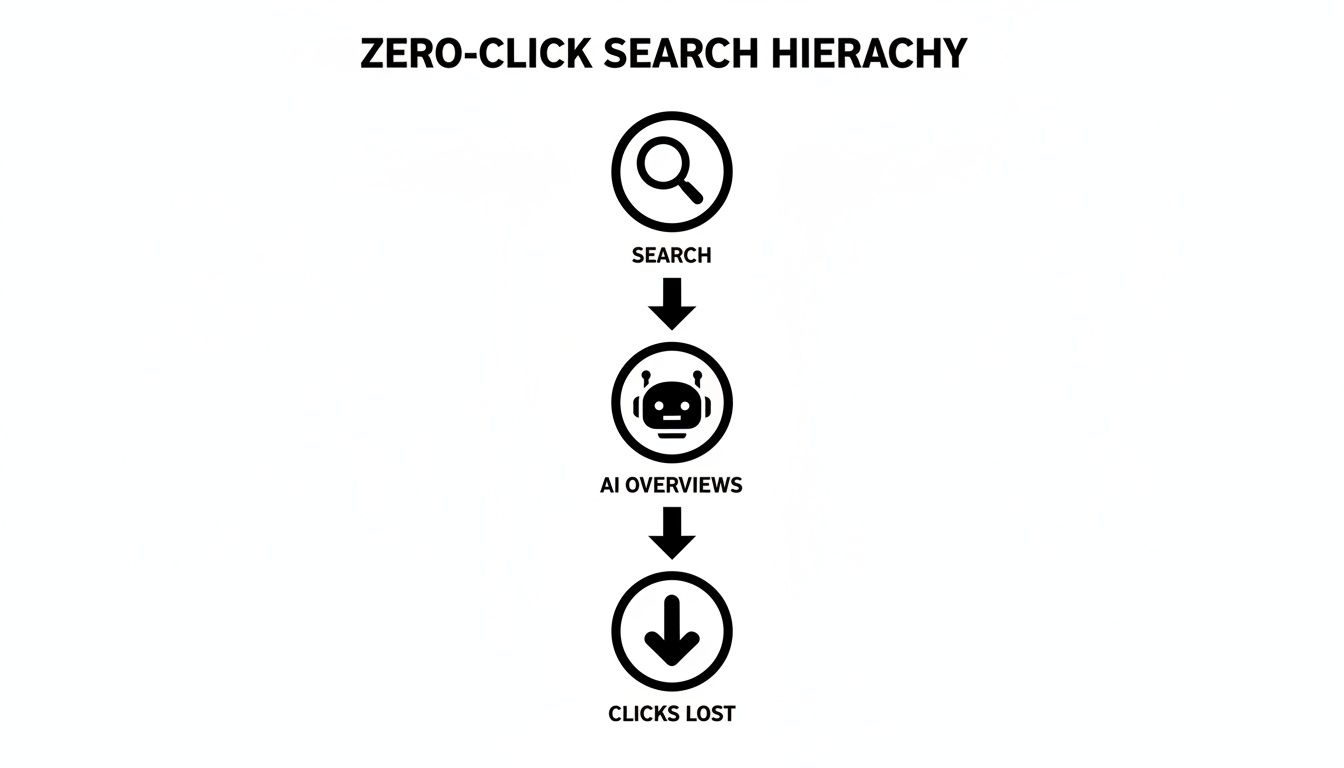
This visual really drives home why earning citations within AI answers is so crucial for staying visible in a zero-click world. By focusing on these four pillars, you create a holistic strategy that positions your content not just to be found, but to become the definitive answer.
Your AEO Playbook: Content and Technical Tactics
Moving from theory to action means you need a solid playbook. Getting your content ready for answer engines isn't about just tweaking a few keywords here and there. It’s a deliberate one-two punch of refining your content and the technical structure that holds it all together.
Let’s break this down into the two core areas you need to master. First, we’ll get into the content strategies that sync up with how AIs think. Then, we’ll dive into the technical tune-ups that make your content both machine-readable and authoritative.
Crafting Content That AI Understands
Your AEO content strategy needs to be laser-focused on one thing: answering questions directly and clearly. AI models are wired to find the fastest, most efficient path to a correct answer. Your job is to create that path for them.
This all starts with a fresh take on keyword research. Forget just targeting short, punchy keywords. Your new primary targets are the full, conversational questions your audience is actually asking. Think in terms of "how," "what," "why," and "compare."
Once you’ve got your list of questions, you need to structure your articles in a clean hierarchy that an AI can parse in a split second:
- Answer First: Start your articles or key sections with a direct, concise answer to the main question. A 40-60 word summary is the perfect bite-sized chunk for an AI to grab.
- Use Definitive Statements: Write with confidence and clarity. AI models are far more likely to cite unambiguous, factual statements than wishy-washy language.
- Create FAQ Sections: Dedicate a part of your page to knocking down related follow-up questions. This not only adds incredible depth but also lets you target a whole cluster of long-tail queries in one go.
When you adopt this structure, you're essentially pre-formatting your content for AI consumption. It makes you an easy choice for a cited source. For a much deeper dive into these strategies, check out our guide on how to optimize for answer engines, which is packed with actionable steps.
Implementing Crucial Technical Optimizations
While content may be king, technical optimization is the kingdom it rules. Without a solid technical foundation, even the most brilliant content can be totally invisible to answer engines. The goal here is simple: explicitly tell machines what your content is about, leaving zero room for interpretation.
The single most powerful technical lever you can pull for AEO is Schema markup, also known as structured data. It's basically code you add to your website that acts as a translator, telling search engines and AI models exactly what each piece of information means.
Think of Schema markup as adding descriptive labels to your content. Instead of an AI just seeing a block of text, it sees "This is a question," "This is the answer," and "This is a step-by-step process."
This level of clarity is pure gold for AEO. There are hundreds of Schema types out there, but a few are absolute powerhouses for this purpose:
- FAQPage Schema: This is non-negotiable for any page with a question-and-answer format. It directly flags your Q&A pairs, making them incredibly easy for an AI to pull into a response.
- Article Schema: This markup defines key elements like the author, publication date, and headline. It helps establish your content's credibility and freshness—both are critical signals for AI.
- HowTo Schema: If your content explains a process, this Schema breaks it down into a clear sequence of steps that an AI can easily understand and serve up to a user.
Beyond Schema, other technical elements are also playing a huge role. Strong internal linking helps AI discover related content on your site, which reinforces your authority on a topic. Making sure your pages are submitted for efficient indexing through tools like IndexNow helps AI models find your newest, most relevant answers much faster.
Put them all together, and these content and technical tactics create a formidable AEO strategy.
To make this even more practical, we've put together a checklist of the key tasks you can start implementing right away. Think of this as your immediate action plan for getting your site ready for the new age of search.
Actionable AEO Checklist
This table breaks down the core content and technical tasks into manageable steps. Use it to guide your implementation and track your progress as you begin optimizing for answer engines.
| Category | Action Item | Impact on AEO |
|---|---|---|
| Content | Answer-First Formatting: Start key sections with a direct, 40-60 word summary. | Provides a clear, extractable snippet for AI, increasing the chance of being cited. |
| Content | Conversational Keyword Research: Target "how," "what," and "why" queries. | Aligns content with the natural language questions users ask AI assistants. |
| Content | Build FAQ Sections: Add dedicated Q&A sections to relevant pages. | Captures a wide range of long-tail queries and signals comprehensive knowledge. |
| Technical | Implement FAQPage Schema: Mark up all question-and-answer content. | Explicitly tells AI models which parts of your text are questions and which are answers. |
| Technical | Use Article & HowTo Schema: Apply relevant structured data to all content types. | Adds context and credibility, helping AI understand the purpose and structure of your content. |
| Technical | Strengthen Internal Linking: Link to related, authoritative pages on your site. | Establishes topical authority and helps AI models discover your full range of expertise. |
| Technical | Ensure Efficient Indexing: Use tools like IndexNow to submit new content. | Speeds up the discovery of new and updated content, making answers available to AI faster. |
By systematically working through this checklist, you're not just tweaking your site—you're fundamentally restructuring it to communicate effectively with the AI models that are increasingly becoming the gatekeepers of information.
How to Measure Success in Answer Engine Optimization
So, you’re putting in the work for AEO, but how do you know if it's actually paying off? If you’re still staring at your organic traffic and keyword ranking reports, you’re only getting half the story. Success in this new world requires a totally different dashboard, one that shifts the focus from clicks to influence.
In the AEO game, getting your content featured in an AI-generated answer is a massive win, even if it doesn't lead to an immediate click. The old playbook just doesn’t cut it anymore because it can't measure the value of becoming a trusted source cited by AI. You need to start tracking metrics that truly reflect your authority and presence inside these new answer ecosystems.
Shifting From Clicks to Citations
The most important change you need to make is moving from tracking clicks to tracking citations. A citation happens when an AI model like ChatGPT, Gemini, or Perplexity directly references your content as a source for its answer. This is the holy grail of AEO—becoming the authority behind the information.
But it goes beyond just a simple citation. You also need to keep an eye on:
- Brand Mentions: How often does the AI drop your brand name in its responses, even without a direct link? This is a great way to measure brand recall and how strongly you're associated with key topics.
- Sentiment Analysis: Is the AI talking about your brand in a positive, neutral, or negative way? Understanding the sentiment is absolutely critical for managing your brand's reputation.
- Share of Voice: For a specific set of prompts, how often are you cited compared to your competitors? This gives you a clear picture of where you stand in the market.
Getting a handle on these new metrics is a big departure from traditional methods. To see how we got here, you can check out our guide on what is rank tracking and how its core ideas are being adapted for this new era.
Using Modern Tools to Prove ROI
Let's be real: trying to manually track all this new data across a dozen different AI platforms is next to impossible. This is where specialized tools become non-negotiable for anyone serious about answer engine optimization. Platforms like Sight AI were built from the ground up to solve this exact measurement problem.
These tools give you a single, unified dashboard to see how your brand is showing up across the leading AI models. They turn abstract ideas like "citations" and "mentions" into hard, tangible data you can actually use.
Here’s a look at the Sight AI platform, where you can easily track source citations and brand mentions over time. It gives you a crystal-clear view of how your AEO efforts are performing.

With this kind of data, you can finally draw a straight line from your content efforts to your visibility in AI. You can pinpoint which pages are getting surfaced and, just as importantly, spot opportunities where your competitors are being cited instead of you.
By tracking citations and mentions, you can finally prove the tangible ROI of your AEO strategy. It allows you to demonstrate how your content is building authority and influencing audiences, even in a zero-click environment.
Ultimately, measuring AEO is all about redefining what success looks like. It’s no longer just about driving traffic to your site; it’s about becoming the trusted, authoritative voice that powers the answers of tomorrow.
The Future of Search and Your Role in It
Answer Engine Optimization isn't just another marketing trend to slap on your checklist. It’s a seismic shift in how people get information. The era of scrolling through ten blue links is fading fast, replaced by a new world of direct, AI-synthesized answers—and this change is picking up speed. Brands treating AEO as a core part of their strategy today are the ones building a serious competitive advantage for tomorrow.
This isn't happening in a vacuum; it's driven by a massive change in how people behave online. By 2027, experts predict over 90 million U.S. users will turn to generative AI for their searches. That’s a huge leap from just 13 million back in 2023. At the same time, traditional organic traffic is facing a potential 25% dip by 2026 as users flock to AI chatbots. AEO isn't just important; it's essential for future-proofing your brand.
Securing Your Brand's Authority
As AI weaves itself deeper into our lives—from smart speakers to the assistants in our cars—the sources it trusts will gain enormous authority. When your brand is the one cited in an AI answer, you’re not just a source; you’re positioned as the definitive expert. This builds credibility at a scale that traditional SEO just can't match. It’s your chance to stop being one of many options and start being the answer. To get a better feel for where things are headed, you can explore forward-looking perspectives like Wikio.ai's vision for AI-driven search.
The future of digital discovery won't be about who has the highest rank, but who owns the answer. Your role is to become the most reliable, citable, and authoritative source in your niche.
The time to get started was yesterday, but today is a close second. The strategies laid out in this guide give you a clear roadmap. Go audit your content, put the technical and content tactics we've discussed into action, and use modern tools like Sight AI to turn visibility insights into winning moves. If you do this, you’ll secure your brand's place as a trusted authority in the new age of AI-driven discovery, ensuring you aren't just part of the conversation—you're leading it.
Frequently Asked Questions About AEO
Even with a clear strategy, digging into Answer Engine Optimization is bound to bring up a few questions. Let's tackle some of the most common ones to clear the path as you step into this new world of search.
How Long Does It Take to See Results From AEO?
Patience is a virtue, but you won’t be waiting forever. You can often see the first signs of life from Answer Engine Optimization—like getting citations for very specific, long-tail questions—within 60-90 days. This is especially true if you’re publishing fresh content that Google and other engines pick up quickly.
But the real win is building deep topical authority, the kind that convinces AI models you're the definitive source on a subject. Earning that level of trust for consistent, high-impact citations is more of a long game. For significant, scalable results, you should be thinking in terms of 6-12 months of consistently shipping high-quality, well-structured content.
Should I Replace Traditional SEO with AEO?
Absolutely not. Think of AEO as a new, critical layer you build on top of a solid SEO foundation—not a replacement for it. The two are completely intertwined and work together to get you seen.
In fact, AEO leans heavily on strong SEO fundamentals. Things like:
- A healthy backlink profile
- Fast page speeds and a great mobile experience
- High-quality, authoritative content
These are the exact signals that help AI models find and trust your content in the first place. Content that already ranks well in traditional search is often the first place answer engines look for reliable information.
What Is the Most Important Factor for AEO Success?
While all the technical details like Schema markup are crucial, the single most important factor for winning at AEO is consistently creating high-quality, authoritative, and trustworthy content. Your number one job has to be answering your audience's questions directly and completely.
AI models are designed to hunt down the most reliable and thorough answers out there. Proving your expertise with well-researched, clearly written, and factually accurate content is the absolute cornerstone of any good AEO strategy. Without it, even the most perfect technical setup won't get you very far.
How Can a Tool Like Sight AI Help My AEO Strategy?
A platform like Sight AI is what turns AEO from a good idea into a practical, repeatable process. It solves the two biggest headaches in this new space: measurement and finding opportunities. It gives you direct feedback on your work by showing you how models like ChatGPT and Gemini are citing and talking about your brand.
Sight AI closes the loop from insight to action. It gives you the data to prove what's working and reveals exactly where you need to focus your content efforts to win more citations and build authority.
This allows you to see what competitors are doing, find the content gaps you need to fill, and then create optimized articles to capture those conversations. It provides the critical data and workflow you need to turn your AEO strategy into measurable growth.
Ready to stop guessing and start measuring your impact in the new age of search? Sight AI gives you the tools to monitor your brand's visibility across AI, find high-value content opportunities, and publish optimized articles that get you cited. Learn more and see how it works at https://www.trysight.ai.