An ecommerce content marketing strategy is your game plan for creating and sharing genuinely useful content—think blog posts, videos, and guides—that draws in the right people and keeps them coming back. It’s all about solving your audience's problems and building trust long before you ever ask for the sale. This approach turns your brand into a go-to resource, not just another online store.
Building Your Foundation for Sustainable Growth
A powerful ecommerce content marketing strategy doesn't just spring from a clever blog post idea or a viral video concept. It starts with a deep, honest look at where you are now and a crystal-clear understanding of the people you want to reach. Before you write a single word, you have to build a solid foundation.
This whole process is a logical sequence: you audit, you profile, you analyze, and then you research.
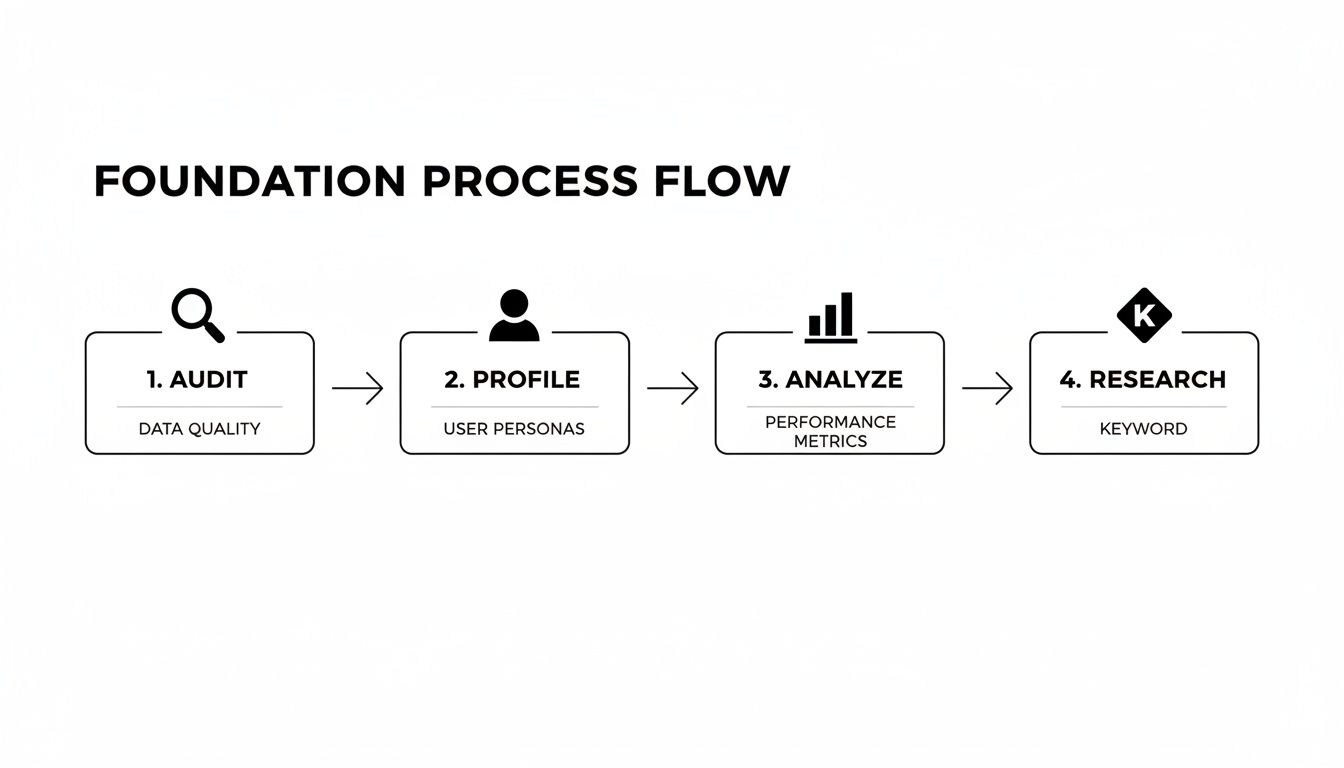
Each of these steps builds on the last, making sure your strategy is grounded in hard data, not just guesswork. Following this path saves you from wasting time and money, ensuring every piece of content you create has a purpose and is tied to a real business goal.
Performing a Realistic Content Audit
First things first: you need to audit what you’ve already got. This isn't just about making a list of every blog post you've ever published; it’s a strategic deep-dive to figure out what's actually working and what's collecting dust.
Pull together your top-performing content from the last 12 months. You’ll want to look at a few key metrics:
- Organic Traffic: Which pages are pulling in the most visitors from Google?
- Engagement: What content keeps people on the page the longest or has the lowest bounce rate?
- Conversions: Are any of your articles directly leading to sales? You can track this with event-based goals in your analytics.
- Backlinks: Which articles have earned links from other reputable sites?
This audit will reveal patterns. You might find that your "how-to" guides are driving 70% of your organic traffic while your company news gets next to nothing. That insight is pure gold—it tells you exactly what your audience finds valuable.
Developing Data-Driven Customer Profiles
Generic personas are a complete waste of time. "Marketing Molly" isn't real. Instead, you need to build customer profiles based on actual purchase data and user behavior. Dig into your analytics and CRM to get answers.
Who are your best customers? Don't just look at their age or location. Analyze their buying habits. Do they always buy specific product bundles? What was the very first product they ever bought from you? What content did they look at on your site right before they made that purchase?
For example, a skincare brand might discover its highest lifetime value customers consistently buy an anti-aging serum and a vitamin C moisturizer together. They also tend to read blog posts about "building a minimalist skincare routine." Now that's a tangible profile you can create content for, not some vague persona named "Skincare Sarah."
Key Takeaway: Your best content ideas are hiding in your customer data. Analyze purchase history, browsing behavior, and support tickets to understand what problems your customers need solved. This is the secret to creating content that converts.
Analyzing Your Competitors' Content
Once you know what's working for you and who you're talking to, it's time to scope out the competition. Analyzing their content isn't about copying what they do; it's about spotting their weaknesses and finding your opportunities.
Use SEO tools to see their top-ranking pages. Are they dominating with super in-depth product guides? Or are they ranking with thin, unhelpful content that you could easily one-up? Look for "content gaps"—valuable keywords they aren't even targeting that you can swoop in and own.
Maybe a competitor has a popular article on "The 5 Best Coffee Grinders," but it hasn't been touched in three years. That’s your opening. You can create "The Ultimate Guide to Coffee Grinders in 2024," complete with video demos and direct links to your products.
This whole foundational process is a crucial piece of a much larger digital marketing puzzle. For brands looking for a helping hand in building out a robust strategy, understanding the landscape of professional SEO and content marketing services can offer some valuable perspective. At the end of the day, a well-planned approach aligns your content with what people are actually searching for, a core principle you can dive deeper into by learning more about what is SEO content strategy.
Developing Content Pillars and Product-Led Stories
Throwing content at the wall and seeing what sticks is a recipe for random, unpredictable results. If you want to build a scalable content engine for your ecommerce brand, you have to ditch the one-off blog posts and get strategic. It all starts with defining your content pillars.
Content pillars are the handful of core topics your brand is going to own—the big-picture subjects you want to be known for. These aren't just your product categories; they're the broader problems, passions, and goals that your audience cares about. For a company selling high-end kitchen knives, the pillars wouldn't be "chef's knives" and "paring knives." They'd be "Culinary Techniques," "Ingredient Sourcing," and "Kitchen Maintenance."

Choosing the right pillars means finding that perfect intersection of your brand's expertise, your product catalog, and what your audience is actively searching for. Getting this foundation right ensures every article, guide, and video you create actually contributes to a larger goal: building authority. To get a deeper dive into this framework, check out our guide explaining what is a pillar page and why it's so crucial for a killer SEO strategy.
Identifying Your Core Content Pillars
Time to pick your pillars. Start by digging back into your customer personas and all that keyword research you did. What are the big, recurring themes? You need to look past what people are buying and figure out why they're buying it and what they hope to accomplish.
Ask yourself these questions to zero in on the best options:
- What broad goals do our products help achieve? A business selling running shoes isn't just moving footwear. They're part of a customer's journey toward "Marathon Training," "Injury Prevention," or "Beginner Running Programs."
- What are our customers' biggest frustrations? If you sell home organization products, your pillars could easily be "Home Decluttering," "Productivity Hacks," and "Small Space Living."
- Where can our brand provide genuinely expert value? If your team has unique credentials, that’s your secret weapon. A baby gear store with a certified sleep consultant on staff absolutely must own the "Infant Sleep Training" pillar.
You should aim for three to five core pillars. That’s broad enough to keep the ideas flowing for years but focused enough to actually build topical authority that both Google and your audience will recognize.
Pro Tip: Your content pillars need to have a long shelf life. Don't chase trends that will be irrelevant in six months. Pillars like "Sustainable Living" or "Home Improvement" are evergreen, letting you build a massive library of valuable content over time.
Weaving Products into Authentic Stories
Once your pillars are set, the next move is to master product-led storytelling. Honestly, this is the single most important tactic for any online store. It’s about making the shift from just listing features and specs to showing how your products are the hero in a larger story.
So, instead of a boring blog post titled "Our New Blender X2000," you create a piece under your "Healthy Recipes" pillar called "5 High-Protein Smoothies You Can Make in Under Two Minutes." Your blender is naturally featured as the key tool that makes it all happen.
This simple switch turns your blog from a marketing channel into a genuinely helpful shopping assistant. When a reader finds an answer to their problem (like needing a quick, healthy breakfast), your product becomes an organic part of that solution, not a pushy ad.
Here’s a simple framework to connect every content idea directly to your catalog:
- Start with the problem or goal: What is the reader trying to do? (e.g., "organize my messy garage")
- Identify the solution-oriented content: What's the best format to help them? (e.g., A "Step-by-Step Garage Organization Checklist" article)
- Integrate the product naturally: Which of your products are essential to get the job done? (e.g., Your heavy-duty shelving units and clear storage bins)
Follow this process every single time, and each article becomes a soft sell. You build trust and guide readers toward a purchase without ever feeling like you're selling. This is how you convert casual readers into loyal customers.
From Strategy to Execution: Creating High-Impact Content and Mastering On-Page SEO
Alright, you've got your content pillars mapped out. Now for the fun part: shifting from abstract strategy to actually creating the stuff that will attract, engage, and convert customers. A brilliant idea is just an idea until it's a published asset, which is why creating killer content and nailing your on-page SEO are two sides of the same coin.
This is where your plans transform into tangible assets. The goal here is twofold: produce content that's genuinely valuable to your audience and perfectly optimized for search engines. This ensures all your hard work actually gets discovered by the right people, right when they're looking for answers.
Crafting Content That Actually Converts
For an ecommerce brand, content isn't just about getting your name out there; it's a direct path to sales. Two of the most powerful formats I've seen work time and time again are in-depth buying guides and compelling product comparisons. Why? Because they meet buyers at a critical decision-making point, offering genuine help while showcasing your products as the perfect solution.
A great buying guide does so much more than just list your products. It educates the customer, helps them clarify their own needs, and builds a massive amount of trust.
- Structure for Success: Frame it around the customer's problem. Think "How to Choose the Right Tent for Backpacking," not "Our Tents." Then, break it down into the key things they need to consider, like weight, seasonality, and capacity.
- Weave in Products Naturally: As you explain each category, feature your products as the prime examples. In the "Solo Backpacking" section, for instance, you'd showcase your ultralight one-person tent.
- Lean Heavily on Visuals: Pack it with high-quality photos, charts comparing specs, and even short videos demonstrating key features. This makes complex information a breeze to digest.
Product comparisons, on the other hand, are for shoppers who are a little further down the funnel. They're actively weighing their options, and your content can be the final nudge they need. Instead of a dry "Product A vs. Product B," frame it around a use case, like "Which Running Shoe is Best for Trail vs. Road?" This problem-first approach feels much more authentic and helpful.
For ecommerce, where global retail sales are projected to hit $7.95 trillion by 2027, content isn't fluff—it's fuel. Just look at product descriptions: a staggering 87% of consumers say they're the deciding factor in a purchase since they can't physically touch the items. This is a stark reminder of how powerful well-crafted, informative content really is.
A Crash Course in Ecommerce On-Page SEO
Creating amazing content is half the battle; optimizing it is how you win the war for rankings. On-page SEO is the art and science of signaling to search engines what your page is about and why it deserves that coveted top spot. For an ecommerce site, this requires a specific, surgical focus.
Your title tag is the single most important piece of on-page SEO real estate you own. It has to be compelling for both Google's bots and the human beings doing the searching.
A Title Tag Formula That Just Works:Primary Keyword | Secondary Keyword | Brand Name
Example: "Best Waterproof Hiking Boots for Men | All-Terrain Footwear | OutdoorCo"
This structure is crystal clear, keyword-rich, and includes your brand for recognition. While your meta description doesn't directly impact rankings, it has a massive influence on whether someone clicks on your link or a competitor's. Treat it like a tiny ad for your content—summarize the value and include a call to action.
Beyond the metadata, the structure of your content is critical. Use clear H2 and H3 headings to break up topics into logical sections. Keep your paragraphs short and punchy—no more than three sentences. This makes the content scannable and improves the reader experience, which is a huge positive signal to search engines. To really drive sustainable growth, mastering these ecommerce SEO best practices is non-negotiable.
The Underrated Power of Strategic Internal Linking
Internal linking is one of the most overlooked—and most powerful—levers in an ecommerce content marketing strategy. It's simply the practice of linking from one page on your website to another, creating a web that guides both users and search engine crawlers exactly where you want them to go.
Every time you publish a new blog post, you should immediately think about two things:
- Which of my older, high-authority pages can I link from to this new post? This passes "link equity" and helps your new content get indexed and ranked much faster.
- Where can this new post link to that's relevant? Think product pages, category pages, or other related articles. This creates a seamless path from information to purchase.
For example, in your shiny new "Ultimate Guide to French Press Coffee," you should be linking out to your main category page for "French Presses" and directly to the product page for your best-selling model. This is the simple mechanism that turns your blog traffic into actual revenue. If you want a deeper dive, check out our guide on how to write SEO-friendly blog posts.
This one simple, strategic practice transforms your site from a random collection of pages into a cohesive, authority-building ecosystem.
Get Your Content Seen: A Guide to Smart Distribution
Hitting "publish" on a brilliant piece of content and then just walking away? That’s like setting up a beautiful storefront in a back alley—no one is going to find it. The real work, the part of your ecommerce content marketing strategy that actually drives results, begins after your content goes live.
Smart, multi-channel distribution is what turns a blog post from a static asset into a traffic-and-sales machine. It's time to build a system for getting eyes on your content that works just as hard as you did creating it in the first place.
Stop Just Dropping Links on Social Media
We've all seen it: a link to a new blog post on social media, with the article title slapped on as the caption. That’s a huge missed opportunity. Your social channels aren't just bulletin boards for your blog; they're unique platforms where you need to create native, engaging experiences that actually start conversations.
Instead of a generic link-post, try deconstructing your main article into bite-sized content tailored for each platform. This simple shift shows you respect the user's context and will dramatically boost your engagement.
- Instagram: Pull a few key statistics from your article and turn them into a slick, shareable infographic carousel. Or, create a quick Reel that summarizes the top three tips from your guide, ending with a clear CTA in the caption: "Get all the details at the link in our bio."
- Facebook: Use this platform to spark a discussion. Ask a question related to your article's topic. Post a compelling excerpt and invite your followers to chime in with their own experiences in the comments.
- LinkedIn: If your audience includes B2B customers or your product solves a professional pain point, this is your spot. Share the business-focused angle of your content, framing it as an industry insight or a solution to a common challenge professionals face.
The goal is to provide real value right there on the platform, giving them a taste of the even deeper value waiting in the full article.
Nurture Your Audience with Email Marketing
Your email list is gold. It's a direct line to an audience that has already raised their hand and said they're interested in what you have to say. Don't just blast them with sales promotions—use email to deliver genuine value and strengthen that relationship.
When you publish a new, high-value piece of content, like an ultimate buying guide, make it a star feature in your next newsletter. Don't just link to it. Explain why it's so helpful and who it's for. This approach positions your brand as a helpful expert, not just another retailer trying to make a sale. It's a foundational part of any successful digital marketing campaign.
Expert Insight: Take it a step further by segmenting your email list based on past purchases or browsing history. If a customer recently bought a pair of hiking boots from you, send them your new article on "The Top 10 Local Hiking Trails." That's not marketing anymore; that's a genuinely helpful, personalized recommendation.
The Art of Content Repurposing
The most efficient content marketers I know don't constantly reinvent the wheel. They repurpose. One well-researched pillar page or in-depth guide can be the source material for dozens of smaller content assets. This strategy extends the life of your original work and maximizes its impact across every channel.
It also respects the fact that people consume content differently. Some love to read, others want to watch a video, and many just want a quick, scannable graphic they can digest in seconds.
A Single Blog Post Can Become:
- A Short-Form Video: A 60-second script for TikTok or Reels that hits the key takeaways.
- An Infographic: A visual summary of the data or steps outlined in the post, perfect for Pinterest and Instagram.
- A Series of Tweets: Break down the main arguments into a threaded conversation on X (formerly Twitter).
- A YouTube Tutorial: If the post is a how-to guide, create a detailed video walkthrough showing the process.
Let's be clear: video is absolutely dominating ecommerce content marketing right now. An incredible 91% of businesses now use it in their strategies, with short-form video delivering the highest ROI. Plus, 70% of people globally have bought a product after seeing it on YouTube, which makes the platform a powerhouse for discovery. To see more stats like this, you can explore more powerful content marketing stats on keywordseverywhere.com. This all means that turning your written content into video isn't just a "nice to have"—it's one of the highest-leverage activities you can do.
Measuring Performance and Scaling With Automation
An effective ecommerce content marketing strategy runs on data, not just creative instinct. Once your content engine is humming along, you need a reliable way to measure what’s working, what isn't, and how to scale your successes without burning out your team.
This is where you have to move beyond vanity metrics and focus on the key performance indicators (KPIs) that actually hit your bottom line. It's also where automation and AI become your most valuable allies, giving you the power to analyze performance at scale, spot hidden opportunities, and seriously ramp up your content production. By pairing sharp data analysis with smart automation, you can build a system that not only attracts traffic but predictably drives revenue.

Identifying KPIs That Actually Matter
Forget about chasing likes and shares. For an ecommerce business, the only metrics that truly count are those that track the journey from reader to customer. Your goal is to connect the dots between a piece of content and a sale.
Here are the core KPIs you should be tracking relentlessly:
- Content-Assisted Conversions: This is your North Star. It tracks how many users viewed a specific blog post or guide before eventually making a purchase. Most analytics platforms can track this through attribution modeling, showing you which articles are your real workhorses.
- Organic Traffic to Product/Category Pages: A high-performing article doesn’t just sit there and rank; it successfully funnels interested readers deeper into your site. Keep an eye on how much traffic your content is pushing to your actual "money" pages.
- Keyword Rankings for Commercial Intent Terms: You need to track your rankings for keywords that signal someone is ready to buy (think "best [product type]," "[product] reviews," or "buy [product] online"). Seeing these improve is a direct sign you're attracting the right kind of audience.
- Lead Generation from Content: If you’re using lead magnets like downloadable guides or email sign-ups in your content, track how many qualified leads each article generates. This is especially crucial for products with a longer sales cycle.
Focusing on these performance indicators gives you a clear, data-backed picture of your content's ROI. You'll know exactly which articles are driving sales and which ones need a refresh.
Leveraging AI for Scalable Content Production
The single biggest bottleneck for any content team is scale. How do you consistently produce high-quality, SEO-optimized articles without sacrificing quality? This is where AI and automation have completely changed the game.
AI is already transforming this space. An impressive 68% of companies report higher content marketing ROI thanks to AI, with 78% seeing real improvements in content quality. Tools like Sight AI fit perfectly into this new reality, using specialized AI agents to generate 2,500–4,500 word SEO-optimized articles daily. This kind of tech can fill content gaps identified from competitor insights, turning raw data into high-ranking content at an incredible pace.
Key Takeaway: AI isn't here to replace marketers; it's here to supercharge them. Use it to handle the heavy lifting of research, drafting, and optimization so your team can focus on high-level strategy and creativity. This is how you achieve sustainable growth.
Automating Your Content Workflow
Beyond just writing, automation can streamline your entire workflow, from brainstorming ideas to distributing the finished piece. Imagine a system that automatically flags what your competitors are writing about, generates a data-driven brief, and pushes the published article to all your channels. It's totally possible.
Here’s how you can build a more automated content pipeline:
- Automated Competitor Monitoring: Set up alerts to ping you whenever a competitor publishes a new article or starts ranking for a new keyword. This keeps you ahead of trends.
- AI-Powered Content Briefs: Use AI tools to generate detailed content briefs in minutes, complete with target keywords, recommended headings, and internal linking suggestions. This gives writers a perfect roadmap.
- Automated On-Page SEO Checks: Integrate tools that automatically scan your content before publishing to ensure it nails all on-page SEO best practices, from keyword density to meta descriptions.
- Scheduled Distribution: Once an article is live, use scheduling tools to automatically promote it across your social media channels and email newsletters for weeks to come, maximizing its reach.
Building this kind of automated system allows you to compound your organic traffic over time without exponentially increasing your manual workload. If you want to go deeper on this, you can learn how to automate content marketing with our detailed guide. It’s the key to scaling your efforts efficiently.
Of all the questions that come up when building an ecommerce content strategy, a few pop up over and over again. Store owners and marketers all seem to hit the same roadblocks when they're just getting started. Let's clear up these common sticking points so you can get moving.
How Much Should We Budget for Content?
There’s no magic number, but a solid starting point for most ecommerce brands is to earmark 5-15% of your total marketing budget for content. Don't think of this as a cost. It’s an investment in a long-term asset, one that actually appreciates over time.
If you’re just kicking things off, stick to the lower end of that range. Your initial goal shouldn't be cranking out a huge volume of mediocre articles. Instead, focus on creating a few killer, product-led pieces—like one definitive buying guide for each of your main product categories.
Pro Tip: Track your ROI like a hawk. You need to know the organic traffic, leads, and—most importantly—the sales that each piece of content brings in. Once you see a positive return, you can scale up your budget with confidence, knowing every dollar is fueling real growth.
This data-first approach stops you from just throwing money at the wall and hoping something sticks. You'll be investing strategically where it counts.
Blog Content or Social Media Content First?
This is a classic chicken-or-egg question, but the answer is pretty straightforward: they play different positions on the same team and work best together. I like to think of the blog as the sun and social media as the planets orbiting it.
Your blog is the center of your content universe. It’s where you build lasting SEO value and establish yourself as a genuine authority with in-depth guides, tutorials, and product comparisons. This is the stuff that will rank on Google for years, becoming a durable asset that works for you 24/7.
Social media, on the other hand, is your megaphone. It’s perfect for:
- Community Engagement: Firing up conversations and building a loyal tribe around your brand.
- Brand Building: Showing off your brand’s personality with more immediate, visual content.
- Traffic Amplification: Pushing immediate traffic to your brand-new blog posts and critical product pages.
So, the play is to build your blog as the core foundation first. Then, use social media as the powerful distribution engine to get those valuable, long-form assets in front of as many eyes as possible.
How Long Until We See Results?
Patience is probably the most underrated skill in content marketing. While a hot social media post can give you a nice, quick traffic spike, the real, game-changing SEO results from your content strategy are a long-term play.
Generally speaking, you should start seeing meaningful traction in about 6 to 12 months. That’s the typical window for new content to get indexed by Google, start earning some authority, and begin climbing the rankings for those valuable, commercial keywords.
Consistency is everything. The goal isn't to create one viral masterpiece. It's to consistently publish genuinely helpful content, building up a library of resources over time. This library becomes your evergreen asset that attracts, educates, and converts customers around the clock, long after you’ve hit publish.
Ready to turn AI-driven insights into a scalable content engine? Sight AI monitors how AI models talk about your brand, identifies your competitors' content gaps, and uses specialized AI agents to generate high-ranking, long-form articles daily. Discover your opportunities and automate your growth at https://www.trysight.ai.