Let's be honest, content creation for websites has to be more than just firing off blog posts into the void and hoping something sticks. To really move the needle, you need a system—a strategic engine that pulls in the right people, keeps them engaged, and ultimately grows your business. This is how your website stops being a static digital brochure and starts becoming your best salesperson.
Why Your Website Content Needs a Real Strategy

We can all agree the old "content is king" cliché is tired. Today, creating content without a clear strategy is like trying to navigate a new city without a map. It’s a surefire way to waste time, burn through your budget, and end up completely lost. A smart, documented strategy is what turns random acts of content into predictable, measurable growth.
When you get it right, high-quality content does so much more than fill up your blog. It builds topical authority, signaling to Google and your audience that you're a genuine expert. This is how you earn trust, generate qualified leads, and build a reliable revenue stream. Without that plan, you're just adding to the internet's noise.
The Business Case for Strategic Content
Investing in a proper content plan isn't a "nice-to-have" marketing expense; it's a direct investment in your company's growth. The numbers back this up. The global content marketing industry is on track to hit $107 billion by 2026, and a staggering 82% of businesses already use it as a core part of their digital strategy.
Even more telling, businesses that commit to high-quality content are 2.6 times more likely to call their strategy "very successful." It just works.
This guide is your roadmap. We’ll walk through the essential pillars of building a content machine that performs, covering how to:
- Lay the groundwork with deep audience and keyword research.
- Turn that research into actionable plans with winning content briefs.
- Write for both people and search engines by balancing SEO with a great user experience.
- Use smart workflows and AI to scale your efforts without sacrificing quality.
A well-defined content strategy ensures every article, guide, and landing page you publish has a purpose. It ties your content directly to business goals, so you stop wasting resources on pieces that don't contribute to the bottom line.
From Plan to Performance
A solid plan is the bedrock of everything that follows. Using a clear content marketing strategy template helps ensure every piece of content serves a specific goal, whether that's attracting brand new visitors or nurturing leads further down the funnel.
If you want to go deeper on this foundational step, our guide on what an SEO content strategy truly entails is a great next read. By aligning your efforts from the very beginning, you set the stage for measurable results and sustainable growth. Now, let's get into the step-by-step process.
Building the Foundation for Content That Performs

The best website content isn’t created on a whim; it’s engineered from the ground up with meticulous research. Before a single word is written, you need a deep, almost intuitive understanding of who you're talking to and exactly what they're looking for.
This foundational work is the difference between content that disappears into the digital void and content that actually drives business. It all starts with your audience.
Creating a Clear Audience Profile
Effective content creation isn't about casting the widest net possible. It's about speaking directly to a specific person with a specific problem. That's why the first real step is always building a detailed Ideal Customer Profile (ICP) or buyer persona.
Instead of just guessing what your audience wants, you need to build a profile based on real data and insights. This isn't just about surface-level demographics like age and job title. It's about getting into their mindset and truly understanding their world.
To create a persona that feels real and actionable, dig into these areas:
- Pain Points and Challenges: What specific problems keep them up at night? What frustrations are they trying to solve with a product or service like yours?
- Goals and Motivations: What does success look like for them? Are they trying to increase revenue, save precious time, or finally get that promotion?
- Information Sources: Where do they actually go for information? Do they trust industry blogs, follow key influencers on LinkedIn, or rely on peer recommendations in a Slack community?
Answering these questions turns a vague "target market" into a concrete person you can write for. For example, instead of targeting "small business owners," you might define your ICP as "Sarah, the founder of a 10-person SaaS startup who is struggling to generate leads and needs a scalable marketing solution she can implement yesterday." Now you can write directly to Sarah.
Uncovering High-Intent Keywords
Once you know who you're talking to, the next challenge is figuring out what they’re searching for online. This is where strategic keyword research comes in. The goal isn't just to find popular terms, but to uncover the specific queries that signal a user is ready to learn, compare, or buy.
It's absolutely crucial to look beyond just search volume and focus on user intent—the "why" behind every search query.
By aligning your content with user intent, you don't just improve search engine rankings; you create a better, more relevant experience for your audience. You’re giving them exactly what they came for, which builds trust and encourages them to take the next step.
Understanding intent helps you create the right kind of content to meet a user's needs at a specific moment in their journey. For instance, someone searching "what is content marketing" needs a high-level educational article. But someone searching "best content marketing software for startups" is much closer to making a purchase decision.
To help map this out, think about how different types of search intent line up with specific content formats. This is a critical step in planning a content calendar that actually produces results.
Matching Keyword Intent to Content Formats
| Keyword Intent Type | Description | Example Keyword | Ideal Content Format |
|---|---|---|---|
| Informational | The user is looking for answers, definitions, or how-to guides. | "how to start a blog" | Blog posts, guides, tutorials |
| Navigational | The user is trying to find a specific website or brand. | "Sight AI login" | Homepage, product pages |
| Commercial | The user is comparing options and researching solutions before buying. | "Sight AI vs Jasper" | Comparison pages, reviews |
| Transactional | The user is ready to make a purchase or take a specific action. | "Sight AI pricing plans" | Pricing pages, sign-up forms |
Matching your content format to the user's intent is a simple but powerful way to ensure you're meeting their needs head-on, which is exactly what search engines want to see.
Organizing Ideas into Topic Clusters
Finding individual keywords isn't enough anymore. To establish genuine authority in your niche, you need to organize your content strategy around topic clusters. This model involves creating a central "pillar page" on a broad topic and surrounding it with "cluster content" that dives deep into more specific subtopics.
For example, your pillar page might be a comprehensive guide to "Content Creation for Websites." Your cluster content could then include dedicated articles on "keyword research tools," "writing a content brief," and "how to measure content ROI."
Each cluster article links back to the pillar page, creating a web of interconnected content that signals deep expertise to search engines. This structure not only helps organize your publishing schedule but also makes it easier for users to find related information on your site, keeping them engaged longer.
If you’re interested in a deeper dive, our guide on what keyword clustering is and how to apply it can provide more detailed steps. By building this strong foundation, you set the stage for every piece of content to perform at its absolute best.
Turning Research Into a Winning Content Brief
Once you've done the legwork on your research, it's time to translate all those golden insights into a clear, actionable plan. This is where the content brief comes in. Think of it as the architectural blueprint for your article—it ensures every piece of content is built to precise specifications, leaving nothing to chance.
A well-crafted brief is the secret weapon behind consistently high-performing content. It’s the critical link between your high-level strategy and the final published post, making sure your writer—whether they're in-house or a freelancer—knows exactly what success looks like for this specific article. This single document can save you countless hours of back-and-forth revisions and prevent the all-too-common frustration of getting a draft that completely misses the mark.
The Core Components of an Effective Brief
A winning brief goes way beyond a simple topic and a keyword. It needs to be a comprehensive set of instructions that guides the writer from start to finish. Without these details, you're basically asking them to read your mind, which, as we all know, rarely ends well.
Your brief should be the single source of truth for the article. It has to clearly spell out the who, what, why, and how of the piece.
Here are the non-negotiables I always include:
- Target Audience Nuances: Get more specific than your general persona. For this article, who are you talking to? Are they absolute beginners who need every acronym spelled out, or are they seasoned experts looking for advanced, nuanced tactics?
- Primary and Secondary Keywords: Clearly list the main keyword you're targeting and a handful of related LSI keywords that should be woven in naturally.
- Search Intent Analysis: Don't make the writer guess. Explicitly state the user's goal. Are they trying to learn "how-to" do something, compare two products, or just get a high-level explanation of a concept?
- Competitor Weak Spots: Briefly summarize what the top-ranking articles are missing. Is their data from 2021? Is it a wall of text with no images? This gives your writer a clear path to creating something that’s genuinely better.
- A Logical Article Structure: Provide a suggested H2 and H3 outline. This isn't about micromanaging; it's about controlling the narrative flow and making sure all the key subtopics you uncovered in your research get covered.
A great content brief doesn’t just tell a writer what to write about; it shows them how to win. By including competitor analysis and a clear outline, you’re equipping them with the strategic insights needed to create content that outperforms what’s already ranking.
A Real-World SaaS Example
Let's say you work for a SaaS company that sells project management software. Your goal is to create a blog post targeting the keyword "how to improve team collaboration." A weak brief might just list the keyword and a word count. Yikes.
A strong brief, on the other hand, would add much-needed context.
It would specify that the target reader is a non-technical project manager at a fast-growing startup, someone who feels completely overwhelmed by chaotic workflows. It would list secondary keywords like "collaboration tools," "team communication," and "project workflow tips."
Even better, it would point out that the top three competing articles are all generic, fluffy listicles. The brief would then instruct the writer to build a better mousetrap by including a section on "Integrating Asynchronous Communication" and another on "Choosing a Collaboration Stack," directly hitting on the target audience's biggest pain points. That level of detail is what separates content that ranks from content that vanishes.
From Blueprint to Published Post
This meticulous planning document is the most critical handoff in the entire content creation for websites workflow. It’s what turns abstract research into concrete directives, ensuring the final article aligns perfectly with your business goals.
If you're looking to make this process even smoother, working from a structured guide can be a game-changer. You can get a much deeper look by exploring a comprehensive SEO content brief template that breaks these components down even further. Once you master the art of the content brief, you’re not just creating one good article; you’re building a scalable system for producing top-tier content every single time.
Crafting Content for Both Search Engines and People
Great website content has to serve two masters: the search engine algorithms that rank it and the actual humans who read it. This isn't a zero-sum game. The sweet spot is where technical optimization makes your content more readable and engaging, not less.
Think of it this way: your goal is to create something a search engine can easily understand and categorize, but that a person genuinely wants to read, share, and come back to. This balance is the difference between an article that just ranks and one that actually builds your business. It all starts the second a visitor lands on your page.
Writing Headlines and Intros That Hook
Your headline is your first impression. On a crowded search results page, it’s your one shot to earn the click. It has to be compelling enough to grab attention while clearly signaling what the reader will get out of your article.
A truly effective headline blends a core keyword with a powerful benefit. So, instead of a flat title like "Tips for Teamwork," you'd write something like "10 Actionable Team Collaboration Strategies to Boost Productivity." It’s specific, it includes the keyword "team collaboration," and it promises a tangible result.
Once they've clicked, your introduction has about three seconds to convince them to stay. This is where you connect with their problem, give them a quick preview of the solution you're about to provide, and reassure them they’ve come to the right place. A strong intro builds instant trust and helps crush your bounce rate—a signal Google definitely pays attention to.
Mastering On-Page SEO Essentials
With the reader hooked, it's time to make sure search engines are just as impressed. This is where on-page SEO comes in, but it's about much more than just jamming keywords into your text. It’s about weaving them in strategically so they feel completely natural.
Here’s what to nail down every time:
- Smart Keyword Placement: Your main keyword needs to show up in a few key places: your title tag, meta description, URL, and within the first 100 words or so. After that, sprinkle it and some related secondary keywords throughout your subheadings and body copy wherever it makes sense.
- Strategic Internal Linking: This is one of the most powerful and overlooked SEO tactics. Linking to other relevant articles on your own site helps search engines find more of your content, spreads authority across your pages, and keeps people on your site longer. It's a win-win-win.
- Image Optimization: Every single image needs a descriptive file name (e.g., "team-collaboration-software-dashboard.jpg") and clear alt text. Alt text is crucial for accessibility, but it also gives search engines another clue about what your page is about.
Getting these fundamentals right builds a rock-solid foundation. For a deeper dive, our guide on how to write SEO-friendly articles walks through these on-page tactics in even more detail.
Designing for a Frictionless Reading Experience
Here’s a hard truth: all the SEO in the world won’t save you if your article is a giant, intimidating wall of text. People don’t read online; they skim. Your formatting choices are absolutely critical for making your content easy to scan and digest.
This isn’t just about making things look pretty. Good formatting directly impacts user engagement metrics like time on page, which tells search engines that people are finding your content valuable.
Creating a frictionless reading experience isn't just about aesthetics; it's a powerful SEO signal. When users stay on your page longer, click through to other articles, and easily find what they need, Google takes notice. These positive user engagement metrics are a direct reflection of high-quality, well-structured content.
Here’s how to structure your content for modern readers:
- Embrace Short Paragraphs: Keep your paragraphs to 1-3 sentences, max. This creates white space that makes your content feel approachable and easy to read, especially on a phone.
- Use Bullet Points and Numbered Lists: Any time you’re listing steps, features, or benefits, break them out into a list. It’s a magnet for skimmers and helps them pull out the most important information instantly.
- Leverage Subheadings (H2s & H3s): Think of subheadings as signposts that guide your reader through the article. They should be clear, descriptive, and ideally, include relevant keywords to help both users and search engines follow the flow.
- Incorporate Blockquotes: Use blockquotes to pull out a powerful statistic, a key insight, or an important quote. They break up the text visually and draw the eye to your most impactful points.
When you pair strong writing with smart formatting, you create content that serves both of your audiences perfectly. It's optimized for search engines to find and designed for people to love—which is exactly what great website content is all about.
How to Scale Content Creation with AI and Smart Workflows
Let's be honest: creating high-quality content consistently is a massive undertaking. The manual grind of researching, outlining, writing, and optimizing every single article can bog down even the most driven teams. This is exactly where AI and smart workflows move beyond buzzwords and become your secret weapon for scaling up without watering down the quality you've worked so hard to establish.
Modern AI isn't just about writing faster. It's about working smarter. These platforms can dissect competitor weaknesses on a massive scale, find keyword opportunities you'd never spot manually, and whip up data-backed outlines in minutes. The trick is to take a practical, human-in-the-loop approach. Let the AI do the heavy lifting, and free up your team to focus on what humans do best: strategic oversight, injecting your brand's unique personality, and adding that final, critical layer of polish.
This isn't about replacing writers. It's about giving them superpowers so they can produce better work, faster. When you automate the tedious stuff, you give your experts more room to breathe, think, and create.
From Manual Effort to an Automated Content Machine
The real magic happens when you weave AI into an end-to-end workflow. Instead of jumping between a dozen different tools for research, writing, and publishing, a unified system creates a seamless production line for your content creation for websites.
Imagine a platform that can identify a high-value content gap, help you generate a solid first draft, and then push that finished piece directly into your CMS without you having to copy and paste a thing.
This isn't just about speed; it's about building a smarter, more consistent content engine. For a great example of this in action, take a look at Docsbot's approach to content creation.
The Human-in-the-Loop AI Model
Handing over tasks to AI doesn't mean taking humans out of the picture. Far from it. The most successful content teams operate on a "human-in-the-loop" model, where technology and human talent are partners.
Here’s what that actually looks like:
- AI for Discovery: The system churns through search data and competitor content, flagging topics with the highest potential to rank and drive real traffic. It finds the questions your audience is actually asking.
- Human for Strategy: Your team steps in to review these AI-powered suggestions. You pick the topics that perfectly align with your business goals and current campaigns. You set the direction.
- AI for Production: Once you give the green light, specialized AI agents can analyze the SERPs, build out a detailed outline, and generate a strong first draft that has on-page SEO best practices baked in from the start.
- Human for Refinement: Now, your writers and editors work their magic. They refine the tone, weave in personal stories, fact-check every claim, and make sure the final piece sounds exactly like your brand.
This collaborative model gives you the best of both worlds: the raw speed and data-crunching power of AI, combined with the creativity, nuance, and strategic insight of your human experts. It's how you scale without becoming a generic content farm.
Accelerating Publishing and Indexing
Getting the content written is only half the job. The real results start when it's published and indexed by search engines. This is another final, crucial step that integrated workflows can automate. A platform like Sight AI, for instance, can push a finished article straight to your CMS, complete with all the right formatting, images, and metadata.
This simple diagram shows how a balanced workflow brings together the key ingredients for success.
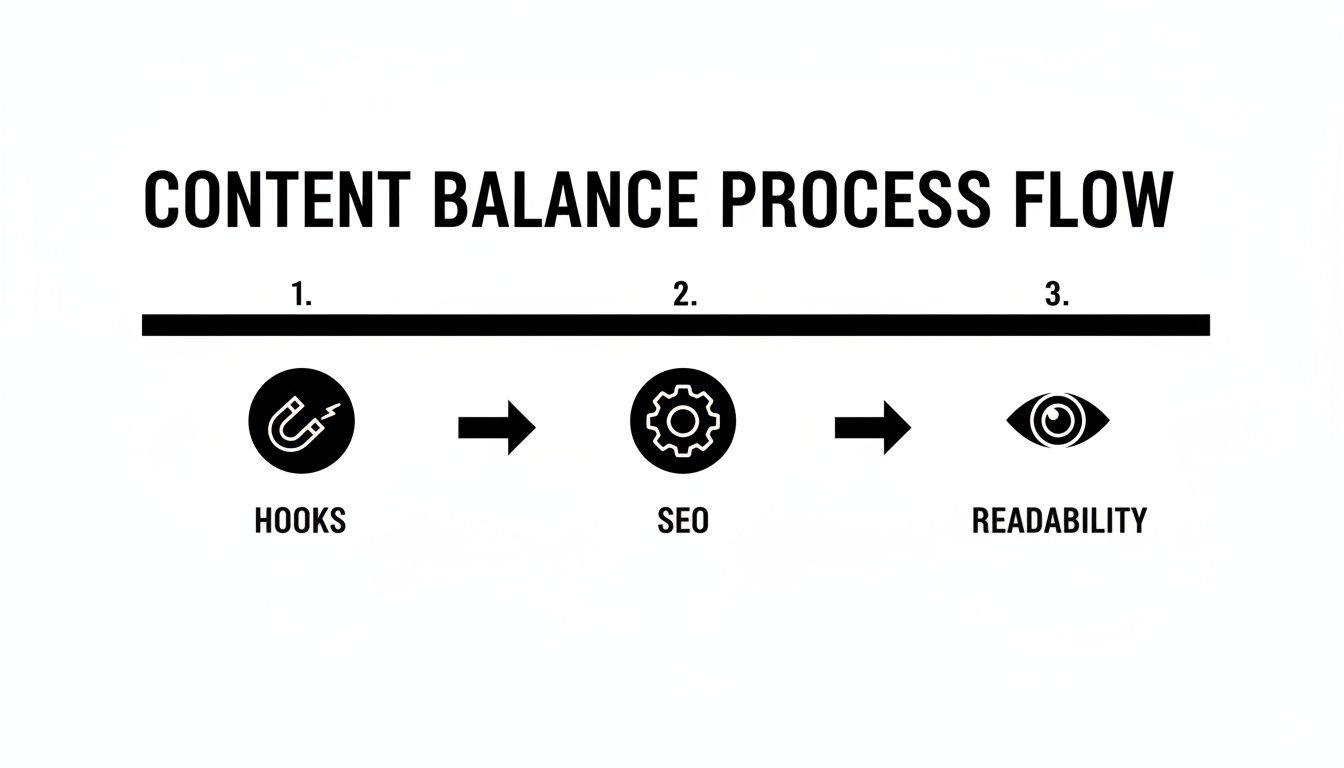
Moving from compelling hooks to solid SEO and on to readability is the formula for content that actually gets results.
Better yet, these systems can automatically update your sitemap and use protocols like IndexNow to ping Google and Bing the second a new article is live. This dramatically cuts down the time it takes for search engines to discover and index your content, helping you start to rank much faster.
If you're interested in building these kinds of systems yourself, our guide on how to create workflows is the perfect place to start. By connecting all the dots, you can build a genuinely efficient content machine that fuels real, measurable growth.
Answering Your Burning Content Creation Questions
Even with the best strategy laid out, things get messy when you start executing. The practical side of content creation for websites always throws a few curveballs. Moving from a neat plan on a spreadsheet to actually hitting 'publish' brings up a ton of questions.
This is where we get practical. Think of this section as a quick-reference guide for the real-world challenges you'll face. We'll cut through the noise and give you straight answers on everything from publishing frequency to deciding when an old post needs a facelift.
How Often Should I Be Publishing New Content?
This is easily the most common question I get, and the honest answer is this: consistency will always beat frequency.
Putting out three deeply researched, high-quality articles a month is infinitely more valuable than publishing ten shallow, rushed posts just to hit a quota. The real goal is to create the best possible content at a pace you can actually sustain.
For most businesses, a great starting point is one to two new blog posts per week. That's frequent enough to build momentum with search engines, keep your site feeling fresh, and steadily grow your library of helpful resources. If you're a smaller team, one truly excellent post a week is a powerful goal to aim for.
Don’t get caught up chasing an arbitrary number. Find a rhythm your team can realistically maintain without sacrificing the quality of the research, writing, and optimization. Burnout doesn't help your rankings or your team.
How Long Does a Blog Post Need to Be?
The old "500-word blog post" advice is officially dead. While there's no single magic number, today's search landscape heavily favors long-form content that comprehensively covers a topic.
A good rule of thumb is to aim for a minimum of 800-1,200 words for a standard, informative blog post. It's tough to provide real value in less than that.
For more competitive keywords or foundational "pillar pages," you'll often need to push that to 2,000 words or more. The goal isn't just to hit a word count; it's to write enough to completely answer the reader's question and provide more depth than your competitors. Write what's needed, and not a word more.
Should I Update Old Content or Just Write New Articles?
The answer is simple: you need to do both. A healthy content strategy is a mix of creating new assets and maintaining the value of your existing ones. Ignoring your old content is like letting a perfectly good car rust in the driveway.
Here’s a simple way to think about it:
- When to Update: Is an article already ranking on page two or three of Google? Does it have outdated stats or screenshots? Is it missing new, relevant information? These are prime candidates for a refresh. Updating an existing post is often a much faster path to page one than starting from scratch.
- When to Write New: If you're targeting a brand-new keyword, tackling a different audience pain point, or covering a topic you've never touched on before, a new article is the only way to go.
Get into the habit of doing a content audit every quarter. It's the best way to spot posts that are starting to lose traffic and could use a quick refresh to get back in the game.
What’s the Difference Between Content Strategy and Content Marketing?
People throw these terms around interchangeably, but they're two distinct—and equally important—pieces of the puzzle. Nailing the difference is key to building a plan that actually works.
| Aspect | Content Strategy | Content Marketing |
|---|---|---|
| Focus | The "why" and "how" | The "what" and "where" |
| Activities | Planning, governance, workflows, and setting up measurement frameworks. | Creating, publishing, and promoting the content itself (blogs, videos, etc.). |
| Purpose | To build a repeatable, scalable system for using content to hit business goals. | To execute the plan by getting the content in front of the right people. |
In short, your content strategy is your high-level blueprint—the entire operational plan. Your content marketing is the hands-on work of carrying out that plan. You can’t have successful, long-term content marketing without a solid strategy guiding every decision.
Ready to turn AI insights into a powerful, automated content engine? Sight AI helps you discover what your audience is asking, generates SEO-optimized articles in minutes, and automates publishing to your CMS. Start building your content machine today at https://www.trysight.ai.