AI-powered content marketing is all about using artificial intelligence to help with content strategy, creation, and distribution. Think of it as upgrading your workshop from hand-carving every single piece to running a sleek, modern assembly line. The AI handles the heavy lifting—the research, the initial drafts, the optimization—so you can focus on the big picture.
The New Reality of Content Marketing

The old way of doing content marketing feels a lot like building a car by hand. It's a slow, painstaking craft that’s incredibly tough to scale. Every single blog post, social media update, or email campaign demands hours of manual research, writing, and editing.
But now, AI-powered content marketing brings an assembly-line efficiency to the process, and it’s completely changing the game.
This guide isn’t just about definitions; it's a blueprint for running that modern assembly line. It’s not about replacing marketers. Far from it. It’s about elevating your role from a hands-on creator to a strategic chief engineer, steering a powerful content engine with data-driven precision and speed.
Shifting from Creator to Strategist
The move to AI in marketing is happening fast. Most marketing pros are already using AI tools in their day-to-day work. This shift lets you stop worrying about the "how" and start focusing on the "why" and "what." Instead of spending days writing one article, you can direct an AI to generate multiple drafts, freeing you up to polish the messaging, analyze what’s working, and plan your next big move.
This evolution is redefining what it even means to be a marketer today. Your job becomes less about writing and more about strategy. Key responsibilities now center on:
- Spotting hidden content opportunities by interpreting AI-driven insights.
- Directing AI agents with sharp, strategic prompts to get high-quality results.
- Ensuring quality and brand voice, making sure everything sounds authentic.
- Analyzing performance data to constantly fine-tune the entire operation.
Your job will not be taken by AI. It will be taken by a person who knows how to use AI.
Understanding the AI Visibility Gap
This is where platforms like Sight AI come in. They do more than just help you create content; they shine a light on a brand-new metric: AI visibility. This is all about understanding how large language models like ChatGPT and Gemini see and talk about your brand, your products, and your competition.
For any Content Marketing Manager, getting a handle on this is a massive advantage.
By tuning into these AI conversations, you can figure out what questions people are asking, see where your competitors are getting mentioned, and find chances to establish yourself as the go-to source. This guide will walk you through building a scalable, effective content engine, starting with the crucial first step: understanding how AI sees you. If you want to dive deeper, you can learn more about content creation with AI in our detailed guide.
How AI Transforms Your Content Workflow
Bringing AI into your content marketing isn't just about adding another tool to the stack. It's about a complete teardown and rebuild of your entire process. Think of your old workflow as a manual assembly line, where every piece of content is painstakingly crafted by hand. An AI-powered content marketing workflow, on the other hand, is a fully automated, high-speed production line where your team graduates from being laborers to strategic supervisors.
This fundamental shift is what takes you from producing slow, one-off articles to running a scalable, data-driven content engine. Let's walk through how this transformation actually happens across the four key stages of the content lifecycle.
Stage 1: AI-Driven Strategy and Discovery
The most important change happens before you even think about writing a single word. Traditionally, content strategy was a mix of manual keyword research, spying on competitors, and a healthy dose of educated guesswork. AI blows that old model up by giving you a direct line into what your audience—and other AI models—are actually thinking.
Instead of just chasing search volume, platforms like Sight AI let you see exactly how models like ChatGPT and Gemini perceive your brand versus your competitors. You can spot hidden opportunities by finding the questions your rivals are being cited for, which reveals high-value content gaps you can strategically own. This flips your strategy from being reactive to truly proactive, all guided by precise data.
Stage 2: Automated Content Creation
With a smart strategy in place, it's time to create. This is where AI delivers an almost unbelievable boost in productivity. A typical 1,500-word article can easily take hours, if not days, to properly research, outline, write, and edit. With specialized AI agents, that timeline shrinks from days to minutes.
These agents can take a strategic prompt—informed by your discovery phase—and generate a comprehensive, research-backed, and SEO-optimized article almost instantly. This frees up your content team from the grind of drafting. Now, they can focus their expertise on the high-value work: refining the content, fact-checking, and injecting it with your unique brand personality. The result is a massive increase in publishing velocity without cutting corners on quality.
Marketers are already seeing this pay off. Recent studies show that 71% of marketers rate their AI-driven content efforts as effective or very effective, and 87% of B2B users report significant productivity gains. They're using it for:
- Researching topics (58%)
- Rewriting text (52%)
- Drafting articles from scratch (50%)
Stage 3: Intelligent Content Optimization
Getting the content written is only half the battle. You still need to make sure it performs, and AI acts as a tireless optimization assistant here, too. It helps with everything from on-page SEO to adding multimedia elements.
AI tools can instantly scan a draft and suggest improvements for keyword density, find internal linking opportunities, and perfect the metadata. But it goes beyond text. AI can generate unique images, create short video clips, and even suggest accessibility improvements. A powerful example is automating AI video creation, turning a complex task into a simple one. This intelligent layer of optimization ensures every piece is perfectly primed for both search engines and human readers before it ever goes live.
Stage 4: Accelerated Publishing and Distribution
The final leg of the journey—publishing and distribution—is an often-overlooked bottleneck. Manually uploading articles, formatting them in a CMS, updating sitemaps, and begging Google to index your new page is tedious and slow.
AI streamlines this entire final mile. Modern platforms can automatically push finished articles directly to your CMS, format them correctly, update your sitemap, and use protocols like IndexNow to notify search engines like Google and Bing immediately.
This automation doesn't just save time; it accelerates discovery, helping your content get indexed and start ranking much faster. By overhauling each of these four stages, AI turns your content process into a highly efficient, scalable, and strategic operation. For a deeper look at building these new processes, check out our guide on creating a workflow for your content strategy.
To really see the difference, let’s compare the old way of doing things with the new, AI-powered approach.
Traditional Workflow vs AI-Powered Workflow
| Content Stage | Traditional Workflow (Manual) | AI-Powered Workflow (Automated and Strategic) |
|---|---|---|
| Strategy & Discovery | Manual keyword research, guesswork, reactive competitor analysis. | Data-driven analysis of AI models, proactive gap identification, audience intent mapping. |
| Content Creation | Slow, manual drafting process (hours/days per article). | Automated first drafts in minutes, freeing up humans for high-level editing and creative input. |
| Optimization | Manual SEO checks, separate tools for images/video, often inconsistent. | Real-time SEO suggestions, automated internal linking, integrated multimedia generation. |
| Publishing & Distribution | Manual CMS upload, formatting, sitemap updates, manual index requests. | Automated publishing to CMS, instant sitemap updates, and automatic indexing notifications. |
As you can see, the shift isn't just about speed—it's about elevating your team's focus from tedious manual tasks to high-impact strategic decisions that drive real growth.
Building Your AI Content Team and Tech Stack
Jumping into AI-powered content marketing isn't just about getting a new tool subscription. It's a fundamental shift in how your team and technology work together. To do it right, you need to rethink your content engine, moving it from a manual assembly line to a high-level strategic command center.
This isn't about replacing people. Far from it. The goal is to elevate their roles by combining human expertise with AI's incredible speed and processing power. Your team can finally stop spending days on tedious grunt work and focus on the high-value strategy that actually moves the needle.
Evolving Roles for the AI Era
Your current team already has priceless knowledge about your brand and market. The idea is to redirect that insight toward managing an AI-driven workflow, which means adapting some roles and creating a couple of new ones.
Two roles become absolutely critical in this new setup:
- The AI Content Strategist: Think of this person as the architect of your entire content operation. They don't just poke around for keywords. They use platforms like Sight AI to see how AI models view your brand, find weak spots in your competitors' content, and identify high-potential content gaps. Their job is to translate all that data into a clear strategic roadmap for the AI to follow.
- The Human Editor and Brand Guardian: An AI can spit out a first draft in minutes, but it has no feel for your brand's unique voice, subtle nuances, or hard-won authority. This role is your quality control, your fact-checker, and the person responsible for infusing every piece with the authentic personality that builds trust. They make sure the final product is polished, on-point, and undeniably yours.
Assembling the Right Technology
Your tech stack is the machinery that powers your new content operation. Forget juggling a dozen disconnected tools for research, writing, and SEO. What you need is a single, unified platform that ties everything together. This central hub should seamlessly connect strategic insights with content production and distribution.
This flowchart breaks down the core stages of a smooth, effective AI-powered content process.
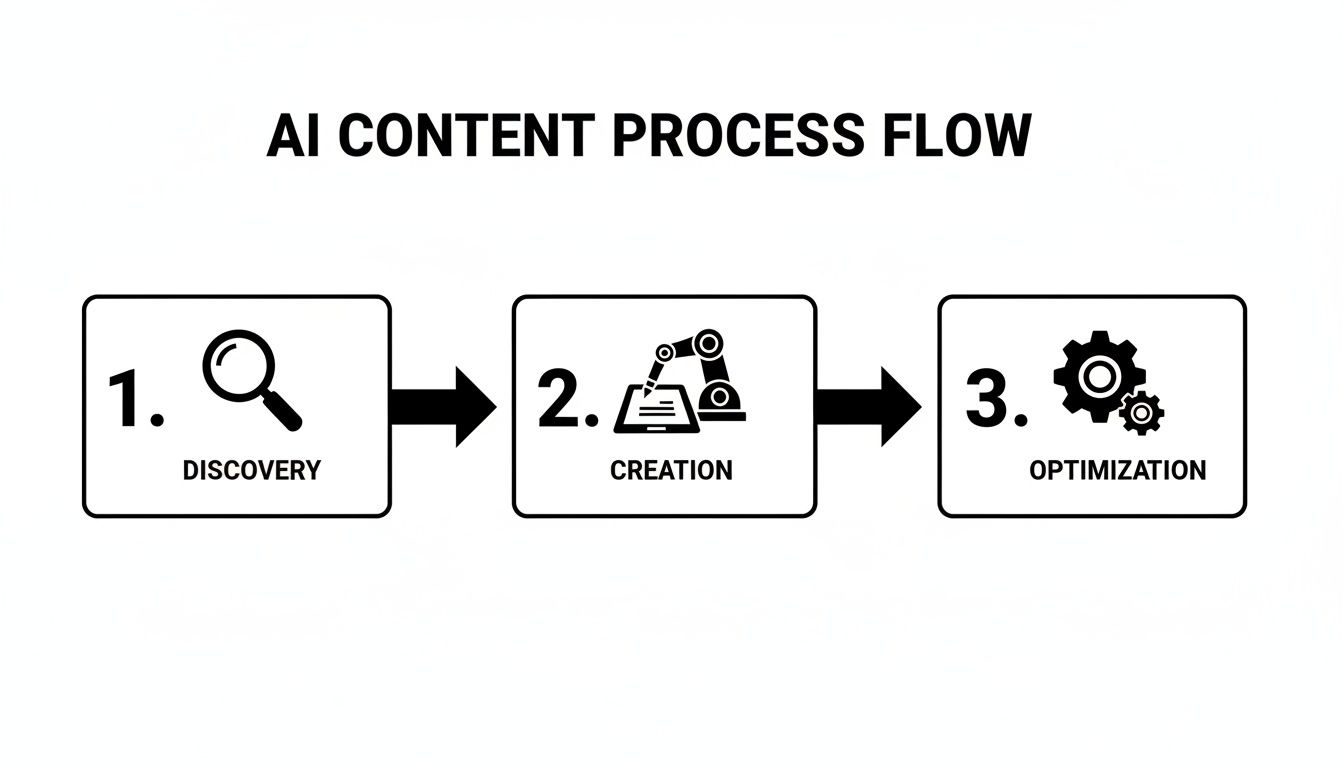
As you can see, the journey from discovery to optimization shows how a unified platform can turn a strategic idea directly into a published, high-performing article.
When you're looking at different platforms, focus on features that support this all-in-one approach. Your checklist should have these four must-haves:
- Centralized AI Visibility Monitoring: Does the tool actually show you how models like ChatGPT, Gemini, and Perplexity see your brand? If not, your entire strategy is just a shot in the dark.
- Access to Specialized AI Agents: Generic AI writers are fine for a first pass, but specialized agents trained for specific jobs—like cranking out SEO-optimized long-form articles or creating GEO-targeted content—will give you far better results with way less editing.
- Direct CMS Integration: The ability to push finished content straight to your WordPress site or another CMS is a massive time-saver. It automates one of the most annoying manual steps in the whole publishing process.
- Automated Indexing: Look for features that automatically update your sitemap and handle IndexNow submissions. This is how you get search engines to find and rank your new content as fast as possible.
The best setup is a true human-AI partnership. Let the AI handle the heavy lifting—research, drafting, and data analysis—while your team provides the strategic direction, creative oversight, and brand authenticity that machines can't replicate.
By combining the right people with the right technology, you build a content operation that’s not just efficient but also incredibly resilient. This setup doesn't just let you scale up content production; it sharpens your strategic focus so you can consistently outmaneuver the competition. To get started finding the right platforms, check out our complete guide on AI-powered SEO tools that can speed up your entire workflow. Building this foundation is the key to unlocking what AI content marketing can really do.
Real-World Examples of AI Marketing in Action
Theory is one thing, but seeing AI-powered content marketing on the ground shows you what’s really possible. These aren't just tools for writing faster; they’re strategic weapons for winning competitive fights. Let's walk through three different scenarios where brands used AI to spot a unique opening and execute a content plan that delivered real results.
Each of these stories follows a simple but powerful playbook. They started by using AI to uncover a critical insight, acted on that insight with incredible speed and scale, and ended up with measurable business growth.
A B2B SaaS Company Captures High-Intent Traffic
The Challenge: A growing B2B SaaS company was fighting to get noticed in a saturated market. Their biggest rival completely owned the search results for valuable keywords around "project management automation." Old-school manual research wasn't turning up any weaknesses; the competitor had a massive backlink profile and years of content under its belt.
The AI-Driven Solution: Instead of just guessing, the team used an AI visibility platform to see how models like ChatGPT and Perplexity were answering user questions. They found a crack in the armor. While their competitor was cited constantly for general topics, they were nowhere to be found in conversations about integrations with specific enterprise software. This was the opening they needed.
With this insight, they spun up a specialized AI agent to quickly create a whole series of deep-dive articles, each one targeting a specific integration. Titles like "How to Automate Project Updates with Salesforce and [Their Product]" were generated in minutes, not weeks. Every article was optimized for search, packed with actionable steps, and pushed live to their CMS immediately.
The Measurable Outcome: Within just 60 days, the company landed top-three rankings for five of their new long-tail keywords. This surgical strike on their competitor's blind spot drove a 45% increase in qualified organic traffic from decision-makers actively searching for solutions, leading directly to more demo requests.
An Ecommerce Brand Shifts the Sustainability Narrative
The Challenge: An eco-friendly e-commerce brand was proud of its sustainable sourcing, but a major competitor was getting all the public credit. Their rival was constantly named by AI models and top blogs as the poster child for "sustainable retail," even though their credentials weren't as strong.
The AI-Driven Solution: The brand turned to AI monitoring tools to dissect the exact language and sources the AI models were pulling from. They discovered the competitor’s entire reputation was built on a single, data-heavy "Annual Sustainability Report" they published two years ago. One cornerstone asset had shaped the whole conversation.
Knowing this, the brand used AI to build something better. An AI agent researched and pulled together an exhaustive "2024 State of Ethical Sourcing" guide, complete with fresh statistics, supplier interviews, and interactive charts. The AI did the heavy lifting on data aggregation and first drafts, letting the human team focus on storytelling and design.
The Measurable Outcome: After launching and promoting the guide, the brand earned citations from three major industry publications in the first month. Better yet, AI models started citing their new guide instead. Six months later, their brand was being mentioned in 30% of AI-generated responses about sustainable e-commerce, completely changing their brand perception and authority. You can find more inspiration for this kind of strategic play in our guide to powerful content marketing strategy examples.
A Marketing Agency Scales Local SEO for Clients
The Challenge: A digital marketing agency was handling SEO for dozens of local service businesses—plumbers, electricians, you name it. Creating unique, geo-targeted content for every single client in every suburb they covered was a logistical nightmare. It was slow, expensive, and the content ended up feeling generic.
The AI-Driven Solution: The agency brought in a platform with a specialized GEO-targeting AI agent. For each client, they would create one master service page and then use the AI to spin up dozens of localized versions. For a plumber in Austin, the AI could instantly create pages for "Emergency Pipe Repair in Round Rock" and "Drain Cleaning Services in Cedar Park."
The AI agent automatically wove in local landmarks, neighborhood names, and relevant service details for each specific area, creating content that felt authentic and locally relevant. This allowed the agency to scale a highly effective local SEO strategy that was previously impossible to manage manually.
The AI content marketing explosion is reshaping how agencies and teams operate. A recent report highlights this trend, noting that 45% of B2B marketers plan to increase their investment in AI tools by 2026, with adoption expected to hit 90.1% by 2025. For agencies, this means using platforms like Sight AI to discover these high-value opportunities and scale execution for their clients. Discover more insights about the future of content marketing on thedigitalelevator.com.
The Measurable Outcome: The agency cut content production time for its local clients by over 80%. Even more impressive, within three months, their clients saw an average 200% increase in visibility in Google's local pack for their target service areas. This led to a huge jump in local calls and contact form submissions.
Measuring Success and Proving ROI
Putting an AI powered content marketing strategy into motion is exciting, but that initial buzz won't get you far in a budget meeting. To justify the investment and scale up with confidence, you need cold, hard proof that it’s actually working. This means looking past surface-level vanity metrics and drawing a straight line from your AI-driven work to real business results.
A simple, three-tiered framework is the best way to measure what truly matters. It helps you connect the dots from the first ripples of AI visibility all the way down to bottom-line revenue. With this structure, you'll have the data to tell a compelling ROI story and track progress at every single stage of the funnel.
Tier 1: Visibility Metrics
This first layer is all about a new, crucial performance area: how your brand shows up and is talked about within AI models themselves. Think of this as the very top of your new AI funnel. It’s where people first become aware of you and where brand associations are formed. Nailing this part lays the foundation for everything else.
Key visibility metrics to keep an eye on include:
- Share of Voice in AI Responses: How often do models like ChatGPT and Gemini mention or cite your brand on key topics compared to your competitors? A higher share of voice means you're becoming the go-to authority in your space.
- Sentiment Analysis: When your brand gets mentioned, is it positive, negative, or just neutral? Tracking sentiment helps you get a handle on the narrative AI is building around your brand.
- Citation Quality: When an AI model does cite your content, is it linking to a high-value pillar page or just a random blog post? High-quality citations are what drive qualified, ready-to-engage referral traffic.
Tier 2: Performance Metrics
The second tier digs into the more traditional performance indicators that SEO and content teams live and breathe every day. The trick here, though, is to view these metrics through the specific lens of your AI-driven activities. This is where you measure the direct impact of the content your AI agents are creating and publishing at scale.
These metrics prove that your AI-generated content is hitting the mark and reaching the right people. Relevant KPIs include:
- Organic Traffic Growth: Are you seeing a real, measurable lift in organic traffic to the pages created with AI?
- Keyword Rankings: How are your AI-generated articles stacking up for their target keywords? Are they climbing the SERPs?
- Indexing Speed: With automation in your corner, how quickly are new pages getting indexed by Google and Bing? Faster indexing means faster results. Period.
Tier 3: Business Impact Metrics
Finally, the third tier ties all your hard work to the numbers that executives and stakeholders really care about: revenue and growth. This is where you prove the ultimate business value of your AI-powered content marketing. You have to show that all that increased visibility and traffic are translating into actual business.
This final connection is absolutely critical. It’s not just about creating content faster; it’s about creating content that directly fuels business growth and lowers the cost of acquiring new customers. For a detailed guide on this, you can learn more about measuring content marketing ROI in our dedicated article.
Core business impact metrics are:
- Lead Generation: How many new, qualified leads are coming in from content created by your AI?
- Conversion Rates: Are visitors arriving from AI-driven content converting into customers at a healthy clip?
- Customer Acquisition Cost (CAC) Reduction: By automating a huge chunk of content production, are you successfully lowering the overall cost to acquire a new customer?
This comprehensive measurement framework gives you a powerful story to tell. You can walk into any meeting and show stakeholders exactly how gaining visibility in AI chat leads directly to higher traffic, which in turn generates more leads and, ultimately, drives revenue. This is becoming non-negotiable as more businesses jump on board. In 2024, a staggering 83.2% of content marketers planned to bring AI into their workflows, with 68% already reporting a significant ROI boost from their efforts. You can discover more insights about these content marketing trends on rebootonline.com.
Your 90-Day AI Content Marketing Rollout Plan

Making the switch to an AI-powered content marketing model isn’t a flip-of-the-switch affair. It requires a thoughtful, phased rollout that gives your team the space to learn, build momentum, and get comfortable with new workflows. This practical 90-day roadmap is designed to move you from idea to execution with a clear, step-by-step timeline.
We've designed this plan to get you measurable results by nailing the fundamentals first, then moving into controlled production, and finally scaling up your efforts. Think of it like building a new factory: you pour the concrete foundation before you bring in the machinery, and only then do you start cranking up the assembly line.
Days 1-30: Foundation and Discovery
Your first month is all about getting your command center online and picking your first strategic target. Don't rush this part. A solid foundation is non-negotiable for everything that comes next. The main goal here is to establish a clear baseline and find that first perfect opening.
Here are your key actions for this phase:
- Set Up Monitoring Tools: Get a platform like Sight AI integrated to start tracking your brand's visibility and sentiment across major AI models. This initial data stream is absolutely essential.
- Establish Baseline Metrics: Document where you stand today. What’s your organic traffic? What are your key rankings and share of voice? You can't show a solid ROI if you don’t know your starting point.
- Identify Your First Opportunity: Use the visibility insights from your new tools to pinpoint a high-impact content gap. Look for a topic where a competitor is vulnerable or where the AI models themselves don't have a clear, authoritative answer yet.
Days 31-60: Production and Optimization
With your first target locked in, month two is all about production and refinement. This is where your team gets their hands dirty with the new AI-driven workflow, turning those strategic insights into actual content. The focus here is on nailing the process and quality, not just pumping out volume.
During this period, you will:
- Generate Your First Content Batch: Fire up a specialized AI agent to create 3-5 articles aimed squarely at the opportunity you identified last month.
- Refine the Human Review Process: Build out a clear, simple checklist for your editors. Every piece needs to be fact-checked, polished to match your brand voice, and genuinely add value that the AI couldn't on its own.
- Publish and Accelerate Indexing: Get the finished articles into your CMS and use automated tools to get them submitted for indexing right away.
This first batch is your training ground. It’s where you’ll smooth out the wrinkles in your workflow and set the quality bar for every piece of AI-assisted content you create from here on out.
Days 61-90: Scaling and Compounding
In the final month of the plan, it’s time to start scaling up and looking at the early results. Now that you've validated your workflow, you can confidently increase your publishing speed and use real performance data to decide your next move. This is where you’ll start to see the compounding effects of publishing great content, consistently.
Your focus shifts to growth and analysis:
- Increase Publishing Cadence: Start publishing new AI-generated articles more frequently, building toward a steady, predictable rhythm.
- Track Early Performance: Keep a close eye on the rankings and traffic for your first batch of articles. Look for those early wins you can share with stakeholders to build excitement.
- Inform Your Next Move: Use the performance data and fresh AI visibility insights to identify the next cluster of content targets, kicking off the cycle again with a much smarter, data-backed strategy.
Common Questions About AI in Content Marketing
As teams start weaving AI into their content marketing, a few questions pop up time and again. Getting a handle on this new landscape means knowing what AI is great at, what it isn't, and how to use it smartly to get real results. Let's tackle some of the big ones.
Will AI Completely Replace Human Content Creators?
Nope, and frankly, that's not even the point. The winning formula is a human-AI partnership.
Think of it this way: AI is like a state-of-the-art jet, capable of incredible speed and processing massive amounts of data. But you still need a skilled pilot—the human—to provide the strategic direction, creativity, and critical judgment.
AI is a workhorse. It excels at the heavy lifting—research, data analysis, and banging out first drafts at a scale that would make your head spin. This frees up your human experts to focus on what they do best: overseeing the strategy, injecting brand personality, and adding the creative flair that actually connects with people.
"Your job will not be taken by AI. It will be taken by a person who knows how to use AI."
This hits the nail on the head. A marketer's role is shifting from being a manual creator to a strategic operator who directs powerful tools to hit business goals.
How Can You Be Sure AI Content Is Accurate and Original?
The best AI platforms are built from the ground up to generate original content. They work by synthesizing information from countless sources, not just grabbing and stitching together existing sentences. That said, a human review is still a non-negotiable final step.
This human-in-the-loop process is crucial for two reasons:
- Fact-Checking: An expert needs to give the final sign-off on any stats, claims, or technical details. You can't afford to get this wrong.
- Quality Control: An editor polishes the piece, makes sure it sounds like your brand, and smooths out any clunky phrasing that might give away its AI origins.
Many teams also run the final draft through a plagiarism checker just to be safe. This double-check ensures every single piece of content is both accurate and unique before it goes live.
What's the Biggest Mistake to Avoid When Getting Started?
The single biggest pitfall is chasing volume instead of strategy.
It's tempting to get dazzled by an AI's ability to crank out 10 articles in an hour. But just flooding your site with generic, low-effort AI content is a recipe for disaster. You'll see poor engagement, and you could even hurt your search rankings.
Success in AI-powered content marketing starts with a strategy-first mindset. You begin by using AI to find strategic opportunities—like spotting a gap in a competitor's content or figuring out the exact questions your audience is asking. Then, and only then, you use AI to create high-quality, targeted content at scale to own those opportunities.
Ready to stop creating generic content and start finding strategic opportunities with AI? Sight AI shows you exactly how AI models see your brand, helping you find high-value content gaps and scale production with specialized agents. Discover how Sight AI can transform your content strategy.