An AI article generator is a piece of software that uses artificial intelligence to write content, like blog posts and articles, based on simple instructions from you. These tools are built to dramatically cut down on content production time, helping teams scale up their SEO game and finally break through writer's block.
Why AI Article Generators Are Reshaping Content Strategy

Think about having a content specialist on your team who can research, draft, and optimize articles 24/7. That's the edge an AI article generator gives to SEO managers and content teams right now. This isn't just a neat gadget; it's become a core part of tackling the biggest challenge every brand faces: creating high-quality content at scale in a ridiculously competitive space.
The speed at which these tools are being adopted is just incredible. The global AI text generator market jumped from USD 360 million in 2022 and is on track to hit a projected USD 1,808 million by 2032. This isn't just growth; it's a fundamental change in how businesses think about and create content.
Moving Beyond Production Bottlenecks
For years, the biggest hurdle in any serious content strategy was the sheer amount of time and effort it took to create everything by hand. An AI article generator smashes right through that bottleneck.
Instead of spending weeks chipping away at a single long-form article, teams can now get a solid first draft in just a few minutes. This efficiency frees up marketers to work on the high-impact stuff that actually moves the needle.
This shift lets teams zero in on:
- Strategic Planning: Digging into competitor weaknesses and finding fresh content opportunities.
- Audience Research: Getting a much deeper understanding of what users are actually looking for.
- Creative Direction: Honing the brand's voice and making sure the final content is original and top-notch.
By taking over the heavy lifting of drafting, these tools allow content teams to evolve from just being producers to becoming the strategic architects of their brand's online presence.
A Strategic Partner for SEO Growth
Thinking of an AI writer as just another tool is missing the point. It's really a strategic partner that plugs directly into the entire SEO workflow. For a closer look at how this plays out, check out our guide on using AI content for SEO.
The impact goes way beyond just writing articles. To get the bigger picture of how AI is changing the game, it's worth looking at trends like AI integration in the publishing industry. This evolution shows that smart automation isn't some far-off idea anymore—it's a must-have for anyone serious about winning and keeping a competitive edge.
How an AI Article Generator Actually Works

So, what's really going on behind the scenes when you ask an AI article generator to create content? It’s not magic, but it’s close. Think of it like a master chef—the AI model—who has spent a lifetime studying every cookbook ever written. This chef pulls from a massive pantry of ingredients (its training data) to follow a specific recipe you provide (your prompt) and whip up a unique dish (the article).
At the core of this whole operation are Large Language Models (LLMs). These are incredibly complex AI systems that have been trained on staggering amounts of text and code scraped from the internet. By analyzing literally trillions of words, sentences, and data points, an LLM learns the intricate patterns, context, and structure of human language.
This training gives it the ability to predict the next most likely word in a sentence, which is fundamentally how it "writes." When you give it a prompt, you're just giving it a starting point and the rules for the recipe it needs to follow.
The Core Components of AI Writing
Every article you generate is the direct result of three key ingredients working together. If you get a handle on each one, you’ll be much better at crafting great content and figuring out what went wrong when the results aren't quite right. Getting these elements right is the key to using any type of AI writing software well.
These three core components are:
- The Model: This is the AI "brain" itself, like OpenAI's GPT-4 or Anthropic's Claude. Different models have different personalities; some are fantastic at creative writing, while others are better at summarizing dense, factual information. The model you use sets the ceiling for what your generator can do.
- The Training Data: This is the "pantry" of information the model learned from. A model trained on a wider, more up-to-date dataset will naturally produce more relevant and accurate content. Outdated data is a fast track to factual errors.
- The Prompt: This is your "recipe"—the instructions you give the AI. A lazy prompt like "write about SEO" will get you a generic, forgettable article. A detailed prompt that specifies the tone of voice, target audience, keywords, and a structured outline will produce something far more specific and valuable.
Your ability to craft a clear and detailed prompt is the single most important factor you can control to influence the quality of the generated article. A great chef needs a great recipe to create a masterpiece.
From Prompt to Published Post
The moment you hit "generate," the AI model fires up its predictive engine. It deconstructs your prompt, dives into its vast knowledge base, and starts stringing sentences together one word at a time. It builds out the intro, headings, and body paragraphs based on the logical structures it picked up during its training.
The growth in this space is just incredible. The generative AI market is on track to become a USD 324.68 billion industry by 2033, which tells you just how central these tools are becoming. This explosion is fueled by massive user interest, with online searches for 'AI text generators' in the U.S. jumping 49% in a single year. You can dive deeper into the trends shaping the generative AI market and see the numbers for yourself.
Essential Features of a Powerful AI Article Generator
So, let's move from theory to practice. It’s pretty clear that not all AI article generators are built the same. A basic tool might be able to churn out some generic text, but a truly powerful one acts more like a strategic content engine for your team. To make the right choice, you have to look past the flashy marketing and dig into the core features that actually drive results.
Think of it like choosing a car. Sure, a basic model gets you from point A to B. But a high-performance vehicle? That comes with advanced navigation, superior safety features, and a powerful engine that delivers a completely different experience. The same logic applies here; the right features can transform your content efforts from a slow crawl into a high-speed journey toward your SEO goals.
Beyond Basic Text Generation
The market is definitely crowded, but the top-tier platforms stand out with capabilities designed for serious content teams. In major markets like North America, 71% of organizations are now regularly using generative AI, and 40% of marketers rely on it every single day. With adoption this widespread, the demand for sophisticated features has never been higher. You can see this trend reflected in the latest AI text generator market data.
A truly effective ai article generator has to offer more than just words on a page. It needs a robust set of features that supports the entire content lifecycle—from the initial idea all the way to publication and ongoing optimization.
Here are the non-negotiable features you should be looking for:
- Integrated SEO Optimization: The tool needs to do more than just let you sprinkle in a few keywords. Look for platforms that can analyze the SERPs, suggest relevant LSI keywords, and build outlines based on what's already ranking. This ensures every article is primed for search visibility from the get-go.
- Factual Accuracy and Citation: To fight back against AI "hallucinations" and build real trust with your audience, a great generator will have fact-checking capabilities or provide direct citations from credible sources. This is absolutely critical for maintaining your E-E-A-T (Experience, Expertise, Authoritativeness, Trustworthiness).
- Content Scalability and Automation: The ability to generate articles in bulk or schedule your content production is a total game-changer. Features like Sight AI's AI content automation allow teams to publish fresh material consistently without getting bogged down by constant manual effort.
Seamless Workflow Integration
The best AI article generator doesn't just create content; it fits seamlessly into your existing workflow. A clunky tool that requires endless copy-pasting and manual formatting creates more friction than it solves.
Look for direct integrations with popular Content Management Systems (CMS) like WordPress or Webflow. The ability to push a generated article straight to your CMS as a fully formatted draft—complete with images and metadata—can save your team hours of tedious work every single week. This seemingly small feature is a true hallmark of a platform built for professional use.
Smart Strategies to Overcome AI Content Challenges
While an AI article generator can feel like a superpower for content teams, it's not a magic wand. Just hitting "generate" and publishing the raw output is a fast track to mediocre content that can chip away at your brand's credibility and tank your SEO. The trick isn't to ditch AI, but to use it smartly—pairing its incredible speed with essential human oversight.
The most common traps are often subtle. Factual errors, or "hallucinations," can easily slip in, presenting wrong numbers or outdated info as hard facts. On top of that, the tone can feel bland and robotic, completely missing the unique voice that makes your brand recognizable and builds trust with your audience.
Balancing Automation with Authenticity
To get the best of both worlds, you need to build a hybrid workflow. This approach treats the AI like a highly efficient junior writer, one who handles the initial research and drafting. A human editor then comes in to provide the strategic polish, expertise, and final sign-off.
Think of it this way: the AI lays the foundation, but a human architect makes sure the building is safe, functional, and actually looks like it belongs to your brand. This partnership is especially crucial for satisfying Google's E-E-A-T guidelines, which reward content that shows real-world Experience, Expertise, Authoritativeness, and Trustworthiness.
Here’s how to put this into practice:
- Human-Led Fact-Checking: Never trust a number or claim without verification. An AI might pull a statistic from a five-year-old article or misinterpret the context entirely. Your team's job is to be the final authority on what's true.
- Injecting Brand Voice: Go through the AI-generated draft specifically to weave in your brand's personality—be it witty, serious, or inspirational. Add personal stories, inside jokes, or industry-specific examples that an AI could never invent.
- Adding Unique Expertise: Use the AI's draft as a jumping-off point. Layer in your team's firsthand experience, expert analysis, and unique perspective. This is the human element that separates genuinely helpful content from generic filler.
Mitigating Deeper AI Risks
Beyond surface-level edits, bigger issues like inherent bias and data privacy are becoming real concerns for brands. For example, transcription inaccuracies from diverse audio sources can introduce subtle errors, highlighting the need for platforms that use specialized agents to monitor AI models like ChatGPT and Gemini for accuracy and sentiment.
With Gen Z leaders citing data privacy as a top concern, using platforms that guarantee ethical and targeted output is more important than ever. You can dig into the research on generative AI challenges and market growth to get a sense of the full landscape.
The most successful content teams don't see AI as a replacement for writers, but as a powerful tool to amplify their creativity and expertise. The human element remains the most important part of the content creation process.
By using these smart strategies, you can turn your ai article generator from a potential risk into a dependable asset. You'll ensure every single piece of content you publish is accurate, authentic, and truly valuable to your readers.
Integrating AI Into Your Content Workflow
Let's get one thing straight: bringing an AI article generator into your content process isn't about firing your writers. It's about giving them a serious upgrade—like trading a hand saw for a power saw. The goal is a hybrid workflow where AI handles the grunt work of production, freeing up your team to focus on what humans do best: strategy, creative thinking, and quality control.
Think of it like an assembly line for content. The AI can quickly piece together the basic frame of an article by researching topics, mapping out a structure, and spitting out a first draft. This initial phase, which used to eat up hours or even days, now takes just a few minutes. That simple change speeds up the entire content pipeline from ideation to publish.
The numbers back this up. For content marketers and agencies, 70% say AI makes their jobs easier, while 71% report a major drop in busywork. This is exactly why 51% of companies are already using generative AI to create content. They’re letting automation handle the scale while their experts tackle the high-impact strategic tasks. You can find more stats on this shift over at planable.io's AI statistics roundup.
A Practical Four-Step Hybrid Workflow
To really make an AI article generator work for you, you need a clear, repeatable process. This is what keeps your quality high and consistent while still reaping the benefits of AI's speed. A structured workflow is your best defense against common AI pitfalls like factual errors or a generic, off-brand voice.
Here’s a simple framework to get you started:
- Human-Led Strategy and Prompting: Everything starts with a human. Your team is still in charge of identifying the right keywords, analyzing the SERPs, and setting the goals for the article. From there, they craft a detailed prompt that tells the AI exactly what to do—specifying the target audience, tone of voice, key points to cover, and anything to avoid.
- AI-Powered Drafting: With a solid prompt in hand, the AI article generator gets to work. It will build a comprehensive outline and then generate the first draft. The key here is to treat it as just that—a draft, not the final product. Its job is to give your team a strong foundation to build on.
- Human-Driven Editing and Enhancement: This is where the magic really happens and, frankly, the most important step. A human editor needs to go through the AI-generated text to check for accuracy, clarity, and brand voice. They'll fact-check every claim, add unique insights from their own experience, sprinkle in personal stories, and make sure the content hits all the right notes for E-E-A-T.
- Final Optimization and Publishing: Once the content is polished, a human takes the last lap. This involves optimizing on-page SEO elements, adding internal links, choosing compelling images, and finally publishing the article through your CMS.
The flow chart below shows how this "human-in-the-loop" approach helps manage the risks and maintain high-quality output.
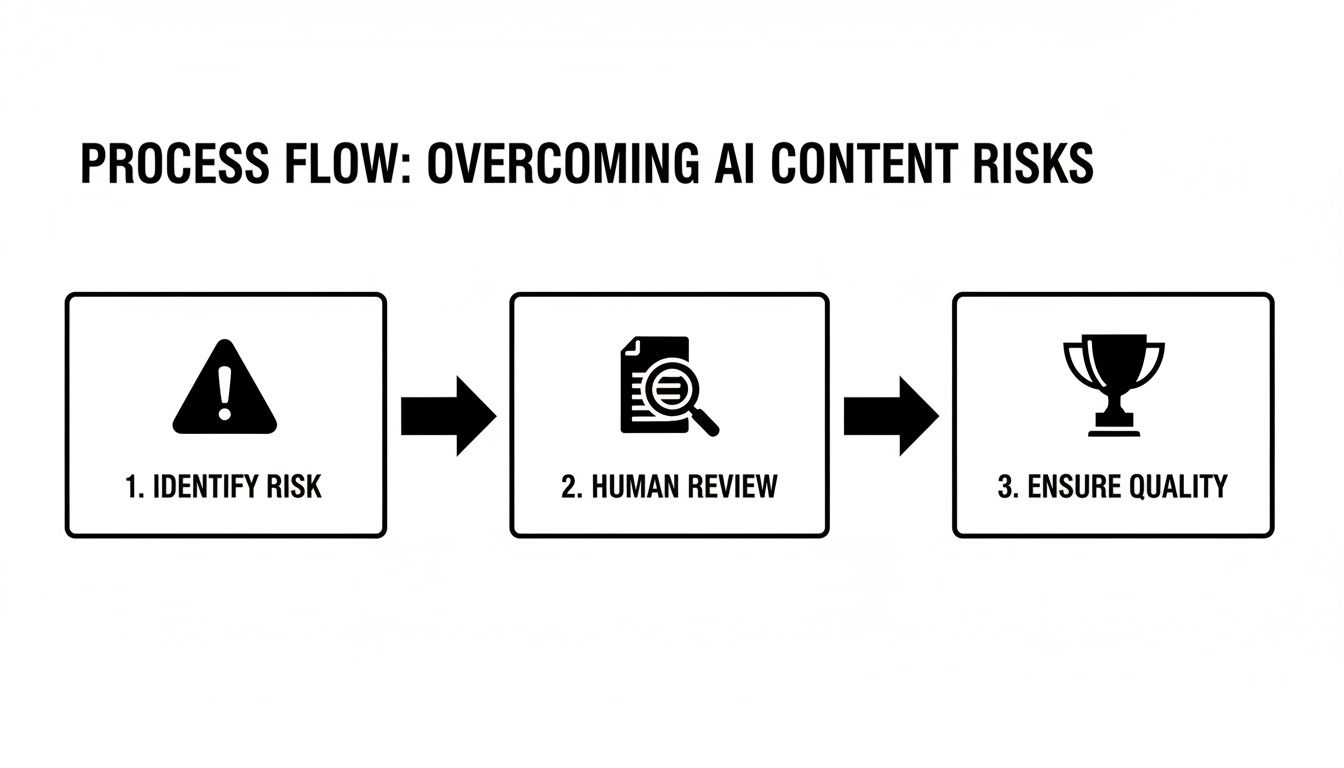
This process shows that by adding a dedicated human review step, you can confidently turn the potential downsides of AI into a reliable, high-quality content engine. For a deeper dive, check out our guide on how to integrate AI in an SEO workflow.
Driving Growth with AI Content Intelligence
The real power of an AI article generator kicks in when it stops being just a content factory and starts acting like the brain of a complete content intelligence system. Basic tools spit out articles. That’s fine. But the advanced platforms? They create growth. They do this by closing the loop between creating content, seeing how it performs, and automatically finding the next big opportunity. This is where you get a real edge.
Imagine a system that not only writes a blog post but then keeps an eye on its rankings. It tracks what AI models like ChatGPT and Gemini are saying about your brand and even dissects your competitors' content to find their weak spots. This is a complete shift from reacting to the market to proactively shaping it, turning live data into your next winning content brief without you lifting a finger.
From Content Production to Strategic Advantage
This change elevates your whole game. Instead of sitting in a meeting guessing what to write about next, the system tells you. It pinpoints high-value content gaps based on hard data and what your competitors are failing to do. This data-driven cycle means every single piece of content you create has a clear, strategic purpose behind it, massively boosting its odds of success.
That's the core idea behind a platform like Sight AI—turning raw insights into a never-ending pipeline of high-impact content. By automating this whole feedback loop, you build a self-sustaining SEO machine. To see what this looks like in practice, check out the broader benefits of AI-driven SEO strategies.
A true content intelligence system doesn't just answer your prompts; it tells you which prompts will drive the most business growth. It connects creation directly to results, ensuring your efforts compound over time.
Closing the Content Loop
An integrated system gives you a few key advantages you just can't get from a standalone AI writer:
- Automated Opportunity Discovery: It’s constantly scanning the digital landscape, looking for topics where your competitors are dropping the ball and you can swoop in for a win.
- Performance-Driven Content: The system is always learning. It sees what works—what ranks, what gets shared—and uses that data to make future articles even better.
- Brand Monitoring in AI: It keeps tabs on how your brand is being talked about in AI chat responses, giving you a whole new frontier for reputation management.
Of course, creating strategic content is only half the battle; getting it out there is just as crucial. Effective distribution on platforms for Medium publishing for AI content can seriously amplify your message and bring in more readers. When you connect sharp insights to smart action, your content generator stops being a tool and becomes a predictable engine for business growth.
Got Questions About AI Article Generators? We’ve Got Answers.
As you start looking at bringing an AI article generator into your workflow, some questions are bound to pop up. It's only natural. Getting these cleared up is key to figuring out how AI fits into a modern, quality-first content strategy, so you can move forward feeling confident.
Let's dive into some of the most common things we hear from teams exploring these powerful tools for the first time.
Is It Safe to Use an AI Article Generator for SEO?
Yes, it’s completely safe for SEO, but there’s a huge catch: you have to stay laser-focused on creating genuinely helpful content. Google has been crystal clear on this—they reward valuable content, no matter how it was made.
The trick is to treat AI as a powerful assistant that supercharges human creativity, not a shortcut to churn out low-effort spam. The final article must always be fact-checked, polished to match your brand's voice, and packed with real value for the reader. This approach keeps you in good standing with search engines and, more importantly, with your audience.
How Can I Ensure AI-Generated Articles Match My Brand Voice?
Getting that specific brand voice just right is a team effort between you and the AI. The best workflow involves using the AI to build the foundation—the initial draft and structure—and then letting a human editor sprinkle in the nuance, tone, and style that makes it yours.
You can nudge the AI in the right direction by feeding it detailed prompts that include things like:
- Snippets from your brand style guide
- Specific tone descriptors (e.g., "authoritative but witty," "informative and friendly")
- Links to existing articles that you feel perfectly capture your voice
Even the most advanced tools need a human touch. Your oversight is the secret ingredient that ensures the final piece feels 100% on-brand.
The teams winning with AI aren't just hitting "generate." They're guiding the AI to create a solid first draft, then layering their human expertise on top to make it truly exceptional. It's this blend of efficiency and authenticity that actually moves the needle.
How Much Human Involvement Is Still Needed with AI?
While AI does the heavy lifting and drastically cuts down on production time, strategic human involvement is still what separates good content from great content. People should always own the high-level stuff: the strategy, the initial ideas, and the art of crafting the perfect prompt.
Once the AI delivers a draft, a human needs to step in for fact-checking, editing for E-E-A-T signals (Experience, Expertise, Authoritativeness, and Trustworthiness), and adding those unique insights or personal stories that AI just can’t replicate. A good way to think about it is that AI handles 80% of the production work, while your team provides the critical 20% of strategy, refinement, and authenticity that makes the content connect.
Ready to turn AI insights into measurable growth? With Sight AI, you can monitor your brand's visibility across AI models, discover high-value content gaps, and automate the creation of SEO-optimized articles. Stop guessing and start driving results. Explore Sight AI today.