You publish a strong article. It is well researched, on-brand, internally linked, and aligned to a keyword your team cares about.
Then nothing happens.
A few impressions show up in Search Console. Traffic stays flat. The sales team asks whether the piece is “doing anything.” You check Google manually, see different results depending on device and location, and end up guessing. That is the point where rank tracking stops being a nice-to-have and becomes operational.
Many teams do not have a content problem. They have a visibility measurement problem. They cannot connect what they published to where they appear, which page Google chose, what SERP features are stealing attention, or how competitors are moving around them. The same problem now exists inside AI search experiences. If ChatGPT, Gemini, and similar systems mention your category without mentioning your brand, that is a visibility gap too.
How to use rank tracker well is not about watching positions bounce up and down. It is about building a workflow that turns rankings, SERP features, and AI mentions into decisions your team can act on this week.
Bridging the Gap Between Content and Rankings
A familiar pattern shows up in almost every content program. The team picks a target topic, writes the piece, publishes it, shares it in a newsletter, and waits. When the page does not move, people blame the content, the keyword, or Google.
Usually, the missing piece is simpler. Nobody set up a system to track whether the page was visible for the right query set, in the right market, on the right device, against the right competitors.
That matters because ranking is not one number. A page can sit just outside the top results on desktop, perform better on mobile, trigger different SERP features depending on the query variant, and get displaced when a stronger page from a competitor enters the result. Without a tracker, those shifts stay hidden.
I see the same issue with AI visibility. A brand might rank well for classic search terms and still be missing from generative answers. Teams assume authority transfers automatically from organic search to AI systems. It does not always. You need to monitor both surfaces and compare them.
A practical rank tracking workflow creates that missing bridge. It tells you which keywords matter, which URL is ranking, how competitors are changing, and whether search engines or AI systems are citing your brand when category prompts appear. That is the difference between “we published content” and “we know what the content is doing.”
If you want a cleaner way to think about that connection, this breakdown of rank data for SEO is a useful companion. The core idea is simple. Visibility data should influence what you publish next, what you refresh, and what you stop guessing about.
Building Your Rank Tracking Foundation
A rank tracker is only as useful as the inputs you give it. Bad keyword sets produce noisy dashboards. Loose organization makes the data hard to act on. Wrong competitors send the team in the wrong direction.
Start with structure.

Choose keywords by business intent
Do not begin with a giant export of high-volume phrases. Begin with the questions your site must answer to support revenue.
I usually build the list in three layers:
- Problem awareness terms. These are informational queries. They bring in people early, before they know which solution they want.
- Solution evaluation terms. These queries compare approaches, categories, or vendors.
- Decision terms. These are product, feature, service, and high-intent commercial phrases.
This structure matters because each layer behaves differently. Informational terms often fluctuate more and trigger richer SERP features. Decision terms tend to expose whether your money pages are competitive enough.
If you only track bottom-funnel phrases, you miss early authority signals. If you only track top-funnel terms, you may mistake traffic potential for business impact.
Pull in what your site already shows for
A practical shortcut is to start from real impression data instead of brainstorming from scratch.
Sitechecker notes that connecting Google Search Console during project setup can auto-suggest high-volume keywords, boosting coverage by 35%, and users can assign target URLs and groups per keyword to catch ranking mismatches, which occur in an estimated 22% of cases (Sitechecker documentation). That is useful because it anchors your tracking set in terms Google already associates with your site.
Once you have that list, trim aggressively. Keep keywords that map to a specific page or a page you intend to build. Drop vanity terms with no clear owner.
For teams trying to sanity-check current visibility before building the list, this guide on where does my site rank on Google search helps frame the starting point.
Track keywords you can act on. If no page exists and no page is planned, the keyword belongs in ideation, not rank tracking.
Group keywords like an operator, not a spreadsheet
Many teams underuse grouping. They track a flat list, then wonder why the report feels messy.
Group by something the business already understands:
- Product line for SaaS or ecommerce
- Service category for agencies or local businesses
- Funnel stage if your content program is mature
- Geography when market differences matter
- Content cluster when one hub page supports several supporting articles
Rank tracking becomes actionable with this approach. If a product cluster slips, you know which team owns the fix. If only one geography drops, you do not waste time refreshing sitewide copy.
Set a target URL for every important term
This one step prevents a lot of confusion.
When a keyword rises, you want to know whether the right page is gaining. If the wrong page ranks, the position can look healthy while the user journey stays broken. The wrong article may be cannibalizing a commercial page. A legacy blog post may outrank the current landing page. A comparison page may start ranking for a generic category term and create weak conversion paths.
A rank tracker should help you spot that mismatch quickly.
Identify your real competitors
The sites you mention in sales calls are not the sites beating you in search.
Your true SERP competitors are the domains that repeatedly appear for your tracked topics. Sometimes they are publishers. Sometimes they are marketplaces. Sometimes they are tiny niche sites with one excellent page.
Build a short list by checking who appears most often across your categories. Then separate them into:
- Direct business competitors
- Content competitors
- AI citation competitors
That third category matters more now. A domain can be weak in classic organic rankings and still become a frequent source in AI-generated answers because it publishes clear, citable explanations.
Configuring Your Tracker for Pinpoint Accuracy
Once the keyword set is clean, configuration decides whether the data is trustworthy. Many teams unwittingly sabotage their own reporting by using defaults.
If you want to know how to use rank tracker properly, pay attention to market settings before you look at the charts.

Match the search environment your audience uses
Rank data only matters if it reflects what your buyer sees.
With a tool like ProRankTracker, specifying search engine, device, language, and location is critical because mobile rankings can differ by up to 30% from desktop in major markets. The same source also notes that its API supports bulk uploads of over 10,000 keywords per minute, but teams should batch uploads to avoid the 100 calls/minute throttling limit (ProRankTracker automated rank tracker guide).
That has two direct implications.
First, do not track “Google” in the abstract. Track Google in the country, language, and device mix your customers use. If you sell into the UK and US, split them. If mobile drives your category, track mobile separately.
Second, if you are setting this up across many clients, markets, or product lines, bulk import is worth using. Just do it with clean batching and naming conventions so the account stays readable.
A useful checklist lives in this overview of rank tracker features, especially if you are comparing tools and deciding which settings deserve priority.
Pick locations with business logic
Location settings should follow demand and delivery.
A local company should track city or service-area queries. A national SaaS company should track its priority countries. An ecommerce brand with regional inventory should track where availability and margins matter most.
Do not create location variants just because the tool allows it. Track the places where a ranking change would alter budget, pipeline, or customer acquisition decisions.
A simple rule works well:
| Scenario | Best tracking setup | Common mistake |
|---|---|---|
| Local service business | City or service area | National tracking only |
| Multi-country SaaS | Separate country sets | Combining all English markets |
| Ecommerce with regional catalogs | Market-specific keyword groups | One global keyword list |
| Publisher | Core audience markets | Tracking too many low-value regions |
Separate desktop, mobile, and AI monitoring
Classic rank tracking already needs device separation. AI visibility adds another layer.
For search, keep desktop and mobile data separate when the keyword matters commercially. Mobile results can present different layouts, tighter screens, and different feature competition.
For AI systems, think in prompts instead of keywords. Track recurring buyer questions, comparison prompts, and category-definition prompts. Then monitor whether your brand is:
- Mentioned at all
- Mentioned positively or neutrally
- Cited with a source
- Shown alongside competitors
- Associated with the product category you want to own
This is the operational shift many teams have not made yet. Traditional rank tracking tells you where your pages stand in search results. AI visibility tracking tells you whether your brand enters the answer layer itself.
If your team only tracks keywords and never tracks prompts, you are measuring search visibility but not answer visibility.
Configure for maintenance, not just launch
A setup that works on day one can still fail later if naming conventions are weak.
Use a structure your team can filter fast:
- Project by brand or site
- Group by category or market
- Tags by funnel stage, feature, or campaign
- Naming patterns that stay consistent across imports
Good configuration reduces analysis time later. That matters more than squeezing every possible keyword into the system.
Interpreting Rank Trends and SERP Features
Once the tracker starts collecting data, resist the urge to obsess over every movement. Single-position changes are often noise. Useful interpretation starts by asking whether the pattern changes the business response.

Read the dashboard from cluster to keyword
Start broad. Look at groups before individual terms.
A stable overall trend with a few slipping keywords usually points to page-level issues. A category-wide decline suggests a stronger competitive move, internal cannibalization, or a broader relevance problem. A sudden shift across many groups may indicate a change in the search environment rather than a single bad page.
This is why grouped reporting matters. You need to know whether the problem is isolated or systemic.
A simple reading order works well:
- Group trend. Did a category or cluster move?
- Winning and losing URLs. Which pages drove the change?
- Keyword spread. Are top positions consolidating or fragmenting?
- SERP context. Did the result page itself change?
- Competitor pattern. Who gained when you lost?
Look for context, not just position
Position alone is incomplete. A keyword can stay numerically stable while clicks fall because the SERP gained more aggressive features, a new forum result appeared, or AI-generated summaries changed user behavior.
Advanced tools help here. Rank Tracker by Link-Assistant lets users Record SERP history, capturing the evolving top 30 SERP competitors for a keyword at each rank check. It also overlays major Google algorithm updates on the progress graph, which gives useful context for diagnosing ranking shifts (Link-Assistant guide).
That kind of history is valuable because it answers questions teams ask too late:
- Did one competitor steadily climb, or did the whole page reshuffle?
- Did the ranking move after an algorithm update marker?
- Did the result page start showing a featured snippet, knowledge panel, or other feature that changed click behavior?
A rank chart without SERP context encourages bad decisions. Teams rewrite content when the underlying issue is a changed result layout.
Interpret SERP features by impact
SERP features are not decoration. They shape whether your ranking is visible enough to earn attention.
I sort them into three buckets:
Attention-stealers
These features crowd or displace classic blue links.
Examples include featured snippets, local packs, video blocks, and other rich elements. When they appear above your result, your raw ranking can look fine while practical visibility weakens.
Relevance signals
Some features tell you what Google thinks the query needs.
If a query suddenly shows more comparison, visual, or entity-rich results, that is a clue about intent. It often means your page needs a better format match, not just fresher wording.
Opportunity indicators
Certain features create openings.
If your page already ranks on page one and the query triggers a feature you do not own, you may have a realistic path to capturing more visibility without needing a new topic. The process is less about “ranking higher” and more about “showing up better.”
A helpful resource for spotting those openings is this guide on how to find SERP features opportunities.
When rankings stall, inspect the result page before you touch the content. Google often tells you what kind of asset it wants.
Apply the same logic to AI responses
AI visibility should be interpreted with similar discipline.
If a brand appears in generative answers only for branded prompts, that is weak category visibility. If it appears for category prompts but without citations, authority may be shallow. If competitors are cited repeatedly for educational prompts, they likely have stronger explanatory assets.
The useful questions are not “Are we mentioned?” alone. Ask these instead:
- Are we present for non-branded prompts?
- Are we cited as a source or merely named?
- Which competitors appear next to us?
- Which themes trigger mentions consistently?
- Where do search visibility and AI visibility disagree?
That comparison often reveals the next content move. A page that ranks well but is rarely cited by AI systems may need clearer definitions, stronger evidence, cleaner structure, or more quote-worthy passages.
Turning Rank Insights into Actionable SEO Tasks
Tracking is only worth the effort if it creates work the team can execute. The best rank review meetings end with a prioritized task list, not a screenshot deck.

Turn drops into diagnosis
When an important keyword group slips, do not jump straight to rewriting. Triage first.
I use a short diagnostic sequence:
- Check the URL. Is the intended page still ranking?
- Inspect the SERP. Did the layout or intent shift?
- Review competitors. Did one page overtake several sites at once?
- Assess the page. Is the content outdated, thin, or mismatched to query intent?
- Review internal links. Has the page lost support from related content?
- Compare AI presence. Has the topic also become less visible in generative answers?
This narrows the task quickly. If the wrong page ranks, fix cannibalization or internal linking before rewriting the copy. If a competitor won with a stronger comparison format, update structure and intent match. If the query now surfaces richer SERP features, adapt for feature capture.
Use grouped performance to decide what deserves effort
AIOSEO’s rank tracker supports keyword Groups for consolidated reporting, and its documentation notes that sites maintaining top-3 positions capture over 60% of clicks. That grouping model is useful because it helps a manager evaluate a content cluster instead of one isolated phrase (AIOSEO Keyword Rank Tracker documentation).
That is the right way to prioritize. Do not optimize by keyword ego. Optimize by cluster impact.
If a whole feature set, product category, or topic family is hovering just outside stronger visibility, that often deserves more attention than a single vanity keyword already sitting mid-page one.
Build task types from the pattern you see
Different ranking patterns should create different work.
When one page slips but the cluster is healthy
This usually means the problem is local to the page.
Actions:
- refresh outdated sections
- improve intent match
- add missing subtopics
- tighten title and heading language
- add internal links from newer supporting pieces
When multiple pages in one topic cluster weaken
This points to topical authority or cluster architecture.
Actions:
- review hub-and-spoke internal linking
- identify missing support articles
- consolidate overlapping pages
- improve consistency in terminology and definitions
- add clearer sourceable sections for AI citation potential
When a competitor owns keywords you do not target
That is not a “monitor it” issue. It is a content gap.
Actions:
- add the keyword set to a new cluster
- create a page mapped to the missing intent
- build links from adjacent category pages
- publish supporting educational assets that can feed both search and AI visibility
When rankings hold but AI mentions do not
That often means your content is discoverable but not reusable in answer generation.
Actions:
- make explanations tighter
- add concise definitions
- use clearer formatting
- strengthen entities and topic framing
- create content that answers category-level prompts, not just keyword variants
Turn the review into a weekly operating cadence
One of the biggest mistakes in SEO teams is treating rank reviews like reporting instead of production planning.
A better cadence looks like this:
| Signal from tracker | Likely issue | Action owner |
|---|---|---|
| Wrong URL ranking | Cannibalization or weak mapping | SEO lead |
| Group-level drop | Competitive or intent shift | SEO strategist |
| Feature appears above results | SERP layout change | Content + SEO |
| Competitor enters repeatedly | New threat or stronger asset | Content strategist |
| AI mentions absent for category prompts | Weak answer-layer visibility | Content + brand team |
Good rank tracking creates assignments. If nobody owns the follow-up, the dashboard is just decoration.
This is also where AI-assisted content operations can help. Once a gap is clear, teams can move faster on briefs, refreshes, supporting articles, and entity coverage. The key is to let rank data decide the queue instead of publishing from a generic content calendar.
Automating Reports and Alerts to Scale Your Workflow
Manual spot checks are fine when you track a handful of terms. They break once the site, product set, or client roster grows.
The solution is not more dashboards. It is a reporting system that sends the right signal to the right person at the right frequency.
Build reports for decisions, not curiosity
Different stakeholders need different views.
Executives usually need a compact summary: category movement, major gains or losses, and risk areas. Content teams need URL-level and cluster-level changes. SEO leads need enough detail to diagnose whether the issue is technical, competitive, or editorial.
That means one default report rarely works.
Set up reporting around roles:
- Leadership report with trend direction, important wins, and notable losses
- Content report with pages that need refreshes or new supporting content
- SEO operations report with ranking anomalies, competitor movement, and ownership gaps
- AI visibility report with prompt coverage, brand mentions, citation presence, and competitor overlap
For teams comparing platforms that support this kind of workflow, these SEO reporting software reviews provide a useful lens.
Use alerts sparingly
Often, teams over-alert and then ignore everything.
Alerts should exist for events that trigger action. Good examples include a money-page keyword group slipping sharply, a target URL being replaced by the wrong page, a new competitor appearing repeatedly in a priority cluster, or a meaningful change in branded versus non-branded AI mentions.
Poor alerts are too broad. “Any ranking movement” is noise. So is a notification every time one long-tail keyword moves a little.
A clean alert system usually follows three rules:
- Tie the alert to a business-critical group
- Require a meaningful threshold
- Assign an owner before the alert goes live
Match cadence to volatility
Not every report should run daily.
Daily reporting makes sense for a short list of revenue-critical terms, active launches, or high-volatility categories. Weekly reporting works for most editorial and category reviews. Monthly summaries help leadership see patterns without overreacting.
AI visibility deserves a similar rhythm. Prompt-level monitoring can be reviewed weekly, while executive summaries can stay monthly unless the brand is in a highly competitive market or a launch window.
Reporting should reduce checking behavior, not create a new ritual of opening ten emails nobody uses.
Keep one source of truth
If rankings live in one tool, SERP feature notes in another spreadsheet, and AI mention reviews in a Slack thread, the workflow will drift.
A scalable system keeps the monitoring centralized and the outputs role-specific. That way the strategist can drill into causes, while the broader team gets concise updates they can act on.
Frequently Asked Questions About Rank Tracking
How often should I check rankings?
Check critical keyword groups often enough to catch meaningful changes, but do not interpret every movement as a problem. Daily monitoring works best for priority terms, launches, and volatile categories. Weekly review is usually enough for broader analysis and task planning.
Should I track every keyword my site ranks for?
No. Track the terms that map to business goals, important pages, and content clusters you can improve. If the list is too broad, the team stops acting on it. A focused set produces better decisions.
What is the difference between rank tracking and Search Console?
Search Console shows performance data from Google and is useful for identifying impressions, clicks, and queries your site already appears for. Rank tracking gives you a controlled monitoring setup for specific keywords, competitors, locations, and devices. Use both. Search Console helps discover. Rank tracking helps monitor and compare.
Why do rankings look different when I check manually?
Manual checks are affected by location, device, personalization, and result-page differences. That is why configuration matters. A rank tracker gives you a more consistent baseline than ad hoc searching in a browser.
Should I track competitors directly?
Yes, but track the competitors that appear in the SERPs you care about. That list often includes publishers, directories, and niche sites, not just direct commercial rivals.
How does AI visibility fit into rank tracking?
It belongs in the same workflow, but it is a different measurement layer. In search, you track keywords and result positions. In AI systems, you track prompts, mentions, citations, and how your brand is framed in the answer. Both matter because users increasingly move between classic search results and generated responses.
What is the biggest mistake teams make?
A common mistake teams make is treating the tracker like a scoreboard instead of an operating system. Watching positions is passive. Using trend data to update content, fix page targeting, improve internal links, and close topic gaps is where the value comes from.
How do I know whether a drop needs action?
Look for pattern, not panic. A single term wobbling is usually less important than a cluster slipping, a target URL being replaced, or a competitor taking over multiple related queries. If the movement changes what your audience sees or what the team should do next, it deserves action.
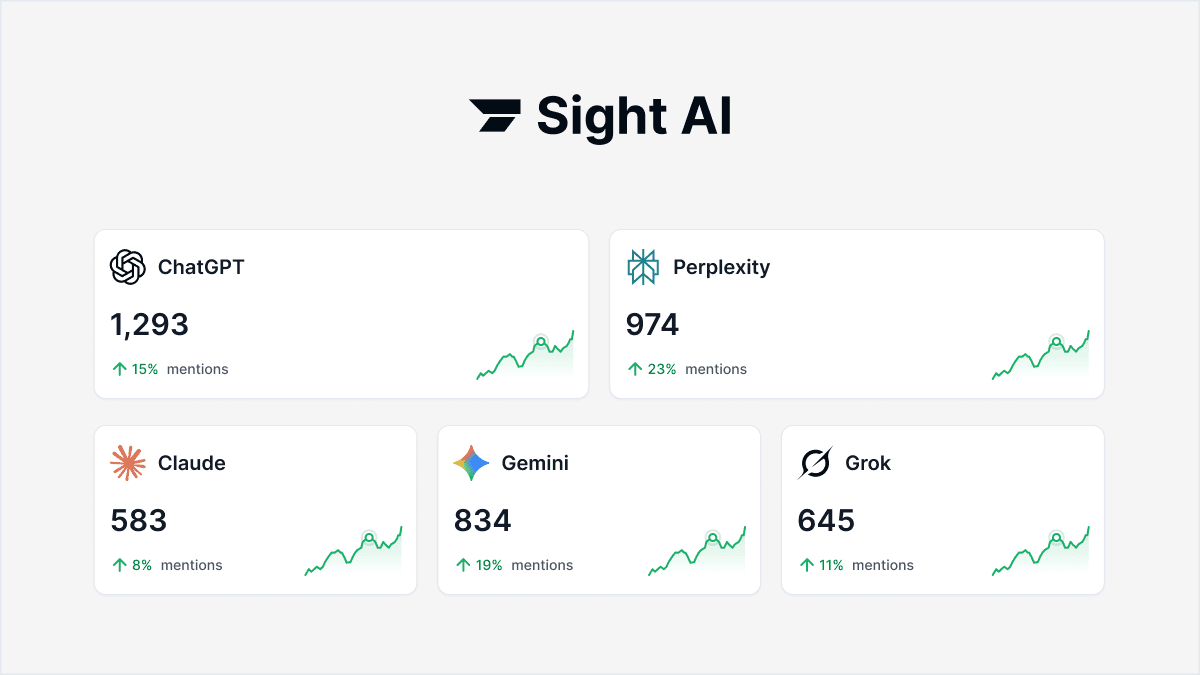
Sight AI helps teams move beyond passive rank monitoring. It tracks how AI models like ChatGPT, Gemini, Claude, Perplexity, and Grok talk about your brand, alongside the search and content gaps shaping that visibility. If you want one system for prompt monitoring, competitor insight, and turning those findings into publish-ready content, explore Sight AI.