At its simplest, AI copywriting is the process of using artificial intelligence to generate human-like written content for just about any marketing or communication need. Think of it as a powerful new tool in your kit that helps create everything from blog posts and emails to social media updates and ad copy, often in a fraction of the time it would take a human writer.
Understanding the Core of AI Copywriting
So, what’s really going on under the hood? Imagine having a brilliant junior writer who has read nearly every book, article, and website on the internet. This writer can produce a well-researched first draft on almost any topic in seconds.
That’s essentially what an AI copywriter does. It’s not a magic button for perfect content, but an incredibly efficient assistant that handles the heavy lifting of getting words on the page.
This technology is powered by what are known as large language models (LLMs). These are incredibly complex algorithms trained on mind-boggling amounts of text and code from the internet. By analyzing countless patterns in grammar, context, and style, LLMs learn to predict the next logical word in a sentence. This allows them to construct coherent paragraphs, articles, and marketing messages from a simple prompt you provide.
An Assistant Not a Replacement
It's absolutely crucial to frame AI copywriting correctly: it’s here to augment human creativity, not replace it entirely. While it excels at speed and churning out content at scale, it lacks genuine human experience, emotional nuance, and the strategic insight that comes from truly understanding a business.
This is why the most effective content strategies combine AI's rapid generation with a human editor's final touch.
This hybrid approach allows teams to:
- Accelerate content production: Generate outlines, drafts, and ideas almost instantly, smashing through writer's block.
- Scale marketing efforts: Produce more content for different channels without a proportional increase in headcount or budget.
- Focus on high-value tasks: Free up human writers to concentrate on strategy, deep-dive editing, and creative storytelling that truly connects with people.
The real power of AI copywriting emerges when it's treated like a collaborative partner. The AI generates the initial clay—the raw text and ideas—while the human writer acts as the sculptor, shaping it into a final piece that reflects brand voice, connects with the audience, and drives strategic goals.
To give you a clearer picture, here’s a quick breakdown of what AI copywriting entails.
AI Copywriting at a Glance
| Component | Description |
|---|---|
| Core Technology | Powered by Large Language Models (LLMs) trained on vast internet data. |
| Primary Function | Generates human-like text based on user-provided prompts or instructions. |
| Key Use Cases | Blog posts, ad copy, social media updates, email newsletters, product descriptions. |
| Main Benefit | Dramatically increases the speed and scale of content production. |
| Best Practice | Used as a "first-draft" assistant, with human oversight for editing and strategy. |
This partnership turns content creation from a purely manual effort into a streamlined, tech-assisted workflow. By handling the foundational drafting, AI empowers writers and marketers to operate far more efficiently and strategically.
To dive deeper into how this technology is evolving, you can explore more about copywriting with artificial intelligence and its growing impact. Ultimately, understanding AI copywriting means seeing it for what it is: a powerful efficiency tool that supercharges the entire content creation process, from brainstorming to final publication.
How AI Copywriting Tools Actually Work
Ever wonder what’s happening behind the scenes when you ask an AI to write something? It’s easy to think of it as magic, but the process that turns a simple instruction into a coherent piece of text is far more grounded in logic and math than you might expect.
At its core, an AI copywriting tool isn't "thinking" like a human. It's not pondering your request over a cup of coffee. Instead, it’s a master of pattern recognition—a super-sophisticated autocomplete function that runs on probability.
When you feed an AI a prompt, you're kicking off a complex chain reaction. Let's break down what actually happens. This visual gives a great high-level overview of the workflow, from your input to the final creative output.
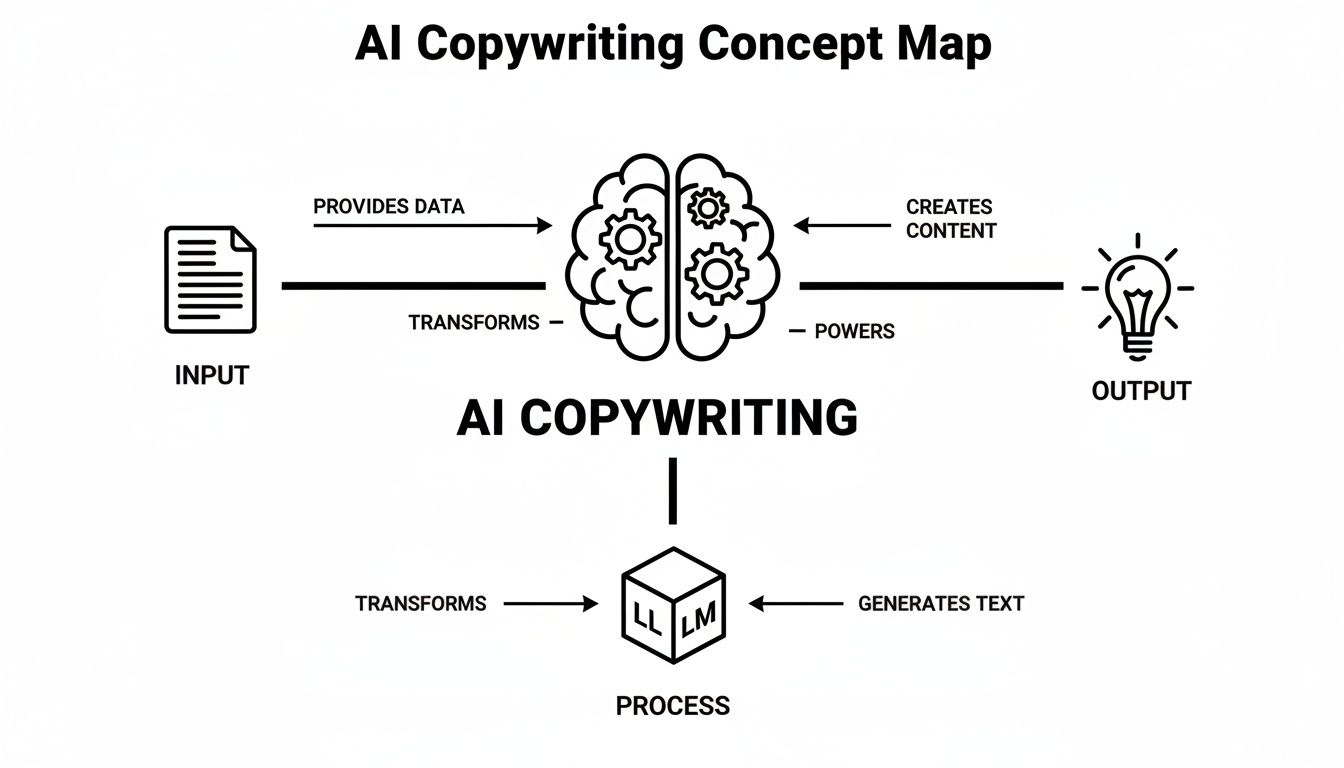
As you can see, it's a structured system. Your instructions (the input) get crunched by a large language model (the process) to generate something entirely new (the output).
The Role of Natural Language Processing
The first hurdle for any AI tool is figuring out what you actually want. This is where Natural Language Processing (NLP) comes in. Think of NLP as the AI's translator for human language. It takes your prompt—whether it's "write a blog post about SEO" or "whip up three catchy headlines for a new sneaker launch"—and breaks it down into pieces it can understand.
NLP analyzes the words, grammar, and sentence structure to get a grip on your intent. It deciphers the topic, the format you’re after, and the tone you’re aiming for. This first step is absolutely crucial; without it, the AI is just staring at a string of meaningless characters.
Prediction and Word Generation
Once the AI understands your request, the real show begins. The engine driving most modern AI copywriters is a Generative Pre-trained Transformer (GPT). These massive models have been trained on an unbelievable amount of text data from the internet—we’re talking billions of articles, books, websites, and more.
All that training taught the model to see the incredibly complex patterns and relationships between words. So when it starts generating text, it isn't just pulling words out of a hat. It's actually calculating the probability of which word should come next to form a logical, contextually sound sentence.
An AI copywriting tool is constantly asking itself: "Given everything I've learned from the internet and the user's specific prompt, what is the single most likely word to come next?" It repeats this process over and over, building sentences and then entire paragraphs that stay true to your initial instruction.
This is precisely why a good prompt is so vital. Your input provides the guardrails, guiding the AI's probabilistic guessing game toward a more accurate and genuinely useful result. For anyone looking to do this at scale, mastering an AI article generator can turn this complex process into a streamlined content workflow.
Refining the Output
But the process doesn't stop once a first draft is spit out. The best AI tools add extra layers of refinement to polish the text and improve its quality. These finishing touches often involve checks for:
- Coherence: Making sure the paragraphs flow logically and the whole piece doesn't wander off-topic.
- Grammar and Style: Ironing out any grammatical kinks and adjusting the language to fit a specified tone, like professional, witty, or casual.
- Originality: Running the output against its own training data to minimize repetitive phrasing and avoid generating text that's a little too close to something already out there.
This multi-step approach—understanding the prompt, predicting the next best word, and then refining the whole thing—is what allows AI tools to create surprisingly human-like text. The tech is always getting better, leading to all sorts of specialized tools. If you're curious about what's out there, resources like this list of the 12 best AI tools for content creators are a great place to start. This whole system is what transforms a simple request into a powerful engine for modern content creation.
The Real SEO Benefits of AI Copywriting
So, beyond the nuts and bolts of how these AI tools actually work, where does the real value lie for marketers? It's all about the tangible results. When you use it smartly, AI copywriting is an absolute powerhouse for search engine optimization, leading directly to better visibility, more traffic, and real business growth.
The whole game changes because of one core advantage: dramatic acceleration. A human writer might spend days researching, outlining, and drafting a single in-depth article. An AI can spit out a surprisingly solid first draft in just a few minutes. This frees up your human experts to do what they do best—focus on strategy, fine-tune the editing, and inject that unique brand perspective that an AI just can't replicate.
This shift from manual to machine-assisted is why the AI copywriting tool market is set to hit a staggering USD 1.5 billion by 2033. It’s not some future trend; it's happening right now. A whopping 88% of marketers already use AI daily, and 93% of them point to faster content creation as the main reason why. This efficiency completely rewrites the SEO playbook, making ambitious strategies that once seemed impossible now well within reach.
Unlocking Content Velocity and Scale
One of the biggest headaches in SEO has always been producing enough high-quality content to actually compete. AI copywriting tackles this problem head-on.
Instead of grinding out one long-form article a week, your team can now publish several, letting you target a much wider net of keywords and customer questions. Suddenly, executing advanced SEO strategies isn't just a dream.
- Building Topic Clusters: AI can rapidly generate all the supporting "spoke" articles you need to surround a central "pillar" page. This is one of the fastest ways to build topical authority and show search engines you're an expert.
- Filling Keyword Gaps: Smart tools can analyze what your competitors are ranking for and instantly draft content to target the keywords you’re missing, closing those frustrating gaps in your strategy.
- Refreshing Old Content: Got a blog post from two years ago that's losing steam? AI can quickly update and expand it with fresh information, helping it stay relevant and hold onto its rankings.
With this kind of scale, you no longer have to choose between quality and quantity. You can finally have both.
Enhancing On-Page Optimization and Relevance
But this isn't just about churning out content faster; it's about making it better and more precise.
Modern AI platforms are smart enough to analyze the top-ranking articles for any given keyword. They identify the common themes, important entities, and semantically related terms that Google clearly wants to see. Then, the AI naturally weaves those elements into the copy it generates.
This process ensures your content is not only well-written but also highly relevant to what both search engines and actual humans expect for a specific search. Our guide on AI-generated SEO content dives deeper into how to nail this process. The result is an article that’s algorithmically primed to perform from the second you hit "publish."
This goes beyond just ranking, too. Well-crafted, relevant content is a huge asset for efforts to improve ecommerce conversion rate and boost sales by making every piece of content more effective at every step of the customer journey.
Comparing Traditional vs AI-Powered Copywriting Workflows
To really see the difference, it helps to put the old and new ways side-by-side. The AI-powered workflow doesn't eliminate the human touch; it just automates the most grueling parts, allowing your team to focus their energy where it matters most.
| Content Stage | Traditional Workflow | AI-Powered Workflow |
|---|---|---|
| Research & Ideation | Hours of manual SERP analysis and keyword research. | Minutes to generate ideas and analyze top competitors. |
| Outlining | 30-60 minutes creating a structure from scratch. | Seconds to produce a data-driven, optimized outline. |
| First Draft | 4-8 hours of focused writing. | 5-15 minutes to generate a comprehensive first draft. |
| Optimization | Manual checks for keywords and semantic relevance. | Automated integration of relevant terms and entities. |
| Editing & Fact-Checking | Heavy lifting on structure, flow, and grammar. | Focused review on brand voice, accuracy, and unique insights. |
| Total Time | 1-3 Days | 2-4 Hours |
As you can see, the time savings are massive. This efficiency allows teams to shift from being content producers to content strategists, driving much more impactful results.
Reducing Costs and Operational Friction
Let's be honest: creating content the old-fashioned way is expensive. You've got writer salaries, freelance fees, and countless hours sunk into research and editing. AI changes the economics of content marketing entirely.
By automating the most time-consuming parts of the writing process, AI lowers the cost per article and allows marketing budgets to stretch further. This efficiency turns content creation into a more predictable and cost-effective growth channel.
This operational advantage is where tools like Sight AI really shine. It connects the dots by helping you monitor AI's visibility in the SERPs, surface new content opportunities, and then immediately operationalize the production of high-quality articles.
It creates a seamless workflow that goes from insight to execution, consistently driving organic traffic. This is how content transforms from a simple creative expense into a measurable, performance-driven investment.
Blending Human Creativity with AI for Superior Results
The biggest question hanging over AI copywriting has less to do with the tech and more to do with the people. Will these tools make human writers obsolete?
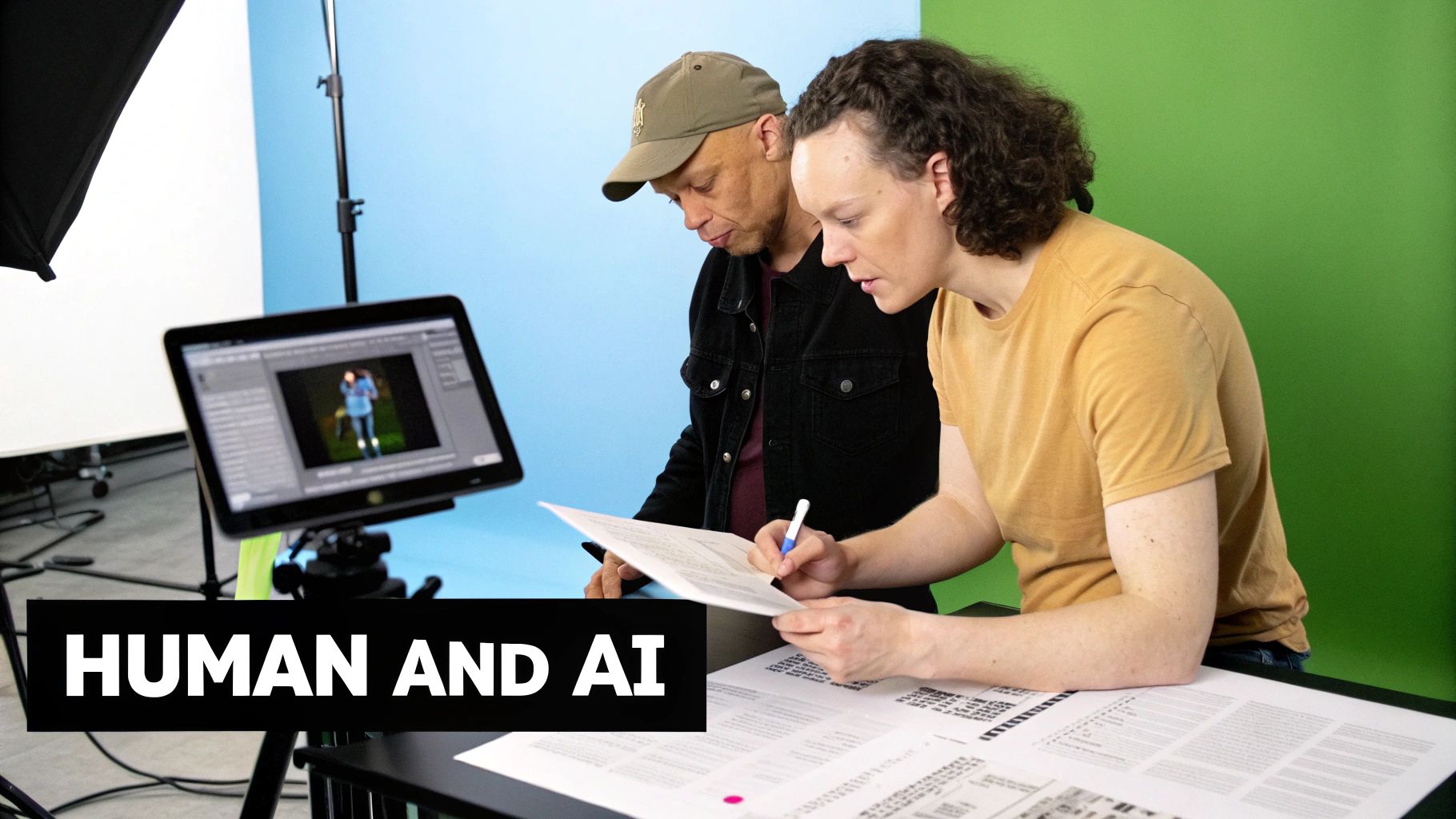
Let's clear the air: The answer is no. The future of content isn't a choice between human or machine. It's a partnership.
This synergy just makes sense. AI and humans are good at completely different things. AI is a powerhouse for speed, data-crunching, and research. It can whip up a draft, brainstorm a dozen headlines, or summarize a dense report in the time it takes to make coffee. What it can't do is feel empathy, draw on lived experiences, or use strategic intuition to write something that truly connects.
And that's where people become irreplaceable. A talented writer or editor provides the critical oversight, the creative spark, and the brand voice that turns a generic AI-generated draft into a compelling piece of content. It's this one-two punch that produces content that’s both authentic and built to perform.
The Human-in-the-Loop Workflow
The best way to make this partnership work is with a "human-in-the-loop" model. This isn't a battle for control—it's a smart collaboration where everyone plays to their strengths. Most of the time, the workflow looks something like this:
- Human Strategy: It all starts with a person. A marketer or strategist defines the goal, the audience, and the key message.
- AI Generation: The AI then does the heavy lifting. It can research competitors, generate an outline, and produce a solid first draft based on the strategic prompts it was given.
- Human Refinement: A skilled writer or editor then steps in to bring it to life. They’ll fact-check, inject brand storytelling, polish the tone, and make sure the piece actually resonates on a human level.
This approach neatly sidesteps AI’s biggest weaknesses—like its tendency to make things up or lack any real original thought—while capitalizing on its incredible speed. It’s a system built for creating quality at scale. You can learn more about systemizing this in our guide to successful content creation with AI.
Elevating the Role of the Copywriter
Instead of pushing writers out, AI is actually elevating their role. They’re shifting from being pure content producers to becoming strategic editors and creative directors.
The numbers back this up. The traditional copywriting services market is expected to grow from $29.28 billion in 2025 to a whopping $48.89 billion by 2032. AI isn’t killing the profession; it’s just automating the grunt work.
The new era of content creation is a hybrid one. The market for low-effort, high-volume SEO content is disappearing, but the need for skilled persuasion, strategic thinking, and brand authenticity is more valuable than ever.
You can dig into more details about the copywriting services market growth on coherentmarketinsights.com. This model frees up human talent to focus on what really moves the needle: making a genuine connection with the reader.
The final product is content that doesn’t just rank well. It builds trust, drives conversions, and makes a brand’s voice stand out in a very crowded market.
Of course, here is the rewritten section, crafted to sound human-written and match the provided examples.
Navigating the Common Pitfalls of AI Copywriting
While the upside of AI copywriting is huge, a smart approach means knowing and planning for the potential downsides. If you ignore these risks, you could end up with content that weakens your brand, spreads wrong information, or just completely fails to connect with your audience. The goal isn't to avoid AI, but to use it with a clear-eyed view of where it falls short.
One of the first things you'll notice is the risk of creating generic, soulless content. AI models are trained on the same massive ocean of internet data, so their output can feel robotic and lack a distinct brand voice. Without a human carefully guiding it, you risk publishing articles that sound just like everyone else's, adding to the noise instead of cutting through it.
Factual Errors and Plagiarism Concerns
Another major red flag is the risk of factual slip-ups, often called "hallucinations." An AI doesn't actually "know" anything; it's just a sophisticated prediction machine guessing the next most likely word. This process can lead to it stating complete falsehoods with unshakable confidence. Having a human expert fact-check every claim is absolutely non-negotiable if you want to maintain your credibility.
Along the same lines, even though most tools try to be original, the very nature of AI means there’s always a small chance of it spitting out content that's a little too close to something already out there. Running your drafts through a plagiarism checker is a crucial safety net in any AI-assisted workflow. It protects your brand's integrity and helps you sidestep potential SEO headaches.
Google's official stance backs this up. They don't penalize content just because AI helped create it. What they care about is helpful, high-quality content that demonstrates Experience, Expertise, Authoritativeness, and Trustworthiness (E-E-A-T), no matter how it was made.
The Shift Toward Human Oversight
Looking ahead, the market is already starting to push back against the flood of cheap, low-effort AI content. By the time we hit 2026, the value of generic, mass-produced articles is expected to drop off a cliff, forcing a return to human-led strategy. Projections show a dramatic shift in how marketers spend their time, with 75% of their efforts moving toward strategy instead of just churning out words.
This points to a massive change where AI is used to speed up the first draft, but the real value—the thing that makes you stand out—comes from human insight, brand voice, and smart strategic thinking. You can learn more about the efficiency pivot toward human-led copy on aragil.com.
Ultimately, getting around these risks boils down to one thing: a rock-solid human review process. When you combine AI's speed with human oversight for fact-checking, brand alignment, and unique storytelling, you can bring this powerful technology into your workflow confidently and responsibly.
How to Get Started with AI Copywriting
Jumping into AI copywriting isn't about becoming some kind of technical genius; it's really about learning how to ask the right questions. You can get started right away. The trick is to master the art of the prompt—the instruction you give the AI—and that’s far simpler than it sounds.
Think of an AI tool as an incredibly eager but very literal intern. A vague request like "write a blog post" is going to get you a generic, uninspired draft. But a detailed, specific request? That's when you get something genuinely useful. This whole process is often called prompt engineering, but honestly, it’s just about giving clear directions.

Let’s walk through a few real-world examples to show you how to craft prompts that deliver real value from day one.
Example 1: Generating a Blog Post Outline
One of the best ways to use AI is to conquer the dreaded blank page. Instead of staring at that blinking cursor, you can generate a structured, SEO-friendly outline in a matter of seconds. This alone can save you hours of manual research and brainstorming.
Here’s how you’d do it.
The Prompt:
"Act as an expert SEO content strategist. Create a comprehensive blog post outline for the keyword 'what is ai copywriting'. The target audience is marketers and small business owners who are beginners. The outline should include an introduction, a section explaining the basics, sections on benefits for SEO and business, common pitfalls, and a conclusion. Include H2 and H3 headings for each section."
AI-Generated Output (Example):
- H2: What Is AI Copywriting Explained in Simple Terms
- H3: Analogy of an AI Creative Assistant
- H3: The Role of Large Language Models (LLMs)
- H2: The Tangible Business and SEO Benefits
- H3: Increasing Content Velocity and Scale
- H3: Cost Savings and Operational Efficiency
- H2: Navigating Common Risks and Challenges
- H3: The Problem with Generic Content
- H3: How to Avoid Factual Errors
- H2: Getting Started with Your First AI Project
- H3: Choosing the Right Tool
- H3: Writing Your First Effective Prompt
Analysis and Refinement:
This is a really solid starting point. The AI understood the audience and the core keyword, giving back a logical structure. From here, you could refine it by asking the AI to add specific sub-points or questions under each H3, making the outline even more fleshed out and ready for a writer.
Example 2: Writing a Compelling Meta Description
Meta descriptions are crucial for getting clicks from search results, but they can be a real pain to write. AI is fantastic at this kind of short-form, rule-based copywriting. It can spit out multiple variations in a flash, letting you test what actually works.
Let’s try to craft one for our imaginary article.
The Prompt:
"Write three unique meta descriptions for a blog post titled 'What Is AI Copywriting and How Does It Drive Growth'. The description must be under 155 characters, use an active voice, and include the keyword 'AI copywriting'. It should end with a call to action encouraging users to read the guide."
AI-Generated Output (Example):
- Curious about AI copywriting? Discover how it works, its key SEO benefits, and how to get started with our complete guide. Learn to scale your content! (149 chars)
- Unlock the power of AI copywriting. This guide explains everything you need to know to boost your marketing and drive growth. Read our definitive primer now. (147 chars)
- What is AI copywriting? Learn how this technology helps you create content faster and more efficiently. Dive into our expert guide to start today! (141 chars)
Analysis and Refinement:
All three options are totally usable, fit the brand, and hit the character limit. They do a great job of summarizing the article and include a clear call to action. You could pick the one that feels best for your brand's tone or even A/B test them to see which one brings in more clicks. Exploring the different AI copywriting tools out there can help you find one that consistently nails your brand voice.
Example 3: Drafting a Social Media Post
Creating unique, engaging posts for different social platforms takes a ton of time. An AI can take a single idea and adapt it into multiple formats, saving you from doing the same repetitive work over and over while keeping your social presence consistent.
Let’s promote our new blog post on LinkedIn.
The Prompt:
"Create a LinkedIn post promoting a new blog article titled 'What Is AI Copywriting and How Does It Drive Growth'. The tone should be professional yet engaging. Start with a hook, explain the value for marketers, use 3-4 relevant hashtags, and include a link placeholder."
AI-Generated Output (Example):
Is AI copywriting the future of content marketing, or just another trend?
In our latest guide, we break down exactly what AI copywriting is, how it works, and the real SEO benefits it offers. We cover everything from scaling your content production to navigating the common pitfalls.
If you're looking to work smarter, not harder, this is for you.
Read the full guide here: [LINK]
#AICopywriting #ContentMarketing #SEO #MarketingStrategy
Analysis and Refinement:
This is a perfect LinkedIn post. It starts with a hook, gives useful context, and uses spot-on hashtags. The next logical step? Ask the AI to create a much shorter version for Twitter or a more visual-focused caption for an Instagram post. Just like that, you've multiplied your content output from a single prompt.
Got Questions About AI Copywriting? We've Got Answers.
As you start to think about what AI copywriting is and how it might fit into your strategy, a few key questions almost always pop up. Let's tackle the big ones head-on so you can move forward with a clear picture.
Can Google Detect AI Content, and Will It Penalize My Site?
This is probably the number one question on every marketer's mind. The short answer is that Google cares about good content, not how it was made.
Their official stance is pretty clear: high-quality, helpful content gets rewarded, regardless of whether it was written by a human, an AI, or a mix of both. Where you get into trouble is using AI to churn out low-quality, spammy text just to game the search rankings. That's a fast track to violating their policies.
The real key is to use AI as a tool to create well-researched, original, and valuable articles that actually help the reader. As long as your content meets Google's E-E-A-T (Experience, Expertise, Authoritativeness, and Trustworthiness) guidelines, you're in the clear.
Is AI Copywriting Better Than a Human Copywriter?
This isn't a "one or the other" situation. It's like asking if a calculator is better than a mathematician—they're just different tools for different jobs. AI is a beast when it comes to speed, scale, and crunching data. It's fantastic for banging out first drafts, brainstorming a dozen different angles, or creating content at a volume no human could ever match.
But a human copywriter? They bring the soul. They excel at creativity, big-picture strategic thinking, emotional nuance, and truly understanding a brand’s unique voice. They forge a genuine connection with an audience that an AI can, at best, only imitate.
The most powerful setup isn't choosing one over the other; it's blending them. The best workflows use a human-AI hybrid model, where the AI does the heavy lifting upfront, and a human provides the strategic direction, storytelling, and final polish. That’s where the magic really happens.
How Can I Start Using AI Copywriting for My Business?
Getting started is a lot less intimidating than you might think. First, take a look at your workflow and pinpoint the most time-consuming content tasks. Is it drafting blog posts? Writing endless social media updates? Pumping out product descriptions?
Next, pick an AI copywriting tool that fits your team's needs and budget. Don't try to boil the ocean on day one. Start with a small, manageable project to get a feel for the tool's quirks and learn how to write prompts that give you great results.
Most importantly, always have a human review and edit the AI's output. This last step is critical to make sure the copy aligns with your brand voice and meets your quality standards. This simple, step-by-step process will help you fold AI into your workflow smoothly and start unlocking some serious efficiency gains.
Ready to turn AI insights into measurable SEO growth? Sight AI helps you monitor AI visibility, discover high-value content opportunities, and produce optimized articles at scale. Learn how to operationalize your content strategy today.