That dreaded blinking cursor on a blank page is a feeling every writer knows. But what if you had a partner to help you get started? That's essentially what copywriting artificial intelligence is—a category of software designed to be your creative co-pilot. These tools use powerful AI models to help generate, edit, and fine-tune everything from blog posts to ad copy, fundamentally changing the content creation game.
The New Reality of AI in Content Creation
The move toward AI-assisted content creation isn’t just some passing trend; it's a real, foundational shift in how marketing teams get work done. For years, the content process has been a manual, slow-moving beast that’s notoriously hard to scale. Now, AI steps in as an expert assistant, helping everyone from solo creators to massive enterprise marketing departments.
This guide is designed to cut through the noise and show you how to use AI as a real strategic asset. Getting a handle on this technology isn't just a "nice-to-have" anymore; it's essential for growth. We'll skip the generic definitions and give you a playbook for turning AI from a buzzword into your most powerful tool for creating better content faster, boosting your search rankings, and scaling your entire operation.
Why AI in Copywriting Matters Now
The demand for great content is higher than ever, but production bottlenecks are a constant headache for most teams. AI tackles this problem head-on by augmenting human creativity, not trying to replace it. It does the heavy lifting—like churning out first drafts, helping with research, or brainstorming ideas—so writers and marketers can focus on high-level strategy, unique insights, and adding that final human polish.
This human-AI collaboration is where the magic really happens. To see how this partnership is taking shape across the industry, you can explore the latest trends in AI content generation.
At its core, copywriting artificial intelligence delivers efficiency at scale. It gives teams the power to produce a much higher volume of targeted, optimized content without losing the strategic oversight that guarantees quality and keeps everything on-brand.
The market is already voting with its dollars. The AI writing market is on track to hit an incredible $18.27 billion by 2035, growing at a blistering compound annual growth rate of 23.4%. This explosive growth makes one thing clear: integrating these tools isn't just an option anymore; it's becoming the standard.
How Copywriting AI Actually Works
Ever wondered what’s going on inside the ‘black box’ of an AI writer? It can feel a bit like magic, but the technology is built on surprisingly understandable principles. Once you peel back the curtain, you can stop seeing AI as a mysterious gadget and start treating it like a reliable creative partner.
At the core of nearly every modern AI writing tool is a Large Language Model (LLM). Imagine a brilliant apprentice who has read almost the entire internet—billions of articles, books, conversations, and websites. It hasn't just memorized everything; it has learned the incredibly complex relationships and statistical patterns between words, phrases, and ideas.
This learning happens inside a digital structure inspired by the human brain, called a neural network. These networks are designed to process information, spot patterns, and make connections, which allows the AI to grasp context and generate text that actually makes sense.
The Engine of Modern AI: Transformers
The real game-changer was a specific type of neural network called a transformer. Before transformers, AI models had a terrible short-term memory. They might start a paragraph with a clear point but completely forget it by the time they reached the end.
Transformers fixed this with a concept called "attention." This lets the model weigh the importance of different words in the text you provide it. When it generates a new sentence, it can "pay attention" to the most relevant concepts from earlier, ensuring the output is not just grammatically correct, but also consistent and on-topic. It’s the difference between someone who crams facts versus someone who genuinely understands the material.
This is how AI can accelerate key business goals, from content creation to overall growth.
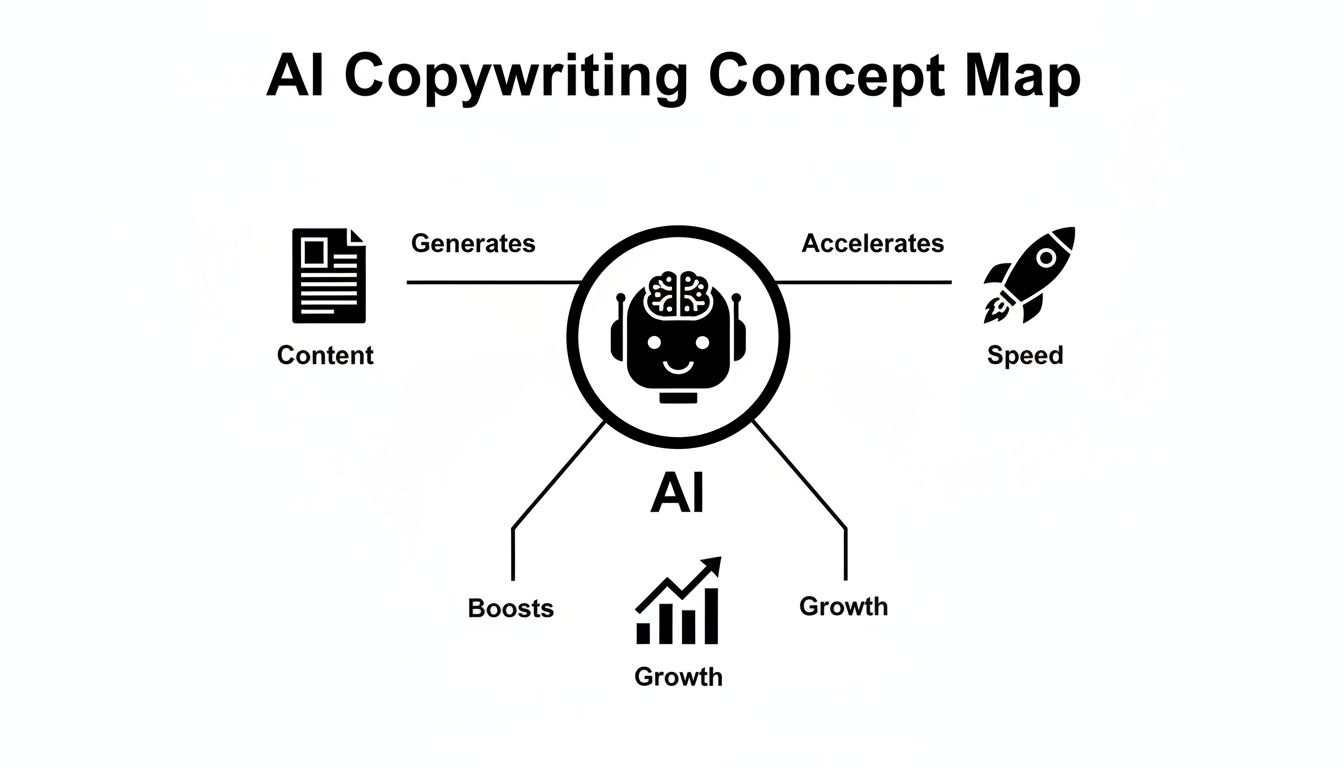
As you can see, the technology isn't just a writing tool. It acts as a central hub that speeds up content production, which directly fuels faster execution and measurable business expansion.
Prediction, Not Cognition
This is the single most important thing to get your head around: AI doesn't "think" or "understand" like a human. When you give it a prompt, it's actually performing a lightning-fast calculation to predict the next most likely word, then the next, and the next, all based on the patterns it learned from its training data.
AI copywriting is fundamentally a game of probabilities. It assembles sentences by predicting the most statistically likely sequence of words to satisfy your request, based on the vast amount of human-written text it has analyzed.
This predictive engine is responsible for both its biggest strengths and its most glaring weaknesses. It can generate incredibly fluent, human-like text because it has an unmatched grasp of linguistic patterns. But it can also confidently state factual errors (often called "hallucinations") or spit out generic content if the topic is niche or the training data was weak. Your job is to guide this engine with clear prompts and then fact-check its work.
The Role of Training Data and Fine-Tuning
The quality and sheer size of an LLM's training data define what it can do. A model trained on a massive, diverse dataset—like GPT-4 or Claude 3—becomes a versatile generalist capable of writing about almost anything. To see just how powerful these models are becoming, it's worth understanding the latest advancements in models like ChatGPT 5.
Beyond that initial training, many AI tools are also fine-tuned for specific jobs. This involves a second round of training on a much smaller, highly curated dataset. For instance, a copywriting AI might be fine-tuned on thousands of top-performing ads, making it exceptionally good at writing persuasive marketing copy.
This is exactly why some AI tools are great for blog posts while others excel at email subject lines. Knowing how this all works—from pattern recognition to word prediction—empowers you to write better prompts, critique the output, and ultimately get the high-quality results you’re after.
Putting AI to Work in Your Content Workflow

Knowing how copywriting artificial intelligence works is one thing, but the real magic happens when you start plugging it into your day-to-day routine. It’s time to move from theory to practice and pinpoint the exact spots in your content lifecycle where AI can do the heavy lifting, turning it from a cool new toy into an essential part of your team.
Think about it: instead of staring at a blinking cursor on a blank page, you can have an AI kickstart the whole process for you. This isn’t about replacing human writers. It’s about automating the grunt work so your team can pour their energy into strategy, polishing drafts, and adding the kind of unique insights no algorithm can touch.
This isn't some fringe strategy anymore. AI adoption is hitting a tipping point, with 88% of marketers now using it in their daily tasks. The number one job they're giving it? Content creation, with 64.5% of marketers using AI specifically for that purpose. The proof is in the numbers—AI is here to stay.
Supercharging Content Ideation and Research
One of the first places you'll feel the impact of AI is in breaking through creative blocks and speeding up research. It’s like having a brainstorming partner who has read the entire internet and can come up with endless ideas in minutes.
Let's say you're launching a new software product and need blog topics. Instead of spending a full day digging through forums and sizing up competitors, you can task an AI with generating a list of compelling ideas in the time it takes to grab a coffee.
Here’s how teams are using AI for ideation:
- Generating headline variations: Give it a core topic, and it can spit out 20 different headlines, each tweaked for clicks, engagement, or a specific emotional response.
- Creating content outlines: Hand it a target keyword, and it will structure a complete blog post with logical H2s and H3s, mapping out the key points for each section.
- Identifying audience pain points: Prompt the AI to "act like" your ideal customer and list their biggest frustrations. Suddenly, you have a goldmine of problems you can solve with your content.
By automating these early steps, you build momentum right from the start, freeing up brainpower for the more strategic parts of content creation.
Accelerating First Draft Creation
Once your idea and outline are locked in, AI truly shines by churning out a solid first draft. This is easily its biggest superpower, cutting down a task that used to take hours—or even days—into just a few minutes. The goal isn't a final, publish-ready article. It's about getting 80% of the way there almost instantly.
One of the biggest mistakes people make is treating the first AI draft as the final product. The real power is in using it as a strong foundation that a human expert can then elevate with their unique perspective, brand voice, and storytelling.
For instance, an AI can write an entire email nurture sequence from a simple prompt about your goal and audience. Then, a human copywriter can jump in to sharpen the tone, weave in real customer stories, and make sure every word feels authentically you. This kind of structured process is key, and you can learn more by checking out our guide on creating a workflow for your content.
This collaborative model completely changes the math of content production. Teams can finally scale their output without having to scale their budget and headcount at the same rate.
Scaling Ad and Social Media Copy
The fast-paced, high-volume world of advertising and social media is a perfect match for copywriting artificial intelligence. For any given campaign, you might need dozens of ad copy variations for different platforms, audiences, and A/B tests. Writing all of that by hand is a recipe for burnout.
With an AI, you can feed it a core message and instantly get back tons of options that are:
- Platform-specific: It can generate short, punchy copy for Twitter, longer narratives for Facebook, and benefit-driven text for LinkedIn ads.
- Audience-segmented: You can easily tweak the tone and angle to connect with different customer segments, from brand-new leads to your most loyal fans.
- Built for testing: Need to test five different headlines and three calls-to-action? An AI can generate all 15 combinations in seconds, letting you optimize campaigns faster.
This shifts the marketer's job from painstakingly crafting a few "perfect" ads to generating a wide range of possibilities and letting the data decide the winner. That speed and agility are what gives you an edge and boosts your campaign ROI.
AI can be applied across the entire marketing funnel to drive efficiency and results. Here's a look at how you can integrate AI copywriting at each stage to support your strategic goals.
Integrating AI Across the Content Marketing Funnel
| Funnel Stage | Objective | AI Copywriting Application Example |
|---|---|---|
| Top of Funnel (ToFu) | Build brand awareness and attract a broad audience. | Generate SEO-optimized blog post ideas and outlines around industry pain points. |
| Middle of Funnel (MoFu) | Nurture leads and build trust with valuable content. | Draft in-depth eBooks, whitepapers, or email nurture sequences for lead magnets. |
| Bottom of Funnel (BoFu) | Drive conversions and guide prospects to a decision. | Create persuasive landing page copy, product descriptions, and case study summaries. |
| Post-Purchase | Foster loyalty and encourage repeat business. | Write onboarding emails, customer support scripts, and personalized follow-up messages. |
By mapping AI's capabilities to specific funnel objectives, you can build a more cohesive and effective content strategy. It ensures that you're not just creating more content, but smarter content that moves customers through their journey.
Using AI Content to Win at SEO
So, does Google actually penalize AI content? It’s the multi-billion dollar question on the mind of every single SEO and content manager out there. The short answer is a simple no—but the full story is, as always, a bit more complicated.
Google's official stance is that it rewards helpful, high-quality content that genuinely serves the user, regardless of how it was made. This reframes the entire debate. It's not about human versus machine; it’s about valuable content versus spam.
When used the right way, copywriting artificial intelligence is a massive SEO accelerator, not some risky shortcut. The trick is to stop thinking about "automating" content and start "augmenting" your own expertise. The goal is to produce articles that are not just algorithmically sound but also deeply connect with a human audience. It's about blending AI's raw efficiency with your unique, strategic insight.
The Role of E-E-A-T in an AI World
Google’s quality standards are built on the foundation of E-E-A-T: Experience, Expertise, Authoritativeness, and Trustworthiness. This is exactly where so many teams using AI fall flat. Just generating a generic article and hitting "publish" creates thin, soulless content that misses these critical benchmarks entirely. It lacks the very human elements that build credibility.
This is why a human-in-the-loop workflow isn't just a good idea for SEO—it's non-negotiable. Your job is to layer your team's unique perspective right on top of the AI's foundation.
- Experience: Inject real-world case studies, personal stories, and proprietary data that an AI could never have access to.
- Expertise: Weave in your nuanced opinions, expert analysis, and the kind of insights that only come from years in your industry.
- Authoritativeness: Add quotes from recognized experts, link out to authoritative sources, and showcase your brand's unique place in the market.
- Trustworthiness: Make sure every single claim is fact-checked, statistics are properly cited, and all information is accurate and up-to-date.
By focusing on these elements, you transform a generic AI draft into a genuinely valuable asset that both search engines and human readers will reward.
The real SEO value of AI isn't in replacing the writer, but in freeing up the strategist. AI handles the structural heavy lifting, allowing you to focus your time on adding the deep, human-centric layers that drive rankings and build brand loyalty.
Leveraging AI for Keyword Research and Semantic SEO
AI is more than just a writing tool; it's an indispensable partner for modern keyword research. Old-school methods often fixate on a handful of high-volume keywords, but today's SEO is all about covering topics comprehensively. An AI can analyze thousands of competitor pages in seconds to identify not just the primary keywords but also all the critical semantic terms and related questions people are asking.
For instance, an AI can instantly generate a list of LSI (Latent Semantic Indexing) keywords—those thematic terms Google expects to see in a top-tier article on your topic. For a blog post about "homebrewing," it might suggest terms like "sanitization," "fermentation," "wort chiller," and "hydrometer." Sprinkling these terms into your content signals to Google that your article is thorough and authoritative.
You can find more practical strategies for creating AI-generated SEO content that actually ranks in our detailed guide.
Building SEO-Optimized Article Structures
One of the most immediate ways AI can boost your SEO is by creating perfectly structured article outlines. A logical hierarchy of headings (H1, H2, H3) is absolutely crucial for both user experience and search engine crawlers. Instead of guessing at the best structure, you can prompt an AI to create a comprehensive outline based on what's already working for the top-ranking articles for your target keyword.
This process ensures your article covers all the essential subtopics that users are searching for, helping you create a piece of content that is far more complete than anything your competitors have published. This structured approach helps Google quickly understand the main themes of your content, making it easier to rank for a whole range of relevant queries.
Ultimately, using copywriting artificial intelligence for SEO is a partnership. The AI provides the scale and data-driven insights, while you provide the strategic direction and authentic human experience that wins in the long run.
Mastering the Art of Prompting and Editing

The real secret to getting incredible content from an AI isn't the tool itself—it's how you talk to it. Think of your AI as a brilliant but extremely literal intern. It has access to a staggering amount of information, but without a clear, detailed brief, it's just going to give you something bland and useless. This is where the art of prompting comes in.
If you give it a weak, vague prompt like, "write a blog post about email marketing," you'll almost always get a generic, forgettable article. The AI has no context, no audience to write for, and no specific goal. To get something truly great, you need to provide specific, layered instructions that steer the AI toward the exact result you have in mind.
The Anatomy of a Powerful Prompt
The best prompts give the AI two things: clarity and constraints. A simple but incredibly effective way to structure your instructions is by thinking about a few key elements. When you define these, you're essentially giving the AI the guardrails it needs to do its job well.
Here’s a breakdown of the essential components that turn a basic request into a powerful command:
- Role: Tell the AI who it should be. For example, "Act as an expert B2B SaaS copywriter with 10 years of experience writing for enterprise clients."
- Task: Define the specific action you want it to take. "Write three compelling headlines for a landing page about our new project management tool."
- Context: Give it all the necessary background. "The target audience is non-technical project managers in creative agencies. The tool's main benefit is its intuitive visual interface that simplifies complex workflows."
- Tone: Specify the voice and style you're after. "The tone should be professional, confident, and helpful, but avoid corporate jargon."
Getting this structure right is fundamental. For anyone serious about getting the best results, mastering prompt engineering is non-negotiable for guiding an AI effectively.
To make this even clearer, let's look at a structured framework for building your prompts.
Prompt Engineering Framework
This table breaks down the key components you should include in every prompt to ensure you get high-quality, relevant copy every time.
| Component | Description | Example |
|---|---|---|
| Role & Goal | Define the AI's persona and the ultimate objective of the content. | "You are a senior copywriter creating a campaign to drive sign-ups." |
| Task | State the specific action the AI needs to perform. | "Write three versions of a Facebook ad." |
| Context | Provide crucial background info about the product, audience, and market. | "The product is a new fitness app for busy professionals over 40." |
| Constraints | Set specific limits, such as word count, format, or things to avoid. | "Keep each ad under 150 words. Do not mention competitor names." |
| Tone & Style | Describe the desired voice and writing style. | "The tone should be motivational and empathetic, using simple language." |
| Examples | Give a few 'good' examples to guide the AI's output. | "Here is a headline that worked well for us: 'Finally, a Fitness Plan That Fits Your Schedule.'" |
By consistently using a framework like this, you take the guesswork out of the process and put yourself in complete control of the final output.
The Indispensable Final Step: Human Editing
No matter how sophisticated your prompt is, the AI's first draft is just that—a draft. It's never the final product. The human touch is what elevates good copy to great copy. This is where you inject personality, verify facts, and make sure the piece aligns perfectly with your brand's unique voice.
This editing phase is non-negotiable. It’s the step where you refine raw output into a polished, strategic asset. Even simple editing tasks, like expanding on a basic idea, can be aided by technology; for instance, you can see how an AI paragraph expander can refine initial drafts to add more depth.
Human oversight remains the most critical component in any AI-assisted workflow. It’s the bridge between automated efficiency and genuine quality, ensuring accuracy, authenticity, and strategic alignment.
This human-AI partnership mirrors what’s happening across the industry. The copywriting services market, valued at $27.96 billion in 2025, is projected to hit $42.83 billion by 2030. This growth shows that skilled copywriting is more valuable than ever, even as AI tools become more common.
Building an AI-Powered Content Operation
Bringing AI into your content team is much more than just signing up for a new piece of software; it’s about architecting a completely new way of working. A smart rollout isn't a mad dash—it's a strategic process that moves from small-scale experiments to full team adoption, making sure quality and consistency never take a backseat to speed.
The best way to start is to think small. Pinpoint one or two high-impact, low-risk areas to pilot your AI workflow. This could be something like generating blog outlines or whipping up a few social media drafts. A focused approach like this lets your team get comfortable with the technology and build confidence without derailing your entire content calendar.
Once you’ve got some wins under your belt, it’s time to standardize. This is where you build the guardrails that ensure every single piece of AI-assisted content hits your brand’s high standards.
Establishing Your AI Guardrails
To really scale up, you need a clear rulebook for how your team uses AI. These guidelines are your defense against common traps like an inconsistent brand voice, factual slip-ups, or leaning too heavily on the tech. Think of this as the foundation for a scalable system.
Your core guardrails should cover three key areas:
- A Shared Prompt Library: Don't let everyone reinvent the wheel. Create and maintain a central hub of proven, high-performance prompts for everyday tasks. This is how you get consistently great first drafts, no matter who's at the keyboard.
- Brand Voice Guidelines: Develop specific instructions for infusing your brand’s unique personality, tone, and vocabulary into AI-generated text. It helps to provide clear "do" and "don't" examples so there's no ambiguity.
- Mandatory Editing and Fact-Checking: Make human review a non-negotiable step for every AI draft. This final check is absolutely critical for catching errors, refining the narrative, and adding those authentic human insights that AI just can't replicate.
Creating a Scalable Content Engine
With these guidelines locked in, you can start building a true content engine. This means weaving AI into every stage of your production cycle, from the initial research to the final publish. The goal is to create a repeatable process that marries AI's efficiency with human strategic oversight.
The real aim here is to build a system where AI handles 80% of the heavy lifting—the repetitive drafting and structuring. This frees up your team to pour their energy into the final 20%: the strategic insights, unique data, and creative storytelling that actually drive results and build lasting brand authority.
This operational shift transforms your content creation from a series of one-off projects into a predictable, scalable machine. By documenting these steps, you can create a robust AI content pipeline that consistently churns out high-quality assets. It’s this methodical approach that allows you to truly unlock the power of AI copywriting for sustainable, long-term growth.
Got Questions About AI Copywriting? We’ve Got Answers.
As copywriting artificial intelligence becomes a go-to tool for marketers, a lot of practical questions pop up. Let's tackle the big ones so you can start using AI with confidence.
Is AI-Generated Content Considered Plagiarism?
Nope, not inherently. Reputable AI models are designed to generate original text by predicting the next word in a sequence, not by copying and pasting.
However, there's a small catch. If a topic is super niche or a prompt is extremely specific, the AI might produce something that sounds a lot like its training data. That’s why it's always smart to run your final AI-assisted draft through a plagiarism checker. Think of it as a quick quality control step to protect your brand's integrity.
Will Google Penalize My Site for Using AI Content?
This is a big one, but the answer is pretty straightforward. Google doesn't care how content is made; it cares if the content is helpful and high-quality.
Their official stance is that they reward content that serves the reader, whether a human or an AI wrote it. On the flip side, they penalize low-quality, spammy content that offers zero value—again, regardless of the author. The key is to use AI as a tool to enhance your expertise, not replace it. Your goal is to create insightful, accurate content that solves a reader's problem, which is exactly what Google wants.
Key Takeaway: Google doesn't penalize AI content; it penalizes bad content. Focus on creating value for your audience, and you'll be perfectly in line with SEO best practices.
Will AI Copywriting Replace Human Writers?
This question comes up a lot, but the reality is that AI is more of a co-pilot than a replacement. Sure, AI is fantastic at churning out first drafts, brainstorming ideas, and knocking out repetitive writing tasks.
But it can’t replicate true human creativity, strategic thinking, or the emotional connection that builds a loyal audience. The writer's job is evolving. It's shifting from being just a creator to also being a strategist, an editor, and an expert prompter. The most successful content teams will be the ones who master this collaboration between human insight and AI efficiency.
How Do I Get AI to Write in My Brand's Voice?
Maintaining a consistent brand voice is crucial, and it takes a bit of deliberate setup. You can't just tell the AI to "sound like us" and hope for the best. You need to create detailed brand voice guidelines specifically for AI prompting.
Here’s what to include:
- Tone of Voice: Be specific. Is your brand "helpful and expert" or more "playful and witty"? Give the AI clear descriptors.
- Specific Vocabulary: Create a list of words and phrases you love and, just as importantly, ones you want to avoid.
- Example-Driven Prompts: The best way to teach an AI is by example. Build a library of prompts that include snippets of your writing so it has a clear model to follow.
By giving the AI these clear guardrails, you can guide it to produce content that sounds on-brand right from the first draft.
Ready to turn AI visibility insights into measurable growth? Sight AI helps you monitor your brand's presence across leading AI models and creates high-ranking, optimized content to fill strategic gaps. Discover your next opportunity at https://www.trysight.ai.