When potential customers ask ChatGPT for product recommendations in your industry, is your brand being mentioned? For marketers and founders focused on organic growth, this question has become critical. AI-powered search is reshaping how consumers discover brands, and ChatGPT alone processes millions of recommendation queries daily.
The brands that get mentioned capture attention at the exact moment of purchase intent—while those left out lose visibility they may never know they're missing.
This guide walks you through exactly how to track when and how ChatGPT recommends your brand, from setting up your first monitoring queries to building a systematic tracking workflow. You'll learn to identify which prompts trigger brand mentions, measure your AI visibility over time, and uncover opportunities to improve your positioning.
Whether you're a SaaS founder wanting to know if ChatGPT suggests your tool, an agency tracking client visibility, or a marketer building an AI-first SEO strategy, these steps will give you the visibility data you need to compete in the age of AI search.
Step 1: Define Your Brand Tracking Parameters
Before you run a single test query, you need to map out exactly what you're tracking. Think of this as creating your monitoring blueprint—the foundation that determines whether your tracking efforts reveal genuine insights or miss critical visibility gaps.
Start with your brand name variations. Your official company name is just the beginning. How do customers actually refer to you in conversation? If you're "Acme Analytics Platform," users might search for "Acme," "Acme Analytics," or even common misspellings like "Akme Analytics." Create a comprehensive list that includes abbreviations, acronyms, and any legacy names if you've rebranded.
Product-level tracking matters too. If you offer multiple products or services, each one represents a separate tracking opportunity. A marketing automation company might need to monitor mentions of their email platform, their CRM integration, and their analytics dashboard as distinct entities. ChatGPT might recommend your email tool while ignoring your CRM—you won't know unless you're tracking both.
Next, map your competitive landscape. You're not tracking in a vacuum. Which three to five competitors should appear alongside you in recommendation lists? Identifying these brands gives you benchmark data. If ChatGPT consistently recommends Competitor A but never mentions you, that's actionable intelligence about where you stand in the AI's perception of your market.
Define your product categories and use cases with precision. A project management tool might be relevant for "team collaboration software," "agile project tracking," "remote work tools," and "task management platforms." Each category represents different user intent and different recommendation contexts. The more specific you are here, the more targeted your ChatGPT brand tracking becomes.
Create your master tracking document. This should list every brand variation, product name, competitor, and category you've identified. This becomes your reference point for every subsequent step. When you're building prompts or analyzing results weeks from now, you'll return to this document to ensure consistency.
The goal isn't to track everything—it's to track what matters. A focused list of 15-20 core parameters beats a scattered list of 100. You can always expand later, but start with the tracking parameters that directly connect to your business goals and customer acquisition strategy.
Step 2: Build Your Prompt Library for Systematic Queries
Now that you know what to track, you need to know how to ask. The prompts you use to query ChatGPT determine which responses you'll see—and random, inconsistent questions produce random, inconsistent data. Your prompt library is where systematic tracking begins.
Think about how real users actually ask ChatGPT for recommendations. They don't use formal search queries. They ask conversational questions: "What's the best email marketing tool for small businesses?" or "I need a CRM that integrates with Slack—what do you recommend?" Your prompts should mirror this natural language.
Category-level discovery prompts capture broad recommendation scenarios. These are the "best of" queries where users are exploring options without preconceptions. Examples: "What are the top project management tools in 2026?" or "Recommend analytics platforms for e-commerce businesses." These prompts reveal whether your brand appears in general category discussions.
Comparison prompts test how you stack up against specific competitors. "Compare Acme Analytics to Google Analytics" or "What's better for startups: Acme or Competitor X?" These queries show how ChatGPT positions you relative to known alternatives and whether it recommends you in direct head-to-head scenarios.
Problem-solution prompts focus on user pain points and desired outcomes. "I need to track user behavior across multiple domains—what tool should I use?" or "How can I reduce customer churn with better analytics?" These prompts have the highest purchase intent because users are describing specific problems they need to solve right now.
Vary your phrasing deliberately. The same question asked three different ways can produce three different responses. "Best CRM tools," "Top CRM platforms," and "Which CRM should I choose" might trigger different brand mentions. Your prompt tracking for brands library should include multiple phrasings for each core topic you're tracking.
Organize your prompts by intent type. Create separate sections in your tracking document for discovery prompts, comparison prompts, and problem-solution prompts. This organization helps you analyze patterns later—you might discover you appear in comparison queries but rarely in discovery prompts, which tells you something important about your market positioning.
Start with 15-20 prompts that cover your most important categories and use cases. Quality beats quantity here. Five well-crafted prompts that reflect genuine user intent are more valuable than fifty generic variations. You can expand your library as you identify gaps, but begin with prompts that directly connect to how customers discover and evaluate solutions in your space.
Test each prompt manually at least once before adding it to your systematic tracking. This helps you refine phrasing and ensures the prompt actually generates recommendation-style responses rather than general information.
Step 3: Set Up Automated Monitoring with AI Visibility Tools
Here's where manual tracking falls apart: running the same prompts consistently across multiple AI models, documenting every response, tracking changes over time, and doing this weekly or monthly without fail. It's theoretically possible to track ChatGPT recommendations manually, but in practice, it creates inconsistent data and burns hours you could spend acting on insights.
Manual tracking introduces variables you can't control. You might run prompts at different times of day, use slightly different phrasing, or skip tracking sessions when other priorities emerge. ChatGPT's responses can vary based on model updates, making it critical to track at consistent intervals. Missing even one tracking cycle means losing visibility into when changes occurred.
Automated monitoring solves the consistency problem. AI visibility tracking tools run your prompt library on a set schedule, query multiple AI models with identical prompts, and log every response for historical comparison. This gives you the clean, comparable data you need to measure progress and identify trends.
When configuring automated tracking, start with your monitoring frequency. How often does your competitive landscape shift? SaaS tools in rapidly evolving categories might need weekly tracking to catch changes quickly. More stable industries can track bi-weekly or monthly. The key is consistency—pick a frequency and stick to it so your data remains comparable over time.
Set up tracking across multiple AI models, not just ChatGPT. Users ask recommendation questions to Claude, Perplexity, Gemini, and other AI platforms. Your brand might appear consistently in ChatGPT responses but be invisible to Perplexity users. Learning how to track brand in multiple AI models reveals your complete AI visibility picture and shows where to focus improvement efforts.
Establish your baseline measurements first. Before you start making content changes or optimization efforts, you need to know where you stand today. Your initial tracking cycle captures your AI visibility score—how often you're mentioned, in what contexts, and with what sentiment. This baseline becomes your benchmark for measuring improvement.
Configure alerts for significant changes. Automated monitoring should notify you when your mention frequency drops suddenly or when you start appearing in new prompt categories. These alerts help you connect changes in AI visibility to specific actions—a new content piece might correlate with improved mentions, or a competitor's product launch might coincide with decreased visibility.
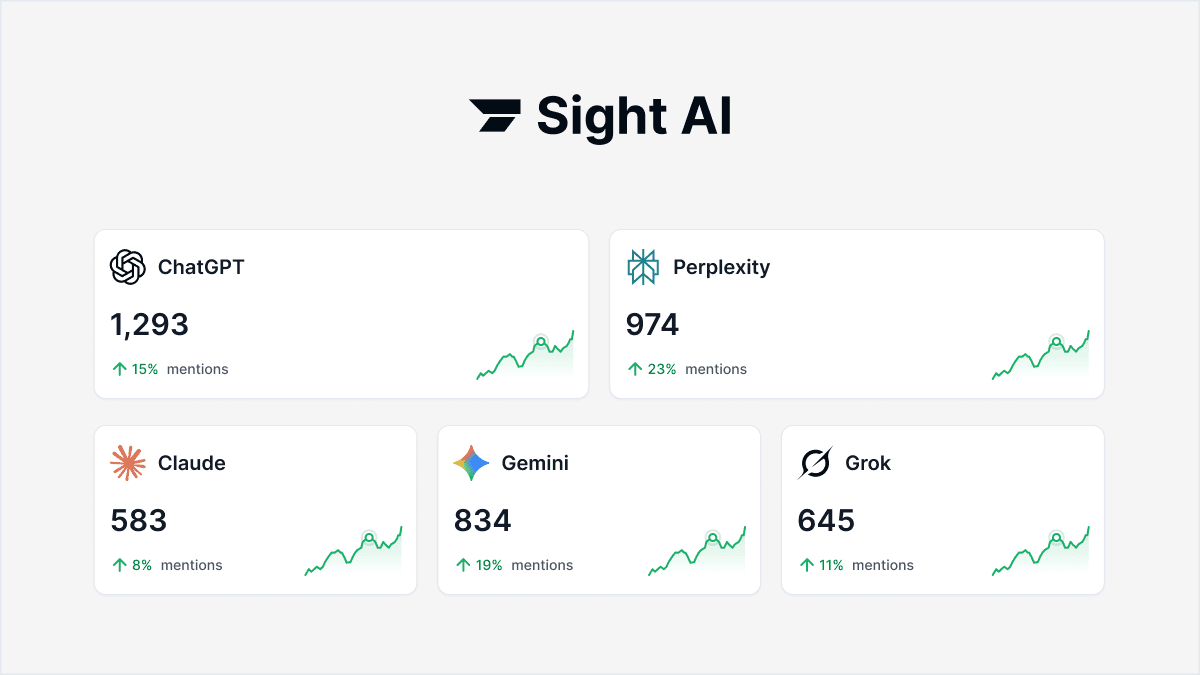
The right tracking setup captures three core metrics: mention frequency (how often you appear), mention position (where you rank in recommendation lists), and sentiment (how you're described). Platforms that track AI visibility across ChatGPT, Claude, Perplexity, and other models give you the complete picture you need to make strategic decisions.
With automated monitoring in place, you move from sporadic manual checks to systematic visibility measurement. You'll have clean data showing exactly how AI models talk about your brand, updated on a schedule that matches your business needs.
Step 4: Analyze Brand Mention Patterns and Sentiment
Raw tracking data is just numbers until you analyze what it means. This step is where you transform mention counts into actionable insights about your AI visibility and competitive positioning.
Start with sentiment analysis. How does ChatGPT actually describe your brand when it recommends you? There's a massive difference between "Acme Analytics is a powerful platform used by leading enterprises" and "Acme Analytics is an option, though some users report a steep learning curve." Both are mentions, but only one is helping you win customers.
Review the language surrounding your brand mentions. Are you described with positive qualifiers like "industry-leading," "innovative," or "comprehensive"? Or do mentions come with caveats like "however," "although," or "some users find"? Positive sentiment indicates strong authority signals in your content and online presence. Neutral or negative sentiment reveals perception gaps you need to address through brand sentiment tracking in AI.
Track your mention position within responses. Being the first recommendation in a list of five tools is fundamentally different from appearing fifth. Users often focus on the first one or two suggestions, especially in conversational AI where they're looking for quick answers. If you're consistently mentioned but always buried at the end of lists, you have a positioning problem to solve.
Identify prompt patterns that consistently include or exclude your brand. You might discover ChatGPT recommends you for "enterprise analytics platforms" but never mentions you for "startup analytics tools." This pattern reveals how AI models categorize you and where you have visibility gaps. If you're targeting startups but only appearing in enterprise queries, you've found a critical content opportunity.
Compare your mention frequency against key competitors. If Competitor A appears in 80% of relevant prompts while you appear in 30%, that gap represents lost visibility and potential customers. Track these competitive benchmarks over time—your goal is to close the gap and eventually exceed competitor mention rates in your target categories.
Look for correlation between prompt types and mention success. You might appear frequently in problem-solution prompts but rarely in category discovery prompts. This tells you users find you when searching for specific solutions but not when exploring options broadly. That insight should drive your content strategy—you need more category-level authority content.
Document specific examples of strong and weak mentions. Save actual ChatGPT responses that represent ideal positioning alongside responses where you're absent or poorly described. These examples become reference points for content creation. What do the prompts that generate strong mentions have in common? What's missing from prompts where you don't appear?
The analysis phase should produce clear answers to three questions: Where do we appear and how are we described? Where are we missing that we should appear? How do we compare to competitors in mention frequency, position, and sentiment? These answers drive everything you do next.
Step 5: Identify Content Gaps Causing Missing Recommendations
When ChatGPT doesn't mention your brand in relevant recommendation queries, it's not random. AI models base recommendations on the content, authority signals, and online presence they can access about your brand. Missing mentions point directly to gaps in your content strategy.
Connect your tracking data to your content inventory. For each prompt category where you're absent, ask: Do we have comprehensive content addressing this topic? If ChatGPT never recommends you for "startup analytics tools" but you target startups, do you have case studies, guides, or resources specifically for startup users? Understanding why brand mentions are not tracked in AI helps you identify these critical gaps.
Analyze what competitors with stronger AI visibility are doing differently. If Competitor A appears consistently in prompts where you don't, examine their content. They likely have topical depth you're missing—multiple pieces addressing the same topic from different angles, detailed guides that establish authority, or structured content that AI models can easily parse and reference.
Look for patterns in your content gaps. You might discover you have product-focused content but lack educational resources. Or you have features documentation but no use case guides. AI models recommend brands that demonstrate expertise and help users solve problems. Feature lists alone don't establish the authority that drives recommendations.
Map prompt categories where you're absent to specific content opportunities. If you're missing from "project management for remote teams" prompts, that becomes a content brief: create comprehensive resources about remote team project management that establish your expertise in this specific use case. Prioritize opportunities based on business value—focus first on high-intent queries that drive your target customers.
Consider structured data and citation-worthy content. AI models favor content that's well-organized, comprehensive, and referenced by authoritative sources. How-to guides, original research, detailed comparisons, and expert roundups tend to carry more weight than basic blog posts. Your content gaps might be as much about depth and structure as about topic coverage.
Identify quick wins alongside long-term content initiatives. Some gaps can be filled with focused articles or updated product pages. Others require comprehensive guides, case study programs, or thought leadership campaigns. Build a prioritized content roadmap that addresses both—quick wins give you near-term visibility improvements while strategic content builds long-term authority.
Connect content gaps to your keyword and SEO strategy. The prompts where you're missing often reveal keyword opportunities you haven't targeted. If ChatGPT doesn't recommend you for "affordable CRM solutions," you probably haven't optimized for affordability-focused keywords. Content that fills AI visibility gaps often improves traditional search visibility too.
The goal is a clear action plan: specific content pieces to create, topics to cover, and use cases to address. Each piece of content you create should target a specific visibility gap identified in your tracking data. This transforms AI visibility tracking from passive monitoring into active improvement.
Step 6: Create a Recurring Tracking and Reporting Workflow
AI visibility isn't a metric you check once and forget. ChatGPT's training data updates, competitors publish new content, and your own optimization efforts shift the landscape continuously. A recurring workflow ensures you're measuring progress and catching changes before they impact your business.
Establish your tracking cadence based on your industry's pace of change and your optimization efforts. If you're actively publishing content to improve AI visibility, weekly tracking helps you correlate content publication with mention changes. Many teams find success when they track ChatGPT recommendations daily during active optimization campaigns, then shift to weekly monitoring for maintenance.
Build dashboards that surface the metrics that matter. You need to see mention frequency trends over time, changes in mention position, sentiment shifts, and competitive benchmarks at a glance. Effective dashboards answer key questions immediately: Are we appearing more or less frequently than last month? Has our average mention position improved? Where are we gaining or losing ground against competitors?
Set up alerts for significant changes in either direction. A sudden drop in mention frequency might indicate a competitor's content push or a change in how AI models perceive your category. An unexpected improvement could validate a content strategy or reveal a new opportunity to double down on. Alerts ensure you're responding to changes quickly rather than discovering them weeks later in monthly reports.
Schedule regular analysis sessions to review tracking data and extract insights. Monthly deep dives work well for most teams—frequent enough to catch trends early but spaced enough to allow meaningful data accumulation. These sessions should produce documented insights: What changed? Why might it have changed? What actions should we take based on these findings?
Connect tracking data to your content and SEO initiatives. When you publish a comprehensive guide about a specific use case, note the publication date in your tracking dashboard. This lets you measure whether that content improved mentions in related prompt categories. Over time, you'll identify which content types and topics drive the strongest AI visibility improvements.
Create a reporting format that communicates progress to stakeholders. Executive teams and clients need high-level visibility: Are we appearing more frequently? Is sentiment improving? How do we compare to competitors? Your reports should tell a clear story about AI visibility trends and tie them to business outcomes like organic traffic and customer acquisition. Using dedicated ChatGPT tracking software for brands makes this reporting significantly easier.
Document your learnings in a tracking insights log. When you discover that problem-solution prompts drive higher mention rates than category prompts, record that insight. When you find that detailed how-to content correlates with improved sentiment, note it. This log becomes your playbook for AI visibility optimization—a growing knowledge base of what works for your specific brand and market.
The workflow should feel systematic but not burdensome. Automated tracking handles data collection, scheduled analysis sessions extract insights, and alerts catch significant changes. You're investing focused time in understanding and acting on AI visibility rather than manually running prompts and logging responses.
Putting It All Together
Tracking ChatGPT brand recommendations isn't a one-time project—it's an ongoing visibility practice that compounds over time. The brands winning in AI search are the ones who started measuring their visibility months ago, not the ones waiting for perfect conditions to begin.
Start by defining your tracking parameters and building a prompt library that reflects real user queries. These foundational steps ensure you're tracking what matters and asking questions that mirror genuine customer behavior. Set up automated monitoring to capture consistent data across ChatGPT and other AI platforms, then analyze patterns to understand where you stand and where you're missing.
Use those insights to fuel content that closes visibility gaps. Every missing mention represents a content opportunity. Every competitor outperforming you in specific categories shows you what authority signals you need to build. With a recurring workflow in place, you'll move from guessing about AI visibility to measuring and improving it systematically.
Your quick-start checklist:
Define brand variations, product names, and three to five competitors to track. Create your master tracking parameters document before running any queries.
Build 15-20 prompts across discovery, comparison, and problem-solution categories. Focus on prompts that mirror how real users ask for recommendations.
Configure automated monitoring with baseline measurements. Set your tracking frequency and establish where you stand today.
Schedule your first analysis session for one tracking cycle from now. Block time to review mention patterns, sentiment, and competitive positioning.
Identify three content opportunities from your initial findings. Pick the highest-value gaps and start creating content to address them.
The difference between brands that appear in AI recommendations and those that don't often comes down to systematic visibility tracking. You can't improve what you don't measure. Start tracking your AI visibility today and see exactly where your brand appears across top AI platforms—because the customers asking ChatGPT for recommendations in your category are making decisions right now, with or without you in the conversation.