A good PR email template isn’t just a shortcut; it's a strategic framework that helps you build consistent, high-impact pitches. It's about making sure every piece of outreach has your brand's voice and all the essential ingredients, which saves you a ton of time and prevents costly slip-ups.
Why a Smart PR Email Template Is Your Secret Weapon
In a world of overflowing inboxes, a generic email is a deleted email. That's a hard truth. Successful PR pros don't see templates as tools for bland mass-mailing. Instead, they view them as a reliable foundation for crafting personalized, compelling pitches that actually demand attention.
Think of your template as a pre-flight checklist. It ensures all the critical components are in place before you tailor the message to the specific journalist you're contacting.
This brings a much-needed structure to your outreach. Instead of staring at a blank page every single time, you start with a proven format that guides your storytelling. That kind of consistency is key for building professional, recognizable communication, which is a huge part of your efforts to improve https://www.trysight.ai/blog/why-brand-awareness-is-important.
The Power of a Personalized Framework
There's a common myth that templates lead to robotic, impersonal emails. When used correctly, the exact opposite is true. A smart PR email template handles the repeatable stuff—the structure, the core message, your call-to-action—freeing you up to nail the most important part: personalization.
This is where you make a real, human connection with the journalist. You can pour your energy into referencing their latest article, tweaking your story angle to fit their beat, or clearly explaining why your news is a perfect match for their readers. It’s this blend of solid structure and thoughtful customization that makes a pitch impossible to ignore.
A great template doesn't write the email for you; it gives you the perfect canvas to paint a compelling, personalized story that resonates with each individual journalist.
Standing Out in a Crowded Inbox
The data tells a pretty clear story here. While the average email open rate hovers around 21%, pitches with personalized subject lines see way more engagement. In fact, a staggering 69% of recipients will mark an email as spam based on the subject line alone.
A solid template gives you a tested subject line formula you can adapt, making sure that first impression is a strong one. It's your first—and sometimes only—shot to get them to click.
Alright, let's move past the idea of some one-size-fits-all PR email template and actually break down what makes a pitch connect with a real, live journalist. A winning email pitch isn't just a block of text. It's a carefully engineered message with four distinct parts, all working in harmony.
Each piece has a job to do, from grabbing attention right out of the gate to making the final "ask" feel like a no-brainer. Think of it like this: you have the essential components—a subject line, an intro, the core message, and a call-to-action—but how you put them together determines whether you've built something compelling or just a jumbled mess.
Nailing this structure is your first, and most important, step toward actually getting a reply.
The Irresistible Subject Line
This is your first impression. Let's be honest, it's probably the most critical part of the whole email. A bland subject line is a one-way ticket to the trash folder, no questions asked. The goal here is to be clear, punchy, and intriguing without ever dipping into spammy clickbait territory.
I've seen a few formulas work consistently well over the years:
- Benefit-Driven: "New Data: Why the [Your Industry] Industry Is Shifting Its [Key Strategy]"
- Personalized Angle: "Story Idea for Your [Journalist's Beat] Column"
- Exclusive Offer: "Exclusive Look: [Your Company] Unveils [New Product]"
Whatever you do, please avoid generic dead-ends like "Press Release" or "Story Pitch." Treat your subject line like it’s the headline for the story you're pitching. Make it so compelling they simply have to open it to find out more.
The Hook and Introduction
Once they open the email, the clock is ticking. You've got maybe three seconds to convince them to keep reading. Your intro needs to immediately answer the silent question in their head: "Why should I care about this right now?"
This is where sharp personalization makes all the difference. Don't lead with your news. Lead with them.
A great hook might reference a recent article they published, a topic they've been all over on social media, or even a shared professional connection. This isn't about flattery; it's about building instant rapport and showing you've actually done your homework.
For example: "I saw your recent piece on sustainable packaging and thought this new data on compostable materials would be a perfect fit for your audience." In one simple sentence, you've connected your story directly to their work. If you want to get even better at this, digging into powerful persuasive techniques in writing can seriously level up your intros.
The Body: The Value Proposition
Okay, you've hooked them. Now, the body of your email has to deliver the goods. This is absolutely not the place for long, winding paragraphs. Your message has to be scannable, period.
A journalist's goal isn't to read your email; it's to find a story. Make it easy for them. Structure your information clearly with bullet points, bolded key stats, and short sentences.
Get straight to the point. Use the "inverted pyramid" model that journalists themselves live by: lead with the most important information first, then fill in the supporting details. This section needs to concisely cover the who, what, when, where, and—most importantly—the why of your story.
The Clear Call to Action
Finally, every great pitch wraps up with a clear, low-effort call-to-action (CTA). You have to explicitly tell the journalist what you want them to do next. Weak, passive endings like "Let me know what you think" just create more work for them and are easy to ignore.
Instead, propose a specific and easy next step. Make it simple for them to say "yes."
- "Are you available for a brief 15-minute chat early next week to discuss the findings?"
- "Would you be interested in receiving the full data report and high-res images?"
- "I can connect you with our CEO for an exclusive comment if this is of interest."
This removes the friction and gives them a clear path to move the conversation forward.
PR Email Templates for Your Most Common Scenarios
Having a solid framework is one thing, but applying it to real-world situations is what gets results. This section is your practical toolkit. We’ve put together a few adaptable templates for the situations you'll face most often: launching a new product, offering an expert for commentary, and inviting media to an event.
Don't think of these as rigid, copy-paste scripts. They're flexible frameworks. Each one is built to be customized with your brand’s unique story and voice. The real goal is to get a feel for the strategic thinking behind each template so you can adapt it with confidence.
Before we dive into the templates, this flowchart breaks down the core components of any successful pitch—the subject, body, and call-to-action. These are the building blocks for everything that follows.
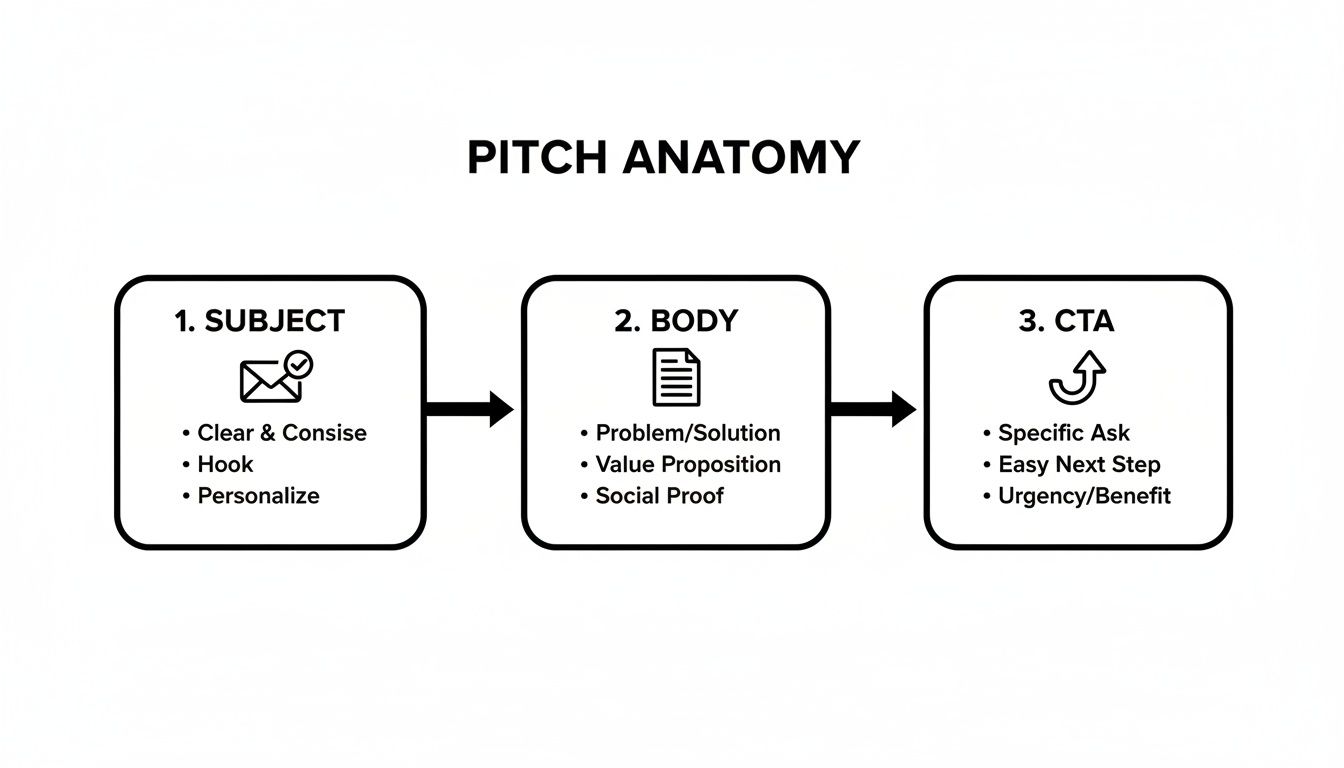
This visual is a great reminder that every part of your email, from the first word in the subject line to your final ask, needs to work together. It’s all about guiding the journalist toward a "yes."
While the core anatomy stays the same, the focus and key information shift depending on your goal. This table gives a quick overview of how the essential components adapt across our three main PR scenarios.
PR Outreach Template Components
| Email Section | Product Launch Pitch | Expert Commentary Pitch | Event Invitation Pitch |
|---|---|---|---|
| Opener | Hook with personalization based on their recent work. | Reference a recent, relevant article they've written. | Direct and personal invitation on behalf of the company. |
| The "What" | Announce the new product and its launch date. | Introduce the expert and their specific area of expertise. | Clearly state the event name, purpose, and date. |
| The "Why" | Explain the problem the product solves for customers. | Connect the expert's knowledge to a current news trend. | Highlight the value for them (e.g., exclusive access). |
| Key Details | Bullet points on features, benefits, and key stats. | Bullet points on specific talking points or unique insights. | Bullet points for event logistics: When, Where, What. |
| Call-to-Action | Offer an exclusive demo or an interview with the founder. | Ask if they're open to connecting with the expert for a comment. | Request an RSVP by a specific date to confirm their spot. |
Understanding these nuances helps you tailor your message for maximum impact, ensuring the journalist immediately grasps the value you're offering.
Template 1: Product Launch
When you’re launching something new, your pitch needs to build excitement and clearly answer the "why now?" question. The focus should always be on the problem your product solves for customers, not just a laundry list of its features.
Subject: Exclusive First Look: [Your Company] Launches [Product Name] to Solve [Customer Pain Point]
Hi [Journalist’s Name],
I saw your recent coverage of [Relevant Topic or Competitor] and thought you’d be interested in a new solution entering the market.
On [Date], we’re officially launching [Product Name], a [brief, one-sentence product description]. We created it specifically to address the growing challenge of [describe the problem your product solves].
Here are a few highlights:
- Key Feature 1: [Briefly explain the benefit, not just the function].
- Key Feature 2: [Explain how this feature directly impacts the user].
- Key Stat: [Include a powerful data point, e.g., "improves efficiency by 40%"].
Would you be open to an exclusive demo or an interview with our founder, [Founder’s Name], next week?
Best,
[Your Name]
Template 2: Expert Commentary
Offering up an expert for comment is a classic PR move that positions your brand as a thought leader. The secret is to connect your expert’s knowledge directly to a current news trend or a topic the journalist already covers obsessively.
This pitch isn't about promoting your company; it's about providing genuine value to their reporting. For more on building a compelling narrative around your key people, take a look at these winning cold email examples and templates.
Subject: Expert for your story on [Trending Topic]
Hi [Journalist’s Name],
Following your excellent article on [Article Topic], I wanted to offer a source for your future stories.
Our [Job Title], [Expert’s Name], is an expert on [Area of Expertise] and can offer a unique perspective on [specific angle, e.g., "the long-term impact of AI on small business marketing"].
They can speak to:
- [Specific Talking Point 1]
- [Specific Talking Point 2 - related to a recent event or data]
- [Contrarian or Surprising Insight]
Would you be open to connecting with [Expert’s First Name] for a brief comment?
Regards,
[Your Name]
Template 3: Media Event Invitation
An event invite needs to be concise and compelling, quickly getting across why it's worth their time to show up. Journalists are incredibly busy, so your invitation must clearly state what’s in it for them—whether that's exclusive access, key networking opportunities, or a first-hand look at something genuinely newsworthy.
Subject: You’re Invited: Exclusive Preview of [Product/Event Name] on [Date]
Hi [Journalist’s Name],
On behalf of [Your Company], I’d like to invite you to an exclusive media event for the launch of [Product/Initiative Name].
Join us for a first look and live demos at:
- When: [Date], [Time]
- Where: [Venue or Virtual Link]
- What: [Briefly describe the event, e.g., "An evening with our CEO, hands-on product demos, and networking with industry leaders."].
Please RSVP by [Date] so we can confirm your spot.
Hope to see you there,
[Your Name]
Mastering the Art of the Follow-Up
Sending a great pitch is a fantastic start, but it's rarely the end of the story. Journalists are drowning in emails—hundreds a day is no exaggeration. Even a perfectly relevant story can get buried under the digital avalanche. This is where a strategic follow-up becomes your most powerful tool, turning a silent "maybe" into a definite "yes."
The trick is to be persistent without becoming a pest. It's a fine line. Every single follow-up needs to add new value. Just "bumping" your original message or asking if they "saw your email" is a fast track to the spam folder. Think of each follow-up as a new opportunity to make their job easier, not just another notification to clear.
Timing and Adding Value
The sweet spot for your first follow-up is 3-5 business days after the initial pitch. This gives the journalist enough time to actually read it but doesn't let the trail go completely cold. Your goal is to gently pop your story back to the top of their inbox while offering something new to reignite their interest.
So, what does this "new value" actually look like?
- A Fresh Angle: "Following up on my note about our new product—I thought your readers might also be interested in the sustainability angle of its manufacturing process."
- New Data: "Just wanted to add a quick update to my previous email. A new survey found that 78% of consumers in this space are looking for this exact solution."
- An Exclusive Asset: "Hi again, I wanted to offer an exclusive infographic that visualizes the data I sent over last week. It's not public yet."
A follow-up without new value is just noise. A follow-up that offers a new insight, a compelling statistic, or a helpful asset is a collaboration. It shows you're thinking like a partner, not just a pitcher.
The Gentle Nudge Template
Your follow-up should be brief, polite, and directly reference your original message. Don't re-pitch the entire story from scratch. All you need is a concise reminder to jog their memory.
Here’s a simple structure you can adapt:
Subject: Re: [Your Original Subject Line]
Hi [Journalist’s Name],
Hope you're having a productive week. I'm just quickly following up on the story idea I sent over about [briefly mention the topic].
To add a bit more context, we just gathered some data showing [new statistic or insight]. I thought this might be a compelling hook for your audience.
Is this something you'd be interested in exploring further?
Best,
[Your Name]
This approach is respectful of their time and makes your message relevant all over again.
To really get this down to a science, it's worth reviewing proven sales follow-up email templates, since many of the same psychological triggers apply. As you scale, automating these sequences can be a game-changer. You can learn more about how to create workflows to build a system that’s both effective and efficient. If you don't hear back after one or two value-packed follow-ups, it's usually best to move on.
How to Scale Your Outreach Without Sounding Like a Robot

As your brand picks up steam, your outreach has to keep pace. But here’s the classic trap: you start sending more pitches, and suddenly, that personal touch that actually got replies in the first place vanishes. That's a one-way ticket to failure, turning what was thoughtful outreach into generic spam that’s instantly deleted.
The real key isn't just to send more emails; it's to build a smarter system. This means graduating from one-off pitches to a repeatable process that can handle a higher volume without sacrificing quality. It all starts with slicing up your media list into smaller, laser-focused groups.
Instead of staring down a single, overwhelming list of 200 journalists, think in micro-lists. Group them by their specific beat, the publication they write for, or even topics they've covered recently. This setup lets you personalize your pr email template in targeted batches, making your outreach both efficient and genuinely relevant.
Batching Personalization with Smart Segmentation
Once you've got your segmented lists, you can start tailoring your core template for each group. We're not just talking about changing the name, either. You need to tweak the entire angle of your pitch so it connects with that specific audience.
- Tech Reporters: Your template should zero in on innovation, hard data, and what sets you apart from the competition.
- Lifestyle Bloggers: Pivot the angle to highlight the human story, the user experience, or the aesthetic appeal.
- Business Journalists: For this group, it’s all about the numbers. Emphasize market trends, ROI, and the business impact of your story.
This batching method lets you write one killer pitch that resonates with 10-15 people instead of a bland, generic one for 100. It's the sweet spot between speed and authenticity. You can even take it a step further by exploring different tones of voice to make sure your message lands just right for each segment.
Scaling outreach is a numbers game, but not in the way you think. It's about increasing the number of high-quality, personalized interactions, not just the raw volume of emails sent.
Using Tools and Metrics to Sharpen Your Strategy
You can't improve what you don't measure. As you start to scale, using an email outreach tool is no longer a "nice to have"—it's essential. These platforms give you the hard data you need to see what’s working and what isn’t, helping you fine-tune your system with every send.
Keep a close eye on these key metrics to guide your tweaks:
- Open Rates: This is a direct reflection of your subject lines. If your numbers are low, it's time to A/B test. Try being more direct, ask a question, or lead with a jaw-dropping statistic.
- Reply Rates: This is the ultimate measure of success. A high open rate but a low reply rate is a huge red flag that your pitch itself is missing the mark. Go back and look at your value proposition, your clarity, and your call-to-action.
- Click-Through Rates (CTR): If your email includes links to a press kit or a new report, a low CTR could mean your link isn't compelling enough or it's buried in the email.
Analyzing this data transforms your outreach from a guessing game into a data-driven strategy. Every campaign becomes a learning opportunity that makes the next one smarter, helping you build a scalable system that actually delivers results.
Answering Your Top Questions About PR Email Templates
Even with the best frameworks in your back pocket, you're bound to have questions once you start pitching. The world of media outreach has its own set of unwritten rules, and navigating them can feel a little tricky at first.
Let's clear up some of the most common questions that pop up when you're working with a PR email template. Getting these sorted will give you the confidence to hit "send" and start building real relationships with journalists.
How Long Should a PR Pitch Email Be, Really?
Keep it tight. Your target is 100-200 words, max. Journalists are absolutely buried in their inboxes, so your one and only job is to get to the point—fast.
Think of it this way: your pitch needs to be so clear and concise that they can grasp the entire story in a single glance. Use short paragraphs, maybe just two or three sentences each. Bullet points are your best friend for highlighting the juicy details. Make your call-to-action simple and direct. Your goal is to make it easier for them to say "yes" than to hit delete.
How Many Follow-Up Emails Should I Send?
One or two thoughtful follow-ups is the industry sweet spot. Anything more than that, and you risk drifting from "persistent" into "annoying," which can burn that bridge for good.
Timing is everything, too. Wait about 3-5 days after your initial pitch before sending the first follow-up. If you still hear crickets, a final, gentle nudge about a week later is acceptable.
Quick tip: Every follow-up has to add new value. Never just "check in." Offer a fresh statistic, suggest a slightly different angle, or share a new resource. If two value-packed follow-ups get you nothing but silence, it's time to move on.
Can I Just Use the Same PR Email Template for Everyone?
Please don't. This is probably the single biggest mistake you can make in media outreach. Think of a template as your foundation, not the finished house. It's a starting point, not a copy-paste solution.
Personalization is what separates a real pitch from spam. It’s how you prove you've done your homework and actually respect the journalist's work.
At the absolute minimum, you need to customize:
- The journalist's first name (get the spelling right!)
- The name of their publication
- A recent, specific article they wrote that you genuinely enjoyed
But the best pitches go deeper. They connect their story directly to the journalist's beat, their recent coverage, and what their audience cares about. That's the kind of genuine effort that gets replies.
What Are the Biggest Mistakes to Avoid in a PR Pitch?
The most common blunders are often the simplest. Things like generic subject lines, zero personalization, and massive walls of text will get your email deleted before it's even read.
Another huge mistake is sending a pitch that's completely irrelevant to what the journalist covers. Pitching your new tech gadget to a food critic isn't just a waste of their time; it's a waste of yours. Always, always do your research to make sure your story is a perfect fit.
At Sight AI, we turn AI visibility insights into action, helping you discover high-value content gaps and outreach opportunities to drive sustainable rankings and measurable growth. Learn how Sight AI can get your brand discovered.