
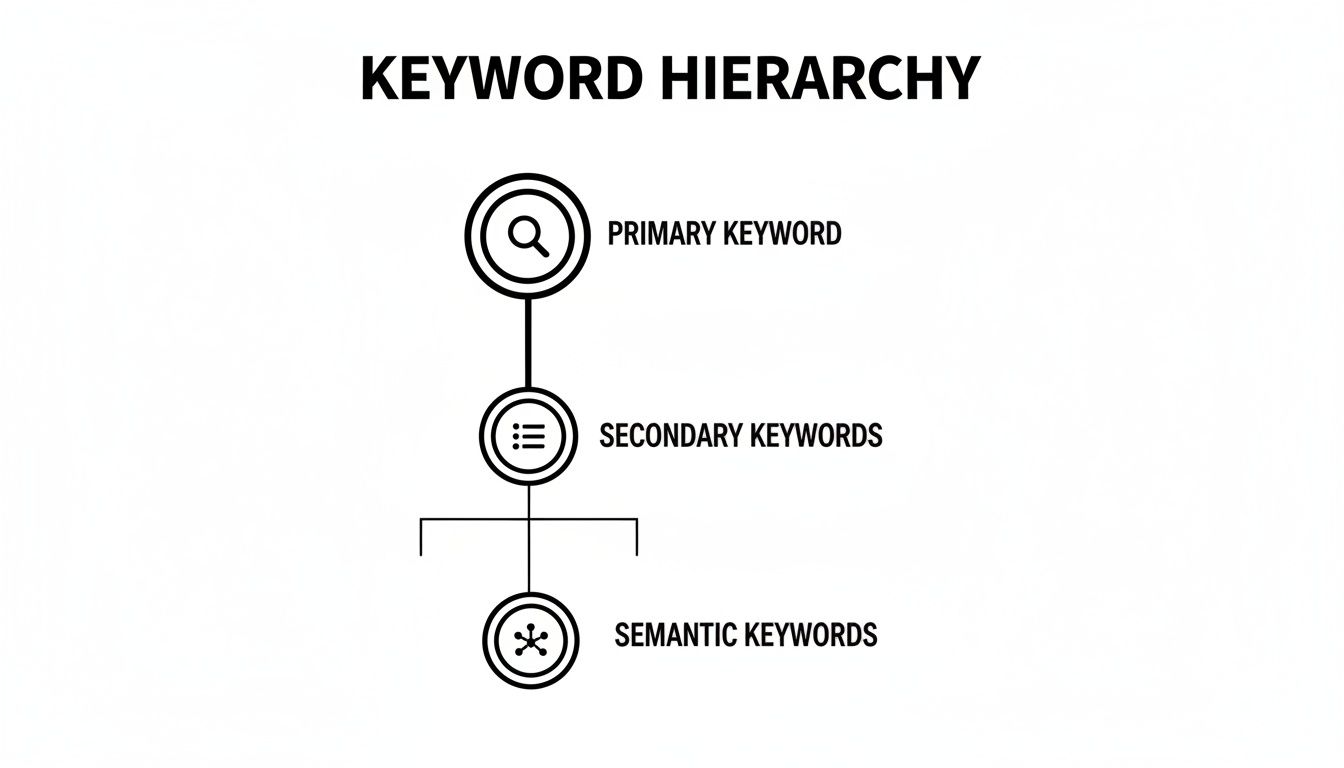
In my experience, every page performs best when it revolves around one primary keyword. Then I weave in two to three secondary or semantic terms to deepen the topic without overwhelming readers or search engines. This approach keeps your focus sharp and your content meaningful.
Keyword Optimization Fundamentals
By the end of this section, you’ll know:
- The shift from strict density rules to AI-driven semantic understanding
- Why a single primary keyword outshines multiple competing targets
- How to integrate secondary and related terms in a natural way
- A handy table of recommended keyword counts by page length
Search engines today look beyond repeated phrases—they hunt for context and intent. Instead of counting mentions, they scan for depth. Once you grasp modern keyword strategy, balancing focus with thorough coverage becomes second nature.
Evolution Of Keyword Density
Back in the early 2010s, SEO felt like a numbers game: hit about 2% density and you were golden. A 1,500-word post needed roughly 30 exact matches of your target phrase to “optimize” ranking.
“Exact-match stuffing backfires. Today’s algorithms reward context and semantic variations over rigid repetition.”
Fast-forward to now, and AI models recognize synonyms and related concepts. They flag relevance through topic coverage instead of phrase repetition. Think of it as shifting from painting by numbers to creating a full-color masterpiece.
Selecting Your Keyword Mix
Start with one strong term that matches search intent and sits in a comfortable competition range. Then add two or three support phrases that expand on subtopics. For example, if your primary keyword is “how many keywords SEO per page,” you might choose “keyword mapping,” “semantic SEO,” and “avoiding cannibalization” as your secondary targets.
Here’s a simple workflow:
- Research volume and difficulty with tools like SEMrush or Ahrefs
- Identify intent-matching phrases (informational, transactional, navigational)
- Pick two to three semantically related keywords with moderate search volume
- Map those terms into headings, bullets, and image alt text
This step-by-step makes sure your page sends unambiguous signals to both readers and algorithms—without feeling forced.
Recommended Keyword Usage By Page Length
Below is a quick reference for balancing primary and secondary keywords based on your word count. Use it as a guide, not a rule etched in stone.
| Page Length (Words) | Primary Keywords | Secondary Keywords |
|---|---|---|
| 500–1,000 | 1 | 2 |
| 1,000–2,000 | 1 | 3 |
| 2,000–3,000 | 1 | 4 |
| 3,000+ | 1 | 5 |
A concise, 800-word overview might pair one primary term with two secondary ones. Meanwhile, a 2,500-word deep dive can comfortably support up to four secondary keywords without losing its focus.
Visualizing Real SERP Examples

Above, you can see how top-ranking pages blend exact terms, synonyms, and related questions. The takeaway? Contextual richness beats brute-force repetition every time.
By now, you understand why one primary keyword paired with a handful of supporting phrases creates clarity and authority. This framework will guide your research, on-page placements, and internal linking decisions.
For deeper insights and advanced tactics, explore our comprehensive how to optimize content for SEO guide.
Choosing Your Primary Keyword
Selecting a single keyword is the anchor for everything that follows on your page. It shapes your title, headings, and even your calls to action. By honing in on one term, you create a clear path for readers—and for search engines.
Before you settle on that keystone phrase, weigh three critical factors: search volume, user intent, and competition.
Your primary keyword is like a compass. It points the way forward.
Evaluating Search Volume
Jump into tools such as SEMrush, Ahrefs, or Google Keyword Planner to see how often a term is searched each month.
You’re aiming for at least 500 monthly searches—but don’t chase every high-volume buzzword. Moderate difficulty often means a sweet spot between traffic potential and realistic ranking chances.
- Look for terms with 500+ average monthly searches in your niche.
- Cross-check volume figures across the platforms you trust.
- Weed out vague phrases that won’t resonate with your audience.
Assessing User Intent
Intent is the “why” behind each search.
Are people looking for a how-to guide? Then deliver step-by-step instructions. Shopping around? Offer clear product comparisons or pricing tables.
Here’s a screenshot showing search volume and intent insights from a popular research tool.
This view makes it easy to match intent with volume at a glance.
Comparing Keyword Competition
Difficulty scores reveal how tough the battle will be.
Aim for keywords scoring under 45 on a 100-point scale. That balance gives you decent traffic without an overwhelming backlink war.
- Review top pages’ domain authority and backlink counts.
- Examine their content quality and coverage.
- Pinpoint gaps you can fill or angles you can own.
Placing Your Primary Keyword
Once you’ve picked your main term, weave it in naturally.
- Title and H1: feature the keyword early
- Meta description: include it without overstuffing
- Opening paragraph: make sure it appears once
- One subheading: slip it in smoothly
Keep density under 1%. Today’s top ten ranking pages average just 0.04% density. Learn more about keyword density findings on guangsuan.com
Check out our guide on organic search keywords for tactics on mapping related terms and boosting topical depth Learn more in our organic keyword strategy article
Real World Keyword Example
Picture a bakery blog. You’ve chosen “artisan sourdough recipe.”
Your title might read Best Artisan Sourdough Recipe, followed by that phrase in the first sentence. Then you’d sprinkle in related terms—“sourdough starter tips,” “baking time guide”—as H2 or H3 headings to deepen the page’s context.
Final Checks Before Publishing
Run a quick pre-publish audit to ensure your primary keyword appears in:
- Title and H1
- Meta description
- Opening paragraph
- One subheading
With those boxes checked, you’re ready to hit publish.
Incorporating Secondary And Semantic Keywords
Think of secondary and semantic keywords as the seasoning in your content. They highlight topic depth for search engines and keep your main idea front and center. By weaving in synonyms and related terms, you give readers more context and help algorithms understand your page’s full scope.
Start by gathering LSI terms and NLP entities that complement your primary focus. Ask yourself which questions users are really asking—Google’s People Also Ask menu is a goldmine. Then, turn to tools like LSI Graph or AnswerThePublic to uncover hidden gems. Finally, scan the top-ranking pages in your niche to spot recurring phrases and entity names.
- Explore related questions in Google’s People Also Ask
- Use LSI Graph or AnswerThePublic for synonyms and variations
- Note high-value terms on top-ranking articles
These tactics ensure you cover subtopics without diluting your core topic. For example, a page on “cloud hosting” might naturally include managed servers and uptime guarantee, giving both humans and search bots more to chew on.
Uncovering Related Phrases
First, build a seed list of your main keyword plus key concepts. Then, feed that list into your semantic research tool of choice.
- Input your primary phrase into the tool
- Note recurring terms and context hints
- Filter out off-topic or low-value suggestions
This simple process preserves your main keyword’s strength while broadening your coverage.
Natural Integration In Content
Now, blend those secondary keywords into your subheaders, body copy, and image alt text as though they were always there. It’s like threading a needle—each term supports the overall picture without sticking out awkwardly.
For instance, instead of repeating “how many keywords seo per page” verbatim, use a subheading like “Ideal Keyword Count Per Page.” In the paragraph, mention “keyword mapping strategies” to keep the narrative smooth.
A thoughtful mix of core and semantic phrases serves both your audience and search engines alike.
Imagine an e-commerce post on “artisan sourdough recipe.” You might use H3 headings such as “Sourdough Starter Care” and “Baking Time Tips” to enrich the reader’s experience.
- Place secondary terms in at least two subheaders
- Slip semantic phrases into natural breaks in your text
- Add related entities to image alt attributes for extra signals
Once your content is live, monitor metrics like time on page and bounce rate in Google Search Console. Identify which queries trigger your secondary keywords and refine accordingly. For real-world examples and deeper insights, explore our advanced guide on SEO content writing best practices. This balanced approach lets you expand your keyword map without straying from your main topic—making your pages both reader-friendly and algorithm-friendly.
Start sprinkling in those terms and watch your relevance climb.
Mapping Keywords Across Your Site
Think of your website as a sprawling city. Each page is a unique neighborhood, and one primary keyword acts as its address.
When you assign that main term, you create a clear path for search engines and readers. Then, sprinkle in two to three secondary keywords to give each page extra context without overcrowding your focus.
Start by listing every URL in a simple spreadsheet.
Set up three columns:
- Page URL: The full path for quick reference.
- Primary Keyword: Your main focus for that page.
- Secondary Keywords: A handful of related phrases to flesh out the topic.
This structure makes gaps and overlaps jump out at you.
The screenshot shows how a keyword map keeps your strategy organized and transparent.
Avoiding Keyword Cannibalization
In a library, you wouldn’t shelve two books under the same title. Your site deserves that same precision.
Assign each URL a unique primary term, so pages don’t trip over one another in search results. Group related pages into topical clusters. This builds authority and signals to search engines that your site covers a topic thoroughly.
- Check existing content before adding new pages.
- Update your keyword map when you launch a fresh article.
- Merge or retire pages that no longer fit your strategy.
Sample Keyword Mapping Chart
Here’s a quick look at how you might lay out keywords across different pages to keep everything distinct:
| Page URL | Primary Keyword | Secondary Keywords |
|---|---|---|
| /blog/seo-basics | seo keywords per page | keyword mapping, semantics |
| /services/seo-audit | site keyword map | cannibalization, clusters |
| /guides/keyword-guide | how many keywords seo per page | secondary terms, LSI |
This chart makes it easy to see each page’s unique focus and spot any overlapping targets.
Tools To Streamline Keyword Mapping
You don’t need a complex setup. A collaborative sheet can work wonders:
- Google Sheets or Airtable for real-time updates.
- Sync data automatically from Google Search Console to discover new keyword opportunities.
- Look for platforms that pull in queries and suggest semantic terms on the fly.
This approach keeps your keyword map fresh without manual wrangling.
Collaborating With Your Team
A keyword map is only effective if everyone knows about it. Share it with writers, editors, and developers so they’re all on the same page. Use descriptive anchor text when linking between pages—for example, link to in-depth topics with your exact primary keyword.
Monitor performance in Google Search Console and analytics, then refine your plan quarterly. You can even automate some of this by following our guide on automated internal links.
Over time, this living document becomes the backbone of your SEO strategy, driving clearer priorities and better results.
Implement your map today and watch your site’s focus—and traffic—grow.
Actionable Steps For Your Keyword Strategy

Kick off your SEO playbook with a clear sequence that anyone on your team can follow. Think of this as a recipe: start with research, mix in on-page tweaks, layer on smart linking, and finish with metadata that seals the deal.
This guide breaks down each phase into bite-sized actions. You’ll get tool recommendations—Google Search Console, SEMrush, Ahrefs, and IndexPilot—to speed things up, along with collaboration tips for writers, editors, and devs.
- Scout keywords with precision
- Place primary and secondary terms strategically
- Set up internal links that pass authority
- Craft metadata that’s on-point and concise
- Coordinate across teams to keep everyone aligned
The sections that follow will walk you through each step, helping you plant your keyword strategy on solid ground.
Conduct Efficient Keyword Research
Research feels messy until you give it structure. Start with your main query—how many keywords SEO per page—and expand into related ideas.
First, collect seed terms in a shared sheet. Then run them through SEMrush, Ahrefs, or IndexPilot’s AI Agents. Your goal? 2–3 strong secondary keywords with 500+ monthly searches and difficulty under 45.
- Assemble seed terms in a live spreadsheet.
- Process keywords through planning tools.
- Filter by user intent (informational vs. commercial).
- Label each phrase as primary or secondary.
- Export the list for on-page use and meta fields.
This approach hands you a living blueprint for every content brief.
“A structured keyword inventory ensures you never miss a relevant term.” – SEO Expert
Optimize Titles And Headings
Think of titles and headers as signposts for both readers and search engines. Place your primary term in the H1 to make your focus crystal clear.
For example, targeting how many keywords SEO per page could turn into “Best Keyword Count Practices Per Page.” Slot one secondary keyword into an H2 or H3 to add context.
- Front-load titles with your primary keyword
- Keep titles under 60 characters for full SERP visibility
- Stick to one H1 per page to avoid mixed messages
- Use H2s for major sections and H3s for subpoints
- Weave semantic terms into H3s for richer context
This blend of clarity and variety keeps your headings both sleek and SEO-friendly.
Structure Internal Links
Internal links work like secret passageways, guiding readers around your site and sharing page authority. Aim for at least two contextual links on every page.
Link back to your main topic page using the primary keyword as anchor text. Then, for supplementary posts, switch to secondary keywords.
| Link Type | Anchor Text Example | Purpose |
|---|---|---|
| Primary Link | how many keywords SEO per page | Passes authority to the main topic |
| Secondary Link | keyword mapping strategies | Explores related subtopics |
| Contextual Link | Learn about metadata tips | Improves user flow and engagement |
This setup prevents cannibalization and builds a tidy topical cluster that search engines can easily crawl.
Collaborate With Team For Consistency
A rock-solid keyword plan needs buy-in from writers, editors, and developers. Use a shared doc or platform where each URL lists its primary and secondary keywords.
- Define each keyword with clear examples
- Set deadlines for drafts and approvals
- Let IndexPilot auto-generate metadata and schedule posts
- Host quick workshops to onboard new contributors
When everyone knows which terms go where, your content stays consistent and authoritative across the board.
Follow this roadmap, and you’ll turn your keyword strategy into a repeatable process that fuels sustained SEO growth.
Measuring Success And Testing
Real progress in SEO comes from steady measurement. By keeping an eye on organic rankings, traffic, and click-through rates, you’ll know whether your keyword-per-page strategy is paying off. User engagement signals—like time on page and bounce rate—reveal if your content depth and keyword placement are on point.
- Organic Rankings: Track position changes week over week
- Click-Through Rate (CTR): Measure how often searchers click your titles
- Engagement Metrics: Monitor average time on page and bounce rate
Tools like Google Analytics and Google Search Console make data collection painless. For example, you can compare average position and CTR before and after tweaking your title tags. Those insights feed directly into your next optimization cycle.
Key Metrics To Monitor
Before you run any experiments, set clear benchmarks:
- Organic Rankings show how adjustments shift your positions.
- Traffic Volume indicates how many visitors arrive via organic search.
- Click-Through Rate (CTR) calculates the ratio of clicks to impressions.
- Engagement Metrics—like average time on page—highlight content relevance.
By logging these figures, you establish a baseline for future tests. Track ranking movements weekly to spot patterns early. Review bounce rate and session duration to ensure your pages resonate.
In one test, a content team saw organic traffic jump by 25% after refining meta descriptions and internal linking over two weeks.
- Benchmark baseline metrics before running tests.
A/B Testing Fundamentals
A/B testing helps you validate changes in title tags, meta descriptions or semantic phrasing. Split traffic evenly between two versions and compare metrics like CTR and dwell time. Aim for at least 1,000 visitors per variant to hit statistical significance.
- Identify the element to test (title, headline, link text)
- Create two versions differing by just one change
- Run the test for a set period (usually 1–2 weeks)
- Analyze the winning variation against the control
“Small changes in title tags can yield a 15% increase in organic clicks.”
Once you pinpoint a winner, roll out that change site-wide and watch for long-term gains.
Interpreting And Iterating
After your test ends, compare key metrics side by side. If a variant underperforms, revisit your keyword mapping and on-page placement. Iteration is the engine that keeps your pages aligned with both user intent and search-engine updates.
| Element | Control | Variant |
|---|---|---|
| Title Tag | Original H1 | Updated keyword emphasis |
| Click-Through | 3.2% | 3.7% |
| Average Rank | 12.4 | 11.8 |
For ongoing success, learn more about tracking keyword rankings in our dedicated guide.
Combining data-driven tweaks with a solid keyword-per-page strategy ensures continued growth. Regular testing and measurement make your content adapt and thrive.
FAQs On Keywords Per Page
Nailing down how many keywords per page truly sharpens your content’s focus.
These FAQs dive into exact-match counts, readability tactics, and strategies to keep pages from competing with each other.
You’ll find quick, actionable tips that build on the steps we covered earlier.
Key Topics Covered
- Primary vs. Secondary Keyword Counts Explained
- Why One Main Topic Per Page Matters
- How to Weave in Semantic Variations Smoothly
- Tools and Metrics for Fine-Tuning Your Approach
How Many Exact Match Keywords Should You Target
Start by featuring your primary keyword in your title, H1, and opening paragraph.
Then, sprinkle in two to three related terms that deepen the context without overwhelming the reader.
Over a 1,500-word article, this approach keeps your keyword density under 1%, which aligns with top-ranking pages.
For instance, a 1,200-word guide might include the primary term four times and three semantic mentions.
“One primary term keeps focus sharp, three support phrases round out coverage.”
- One primary keyword for clear focus
- Two to three secondary keywords for added depth
- Avoid keyword stuffing to preserve readability
This balance prevents dilution and plays nicely with modern semantic search.
Can You Use More Than One Primary Keyword
Generally, stick to a single primary keyword per page.
Trying to juggle two can split your signals and leave readers wondering what your page is really about.
If you have two major topics to cover, build separate pages or dedicated subpages.
That way, each page earns its own spotlight in search results—and you sidestep cannibalization.
Think about this when sketching out your sitemap and internal linking.
How Do You Balance Keyword Usage With Readability
Good SEO never reads like SEO. Natural language always wins.
Follow this simple three-step process:
- Use your primary keyword once in the H1
- Integrate secondary terms only where they make sense
- Read your draft aloud—trim any forced or awkward phrases
That routine smooths out rough spots and helps lower your bounce rate.
Bullet Tips for Flow
- Swap exact-match phrases with synonyms to keep things fresh
- Break long sentences into digestible chunks
- Keep paragraphs to 2–3 sentences for easy scanning
What Tools Can Help Find Semantic Keywords
Semantic variations expand your content’s reach and authority. Try these tools:
- Google’s People Also Ask to uncover real user questions
- SEMrush Keyword Magic Tool for related-phrase discovery
- Clearscope for NLP-driven term suggestions
Each platform surfaces contextually relevant phrases you can map to your subtopics.
Then track metrics like time on page and click-through rate to see which terms resonate.
Ongoing Monitoring Tips
- Review ranking and traffic trends weekly
- Adjust keyword counts based on engagement signals
- Refine your semantic mix to capture more long-tail queries
This continuous loop keeps your pages in tune with what users and search engines want.
How Often Should You Review Keywords Per Page
SEO isn’t a set-and-forget project. Revisit your keyword strategy at least quarterly.
Watch for shifts in rankings, user behavior, and competitor tactics.
Then tweak your primary and secondary term mix based on real data.
That ensures your pages stay aligned with evolving search patterns.
Ready to automate your keyword strategy and boost organic rankings?
Check out IndexPilot to streamline keyword research, content planning, and publishing at scale.