Chasing keywords alone is a surefire way to fall behind in SEO. The real strategic play is content gap analysis, a process for pinpointing topics your audience is searching for that your competitors are all over, but you’re nowhere to be found. It’s a fundamental shift from guessing what to create to knowing what your audience needs and where you're completely absent from the conversation.
Go Beyond Keywords with Content Gap Analysis
Let’s be clear: the goal isn’t just to rank for more keywords—it’s to rank for the right ones. This is exactly where a content gap analysis becomes your most powerful tool. It’s less of a technical audit and more of a strategic review of your entire content footprint against your top competitors.
By systematically digging into these gaps, you stop chasing small keyword wins and start building the kind of topical authority that Google loves to reward. You’ll uncover entire topic clusters, mismatches in user intent, and even content format opportunities you’ve been sleeping on. Instead of just churning out another blog post, you’ll be creating the precise piece of content your audience is actively trying to find but can't get from you.
Understanding Different Types of Gaps
A proper content gap analysis goes deep, revealing a few different kinds of opportunities you might be missing. Think of it as looking at your content landscape from multiple altitudes.
Before you can fill the gaps, you have to know what you're looking for. The table below breaks down the common types of content gaps you'll uncover.
| Key Focus Areas in Content Gap Analysis | ||
|---|---|---|
| Gap Type | Description | Example |
| Topic Gaps | These are entire subject areas or subtopics your competitors cover that you haven't touched at all. It's a high-level, domain-wide blind spot. | Your e-commerce site sells hiking boots, but competitors have extensive content on "best hiking trails" and "waterproofing gear." |
| Keyword Gaps | This is more granular. You and a competitor both cover a topic, but they rank for specific long-tail keywords or user questions that you've missed. | You both have articles on "how to choose a tent," but their page ranks for "best tent for cold weather camping" while yours doesn't. |
| Intent Gaps | You have content on a topic, but it doesn't match what the searcher is actually trying to do (the search intent). | A user searches for "compare running shoes" (commercial intent), but your page is a blog post about the history of running (informational intent). |
| Format Gaps | Your content exists, but it's in the wrong format. Search results are dominated by videos or calculators, and you only have a blog post. | The top results for "how to tie a bowline knot" are all short videos, but you only have a text-based guide with a few images. |
Understanding these different types of gaps is crucial because each one requires a different strategic response, from creating a new content pillar to simply updating an existing page with a new section or format.
The process essentially boils down to three core elements: the topics themselves, the underlying user intent, and the format you use to deliver the information. This visual helps illustrate that flow.
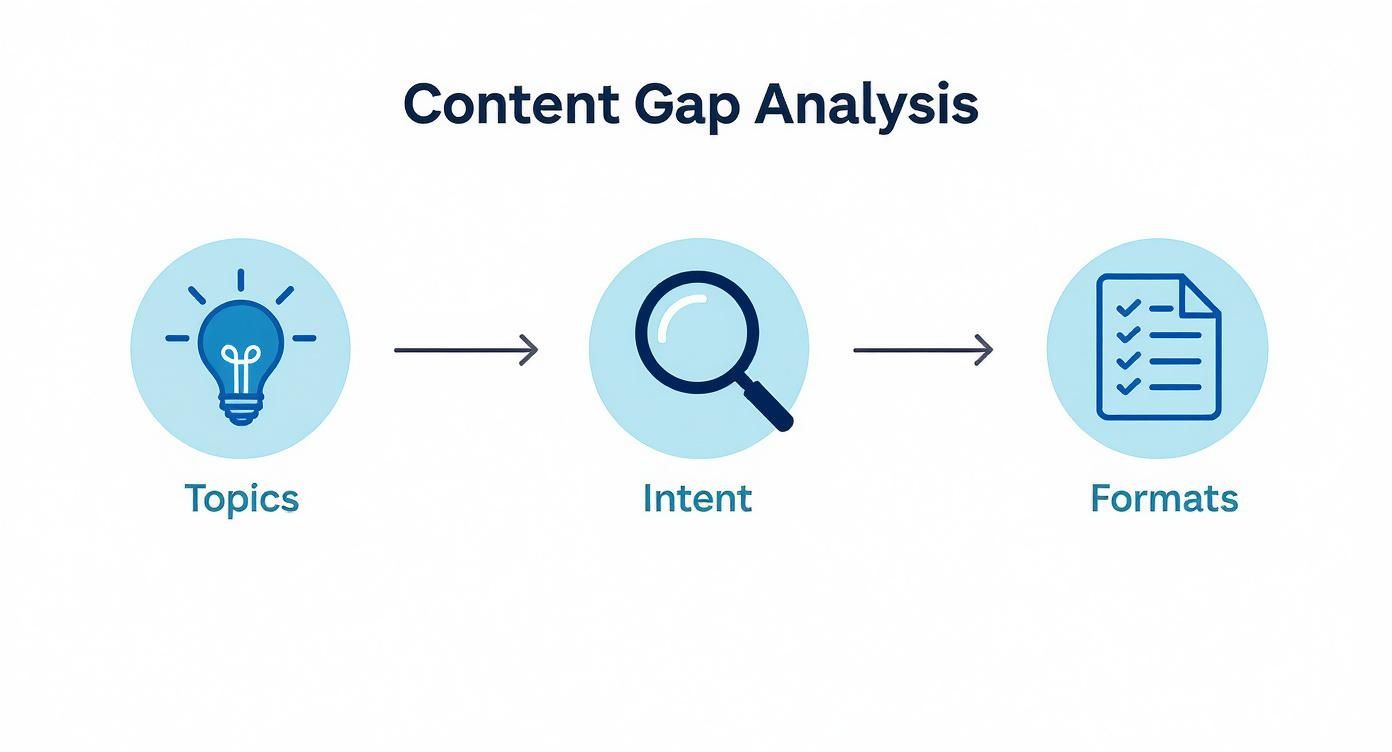
As the diagram shows, a successful analysis always moves from identifying the missing topics to truly understanding the searcher's intent, which then dictates the perfect format. To get a better handle on the foundational pieces here, check out our guide on how to find the best organic search keywords.
The Strategic Advantage of Filling Gaps
By the time you finish this guide, you’ll have a repeatable framework for capturing highly qualified traffic and investing your content budget where it delivers real, measurable results. This isn't just about plugging holes in your content plan; it's about building a more complete, authoritative, and helpful resource for your audience.
"A content gap isn't just a missing keyword; it's a missed opportunity to connect with your audience and solve their problem. Finding and filling that gap is how you turn a competitor's strength into your advantage."
Ultimately, this analysis empowers you to:
- Capture Qualified Traffic: Attract users who are deeper in the buying funnel and searching for specific solutions you can provide.
- Build Topical Authority: Show search engines that you are a comprehensive, go-to resource on a particular subject.
- Improve User Engagement: Give users everything they need in one place, which naturally keeps them on your site longer and reduces bounce rates.
Gathering the Right Tools and Intelligence
Before you can spot any meaningful gaps, you need to arm yourself with the right intelligence. Think of this phase as your pre-mission briefing. Assembling accurate, multi-faceted data is the difference between a targeted strike and a wild shot in the dark. A successful content gap analysis seo strategy is built on a foundation of solid data, not assumptions.
This means pulling information from several key sources. Each one provides a unique piece of the puzzle, and when you put them together, you get a complete, 360-degree view of your content landscape and all the opportunities hiding within it.

Uncovering Hidden Opportunities in Google Search Console
Your first stop should always be Google Search Console (GSC). This is your direct line to Google, offering unfiltered data on how your site is actually performing in search, straight from the source. It’s an absolute goldmine for finding low-hanging fruit.
The key here is to look for "striking distance" keywords. These are queries where you’re already ranking on page two or three—think positions 11-30. Your content is relevant enough for Google to notice, but it's not quite strong enough to earn those valuable page-one clicks.
To find these, head over to the Performance report in GSC. I like to filter by an average position greater than 10 and then sort the whole list by impressions. This immediately surfaces pages that are getting seen but not clicked, highlighting a clear gap between your current content and what searchers actually want.
Auditing Your Own Content Performance
Next, turn your attention inward to your own website analytics, whether that's Google Analytics or another platform. While GSC shows you what happens on the SERP, your analytics tell you what happens after the click. You're looking for pages with high potential but underwhelming performance.
Specifically, I hunt for pages that have:
- High impressions but low click-through rates (CTR): This signals a disconnect. Your title tag or meta description might be falling flat, or the content itself doesn't fully match the search intent.
- Decent traffic but high bounce rates or low time on page: People are landing on your page but leaving almost immediately. This suggests a format gap or that the content simply doesn't deliver on its promise.
- Declining organic traffic over time: A page that used to be a star performer might be suffering from content decay. It's the perfect candidate for a refresh to fill new gaps that have emerged since it was published.
These metrics point to existing assets that can be improved to fill a page-level gap, often delivering results much faster than creating something from scratch.
Getting a Panoramic View with SEO Platforms
Finally, to see what’s happening beyond your own domain, you need a robust third-party SEO platform. Tools like Semrush, Ahrefs, or Moz are indispensable for getting that panoramic view of the competitive landscape. This is where you run the classic keyword gap analysis.
These platforms let you plug in your domain and compare it directly against two or three of your top search competitors. Within minutes, you can generate a list of hundreds or even thousands of keywords they rank for that you don't. This is, by far, the fastest way to identify major topic gaps.
A powerful SEO platform doesn't just show you what you're missing; it quantifies the opportunity. Seeing the search volume and keyword difficulty for competitor terms turns a vague idea into a data-backed business case for creating new content.
Of course, before diving into a full-blown analysis, it's essential to have a solid grasp of your foundational content strategy. Part of that means knowing how to conduct thorough keyword research in the first place. You'll also want to make sure you have the right toolkit for the job; our guide on what to look for in SEO tools can help you choose the best platform for your needs.
How to Find Your Competitors' Winning Plays
Alright, this is where the real detective work begins. We’re moving past our own data and starting to reverse-engineer what makes your competitors tick. This isn't just about looking at your known business rivals, either. We need to identify your true search competitors—the websites that consistently pop up on the SERP for the topics you want to own.
First things first, let's get clear on the difference between a direct business competitor and a search competitor. A local bakery’s main business rival is probably the shop down the street. But its search competitor? That could be a national food blog that ranks for "best sourdough recipe." SEO tools are perfect for uncovering these search competitors by showing you who's actually winning the keywords you're after.
Uncovering Domain-Level Keyword Gaps
Once you’ve got a solid list of two to four genuine search competitors, it's time for a domain-level gap analysis. Think of this as a high-level, 30,000-foot view. The goal is to find entire topic clusters your competitors are ranking for that you haven't even touched. It's the fastest way to spot major strategic blind spots in your content plan.
Using a keyword gap tool is pretty straightforward. You'll plug in your domain next to your competitors' domains. The tool then crunches the data, cross-references everyone's keyword profiles, and spits out a list of terms your competitors rank for, but you don't. This can instantly reveal entire categories of content you're completely missing out on.
For example, a project management software company might discover its rivals are ranking for dozens of keywords around "agile methodologies" and "scrum master certification," while their own blog has only talked about product features. That's a massive domain-level gap, representing a huge opportunity to attract a whole new, relevant audience segment they've been ignoring.
The screenshot below from Ahrefs' Content Gap tool shows you exactly what this looks like, highlighting keywords where competitors rank and the target site doesn't.
This kind of visual makes it easy to see the keywords your competitors are scooping up traffic for, along with search volume and their ranking positions. You get a prioritized list of opportunities handed to you on a silver platter.
Digging Deeper with Page-Level Analysis
While the domain-level view is great for big-picture strategy, the page-level analysis is where you find the tactical quick wins. Here, we're not comparing entire websites. Instead, we’re pitting one of your pages against a direct competitor's page that's outranking you for a keyword you both want.
This process is all about uncovering the specific long-tail keywords, user questions, and subtopics their page covers more thoroughly than yours.
Let's say you have a blog post on "how to track keyword rankings" that's stubbornly stuck on page two. You'd pull up the top-ranking article for that same query and start dissecting it. The analysis will almost certainly show that the competitor's page also covers things like:
- Related questions: Like "how often to check keyword rankings" or "best free rank tracking tools."
- Specific subtopics: Maybe they have sections on "tracking local SEO rankings" or "monitoring keyword cannibalization."
- Semantic keywords: Terms like "SERP position," "keyword volatility," and "share of voice."
These are your page-level gaps. By going back and updating your existing article to include this missing information, you can often see a surprisingly fast boost in rankings. If you want to brush up on the fundamentals, our guide on how to track keyword rankings is a great place to start.
Analyzing More Than Just Keywords
A truly thorough competitive analysis goes way beyond just looking at keyword lists. The best content marketers also dig into the qualitative side of their competitors' top pages. You need to understand why their content is winning, not just what it’s about.
Start looking for patterns across the top-ranking pages for your target topics.
- Content Format: Are the top results mostly long-form guides? Listicles? Video tutorials? Maybe they're pages with interactive tools. If you've written a short blog post and everyone else has a 3,000-word ultimate guide, that format mismatch is a huge gap.
- Content Structure: Look at how they organize their content. Do they use a lot of subheadings, bullet points, and images to make it easy to read? Is there an executive summary or a clickable table of contents at the top?
- Depth and Uniqueness: Does their content feature original research, quotes from experts, or unique data visualizations? This is the kind of stuff that's hard to copy and sends strong ranking signals to Google.
To go even deeper on understanding what your rivals are up to, check out this excellent guide on how to conduct competitor analysis.
"The goal isn't just to find what keywords your competitors rank for, but to deconstruct the anatomy of their success. The structure, depth, and user experience of their content are often the real 'secrets' to their high rankings."
The reality of modern SEO is that if you're not creating optimized, gap-filling content, you're likely invisible. Recent studies show that a mind-boggling 96.55% of content gets zero traffic from Google. At the same time, the average length of a top-ranking page hovers around 1,447 words, proving that comprehensive, in-depth content usually wins. These numbers really drive home why a detailed competitor analysis is so critical for breaking through all the noise and getting noticed. By identifying and filling these gaps, you turn a mountain of competitor data into a curated list of high-potential content opportunities.
Choosing Your Battles for Maximum SEO Impact

Finding a massive list of potential content gaps? That's the easy part. The real work in any effective content gap analysis seo strategy is figuring out which few opportunities are actually worth chasing.
If you don't have a solid way to prioritize, you’ll end up spreading your resources too thin, chasing keywords that never actually move the needle. This is the moment you switch from being a data collector to a strategist.
I've found the best way to cut through the noise is to filter every opportunity through three core pillars. It's a simple but powerful model for pinpointing the gaps with the highest potential.
The Three Pillars of Prioritization
Every single content idea you have should be put to this test. If an opportunity doesn't score well on at least two of these, it probably belongs on the back burner for now.
- Audience Relevance: Does this topic genuinely matter to your ideal customer? It's so easy to get mesmerized by a high-volume keyword, but if it doesn't solve a problem your product or service addresses, the traffic is basically worthless.
- Traffic Potential: What's the realistic search volume here? While relevance is king, you still need to target topics that a meaningful number of people are actually looking for. A perfectly relevant keyword with zero search volume isn't going to get you very far.
- Competitive Reality: Let's be honest—can you actually win this? This requires a clear-eyed look at the SERP. If the first page is wall-to-wall with household names and sites with massive domain authority, it might be a battle you can't win right now.
This framework forces you to get critical and ensures your content plan is built on smart, strategic bets, not just a wish list of keywords.
A Real-World Prioritization Scenario
Let’s play this out with a common situation. Imagine you’re a SaaS company selling project management software specifically for small creative agencies. Your analysis uncovers two interesting opportunities:
- Opportunity A: The keyword "project management software" gets a massive 40,000 searches a month. But the SERP is absolutely dominated by industry giants.
- Opportunity B: The long-tail keyword "project management for graphic design teams" only gets 400 searches a month, but the competition is weak, mostly old forum posts and thin articles.
At first glance, Opportunity A looks like a goldmine with all that traffic. But once you apply the three pillars, the story changes.
Opportunity A completely bombs the Competitive Reality test; it would take a monumental effort to even crack the first page. Opportunity B, on the other hand, is a perfect match for Audience Relevance—it speaks directly to a core user persona. It also passes the Competitive Reality test with flying colors.
Sure, the traffic potential is lower, but every single visitor will be highly qualified and far more likely to convert. Opportunity B is the clear winner. It's a fight you can actually win that will attract exactly the right people.
Prioritizing content gaps isn't about finding the biggest keywords; it's about finding the best-fit keywords. A small, targeted win is always more valuable than a big, unwinnable war.
Building Your Prioritized Roadmap
Once you’ve scored your opportunities, it's time to build an actual roadmap. I like to use a simple table to keep things organized and turn the analysis into an actionable plan.
| Topic / Keyword | Relevance (1-5) | Traffic Potential (1-5) | Competitive Difficulty (1-5) | Priority Score (R+T-C) | Action Item |
|---|---|---|---|---|---|
| Project management for graphic design teams | 5 | 2 | 1 | 6 | Create New Guide |
| "How to price creative projects" | 4 | 3 | 2 | 5 | Create New Article |
| Refresh "Best agency workflow tips" | 4 | 3 | 2 | 5 | Update Existing Post |
| "Project management software" | 3 | 5 | 5 | 3 | De-prioritize |
This simple scoring system helps quantify your gut feelings and makes it crystal clear what to tackle first. To really see if your choices paid off, you'll want to keep an eye on some of the key website metrics to track. Ultimately, those numbers will tell you if your prioritization strategy is working. This whole process turns a messy list of ideas into a focused plan for creating content that drives real SEO impact.
Turning Your Insights Into High-Ranking Content
All the analysis in the world means nothing until you actually do something with it. This is where the rubber meets the road—transforming that prioritized list of opportunities into content that actually earns its spot on the SERP.
The goal isn't just to churn out something longer than what your competitors have. It’s to create something genuinely better. This could mean going deeper on the topic, bringing in unique data, offering a slicker user experience, or just tackling it from a completely fresh angle. A successful content gap analysis seo workflow always ends with tangible content that solves a user's problem better than anyone else.
Crafting a Powerful Content Brief
Before a single word is written, you need a solid content brief. Think of it as the blueprint for your new article. Honestly, a well-put-together brief is the single best way to set your writers up for success and make sure the final piece hits all the strategic goals you've laid out.
A great brief is more than just a primary keyword. It's a strategic roadmap for the writer, cutting out the guesswork and focusing their energy on what really matters for ranking.
To truly arm your writer for success, the content brief needs to be thorough. It's the central document that translates all your hard-earned analysis into a clear, actionable plan. Here are the must-have elements I always include to ensure there's no confusion and the final content is built to perform.
Essential Elements of a Content Brief
| Brief Component | Purpose | Example |
|---|---|---|
| Primary & Secondary Keywords | Establishes the core SEO target and builds topical depth. | Primary: "content gap analysis seo" Secondary: "how to find content gaps", "competitor content analysis tool" |
| Target Audience & User Intent | Defines who the content is for and what they're trying to achieve. | Audience: In-house SEO managers. Intent: Informational/Commercial (looking for a process and tools). |
| Competitor Weaknesses | Pinpoints specific opportunities for your content to be superior. | "Competitor A's post has outdated stats from 2021. Competitor B is too high-level and lacks actionable steps." |
| Internal Linking Targets | Builds site authority and guides users to relevant related content. | Link to: - /blog/keyword-research-guide - /blog/on-page-seo-checklist |
| Core Talking Points / Outline | Structures the article and ensures all identified gaps are covered. | "Section 1: What is a content gap? Section 2: Tools you'll need... Section 3: Step-by-step process..." |
| SERP Feature Targets | Aims for specific SERP real estate like Featured Snippets or People Also Ask. | "Target the 'What are the types of content gaps?' question for a Featured Snippet by providing a clear, concise list." |
| Call-to-Action (CTA) | Guides the reader on what to do next, aligning with business goals. | "End with a CTA to book a demo of our SEO platform." |
A well-defined brief like this is the difference between a writer delivering exactly what you need versus a piece that requires heavy edits and rewrites. It saves time, money, and headaches for everyone involved.
A content brief is more than an instruction manual; it's a strategic document. It translates your analytical insights into actionable guidance, ensuring that every piece of content is purpose-built to fill a specific gap and win on the SERP.
The Art of Creating Genuinely Better Content
With a solid brief in hand, it all comes down to execution. "Better" content can mean a lot of different things, and knowing which levers to pull is how you outrank established players. This isn't about ticking boxes; it's about adding real, tangible value that the current top results are missing.
Here are a few strategic plays to consider:
- Go Deeper and Be More Comprehensive: Find the subtopics and user questions your competitors just glossed over. The "People Also Ask" section and related searches on Google are goldmines for identifying these page-level gaps. Use them to build a resource that's impossible to ignore.
- Bring Unique Data or Research to the Table: Everyone cites the same old industry stats. Can you do better? Maybe run a small survey on social media or analyze your own internal data to offer a fresh perspective. Original data is a massive differentiator.
- Level Up the User Experience (UX): Sometimes, the winning edge is just better design and formatting. Break up those intimidating walls of text with custom graphics, add a clickable table of contents for easy navigation, embed a helpful video, or create a simple interactive calculator.
For a much deeper dive into the nitty-gritty of execution, our guide on how to optimize content for SEO has a ton of practical steps you can use right away. This is how you make sure your content isn't just another me-too article, but a genuinely superior asset.
The Quick Win: Refreshing Existing Content
Sometimes, the fastest path to filling a content gap is by improving what you already have. Remember those "striking distance" pages you found earlier? The ones hanging out on page two of Google? They are perfect candidates for a content refresh.
Here’s a real-world example: A client had an underperforming post on "agency workflow tips." It was getting decent impressions but had a terrible click-through rate, stuck around position 14. Our analysis showed that the top-ranking pages all had detailed sections on specific software tools and pricing models—topics our article didn't even mention.
We created a new brief focused on filling those specific gaps. We added two entirely new sections, updated some outdated stats, and embedded a quick video tutorial. Within six weeks of hitting "republish," the article jumped to position 4, bringing in a huge lift in organic traffic. That’s a classic case of filling a page-level gap for a quick, high-impact win.
Today, this process is even faster. With around 74% of new web pages using AI-generated content and 86% of SEO experts folding AI into their workflows, the game has changed. Advanced platforms can now blend traditional keyword analysis with engagement metrics to more accurately pinpoint user intent gaps. This shift makes it easier than ever to turn analytical insights into high-ranking content. You can learn more about these findings on smart SEO keyword analysis.
Common Questions About Content Gap Analysis

Even with a solid game plan, a few questions always seem to surface once you get your hands dirty with a content gap analysis. It’s totally normal. Let's walk through some of the most common hurdles I see people run into.
Clearing up these practical questions from the get-go will make your entire process smoother and a lot more effective.
How Often Should I Perform This Analysis?
This isn't a "set it and forget it" kind of task. The key is to think about frequency in a way that keeps your content strategy nimble and ahead of the curve.
Here’s what I’ve found works best: a two-tiered approach. Plan for a deep, comprehensive analysis about once a year. This is perfect for a major strategy refresh or if you’re about to launch a new product line. It gives you that crucial, big-picture view of the entire competitive landscape.
But you can't stop there. You absolutely need to build a lighter, more focused check-in into your quarterly planning. Search trends shift fast, new competitors pop up out of nowhere, and your audience’s questions are always evolving. A regular pulse-check stops your strategy from going stale.
What Is the Difference Between a Keyword Gap and a Content Gap?
Getting this right is a subtle but critical distinction. It's really the difference between doing tactical work and thinking strategically.
A keyword gap is a tactical finding. It’s simply the raw list of specific keywords and search queries your competitors rank for, but you don't. Think of it as the symptom, the raw data point.
A content gap, on the other hand, is the strategic insight you pull from that data. It's the whole topic—the user's underlying intent, the format they prefer, and the actual information you're missing. Spotting a keyword gap is just the first step; the real goal is to identify the broader content gap it points to.
A keyword gap tells you what you're missing. A content gap tells you why it matters to your audience and how you should solve their problem.
For example, your analysis might show a keyword gap for "best tent for cold weather camping." That single keyword reveals a much larger content gap around comprehensive "winter camping gear guides."
Can I Do a Content Gap Analysis Without Expensive SEO Tools?
The honest answer? Technically, yes. But it’s like trying to build a house with just a hammer. You might get there eventually, but it’s going to be slow, incredibly manual, and you’ll definitely miss a lot.
You can piece together some insights using free resources. Google Search Console is fantastic for finding page-level gaps in your existing content, and you can always manually poke around the SERPs to see what's ranking.
However, paid SEO platforms are an investment in efficiency, scale, and data depth. Tools like Ahrefs or Semrush can automate the discovery of thousands of competitor keywords in minutes—a task that would take weeks to do by hand. They provide the competitive intelligence you need to make genuinely informed decisions, turning a painful chore into a streamlined strategic process.
Ready to stop guessing and start ranking? IndexPilot automates the entire SEO content workflow—from gap analysis and keyword strategy to AI-powered writing and publishing. Transform your insights into compounding organic traffic without the manual busywork. Publish SEO content on autopilot with IndexPilot.