An AI paragraph writer is a specialized tool that generates focused, high-quality paragraphs based on your specific prompts. Think of it as a dedicated writing assistant, perfect for those moments you need to tackle a specific section of an article, draft a compelling email, or craft a punchy social media post without getting bogged down.
What Is an AI Paragraph Writer Really Doing?
It might feel like magic, but what’s happening under the hood is pure computation. The tool isn't "thinking" or inventing concepts from thin air; it’s an absolute master of pattern recognition.
At its core, the technology runs on a Large Language Model (LLM). Picture an LLM as a gigantic digital library that has consumed a massive chunk of the internet—books, articles, websites, you name it. When you give it a prompt, the AI taps into this vast knowledge base to predict the most statistically likely next word, then the next one, and so on, until it has assembled a coherent paragraph.
The Engine Behind the Words
This predictive process is precisely what makes the technology so powerful. It isn't just taking random stabs in the dark. It carefully analyzes the context of your request—the keywords, desired tone, and underlying intent—to construct sentences that are grammatically sound and logically structured.
The real job of an AI paragraph writer is to act as a hyper-efficient collaborator. It takes your strategic direction and handles the heavy lifting of drafting, transforming a simple instruction into a well-formed block of text in seconds.
This ability is sparking a huge shift in how content gets made. The AI writing tools market has exploded, growing from $392 million in 2022 to a projected $2.74 billion by 2026. This boom isn't surprising when you consider that 90% of content marketers now use these tools to keep up with high-volume demands.
AI Paragraph Writer vs Full Article Generator
It’s easy to lump all AI writers together, but paragraph writers and full-article generators serve very different purposes. A paragraph writer is your go-to for targeted, surgical tasks, while an article generator is built for broad-stroke, long-form content creation from the ground up.
Here’s a quick breakdown of how they stack up:
| Feature | AI Paragraph Writer | AI Article Generator |
|---|---|---|
| Primary Use Case | Expanding on a single idea, overcoming writer's block, or refining a specific section. | Creating a complete article draft, including introduction, body, and conclusion. |
| Input Required | A concise prompt, a few keywords, or a specific instruction about a single topic. | A broad topic, target keyword, and often a detailed outline or content brief. |
| Output | A focused, single paragraph or a short block of text. | A multi-section, long-form article that can be thousands of words long. |
| Control | High. You guide the content paragraph by paragraph, maintaining tight control. | Lower. You set the initial direction, but the AI generates the full structure. |
| Best For | Writers who need assistance with specific parts of an article, email, or social post. | Content teams looking to scale article production and generate first drafts quickly. |
Understanding this distinction helps you pick the right tool for the job, ensuring you’re working efficiently instead of trying to make one tool do something it wasn’t designed for.
More Than Just Automation
Using an AI paragraph writer isn’t just about churning out words faster; it’s about enhancing human creativity. These tools are becoming indispensable for modern content teams for a few key reasons:
- Overcoming Writer's Block: Instantly generates ideas and text when you’re staring at a blank page, stuck on how to phrase a particular section.
- Improving Efficiency: Drastically cuts down the time spent on initial drafting, freeing you up to focus on high-level strategy and editing.
- Ensuring Consistency: Helps maintain a uniform tone, style, and quality across hundreds of content pieces.
- Scaling Content Production: Allows your team to produce a higher volume of quality content without needing to proportionally increase your resources.
Once you grasp how these tools operate, you can start integrating them thoughtfully into your workflow instead of just automating tasks. The goal is to let the AI handle the grunt work of the first draft, which frees up your expertise for the critical final polish that only a human can provide. If you're just getting started, diving into the fundamentals of AI copywriting can give you a strong foundation.
Putting Your AI Paragraph Writer to Work
Knowing how an AI paragraph writer works is one thing, but seeing it in action during a hectic workday is something else entirely. This is the moment a tool goes from a neat gimmick to a genuine partner for content creators and marketers.
The real magic happens when you let it tackle the repetitive, often soul-crushing writing tasks. By handing off the grunt work, you free up your team’s brainpower for the bigger picture—strategy, creativity, and high-level thinking.
Think about a common headache: writing compelling product descriptions for a massive e-commerce store. With hundreds of products, each needing fresh, benefit-focused copy, it’s a fast track to writer's block and generic, cookie-cutter text.
An AI paragraph writer completely changes the game. You just feed it the key features and target customer, and it spits out multiple descriptions in seconds. This gives you options to A/B test or a solid draft that only needs a quick polish, not a complete rewrite from scratch.
Supercharging Content and SEO Tasks
But it’s not just for product pages. Savvy teams are weaving these tools into their daily routines to speed up content creation across all sorts of channels, each with its own style and length demands.
Here are a few ways it plays out in the real world:
- Social Media Captions: Instantly generate a handful of engaging captions for a LinkedIn or Instagram post. Need something witty? Professional? Informative? Just ask, and you’ll get several options to pick from.
- Email Marketing: Create punchy, concise subject lines that actually get opened. The AI can also draft introductory paragraphs for your newsletters or promotional blasts, getting you past that initial blank page.
- Expanding Blog Post Sections: We’ve all been there—you have a great outline but get stuck on one particular subheading. An AI paragraph writer can flesh out that section with relevant info in a snap, smashing through your writer’s block.
For SEO managers, the value is crystal clear. Crafting optimized meta descriptions is a non-negotiable but tedious chore. An AI paragraph writer can produce several unique, keyword-rich meta descriptions for a single page, letting you test which one pulls the best click-through rate in the SERPs.
An AI paragraph writer can be an invaluable assistant for effectively writing web copy, allowing you to focus on strategic messaging. It handles the initial drafting, so you can concentrate on refining the core message and ensuring it aligns with brand goals.
A Practical Before and After Example
Let's walk through a scenario. An SEO specialist is working on a blog post, "Benefits of Drip Irrigation Systems," and hits a wall at the subheading "Water Conservation."
Before (Human starting point): Just a blank space under the H3 heading. The writer knows they need to explain how drip irrigation saves water but is struggling to find the right words to get started.
After (Using an AI Paragraph Writer): The specialist types in a simple prompt: "Write a short paragraph explaining how drip irrigation systems conserve water for a home gardening blog. Mention targeting the root zone and reducing evaporation."
In seconds, the AI delivers a draft: "Drip irrigation systems are champions of water conservation, delivering moisture directly to the plant's root zone where it's needed most. Unlike traditional sprinklers that lose a significant amount of water to wind and evaporation, this targeted approach ensures that nearly every drop is used effectively, leading to healthier plants and substantially lower water bills."
Just like that, a task that could have eaten up 15 minutes becomes a 30-second win. The result is a quality paragraph ready to be used as-is or tweaked for perfection.
Crafting Prompts That Get Great Results

Ever wonder why your AI paragraph writer sometimes produces bland or off-topic text? The answer is almost always the prompt. Think of the AI as an incredibly skilled but very literal assistant. It only works with the instructions you give it, meaning the quality of your output is a direct reflection of your input.
Tossing out a vague command like "write a paragraph about marketing" is a recipe for a generic, forgettable result. To get something truly great, you need to "speak" the AI's language. This means giving it the specific context, constraints, and creative direction it needs to shine. This whole process is what's known as prompt engineering.
The Anatomy of a Powerful Prompt
A powerful prompt is so much more than a simple question; it's a complete creative brief. By layering your instructions, you guide the AI from a fuzzy idea to a sharp, high-quality paragraph. The best prompts usually contain a few key ingredients that work together to shape the final output.
Here are the essential elements you'll want to include:
- Assign a Role: Tell the AI who it should be. Something like, "Act as a conversion copywriter" or "You are an expert SEO strategist." This one command instantly frames the AI's perspective, vocabulary, and style.
- Provide Rich Context: Give it the backstory. Explain who the target audience is, where this paragraph will live (e.g., a landing page, a blog post), and what you're trying to achieve with the content.
- Define a Specific Tone: Don't just say "professional." Get more descriptive. Try "Write in an encouraging and informative tone," or "Use a witty and slightly informal voice." The more specific, the better.
- Set Clear Constraints: Give the AI some guardrails. Specify a word count, insist on including a particular phrase or keyword, and tell it what not to mention.
Getting these components right is a game-changer. For a deeper look at this, our guide on LLM prompt engineering for brand visibility offers more advanced techniques to really level up your skills.
Weak Prompt vs Strong Prompt Examples
Let's look at the night-and-day difference a well-crafted prompt makes. Imagine you need a paragraph for a real estate landing page aimed at nervous first-time buyers.
Weak Prompt:
Write a paragraph about buying your first home.
This is way too broad. It has no clear role, tone, or context, so the AI has to guess what you're after. The result will probably be generic and completely uninspiring.
Strong Prompt:
Act as an empathetic real estate advisor. Write an encouraging and informative paragraph for a landing page targeting first-time home buyers. The goal is to build trust and reduce their anxiety. Keep it under 75 words and include the phrase 'your dream home'.
See the difference? This prompt gives the AI everything it needs: a persona, a purpose, an audience, a desired emotional impact, a word count, and a specific keyword. The paragraph it generates will be far more targeted, human, and effective.
To really nail this, it helps to see how a prompt evolves from basic to advanced. The table below breaks down how adding layers of detail dramatically improves the final result.
Effective Prompting Techniques
| Prompt Element | Basic Prompt Example | Advanced Prompt Example | Expected Outcome |
|---|---|---|---|
| Topic | Write about email marketing. | - | A generic, textbook-style paragraph about what email marketing is. |
| + Role | Act as a marketing expert and write about email marketing. | - | A slightly more authoritative paragraph, but still lacking specific focus. |
| + Context & Goal | - | Act as a marketing expert. Write a paragraph for a blog post encouraging small business owners to start an email list. The goal is to overcome their hesitation. | The content now has a clear purpose and speaks directly to a specific audience, addressing their potential pain points. |
| + Tone & Constraints | - | Act as a marketing expert with a friendly, motivational tone. Write a concise paragraph (under 60 words) for a blog post encouraging small business owners to start an email list. Goal: overcome their hesitation. Avoid technical jargon. | A short, punchy, and persuasive paragraph that is perfectly suited for its intended context and audience, written in a specific voice. |
By building your prompts with this level of detail, you move from getting random outputs to consistently creating content that hits the mark every single time.
Even when you're using an AI paragraph writer, knowing the basics of copywriting for bloggers is a huge advantage. These fundamentals help you craft more effective prompts and know how to tweak the AI's output to make it truly persuasive. When you combine solid human copywriting knowledge with precise AI instructions, you create a powerful partnership that produces incredible results.
Building AI Into Your Content Workflow
Bringing an AI paragraph writer into your team’s daily routine doesn’t have to be a major shake-up. The idea isn't to replace your writers but to build a smarter, faster process where human strategy steers AI-powered execution. It’s a hybrid approach that keeps your team firmly in the driver's seat while offloading the heavy lifting of initial drafting to the machine.
A successful workflow treats the AI like a collaborator, not an author. It always starts with a human. Your team defines the content goals, figures out the target audience, and nails down the key messages. Only when that strategic foundation is solid does the AI step in to handle specific, well-defined drafting tasks.
This way, every piece of content stays on-brand and strategically sound from the get-go.
The Human-AI Partnership Model
A practical, sustainable workflow breaks down into a clear, three-stage model. This structure helps you sidestep common mistakes, like accidentally publishing unverified info or losing your brand's unique voice in the process.
Human Strategy and Outline: A content strategist or writer puts together a detailed brief. This isn't just a topic—it includes the primary keyword, target audience, key talking points, desired tone, and a structured outline with clear H2s and H3s.
AI-Assisted Drafting: The writer then uses the AI paragraph writer to flesh out specific sections of that outline. They feed the AI targeted prompts for each subheading, guiding it to generate focused, relevant first-draft content for one piece of the puzzle at a time.
Human Review and Refinement: This is the most crucial step, and it's non-negotiable. A human editor meticulously goes over the AI-generated text. They check every fact, polish the language until it shines, and ensure it matches the brand voice. This is also where they weave in SEO elements like internal links and other nuanced keywords.
By following this structured workflow, the AI paragraph writer becomes more than a text generator—it's a productivity engine. You maintain complete human oversight while dramatically cutting down the time spent on the most grueling part of content creation: the first draft.
Streamlining With Advanced Platforms
For teams ready to scale up, advanced platforms can connect this entire process directly to your Content Management System (CMS). These integrated solutions can take your human-created brief, manage the AI drafting, and even handle technical SEO jobs like schema markup automatically. You can dive deeper into how these pieces fit together by learning more about creating a modern content workflow in our detailed guide.
This level of integration delivers real, measurable gains. On average, users are crafting content 40% faster, saving each employee about 2.2 hours every week. It gets better: 41% of marketers report seeing "significant" productivity boosts from tools that manage the entire content lifecycle, from research all the way to publishing. By embedding an AI paragraph writer into a connected system, you create a powerful hybrid model where human expertise remains the guiding force behind AI's rapid execution.
How to Review and Refine AI-Generated Content
Treating the output from an AI paragraph writer as a final, ready-to-publish piece is one of the biggest mistakes you can make. Think of it as a really solid first draft, not the finished article. The real magic happens when you, the human expert, step in.
Your expertise, your brand’s unique voice, and your strategic goals are what transform that raw text into something truly valuable. Without this critical review stage, you’re just adding to the noise with content that might be generic, slightly off-base, or completely misaligned with your audience.
This is where the real work begins. The editing process is about more than just catching typos; it’s about layering in the nuance, authority, and personality that AI simply can’t replicate on its own. It's how you make the content undeniably yours.
This simple workflow keeps human strategy right where it belongs: at the beginning and the end of the process.
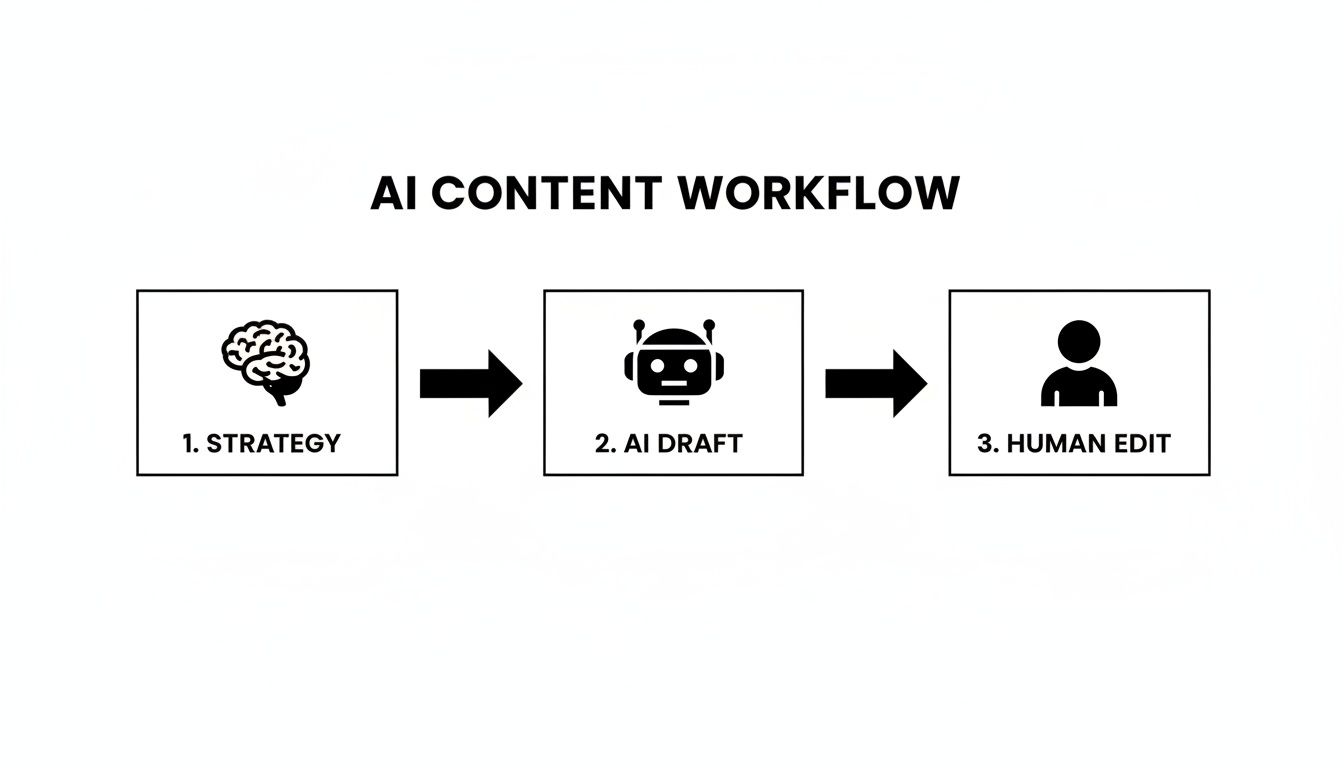
As you can see, the AI serves your strategic goals, not the other way around. Human oversight is the guardrail that ensures quality and relevance from start to finish.
Your Essential Post-Generation Checklist
To make sure every paragraph meets your standards, it helps to run through a consistent checklist. A structured approach like this ensures you never miss a critical step, turning the AI's draft into content that’s ready to perform.
Verify Every Factual Claim: AI models are notorious for "hallucinating," or confidently stating incorrect information. Your first job is to be a relentless fact-checker. If the AI drops a statistic, a date, or a specific detail, you need to verify it with a credible, primary source. Never just assume it's correct.
Check for Originality: While AIs are designed to create new text, they can sometimes generate sentences that are a little too close to their training data. Run the paragraph through a plagiarism checker to ensure it’s completely original. This protects you from potential SEO penalties and copyright headaches down the road.
Refine for Brand Voice and Tone: This is where you inject your company’s personality. Is your brand witty and informal? Or is it more authoritative and academic? Go through the AI’s often-neutral language and swap out generic words for phrases that sound like you. This is absolutely crucial for building a real connection with your readers.
The goal of refining AI content is not just to correct it, but to own it. Your expertise and brand voice are the most valuable assets you have—infuse them into every paragraph to build trust and authority.
Polish for SEO and Readability
Once the content is accurate and on-brand, the final polish is all about performance. This means optimizing it for both search engines and human readers, making sure the paragraph works hard to hit your marketing goals. You can dive deeper into this by exploring best practices for AI-generated SEO content.
Here’s what to focus on in this final pass:
- Integrate Keywords Naturally: Weave your primary and secondary keywords into the text where they make sense. The key is to avoid "stuffing" them in. If it sounds clunky or forced to a human reader, it’s not right. The goal is smooth, natural flow that also signals relevance to search engines.
- Add Internal and External Links: Give your readers somewhere to go next. Strategically add links to other relevant content on your site (internal links) to keep them engaged and boost your SEO. Back up your claims by adding links to authoritative external sources, which builds credibility and trust.
- Improve Sentence Structure: AI can sometimes produce long, rambling sentences. Break them up. Varying your sentence length—mixing short, punchy statements with longer, more explanatory ones—creates a better reading rhythm and makes your content far more engaging.
Answering Your Questions About AI Paragraph Writers
As teams start to work with an AI paragraph writer, plenty of valid questions and concerns pop up. It’s only natural. Getting clear, practical answers is the key to using these tools the right way—unlocking their potential without stumbling into common traps. Let's tackle some of the most frequent questions head-on.
Will Using AI-Generated Content Hurt My SEO Rankings?
This is the number one concern for most content teams, and the answer isn't a simple yes or no. Google doesn't really care how content was created; its main focus is on quality and how helpful it is to the reader. As long as your final article is original, accurate, and provides real value, it can rank just fine.
The trick is to treat AI as a collaborator, not a complete replacement for human expertise.
The real danger isn't the AI tool itself, but how you use it. Low-quality, spammy, or unedited AI content will absolutely tank your rankings, just like low-quality human-written content would. Always edit, fact-check, and inject your unique expertise into every single AI-generated paragraph.
How Is This Different From Using ChatGPT or Gemini?
While general-purpose tools like ChatGPT are incredibly powerful and can definitely write paragraphs, think of them as the Swiss Army knives of the AI world. A dedicated AI paragraph writer, on the other hand, is more like a specialized surgical tool built specifically for marketing and content creation.
Specialized platforms usually come loaded with features that general chatbots just don't have:
- Built-in Content Templates: These are pre-designed structures for specific tasks like writing product descriptions, social media posts, or email subject lines.
- Integrated SEO Tools: Many have features that help you optimize your content for target keywords and other on-page factors right inside your workflow.
- Team-Focused Workflows: You'll often find collaboration features that let multiple users work on content, review drafts, and publish directly to a CMS.
A dedicated platform typically integrates the paragraph writer into a much broader content marketing system. This connects the creation process with performance tracking and publishing, giving you a more complete solution. To see what a tool like this looks like, you can check out some options for a free AI writer for SEO.
What Are the Biggest Mistakes People Make With These Tools?
The most common slip-ups usually come from relying too heavily on the AI and forgetting to apply critical oversight. If you want to maintain your content quality and credibility, you have to avoid these traps.
- Blindly Trusting the Output: Never, ever publish AI-generated text without thoroughly fact-checking every single claim. AI models are known to "hallucinate" and can present completely wrong information with unshakable confidence.
- Skipping the Human Edit: Raw AI output rarely has a distinct brand voice. Publishing it as-is makes your content sound generic and chips away at your brand's unique personality.
- Using Vague Prompts: Giving the AI a weak, lazy instruction like "write about marketing" will always get you a generic, uninspired result. Specificity is everything.
- Forgetting SEO Fundamentals: It’s easy to get a great-sounding paragraph but completely forget to weave in your target keywords, internal links, and other essential on-page SEO elements during the editing stage.
Always, always treat the AI's output as a first draft that needs your expert review to get it across the finish line.
How Do I Make AI-Generated Content Sound Like My Brand?
Getting your brand voice right is a two-step process: it's part smart prompting, part thorough editing. When you're writing the prompt, be explicit about the tone, style, and vocabulary you're after. For instance, you could instruct the AI to "Use a witty, conversational tone and avoid formal language."
But the real magic happens in the editing stage. This is where you finalize the brand alignment. It's your chance to tweak phrasing, swap out generic words for your company's preferred terminology, and adjust the rhythm of the sentences until the paragraph perfectly reflects your brand's personality and connects with your audience.
Ready to turn AI visibility insights into measurable growth? Sight AI helps you get discovered across AI and search. Monitor your brand mentions, find high-value content gaps, and generate SEO-optimized articles with our specialized AI agents. Start building your brand's authority today by visiting https://www.trysight.ai.