A solid small business content strategy is more than just a plan; it’s a documented roadmap that connects every single piece of content you create—from blog posts to TikTok videos—directly to your business goals. It's what separates businesses that grow from those that just make noise.
Why Your Small Business Needs a Strategy, Not Just Content
Let’s be honest: creating content without a plan is a one-way ticket to burnout. I’ve seen countless small businesses fall into the "content trap," where they just keep churning out posts and updates, hoping something, anything, will stick. This rarely works. Why? Because it’s all directionless, making it impossible to know what’s actually effective and what’s a complete waste of your limited time and money.
When you take the time to document your strategy, you start thinking like a business builder, not just a content creator. It forces you to ask why you’re creating that article or video. Instead of just adding to the online chatter, you begin crafting solutions that genuinely guide potential customers from awareness to purchase. This is the foundation that helps businesses grow organically while their competitors stay invisible.
Moving From Random Acts to Measurable Results
The real purpose of a content strategy is to build a repeatable system for growth. It’s about connecting your marketing efforts to real-world, tangible outcomes. With a clear plan, you can finally stop guessing and start making decisions based on data.
The whole process boils down to a few key stages: setting your goals, truly understanding your audience, creating content that speaks to them, and then measuring what worked.
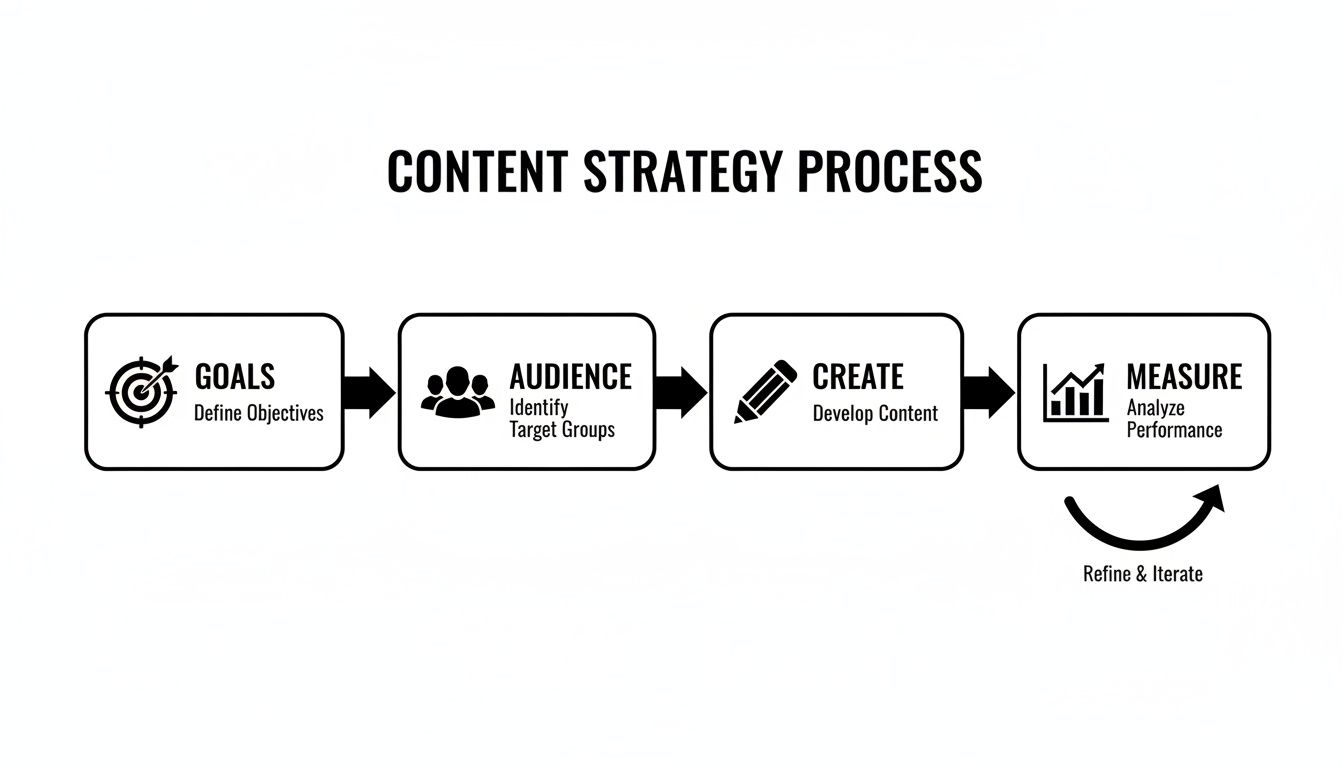
When you see it laid out like this, you can tell how each step builds on the last, creating a cycle of continuous improvement—not just a one-and-done campaign.
A well-defined strategy gives you that roadmap, making sure every ounce of effort is focused and effective. To really nail down these core concepts and build a strong framework, this guide is a great place to start: What Is Content Marketing Strategy: A Practical Guide.
The goal of a content strategy isn't just to make content. It's to build a valuable asset that appreciates over time, consistently attracting the right people and driving growth without needing a perpetual ad spend.
The Benefits of a Documented Plan
Once you have a clear, written plan, your marketing transforms from a cost center into a predictable engine for revenue. The biggest upsides are pretty clear:
- Improved ROI: You finally know where to put your resources, focusing on content that has the highest odds of bringing in leads and sales.
- Greater Consistency: A strategy and a calendar mean a steady stream of valuable content. This builds trust with both your audience and the search engines.
- Enhanced Brand Authority: By consistently solving your audience’s problems, you naturally become the go-to expert in your space.
- Sustainable Traffic Growth: Unlike paid ads that stop when you stop paying, strategic content is a long-term asset that can pull in organic traffic for years to come.
Ultimately, a strong strategy ensures every dollar and every hour you pour into content is pushing your business forward. For anyone looking to get this process structured, diving into effective content planning strategies is a fantastic next move.
Setting Goals and Defining Your Audience
A powerful content strategy always starts with two things: knowing what you want to achieve and knowing who you’re talking to. Without that clarity, you're just shouting into the void. The best content feels like a direct conversation, aimed at a specific person, designed to hit a measurable business goal.
The very first thing to do is get past vague desires like "more traffic." Real, meaningful goals are specific, measurable, and tied directly to the health of your business. We're talking revenue, leads, and customer acquisition.
From Vague Hopes to Concrete Goals
A strong goal gives every piece of content you create a clear purpose. Instead of just chasing higher visitor numbers, challenge yourself to connect your content directly to tangible business results. It’s a simple shift in mindset that makes all the difference.
Here's how to reframe some common, fuzzy goals:
Instead of: "Get more traffic."
Try: "Increase organic traffic to our service pages by 15% in the next quarter."
Instead of: "Improve our brand awareness."
Try: "Generate 25 qualified leads per month from our blog content."
See the difference? The second goal immediately forces you to ask, "Okay, what kind of content would actually make a qualified prospect hand over their email address?" This is how a small business content strategy stops being an expense and starts generating revenue.
The most successful content strategies are built on a simple premise: answer your customers' most pressing questions at every stage of their journey. Your goals tell you which stage to focus on, and your audience knowledge tells you what questions to answer.
Connecting your big-picture business objectives to specific, trackable content metrics is the key. It ensures every article, video, or social post you create has a job to do.
This table should help you map your business goals to the right content KPIs.
Mapping Business Goals to Content KPIs
| Business Goal | Primary Content KPI | Example Content Format |
|---|---|---|
| Increase Brand Awareness | Organic Impressions, Search Rankings for Top-of-Funnel Keywords, Social Media Reach | "What Is..." Blog Posts, Industry Trend Reports, Infographics |
| Generate New Leads | Form Submissions, Email Subscribers, Gated Content Downloads | How-to Guides, Ebooks, Webinars, Case Studies |
| Nurture Existing Leads | Email Click-Through Rate, Content Engagement on Specific Segments | Customer Success Stories, Product Demo Videos, Advanced "How-to" Articles |
| Drive Sales & Revenue | Conversion Rate from Content, Attributed Revenue | Comparison Guides, Pricing Pages, "Best X for Y" Articles |
Once you’ve got this connection clear, every piece of content becomes a strategic asset working towards a specific, important outcome for your business.
Building Buyer Personas That Actually Work
With your goals set, you need to get inside the head of the person on the other side of the screen. A buyer persona is a semi-fictional sketch of your ideal customer, but it's way more than just demographics. It’s about uncovering their real-world problems, what drives them, and the exact words they use when looking for solutions.
Great personas are built from data, not guesswork. Dig into customer feedback emails, sales call notes, online reviews, and survey responses. What are their biggest headaches? What frustrates them about your industry? What are they really trying to accomplish? These insights are content gold.
Let's imagine you run a local bakery. Through casual conversations with customers, you discover a ton of people are asking about celebration cakes for folks with dietary restrictions. You don't just jot down "customers want gluten-free options." You dig deeper and build a persona named "Event Planner Emily."
- Emily's Pain Point: She struggles to find a reliable bakery that offers high-quality, delicious gluten-free options for corporate events and weddings. She’s terrified of cross-contamination and disappointing her clients.
- Her Google Search: "best gluten-free event catering near me" or "allergy-friendly wedding cakes [city name]."
- The Content Opportunity: This one insight reveals a massive content gap. The bakery can create blog posts like "5 Things to Ask Your Baker About Gluten-Free Catering" or a detailed guide on "Planning an Allergy-Friendly Corporate Event."
This targeted approach speaks directly to Emily's specific anxieties and positions the bakery as the expert solution. This is how a deep understanding of your audience unlocks content ideas that your competitors completely miss. It’s a critical part of any successful small business content strategy, especially for local businesses where a well-crafted small business SEO strategy can make a huge impact.
This level of strategic planning isn't just for big corporations anymore. Recent research shows that 97% of B2B marketers now have a documented content strategy, a huge jump from previous years. Yet small businesses often skip this step, missing out on the massive efficiency gains that come from having a clear plan. You can discover more insights about content marketing benchmarks on thedigitalelevator.com.
Finding Content Ideas That Win Customers

Great content ideas don't just appear out of thin air during a brainstorming session. They come from data, empathy, and a bit of good old-fashioned detective work. Instead of guessing what might land with your audience, a smart small business content strategy is all about uncovering what your customers are already searching for.
This is how you stop creating content that just gets clicks and start creating content that actually wins customers. The best place to start looking is right in your own backyard.
Start with a Simple Content Audit
Before you even think about creating something new, it’s time to take stock of what you've already got. A "content audit" sounds like a massive, intimidating project, but for a small business, it can be quick and painless.
Just open up your Google Search Console and look at your top 10 and bottom 10 performing pages. That’s it. This simple exercise will give you some incredibly valuable, and more importantly, actionable insights right away.
Here’s what you’re looking for:
- Hidden Gems: These are the articles hanging out on page two or three of Google for some really valuable keywords. A quick update—maybe adding more depth, some fresh stats, or better examples—is often all it takes to bump them onto page one. Easy win.
- Underperforming Topics: Got a few articles that are collecting digital dust with almost zero traffic? That’s a clear signal. Either the topic is a dud for your audience, or your angle was way off. It tells you to either steer clear of that topic or approach it from a completely different direction.
- High-Traffic, Low-Conversion Pages: We’ve all been there. A post gets a ton of traffic but never seems to lead to a single inquiry or sale. This usually means you’re attracting the wrong crowd, or you forgot to include a clear call-to-action to guide them.
This isn’t about judging your past efforts. It’s about finding the fastest, most efficient path to getting results by improving what’s already there.
Master Keyword Research for Small Business
Once you have a handle on what's working, you can start hunting for new opportunities. Keyword research for a small business is not about chasing the big, flashy, hyper-competitive terms. It’s about finding the quieter, less-traveled paths where you can actually compete and come out on top.
Your secret weapons here are long-tail keywords and local search terms. Long-tail keywords are those longer, super-specific phrases people type in when they’re much closer to making a purchase. For a deeper dive, check out our guide on finding the perfect content creation ideas that truly connect with your audience.
Just think about the difference in intent:
- Broad Keyword: "plumbing" (You'll never rank for this.)
- Long-Tail Keyword: "cost of no-dig sewer repair in Austin" (This person has a serious problem and their wallet is out.)
These specific queries might have lower search volumes, but the person searching for them is a red-hot lead. They aren’t just browsing; they need a plumber, and they need one now.
The most valuable keywords for a small business are not the ones with the highest search volume. They are the ones that perfectly match the language of a customer who is ready to buy.
Tools like the free Google Keyword Planner can get you started, though more advanced platforms will dig up more gems. And don't forget to look at the questions your customers are asking. Sites like AnswerThePublic or even the "People Also Ask" box in Google search results are goldmines for this.
Uncover Your Competitors' AI Blind Spots
The search world is changing fast. For a growing number of people, AI models like ChatGPT and Perplexity are their new search engines. A modern small business content strategy absolutely must account for this shift.
The game here is to figure out where your competitors are being cited by these AI tools and—more importantly—where they're not. This reveals a whole new type of content gap you can fill.
You can use specialized platforms to see which sources AI models are referencing for key topics in your industry. For example, if a competitor is always cited for "beginner bookkeeping tips," you have a perfect opening. You can swoop in and create the definitive guide on "advanced bookkeeping for e-commerce businesses."
This strategy lets you become the go-to authority for a more specific, high-value niche that AI might currently be overlooking. Suddenly, you're not just competing in Google anymore; you're positioning your brand as an authority inside the knowledge bases that power AI conversations. By focusing every idea on real data, each piece of content you create will have a clear purpose tied directly to what customers want and what your business needs.
Getting Your Content Created and Out the Door
Alright, you've got a backlog of fantastic, data-backed ideas. Now comes the real test: turning those ideas into actual, published content without drowning in the process.
An efficient creation and distribution system is the engine that powers your entire small business content strategy. It’s the difference between consistently producing high-quality work and burning out. This isn’t about grinding harder; it’s about working smarter.
The secret is to build a repeatable workflow that shepherds an idea from a rough outline to a polished piece that’s seen by your audience everywhere they hang out.
Your Blueprint for a Sustainable Content Workflow
A solid workflow is what saves you from the dreaded blank-page stare-down. Instead of reinventing the wheel every time, you have a clear, repeatable process. This is the stuff that separates businesses that win with content from those who quietly give up after a few months.
Here’s a simple but incredibly effective flow we've seen work time and time again:
- The Outline is Everything: Seriously, start with a skeleton. Map out your H2s and H3s based on your keyword research and the questions you're trying to answer. A good outline is easily 50% of the work done.
- The "Ugly" First Draft: Just get the words down. Don't worry about perfection—focus on getting your core ideas and research onto the page. You're building the clay, not sculpting the masterpiece just yet.
- Edit and Optimize: This is where the magic happens. Polish your language, check for clarity, and weave in your on-page SEO. Are your keywords in the headings? Is the meta description compelling? Are you linking to other relevant posts?
- Add the Visuals: Break up that wall of text! Add images, charts, or even quick videos that help illustrate your points. Use short paragraphs, bullet points, and callouts to make your content a breeze to scan.
- Publish and Push for Indexing: Get it scheduled in your CMS. A modern workflow includes using a tool to automatically update your sitemap and ping search engines to get your new URL crawled and indexed faster.
This kind of structured process keeps the momentum going and prevents that all-too-common feeling of being overwhelmed. For a deeper dive, check out our guide on creating a content calendar that works.
Building a Smart Content Mix
People consume content differently. Some will happily read a 3,000-word guide, while others just want to watch a two-minute video. A smart content mix acknowledges this reality and uses different formats for different jobs.
Blog posts are the backbone of your SEO. They are your long-term, traffic-generating assets. Video, on the other hand, is incredible for building a personal connection and driving engagement fast.
Don’t just take our word for it. Businesses using video grow revenue 49% faster year-over-year than those who don't. While text is foundational, infographics can increase web traffic by 12% and are 30x more likely to be read than a plain article. It’s no surprise that 93% of marketers say video has given them a good ROI. You can find more of these insights in HubSpot's latest marketing statistics.
For a small business, this doesn't mean you need to build a Hollywood-level studio. Start small. Turn your most popular blog post into a simple screencast tutorial or a quick "talking head" video for social media. The idea is to meet your audience where they are, with the format they love.
The Art of Distribution and Repurposing
Hitting "publish" isn't the finish line—it’s the starting gun. The best content strategies squeeze every last drop of value from each piece they create through smart distribution and relentless repurposing.
Think of your big blog post as a "pillar." From that one pillar, you can carve out dozens of smaller "micro-content" assets. This explodes your reach without demanding you create something from scratch every single day.
Here’s how you can atomize a single blog post:
- Email Newsletter: Write a summary of the key takeaways and link back to the full article.
- Social Media Posts: Pull 3-5 killer quotes, stats, or tips to share as text or image posts on LinkedIn, X, or Facebook.
- Short-Form Video: Turn the main points into a quick script for a TikTok, Reel, or YouTube Short.
- Infographic: Visualize the key data points or steps from the article. A tool like Canva makes this surprisingly easy.
- Slide Deck: Convert the main sections into a presentation you can upload to SlideShare or use in a future webinar.
This strategy amplifies your message across channels, helps you reach new audience segments, and cements your expertise. By systemizing both creation and distribution, you turn your small business content strategy into a predictable, efficient growth machine.
Measuring Your Content ROI to Prove It Works
Let's be honest: creating great content is only half the job. If you can’t prove it’s actually working, your small business content strategy is just another line item on an expense sheet. It’s not a proven revenue driver. Measuring your return on investment (ROI) is how you justify the budget, double down on what’s effective, and cut what’s not.
This means we have to look past the shiny, surface-level vanity metrics. Things like page views and social media likes might feel good, but they don't tell you if your content is actually making you money. The numbers that really matter are the ones you can trace directly to your bottom line.
Key Metrics That Actually Matter
To truly prove your content's worth, you need to connect the dots from a curious reader all the way to a paying customer. These are the numbers that make leadership sit up and pay attention.
You can boil it all down to three core areas:
- Lead Generation & Conversion Rates: How many people who read that blog post actually filled out your contact form? How many downloaded the e-book? You absolutely have to track goal completions in Google Analytics 4. It's non-negotiable.
- Lead Quality: Not all leads are created equal. You might find that the leads coming from your in-depth "how-to" guides are far more qualified than those from other channels. The only way to know is by tying your content performance back to your CRM data to see which articles attract your ideal customer profile.
- Customer Acquisition Cost (CAC): How much are you spending to get a new customer through your content versus, say, paid ads? Over the long haul, content almost always has a much lower CAC, and showing this is a surefire way to win more budget.
This data completely changes the conversation. You stop saying, "We got 1,000 visitors," and start saying, "This article generated 15 qualified leads, which resulted in $5,000 in new business." That's a language every business owner speaks fluently. For a much deeper dive into this, check out our complete guide on measuring content marketing ROI.
Setting Up Your Measurement Dashboard
Google Analytics 4 (GA4) is going to be your best friend here. It can look a bit intimidating at first, but you really only need to focus on a handful of key reports to build a simple dashboard that tells you everything you need to know.
This is a pretty standard GA4 dashboard view, focused on user engagement and where traffic is coming from. The real magic happens when you set up custom events—like tracking a "demo request" button click or a "newsletter signup"—which allows you to directly attribute those valuable actions back to the specific pages that drove them.
The key insight you get from a view like this is seeing which articles are not just pulling in visitors, but are actually keeping them engaged and nudging them to take that next step.
A well-configured analytics setup isn't just about tracking numbers; it's about telling a story. It should clearly show how a stranger found you through a blog post, became a lead, and eventually, a customer.
Let's walk through a quick real-world example. Imagine a small B2B service firm publishes an in-depth guide on "How to Choose the Right Project Management Software." They set up a goal in GA4 to track every single time someone clicks the "Request a Demo" button at the end of that article.
After three months, they see that this one article has driven 30 demo requests. They cross-reference this with their sales data and discover that 5 of those leads converted into clients, generating $25,000 in new revenue. Now they have cold, hard data proving the article's direct ROI. It becomes a no-brainer to invest in creating more content just like it.
Tracking Brand Visibility in the Age of AI
Sometimes, your content's impact isn't a straight line to a sale. Brand visibility—how often and how positively your company shows up online—is a massive long-term asset. This is becoming even more critical as people turn to AI chatbots for quick answers.
Monitoring your brand's footprint in these new channels is a key part of any modern small business content strategy. You need to keep an eye on:
- Brand Mentions: Are AI tools and chatbots citing your articles as a source of truth?
- Sentiment: When your brand does get mentioned, is the tone positive, negative, or just neutral?
- Share of Voice: For your most important topics, how often are you being mentioned compared to your top competitors?
Tracking this helps you gauge your brand's authority and spot new opportunities to become the go-to source in your niche. For small businesses, this can be a huge competitive advantage. In fact, companies that make blogging a priority see a 55% increase in website traffic—a clear sign of growing visibility.
Your Content Strategy Questions, Answered
When you're building a content strategy from the ground up, you're bound to have a few questions. I get it. Let's tackle some of the most common ones I hear from small business owners so you can move forward with confidence.
How Often Should a Small Business Post New Content?
The honest answer? Focus on consistency, not just frequency. For most small businesses just starting out, aiming for one high-quality, in-depth article per week is a fantastic and, more importantly, sustainable goal. This is a great signal to search engines that your site is active and helps you start building authority in your niche.
The biggest mistake I see is sacrificing quality for quantity. A single, excellent post that genuinely solves a customer's problem is worth far more than five thin articles that were rushed out the door. Once you get your rhythm down or bring on more help, you can absolutely ramp up the pace. But for now, commit to a schedule you know you can stick with for the long haul.
Consistency is the currency of content marketing. It builds trust with your audience and signals reliability to search engines, creating a compounding effect over time. One great post every week is a powerful engine for growth.
What Is the Best Way to Create Content on a Limited Budget?
When the budget is tight, you have to be smart and efficient. The best bang for your buck comes from creating what we call pillar content. Think of these as comprehensive, ultimate guides on your core topics that can answer a dozen related questions all in one place.
This is where the magic happens. A single pillar post can be sliced, diced, and repurposed into a ton of other content, maximizing every bit of effort you put into it.
For instance, one pillar guide can easily become:
- A ten-part email nurture series
- A script for a short video tutorial
- A dozen or more social media posts pulling out key quotes or stats
- A downloadable checklist or handy template
Lean on free tools to get the job done. Google Keyword Planner is your best friend for research, and Canva is a lifesaver for creating sharp-looking visuals. Most importantly, start by creating content that directly answers customer questions related to buying, as this will have the most immediate impact on your bottom line.
How Long Does It Take to See Results from Content Marketing?
I’ll be upfront: content marketing is a long game, not an overnight fix. While you might get some early buzz from social media shares or your email list, it typically takes a good 6 to 12 months to see significant, needle-moving results in organic traffic and lead generation.
Think about it from Google's perspective. Your SEO-driven content needs time to be crawled, indexed, and then ranked against competitors who may have been around for years. The two biggest factors influencing this timeline are how competitive your industry is and—you guessed it—your consistency.
It really is like planting a tree. It takes time and patience to see it grow, but the results are lasting and will compound year after year.
Should My Strategy Focus on SEO or Social Media?
This is a classic question, but it’s a false choice. It's not about picking one over the other. The real magic happens when you make them work together as part of a single, cohesive small business content strategy.
Think of it this way:
Your SEO content (your blog posts, guides, and landing pages) is your long-term asset. It's the evergreen library of valuable information that works for you 24/7 to bring in organic traffic and leads. It's your foundation.
Your social media is your distribution and community-building engine. It's how you get your content in front of people right now, start conversations, and build a loyal following that trusts you.
The best approach is to use your core SEO articles as the fuel for your social media calendar. SEO builds the library; social media brings people in to read the books. By integrating them, you create a powerful system where your long-term assets and short-term engagement feed each other, accelerating your growth across the board.