When a potential customer opens ChatGPT and types "best project management software for remote teams," does your company appear in the response? What about when someone asks Claude to compare marketing automation platforms, or when they prompt Perplexity for SaaS recommendations in your category? These conversations are happening thousands of times daily, shaping purchase decisions before prospects ever Google your brand name or visit your website.
The uncomfortable truth: you probably have no idea what AI says about your company right now.
Unlike traditional search where you can check rankings and monitor SERP positions, AI visibility exists in a black box. Each conversation is unique, responses change constantly, and there's no universal dashboard showing where you stand. Yet these AI-generated recommendations are increasingly becoming the new front door to your brand, influencing decisions at the exact moment when buyers are most receptive to guidance.
This guide walks you through building a systematic approach to track what AI says about your company. You'll learn which platforms actually matter for your industry, how to structure monitoring that catches meaningful mentions, and how to analyze what you find to improve your AI visibility over time. By the end, you'll have a working system that transforms AI visibility from mystery to measurable advantage.
Let's start with the foundation: identifying which AI platforms deserve your attention.
Step 1: Identify the AI Platforms That Matter for Your Industry
Not all AI platforms carry equal weight for your business. A B2B software company needs different platform priorities than a consumer brand, and your monitoring strategy should reflect where your actual customers go for recommendations.
Start by mapping the six major AI platforms that currently dominate conversational search: ChatGPT (OpenAI), Claude (Anthropic), Perplexity, Google Gemini, Microsoft Copilot, and Meta AI. Each has distinct user bases and response patterns that affect how they represent brands.
ChatGPT: The market leader with the broadest consumer adoption. Particularly strong for general product recommendations, how-to queries, and comparison requests. If your customers are asking AI for buying advice, they're likely starting here. Understanding how to track ChatGPT responses about your brand is essential for any monitoring strategy.
Claude: Gaining traction in professional and technical communities. Many developers, researchers, and business users prefer Claude for detailed analysis and nuanced recommendations. B2B companies often see higher-value prospects using this platform.
Perplexity: Positioned as an AI-powered search engine with cited sources. Users here are often in research mode, comparing options and seeking authoritative information. Strong for brands with robust published content and industry authority.
Google Gemini: Integrated across Google's ecosystem, reaching users through search, workspace tools, and Android devices. Particularly relevant for brands targeting enterprise customers using Google Workspace.
Microsoft Copilot: Embedded in Windows, Edge browser, and Microsoft 365. Captures users in professional contexts, making it valuable for B2B monitoring.
Meta AI: Accessible through Facebook, Instagram, and WhatsApp. Reaches consumers in social contexts, relevant for brands with strong social presence.
Your priority ranking depends on where your target audience actually seeks recommendations. A consumer electronics brand should prioritize ChatGPT and Perplexity, where product research queries concentrate. A B2B SaaS company might focus on Claude and Copilot, where business users evaluate software solutions.
Document your baseline by testing a simple brand query across each platform: "Tell me about [Your Company Name]." Note which platforms recognize your brand at all, which provide accurate information, and which draw blanks. This initial audit reveals your starting point and highlights immediate opportunities.
Create a simple tracking sheet with columns for platform name, current mention status (mentioned/not mentioned), response accuracy, and priority level for your business. This becomes your monitoring roadmap.
Step 2: Build Your Brand Mention Query Library
The queries you test determine what you discover. Generic brand searches only scratch the surface—you need to think like your customers and ask the questions they actually pose to AI assistants throughout their buying journey.
Start with direct brand queries that prospects use when they've heard of you: "What is [Your Company]?", "Is [Your Company] worth it?", "[Your Company] review", "Pros and cons of [Your Company]". These queries reveal how AI describes your offering when someone specifically asks about you.
Next, build category searches where customers don't know you yet but should discover you: "Best [product category] for [use case]", "Top [industry] solutions for [problem]", "[Category] software recommendations". These queries show whether AI includes you in relevant recommendation sets—the digital equivalent of shelf placement. Implementing AI recommendation tracking for your business helps capture these crucial discovery moments.
Add competitor comparison queries that appear during active evaluation: "[Your Company] vs [Competitor]", "Alternatives to [Competitor]", "Compare [Competitor A] and [Competitor B]". Even if you're not named in the prompt, strong AI visibility means appearing in comparison responses.
Structure queries across the buyer journey stages. Awareness stage: "How to solve [problem your product addresses]", "What causes [pain point]". Consideration stage: "Types of [product category]", "How to choose [product category]". Decision stage: "Best [specific use case] tool", "[Product category] for [specific industry]".
Test query variations because AI responses differ based on phrasing. "Best project management software" might generate different recommendations than "Top project management tools" or "Project management software recommendations". Small wording changes can significantly alter which brands appear.
Include long-tail, specific queries that indicate high purchase intent: "Best [product category] for [specific industry] with [specific feature]", "[Product category] that integrates with [other tool]", "Affordable [product category] for [company size]". These detailed queries often have less competition and higher conversion potential.
Aim for 20-30 queries initially, distributed across query types and buyer stages. Your library should include 5-7 direct brand queries, 8-10 category searches, 5-7 competitor comparisons, and 5-8 long-tail specific queries. This mix provides comprehensive visibility into how AI represents your brand across different contexts.
Document each query with metadata: query type, buyer stage, expected business impact (high/medium/low), and primary platform to test. This structure helps prioritize monitoring efforts and connect findings to business outcomes.
Step 3: Set Up Systematic Monitoring Across Platforms
Inconsistent monitoring produces unreliable insights. You need a systematic approach that captures changes over time and maintains comparable data across platforms and query types.
Choose your tracking method based on scale and resources. Manual tracking works for smaller query libraries—create a spreadsheet with columns for date, platform, query, full AI response, mention status, sentiment, and notes. This approach gives you complete control and deep familiarity with responses, though it's time-intensive as your query library grows.
Dedicated AI brand visibility tracking tools automate monitoring across platforms, track changes over time, and alert you to significant shifts in how AI represents your brand. These tools typically test queries on schedule, extract mentions automatically, and calculate visibility metrics without manual effort. The tradeoff is cost versus the time saved and consistency gained.
Establish your testing schedule based on how quickly AI responses change and your business needs. Weekly monitoring catches most significant shifts and provides enough data points to identify trends. Bi-weekly testing works for brands with stable AI visibility who want to track gradual changes. Monthly monitoring is minimum viable—AI models update frequently enough that longer gaps miss important developments.
Create a standardized testing protocol to ensure consistency. Test the same query list across all priority platforms during each monitoring cycle. Use the same account or incognito/private browsing mode to minimize personalization effects. Document the exact timestamp for each test—AI responses can vary even within the same day.
Capture complete responses, not just whether you were mentioned. Copy the full AI output including all recommended brands, explanations, and any sources cited. This comprehensive documentation lets you analyze competitive positioning, understand why AI recommends certain brands, and identify patterns in how AI structures responses.
Track competitor mentions in AI responses for every query, even those focused on your brand. When testing "What is [Your Company]?", note if AI mentions competitors in the same response. When testing category searches, document all brands mentioned and their order of appearance. This competitive intelligence reveals your share of voice in AI recommendations.
Build in quality checks to catch testing errors. Verify that queries are entered consistently without typos. Confirm that platform responses loaded completely before capturing. Flag any unusual responses that might indicate testing issues rather than actual AI behavior changes.
Set up a backup system for your tracking data. If using spreadsheets, maintain cloud-synced copies. If using tracking tools, export data regularly. AI visibility insights become more valuable over time as you accumulate historical data showing trends and the impact of your optimization efforts.
Step 4: Analyze Sentiment and Accuracy of AI Mentions
Getting mentioned by AI is just the starting point. How AI describes your brand matters as much as whether it mentions you at all. A negative or inaccurate mention can actively harm your reputation with prospects who trust AI recommendations.
Categorize each mention by sentiment: positive, neutral, negative, or mixed. Positive mentions highlight your strengths, recommend you for specific use cases, or position you favorably against competitors. Neutral mentions acknowledge your existence without strong endorsement or criticism. Negative mentions point out limitations, recommend competitors instead, or describe you unfavorably. Mixed mentions present both strengths and weaknesses. Implementing sentiment tracking in AI responses helps systematize this analysis.
Flag factual errors immediately because inaccurate AI information directly misleads potential customers. Common inaccuracies include outdated pricing, discontinued features still described as current, wrong company size or founding date, and incorrect descriptions of your product capabilities. Document each error with the correct information and the source where AI likely found the wrong data.
Analyze competitive positioning when AI recommends alternatives. What reasons does AI give for suggesting competitors? Are they positioned as better for specific use cases, more affordable, easier to use, or more feature-rich? Understanding the logic behind competitive recommendations reveals what information AI has about each brand and how it weighs different factors.
Calculate your AI Visibility Score to quantify your presence across platforms. The basic formula: (queries where you're mentioned / total relevant queries tested) × 100. A score of 60% means you appear in 60% of queries where you should logically be recommended. Track this metric over time to measure whether your optimization efforts improve visibility.
Break down visibility scores by query type to identify specific gaps. You might have 80% visibility in direct brand queries but only 30% in category searches, revealing that AI knows about you when prompted but doesn't proactively recommend you. Or you might appear strongly in awareness-stage queries but rarely in decision-stage comparisons, suggesting content gaps at the bottom of the funnel.
Create a mention quality score beyond just visibility percentage. Weight mentions by sentiment and accuracy: positive accurate mentions score 3 points, neutral accurate mentions score 2 points, positive inaccurate mentions score 1 point, negative accurate mentions score 0 points, and negative inaccurate mentions score -1 point. This weighted score reflects that not all visibility is equally valuable.
Look for patterns in when and why AI mentions you. Does visibility increase for certain use cases or industries? Do specific features get highlighted consistently? Are there common objections or limitations AI raises? These patterns reveal how AI has learned to categorize and describe your brand.
Step 5: Identify Content Gaps Causing Poor AI Visibility
Low AI visibility usually traces back to missing or insufficient content. AI models recommend brands they have substantial, authoritative information about. When you're absent from relevant queries, it's often because AI lacks the content needed to confidently include you.
Map each query where you should appear but don't to potential content gaps. If AI doesn't mention you in "Best [category] for [industry]" searches, you likely lack published content specifically addressing that industry use case. If you're missing from "[Category] with [feature]" queries, you may not have content highlighting that capability.
Analyze what information AI cites when recommending competitors. When Perplexity suggests a competitor and includes source links, follow those links. What type of content does the competitor have that positions them for that query? Often it's comparison pages, use case studies, feature documentation, or industry-specific landing pages. Understanding how to track Perplexity AI citations reveals exactly which content sources drive recommendations.
Examine the depth and specificity of competitor mentions versus yours. If AI provides detailed feature lists for competitors but only generic descriptions for you, your product documentation may lack the specificity AI needs. If competitors get mentioned with specific use cases while you receive only general acknowledgment, you need more targeted content.
Prioritize content gaps based on query volume and business impact. A gap in high-intent decision-stage queries deserves immediate attention because those queries directly influence purchase decisions. Missing visibility in broad awareness queries matters less if you're already capturing consideration and decision-stage searches.
Connect content gaps to your existing content strategy. Many companies have the information AI needs but haven't published it in accessible formats. Internal documentation, sales collateral, and customer success materials often contain valuable content that should be published publicly where AI models can access it. A strong SEO content strategy ensures this information reaches both search engines and AI training data.
Look for quick wins where minimal content creation could significantly improve visibility. Sometimes a single comprehensive comparison page addresses multiple competitor queries. One detailed use case study might improve visibility across several industry-specific searches. Prioritize content that closes multiple gaps simultaneously.
Document each content opportunity with the specific query it addresses, the current visibility gap, the type of content needed, and the expected impact on AI visibility. This creates a roadmap connecting content creation directly to measurable improvements in how AI represents your brand.
Step 6: Create a Tracking Dashboard and Reporting Cadence
Raw monitoring data only becomes useful when transformed into actionable insights. A simple dashboard that visualizes trends and highlights changes turns AI visibility tracking from data collection into strategic advantage.
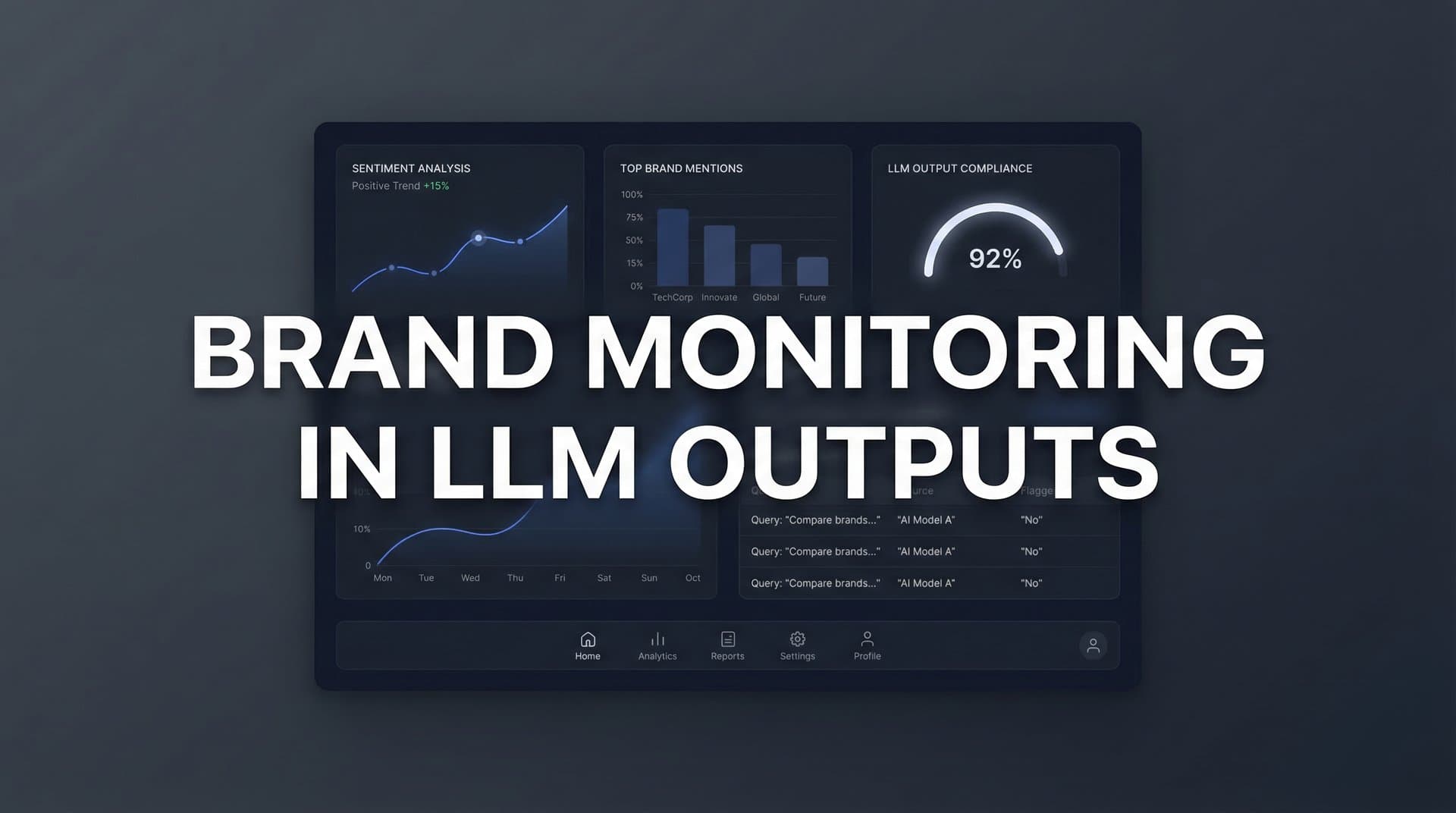
Build a dashboard tracking your core AI visibility metrics over time. At minimum, include overall visibility score across all platforms, visibility score by platform, visibility by query type (brand/category/competitor), sentiment distribution (positive/neutral/negative), and accuracy rate for mentions. Line charts showing these metrics over weeks or months reveal whether you're improving or declining.
Add competitive benchmarking to your dashboard by tracking competitor mention rates in the same queries you monitor. A simple table showing your visibility percentage versus top competitors in category searches immediately shows your competitive position. Track whether the gap is narrowing or widening over time.
Create a changes log that flags significant shifts between monitoring cycles. Highlight new queries where you now appear, queries where you disappeared, sentiment changes from positive to negative or vice versa, and new competitor mentions in your brand queries. This log catches important developments that might get lost in aggregate metrics.
Set up automated alerts for critical changes if your tracking system supports them. Get notified immediately when visibility drops below a threshold, when negative mentions appear, when factual errors are detected, or when you suddenly appear in high-value queries you previously missed. Robust AI mention tracking software can automate these alerts and save hours of manual monitoring.
Establish a regular reporting cadence that matches your testing schedule. Weekly monitoring deserves weekly internal reviews where you analyze changes and identify response needs. Bi-weekly or monthly monitoring can follow the same reporting frequency. The key is consistent review that turns data into decisions.
Create stakeholder reports that connect AI visibility metrics to business outcomes. Instead of just reporting that visibility increased 15%, explain what that means: "We now appear in 15% more category searches, potentially reaching X additional prospects per month based on estimated query volume." Translate metrics into language that resonates with executives and other teams.
Include actionable recommendations in every report. Identify the top three content gaps to address, highlight queries where quick optimization could improve visibility, or flag competitor strategies worth analyzing. Reports that end with clear next steps drive continuous improvement.
Document your monitoring methodology and definitions so reports remain consistent as team members change or responsibilities shift. Define how you calculate visibility scores, what qualifies as a mention, how you categorize sentiment, and what constitutes a significant change worth escalating.
Turning AI Visibility Tracking Into Competitive Advantage
Tracking what AI says about your company isn't a one-time audit—it's an ongoing strategic process that compounds in value over time. The brands investing in systematic AI visibility monitoring now are building an advantage that will only grow as more customers rely on AI for recommendations.
Start with the foundation today: identify which AI platforms your customers actually use for research and recommendations. Build a query library that reflects real questions prospects ask throughout their buying journey. Set up consistent monitoring that captures how AI represents your brand across platforms and over time.
The insights you gain from systematic tracking directly inform content strategy, competitive positioning, and brand messaging. You'll spot content gaps before competitors do, catch and correct misinformation before it spreads, and optimize your presence in the AI-assisted conversations that increasingly shape purchase decisions.
Your implementation checklist: Identify your three priority AI platforms based on where your target audience seeks recommendations. Build a library of 20-30 queries spanning direct brand searches, category queries, and competitor comparisons. Establish a weekly or bi-weekly monitoring schedule and stick to it consistently. Analyze sentiment and accuracy of every mention, not just presence or absence. Map visibility gaps to specific content opportunities and prioritize by business impact. Create a simple dashboard tracking visibility score, sentiment, and competitive positioning over time.
The manual approach works for getting started, but as your query library grows and you need to monitor multiple platforms consistently, automation becomes essential. Start tracking your AI visibility today and see exactly where your brand appears across top AI platforms, which queries you're missing, and what content gaps are costing you opportunities. The conversation about your brand is already happening in AI assistants—the only question is whether you're part of it.