A solid small business SEO strategy isn't just about chasing keywords. It starts with setting clear goals, giving your website a thorough technical health check, and fixing the foundational stuff before you even think about writing new content.
This approach makes sure all the hard work you put into keyword research, content creation, and link building actually pays off, instead of being wasted on a site search engines can't even figure out.
Building Your SEO Foundation for Sustainable Growth
Jumping into SEO without a real plan is a classic mistake I see small businesses make all the time. It’s a surefire way to waste precious time and money. Before you get obsessed with ranking for any specific term, you need to step back and define what "success" actually means for your business.
This isn't about vanity metrics like just getting more traffic. It's about tying your SEO efforts to actual business results.
Are you trying to get more people to walk through the door of your physical shop? Is the main goal to boost online sales for your e-commerce store? Or do you need to fill your pipeline with qualified leads for a service business? The answer will dictate everything you do next.
Defining Your Key Performance Indicators
Your goals are what shape your Key Performance Indicators (KPIs)—the specific numbers you'll look at to see if you're actually making progress. Without them, you're just flying blind.
Here are a few real-world examples of what this looks like:
- For a local bakery: Success could be a 30% increase in organic traffic to the "catering menu" page and more clicks on the "get directions" button in your Google Business Profile.
- For an online clothing boutique: You'd be looking at KPIs like ranking on page one for valuable keywords like "handmade linen dress" and hitting a 5% conversion rate from organic visitors.
- For a B2B consultant: You'd probably track the number of demo requests or contact form submissions coming from organic search.
When you set measurable goals right from the beginning, you build a framework for your SEO strategy that keeps you honest and proves a clear return on your investment.
Running a Technical Health Check
Once you know what you're aiming for, it's time to make sure your website is built on solid ground. Technical problems can completely torpedo your content and link-building efforts, making it impossible for search engines like Google to find, crawl, and rank your pages.
The good news? You don't have to be a web developer to catch the most common culprits.
You can start with a basic audit using free tools. Google Search Console is non-negotiable here; it's like getting feedback directly from Google on your site's health.
Look for these big-time blockers:
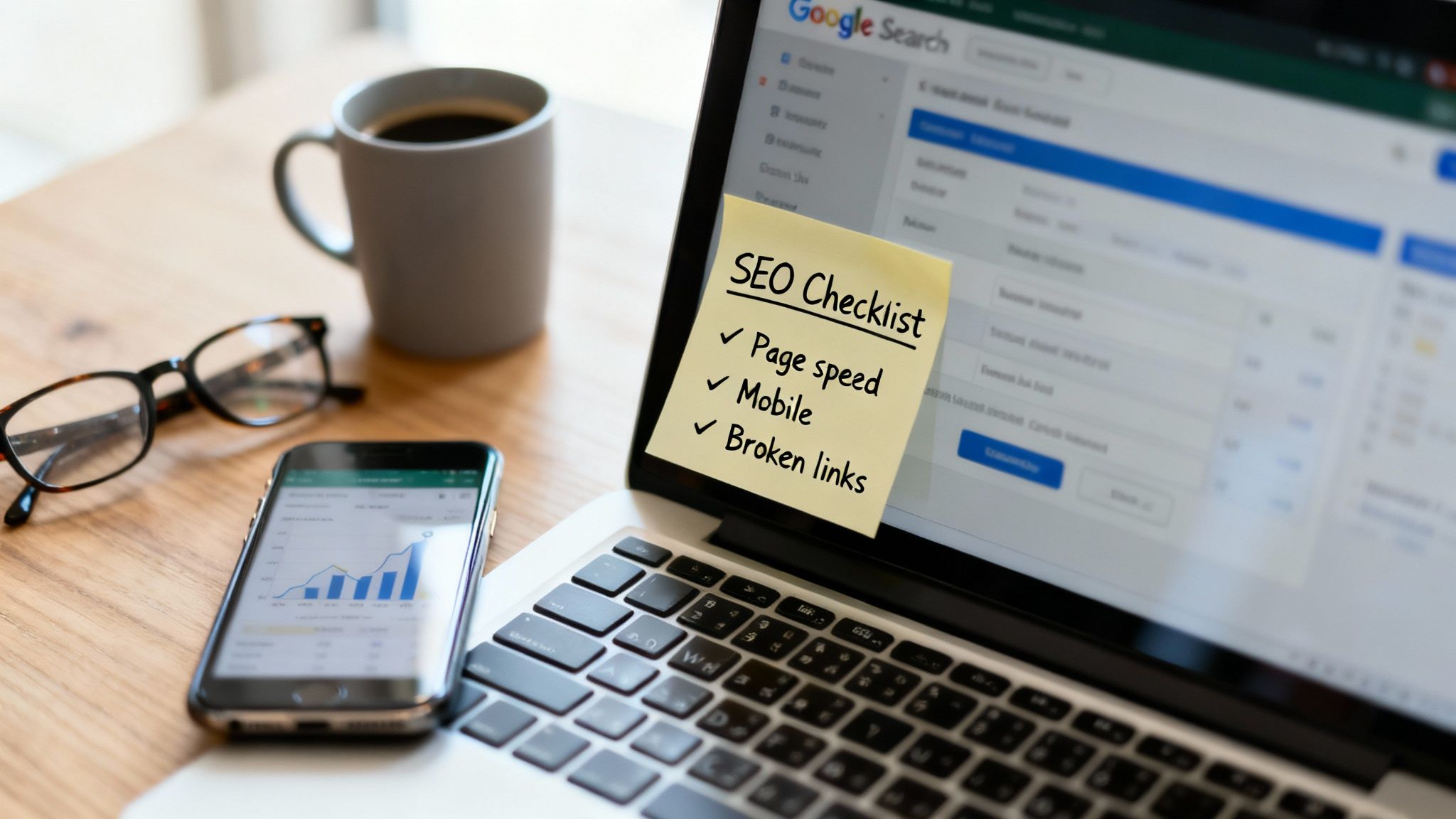
- Slow Page Speed: If your site takes more than a couple of seconds to load, people will bounce. Use Google's PageSpeed Insights to see where you stand.
- Mobile Usability Errors: More than half of all web traffic is on mobile. Your site has to be dead simple to use on a phone.
- Broken Links (404 Errors): These are frustrating for users and tell search engines your site isn't well-maintained.
- Indexing Issues: You need to make sure your most important pages aren't accidentally being hidden from search engines.
To get started on the right foot, a simple small business SEO checklist can be a lifesaver. It helps you tackle these foundational pieces one by one without getting overwhelmed. The goal isn't to become a technical wizard overnight—it's just to clear the major roadblocks that could kill your strategy before it even gets going.
Winning the Neighborhood with Local SEO
For most small businesses, the best customers aren't scattered across the globe—they're right around the corner. If there's one part of your marketing you need to nail, it's local search. Mastering it is how you turn clicks into real foot traffic and sales. After all, the modern customer journey almost always starts with a quick search on their phone.
The numbers don't lie. An estimated 96% of people discover local businesses through online searches, and 46% regularly use "near me" in their queries. Even more critically, 78% of mobile local searches result in a purchase, often within just a few hours. This means your ranking in the local map pack and search results has a direct, immediate impact on your bottom line.
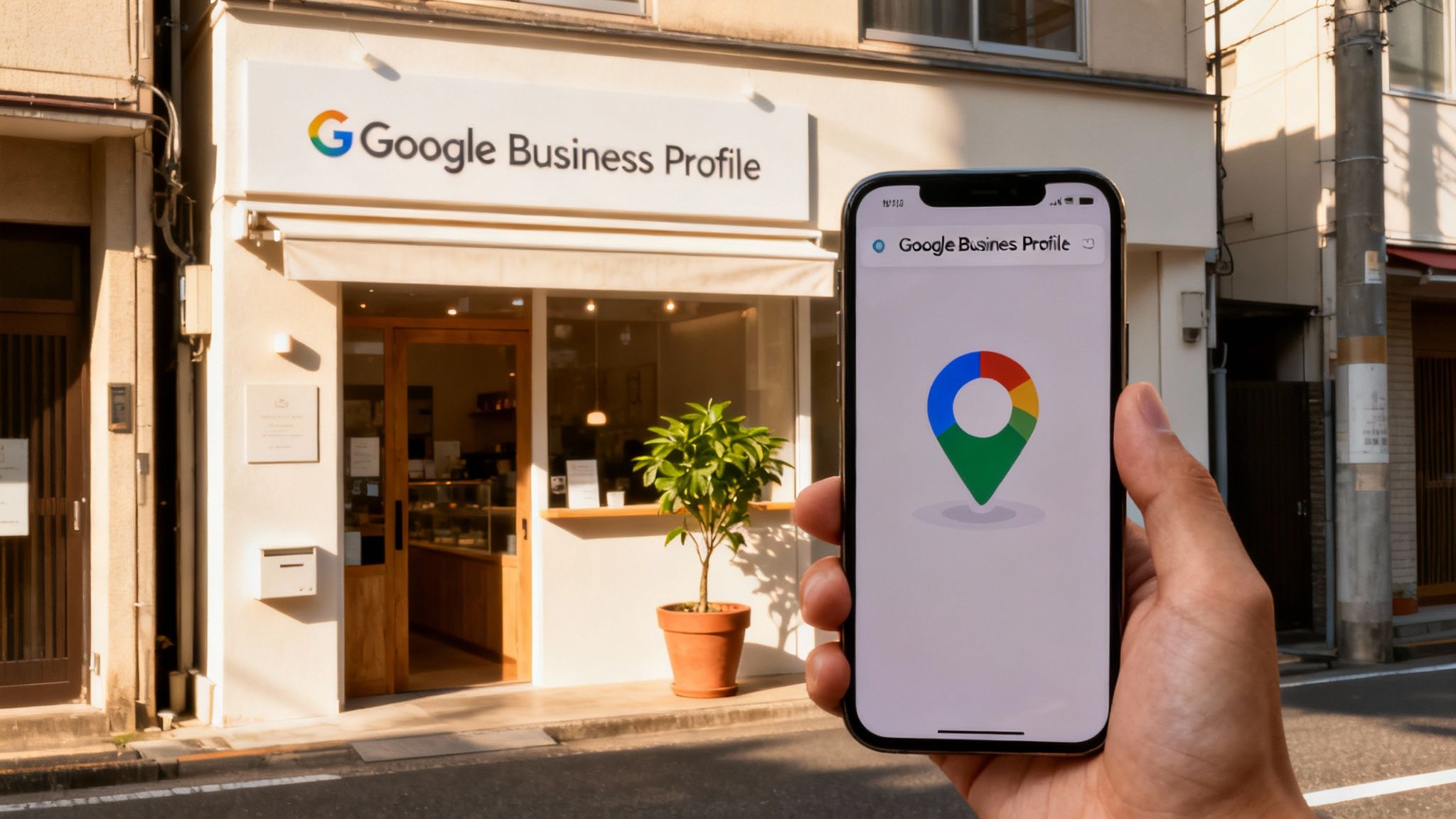
This is where your Google Business Profile (GBP) comes in. It's not just a map pin; it's your most valuable digital asset.
Give Your Google Business Profile the Attention It Deserves
Just claiming your profile is the bare minimum. The real results come when you treat your GBP like a primary channel for talking to customers. Every single detail you fill out is a signal to Google about who you are, what you do, and why you're the best choice in the area.
Start with the basics: make sure every field is 100% complete and accurate. It sounds obvious, but it's a step people rush through all the time. Pay close attention to your business categories. Don't just pick your main one. A "Coffee Shop," for example, should also add secondary categories like "Bakery," "Cafe," and "Sandwich Shop" to show up in a wider range of relevant searches.
Once you’ve covered the fundamentals, it's time to leverage the features that really move the needle:
- Google Posts: Think of these as free mini-ads. Share updates, promotions, and new product announcements. They expire, so posting consistently shows Google (and customers) that your business is active and engaged.
- Q&A Section: Don't wait for customers to ask questions. Seed this section yourself with the FAQs you get all the time. Answering them proactively lets you control the narrative and give people helpful info fast.
- Services and Products: Get granular here. List every single service or product you offer. This is how you rank for super-specific, high-intent searches like "vegan birthday cake bakery."
Think of your Google Business Profile as a mini-website that sits directly on the search results page. The more complete, active, and engaging you make it, the more Google will reward you with that prime real estate in the coveted "Map Pack."
Create a Rock-Solid Foundation with Consistent NAP
One of the foundational pillars of local SEO is simple consistency. Your Name, Address, and Phone number (NAP) needs to be identical everywhere your business is mentioned online, from Yelp to Apple Maps to your industry-specific directories.
Even tiny inconsistencies—like listing "St." on one site and "Street" on another—can confuse search engines and water down your local authority. Do a quick audit of the major online directories to make sure your information is a perfect match across the board. This bit of digital housekeeping sends a strong signal to Google that you're a legitimate, established local business.
Local SEO is a Marathon, Not a Sprint
Jumping into local SEO can feel like a lot, but you don't have to do everything at once. The key is to focus on the activities that deliver the biggest bang for your buck.
High-Impact Local SEO Priorities
Focus your efforts on these key local SEO activities that deliver the best return on investment for small businesses.
| Activity | Why It Matters | Quick Tip |
|---|---|---|
| Google Business Profile | It's your digital storefront. An optimized profile is the #1 factor for ranking in the local map pack. | Use the "Posts" feature weekly to share updates or offers. This shows Google you're an active business. |
| Customer Reviews | Reviews build trust and are a major ranking signal. A steady stream of positive reviews is crucial. | Create a simple QR code that links directly to your GBP review page and place it at your checkout counter. |
| NAP Consistency | Consistent Name, Address, and Phone number across all directories builds trust with search engines. | Do a search for your business name and check the top 10 results. Correct any inconsistencies you find. |
| Local Content | Content targeting your service area establishes you as the local authority for what you do. | Instead of "Our Services," create a page for "Plumbing Repair in East Nashville." Be specific. |
By prioritizing these tasks, you're building a strong foundation that will pay dividends in local search visibility over time.
Let Your Customers Do the Talking
Social proof is incredibly persuasive. A steady stream of recent, positive reviews not only helps potential customers choose you but also acts as a powerful local ranking signal for Google.
Don't be afraid to ask for reviews, but make it easy and natural. You can generate a direct link to your GBP review page and add it to your email signature, print it on receipts, or use that QR code trick I mentioned. A simple, polite request to a happy customer usually gets great results.
Weave Your Location into Your Website Content
Finally, your own website has to scream "local." This means creating pages and blog posts that speak directly to the community you serve. Our guide on localised keyword research is a great place to start if you need help finding the right terms.
Instead of a generic "Services" page, create dedicated pages for each service combined with your location (e.g., "Air Conditioning Repair in Scottsdale, AZ"). Write blog posts that answer questions a local would ask, like an outdoor gear shop writing about the "Best Hiking Trails Near Denver." This kind of hyperlocal content proves you're a local authority, turning your website into a true competitive advantage.
Finding Keywords Your Customers Actually Use
A solid small business SEO strategy lives or dies by its keyword research. Before you even think about writing a single word, you have to get inside your customers' heads. What are the exact phrases they’re typing into Google when they have a problem you can solve? This isn't a guessing game; it's about using data to understand what they really want.
So many businesses fall into the trap of chasing huge, overly competitive keywords. A local hardware store, for instance, has virtually no shot at ranking for a term like "hammers." It's just too broad.
But what about "best hammer for framing a deck" or "tool rental near downtown Austin"? Now we're talking. That's where a small business can win, and it's the heart of smart keyword research.
Distinguishing Between Intent and Volume
The real secret is focusing on search intent—the why behind a search. Not all keywords are created equal. Some people are just looking for information, while others have their credit cards out, ready to buy.
You've got to find the right balance between two main types of keywords:
- Informational Keywords: These are the phrases people use when they're in learning mode. Think "how to fix a leaky faucet" or "what kind of paint to use on kitchen cabinets." Creating genuinely helpful content around these topics builds incredible trust and positions you as the go-to expert.
- Commercial or Transactional Keywords: These are pure, high-intent queries. Phrases like "emergency plumber near me," "buy organic dog food online," or "schedule a roof inspection" signal that the searcher is ready to act. These are your "money" keywords.
Your goal is to map keywords to different stages of the customer journey. You draw them in with helpful informational content and then seal the deal with pages optimized for those transactional terms. It's a powerful one-two punch that creates a natural sales funnel.
Uncovering Your First Batch of Keywords
The good news? You don't need a bunch of expensive, complicated tools to get started. In fact, some of the best keyword ideas are probably right under your nose.
Start by just thinking like a customer. What questions do they ask you on the phone? What problems are they always trying to solve? Jot down every single phrase you can come up with. No idea is too small at this stage.
Next, tap into some free resources to flesh out your list:
- Google Autocomplete: Just start typing your main services into the Google search bar and watch what it suggests. Those aren't random; they're based on what real people are searching for right now.
- "People Also Ask" Section: This little box in the search results is a goldmine for related questions and long-tail keyword ideas.
- Competitor Analysis: Take a peek at the websites of your top local competitors. What are they writing about? Check out their page titles and headings for keyword clues.
Once you've got a decent list, you can use a free tool like Google's Keyword Planner to get actual data on search volume and competition. This helps you figure out which terms are actually worth your time. For a much deeper dive on this, our guide to building a powerful keyword strategy for SEO will give you a complete roadmap.
Organizing Keywords into Topic Clusters
A random list of keywords isn't a strategy; it's just a list. To make your research truly actionable, you need to group related keywords into topic clusters. Think of it like this: a topic cluster is a collection of related content pages all pointing back to one central, authoritative page—often called a "pillar page."
For example, a landscaping company might create a big pillar page on "Backyard Design." This central hub would then link out to more specific blog posts, or "cluster pages," targeting keywords like:
- "low maintenance garden ideas"
- "how to build a paver patio"
- "best plants for shady areas"
- "outdoor lighting for patios"
This structure does something amazing: it signals to search engines that you have serious expertise on the entire subject of backyard design. It helps your site rank for a much wider range of related terms and, just as importantly, creates a more organized and helpful experience for anyone who visits your site. This keyword map becomes the blueprint for your entire content plan, ensuring every single page you create has a clear purpose.
Creating Content That Ranks and Converts

Alright, you've got your keyword map. Now it's time to build the engine of your small business SEO strategy: the content itself. This is where a lot of business owners get stuck, thinking they need a huge marketing department to get anywhere. The truth? A smart, focused plan beats a big budget every single time.
Your content strategy needs to balance two different but equally important types of content. The first is your foundational "pillar pages"—these are the in-depth guides about your core services that you want ranking for your most valuable, transactional keywords. Then, you have your supporting blog posts, which are all about solving problems, answering customer questions, and building trust.
A simple content calendar is your best friend here. Start by mapping out your main pillar pages. Then, schedule blog posts that branch off from and support those core topics. This approach gives every article a clear purpose, ensuring it contributes to your overall authority on the subject.
Streamlining Content Creation with AI
Let's be real: consistency is everything in SEO, but finding the time to actually write is a massive hurdle for small businesses. This is where AI tools can be an absolute game-changer. Think of them as a powerful assistant, ready to speed up your workflow without killing the quality.
Instead of staring at that dreaded blank page, you can lean on AI to:
- Brainstorm Topics: Quickly generate a list of relevant questions and subtopics your customers are actually searching for related to your main keyword.
- Generate Outlines: Instantly create a logical structure for your article, complete with H2 and H3 headings, making sure you cover the topic from all angles.
- Draft SEO-Ready Articles: Get a solid first draft that already incorporates your target keywords and follows on-page SEO best practices.
The key is to treat AI as a collaborator, not a replacement. Use it to do the heavy lifting—the research and initial drafting. Then, you step in with your human expertise to refine the content, inject your unique voice, add personal stories, and make sure it genuinely connects with your audience. This partnership is how you publish great content, consistently.
Mastering On-Page SEO Essentials
Creating amazing content is half the battle. The other half is optimizing it so search engines can actually understand what it's about. This is called on-page SEO, and it boils down to a few simple but crucial elements.
Title Tags are the clickable headlines people see in the search results. They need to be compelling enough to earn a click and should include your primary keyword, ideally near the front. You only get one shot to grab a searcher's attention.
Headings (H1, H2, H3) are your content's skeleton. They organize your article for both human readers and search engine bots. Your main title is always the H1, with H2s for major sections and H3s for the sub-points within them. Sprinkling your keywords naturally into these headings helps signal what each part of the page is about.
Image Optimization is a detail that's too often overlooked. Before you upload a picture, give the file a descriptive name (like "chocolate-chip-cookies-local-bakery.jpg"). Then, write a short, keyword-rich alt tag describing the image. This is huge for accessibility and can help you rank in image search.
On-page SEO isn't some complex, technical mystery. It's about giving search engines clear signals and creating a well-organized, easy-to-read experience for your visitors. Nailing these small details can make a massive difference in your rankings.
The Power of Internal Linking
Finally, let's talk about one of the most powerful—and most underused—on-page tactics: internal linking. This is just the simple act of linking from one page on your website to another relevant page on your own site.
Think of internal links as a road map. They guide both users and search engine crawlers through your website. When you link from a new blog post back to one of your core service pages, you're essentially telling Google, "Hey, this service page is a big deal for this topic." This simple move passes authority between your pages and helps people discover more of your great content.
A solid internal linking structure keeps visitors on your site longer, which lowers your bounce rate and signals to Google that your site is valuable. As you publish more content, make it a habit to link new articles to older, relevant ones. Doing this consistently isn't just good for SEO; it's a fundamental part of improving website conversion rates by creating a natural path for users to follow toward your most important pages.
Building Authority with Smart Link Building
Backlinks—those links pointing to your website from other sites—are essentially votes of confidence in the eyes of Google. Think of them as digital referrals. When a respected local news outlet or a well-known industry blog links to you, it sends a powerful signal that your business is a credible, authoritative resource. This is a massive piece of any successful small business SEO strategy, but let's be honest, the whole process can feel pretty overwhelming.
First, forget everything you might have heard about old-school, spammy tactics. Buying links or dropping your URL in random comment sections is a fast track to getting penalized by Google. Today, smart link building is all about earning quality links through real-world relationships and by creating things so valuable that other people genuinely want to share them. It’s less about gaming the system and more about becoming a recognized authority in your community.
Become a Local Resource
One of the absolute best ways for a small business to earn high-quality links is by creating something that other local businesses and organizations will find truly useful. This means shifting your mindset from only writing about your own services to thinking about what your entire community needs.
For example, a local accounting firm could put together the definitive guide to local business grants and tax incentives, complete with deadlines and application links. A real estate agent might build an interactive map of the best family-friendly parks and activities in each neighborhood. See the pattern?
When you create something that solves a community problem or offers unique local insight, you build a natural magnet for links. Other businesses, local bloggers, and even the chamber of commerce will be more than happy to link to it. Why? Because it helps their own audience and makes them look good in the process.
The best link-building assets aren't promotional at all. They're genuinely helpful resources that position you as a central, knowledgeable hub in your local ecosystem. This approach builds real authority and earns links at the same time.
Leverage Community Connections
You're probably sitting on a goldmine of link-building opportunities and don't even know it: your existing community connections. This is where your real-world networking pays off big time in the digital world. The trick is to start thinking about every relationship as a potential partnership.
Consider these practical, relationship-driven tactics that actually work:
- Sponsor a Local Event: Getting behind a local charity run, a little league team, or a community festival almost always gets you a link from the event’s website. It’s a fantastic way to support your community while building your backlink profile.
- Join Business Associations: Your local Chamber of Commerce or other industry-specific groups usually have member directories. Getting listed provides a credible, highly relevant link back to your site.
- Get Featured in Local News: Local journalists and bloggers are always hunting for stories. Offer your expertise for a quote on a topic you know inside and out, host a community workshop, or share a unique business milestone. A feature in the local paper comes with a very powerful link.
Each of these actions builds your brand’s presence in the real world while simultaneously beefing up its digital authority. The links you earn this way are incredibly valuable because they come from relevant, trusted sources in your geographic area. It’s a strategy that proves you are an active, vital part of the community you serve.
And remember, while you're building up your site's authority with these external links, it's just as crucial to perform a regular internal link audit to make sure you're spreading that authority effectively across your own pages.
Measuring What Matters and Planning Your Next Move
You can't just throw an SEO strategy at the wall and hope it sticks. You have to be driven by data, not guesswork. Without tracking your progress, you're flying blind, and you’ll have no way to know if your investment of time and money is actually paying off.
The good news is you don’t need a complicated or expensive setup to see what’s working. Setting up a simple reporting dashboard is easier than you might think, and you can do it for free with Google's own tools: Google Analytics 4 (GA4) and Google Search Console (GSC). These platforms give you a direct line of sight into how people find and use your website.
Focusing on Metrics That Drive Growth
It’s incredibly easy to get lost in a sea of data. The trick is to ignore the "vanity metrics"—like random traffic spikes—and zero in on the numbers that signal real business growth. The only thing that truly matters is whether your SEO efforts are adding to your bottom line.
Here are the core KPIs you should actually be watching:
- Organic Traffic: This tells you how many people are finding your site through search engines, not paid ads. A steady upward trend here is a fantastic sign.
- Keyword Ranking Improvements: Are you climbing the ranks for your target "money" keywords? Tracking this shows whether your content is hitting the mark with Google and your customers.
- Goal Completions (Conversions): This is the big one. Are people filling out your contact form, buying something, or calling your business? In GA4, you can set these actions up as specific conversion events to track them precisely.
Don’t just track traffic; track what the traffic does. A thousand visitors who leave immediately are less valuable than ten visitors who become qualified leads. The goal is to connect your SEO work directly to tangible business outcomes.
You need a clear picture of how to measure SEO success to make smart decisions. Getting this right gives you the confidence to double down on what works and pivot away from what doesn't.
Setting Realistic Timelines and Expectations
Let’s be clear: SEO is a marathon, not a sprint. Results don't happen overnight, and it's critical to set realistic expectations for your investment. Whether you're doing it yourself or hiring an agency, taking a phased approach helps you stay on track and see progress over time.
This timeline, for instance, shows a pretty common path for building authority through smart link-building.
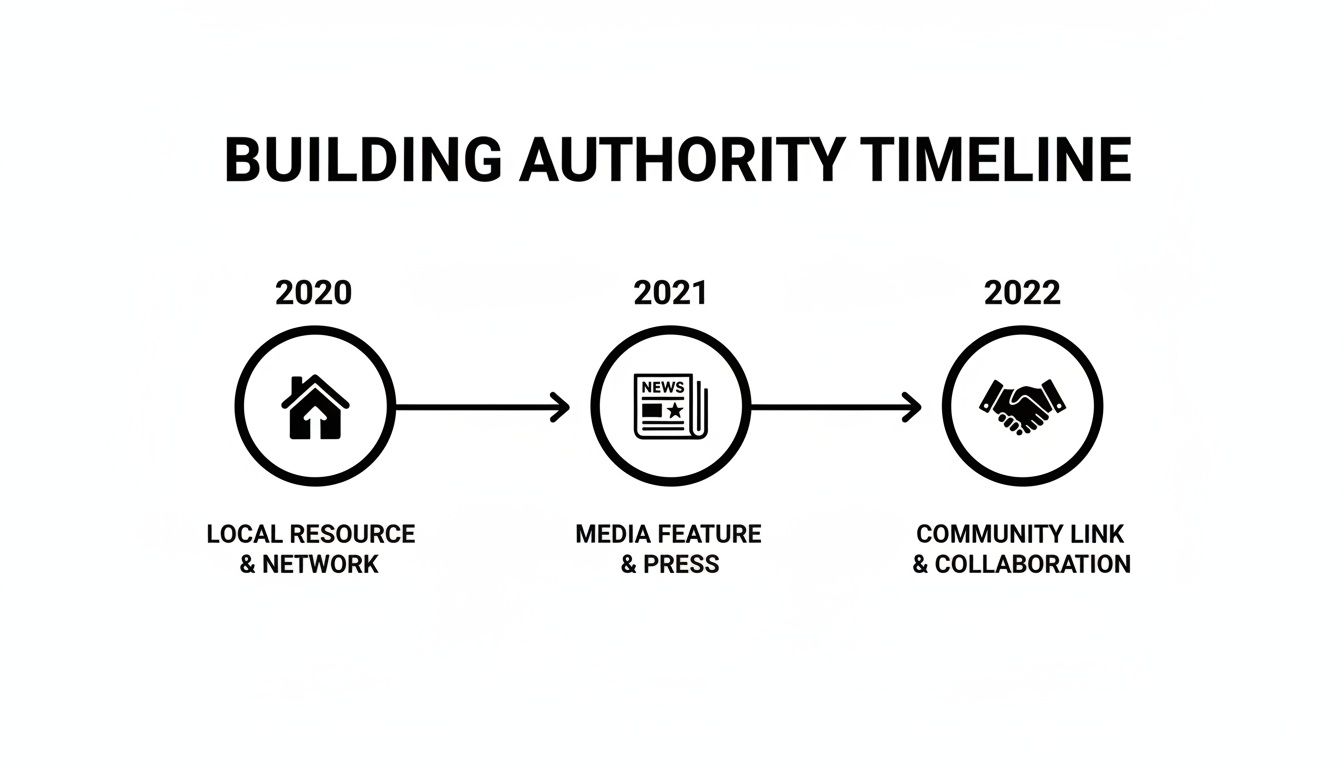
As you can see, building real authority is a cumulative process. It often starts with foundational local SEO and gradually evolves into higher-impact media features and community partnerships.
A Sample 12-Month SEO Roadmap
Having a structured plan helps you visualize the journey and manage expectations—both for yourself and any stakeholders. To keep your strategy on track, it's a good idea to monitor your rankings with reliable analytics; exploring the best AI search tracker tools can give you a serious edge.
Here’s a sample timeline breaking down a typical year of SEO, complete with activities, goals, and potential budget considerations.
Sample 12-Month SEO Timeline and Budget for a Small Business
| Phase (Months) | Key Activities | Primary Goal | Example Monthly Budget (DIY vs. Agency) |
|---|---|---|---|
| 1-3 Foundational | Technical audit, keyword research, GBP optimization, on-page SEO for core pages. | Fix technical issues, establish a local presence, and rank for branded terms. | DIY: $50-$150 (Tools) Agency: $750-$1,500 |
| 4-6 Content & Authority | Create 2-4 blog posts per month, start local link building (e.g., directories, sponsorships). | Increase rankings for long-tail keywords and start building domain authority. | DIY: $100-$300 (Tools/Content) Agency: $1,500-$2,500 |
| 7-12 Expansion & Growth | Target more competitive keywords, create pillar content, pursue higher-quality backlinks. | Achieve page one rankings for commercial keywords and see a clear increase in organic leads. | DIY: $200-$500 (Content/Outreach) Agency: $2,000-$4,000+ |
This roadmap provides a realistic framework, allowing you to plan your resources and measure your progress against clear milestones. By tracking the right metrics and understanding the timeline, you can confidently steer your small business toward sustainable, long-term growth from SEO.