
SEO white labeling is a pretty simple concept: an expert SEO provider does the heavy lifting, and your agency rebrands their services to sell as your own. It's a game-changing way to offer expert SEO solutions without hiring an in-house team. This lets you scale up your services, bring in more revenue, and keep your focus on client relationships while a silent partner handles all the technical work.
What Is SEO White Labeling and Why Agencies Need It

Let's use an analogy. Imagine your digital agency is a high-end restaurant with a stellar reputation. Your main courses are famous, but your clients keep asking for world-class desserts. The problem is, you don't have an expert pastry chef, and you definitely don't have the budget or space to build a new bakery from the ground up.
So, instead of turning those clients away, you find a master baker who creates incredible desserts behind the scenes. You simply serve these amazing creations on your branded plates, under your restaurant's name. Your customers are thrilled, and your menu just got a whole lot better. That's SEO white labeling in a nutshell.
The Core Concept Explained
In this model, your agency teams up with a specialized SEO provider. This partner takes on all the complex, time-consuming tasks that go into a successful search engine optimization campaign.
This isn't a surface-level partnership. A good white label provider becomes an extension of your team, delivering a comprehensive suite of services that you can confidently present to your clients.
To give you a clearer picture, let's break down what's typically involved.
Core Components of a White Label SEO Partnership
| Component | Description | Benefit for Your Agency |
|---|---|---|
| Technical SEO Audits | Deep dives into a client's website to find and fix issues that are hurting their search performance. | You can immediately diagnose and solve complex technical problems for clients without needing an in-house expert. |
| Keyword Research | The process of identifying the valuable search terms that a client's customers are actually using online. | Offer data-backed strategies that target the right audience, proving your value from day one. |
| Content Creation | Developing optimized blog posts, landing pages, and other digital assets designed to rank and engage. | Deliver high-quality, SEO-driven content that builds authority and drives traffic, all under your brand. |
| Link Building | Strategically earning authoritative backlinks to boost a website's credibility in the eyes of search engines. | Provide one of the most powerful ranking factors in SEO, helping clients achieve top search positions. |
| Performance Reporting | Compiling all the performance data into clear, easy-to-understand reports that showcase progress and ROI. | Present professional, branded reports that demonstrate the value you're delivering and secure client retention. |
All of this work is handed over to you completely unbranded. You just add your logo and present it to your client. Your partner remains totally invisible, acting as your silent, expert SEO department.
This strategic arrangement allows you to instantly add a highly profitable and in-demand service to your offerings without the massive overhead of salaries, training, and expensive software subscriptions.
A Necessity for Modern Agency Growth
In the past, white labeling might have been a "nice-to-have." Today, it’s a critical tool for survival and growth. The market has become incredibly competitive, and a staggering 89% of agencies now see it as essential for staying in the game.
Why the shift? Because effective SEO campaigns deliver incredible returns. Many agencies are reporting ROI that exceeds 300% in the first year alone.
If your agency focuses on web design, PPC, or social media, adding SEO is the most natural next step. It makes your client relationships stickier and opens up brand new, recurring revenue streams. By working with a white label partner, you can meet this client demand immediately.
This approach is a cornerstone for anyone figuring out how to start an SEO business with minimal upfront investment and maximum potential. You get to skip the steep learning curve and operational headaches, allowing you to focus on what you do best: building your brand and taking care of your clients.
So, you've decided SEO white labeling is the way to go. That's the first step. But here's the thing: not all partnerships are built the same. The business model you choose is the blueprint for your entire collaboration, dictating everything from profit margins to how you talk to your clients.
Picking the wrong one creates friction and headaches. The right one? It feels like a seamless, natural extension of your own agency.
Think of it like picking a vehicle for a job. You wouldn't show up to a construction site in a sports car, and you wouldn't take a semi-truck to the grocery store. Each model is built for a specific purpose, designed around different agency goals, resources, and how hands-on you want to be. Let's break down the three main options to find the perfect fit for your agency's roadmap.
The Referral Partner Model
This is the most hands-off you can get with white label SEO. In this setup, you simply introduce a client who needs SEO services to your partner. That's it. Your partner takes over from there, handling the sales pitch, the onboarding, the actual work, and all the client communication.
For every client you send their way that signs on the dotted line, you get a commission. It's a clean, low-risk way to add value for your clients and generate some passive income without any of the operational weight.
- Best For: Agencies just dipping their toes into SEO, freelancers stretched thin, or any business that wants to solve a client's problem without managing the service themselves.
- Pros: It requires almost no work beyond the initial handshake. It’s a simple way to test the waters with a potential long-term partner.
- Cons: You give up all control over the client's experience and how the service is branded. The profit margins are also the lowest of the bunch since you're really just earning a finder's fee.
This model is your best bet if your main goal is to point a client toward a trusted expert, not to build out a whole new service department.
The Reseller Model
The reseller model is what most people think of when they hear "white label SEO." It's the most common approach, and for good reason. You buy pre-packaged SEO services from your partner at a wholesale price and then sell them to your clients at your own retail price. You own the client relationship, but the partner does all the heavy lifting behind the scenes.
Let’s say you’re a boutique web design firm. A client is thrilled with their new website and asks, "Now how do I get more traffic?" Using a reseller model, you can offer them a "Basic SEO Package" or a "Growth SEO Package." You make the sale and are their main point of contact, while your white label partner is in the background delivering the on-page optimizations, writing the content, and building the links.
This approach is the sweet spot between control and convenience. You get to keep your brand front and center and maintain those crucial client relationships, all while an expert team handles the complicated fulfillment work. This means solid profit margins without the overhead.
This structure is perfect for quickly building a scalable and profitable SEO service line under your own brand.
The Fully Integrated Partner Model
This is the deepest partnership you can have. In a fully integrated model, the white label provider truly becomes a seamless extension of your in-house team. They might use your agency’s email addresses, jump on client calls as your "SEO specialist," and work directly within your project management tools.
This model creates the most unified client experience because, from their perspective, it's just one team handling their account. It demands a massive amount of trust and tight collaboration, but it also delivers the highest potential for customized, high-touch services that are completely under your brand.
- Best For: Full-service marketing agencies that need to scale their SEO department fast or agencies that serve big, enterprise-level clients with complex demands.
- Pros: You get maximum control over the strategy and the entire client experience. It creates the strongest, most consistent branding possible.
- Cons: This requires the biggest operational lift and the most communication management from your team. Vetting the right partner isn't just important here; it's absolutely critical.
Choosing your model isn't just a small-time tactical choice. It's a strategic decision that will shape your agency's growth, profits, and client happiness for years to come.
How to Price and Package Your SEO Services for Profit
Okay, so you've found the right SEO white labeling partner. Now comes the fun part: turning that partnership into actual revenue. The secret isn't just selling a laundry list of SEO tasks; it's about packaging your services in a way that creates real, profitable value for your clients and your agency.
Let's be honest, your clients don't really care about keyword research or technical audits. What they're buying is the outcome: more leads, bigger sales, and a tangible impact on their bottom line. When you frame your packages around those goals, you’re not just justifying your price—you're building a scalable business model that won’t get lost in the crowd.
Structuring Your Tiers for Growth
One of the cleanest ways to present your offerings is with a tiered model. It works because it gives clients clear choices that match their budget and ambition. Think of it as creating a "good," "better," and "best" path for them to follow.
A three-tier structure is a classic for a reason—it just works. Here’s a simple way to break it down:
Launch Package: This is your foot-in-the-door offer. It’s perfect for small businesses or anyone just dipping their toes into SEO. You’ll want to focus on the absolute essentials here, like on-page optimization, getting their local SEO sorted, and basic keyword tracking.
Accelerate Package: This is your mid-tier workhorse, designed for businesses that are ready to get serious about growth. It should include everything from the Launch package, but now you’re adding things like content creation, foundational link building, and much more detailed reporting.
Dominate Package: This is the premium, all-in package for established companies looking to own their market. Here, you're rolling out the big guns: advanced SEO strategies, a comprehensive content marketing engine, authoritative link acquisition, and dedicated one-on-one strategy calls.
This kind of tiered approach does a lot of the selling for you. It empowers potential clients to see where they fit and choose the path that makes the most sense for their goals.
Choosing the Right Pricing Model
Once you've got your packages mapped out, you need to decide how you'll charge for them. This decision directly impacts your cash flow, how profitable you are, and the kind of relationships you build with clients. Every model has its pros and cons.
The key is to pick a model that fits how your agency operates and reflects the value you bring to the table. A flat-retainer model gives you predictable income, which is great for stability. On the other hand, a performance-based structure ties your earnings directly to client results—a powerful selling point if you're confident in your ability to deliver.
Let’s break down the most common pricing structures you’ll see in the SEO white labeling world.
Comparing SEO Pricing Models for Agencies
Here's a look at the common pricing structures for white label SEO. Each has its place, depending on your agency's goals and the types of clients you serve.
| Pricing Model | How It Works | Best For | Potential Pitfall |
|---|---|---|---|
| Flat-Retainer | Clients pay a fixed monthly fee for a pre-defined set of SEO services and deliverables. | Agencies seeking predictable, recurring revenue and long-term client relationships. | Scope creep can become an issue if deliverables are not clearly defined upfront. |
| Project-Based | A one-time fee is charged for a specific, time-bound project like a technical SEO audit or a content campaign. | Agencies handling specific, well-defined tasks or one-off client requests. | Lacks the stability of recurring revenue and requires a constant pipeline of new projects. |
| Performance-Based | Pricing is tied directly to achieving specific KPIs, such as a percentage of sales growth or a fee per lead. | Confident agencies with a proven track record of delivering measurable business results. | Results can be influenced by factors outside your control, leading to unpredictable income. |
| Hourly Consulting | Clients are billed for the exact number of hours your team spends on their account. | Situations requiring strategic guidance, training, or troubleshooting specific issues. | Can be difficult for clients to budget for and may create a focus on hours instead of outcomes. |
In the end, many agencies land on a hybrid approach. You might use a monthly retainer as your base and add a performance bonus for crushing specific goals. As you build your packages, it's also smart to get familiar with the different models of SEO automation software pricing, since your tool stack will be a major piece of your cost structure.
By nailing your pricing model and packaging your services around what clients truly want, you’re not just selling SEO—you're building a powerful engine for profitable, sustainable growth.
Building a Flawless Operational Workflow
The real magic of a great SEO white labeling partnership isn't just delivering results—it's making the whole operation completely invisible to your clients. A flawless workflow ensures that, from their perspective, there's only one unified team working on their account. The goal is to build a reliable, efficient engine that runs silently in the background, making your agency look like a perfectly oiled machine.
This process begins by mapping out every single touchpoint, from the first discovery call all the way to delivering those beautifully branded monthly reports. By setting up clear roles and communication channels from the start, you get rid of any potential confusion and create that "illusion of one team." It’s how you build trust and turn a complex partnership into a simple, repeatable process that just works.
Laying the Foundation for Seamless Integration
First things first: you need a central communication hub. This is more than just a shared Slack channel; it’s about creating a single source of truth for everything related to the project. Whether you use a tool like Asana or Trello, both your team and your white label partner must operate within it. This simple step prevents crucial details from getting lost in endless email threads.
Next, you need to get crystal clear on who does what. I recommend creating a responsibility assignment matrix (often called a RACI chart) that outlines every key task in the client’s journey. This chart should assign a role to each person involved, both from your agency and the partner’s team.
Here's a simple breakdown:
- Client Communication: Your agency is always the face of the operation. The partner should never, ever communicate directly with the end client.
- Strategy and Approvals: Your agency's account manager is the gatekeeper. They're responsible for signing off on the SEO strategy and any major deliverables before they're shared.
- Technical Execution: This is where the white label partner shines. They handle the day-to-day grind, like keyword research, content creation, and link building.
- Reporting: The partner pulls the data and drafts the report, but your team adds the final strategic insights and sends it off to the client under your brand.
This level of clarity ensures everyone knows their part, which slashes bottlenecks and keeps projects moving forward. For a deeper dive into structuring these processes, our guide on creating a workflow offers some really practical, actionable steps.
From Client Onboarding to Monthly Reporting
A structured workflow transforms onboarding from a chaotic scramble into a predictable, smooth sequence. The moment a new client signs on, a pre-defined set of steps should kick in automatically. This should include gathering all the necessary credentials, scheduling a kickoff call with your internal team and the partner, and setting initial campaign goals.
To really nail your white label workflow, you have to understand the massive workflow automation benefits at your disposal. Using automation tools to handle repetitive tasks frees up your team to focus on high-value strategic work that actually moves the needle for your clients.
The ultimate test of your workflow is the monthly reporting process. It’s the most consistent and visible touchpoint you have with your client, and it has to be perfect every time. A streamlined process ensures reports are delivered on time, are 100% brand-compliant, and tell a compelling story of progress and ROI.
This visual shows a common three-stage process for packaging and delivering SEO services over a client's lifecycle.
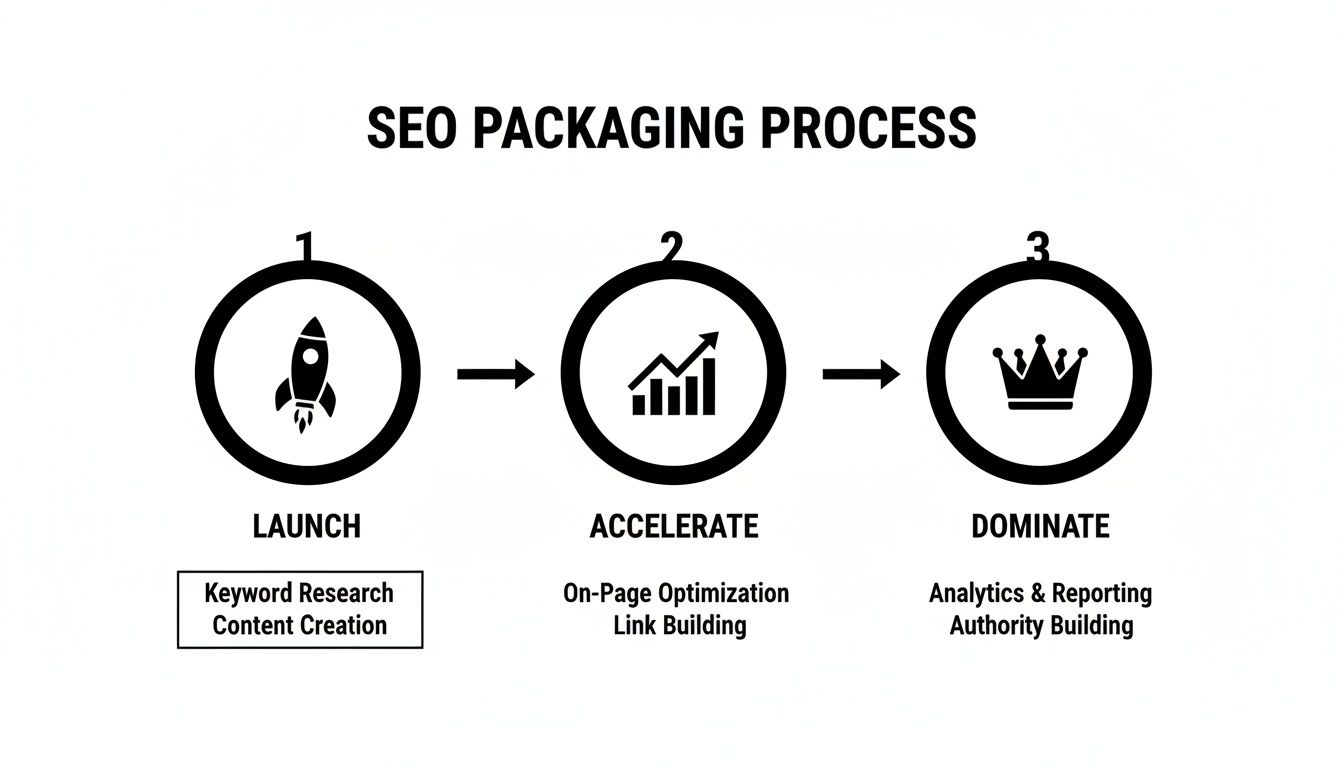
When you structure your service delivery into clear phases like Launch, Accelerate, and Dominate, you create a predictable and scalable system that grows right alongside your client.
Refining and Improving Your Workflow
Finally, remember that a flawless workflow is never truly "finished." It should be a living system that you’re always refining. After the first couple of months with a new partner, schedule a joint review to pinpoint any friction points. Are approvals taking too long? Are the reports missing key insights?
Use that feedback to tweak the process. The result is a highly efficient operational partnership that scales effortlessly as you bring on more clients, cementing your agency's reputation for professionalism and, most importantly, results.
The Tech Stack for Managing White Label Success

Great results are built on a foundation of great data. If you want to successfully manage an SEO white labeling partnership and prove its worth, you need a tech stack that does more than just track tasks. It needs to simplify collaboration and turn complex data into a clear story of success.
Think of your tools as the bridge connecting your partner’s hard work to your client’s satisfaction. This isn't about collecting the most software subscriptions; it's about having the right software. The goal is to streamline project management, centralize communication, and—most importantly—automate the reporting that proves your value and locks in those long-term client retainers.
Core Tools for Project Management and Communication
Even the best partnerships will crumble under the weight of poor communication. Relying on a chaotic mess of emails and DMs is a recipe for missed deadlines, duplicated work, and frustrated teams on both sides. A centralized project management platform isn't a "nice-to-have"—it's non-negotiable.
Tools like Asana, Trello, or Monday.com become your shared command center. They create a single source of truth where you can assign tasks, track deliverables from your white label provider, and see project progress at a glance. This transparency keeps everyone on the same page and projects humming along on schedule.
For those quick, day-to-day conversations, a dedicated Slack or Microsoft Teams channel is a must. It keeps communication immediate and organized, making it feel like you’re working with a team just down the hall, not a partner across the country.
The Heart of the Stack: White Label SEO Reporting Tools
This is where the magic happens. Your clients aren’t paying you for a list of completed SEO tasks. They're investing in business outcomes. Your reporting has to connect the dots between the work being done and the results they care about, and trying to do this manually is a massive time-sink just waiting for errors to happen.
A powerful white label reporting tool is the absolute cornerstone of your tech stack. These platforms plug directly into all the essential data sources to put the entire process on autopilot.
- Data Aggregation: They pull key metrics from Google Analytics, Google Search Console, and SEO giants like Semrush or Ahrefs into one clean, unified dashboard.
- Complete Customization: You can stamp your agency’s logo, colors, and branding all over every report, reinforcing your brand with every single client update.
- Scheduled Delivery: Set up automated weekly or monthly reports to go out like clockwork, ensuring clients get consistent, professional updates without you lifting a finger.
These tools do more than save you a few hours each month; they give you the power to tell a compelling story. By customizing reports, you can stop overwhelming clients with jargon and instead focus their attention on the metrics that actually matter to their bottom line.
This focus is crucial. It’s far too easy to fill a report with vanity metrics like keyword rankings for terms that don't drive any real business. A professional setup helps you highlight the numbers clients really care about, such as:
- Increases in qualified organic traffic.
- Growth in organic leads and conversions.
- Better visibility for high-value, commercial-intent keywords.
When you showcase these tangible results, your reports stop being a simple update and start becoming a powerful retention tool. They turn raw data into a clear narrative of ROI, building the trust and confidence that keeps clients happy. For agencies ready to build an efficient and scalable reporting system, exploring the best SEO software for agencies is the next logical step.
How White Label SEO Directly Scales Your Revenue
Let's connect the dots between SEO white labeling and your bottom line. Sure, expanding your service list is nice, but the real magic of a smart partnership is how it directly fuels your financial growth. It's all about building a more resilient, profitable agency without getting crushed by overhead.
By adding SEO services, you immediately open up new streams of monthly recurring revenue (MRR). Instead of just collecting a one-time project fee for a website or branding guide, you can now offer an ongoing retainer. This provides predictable income, month after month, and that fundamentally changes your business model for the better.
Boosting Client Lifetime Value
Beyond just the MRR, white label SEO massively increases your client lifetime value (LTV). When you start solving a massive business problem like lead generation, your agency becomes indispensable. Clients who see a real, tangible return from your SEO work aren't going anywhere.
Think about it: bundling SEO with what you already do creates an integrated solution that’s way stickier. A client might leave a web designer once the site is live, but they won’t walk away from the agency that’s actively growing their sales. This is how you turn short-term clients into long-term partners.
The core financial benefit is simple: you’re adding a high-demand, high-margin service without adding the associated high costs of an in-house team. This asymmetrical leverage is the key to scalable profitability.
White label SEO partnerships allow for incredible revenue growth without having to hire more people. For example, one web design agency that added SEO packages through a white label service saw their monthly recurring revenue jump by 47%—all without hiring a single new employee. You can dig into a detailed ROI analysis of white label vs in-house SEO to see exactly how the numbers stack up.
The Business Case for Profitable Growth
At the end of the day, using a white label SEO provider isn't just a delivery tactic; it’s a primary engine for scalable, profitable growth. You get to completely sidestep the expensive and time-sucking process of recruiting, training, and managing an SEO team. All of those resources can be poured back into what you do best: sales and client relationships.
Let's break down the financial mechanics:
- No New Salaries: You avoid the huge expense of hiring SEO specialists.
- Zero Software Costs: You don’t have to pay for pricey subscriptions to tools like Semrush or Ahrefs.
- Reduced Training Overhead: Your partner handles all the ongoing training and professional development.
By offloading the execution, you get to focus on strategy and growth while capturing healthy profit margins on the services being delivered. Of course, tracking these gains is key, which is why understanding how to go about measuring content marketing ROI is essential for proving value to clients and your own business. This model transforms your agency into a much more agile and financially robust operation.
Common Questions About SEO White Labeling
Stepping into an SEO white labeling partnership can feel like a big move, and it's totally normal to have a few questions. Getting clear, straightforward answers is the key to moving forward with confidence. We've tackled the most common concerns we hear from agencies just like yours before they decide to make the leap.
How Do I Ensure Quality Control with a Partner?
Handing over your client's results to another company can be nerve-wracking, but quality control is absolutely manageable. It all starts with doing your homework upfront.
Look for partners who are an open book—they should offer transparent reporting, have a portfolio full of extensive case studies, and provide solid, verifiable testimonials from other agencies. Don't be afraid to ask for them.
Before you go all-in, get a clear Service Level Agreement (SLA) in writing. This document should spell out the exact deliverables, how you'll communicate, and what performance benchmarks they're aiming for. The best way to really know what you're getting, though? Start small. Run a trial with one or two of your smaller clients. This lets you see their work, responsiveness, and overall process in a low-risk setting before you scale the partnership.
Will My Clients Know I am Using a White Label Service?
Not a chance—as long as you pick a professional partner. The whole point of a true white label service is to be a ghost, completely invisible to your client.
Your provider's success is tied directly to making you look good, so their commitment to operating behind the scenes is everything. All deliverables, from technical audits to monthly performance reports, should come fully branded with your agency’s logo and identity. You are, and always will be, the sole point of contact for your client. Make sure this is clearly stated in your contract to protect your client relationships and brand integrity.
What Should I Expect to Pay for These Services?
The cost of SEO white labeling can vary quite a bit, but your focus should always be on the value you're getting, not just the rock-bottom price.
Reseller packages for small, local businesses might start at a few hundred dollars a month, while comprehensive national campaigns can easily run into the thousands.
The sweet spot is finding a provider whose wholesale pricing allows you to add a healthy margin—typically between 40-60%—while still offering a competitive price to your clients.
Remember, the cheapest option often leads to cheap results, which can trash your reputation and cause clients to walk. A quality partner who delivers a strong, measurable ROI isn't an expense; it's an investment that pays for itself through client retention and your agency's growth. The right partnership makes your clients win, which in turn, makes you win.
Ready to turn AI visibility into a scalable revenue stream for your agency? With Sight AI, you can uncover precisely what AI models are saying about your clients and generate expert-level, SEO-optimized content to fill the gaps. Automate your content engine and deliver undeniable results. Discover how Sight AI can power your agency's growth.